I was brought up in the Soviet Union to believe that when a malicious, cruel aggressor attacks civilians, you have to take up arms and go do battle with him, and that if you cannot bear arms, you help the people who are doing battle and call on others to do the same.
All my work as a political commentator has been about calling on people to go do battle with the aggressor which has attacked Ukraine, to assist Ukraine with weapons and ammunition.
No one had attacked or threatened Russia.
It was Putin’s Nazi regime which attacked Ukraine, only because of the megalomania of the regime’s ringleaders, because of their inhuman thirst for power over all they survey.
Murdering hundreds of thousands of people is their way of bolstering their self-esteem. They are degenerates, scum, and Nazi riffraff.
The guilt of Putin’s Nazi dictatorship in plotting, unleashing, and waging a war of aggression is obvious and does not need to be proven. We also do not need to prove our right to offer armed resistance to this aggression on the battlefield and in the aggressor’s rear. It would be laughable to expect this right to be acknowledged by a regime which tosses people in prison for morally condemning its aggression out loud. All legal means of protesting Putinist Russia’s aggression have been eliminated.
My calls to resist the aggressor’s regime with armed force have caused me to be charged with terrorism.* I won’t deign to argue with the aggressor’s officials even if they claim my actions constitute pedophilia. Russia’s courts have long ago shown themselves to be appendages of the Nazi tyranny and seeking justice from them is pointless. I will never stand up before these people, who are the lackeys of murderers and scoundrels.
I see no point in arguing with puppets of the dictatorship about how conscientiously they execute their own laws. In any case, these laws are the laws of a totalitarian state and their aim is to stifle dissent. I do not recognize these laws and I will not obey them.
I also have no intention of appealing any rulings made by or actions taken by representatives of the Nazi regime.
The Putinist dictatorship may murder me, but it cannot force me to stop fighting against it. Wherever I find myself, I will keep calling on honest Russians to join the Ukrainian Armed Forces. I will keep calling for airstrikes on military facilities deep in Russian territory. I will keep calling on the civilized world to inflict a strategic defeat on Nazi Russia. I will keep trying to prove that the new Hitler’s regime must be routed militarily.
Putin is the new Hitler, a vampire driven insane by impunity and drunk on blood. I shall never grow tired of saying, “Crush the viper!”
Death to the murder, tyrant and scoundrel Putin!
Death to the Russian fascist invaders!
Glory to Ukraine!
[Grani.Ru:] Thanks to Alexander Valeryevich’s dedicated wife Olga Shcheglova (pictured above). Thanks to SotaVision for filming at the Petersburg military court (Skobov is participating in the trial via video link from Syktyvkar). Thanks to those who didn’t unsubscribe from Grani.Ru after it closed. It’s as if Skobov timed his brave deed to coincide with the final moral collapse of numerous media brands. And yet he will be heard by a handful of his contemporaries. But he has already gone down in history.
* Skobov has been charged with “publicly calling for terrorism,” “publicly condoning terrorism or promoting terrorism using the mass media, including the internet” and “organizing a terrorist community and participating in it.” If Skobov is convicted on these charges, he faces a maximum penalty of ten to fifteen years in prison and fines of up to one million rubles (approx. 9,500 euros)— TRR.
The number of Russians who find themselves behind bars for opposing the authorities who launched the war with Ukraine grows by the day. There are hundreds of political prisoners in the country. We try to remind our readers about these people every chance we get. Today, Mediazona’s David Frenkel tells the story of Alexander Skobov, 67, a historian from St Petersburg, a defendant in the last criminal case against ‘anti-Soviet agitation and propaganda’ in Soviet history, a convinced Marxist, and a veteran of the dissident movement, who after decades has found himself on a very familiar path: searches, arrest, psychiatric ward, jail.
Alexander Skobov is one of the most experienced political prisoners in Russia. In the 1970s and 1980s, he was twice sent to a psychiatric hospital for compulsory treatment: the first time as an editor of samizdat, the second time for slogans in favour of political prisoners, which Skobov wrote on the walls of Leningrad houses.
Almost half a century later, in April 2024, the authorities came after him again. Skobov was accused of ‘justifying terrorism’ because of his post about the explosion on the Crimean Bridge and sent to a pre-trial detention centre. In protest, he refused to take his glasses and medication with him. Later, an article on participation in a ‘terrorist community’ was added to the charge, and Skobov was transferred from St Petersburg to Syktyvkar.
“We were left alone for a long time. The reasoning being: we’ll die out on our own. Or we’ll leave and live out the rest of our lives off the once acquired (quite deservedly) political and moral capital. The blow came to other people, most of them much younger,” he wrote from the pre-trial detention centre.
Skobov maintains an active correspondence in pre-trial detention. He discusses philosophical and political topics, his letters are even published in historical journals. Write to Alexander, argue with him, disagree with him, I’m sure it would be valuable to him. The only thing is that his wife asks that the letters to him be written in 18-point Sans Serif font. Skobov can’t even see his own texts well: he first drafts them on the back of used sheets of paper and then blindly transfers the texts to the reply form.
Address:
167028, г. Сыктывкар, поселок Верхний Чов, д. 99 , ФКУ СИЗО-1 УФСИН России по Республике Коми. Скобову Александру Валерьевичу 1957 года рождения
Please write letters in Russian, otherwise the prison censors won’t let them through. You can send letters online via a special services called PrisonMail.
You can also write in English, using the websites Letters Across Borders and Lifeline, two projects by OVD Info, a media outlet and human rights defense group.
Alexander Skobov. Photo courtesy of V. Izotov/Deutsche Welle
A new criminal case, on charges of “involvement in a terrorist community,” has been opened against former Soviet dissident and Russian political journalist Alexander Skobov, who has been detained for over a month on charges of “condoning terrorism.” This news was reported on Saturday, 18 May, on Skobov’s official Facebook account by his wife, Olga Shcheglova.
Shcheglova said that she visited her husband on 14 May in the pretrial detention center in Syktyvkar, where he had been transferred from St. Petersburg. During a conversation with him, his lawyer and local police investigators, she learned that Skobov has also been charged with “condoning terrorism” and “involvement in a terrorist community.” The dissident’s wife is convinced that these two charges stem from her husband’s affiliation with the Free Russia Forum.
According to Shcheglova, on 21 May, Skobov will be sent to the regional psychiatric hospital in Komi for a forensic psychiatric examination. Skobov himself has stated that he would not participate in the investigation and forensic expertise, and he would appear in court only if his mother were present at the hearings. Skobov’s defense has filed an appeal, which will be heard by the court on 22 May.
Skobov’s Persecution in the USSR and Russia
On 22 March 2024, Russian authorities designated Skobov a “foreign agent.” According to the Justice Ministry, he had “disseminated unreliable information” about the decisions of public officials, opposed the war, “identified the Russian Federation with a terrorist organization,” been involved in the work of an “undesirable organization,” and produced and distributed “foreign agent materials” [sic], the human rights project OVD Info reports.
In 1978, Skobov was arrested over his active involvement in the Left Opposition group and the samizdat publication of an anti-government magazine. He was later sentenced by the court to undergo treatment at a psychiatric hospital, from which he was released in the summer of 1987.
This time around, the political journalist was arrested on charges of “condoning terrorism.” Skobov was detained in St. Petersburg on 2 April 2024. In protest, the dissident refused to take with him to jail his diabetes medication and his glasses, despite his poor eyesight. According to the Telegram channel Memorial Support for Political Prisoners, the real reason for his arrest was “a [social media] post condoning the bombing of the Crimean Bridge.”
In early April, 66-year-old dissident Alexander Skobov was arrested for allegedly “justifying terrorism” in his posts online. For his friends and family members, the arrest came as no surprise.
Skobov, a long-time dissident who was made to spend seven years in a psychiatric ward after taking part in protests against the Soviet authorities in the 1970s, had published multiple posts condemning Russia’s actions in Ukraine since 2014. In March he was named a “foreign agent”, and since then people close to him said his arrest had seemed inevitable.
“He and I talked a hundred times about the fact that he would be arrested — if not today then tomorrow,” said Skobov’s friend Yuly Rybakov, a human rights activist and former deputy in the State Duma, Russia’s lower house of parliament. “People have been imprisoned for much less.”
Skobov’s 90-year-old mother, whom he lives with and cares for, said she had been having nightmares about his arrest for months before it happened, and Rybakov recalled that Skobov himself said he “didn’t understand” why the authorities hadn’t come for him yet.
Skobov’s children, who moved abroad long before Russia’s invasion of Ukraine, urged their father to flee the country when they saw him in Istanbul in early March. Other friends have also tried to convince him to leave and avoid arrest, citing his many health issues, including severe diabetes, hepatitis C, chronic obstructive pulmonary disease and near blindness.
But, Rybakov said, Skobov was resolute, telling him that he “wanted to be part of his own judicial process” when he was inevitably arrested.
Rybakov said that Skobov had been “driven to despair” by what had been happening in Russia in recent years and “felt that someone had to be radical”.
Another friend, Mikhail Sedunov, said that trying to convince Skobov to change his course of action was like “grabbing the wing of a plane that was already accelerating down the runway”.
On 2 April, masked policemen arrived at Rybakov’s flat, where Skobov had been staying. When Rybakov left to take the dog for a walk, the police reportedly entered the property, threw Skobov to the ground, twisted his arms and handcuffed him. According to Rybakov, Skobov “defiantly” refused to take either warm clothing, his diabetes medication, or his glasses with him, intending these gestures as an “act of protest”.
Skobov’s wife, Olga Shcheglova, managed to buy him replacement medication and glasses, which she brought to him ahead of his interrogation by Russia’s Investigative Committee. But Skobov refused to accept them — a reaction Shcheglova said she had “expected” from her husband.
Resistance to the authorities and a fight for justice had defined Skobov’s life for more than four decades. His first foray into political activism was in 1976, when he and other university students in St. Petersburg scattered leaflets calling for the “establishment of true humane socialism” and the “overthrow of the tyranny of officials” ahead of a meeting of the Communist Party of the Soviet Union. The students were expelled from university and brought before a court, and some, like Skobov, were then sentenced to compulsory treatment in psychiatric hospitals because, according to Rybakov, it was believed that “only crazy people could dislike the Soviet regime”.
Skobov’s radical spirit remained unquelled when he was finally released from hospital in 1981, however, and he immediately joined the Free Inter-Professional Association of Workers, a dissident group that led the first attempt to create an independent trade union in the USSR. In 1982 he was arrested for his involvement with the group and sent back to hospital, where he spent another three years.
In the early 1990s Skobov taught history at a secondary school for gifted students, writing and publishing his own award-winning textbooks. But later in the decade political activism again became the focal point of his life as he took part in protests against the Chechen wars.
When Russia annexed Ukraine in 2014, Skobov took to social media to rail against the regime, openly supporting Ukraine and condemning Russia’s military action. The same year, two unidentified men armed with knives attacked him outside his home in what his friends and family members say they are sure was retribution for his criticism of the regime.
Even this did not deter him, however, and his friends said his statements opposing Putin’s rule became “even sharper, more unrestrained, and more radical”. Speaking last year at the Free Russia Forum, an opposition conference held biannually in the Lithuanian capital Vilnius, Skobov condemned the regime more harshly than any of the other attendees, despite being one of the only participants still living in Russia.
Another friend of Skobov, Nikita Yeliseyev, said he doubted Skobov would survive the 7.5-year sentence that he is almost certain to receive.
“He is an old man,” Yeliseyev said. “And he has a number of very serious illnesses.”
Sedunov said all of Skobov’s actions stemmed from a desire to “struggle, as vigorously as possible, against the obvious evil represented by the current Russian government”.
“This is the way he was brought up: he wanted to fight evil any way he could. And this was the only way left,” Sedunov said.
Aleksandr Skobov has been a thorn in the side of authoritarian governments for more than four decades, from the Soviet era to President Vladimir Putin’s long rule. And now, in pretrial detention in St. Petersburg and facing prison, he is in no mood for compromise.
“On principle I refuse to comply with fascist laws,” he told RFE/RL late last month, shortly after the Russian government designated him a “foreign agent” on March 22. “I don’t intend to get into debates with the government. I will not try to prove my innocence. I will not label my writings, and I will not write any financial reports for them.”
“A criminal case could be launched at any moment,” he concluded.
He was right: On April 3, the 66-year-old was arrested and charged with “justifying terrorism” for a social-media post about the Ukrainian attacks that damaged the Crimea Bridge that links Russia with the Ukrainian region of Crimea, which Moscow occupied in 2014. The following day, a St. Petersburg court ordered Skobov held in pretrial detention for at least two months.
“If you take any of my articles or YouTube videos, you can find a whole bouquet of possible charges,” Skobov said in the March 31 interview. “Discrediting the army. Inciting hatred and enmity. Justifying terrorism. The rehabilitation of Nazism. I directly equate the actions of the Stalin regime with those of Hitler’s during World War II.”
Another reason for Skobov’s prosecution, his supporters believe, is his leadership role in the Free Russia Forum, a group of mostly exiled opposition figures founded by former world chess champion Garry Kasparov and activist Ivan Tyutrin in 2016 that has been declared “undesirable” in Russia. If he is charged with participation in an “undesirable” organization, he could face up to six years in prison.
“I am a member of the forum’s council, and I regularly participate in its broadcasts,” Skobov told RFE/RL. “I help write its statements and official pronouncements. Several of them I have written myself. I am actively involved, and I do not intend to stop.”
Skobov said he was drawn to the group because “it was the only opposition organization that categorically rejected the idea of the peaceful transformation of Putin’s dictatorship toward democracy using the procedure established by that dictatorship.”
“It was the only organization that, beginning with the annexation of Crimea, unambiguously stood by Ukraine as a victim of aggression,” he added. “We try to help the Ukrainian Army and the Russian volunteer formations that are fighting with them.”
Writing on Facebook after Skobov’s arrest, writer and critic Mikhail Berg said Skobov suffered from “an unbearable fear of being afraid.”
“And that is why he chooses the most painful forms of criticizing the authorities,” he wrote. “He shouts even though the authorities have long been destroying people for whispering or even for just opening their mouths.”
Parallel Lives
Born in Leningrad, as St. Petersburg was called then, in 1957, Skobov participated in his first anti-government protest when he was 19. He and other members of an underground organization threw about 100 flyers calling for “humanistic socialism” from the roof of a downtown building on the eve of the 25th congress of the Soviet Communist Party. Several of the protesters were kicked out of their universities, but Skobov — a first-year history student at Leningrad State University — got off with a disciplinary meeting of the Komsomol youth group.
In October 1978, he was arrested for publishing an underground, anti-government magazine called Perspectives. He spent half a year in a KGB prison before being sentenced to forced psychiatric treatment.
“In the late 1970s and early 1980s, political prisoners in Soviet psychiatric hospitals were rarely forcibly medicated, although there were such cases, of course,” Skobov said. “But I was treated more or less OK. Most of the doctors that I encountered tried to avoid playing the role of executioners or stranglers.”
He spent three years in confinement.
In 1982, he was again sentenced to psychiatric treatment, this time for a samizdat article he wrote defending Chile’s former socialist president, Salvador Allende, who died in unclear circumstances in 1973, and criticizing the rightist dictator General Augusto Pinochet. That article was deemed “anti-Soviet propaganda.”
This time, Skobov spent five years in the hospital before being released in the summer of 1987 during the initial phase of Soviet leader Mikhail Gorbachev’s liberalization campaign.
In many ways, Skobov and Putin led parallel lives during this period. Putin was born in Leningrad almost exactly five years before Skobov and studied at Leningrad State University just before him. But as Skobov became drawn into a life of opposition to authoritarianism, Putin joined the KGB secret police.
The president’s official biography insists that Putin always worked for the KGB’s First Directorate, which carried out counterintelligence operations. However, rumors have persisted for years that he worked for some time in the Fifth Directorate, which was responsible for suppressing internal dissent and prosecuting political dissidents. At the time, a senior figure in that department was Viktor Cherkesov, a longtime member of Putin’s inner circle who served as his deputy when he headed the Federal Security Service — the KGB successor organization — in the 1990s and who died in 2022.
In 2022, journalist and researcher Konstantin Sholmov published a photograph of a KGB archival document from 1976 that he said was on display at the Political History Museum in St. Petersburg. The document, a protocol of a search of the residence of Leningrad artist and dissident Oleg Volkov, named “Lieutenant Putin” as one of the officers carrying out the search.
In 2013, a series of photographs emerged showing a 1989 Leningrad protest during which KGB operatives roughly detained dissident Valery Terekhov. One of the men in the photograph resembles Putin. The Kremlin later denied that the man was Putin, saying the future president had already been sent to East Germany by 1989.
Prominent human rights activist Aleksandr Cherkasov of the banned rights group Memorial told the news outlet Agentstvo earlier this month that he believes Putin was involved in the investigation of Skobov. He said Skobov had told him Putin staked out his Leningrad apartment in November 1982 when prominent dissidents gathered to celebrate Skobov’s birthday.
Despite the danger growing around him after he was designated a “foreign agent,” Skobov refused to consider emigration.
“I’m not going to quit,” he said.
“Today anyone in Russia who disagrees with Putin’s Nazi regime is taking a risk,” he added, “even if he doesn’t really stick out or act publicly. Since the regime has already made the transformation from ‘hybrid totalitarian’ to totalitarian, it demands not just silence from its loyal subjects, but active participation. And even avoidance can be dangerous.”
Opposition leader Aleksei Navalny’s suspicious death in prison on February 16 was “to be expected,” Skobov said.
“Navalny constantly laughed in [Putin’s] face, and a dictator cannot stand that,” he added. “Unfortunately, I don’t think it will be the last death of a political prisoner in Putin’s Russia.”
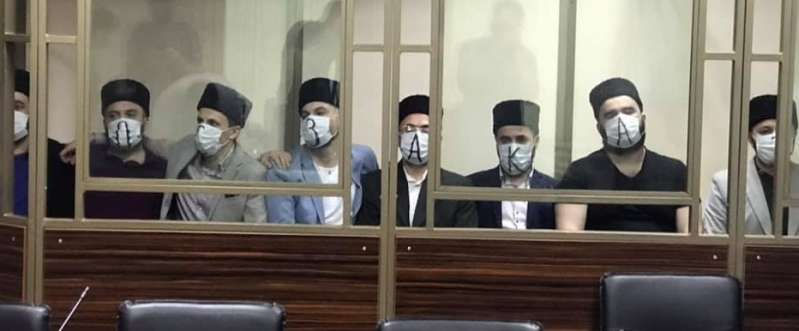
Reading of the sentence on 16.09.2020. The men are each wearing one letter each of the word ГОСЗАКАЗ (“commissioned by the state”). Photo by Crimean Solidarity. Courtesy of khpg.org
Acquittal and monstrous sentences in Russia’s offensive against Crimean Tatar civic journalists & activists Kharkiv Human Rights Protection Group
Halya Coynash
September 17, 2020
In the last decades of the Soviet regime, dissidents received 7-10-year sentences for so-called ‘anti-Soviet agitation and propaganda’. Modern Russia, persecuting Ukrainian citizens on illegally occupied territory for their religious beliefs and political views, is doubling such sentences. Seven Crimean Tatar civic journalists and activists have received sentences of up to 19 years, without any crime. Justice had not been expected from a Russian court, however absurd the charges and flawed the ‘trial’, so the only – wonderful – surprise was the acquittal of Crimean Solidarity civic journalist and photographer Ernes Ametov. If Russia was hoping, in this way, to prove that these are real ‘trials’ before independent courts, there is no chance. All eight men have long been recognized as political prisoners, and all should have been acquitted.
The sentences passed on 16 September by judges Rizvan Zubairov (presiding); Roman Saprunov; and Maxim Nikitin from the Southern District Military Court in Rostov (Russia) were all lower than those demanded by the prosecutor Yevgeny Kolpikov, but still shocking.
Crimean Solidarity civic journalist Marlen (Suleyman) Asanov: 19 years
Crimean Solidarity activist Memet Belyalov: 18 years and 18 months restriction of liberty
Crimean Solidarity civic journalist Timur Ibragimov: 17 years and 18 months restriction of liberty
Crimean Solidarity Coordinator and journalist Server Mustafayev: 14 years and 1 year restriction of liberty
Crimean Solidarity civic journalist Seiran Saliyev: 16 years and 1 year restriction of liberty
Edem Smailov (the leader of a religious community): 13 years and 1 year restriction of liberty
Crimean Solidarity volunteer Server Zekiryaev: 13 years
In Soviet times, dissidents received a term of imprisonment, then one of exile. Now they add ‘restriction of liberty’ (ban on going outside Crimea and attending events, as well as having to register with the police). In all of the above cases, the sentences are for maximum security prison colonies, although not one of the men was even accused of an actual crime. They are also sentences that Russia, as occupying state, is prohibited by international law from imposing.
The armed searches and arrests of the men in October 2017 and May 2018 were the first major offensive against Crimean Solidarity. This important civic organization arose in April 2016 in response to the mounting persecution of Crimean Tatars and other Ukrainians in occupied Crimea. The initiative not only helped political prisoners and their families, but also ensured that information was streamed onto the Internet and in other ways circulated about armed searches, arrests, disappearances and other forms of repression. Given Russia’s crushing of independent media in occupied Crimea, the work that Crimean Solidarity activists and journalists do is absolutely invaluable. It has, however, subjected them to constant harassment, including administrative prosecutions, and, when that has not stopped them, to trumped-up criminal charges.
The charges
The men were essentially accused only of ‘involvement’ in Hizb ut-Tahrir, a peaceful Muslim organization which is legal in Ukraine. In declaring all Ukrainian Muslims arrested on such charges to be political prisoners, the renowned Memorial Human Rights Centre has repeatedly pointed out that Russia is in breach of international law by applying its own legislation on occupied territory. It has, however, also noted that Russia is the only country in the world to have called Hizb ut-Tahrir ‘terrorist’ and the Russian Supreme Court did so in 2003 at a hearing which was deliberately kept secret until it was too late to lodge an appeal.
In occupied Crimea, the Russian FSB are increasingly using such prosecutions as a weapon against civic activists and journalists, particularly from Crimean Solidarity.
Initially, the FSB designated only Asanov as ‘organizer of a Hizb ut-Tahrir group’ under Article 205.5 § 1 of Russia’s criminal code. The other men were all charged with ‘involvement in such an alleged ‘group’ (Article 205.5 § 2). Then suddenly in February 2019 it was announced that Belyalov and Ibragimov were now also facing the ‘organizer’ charge. The essentially meaningless distinction is reflected in the sentences passed on 16 September, with the difference in sentence between Timur Ibragimov as supposed ‘organizer’ only one year longer than that passed on fellow civic journalist, Seiran Saliyev (accused of being a member of the so-called Hizb ut-Tahrir cell).
All eight men were also charged (under Article 278) with ‘planning to violently seize power’. This new charge also appeared only in February 2019, with no attempt ever made to explain how the men were planning such a ‘violent seizure’. The charge only highlights the shocking cynicism of any such ‘terrorism’ charges when the only things ‘found’ when armed searches were carried out of the men’s homes were books (not even Hizb ut-Tahrir books), no weapons, no evidence of plans to commit violence. Russian prosecutors simply claim that this follows from Hizb ut-Tahrir ideology. Memorial HRC notes that the extra charge is often laid where political prisoners refuse to ‘cooperate with the investigators’. Since all the Crimean Muslims prosecuted in these cases have stated that they are political prisoners and have refused to ‘cooperate’, the extra charge is becoming standard.
‘Evidence’
The prosecution’s case was based on the testimony of Nikolai Artykbayev, a Ukrainian turncoat, now working for the Russian FSB; two secret witnesses whose identity and motives for testifying are known, and the ‘expert assessments’ of three people with no expert knowledge of the subject.
Russia is now using so-called ‘secret witnesses’ in all politically-motivated trials of Crimeans and other Ukrainians. No good reason is ever provided for concealing the alleged witnesses’ identity, and the bad reason can easily be seen in this case where their identity was understood. Konstantin Tumarevich (who used the pseudonym ‘Remzi Ismailov’) is a Latvian citizen and fugitive from justice who could not risk being sent back to Latvia after his passport expired. It is likely that the FSB realized this back in May 2016 and have used his vulnerable position as blackmail, getting him to testify both in the earlier trial of four Crimean Tatars from Bakhchysarai, and now in this case.
There is a similar situation with Narzulayev Salakhutdin (whose testimony was under the name ‘Ivan Bekirov’). He is from Uzbekistan and does not have legal documents.
These men gave testimony that in many places was demonstrably false, yet ‘Judge’ Zubairov constantly blocked attempts by the defendants and their lawyers to ask questions demonstrating that the men were telling lies.
As mentioned, the main ‘material evidence’ was in the form of three illicitly taped conversations in a Crimean mosque. These were supposedly understood to be ‘incriminating’ by Artykbayev, although the latter does not know Crimean Tatar (or Arabic) [or] who transcribed them. That transcript, of highly questionable accuracy, was then sent to three supposed ‘experts’: Yulia Fomina and Yelena Khazimulina, and Timur Zakhirovich Urazumetov. Without any professional competence to back their assessments, all of the three ‘found’ what the FSB was looking for.
While the judges also lack such professional competence, they did hear the testimony of Dr Yelena Novozhilova, an independent and experienced forensic linguist, who gave an absolutely damning assessment of the linguistic analysis produced by Fomina and Khazimulina.
This was only one of the many pieces of testimony that the court ignored. Zubairov actually refused to allow a number of defence witnesses to appear and used punitive measures against the defendants and their lawyers.
All such infringements of the men’s rights will be raised at appeal level, although this will also be before a Russian court, with the charges of justice being minimal.
PLEASE WRITE TO THE MEN!
They are likely to be imprisoned at the addresses below until the appeal hearing and letters tell them they are not forgotten, and show Moscow that the ‘trial’ now underway is being followed.
Letters need to be in Russian, and on ‘safe’ subjects. If that is a problem, use the sample letter below (copying it by hand), perhaps adding a picture or photo. Do add a return address so that the men can answer.
Sample letter
Привет,
Желаю Вам здоровья, мужества и терпения, надеюсь на скорое освобождение. Простите, что мало пишу – мне трудно писать по-русски, но мы все о Вас помним.
[Hi. I wish you good health, courage and patience and hope that you will soon be released. I’m sorry that this letter is short – it’s hard for me to write in Russian., but you are not forgotten.]
Addresses
Marlen Asanov
344010, Россия, Ростов-на-Дону, ул. Максима Горького, 219 СИЗО-1.
Асанову, Марлену Рифатовичу, 1977 г. р
[In English: 344010 Russian Federation, Rostov on the Don, 219 Maxim Gorky St, SIZO-1
Asanov, Marlen Rifatovich, b. 1977]
Memet Belyalov
344010, Россия, Ростов-на-Дону, ул. Максима Горького, 219 СИЗО-1.
Белялову, Мемету Решатовичу, 1989 г.р.
[In English: 344010 Russian Federation, Rostov on the Don, 219 Maxim Gorky St, SIZO-1
Belyalov, Memet Reshatovich, b. 1989]
Timur Ibragimov
344010, Россия, Ростов-на-Дону, ул. Максима Горького, 219 СИЗО-1.
Ибрагимову, Тимуру Изетовичу, 1985 г.р.
[In English: 344010 Russian Federation, Rostov on the Don, 219 Maxim Gorky St, SIZO-1
Ibragimov, Timur Izetovich, b. 1985]
Server Mustafayev
344010, Россия, Ростов-на-Дону, ул. Максима Горького, 219 СИЗО-1.
Мустафаеву, Серверу Рустемовичу, 1986 г.р.
[In English: 344010 Russian Federation, Rostov on the Don, 219 Maxim Gorky St, SIZO-1
Mustafayev, Server Rustemovich, b. 1986]
Seiran Saliyev
344010, Россия, Ростов-на-Дону, ул. Максима Горького, 219 СИЗО-1.
Салиеву, Сейрану Алимовичу, 1985 г.р.
[In English: 344010 Russian Federation, Rostov on the Don, 219 Maxim Gorky St, SIZO-1
Saliyev, Seiran Alimovich, b. 1985]
Edem Smailov
344010, Россия, Ростов-на-Дону, ул. Максима Горького, 219 СИЗО-1.
Смаилову, Эдему Назимовичу, 1968 г.р.
[In English: 344010 Russian Federation, Rostov on the Don, 219 Maxim Gorky St, SIZO-1
Smailov, Edem Nazimovich, b. 1968]
Server Zekiryaev
344010, Россия, Ростов-на-Дону, ул. Максима Горького, 219 СИЗО-1.
Зекирьяеву, Серверу Зекиевичу, 1973 г.р.
[In English: 344010 Russian Federation, Rostov on the Don, 219 Maxim Gorky St, SIZO-1
Zekiryaev, Server Zekievich, b. 1973]
Thanks to Comrades SP and RA for the heads-up. The text has been very lightly edited for readability. || TRR
“We Made It Worse for You, So Talk”: A New Defendant Emerges in The Network Case OVD Info
April 11, 2018
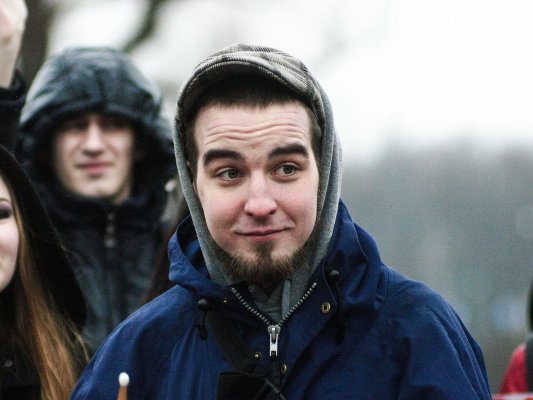
Yuli Boyarshinov, 2015. Photo by Maria Shuter. Courtesy of OVD Info
A new defendant has been added to the case of the so-called Network, Petersburger Yuli Boyarshinov. In the following article, OVD Info reports what it knows about how Mr. Boyarshinov was charged in the case, and about the pressure put on him in the remand prison where he is currently jailed.
Mr. Boyarshinov’s defense attorney Olga Krivonos told OVD Info that he was charged with involvement in The Network on April 11. Ms. Krivonos cannot discuss the particulars of the case, since she was made to sign a nondisclosure agreement concerning the preliminary investigation. Mr. Boyarshinov has been charged with involvement in a terrorist community (Russian Federal Criminal Code Article 205.4 Part 2) and illegal possession of explosives (Russian Federal Criminal Code Article 222.1 Part 1).
27-year-old Yuli Boyarshinov has worked the last several years as an industrial climber. From 2010 to 2015, he was a co-organizer of the Free Fair in Petersburg, events where people donated and took home all kinds of things free of charge. He [CENSORED BY REQUEST OF THE RUSSIAN ANARCHIST CENTRAL COMMITTEE]* volunteered at animal shelters.
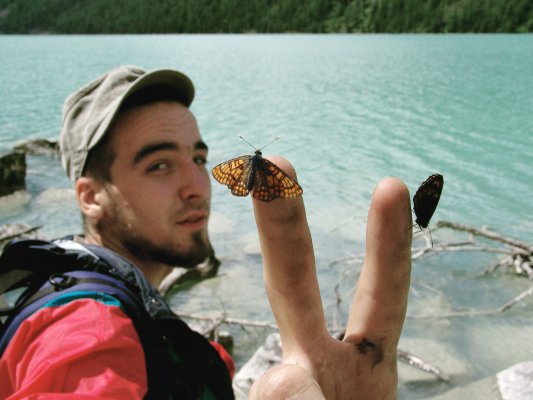
Yuli Boyarshinov. Photo courtesy of Mr. Boyarshinov’s friends and OVD Info
Arrest
Mr. Boyarshinov was detained on the evening of January 21, 2018, in Petersburg’s Primorsky District, most likely accidentally. Several local residents told OVD Info that anti-drugs raids occured there frequently and police regularly stopped passersby.
Mr. Boyarshinov recounted that police from the 53rd Precinct struck him in the face and stomach several times: they did not like the fact the young man had refused to talk with him, citing Article 51 of the Russian Constitution, which guarantees an individual’s right not to incriminate himself. The beating ended when another policeman entered the room, was outraged by what was happening, and asked his fellow officers not to “cause mayhem.”
Police found 400 grams of smoke powder, a relatively weak explosive obtained by mixing saltpeter, charcoal, and sulfur, on Mr. Boyarshinov’s person. Smoke powder is now most often employed in the manufacture of fireworks, as well as by hunters and sport shooters who pack their shells manually. Mr. Boyarshinov has a hunting license, but not a firearms permit. Ms. Krivonos could not say why Mr. Boyarshinov needed the smoke powder, since it fell under her nondisclosure agreement.
On January 22, police searched the home the young man shares with his parents. Law enforcement officers confiscated equipment, books, and the anarchist magazine Avtonom. He was then taken in a police cruiser to St. Elizabeth’s Hospital. Hospital staff did not ask him for either his internal passport or insurance policy. The detainee was given an MRI scan of the brain, and his blood was drawn. Mr. Boyarshinov told his lawyer the physician who administered the MRI scan was quite worried about his condition. After the examination, the young man was transported to the Temporary Detention Center. In conversation with his lawyer, Mr. Boyarshinov suggested he was taken to the hospital first so that it would be impossible to say he had been injured in the Temporary Detention Center. The doctors noted bruises on his face.
On January 23, Primorsky District Court Judge Yelena Tsibizova ordered Mr. Boyarshinov remanded in custody for thirty days. His relatives were not informed of the court hearing. Ms. Krivonos had not yet taken the case, and so Mr. Boyarshinov was represented by a state-appointed attorney. At that point, he had only been charged with illegal possession of explosive substances.
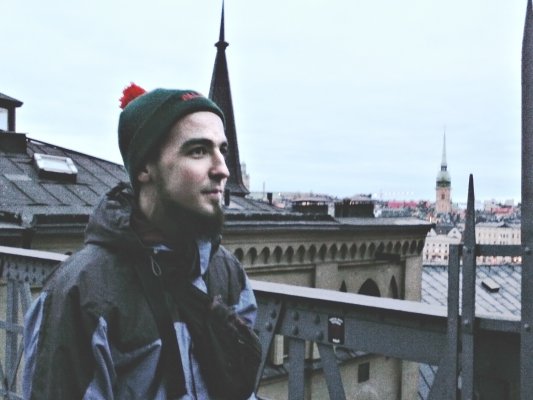
Yuli Boyarshinov. Photo courtesy of Mr. Boyarshinov’s friends and OVD Info
Pressure in the Remand Prison
After the hearing, Mr. Boyarshinov was incarcerated in Remand Prison No. 1 aka The Crosses Two, where doctors noted his injuries: blows to the stomach and head, and a black eye.
As the young man told his lawyer, his cellmates immediately tried to chat him up.
“I’m also in for Article 222.1. I’ll tell you what’s what,” one cellmate said to him.
The anarchist symbol had been traced on the dusty glass in the cell’s window.
On January 31, Mr. Boyarshinov was visited by two men who gave only their first names, Kostya and Dima. Kostya had been present during the search at Mr. Boyarshinov’s home. When he asked where they were from, Kostya and Dima gave him their work number at the Petersburg office of the Russian Federal Security Service (FSB). The supposed FSB officers listed the names of defendants in the Penza-Petersburg “terrorism” case and many other names, promising Mr. Boyarshinov that if he did not talk to them, “things would get worse” for him. The young man refused to speak with the FSB officers, again invoking his rights under Article 51 of the Russian Constitution.
“You’re making things worse for yourself, and you’ll go to prison,” the security service officers told him.
On February 12, Mr. Boyarshinov was transferred to Remand Prison No. 6 in the village of Gorelovo, Leningrad Region, on the orders of an investigator in the Primorsky District office of the Interior Ministry, allegedly, “for the purpose of conducting investigative procedures.” Ms. Krivonos said that then, after she filed an appeal against the extension of Mr. Boyarshinov’s remand in custody, staff at the Primorsky District Court telephoned her and asked her client’s whereabouts. They were looking for him to fill out papers. Ms. Krinovos argues the transfer to another remand prisoner violated her client’s rights. The Gorelovo Remand Prison is a former medium security correctional labor colony, and the conditions there are considerably worse than in The Crosses Two Remand Prison, which was built to satisfy the requirements of current legislation.
Mr. Boyarshinov told his lawyer he was placed in a cell where there were forty inmates, although it was designed for thirty-five. When he moved into the cell, his cellmates beat him up for no reason. They forced him to clean the cell, and because of this he was not let out for walks outside in the yard.
On February 13, FSB officers again came to talk with Mr. Boyarshinov.
“We made things worse for you. Now talk, or conditions will get even worse.”
Mr. Boyarshinov again refused to speak with them.
Yuli Boyarshinov and defense attorney Olga Krivonos at a custody extension hearing on February 19 in Primorsky District Court. Photo courtesy of Ms. Krivonos and OVD Info
On March 2, the remand prison was inspected by members of the Leningrad Region Public Monitoring Commission (PMC). Mr. Boyarshinov told his lawyer the Leningrad PMC members summoned the inmates one by one to chat with them in the office of a warden, who was present during their conversations.
FSB officers visited Mr. Boyarshinov again immediately after the PMC’s inspection. The very same day, he and another inmate (who had not spoken to the PMC) were transferred to a cell that held approximately 150 inmates: the number of inmates constantly changed. There were only 116 bunks in the cell, which was reserved for men charged with murder, rape, and robbery, and who had served time before. However, the inmates who smoked were not segregated from the nonsmokers. At first, Mr. Boyarshinov had to sleep on the floor.
“During the nearly two months of his incarceration in Gorelovo, no investigative procedures involving Yuli have been carried out. Due to the fact the conditions of my client’s imprisonment in terms of cell assignment and personal safety have been violated, his state of mind has deteriorated considerably,” said Ms. Krivonos.
On March 16, Sergei Shabanov, human rights ombudsman for Leningrad Region, and his staff member Sergei Gavrilovich visited the Gorelovo Remand Prison.
“There were no complaints and statements from the persons held in custody,” reads a report of the visit, posted on the remand prison’s website.
“He has not been tasered, but the conditions in which my client is being held are tantamount to torture,” argued Ms. Krivonos.
She also said that Mr. Boyarshinov has chronic tonsillitis, which has been aggravated by his living conditions.
Visit by Leningrad Region Human Rights Ombudsman Sergei Shabanov to Gorelovo Remand Prison. Yuli Boyarshinov sits with his back turned to the camera. Photo courtesy of Remand Prison No. 6 website and OVD Info
Petersburg industrial climber Ilya Kapustin was a witness in The Network case. He claimed FSB agents tasered him, after which he left Russia, requesting political asylum in Finland. Kapustin told OVD Info that, during his interrogation, investigators had asked him whether he knew Boyarshinov, when they had last met, and why he had telephoned him on the day he was detained.
“We had a professional relationship. I telephoned him around the time of his arrest to ask him whether he wanted a job shoveling snow off rooftops,” Kapustin explained.
Novaya Gazetawrites that the Gorelovo Remand Prison is considered a torture chamber. According to the newspaper, inmates are tortured and raped by order of the wardens. This was the reason Vladimir Malenchuk, former head of the local office of the Russian Federal Penitentiary Service was dismissed, and his deputy, Vyacheslav Tippel, who was involved in the torture, was sentenced to seven years in prison. However, the beatings and abuse of inmates at the remand prison have not stopped.
On March 16, antifascist Viktor Filinkov was transferred to Remand Prison No. 6. Mr. Filinkov has been charged with involvement in the terrorist organization The Network (Criminal Code 205.4 Part 2). The FSB claims members of The Network were preparing for the outbreak of unrest in Russia. Mr. Filinkov confessed his guilt, but later claimed he had done so under torture. Members of the Petersburg Public Monitoring Commission noted numerous taser burns on the antifascist’s body. Businessman Igor Shiskin was charged in the same case. He did not complain of torture, but the Petersburg PMC likewise noted injuries on his body. The criminal investigation and arrests in St. Petersburg were sanctioned by a district court in Penza.
In October 2017, five young men were arrested in Penza. A sixth man was arrested in Petersburg, transferred to Penza, and also remanded to custody there. All of them have been charged with involvement in a terrorist community. The FSB claims the young men were also involved in The Network, which, allegedly, has cells in Moscow, Petersburg, Penza, and Belarus. The defendants in the terrorism case in Penza have spoken of psychological pressure, torture by electrical shock, being hung upside down, and having weapons planted by FSB officers in their cars and flats.
* There is no “Russian Anarchist Central Committee,” of course, but I was asked—twice—to expunge a perfectly trivial, innocent passage because it supposedly endangered Mr. Boyarshinov’s safety in remand prison. I dared to doubt out loud that the wardens at Gorelovo Remand Prison read my website and much less that they would happen on this passage. The anarchist authoritarian “we” was forced to repeat its peremptory request, referring to the meaningless fact that it was a “common decision.”
This is what you will discover about 99% of Russian “anti-authoritarian” leftists if you spend enough time with them. They do not understand that solidarity is a two-way street. So, God forbid, for example, that any of them would take the time and then have the guts to speak out against the Russian government’s crimes in Syria. But if something untoward happens with any of their own kind, you can be sure they will demand the world’s attention, because, at the end of the day, they are good “white people,” like the good “white people” in Europe and North America, so they imagine they do not deserve to be treated the way the FSB has been treating their antifascist comrades in Penza and Petersburg.
Of course, they should not be treated this way, but nor should anyone else on God’s green earth be treated this way, even if they do not happen to be good “white people.”
The other thing you discover is that the mindset of most Russian “anti-authoritarian” leftists is completely authoritarian, which is no surprise because Russia has been an authoritarian country for most of its thousand-year history. There has been the odd decade here and there down through the centuries when Russia was not an authoritarian country, and Allah be praised, how sweet it was to live during one of those rare decades, as your humble servant did during the 1990s.
Now, however, the country has endured nearly two decades of increasingly oppressive authoritarian rule, so it should be no surprise that people who nominally espouse democratic, progressive, “anti-authoritarian” beliefs would revert to authoritarian type when push comes to shove.
During the ten-plus years I have been translating, editing, and writing this website and its predecessor, Chtodelat News, I have been clubbed over the head, slandered, and bossed around by my putative Russian “anti-authoritarian” leftist allies so many times I have lost count. On the contrary, the number of times I have been thanked for what I do or encouraged and vigorously supported by these selfsame so-called anti-authoritarians has been much less numerous.
They really don’t get it. Until they do, most of their efforts will be doomed to failure. Despite what Putin and his junta have done to Russia and its people, the country and its people are way past the point where they have the time of day for authoritarians of any stripe, whether nationalist, leftist, rightist, centrist, neoliberal, Anglican or Presbyterian. When and if they rise up to overthrow their oppressors, it will be a democratic revolution. Or it simply won’t happen at all. TRR
Translated by the Russian Reader. Thanks to Comrade NN for correcting a typo.
Read more about the insane FSB frame-up of the wholly fictional Network aka the Penza-Petersburg “terrorism” cases, and related current cases involving torture and framing on the part of the security service once chaired by President Vladimir Putin and in which he proudly served as an officer for many years. It is their increasing dominance of politics and the economy that has pushed the world’s largest country to the brink of toxic governance and administrative insanity.


 Yuli Boyarshinov, 2015. Photo by Maria Shuter. Courtesy of OVD Info
 Yuli Boyarshinov. Photo courtesy of Mr. Boyarshinov’s friends and OVD Info
 Yuli Boyarshinov. Photo courtesy of Mr. Boyarshinov’s friends and OVD Info
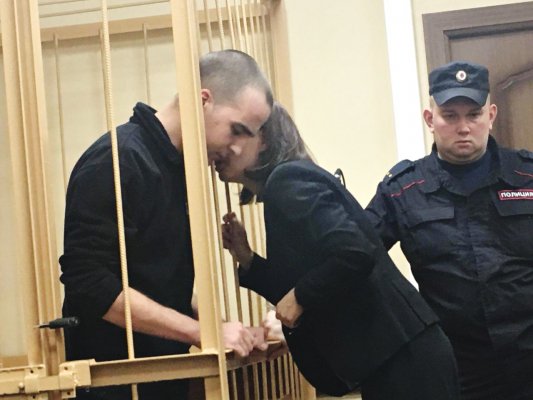 Yuli Boyarshinov and defense attorney Olga Krivonos at a custody extension hearing on February 19 in Primorsky District Court. Photo courtesy of Ms. Krivonos and OVD Info
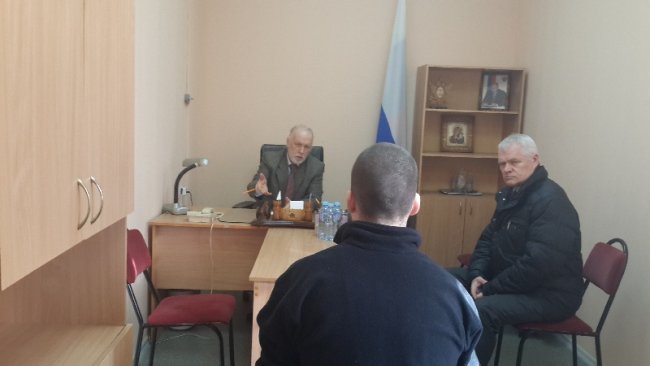 Visit by Leningrad Region Human Rights Ombudsman Sergei Shabanov to Gorelovo Remand Prison. Yuli Boyarshinov sits with his back turned to the camera. Photo courtesy of Remand Prison No. 6 website and OVD Info