The Anti-Anti-War Movement

Ana Tavadze and Dachi Imedadze, members of Georgia’s Shame Movement. Photo: 60 MINUTES

Ana Tavadze: We’re going in with a government that’s completely corrupt, a government that’s pro-Russian, clearly anti-Western, clearly does not really care about what the majority of the population wants and needs.

Ana Tavadze and Dachi Imedadze are members of the Shame Movement – a group with thousands of young followers working towards Georgia’s entry into the European Union.

Ana Tavadze: If Russia wins, it means loss of freedom, loss of everything that we fought for in the past 30 years basically. It’s a fight for values, it’s a fight for where you want to stand in this big fight for democracy.

Dachi Imedadze: As soon as the West in any form, be it the U.S. partnership, be it the European Union, is not represented in this country, Russia will fill the void right away. 

They say the influx of Russians is already changing the face of Georgia.

Ana Tavadze: What are they doing, if we look at it? They’re buying apartments. They’re buying private property. They are opening up businesses. Their actions changed — Georgian economy.

Dachi Imedadze: The Russians are buying apartments here in every 33 minutes. They’re purchasing a piece of land in every 27 minutes. And they’re registering a business in every 26 minutes. So, I think we are on the brink of very dangerous situation here in Georgia.

According to public records, Russians have registered more than 20,000 businesses in Georgia over the last two years. And launched five new Russian-only schools, none of which are licensed by Georgia’s department of education.

Russians have driven rent up nearly 130%, prices for everything from food to cars have gone up 7%. over 100,000 Georgians have left the country because many of them can’t afford to live here anymore.

Sharyn Alfonsi: I’ve heard this described as a quiet invasion.

Dachi Imedadze: Quiet invasion, yeah. There is a risk of the economic diversions. There is a risk of military intervention. And there’s a risk of — Georgia’s statehood being destroyed. 

Emmanuil Lisnif, George Smorgulenko and Pavel Bakhadov don’t look like much of a threat.

All Russians in their twenties, they fled their country for fear of being drafted or imprisoned for speaking out against Putin.
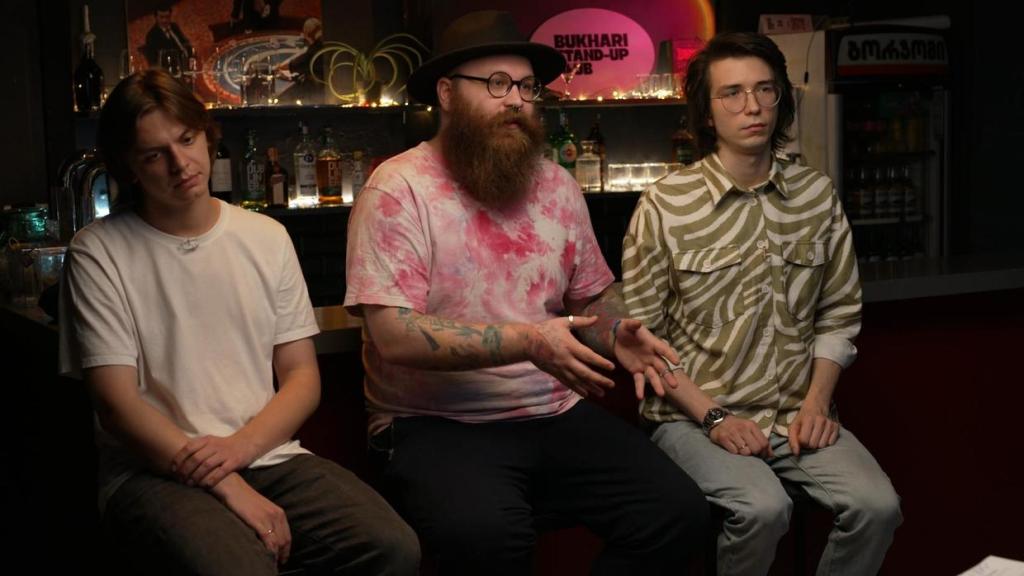
George Smorgulenko, Emmanuil Lisnif and Pavel Bakhadov are all Russians living in Georgia. Photo: 60 MINUTES

They now live in Georgia and work at this Russian-owned comedy club in Tbilisi.

Emmanuil Lisnif: I try and said ‘I’m against the war in Russia. I was beaten. and after that going to prison three times.’

Sharyn Alfonsi: So three times you went to jail?

Emmanuil Lisnif: Yes, yes three times.

Pavel Bakhadov: I believe and I know that Russians actually against the war

Sharyn Alfonsi: You think that most Russians are against the war?

Emmanuil Lisnif: Yeah, just scared, really scared.

Sharyn Alfonsi: Have any of you had any aggression towards you because you’re Russian?

Pavel Bakhadov: Actually I have a big writing on the wall. It’s the biggest thing I see from my window, just big ‘Russians go home.’ 

There is no subtlety in spray paint… anti-Russian graffiti blankets the city along with support for Ukraine.

[…]

Source: Sharyn Alfonsi, “Denial of Georgia’s EU membership bid would be ‘a big victory for Russia,’ President Zourabichvili says,” 60 Minutes, updated 9 June 2024. The emphasis, above, is mine. ||| TRR


This text is based on interviews I did as part of the Hidden Opinions public opinion polling project, which I launched in 2022 and continued in 2023 and 2024. I spoke with dissenting Russians — with those who oppose the current regime and its military actions against Ukraine, both those who have stayed in Russia and those who have left the country. My youngest respondent at the time of the [first] survey was sixteen years old, while the oldest was seventy-two years old. These people hail from a wide range of professions and walks of life, but what they have in common is their categorical opposition to the actions of the Russian authorities. In just two years, I have interviewed 154 people for this project, some of whom I have spoken with two or three times.

In 2022, all of my respondents — both those who had left the country and those who stayed — espoused anti-war views and expressed a negative attitude toward the Kremlin’s policies. However, in 2023, about a year and a half after the war’s outbreak, a group amongst my sources in Russia emerged. Small at first, but constantly growing, it consisted of people who had changed their negative attitudes toward the war and/or the government.

This does not mean that such changes are impossible among those Russians who have left the country. Amidst a full-scale war, research based on representative samples is hampered by the fact that the most accessible respondents are those who have agreed to be interviewed as a result of self-selection. This is a significant limitation to the project.

My research is qualitative, not quantitative, meaning that it would be wrong to speak of a particular percentage of anti-war Russians who have become pro-war. I think it is important to study and understand how views are transformed and what triggers them to change. It is the subject of this text.

***

The sociologist and philosopher Zygmunt Bauman, experimenting with means of gauging the conservatism–to–radicalism spectrum, asked his students to do the following exercise. They were shown twenty drawings, the first one depicting a dog, the last one depicting a cat; in between, the dog gradually shed its canine features and turned into the cat. It was vital that the researcher record the moment when the test subjects had doubts about what exactly was depicted in the picture, when they realized that the dog had mutated irreversibly. In a sense, I have been doing something similar, trying to record the moment at which anti-war or anti-Putin views have been transformed into pro-war or pro-government views.

I have observed that such a change in views depends on a number of extrinsic factors, and the more such factors that are combined, the more likely it is that the person’s stance will change. In addition, a great deal is determined by an individual’s (psychological, social, etc.) resources. Finally, inconsistent views play an important role in transformation and adaptation. In recent years, sociologists have increasingly noted that people often pursue mutually exclusive goals simultaneously without noticing the contradictions in their own behavior.

New rationalizations, disillusionment and loneliness

The gradual realization that the war is a long-term affair, combined with Alexei Navalny’s sudden death in a penal colony, has had a considerable impact on those resisting the regime within Russia. One can swim against the current, but it requires a considerable amount of strength, something not everyone possesses. It is difficult to be amongst the minority for years on end, to conceal one’s views and live in fear of being reported to the authorities. Respondents have thus begun reformatting [sic] their attitude to reality, explaining events in a new light and providing new rationalizations.

Failing to receive the expected support from the outside world or the possibility of a dignified workaround, some of my respondents eventually chose non-resistance to the regime, which in some cases has transmogrified into full-fledged loyalty.

I don’t want to go to prison, I don’t want to play the rebel. I just want to live. If they send me to listen to ‘Exorcist TV,’ I’ll go without question. If they tell me to go to a [pro-war] concert, I’ll go. I’m not trying to convince anyone of anything anymore. I’m tired. I can only accept it and live the life I have.”

This stance is not directly bound up with support for the war or the regime. Rather, it indicates fatigue and the lack of strength to resist. If the circumstances shift in a direction more in keeping with their own values, these people will gladly slough off the “burden of adaptation.”

It is worth noting that, over the last year, many of my respondents have stopped following the news and focused on their daily lives. There are respondents who, despite the troubling times, have decided to have children. This is also a way of disconnecting from current events.

Another important factor influencing the change of respondents’ views is the narrowing of their circles of trust. Fearing denunciation, dissenters avoid making new contacts. Afraid of being alone and unwilling to live in fear, uncertainty and/or exile, they then join the majority.

The distance between Russians who have left Russia and those who have stayed in Russia has grown greater with every passing year. In 2022–2023, when I asked my respondents about opposition members who had left Russia, they most often would say nothing or would limit themselves to brief remarks along the lines of “We still watch them on YouTube, but they have less and less sense of what’s happening at home.”

Expressions of resentment and frustration have become more frequent in my interviews in 2024. My sources have said that the opposition often engages in wishful thinking and plays fast and loose with the facts, and that the west does not always act logically and decently.

Consequently, previously opposition-minded people have chosen to abandon painful and exhausting self-reflection in favor of loyalty to the regime. This helps them to get on with their lives, normalizing both the war and the political crackdowns. As one respondent put it, “Since the opposition and the west cannot be trusted, we will make friends with Putin. He is an ogre, but he is our own ogre.”

“Western countries seem to be doing everything to help Putin’s propaganda machine. I was quite surprised when I heard Angela Merkel say that all our negotiations were just a smokescreen: we wanted to let Ukraine catch its breath, and the negotiations were just a deception. That is, the leader of one of the largest countries in Europe openly says: a) we can’t be trusted in any negotiations, and b) we have conspired to deceive you. […] Putin’s propaganda machine skillfully makes use of this. But the point is not that the propaganda machine is using it, it’s that it is reality. As a normal person, a question occurs to me: if they treat us this way, [then] we are their enemies. After such statements, the ‘west’ is regarded as the enemy of Russians, and, accordingly, their enemy — Putin — is our friend.”

Those respondents who have changed their views on the war emphasize that when the west blocked their bank cards and accounts, when they heard what Ukrainians (including their relatives and friends) were saying about Russians and how they called for killing them, they decided that the current regime, whatever it was like, was less hostile to them on balance.

Tired of guilt, shame, disappointment and indignation, they have essentially chosen peace by joining the majority and accepting the existing rules: don’t discuss politics, don’t speak out publicly, swear to the values that the government declares. This choice seems reasonable to them in a situation in which no political activism is possible anyway, and the political crackdown machine is only picking up steam.

This strategy ensured material well-being and career success for some of my respondents. For example, some mid-level specialists in the IT sector received good positions and salaries, while for other people the involvement of their relatives in the war has been a means of social mobility and a source of access to material goods. Still others have benefited from the war by arranging parallel imports, etc.

Another factor contributing to the shift in sentiment from anti-Putin to pro-government has been the radicalization and polarization of society.

“A sharp delineation between ‘black and white’ leads to the opposite outcome. Any attempts to express doubts about the actions of the Ukrainian or western side are automatically regarded both inside and outside [Russia] as pro-Putin behavior, the outcome of brainwashing, etc. The other side appears infallible and beyond criticism.

“If you criticize the west’s actions in any way, you are automatically pigeonholed as a ‘Putinist.’ It makes me feel like saying: if that’s how you treat me, well, to hell with you, chalk me up as a Putin supporter.”

The state of rejection and isolation provokes protests amongst some people: since the west condemns them for staying in Russia, they “will go the full mile and become real orcs.”

The mechanisms by which feelings of rejection are transformed into collective pride have been described by researchers and are not unique to Russia. These feelings reinforce nationalist sentiments and contribute to the strengthening of authoritarian regimes.

Emotional dilemma

Speaking about the change in their views from anti-war to pro-war, my respondents noted that in one way or another they were surrounded by people who had suffered in the war: classmates or school friends who had been drafted to the front or had volunteered for combat, their children, colleagues, and mere acquaintances. Telling them straight to their face that their sacrifices were in vain had become both emotionally more difficult and more dangerous. To maintain relationships and friendships, my sources generally had to listen in silence to their acquaintances’ stories about what they had experienced and seen at the front. And if they were people who mattered to them, it was impossible not to sympathize with them.

We should understand that Russians who initially opposed the war and the regime but remained in Russia feel definitely closer to those who went to the front or delivered humanitarian aid there than to those who have left the country. They are “in the same boat” as their relatives, friends, and colleagues. They feel compassion for them.

“When we were teenagers, all sorts of things happened. If the guys were caught [by the authorities], I would perjure myself and lie in all sorts of ways. Later I could tell them what I actually thought of them, but I wouldn’t abandon them. That’s not the way that blokes do things. Now I realize with my head that they are wrong a hundred times over, but they are my boys, I am on their side. And even if I am against the war, I cannot be against them.”

Propaganda equates anti-war sentiment with betrayal, and it paints people who espouse such views as accomplices of Russia’s enemies, who want to kill as many Russians as possible. This causes a very heavy feeling, my respondents note.

Meanwhile, the state softens such emotional blows by offering loyal citizens new benefits and additional material and social goods, free concerts, and beautiful and comfortable urban environments, demonstrating concern for people in general and for those returning from war in particular. “People-centeredness” has become the buzzword in the PR strategies of many employers and officials throughout Russia.

Russians who are concerned about their neighbors also respond to calls for help front-line soldiers, because amidst war and external isolation it is these people with whom, they say, they “share a common plight.” One of my respondents, overwhelmed by such sentimental feelings, volunteered for the army.

As a religious man, he hoped he would not face the need to kill others, but would be able to help “his boys” without bearing arms, because he “could not stand on the sidelines any longer.” If the need to kill arose, he would desert, my source had decided, explaining that he was emotionally prepared to be beaten up and go to prison.

Another type of people whom I have encountered more and more often are those whom researchers Maria Lipman and Michael Kimmage have characterized as anti-anti-war: these people do not necessarily support the war, but they strongly condemn or resent “unpatriotic” fellow citizens who do not support the Russian army or who even take the side of Ukraine.

Seeing soldiers returning from the front and watching the growing number of Russians killed in combat, my sources now often place the blame not on Putin or the Russian military, but on their compatriots who oppose continuing the war until Russia achieves total victory.

Ressentiment and the “demons” of propaganda

Propaganda has awakened ressentiment in some of my respondents. They have come to believe that this war is really about maintaining Russia’s status as a great power, which its enemies are trying to flout and rob. Such people believe it vital that Russia maintain its status as a victor, and they accept the state-imposed version of Russian history that asserts Russia’s greatness in all periods.

War, as happens under autocracies and dictatorships, is seen as the ultimate manifestation of the nation’s strength and vitality and a guarantee that its culture and traditions will be maintained. In conversations with me, my sources have repeatedly used the phrase “releasing demons,” referring to the fact that the current situation helps their acquaintances and themselves experience a sense of unity and superiority over the rest of the world, a sense of their own righteousness and chosenness.

Some respondents noted that the official rhetoric, concrete and catchy, seemed more acceptable to them than the verbose arguments and meaningless self-reflections of the opposition.

Meanwhile, according to my respondents, the number of anti-war-minded Russians today is decreasing. Since Navalny’s death, I have often heard in interviews that every second or third person in the orbit of my sources has changed their views.

It is difficult to say how strong this trend really is. I would estimate that a third of those who unequivocally opposed the war and the regime when I spoke to them [initially] have changed their views, but of course these numbers are in need of supplemental verification, which is not easy to accomplish today. There are probably also people who have switched their pro-war patriotic views to oppositional ones, but I assume that we hear the voices of these people even less frequently.

Respondents who are in a state of uncertainty and/or in the course of switching their views feel the need for support, at least informational support. They need arguments explaining that anti-war sentiments are not a betrayal and that the current war is destroying Russia, not restoring its greatness. But they also acknowledge that such an argument would hardly convince them under the current circumstances. For now, the only thing they think they can do is to maintain their sanity and adapt to reality in order to live to see better days.

***

The Russian regime has proven to be “smarter” and more adaptive than Russian opposition activists and western democracies thought, but this does not mean there is no point or possibility of supporting by any means possible those who have remained in Russia and are still resisting the regime or straddling the fence. One way or another, positive change in Russia is impossible without their involvement.

Source: Anna Kuleshova, “‘I’m a person with anti-war views, but I suddenly found myself signing up for the front’: how and why Russians have changed their attitude to the war,” Republic, 4 June 2024. The emphasis, above, is the author’s. Translated by the Russian Reader

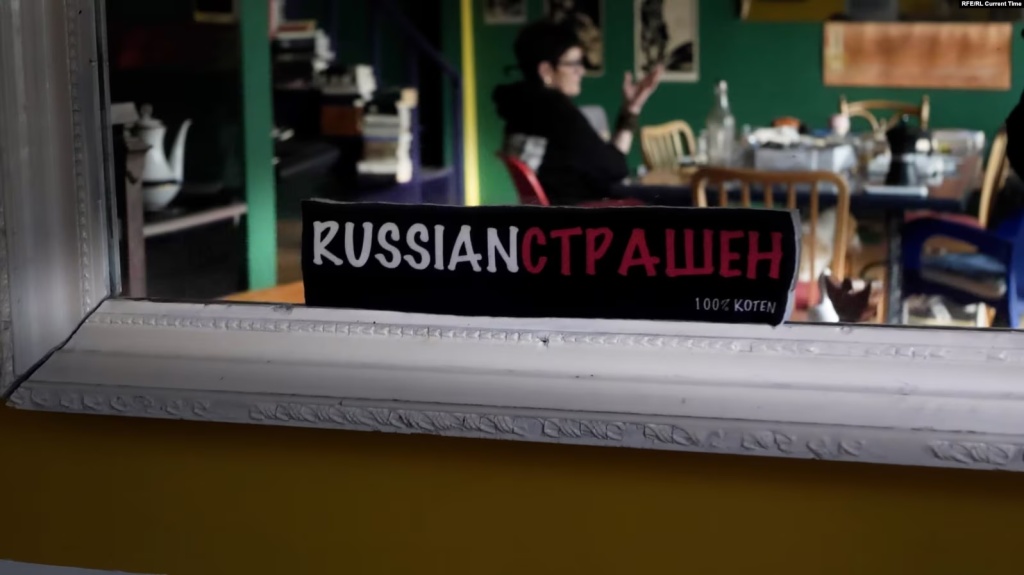
Rusebo!


Rusebo is Georgian for “Russians” in the vocative case. The word is chanted in Tbilisi by demonstrators protesting against the Georgian government’s draft law on “Transparency of Foreign Influence.” The draft law is called the “Russian law” because it is similar to the Russian law on so-called foreign agents, targeting organizations that receive funding from abroad.

In 2023, large-scale protests in Georgia stopped the law from being passed, but now the government is trying to pass it again in order, according to the opposition, to demonstrate loyalty to Russia and distance itself from the European Union.

The chant rusebo! is directed at the police officers dispersing the protests and, more generally, at the Georgian authorities, which the opposition labels pro-Russian. However, the word rusebo is also taken personally by many Russian emigrants who fled to Georgia after Russia’s invasion of Ukraine. They include persecuted political activists, men fearing mobilization, and ordinary people who disagree with Putin’s politics. The attitude of Georgians toward them is wary and often outright negative, simply because they are from Russia. As one of the emigrants puts it, “Tough people, they resist, I wish they could be like that in Russia too. But I also feel a little bit on the other side. They shout rusebo—that’s literally me.”

Russian emigrants amidst the protests in Georgia is the subject of Rusebo!, a film by Yulia Vishnevetskaya.

Yulia Vishnevetskaya, “Rusebo! Russian Emigrants Amidst the Protests in Georgia”
(2024; in Russian, English and Georgian; no subtitles)

An argument between a Georgian activist and a Russian emigrant

— I was walking down the street, and a Russian was walking towards me. I didn’t know whether tomorrow he would change into a Russian uniform and shoot at me. The people who have no money but who had the opportunity to settle down here in some way I understand very well. But those who could go anywhere in the world because they had money, why did they come here too? They eat khinkali, it’s all they talk about. They post pictures on Facebook of themselves swanning around here, but I don’t understand why they left Russia. Just to tag along?

— Would you just leave your home like that and run away?

— No. The only thing I do know is that running away won’t change anything.

— You think you can change anything by not running away?

— Well, they’d be put in prison.

— So, it’s okay to “emigrate” to a place where people are raped with mops? Wouldn’t that scare you?

— I understand perfectly well. I feel sorry for the people who had to leave their homes, their beloved dachas, and so on. But it doesn’t change my attitude at all. I would not have run off to any country. Maybe I would have sent my son away so that he would not be mobilized, but I would have stayed and continued to fight.

“Russian is terrible.” A still from the film “Rusebo!”

— Do you hold it against us that we ran away?

— Navalny was not afraid: he went back and did the right thing, despite everything that happened afterwards. I respected him after he came back: he knew that he would be imprisoned and killed, but he went back anyway. I’m not encouraging anyone to go back and die in prison, but the man did the right thing. That’s what justified him in my eyes.

— I care more about a living person than symbolic ones….

— A living person who can’t do anything?

— Yes, as opposed to a dead man who wanted to do something. I’m not willing to pay with lives.

— And I’m willing to pay with my life for my freedom.

— You don’t understand how infuriating it is. When you realize that there is Putin, who is ten times stronger than you, who can do anything to you, when people you respect, whom you know perfectly well, are in prison, dying there, and then you come to Georgia and are told, “You are trying badly, we want you to win, but you somehow don’t want it badly enough.” I just don’t understand how you can seriously say this. I am quite offended that you say it.

— You occupied twenty percent of Georgia, your country occupied us.

— I am not responsible for my country.

— But we are responsible for our country, that’s the difference. Why do you take offense at me for complaining? You’ve been letting it happen for three hundred years—all of you, there are many of you and not enough of us. And for three hundred years you’ve been allowing it to happen and occupying us. You speak for everyone now. We have a shitty government, we’ve been sitting in shit for twelve years and we’re fighting our government. Take offense at your fellow Russians, not at me. I’m not at war with you, I’m at war with our regime and your regime. Everything was taken away from us, they took away the place where I had been going since I was a child. I cried, I stood and sobbed, there were Russians standing there with machine guns. And this is my life, this is how we have been living for so many years.

— Everything was taken away from us too, can you understand that?

— No, I can’t. Nothing was taken from you. Did you have a protest rally when we were bombed in 2008, when they took away more Georgian territory? This building shook because a bomb was dropped nearby. I walked around for three months, looking up at the sky to see if any airplanes were flying by. It was a fright. So I understand Ukrainians perfectly well. We will win.

— No.

— Why won’t we win?

— Because you’re outnumbered.

— We are few but we are strong.

— It is just important that there is a moment when you have to start believing.

Monologues of Georgians and Russians

— I had a friend from Russia. We would meet at international conferences. He was a young Russian, very interesting, very fond of Georgia and Georgians. We became friends, and one day, right after the war in 2008, he and I met. He hadn’t written anything to me during the war, which seemed crazy to me. He never once asked how we were doing. And so we met, and I expected him to say something, but he didn’t say anything. So I told him I was very upset about it. And he said, “Oh, come on! Did those few little firecrackers make you scared?” That reinforced my feelings about Russia. If an ordinary, normal, good Russian has these feelings about a war that was terrible, that took people’s lives and people’s homes and divided their lands, and says, “You were scared of a couple of firecrackers,” I thought that it must be true that everyone in Russia thinks that way. Before 2008, my university friends still went to Russia to get their residency training. But if someone went after 2008, everyone said, “What? What are you doing?” That was really a turning point.

I was anti-Russian from the age of eight when I learned that members of my family had been murdered in a single night in 1924. My parents joined the anti-Soviet movement in the 1980s. In 2008, some of my friends went off to fight against the Russians. We have a lot of reasons to hold grudges. But I think this war, which brought so many anti-Putin Russians to Georgia, has shown a different side of Russia. I thought, Okay, these people can bring us know-how and knowledge of how to fight Putin. They came here to survive. I see Russians in Tbilisi, some of them have even opened their own establishments on my street, and if the fact that I buy a cup of coffee from them will help defeat Putin, and if they are here without guns, not killing Ukrainians, then I support that.


— I lived most of my life in Nizhny Novgorod, but the last ten years I lived in Petersburg. I was a carpenter, a joiner: I built ships and did all sorts of renovations. I was involved in the anarchist, anti-fascist and environmentalist movements. Then it all became about helping political prisoners. The rumors that the borders would be closed was the last straw: I realized that I had to move while I had the chance. I hoped that the regime would not withstand such a thing, that there would be mass strikes and so on. No way.

The unemployment here [in Georgia] is serious, of course. There is little purchasing power. The rates for all work are lower than in Russia. While an IT guy can tuck his laptop under his arm and throw everything he has into crypto, I have a workshop and machines. I’m not a little boy anymore: you’ll break down drilling all your life. You can’t go back. If you’ve made that choice, go on pivoting as you wish.

With its values—its love of freedom, love of nature, love of history, and love of human rights—Georgia has everything I need, except that “I am part of the power which forever wills good and forever works evil.”* Georgians have the sense that there is a mighty power on their doorstep and that it is hostile. Accordingly, you can be seen as part of this danger, even amongst those Georgians who are friendly to Russians. I have local friends here who treat me normally: there is nothing imperialist about you, they say to me. But you can’t expect to fit in in a country that has been experiencing Russian aggression essentially nonstop for better or worse since it gained independence. Some Russians intend to stay here, but I don’t think it will be particularly possible.

But we should support the people protesting for their freedom if only out of gratitude to this country that they put up with us here. Anarchists basically have this principle: we are always on the side of the oppressed and against the oppressors. I do not wish any country to suffer the same fate as Russia. I do not want the same idiotic regime to be established here. No one has any use for it, neither the Georgians nor us.

* An inversion of the quotation from Goethe’s Faust that serves as the epigraph to Mikhail Bulgakov’s novel The Master and Margarita: “I am part of the power which forever wills evil and forever works good.”

Source: “A life for freedom’: Russian emigrants amidst the protests in Georgia,” Radio Svoboda, 12 May 2024. Translated by the Russian Reader. The film also features a former auditor from Rostov who moved to Tbilisi after the war started and now works as a cleaner, but her monologue wasn’t included in this online article. I have translated the Georgian doctor’s monologue as reproduced here in Russian, although her original remarks, made in English, are nearly entirely audible through the Russian overdub.

Our Blood Is Wine

Earlier this afternoon, my dog was feeling “agitated,” as she put it, so she asked me to lie down on the couch with her and watch this doco. Emily Railsback’s Our Blood Is Wine is unpretentiously lovely and informative and reassuring. It’s a treat for people like me who love Georgian wine, food, music, cinema and culture. You should watch it too, especially if you know nothing about Georgia. See below for a hint on signing up to the streaming service I watched it on. NB. This is not a paid endorsement of this service. ||| TRR

Our Blood is Wine
A Film by Emily Railsback

“Embraces both its subjects and the audience in a kind of cultural exchange that you rarely find.”
—Third Coast Review

Filmmaker Emily Railsback and award-winning sommelier Jeremy Quinn provide intimate access to rural family life in the Republic of Georgia as they explore the rebirth of 8,000-year-old winemaking traditions almost lost during the period of Soviet rule.

By using unobtrusive iPhone technology, Railsback brings the voices and ancestral legacies of modern Georgians directly to the viewer, revealing an intricate and resilient society that has survived regular foreign invasion and repeated attempts to erase Georgian culture. The revival of traditional winemaking is the central force driving this powerful, independent and autonomous nation to find its 21st century identity.

Source: Ovid Email Newsletter, 19 November 2021

Give the gift of OVID and your friends and family will be able to watch over 1,300 documentaries and films from around the world! From now until December 18th, get 50% off – just enter the promo code JOYFUL at checkout.
Purchase now: https://misc.ovid.tv/gift.html

Source: Facebook

Guerillas Gone Mental: Why the Russian Secret Services Forced Kristina Snopp and Her Husband to Leave Russia

Refusing to Cooperate with the FSB and Pictures of Putin: The Story of a Couple Seeking Political Asylum in Georgia
Sofia Rusova
OVD Info
August 22, 2018

Kristina Snopp and her husband, Denis. Photo courtesy of Ms. Snopp and OVD Info
A young married couple from Krasnodar Territory have applied for political asylum in Georgia. So far, they have had two interviews with the immigration service. The couple are certain that if they weresent back to Russia they would face criminal charges and prison sentences. Sofia Rusova discovered how a reporter at a municipal newspaper and her bike mechanic husband attracted the notice of local FSB agents and the police.

Refusing to Cooperate with the FSB
“I am Kristina Snopp,  and I am afraid to return to Russia.”

This was how the 32-year-old reporter from Tuapse prefaced her asylum request to the Georgian authorities. Snopp and her husband, Denis Snopp, are currently living in a refugee center in Georgia. Snopp made the decision to leave Russia after she learned her posts on the social media network VK had been examined for “extremism” and “insulting religious believers.”

Snopp never wanted to be involved in politics. She was never a member of a political party, permitting herself to have opinions only on a few issues like religion, the environment, and Russia’s foreign policy. If she did attend protest rallies,  they mainly had to do with ecological issues. Like many residents of Tuapse she protested construction of a bulk shipping terminal by the company EuroChem in 2011.

Back in 2014, Snopp received a call on her mobile phone from an FSB officer who introduced himself as Denis. He wanted to talk with her.

“For around two hours, he grilled me about the people with whom I interacted. Moreover, he asked personal questions about my beliefs, what organizations I was involved with, and why,” Snopp recounts.

“I’m a very inquisitive person. I’m really interested in world religions and, at the time, I was hanging out with people from different confessions, with the Hindus (yogis),  Muslims, Protestants, and pagans in our area. FSB agent Denis was really interested in information about people who practiced religions other than Russian Orthodoxy. He suggested I cooperate with the FSB in combating ‘cults.’ I turned him down. Denis copied down my details and said we should stay in touch, and I should contact him if I found out something new. He told me people in Russia should be religious believers, moreover they had better be Russian Orthodox Christians, since it was the ‘state religion and the most correct religion,’ as he put it. Denis also asked me questions about my political views. I replied I was basically uninterested in politics.”

As the saying goes, if you are not interested in politics, politics is interested in you. Roughly a month after the first informal meeting, the FSB agent came to the offices of the newspaper Chernomorye segodnya [Black Sea Today], where Snopp worked, and tried to make contact with her coworkers.

Chernomorye segodnya
In 2012, Snopp officially began working at Chernomorye segodnya, the local newspaper. After Russia’s conflict with Ukraine, the editorial policies of national media outlets changed radically. This change also affected the tiny newspaper in Tuapse. When she publicly criticized Putin’s foreign policies on social networks, local internet forums, and in discussions with friends, Snopp attracted the close scrutiny of her editors and once again came to the attention of Tuapse’s intelligence services.

“I was concerned about it, since I believed Russia’s actions were mean and unfair to Ukraine. Moreover, I had friends in Ukraine, who wrote to me on social networks about the real state of affairs there, about the presence of Russian troops in Crimea and Donbass, and the lawlessness they were perpetrating even as President Putin denied it was happening. I published posts on my page on VK in which Putin was compared with Hitler,” Snopp says.

Her editors at Chernomorye segodnya knew about Snopp’s stance on Russia’s military actions in Ukraine. When she labeled it annexation outright, her editor, Alexei Chamchev, said, “Then, what are you doing here? Leave the country.”

According to Snopp,  her job became more and more emotionally complicated. The newspaper published numerous commissioned articles meant to defame specific people, as well as articles that openly encouraged hatred of Ukrainians and praised Russian politicians. Snopp would refuse to work on these articles. She mainly wrote about daily news, and cultural and religious events.

Devastated Tuapse 
In 2015, under a pseudonym, Snopp published articles about environmental conditions in Tuapse on the website Proza.ru and VK. She wrote about environmentally harmful industrial facilities, the increase in incidences of cancer and high levels of unemployment in the city, and how city hall hushed up the problems.

“At press conferences, I would post straight, tough questions to regional ecologists who argued that all the indicators were well within the norms. My boss knew about it, of course. When I arrived in Tuapse as a student in 2001, the city was still beautiful and thriving. Lots of tourists visited the city. Gradually, the industrial estates expanded so much they literally consumed all the beauty of those places. The ugly oil tanks, the industrial buildings, the fumes, steam, and chemical dust produced by the factories, and the oil waste pouring into the river and the sea have disfigured and poisoned my beloved city. There is a lot to say about the harm caused to the locals,” says Snopp.

Dismissal from the Newspaper
There were no actual reasons to fire Snopp from her  job at the newspaper, but immediately after the 2016 New Year’s holiday, she was urged to quit her job on her own, as it were.

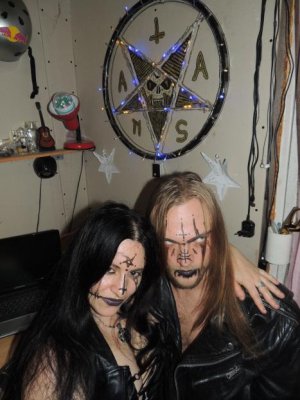
kristina_d.rThe photograph that supposedly led to Kristina Snopp’s dismissal from her job. Courtesy of Ms. Snopp and OVD Info
The ostensible cause for her dismissal was a playful, artsy photo shoot in which Snopp and her husband, dressed in black leather, portrayed Satanist metalheads, an inverted pentagram hanging in the background.

“The editor told me privately the real reason I was fired was something else. People in city hall had long been advising him to get rid of such a politically unreliable reporter,” says Snopp.

Krasnodar
After her dismissal from the newspaper in Tuapse, Snopp and her husband moved to Krasnodar. Snopp thought she would have no trouble finding work in the big city. At first, she looked for jobs in journalism. She had dozens of interviews and completed various assignments, but she was constantly turned down.

Snopp decided to write for her own pleasure while earning money another way. She got a job as a shop clerk at a tobacco chain store. Soon, however, the proprietor got a phone call from an anonymous caller who informed him Snopp was a member of an “extremist” organization. She was fired.

In February 2018, police officers telephoned Snopp’s relatives and her husband’s relatives, demanding they provide them with the couple’s exact address.

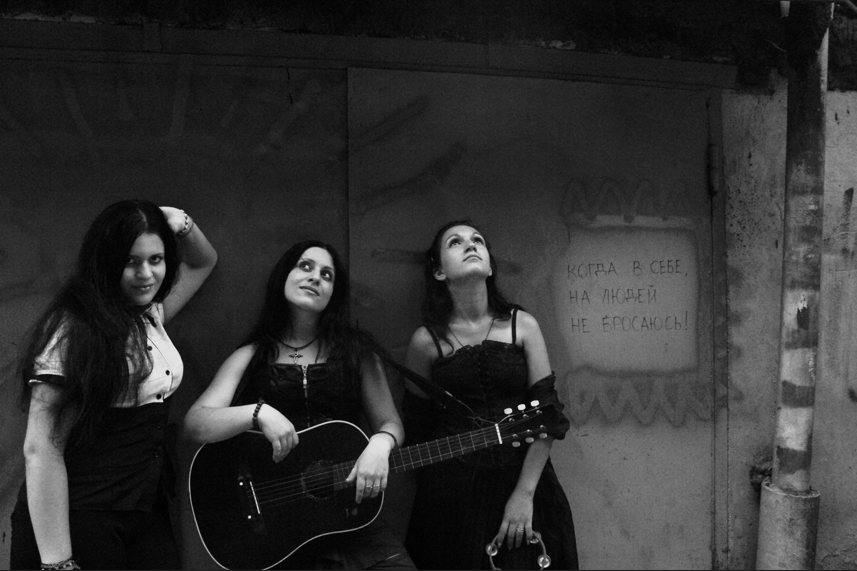
“On February 14, police showed up at Denis’s workplace. They wanted to see me as well. Denis called, and I went there. We were not given an official written summons. Nothing was explained to us. We were told we would have to go to the Interior Ministry’s main office for Krasnodar Territory.  Police Captain Denis Polyantsev assured us both it was no big deal. He just needed information from us. However, Polyantsev joked I could have been as famous as Nadezhda Tolokonnikova, meaning my amateur punk rock group Guerillas Gone Mental, which I founded in 2012. According to Polyantsev, it was the group that had provoked suspicions of ‘extremism,'” says Snopp.

guerillas gone mentalA photo of Kristina Snopp’s punk rock group Guerillas Gone Mental. Courtesy of the band’s VK page

The couple were delivered to the Center for Extremism Prevention (Center “E”), whose officers asked about posts Snopp had published three years earlier on a social media page that had been deleted. Among the posts was a demotivator in which Putin was compared with Hitler, and parallels were drawn between Nazi Germany’s annexation of the Sudetenland in 1938 and Russia’s annexation of Crimea in 2014. Questions were also asked about post critical of the Russian Orthodox Church (ROC), for example, a demotivator in which an ROC priest blesses a missile dubbed Satan.

“I regarded these posts and cartoons more as political satire, the reaction of a concerned citizen to events in Russia. I had no intention of insulting anyone. Nevertheless, the Interior Ministry’s forensic examiners decided that by posting the cartoons I had incited hatred toward the president, Russian patriots, and Russian Orthodox Christians. I was shown a thick folder containing screenshots of my posts from various years and forensic findings I was not allowed to read,” says Snopp.

foto_s_cherepomA photo of Kristina Snopp holding what looks to be a skull. According to a police forensic examination, the skull was real. Photo courtesy of Ms. Snopp and OVD Info 

A photograph of Snopp holding a skull, taken in a cemetery during an amateur goth style photo shoot she published on her VK page, also caused suspicion among police officers. Polyantsev told Snopp forensic experts who examined the photos determined it was a real human skull. However, the online album containing the photos was captioned, and the captions clearly explained the skull was a fake. To be more precise, it was a piggy bank, purchased for 500 rubles at a souvenir stand in the railway station market in Tuapse.

Snopp says Polyantsev constantly put pressure on the couple during their questioning. He cited facts from her life and the lives of her relatives, suggesting he knew everything about them.

“Alas, my husband and I were so out of it that we went to the meeting without lawyers. We didn’t think about it from a legal viewpoint. We did not ask for copies of the summons, the forensic examinations or our own testimony. Basically, we had no written proof of what happened to us. However, the Russian police operate this way quite often, aware most people are illiterate when it comes to the law and lose their cool in these circumstances. Besides, we did not have the money to pay the fee the lawyer initially requested,” recounts Snopp.

Almost a month later, Polyantsev telephoned Snopp again. He informed her that the case file, containing her posts on VK, had been sent to Tuapse. She would need to go meet a police investigator on March 20, 2018, a meeting at which she would be given an official summons. Snopp realized if she signed for receipt of the summons, she would also be made to sign a form releasing her on her own recognizance and would probably be charged with several crimes, including “extremism.”

Snopp left Russia on March 18, the day of the last presidential election. Soon afterwards, her husband,  who had stayed on in Krasnodar to work, got a call from Polyantsev, who told him that if he did not tell investigators where his wife was, he would be accused of harboring a criminal. Several days later, Denis Snopp left Russia as well.

When they arrived in Georgia, Kristina and Denis Snopp applied for political asylum. They have had their second interview with immigration officials.

Translated by the Russian Reader