Ekaterina Schulman. Photo courtesy of Andrei Stekachov and The Village
Political Scientist Ekaterina Schulman on Why You Should Vote
Anya Chesova and Natasha Fedorenko The Village
September 16, 2016
This Sunday, September 18, the country will vote for a new State Duma, the seventh since the fall of the Soviet Union. The peculiarity of this vote is that it will take place under a mixed electoral system for the first time since 2003. 225 MPs will be elected to five-year tears from party lists, while the other 225 MPs will be elected from single-mandate districts. Several days before the elections, The Village met with Ekaterina Schulman, a political scientist and senior lecturer at the Russian Presidential Academy of National Economy and Public Administration (RANEPA). We talked with her about why you should vote if United Russia is going to win in any case, as well as about the changes in store for the Russian political system in the coming years.
The Upcoming Elections
The Village: On Sunday, the country will hold the first elections to the State Duma since 2011. The social climate in the city and the country as a whole has changed completely since that time. Protests erupted in 2011, and the people who protested on Bolotnaya Square and Sakharov Avenue believed they could impact the political situation. Nowadays, few people have held on to such hopes. What should we expect from the upcoming elections? And why should we bother with them?
Ekaterina Schulman: Everything happening now with the State Duma election is a consequence of the 2011–2012 protests, including changes in the laws, the introduction of the mixed system, the return of single-mandate MPs, the lowering of the threshold for parties to be seated in the Duma from seven to five percent, and the increased number of parties on the ballot. These are the political reforms outlined by then-president Dmitry Medvedev as a response to the events of December 2011. Later, we got a new head of state, but it was already impossible to take back these promises. The entire political reality we observe now has grown to one degree or another out of the 2011–2012 protest campaign, whether as rejection, reaction or consequence. It is the most important thing to happen in the Russian political arena in recent years.
The statements made by Vyacheslav Volodin, the president’s deputy chief of staff, on the need to hold honest elections, Vladimir Churov’s replacement by Ella Pamfilova as head of the Central Electoral Commission, the departure of someone more important than Churov from the CEC, deputy chair Leonid Ivlev, and the vigorous sacking of chairs of regional electoral commissions are all consequences of the protests. If they had not taken place, nothing would have changed. We would still have the same proportional voting system, the same seven-percent threshold, the same old Churov or Churov 2.0. Continue reading ““We Have a Surrogate Democracy”: An Interview with Ekaterina Schulman”→
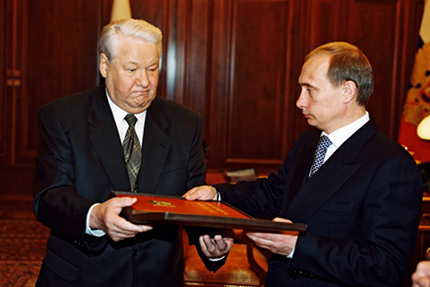
“Before leaving the Kremlin, the first Russian president handed over a copy of the Russian constitution, used to swear in the head of state, and the Presidential Emblem to Mr Putin as a symbolic gesture.” “Boris Yeltsin handed over power to Acting President Vladimir Putin in the Kremlin,” December 31, 1999, kremlin.ru
Article 6
1. The citizenship of the Russian Federation shall be acquired and terminated according to federal law; it shall be one and equal, irrespective of the grounds of acquisition.
2. Every citizen of the Russian Federation shall enjoy in its territory all the rights and freedoms and bear equal duties provided for by the Constitution of the Russian Federation.
The Constitution Does Not Count: How the Duma Has Planned to Strip Russians of Citizenship
Ivan Pavlov RBC
June 22, 2016
Anti-terrorism legislation is a legal grey zone in any country. The balance between protecting public security and preserving civil rights is elusive and unsteady. However, Russian MPs, already inclined to shoot from the hip, have surpassed themselves this time by having a go at no less than the foundations of the Russian Federation’s constitutional system.
One of the measures included in the packet of “anti-terrorist” amendments tabled by a group of MPs led by Irina Yarovaya (which should be adopted in its second reading on June 24) would strip Russians of their citizenship. This punishment would be meted out for terrorist and extremist crimes, joining the civil service in other countries, and working with international organizations in which Russia is not involved.
This list, I am sure, will expand as a matter of political necessity.
Previously, a person could waive his or her citizenship only on their own behest by making a written statement. Now the actions listed above have been made equivalent to this personal initiative. The relevant amendments, if adopted, would be incorporated into the law “On Citizenship.”
Depriving a person of his or her citizenship is banned by Chapter 1, Article 6 of the Russian Constitution. Chapter 1 is entitled “The Fundamentals of the Constitutional System,” meaning the ban is among our country’s most basic laws. A Constitutional Convention would have to be called to amend them. Trying to push through a initiative like this via ordinary legislative procedure looks surprisingly brazen even amid the Sixth Duma’s other legislative feats.
The wording of the bill merits special attention.
“Citizenship of the Russian Federation is terminated on the basis […] of the person’s freely declared intent, as expressed in the commission of acts stipulated by this Federal Law.”
The rationale of legislators is extremely farfetched in this case. The point is not to comply with the Basic Law but to come up with a way of bypassing the mandatory prohibition established by the Constitution.
To get a sense of how crooked this end-around would be, imagine similar wording for bypassing the moratorium on the death penalty: “The person’s voluntary departure from life on the basis of his freely declared intent, as expressed in the commission of certain acts.” This is a case when Lenin’s adage (“technically correct, but basically mockery”) applies.
Against this backdrop, the possibilities for interpreting the proposed rule broadly do not appear so dramatic, but they do exist, and they are dangerous.
“Renunciation of Russian Federation citizenship, as expressed in the commission of acts, is not allowed if the Russian Federation citizen has no other citizenship and no guarantees of obtaining it.”
What would be meant by these guarantees in practice? Anything whatsoever: relatives or even just contacts abroad, employment in foreign organizations, etc. We end up with yet another legal cudgel against “foreign agents” and the “fifth column.”
“Work in international organizations (associations) in whose activities the Russian Federation is not involved, without the consent of the authorities, unless otherwise stipulated by an international treaty of the Russian Federation”: this language provides unprecedented scope for stripping undesirables of Russian citizenship.
It is not just a matter of NGOs, although employees of Amnesty International, Greenpeace, and similar organizations risk being the first to be run over by this steamroller. Any commercial company can be construed as an international organization: all that matters is that its operations extend to several countries.
The new legislative initiative is another step toward isolating Russia from the rest of the world.
Ivan Pavlovis an attorney at law and director ofTeam 29. Translated by the Russian Reader
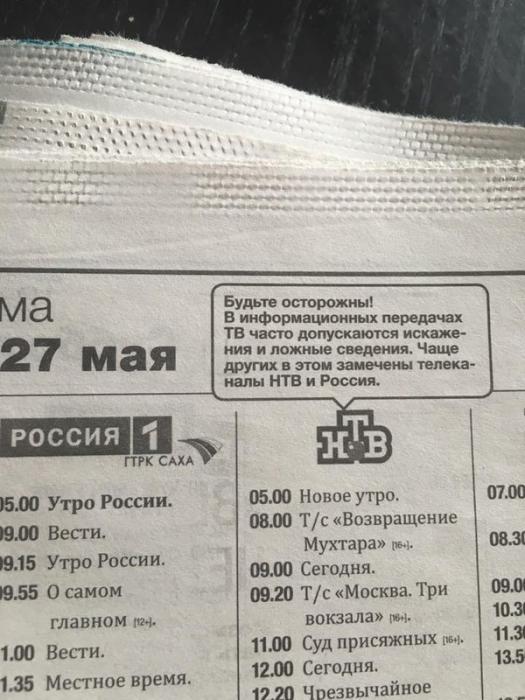
Warning in TV listing next to NTV logo: “Be careful! TV news programs often commit distortions and false information. This tendency has been most often been remarked on the channels NTV and Rossiya.” Photo courtesy of mstrok.ru
Hygienic Modification Regional newspapers warn readers about “false information on NTV” Grani.ru
June 8, 2016
Beginning June 8, up to a hundred regional newspapers, most of them members of the Alliance of Independent Regional Newspapers (ANRI), will publish in their TV listings a warning next to the logo of TV channel NTV that it spreads false information. Valery Bezpyatykh, editor-in-chief of City News, a newspaper published in Redva, Sverdlovsk Region, and one of the organizers of the protest, explained their plans to TV Rain.
According to Bezpyatykh, he vetted the text of the appeal to ANRI members with lawyers before sending the letter, in which he asked members to note in their TV listings for NTV that the channel broadcasts “distorted information or propaganda” under the guise of journalism.
Bezpyatykh estimated that between twenty and forty newspapers could join the protest this week, but by the next week the number could grow to one hundred.
The protest was inspired by the newspaper Evening Yakutsk, which in late May printed a note next to NTV’s logo, warning that the channel committed “distortions and false information” on the air. The note appeared in the newspaper after the film Debtors of the State Department, which claimed the newspaper received funds from foreign sources linked to the US State Department, was aired. The film also mentioned other media outlets, including Tula News Agency, the Tomsk channel TV2, and Chelyabinsk Worker newspaper.
Excerpt from the TV listings in the June 8, 2016, edition of the Redva City News. The warning read, “Be careful! You might get distorted information or propaganda in the guise of journalism on NTV. Details on page 2.” Image courtesy of redva-info.ru
The Public Board on Complaints against the Press has labeled the NTV film a “mendacious denunciation” in which “manipulative techniques for impacting the minds of viewers” were used. The board supported the view of expert Svetlana Shaikhitdinova, who argued the NTV film was an “information product created by spin doctors in order to discredit the directors of Russia’s regional media.”
NTV has repeatedly broadcast made-for-TV films attempting to expose the Russian opposition. The most controversial were Anatomy of a Protest and Anatomy of a Protest 2, shot in 2012. Russian law enforcement authorities filed criminal charges based on claims made in Anatomy of a Protest 2.
Igor Kalyapin, after he was assaulted by a mob in the Hotel Grozny City on March 16, 2016
“Kadyrov said he would not let us work in Chechnya”
Irina Tumakova Fontanka.ru
March 18, 2016
The Committee for Prevention of Torture has been forced to withdraw from the Republic of Chechnya. Its chair, Igor Kalyapin, a member of the Presidential Human Rights Council, was the latest victim of physical assault there. Kalyapin had long had a troubled relationship with Chechen headman Ramzan Kadyrov.
“Igor Kalyapin was just assaulted outside the entrance to the Hotel Grozny City. He was beaten and pelted with eggs,” Dmitry Utukin, an attorney for the organization wrote on Twitter on Wednesday evening.
Later, Kalyapin recounted what had happened to him.
“Around 6 p.m., I checked into Room 2401 in the Hotel Grozny City,” he wrote on Facebook. “About forty minutes later, two reporters and a cameraman came to my room. While I was still in Ingushetia I had promised to give them an interview as soon as I arrived in Grozny. We had begun recording the interview when there was a knock on the door. A man of about sixty years of age, who introduced himself as the hotel’s general manager, a security guard in a black uniform, and another middle-aged man entered. The manager told me that since I had criticized the head of Chechnya and the Chechen police, while he himself was very fond of Ramzan Kadyrov, I had to leave the hotel. […] After that, I was escorted downstairs, where I was detained by a mob of around thirty women, who had apparently been hastily assembled from hotel staff and the employees of the boutiques located on the first floor. They screamed in unison: how dare you speak ill of Ramzan. When I tried to respond, they screamed loudly: we do not want to listen to you. Nevertheless, I was not allowed to leave the hotel. I realized they were purposely delaying me until a team of assailants arrived. I had let my staff go home in a car before dark, and it would have been wrong for them to come after me at such a time in the evening in Grozny. It was apparent I would not be allowed to check into any hotel in Grozny. Any of my Chechen friends living in Grozny would have been exposed to mortal danger [if I had tried to stay with them]. So basically I was in no big hurry nor could I expect anyone to help me. I tried calling Mikhail Fedotov, chair of the Presidential Human Rights Council. I did not manage to get through to him in time [.]”
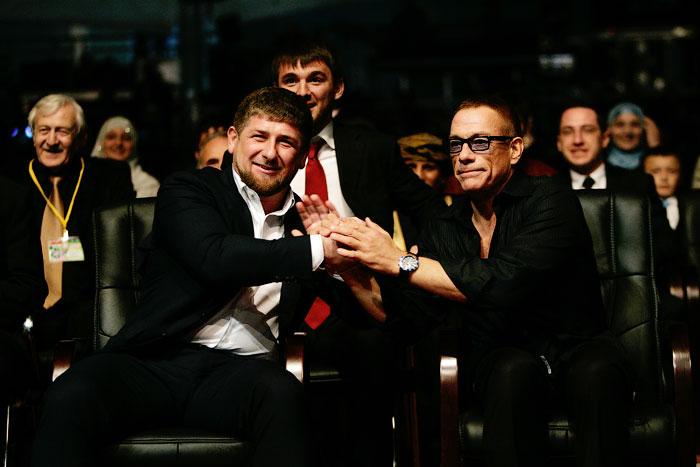
Ramzan Kadyrov and Jean-Claude Van Damme at the opening of the Hotel Grozny City, October 16, 2012
In an interview with Kavpolit, Kalyapin said of his attackers, “I believe the men who attacked me were neither Chechens nor Muslims. People who have done such a thing cannot be called Chechens or Muslims.”
Who, then, were the assailants? What had the anti-torture campaigner done to enrage them? Fontanka.ru posed these questions to Igor Kalyapin.
Igor, how do you explain yesterday’s attack on you?
There is no cause to guess here, it is all fairly simple. Over the past two years, Ramzan Kadyrov has personally, frequently, and quite emotionally accused me of various horrible crimes in the Chechen media. He has said I have defended terrorists and financed terrorism in the Chechen Republic, and that our committee are agents of western intelligence agencies who earn money on the blood of the Chechen people. That is a literal quotation. For example, in December 2014, there was a terrorist attack in Grozny in which a dozen Chechen policemen, young guys, were killed.
Yes, that is a well-known story. Kadyrov blamed you personally for the attack.
He addressed people, including the relatives of the dead, and he did this in the first twenty-four hours after the attack, when people were blinded by grief and pain. And he said to them: I know that a certain Kalyapin transferred money from abroad to the organizers of the attack.
Let us also recall he was not angry with you for no reason. You had tried to prevent him from burning down without trial the houses of people suspected of being relatives of the terrorists.
Of course. But he has said it more than once; he has systematically repeated the charges. Only last month on Chechen TV there were two films about Kalyapin: montages of photographs, videos, and screenshots of our website, and all the charges against me read out against this visual backdrop.
So what is the reason? What has your committee done to Kadyrov?
Many of the kidnappings we have tried to investigate have led us to Kadyrov’s confidants. And he knows it quite well: I once personally told him about it. We constantly pressure the Investigative Committee, which deals with these matters, to perform certain investigative actions. They have tried to stop or suspend criminal proceedings, but we have constantly appealed their actions in the courts.
Well, we understand how our courts and investigators work. Could Kadyrov, for example, just not pay attention to your work?
We publicly talk about all of it. We point out that the Investigative Committee in the Chechen Republic has not been investigating such-and-such a case, although the evidence is there: for example, the case of Murad Amriyev, the case of Islam Umarpashayev, and other matters. We point out that a certain person has not been questioned only because he serves in the Akhmad Kadyrov Regiment, and the investigator is afraid to summon him. We have made such things public on many occasions. We have sent white papers on these cases to all the factions in the State Duma. We have periodically appealed to Alexander Bastrykin, head of the Russian Federal Investigative Committee. Moreover, we have done it openly, by publishing reports, and we have talked about cases not being investigated. I have also spoken about this at the Parliamentary Assembly in Strasbourg. There has been a lot of press about our work. Naturally, it infuriates Kadyrov.
Does it merely infuriate him? Or does he see your work as a serious threat?
Apparently, he does in fact see it as a threat. I think that from time to time he get signals he should stop illegally prosecuting people he does not like. I imagine the powers that be wag their finger at him. Until you stop, they say, your republic will be written about as a lawless land.
Why has everything intensified in recent days? The incidents involving your committee in a single region have been in the headlines for a week running. Whose toes have you stepped on lately?
No, there were incidents before this, too. It was just that nobody wrote about them. If it were not for the March 9 attack on the journalists, which made such a big splash, then no one much would have written about my getting pelted with eggs, probably. The two incidents just happened to coincide. In fact, we have been under intense pressure for at least the last two years. Many things have happened. I cannot detail all of them right now.
For example, three days ago, there was an incident at your committee’s office in Grozny.
Yes, three nights ago, people broke into an apartment in Grozny we use as an office. They tried to turn off the security camera. They thought they had succeeded, but the camera kept on working. So on the recording you can see Emergency Situations Ministry officers and police officers breaking open the door and entering. Then, apparently, they got to the router, and the signal went dead. Basically, one of the reasons I came to Grozny was to get to the bottom of what was going on with the apartment: inspect it, file a complaint with the police, and so on.
Your colleagues at the committee told Fontanka.ru that security officials also went into your office in Ingushetia on March 9.
It was not an office in Ingushetia, but an apartment where we kept documents. And that is important, because we have not done any work in Ingushetia. We do not have a single case in Ingushetia. We do not annoy the security officials in Ingushetia in any way. Moreover, I have had a great relationship with Yunus-bek Yevkurov, head of Ingushetia, and he has had generally good relations with human rights activists, even with the ones who annoy him. So Yevkurov was not behind it, of course. I cannot tell you who these people were. But people at the level of the North Caucasian Federal District have got involved, and I imagine the Interior Ministry could easily establish whether it was policemen or someone else.
Meaning, you are confident they have decided to figure it out?
No, I’m not confident, not confident at all. But if anyone can figure it out, it has to be federal district officials. But if it was security officials who were involved, they were not from Ingushetia.
Why could your committee’s employees not work in Chechnya quietly, without advertising themselves?
That is the specific nature of our work. We are not gathering information, after all; we are lawyers. We are constantly involved in public legal proceedings. Once or twice a week, for example, we are involved in court hearings dealing with the Investigative Committee’s unlawful actions or their inaction. The court sessions are open to the public. Information about them is posted at the entrance to the courthouse or on the court’s website. We are simply legally bound to operate publicly. That is, we have three areas of work: we do paperwork and file documents in court, we are involved in court hearings, and we take part in police investigations. It is quite easy to identify us. And there is nothing to be done about it.
You work to prevent torture, which is a crime. Theoretically, the state should have a stake in the success of your work. How does it help you? Perhaps by physically protecting you?
You know yourself how it “helps” us.
What if I didn’t know?
The work of the Committee against Torture, which is purely juridical and wholly confined to criminal proceedings, was deemed work aimed at changing state policy, and as such the committee was placed on the register of foreign agents. Honestly, I still have not recovered from the shock. We never denied we received foreign funding, but to say that the Committee against Torture had been trying to change state policy is—
A full confession?
In my opinion, it is self-incrimination. When a person says such things, it is called self-incrimination. But here it was the state saying this. Nevertheless, our organization was deemed a foreign agent. So now we have another organization: the Committee for Prevention of Torture does not receive foreign funding. True, they are trying once again to register us as foreign agents. Because they feel like it.
Okay, money from foreign organizations is a very bad thing. But has the Russian government subsidized the prevention of torture?
In 2013–2014, we got our first state subsidy, a so-called presidential grant. Then the organization was declared a foreign agent, and we announced we did not intend to go on working with this status. We discontinued operations and registered the new organization, which for the time being has not received anything from anyone.
How do you survive, then? Legal aid, trips to the regions (you operate in more than just Chechnya), and collecting information are probably all expensive things, no?
Legal aid is not the most expensive thing. And what information collecting do we need to do if people come to us themselves? We need money for other things—for collecting evidence and conducting forensic examinations, and for ensuring people’s safety. We very often send victims to a sanatorium, not only so they get medical treatment there but also to spare them from the intrusiveness of the law enforcement agency whose officers we suspect of having committed the crime. This is what we need money for. For example, last year a man sought our help. He told us a deputy minister of the Chechen Republic had tortured him: the minister had attached electric wires to his body and so on. The victim was in hospital. Moreover, he was disabled: he had only one leg. And he showed us so-called electrode traces, claiming they were evidence of torture. We had this conversation approximately a week after he had been tortured. To force the Investigative Committee to accept this as evidence, you need to carry out a quite complicated forensic examination. So we sent this man with a chaperon (since he was disabled) off to Moscow. In Moscow, we contracted with a licensed, state-accredited forensics bureau, which offers paid services among other things. They did the examination. When we did the numbers, it turned out the examination alone cost us over 100,000 rubles [approx. 1,300 euros at current exchange rates]. They are not always so expensive, but such forensic examinations are required in each case.
So maybe the examinations should be conducted at government expense as part of the investigation.
The Investigative Committee is not going to conduct them, and not only because it is expensive but also because they are afraid of finding out the results. When it does not want to deal with a criminal case, the Investigative Committee’s primary tool is delaying the forensic examination so it is impossible to establish either the nature of the physical injuries or the circumstances in which they were received. So in each case we have to carry out the forensic examinations ourselves.
But someone does pay for it, don’t they? Who are they? Charities, private sponsors?
Our work is divided. There is the Committee for Prevention of Torture. It employs lawyers who go to court, file appeals, and so on. It is a public organization that has no foreign funding. But there is another organization, also noncommercial, which works on the forensic examinations, collects evidence, and so on, that is, on things where money is absolutely necessary, including international protection. It receives foreign funding.
Have I understood you correctly that the fight against torture in Russia is subsidized by foreign organizations?
Yes, that is correct.
You want to return to Chechnya. I gather that the challenges you went there to solve have not been addressed.
The task I have already told you about has lost its relevance. I wanted to inspect our apartment in Grozny, but it is clear I am not going to be allowed to do that. So we will have to solve the problem differently. For example, attorneys can inspect the apartment along with police officers. But I had another objective: to try and organize a press conference in Grozny. Now I would not even risk inviting anyone to go there. In Chechnya, there are reporters who write good things about Kadyrov, and they are not in any danger. But those who have at one time or another permitted themselves even a bit of criticism had better not go there.
What will happen now to the cases your committee has been handling in Chechnya? Will you abandon them?
No, we do not abandon cases. We simply do not have the right, either the moral or the legal right. We will continue to be involved in them. For the time being, I cannot say how we will set up the work and where our lawyers will do the paperwork. It is obvious we will not be allowed to work in the Chechen Republic. Kadyrov himself has said so many times. But we will continue the work itself.
Your staff will still have to travel to Chechnya, won’t they?
Yes, they will. But we are officially involved in criminal cases as counsel for the victims. The investigative authorities are obliged to ensure our safety. They had better do it.
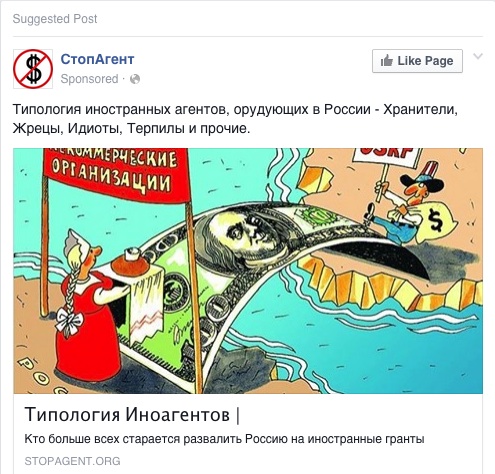
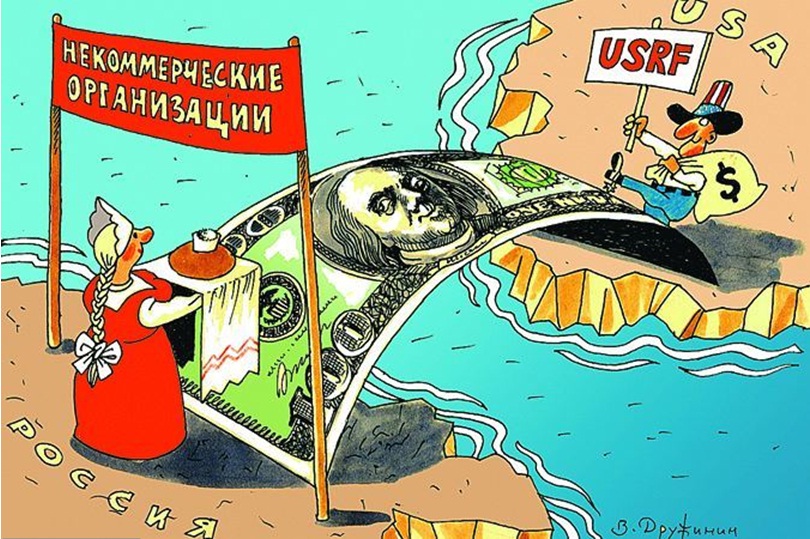
This is a little sample of the crap that Mark Zuckerberg and Company send your way for hard cash if you have the misfortune to live in the “post-Soviet space.”
A typology of foreign agents operating in Russia: Watchdogs, Priests, Idiots, Underdogs, and others.
A Typology of Foreign Agents | Who is trying the hardest to destroy Russia on foreign grants
Here is what the full illustration looks like if you are a total moron (like me) and follow the link.
“Russia. NGOs. USRF [United States of the Russian Federation].” Source: stopagent.org
Petersburg Activists Rally in Support of Saratov Antifascist Sergei Vilkov David Frenkel
Special to The Russian Reader
June 1, 2015
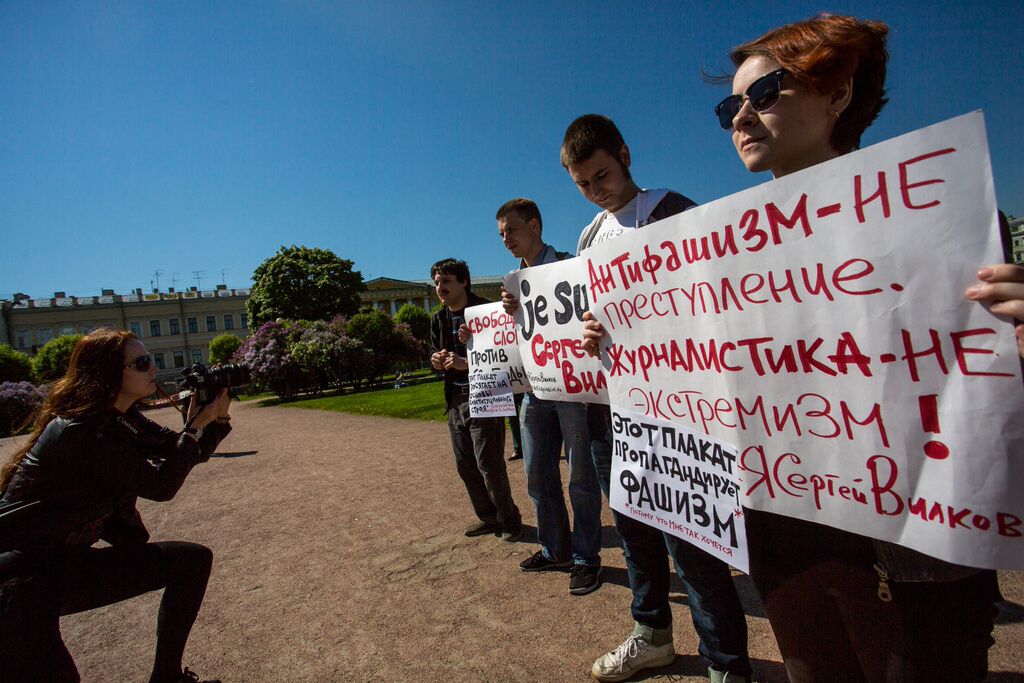
On Saturday, May 30, activists from the Russian Socialist Movement (RSD) organized a theatrical protest rally, entitled “#I Am Sergei Vilkov, or Pinning Labels,” on the Field of Mars in central Petersburg.
Socialist activists rallying in support of Saratov journalist Sergei Vilkov in Petersburg, May 30, 2015. The placard on the far right reads, “Antifascism is not a crime, journalism is not extremism. I am Sergei Vilkov.”
The activists demanded an end to the persecution of Sergei Vilkov, an independent journalist and antifascist in Saratov, who was physically assaulted in January of this year by two unknown assailants and has been accused by various local authorities of “extremism.” In one particular instance in April of this year, Vilkov was fined 1,000 rubles by a Saratov court for having posted, in November 2011, a caricature on his personal page on the VKontakte social network that fused the logo of the ruling United Russia party and a swastika.
Vilkov has blamed his troubles on Saratov businessman and Saratov Regional Duma deputy Sergei Kurikhin. Earlier, Vilkov had published articles in the local monthly news magazine Obshchestvennoe Mnenie (Public Opinion), exposing Kurikhin’s dubious political and business dealings.
Activists at the rally on the Field of Mars held placards demanding prosecution for the persons who, allegedly, assaulted Vilkov in January and decrying censorship.
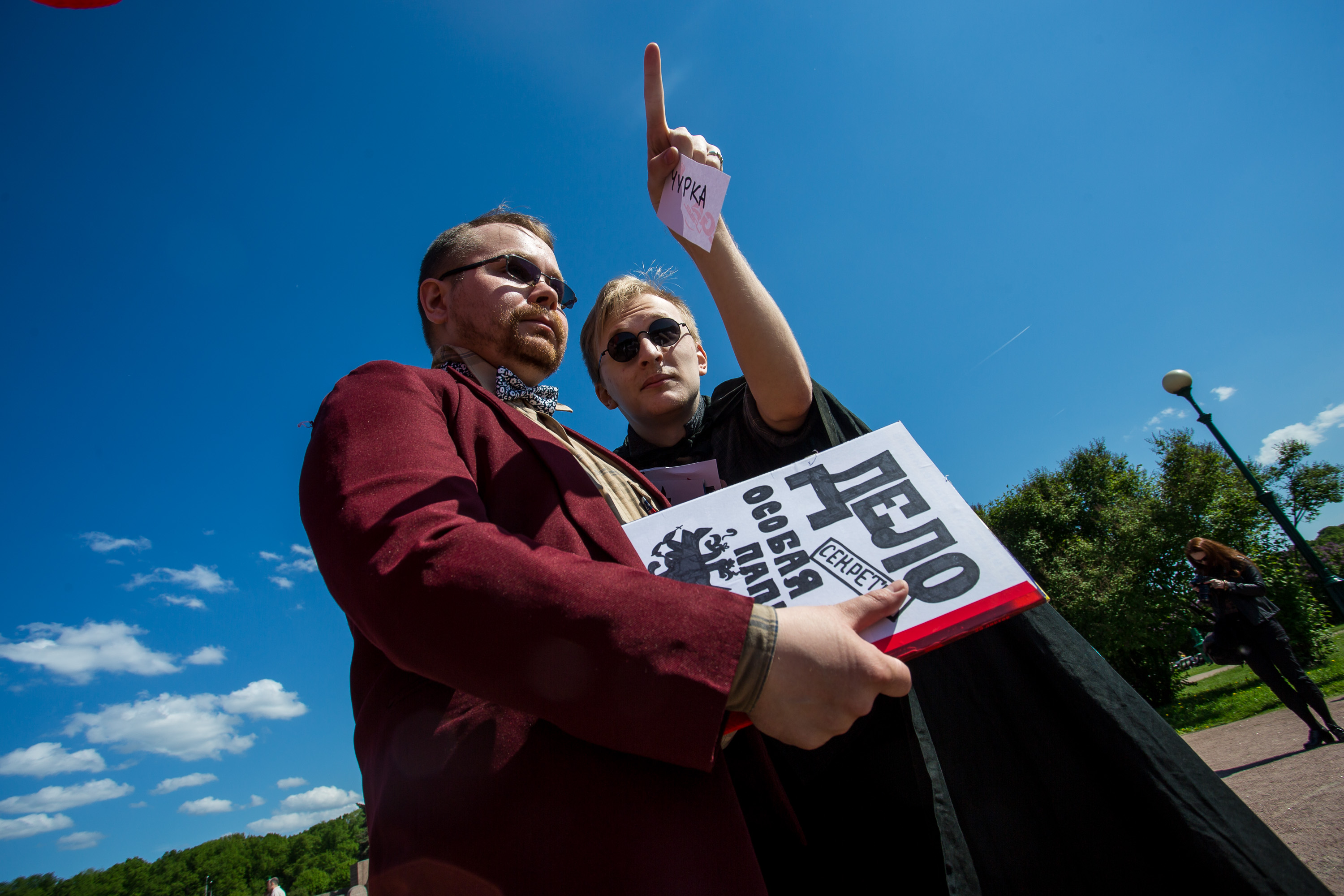
Symbolizing the alliance between the authorities and business, two activists were dressed as a judge and a “new Russian,” who wore a crimson jacket, popularly regarded as typical attire for gangster businessmen during the “wild nineties” in Russia.
“New Russian” and “Judge” at Saturday’s protest rally
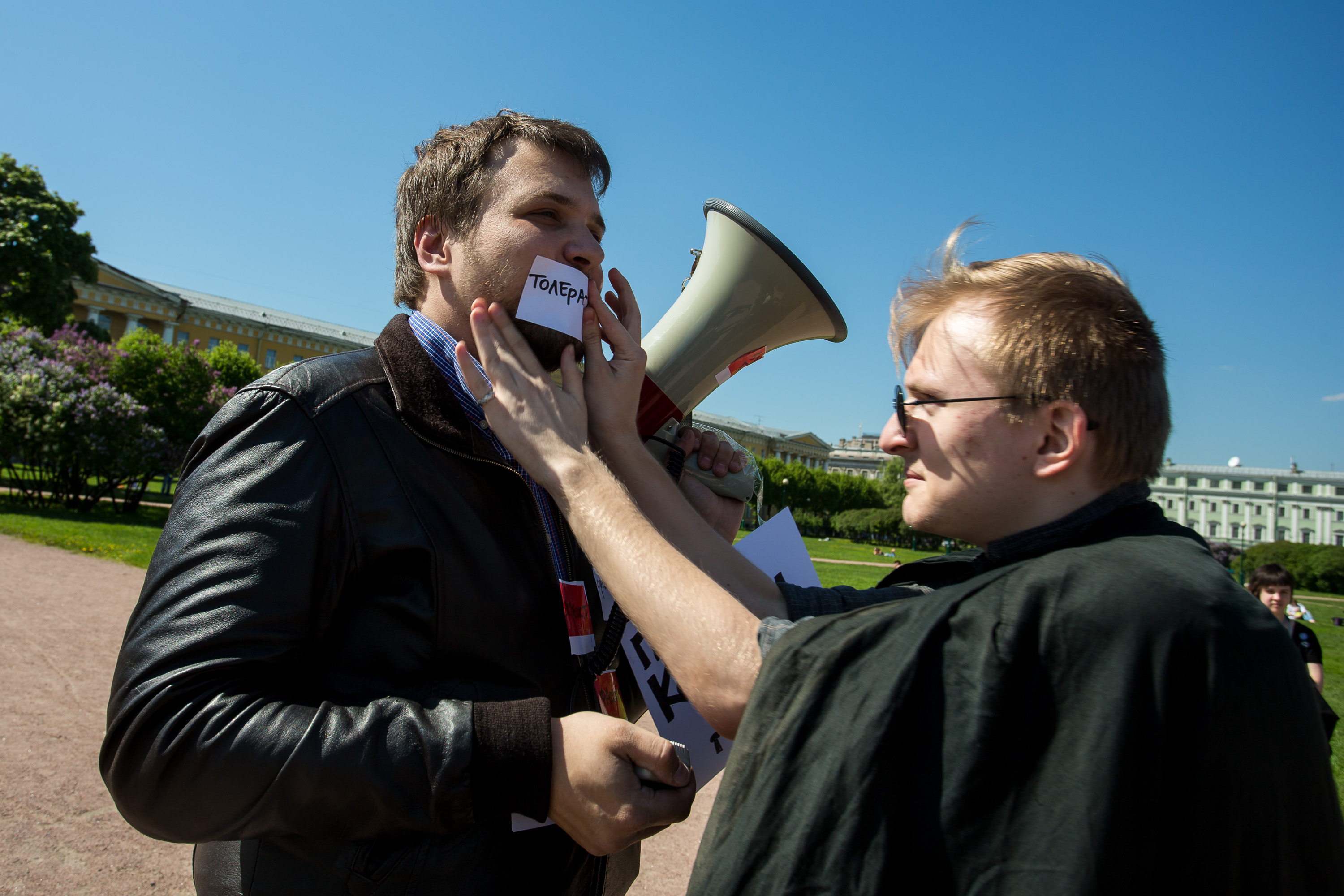
The “judge” and the “new Russian” brought with them a criminal case file full of labels, such as “foreign agent,” “atheist,” “fifth columnist, “tolerast” (an insulting slang term applied to people regarded as having excessively politically correct values), “forbidden by censorship,” and “offends religious sensitivities.” These labels and epithets are typically applied to critics and opponents of the current Russian authorities.
The two men hung and pinned these labels to the other activists who were present in order to “make them feel like Sergei Vilkov.”
“Judge” labels activist a “tolerast” at Saturday’s rally.
The socialist activists are convinced that Vilkov’s case is not an anomaly. Travesties of justice in the courts, political crackdowns against opposition activists, censorship, corruption, and the fusion of political authority and business are rather typical of Russia, they argue.
Here are four reasons why, despite my affection for Kirill Medvedev’s work, I found his recent appeal to the “intelligentsia,” the “youth,” and all other Russians of good will a little odd. He should be honest enough to know he is appealing to what is, increasingly, thin air. Fifteen years of Putinism have decimated “public discourse” and intellectual life in Russia, and now it seems the regime wants to finish the once-mighty Russian mind off once and for all.
Which is not to say that the pro-Putin “euphoria” described in the first two snapshots is not a stage-managed affair to a huge degree, as obliquely suggested by the fourth snapshot.
1. According to a survey published this week by the respected independent pollster Levada Centre, 82% of Russians believe MH17 was brought down by either a Ukrainian army fighter plane or missile. Just 3% thought the insurgents were to blame. Given these kind of figures, the prospect of Putin facing a backlash of public anger over suspected weapons supplies to separatist gunmen is virtually zero. Ironically, Putin probably faces more danger from Russians disappointed by his failure to provide more assistance to the rebels. “Many people feel cheated by his refusal to use military force [in east Ukraine],” Alexander Dugin, an ultranationalist thinker whose ideas are reported to have influenced recent Kremlin policy, told me recently.
Western officials may be hoping economic sanctions will force Russians to rethink their support for Putin, but in reality such measures will achieve little more than an entrenchment of a growing fortress mentality. State media’s routine and increasingly vitriolic attacks on the west’s “decadent” morals mean Russians are likely to accept any economic and social hardships brought about by US and European sanctions. Tellingly, in another Levada Centre poll this week, 61% of Russians said they were unconcerned by the threat of sanctions, while 58% were similarly unfazed by the looming possibility of political isolation over the Kremlin’s stance on Ukraine.
These head-in-the-sand attitudes are bolstered by what the director of Levada Centre, Lev Gudkov, calls a “patriotic and chauvinistic euphoria”rooted in the almost bloodless annexation of Crimea in March, which was popular among Russians across the political spectrum. It’s alsoworth noting that many “ordinary” Russians are uninterested in politics and have only scant knowledge of the issues at hand.
2. MOSCOW, July 31 (RIA Novosti) – Life satisfaction and social optimism indices in Russia skyrocketed, reaching all-time highs despite political challenges according to polls conducted by the Russian Public Opinion Research Center (VCIOM).
“Within the last three months, indices of social well-being have shown unprecedented growth, stabilizing at extremely high levels. In June the satisfaction index reached its all-time high of 79 points and the indices of financial self-assessment and social optimism, now at 76 and 77 points respectively, have also risen and stabilized at new highs,” says the poll.
The economic sanctions imposed by the US and EU over the crisis in Ukraine seem to have little effect on Russians. According to the polls, Russians are now far less concerned with the future of their country than they were last year.
The number of Russians who have not ruled out the possibility of a war with neighboring countries is now 23 percent of the population, up from just 10 percent last year. However, the number of those concerned about a Western military threat has held steady at 13 percent for the past eight years.
The VCIOM opinion poll was conducted in 2014, interviewing 1,600 respondents in 130 communities in 42 regions of Russia. Data are weighted by gender, age, education, working status and type of settlement. The polls have margins of error of no more than 3.4%.
3. It’s bad news for Russian bloggers, then, that starting today, anyone who attracts more than 3,000 daily readers to his blog is considered a de facto journalist and must register. (In a largely symbolic gesture, LiveJournal has already stopped reporting blog subscribers beyond the 2,500 mark.) Registration entails turning over your personal details to the government—including, of course, your name, meaning anonymous blogging is now illegal for many. (By the way, the law applies to any blog written in Russian for Russians; a post you write from a Brooklyn cafe could face censorship from Moscow.) Bloggers will also be held liable for any alleged misinformation they publish, even in comments written by somebody else. And, insult to injury, bloggers aren’t even allowed to use profanity; a single naughty word would put them in violation of the law. Failure to comply results in a $280 to $1,400 fine as well as a ban on your blog.
The new legislation represents a rather obvious attempt by the Russian government to shut down all criticism of the Kremlin, particularly from the left. The government has already granted itself the authority to shut down any website and used this power to crush popular left-leaning news sites. With this next step, the Kremlin clearly hopes to scare the smaller fish into complying with the official party line. And Russia’s insane Internet crackdown won’t stop with blogs: Starting in 2016, all websites that store data on Russian citizens will have to move their servers to Russian soil—a blatant attempt to assert control over social networks and search engines.
4. The application of [the new law on compulsory registration of NGOs receiving foreign funding as “foreign agents”] against scientific institutions, in fact, constitutes a professional ban on sociologists. Sociology that does not affect public opinion (directly or indirectly) is nonsense. Sociology that does not raise sensitive issues or suggest original answers that run counter to public opinion is intellectually bankrupt. Sociology that does not affect management decisions is as defective as governance that does not use the opportunities of independent social research. Sociology that is deprived of critical analysis of different “policies” loses connections with social science and turns into political technology. Sociology that does not succeed in the competitiveinternational research grant market is devoid of incentives for growth and is doomed to extinction.
In the modern world, any science that exists in isolation from the global context loses its ability to develop. All attempts to control global processes of scientific exchange only lead to the bureaucratization of science, the flourishing of pseudoscientific theories, and talented and open-minded scholars leaving the country. The persecution of independent researchers and research organizations puts an end to the development of a full-fledged scientific community and leads to the degradation of the humanities in Russia, which will ultimately result in a deficit of ideas and strategies for the future of our country.
The law on “foreign agents” is not the only sign of the long-standing crisis of the Russian administrative and political system. It is embedded in a series of decisions that aim to expand state control over various aspects of society and their submission to the bureaucratic logic of the “vertical” power. We can see this in the introduction of censorship and persecution of disloyal media, financial and administrative pressure on public (and especially human rights) organizations, the sterilization of historical memory (pressure on the “Memorial” and ”Perm 36”), criminal and administrative persecution for political reasons and independent (not controlled by the state) activism, dismissal of leading high school teachers for being disloyal touniversity superiors and many other cases. Self-censorship is booming in this society, for which survival has become the main motivation for its members. Overt or non-obvious subjection of one’s own activity to the goals of the “vertical” power is turning into the most effective model of behavior.
It is obvious for us that an independent social science is crucial for a society whose interests are not limited to maintaining stability and “unity” at any costs. An authoritarian state does not need reflection that a professional independent research can provide. It is satisfied with VCIOM polls and various ratings that allow the maintenance of “vertical” tension and promotion of “patriotism”. Such a regime will inevitably degrade and become obsolete, but during its heyday it manages to destroy much of what came before it and exists in spite of it.
We believe that the lack of interest towards the professional opinion of independent sociological community, which often oppose bureaucratic perspectives, points to the incompetence of the Russian administration. The pressure exerted on NGOs and non-governmental scientific centers indicates that the political administration of our country no longer needs feedback and has no interest in the actual state of affairs in Russia. This means it condemns our country to the harsh effects of unreasoned political and economic decisions.