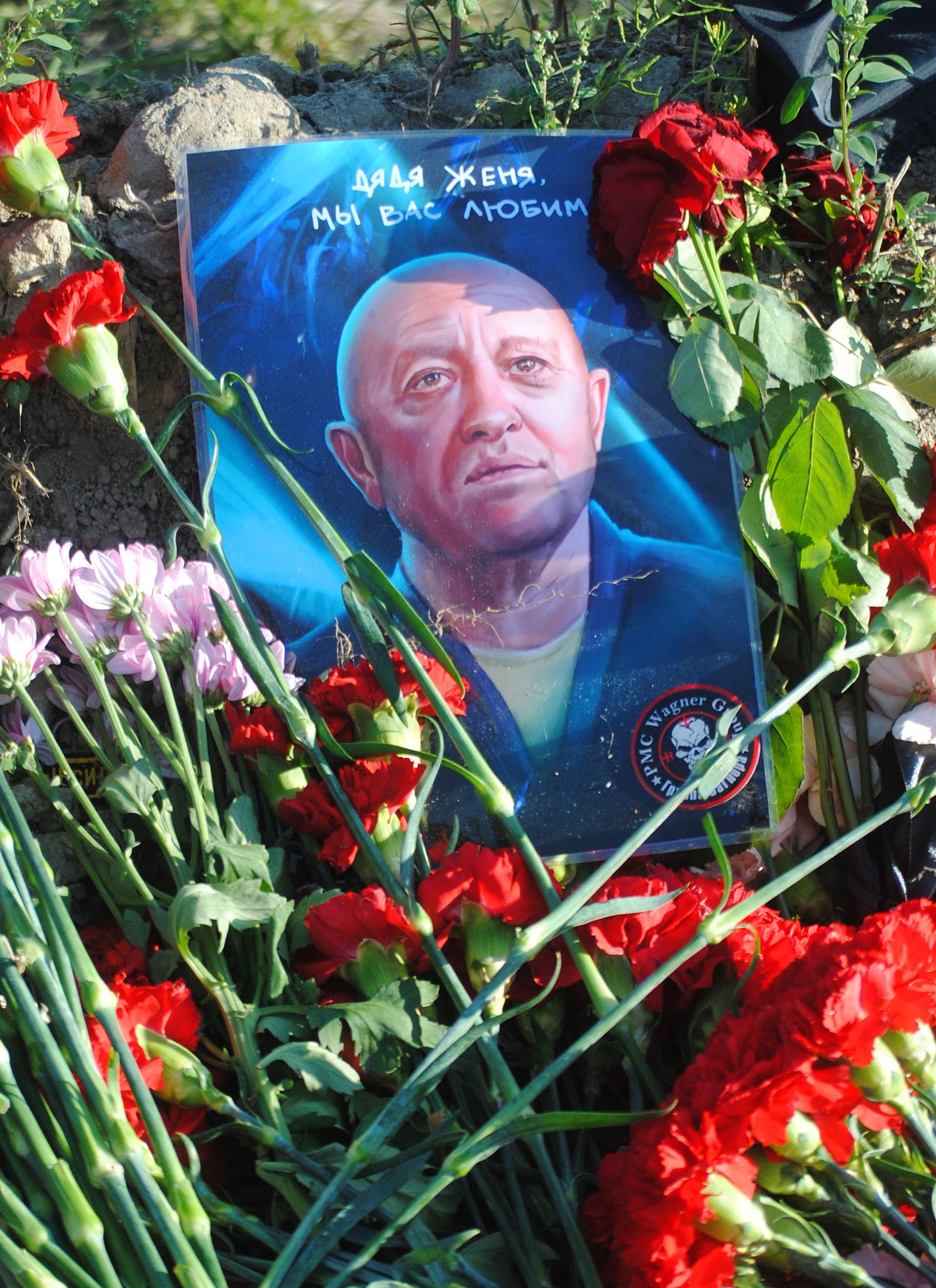
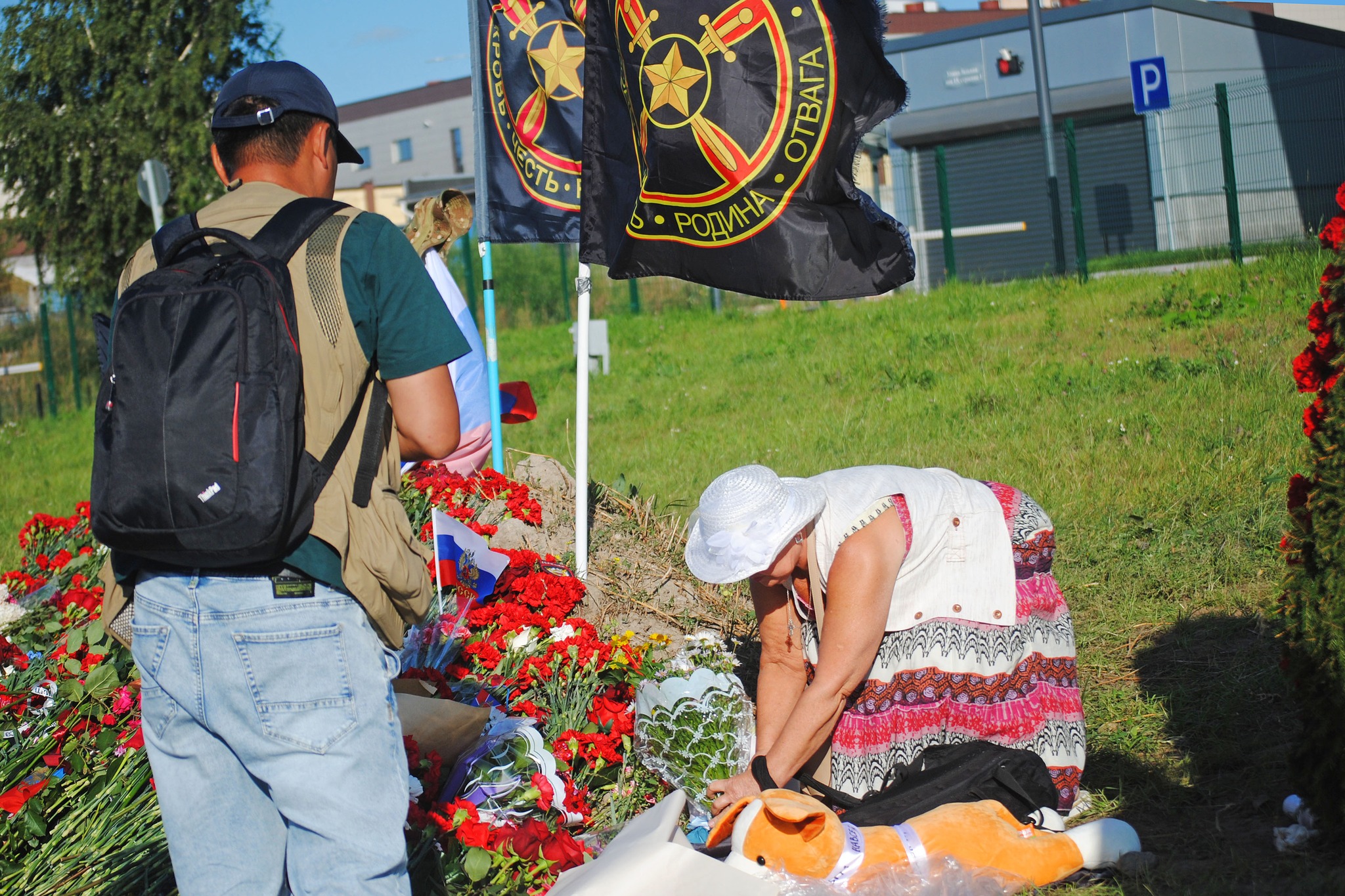
“We Love You, Uncle Zhenya”

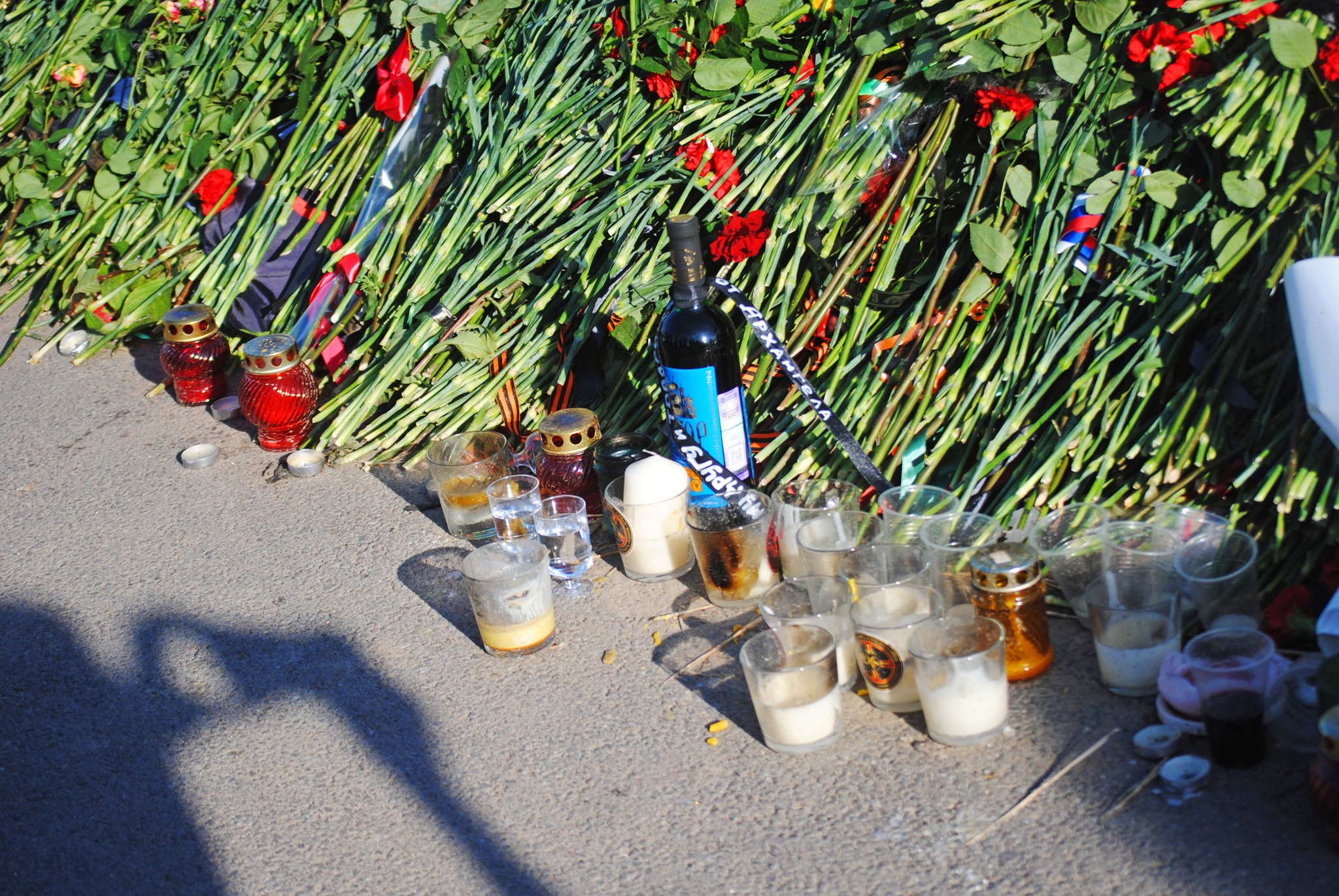
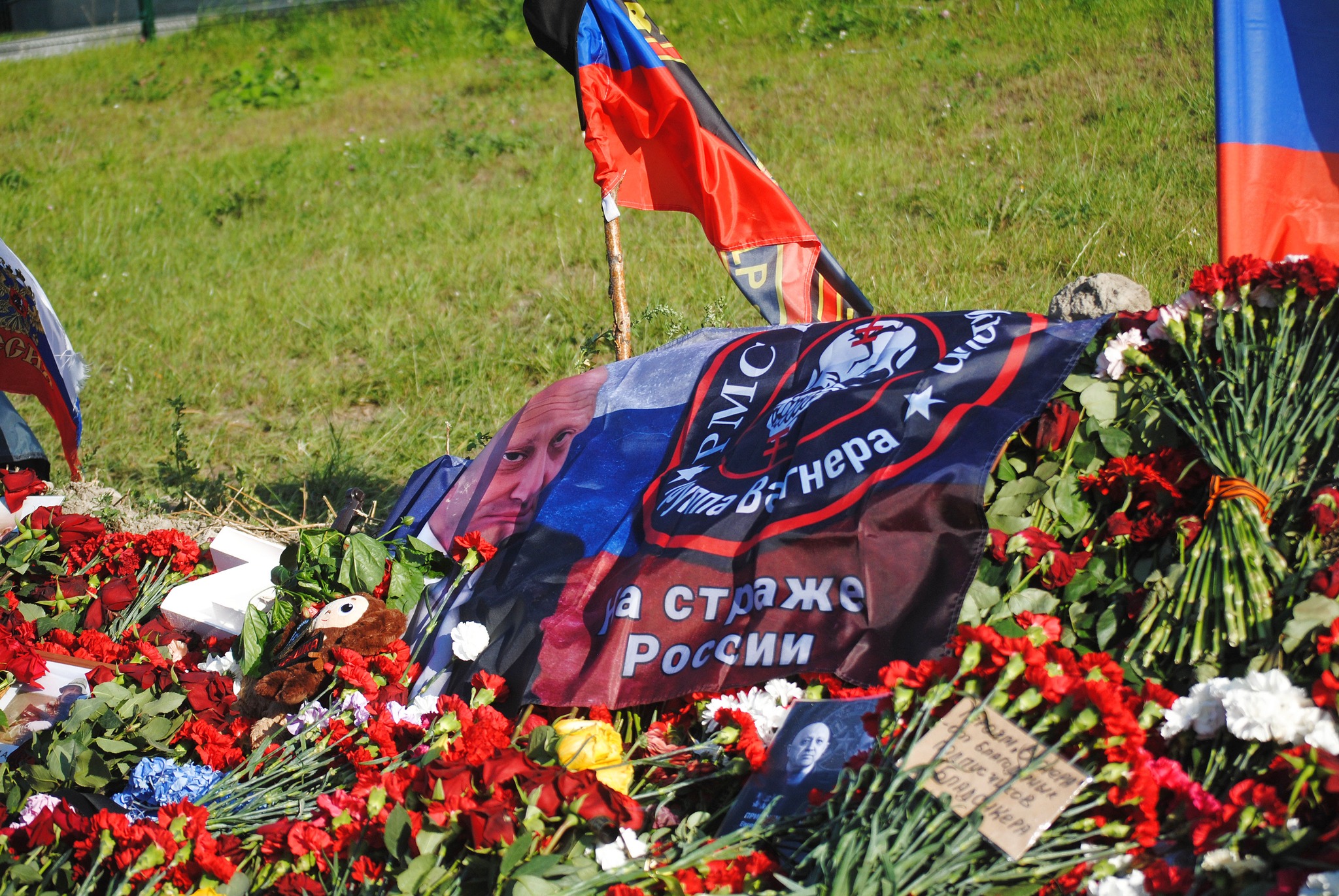
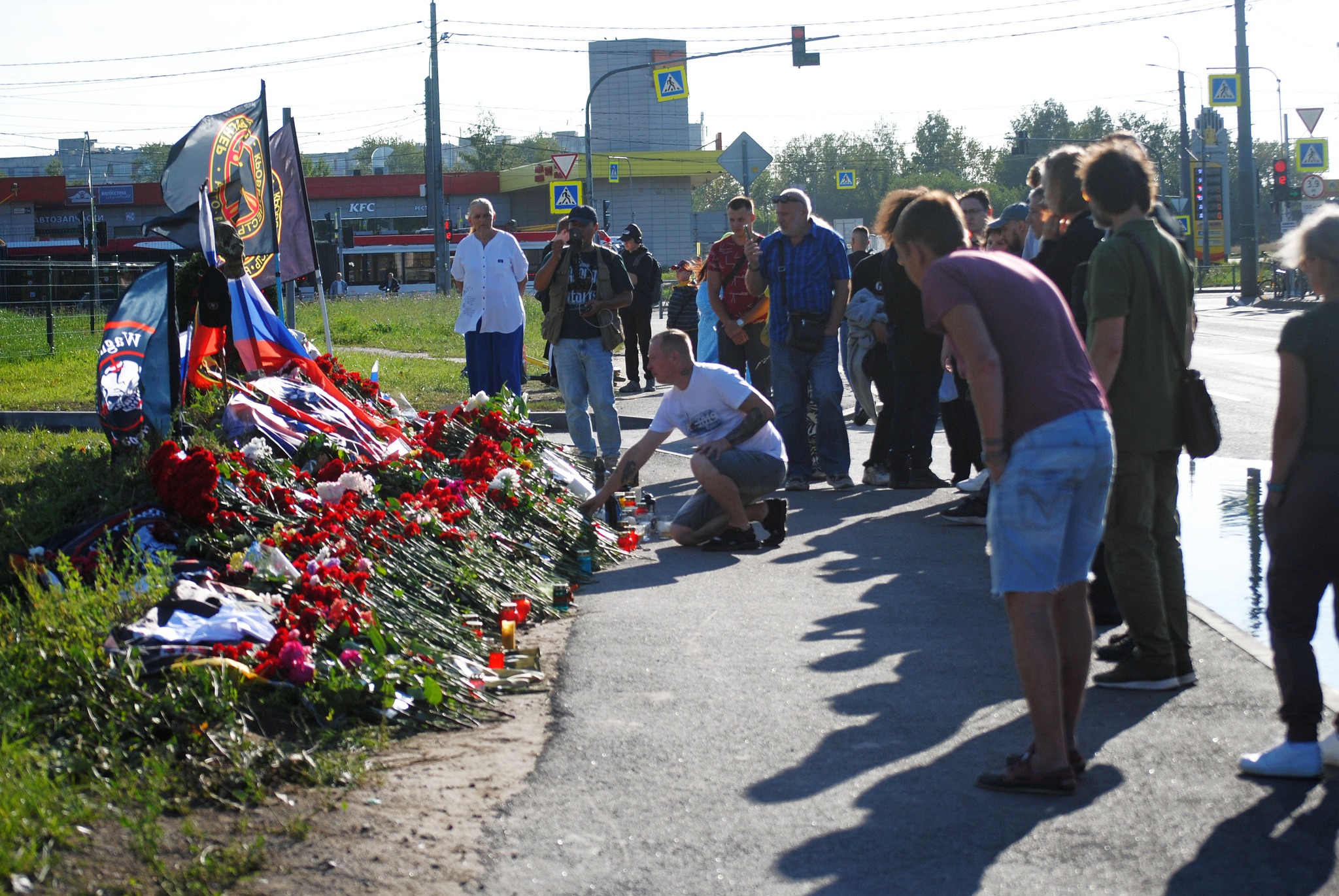
I went to see the spontaneous memorial to Prigozhin on Zolnaya [“Ashes”] Street [near the former (?) Wagner Center office building in St. Petersburg]. I have to say that what I saw impressed me. People kept coming and coming—young dudes and girls, men who were slightly older, and some people even had their kids with them. They brought flowers. They stood and looked for a long while. Some got down on their knees, and this one young dude crossed himself and genuflected. A Chinese guy was videotaping the whole scene and talking in Chinese, but it troubled no one. That’s him sporting a rucksack and filming point-blank the woman in the hat who is putting what looks like a whole bush of roses in a vase.
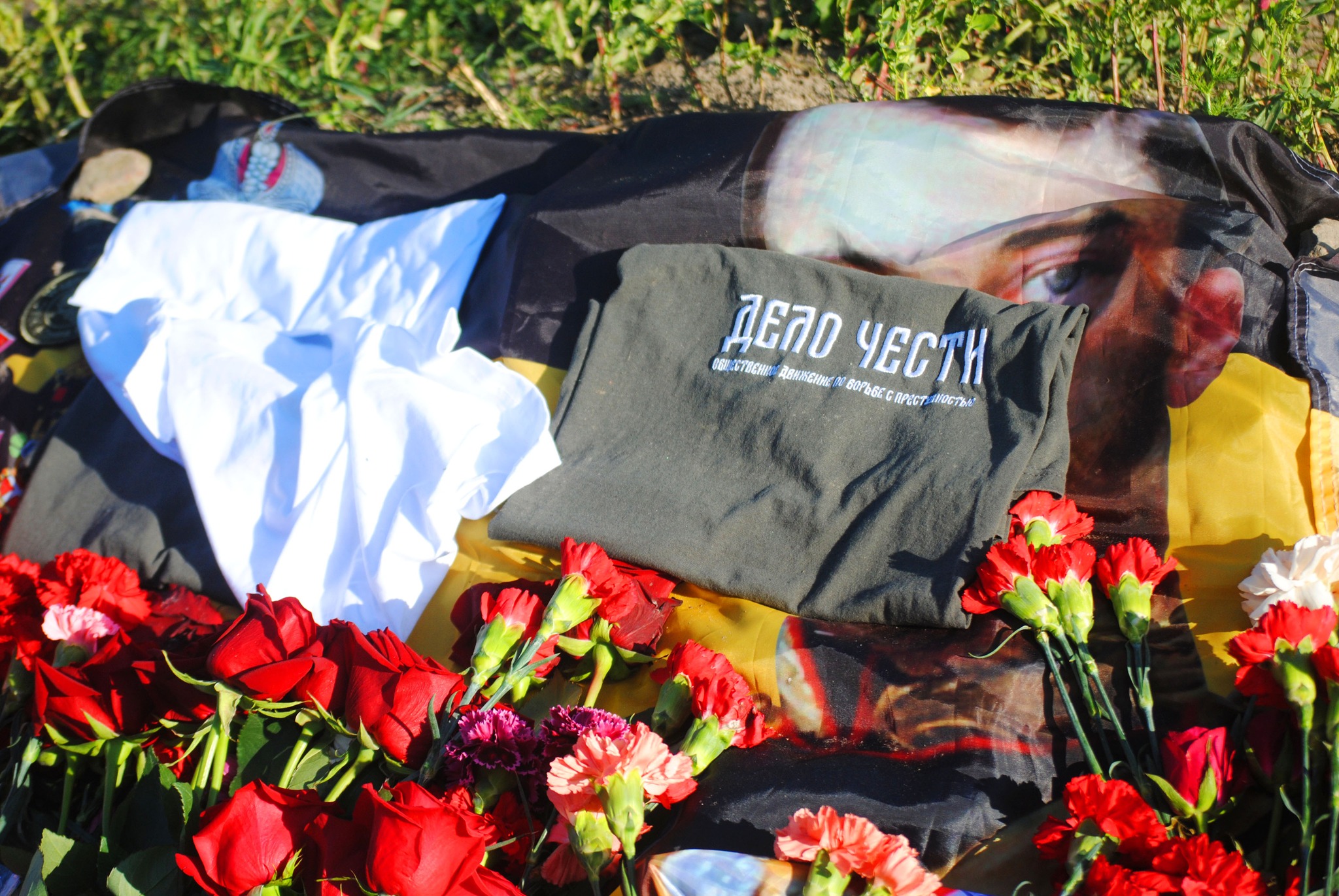
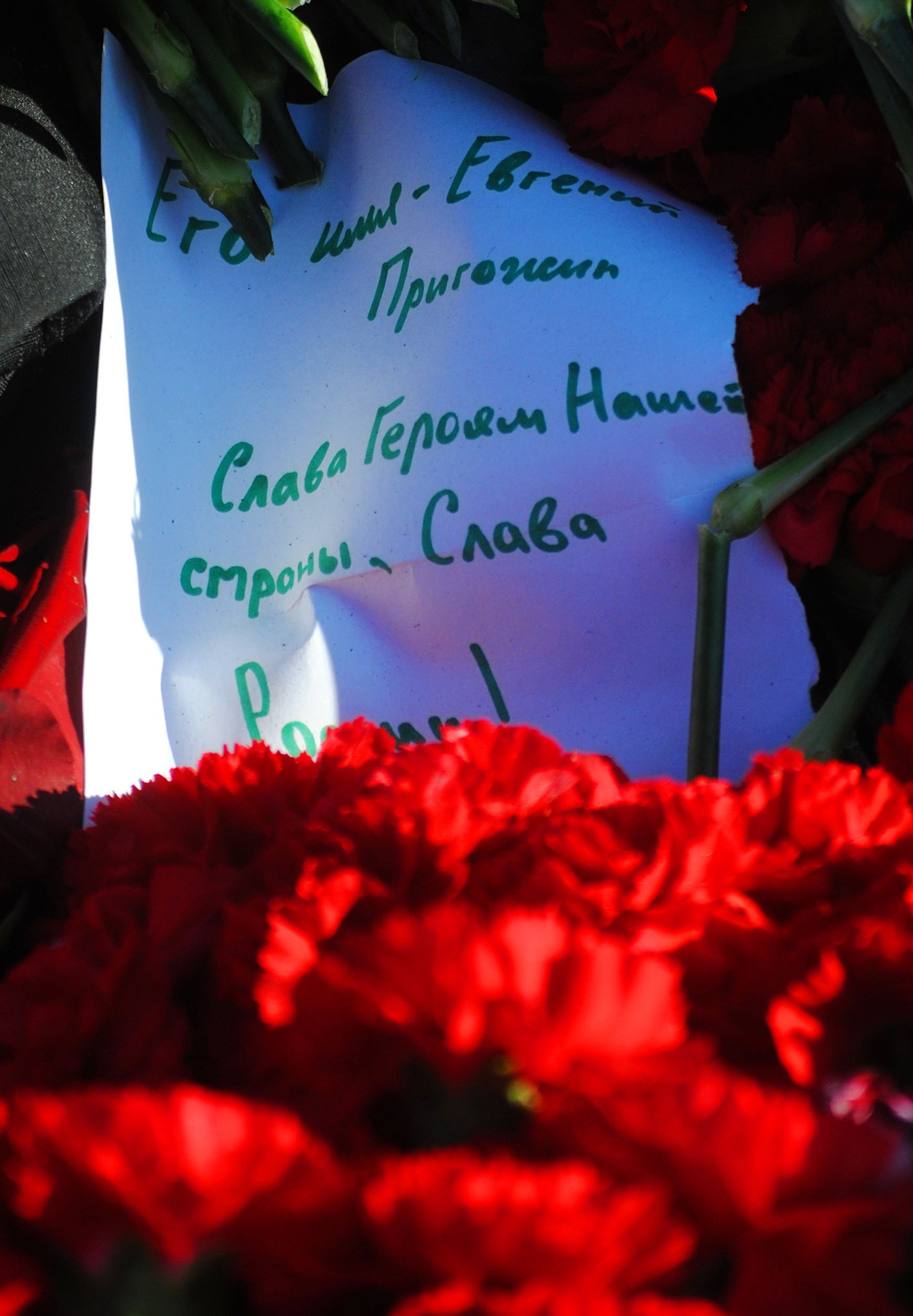
Source: Marina Varchenko (Facebook), 26 August 2023. Translated by the Russian Reader


Hello, dear Moscow Times readers! This is your weekly newsletter, and we’re kicking off with the (near-certain) death of Yevgeny Prigozhin, the man dubbed Vladimir Putin’s “chef.”

However, Prigozhin gained notoriety not for his culinary talents, but for his business ventures. He set up several enterprises that were extremely vital to the Russian authorities. The most well known were the private military company Wagner and the “troll factory” in Olgino, a suburb of Petersburg, which was used as a tool for influencing the information space in the Russian Federation and the world.

Trolls are fantastic creatures, and they vanished of their own accord, you might say, but apparently it was Vladimir Putin who put the kibosh on Wagner. The rowdy band of freewheeling mercenaries, who took their orders from god knows whom, has come to end.

We should recall, of course, that Prigozhin took a long time admitting that Wagner and the Olgino trolls worked for him. He acknowledged this obvious fact only in the midst of the war, and this was the first step toward the mutiny of 23 June and his (near-certain) death on 23 August. The public owner of an effective resource can either use it or give it up. Prigozhin didn’t feel like giving Wagner away—that is, transferring it to the command of the Defense Ministry (and take an oath, as Vladimir Putin has now ordered)—and so the strange mutiny that had such supremely serious political consequences happened, and, later, the Embraer jet plane crashed in the Tver Region. (It was the first time this type of plane had an accident involving fatalities.)

We interviewed people in the know about the moods among Russia’s elites to find out how they were taking the “chef’s” demise. We went further, though, asking several people who kept a close eye on Prigozhin’s rise and (alas, literal) fall to explain the meaning of the story that has unfolded before our eyes.

The first explanation comes from an observer in civil society who claims that the plane crash was caused by underlings going farther than they had been ordered to go. In fact, this observer argues, Putin did not want Prigozhin dead. Without his trolls and without Wagner, which had ceased to operate in the RF and had begun to be transferred to Defense Ministry-controlled outfits in Africa, Prigozhin was no threat to Putin. However, there were people (in the GRU, most likely) who believed that Putin would be pleased if they brought him the mutineer’s head on a plate.

The risks are the same as in the case of the late [Boris] Nemtsov [assassinated near the Kremlin in 2015]. After his untimely death, Prigozhin’s significance as a symbolic figure could increase and thus serve as a consolidating factor. We cannot rule out the possibility that Prigozhin’s memory will lead to the creation of something bigger than what emerged around the man during his lifetime.

The second explanation comes from an observer in the defense sector, who argues that we’re seeing a repeat not of Nemtsov’s murder, but of the death of Polish president Lech Kaczyński in 2010. (The official Polish Tu-154 plane carrying him and other Polish officials crashed while attempting to land in Smolensk, Russia. Many Poles believe that the plane was brought down by a bomb planted onboard by the Russian secret services.)

The hit squad didn’t go too far. On the contrary, [Prigozhin’s plane crash] was a carefully planned operation that was brought off nearly flawlessly. Although we can claim that such things don’t get done without Putin’s consent, there is no way to prove it.

The third explanation comes from a political spin doctor and frequent guest on YouTube channels. He wonders why everyone has decided that the passenger manifest and the presence of his personal effects [at the crash site] is sufficient to prove that Prigozhin was killed. We cannot rule out the possibility that Prigozhin and Putin made a deal and that Yevgeny Viktorovich will be the Kremlin’s secret weapon. I’m joking on this point, of course. But Russian realities are such that a man dies he shakes off all the bad stuff that happened in his life, and people focus on his admirable qualities. Look at Stalin: his bloodthirstiness and lack of principle have been forgotten, and no one remembers the terrible mistakes he made while running the country. He’s a winner, a victor. Stalin and Prigozhin cannot be compared, but nor can we deny that Prigozhin has been the most auspicious commander in the Ukraine war.

The fourth explanation comes from an opinion journalist and writer who asks us to the recall the Russian fairytale about the vixen and the thrush. The vixen terrorizes the thrush by threatening to kill its fledglings. First the vixen asks the thrush to give it something to drink, and then it asks the thrush to feed it, so the thrush helps it to steal food and beer. (The analogy here with the “chef” is obvious.) The sated and drunken predator then orders the thrush to make it laugh, and so the thrush alights on the heads of two peasants, father and son, who cripple (and even kill) each other whilst trying to beat the thrush. (Thus recalling the Olgino trolls and their work on the US elections, for example.) After the vixen has laughed its fill, it says to the thrush, Now scare me! The thrush raises a mutiny against the fox—oh, sorry, it gets hunting dogs to attack the vixen. Depending on which version of the fairytale you find, the vixen either gets killed or escapes the attack, but it is genuinely frightened.

Vladimir Putin wanted to have an alternative both to his own generals and to the supremely dangerous Kadyrovites. He came to count on Prigozhin to carry out sensitive missions both in Africa and the RF, but failed to take into account the man’s ambitions and got carried away. When Putin was faced with Prigozhin as an actual threat, he had to defend himself in earnest.

Source: Moscow Times Russian Service, weekly email newsletter, 27 August 2023. Translated by the Russian Reader


Russian Media Monitor, “Propagandist blames US, Ukraine and NATO for Prigozhin’s crash,” 24 August 2023
Thanks to Monique Camarra (EuroFile) for the heads-up)

Mykola Honchar lives in a crumbling stone house in what is left of a tiny hamlet of eastern Ukraine. The town was attacked by Russian forces in June of last year, as the Wagner mercenary forces were spearheading a renewed offensive.

Even before the Kremlin set Wagner loose to wreak havoc in Ukraine, the Russian campaign was notable for its brutality. But from the moment Wagner forces entered the war in April 2022, they earned a special reputation for bloodlust from civilians and soldiers alike.

To Mr. Honchar, the death this week of Wagner’s leader, Yevgeny V. Prigozhin, responsible for so much carnage in the war, would be fitting — a violent end to a violent life.

“He has blood on his hands,” said Mr. Honchar, 58. “If there is a god, god will figure out what to do with him.”

Even in a war in which civilians were shot dead in the Kyiv suburb of Bucha, and the town of Mariupol was bombed into oblivion, Wagner and Mr. Prigozhin cultivated an image of brutality.

A video was promoted across Wagner-affiliated social media of the execution of one of Mr. Prigozhin’s own soldiers with a sledgehammer after he was captured and then released by the Ukrainians in a prisoner swap. While in custody, the prisoner had taped an interview saying he did not believe in Russia’s war.

“A dog receives a dog’s death,” Mr. Prigozhin said in the video.

By the time Ukraine regained Mr. Honchar’s village of Bohorodychne, Mr. Honchar was one of only two people left living in the village, once home to around 800 people.

The other person was Nina Honchar, his 92-year-old mother. He had stayed there despite the danger to take care of her. She died earlier this month.

He does not know if Wagner fighters were among the occupiers. “I did not ask for their documents,” he said. But he recalls seeing Russian fighters, who appeared to be on drugs, wandering around town in their underwear, their bodies covered with prison tattoos.

Wagner amplified its force by recruiting prisoners. After Wagner left the battlefield in June of this year, the Russian military continued the use of convicts as part of newly formed “Storm Z” units along the most dangerous front line positions.

To Mr. Honchar, it hardly matters under what banner the soldiers fought. The legacy of Wagner and Russian forces, he said, are one and the same: death, destruction and ruin.

“My brother and his wife were torn apart by shells,” Mr. Honchar said. Before he could bury them, he had to collect their body parts. “There was no skull, his hands were scattered,” he said of his brother.

Once he collected what he could find, he wanted to bury them in the local cemetery but it was under constant attack and too dangerous. He laid their remains in a trench and covered them with dirt.

When his 80-year-old neighbor died, he buried her in the crater of the shell that killed her.

Looming over the village is the Church of the Holy Mother of God, ‘Joy of All Who Sorrow.’ With its sky blue walls visible for miles around and majestic golden domes, it was once a draw for tourists and pilgrims.

Now its walls are blasted apart, one dome has tumbled to the ground and the gold leafing blasted away from another.

[…]

Source: Marc Santora, “In a Gutted Village, No Tears For Prigozhin,” New York Times, 27 August 2023, p. 9
Vladislav Inozemtsev: The Foreign Agent in the Kremlin

lakhta wreck

The Foreign Agent in the Kremlin
Vladislav Inozemtsev
The Insider
December 31, 2019

One of the crucial events of the past year was passage of the law on labeling Russian nationals as “foreign agents.” Although the law emphasizes that such “agents” should disseminate information from foreign media outlets and receive financial remuneration from abroad, the notion of “foreign agent” has a quite definite meaning for most Russians: someone who works on behalf of a foreign government to the detriment of their own country.

However, if you think hard about the new law and its implementation (the Justice Ministry has been charged with designating individuals foreign agents, but citizens and NGOs will probably also be able to take the initiative), the first thing that comes to mind is the man who signed it so showily into law on December 2—Vladimir Putin, president of the Russian Federation, who took office exactly twenty years ago today, albeit as acting president.

When Putin moved into the Kremlin, Russia was successfully emerging from an economic crisis triggered by a sharp drop in oil prices in the late 1990s and the ruble crisis of 1998. These two events largely brought to a close the aftermath of the Soviet Union’s collapse and the transition from a planned economy to a market economy. Welcoming the new president, people believed him when he said, “The country’s future, the quality of the Russian economy in the twenty-first century, depends primarily on progress in those industries based on high technology and hi-tech products,” while the world took him at face value when he claimed, “Today we must declare once and for all that the Cold War is over. We abandon our stereotypes and ambitions, and henceforth we will jointly ensure the safety of the European population and the world as a whole.” It seemed that the coming decades should be extremely successful ones for Russia, and the country would inevitably takes its rightful place in the world economy and politics. However, events unfolded following a different scenario, and nearly all the trends that we can now ascertain as well-established suggest that if a CIA officer had taken charge of his country’s recently defeated enemy he would have done less damage to it than Putin has done.

First, Russia in the early noughties had very low labor costs: according to Rosstat, the average salary was $78 a month in 2000. Given that energy prices in Russia were then seven to ten times lower than in Europe, it was self-evident the country should decide to undertake large-scale industrialization by attracting foreign investors. The Central European countries, which in the late nineties and early noughties became successful industrial powers by attracting European capital (we can recall what happened with Škoda’s factories) were an example of the strategy’s wisdom.

However, despite what Russian authorities said at the time, preventing foreign capital from entering strategic industrial sectors became policy. Almost immediately after Putin came to power, the government began renationalizing assets that had been privatized in the nineties: instead of raising taxes on companies owned by Russian oligarchs, the regime commenced buying them out, constantly ratcheting up the price, culminating with Rosneft’s purchase of TNK-BP for $61 billion in 2013. In fact, taxes raised from the competitive sectors of the economy and redistributed through the budget went to buy assets in the extractive sector and were invested in rather dubious projects. Consequently, by the early teens, the share of raw materials (mineral products, ore, and metals) in Russian exports had reached 79–80%, as opposed to 50.4% of Soviet exports in 1989. Finally, in recent years, Russia has begun “diversifying” its raw materials exports by reaching out to China, effectively becoming an “energy appendage” not only of Europe but also of the whole world.

Second, as the economy became ever more dependent on extractive industries, Russia under Putin began to deindustrialize rapidly, resulting in a sharp decline in the demand for skilled workers, who could have been employed to develop the country on new foundations. According to various estimates, 16,000 to 30,000 industrial enterprises, which had employed over 13 million people in the late-Soviet period, were closed between 2000 and 2018. As of 2017, 9.9 million people were employed in Russian processing industries, as opposed to 21.7 million people in the RSFSR in 1989, although there was no significant increase in labor productivity. We can concede, of course, that a good many of these enterprises were not competitive, but most of them were never put up for auctions in which foreign investors were allowed to bid, the Russian government did not provide potential investors guarantees on investments in technically modernizing enterprises, and so on. Essentially, the government adopted a consistent policy of simplifying the industrial infrastructure, increasing dependency on imports, and most significantly, downgrading whole cities that had previously been important industrial centers. It would be no exaggeration to say that the bulk of Soviet industrial enterprises was destroyed not in the “accursed nineties,” but in the noughties and the early teens.

Third, the process went hand in glove with a demonstrative lack of attention to infrastructural problems and managing Russia’s vast expanses. About 700 airports were closed between 2000 and 2010, domestic passenger traffic dropped below international passenger traffic, and so many roads fell into disrepair and collapse that since 2012 city streets have been counted as roads in order to buff up the statistics. Infrastructure projects have been concentrated either in Moscow (e.g., the Moscow Ring Road, the Central Ring Road, expansion of the Moscow subway) or on the country’s borders as a kind of exercise in “flag waving” (e.g., Petersburg and environs, Sochi, Chechnya, the Crimean Bridge, the reconstruction of Vladivostok and Russky Island).

Consequently, rural settlements have begun dying out massively in most regions of the country: since 2000, around 30,000 villages in Russia have disappeared, and nearly 10,000 of them have eight or fewer residents. The number of residents in cities with populations ranging from 50,000 of 200,000 people has decreased: population reductions have been recorded in 70% of these cities, while the population has dropped by a quarter in more than 200 such cities. There has been a massive exodus of people from the Russian Far East.  Even the solution of longstanding problems that were handled for better or worse in the nineties has been abandoned, including disposing solid wastes, minimizing harmful emissions, and storing hazardous industrial waste. Russian infrastructure is close to collapse: depreciation of the power grids exceeds 70%, while 75% of the heating network is obsolete. Only 52.8% of local roads meet Russia’s poor standards. All attempts to remedy the situation are propaganda tricks more than anything, and yet budget funds for infrastructure are allocated regularly, just as taxes are collected from the populace.

Fourth, despite formal achievements, such as increasing life expectancy and reducing per capita alcohol consumption, the nation’s physical and mental health is verging on the disastrous. From 2000 to 2016, the number of HIV-infected Russians increased almost twelve times, reaching 1.06 million people, meaning that the threshold for an epidemic has been crossed. Spending on health care has remained extremely low. It is usually measured as a percentage of GDP, but a comparison of absolute figures is much more telling: in 2019, the government and insurance companies allocated only 23,200 rubles or €330 for every Russian, which was 14.2 times less than in Germany, and 29 times less than in the US, not counting out-of-pocket expenses.

Despite the huge influx of immigrants and migrant workers during Putin’s rule, the population of Russia (without Crimea) decreased by 2.7 million people from 2000 to 2019. Drug addiction has been spreading rapidly, becoming one of the leading causes of death among relatively young people in small towns. And yet the authorities see none of these things as a problem, limiting access to high-quality foreign medicines and accessible medical care (the number of hospitals has been halved since 2000, while the number of clinics has decreased by 40%), all the while believing the HIV crisis can be solved by promoting moral lifestyles. There is little doubt that Russia’s population should began dying off at a furious pace now that the reserves of economic growth have been exhausted.

Fifth, the formation of a bureaucratic oligarchy, able to appropriate at will what the authorities see less as “public property” and more as “budget flows,” has generated enormous corruption and blatantly inefficient public spending. A sizeable increase in spending on the space program—from 9.4 billion rubles in 2000 to 260 billion rubles in 2019—producced a drop in the number of successful launches from 34 to 22. Despite promises in 2006 to build almost 60 new nuclear power units, only 12 units have been brought online over the last twenty years. Programs for growing the military-industrial complex have not been consistently implemented: production of new weapons has been minuscule, amounting to only ten to twenty percent of Soviet-era production. The country’s only aircraft carrier has for the second time suffered combat-like damage during an “upgrade,” while its only 4.5-generation fighter has just crashed during a test flight.

The latest challenges posed to Russia by the development of information technology around the world have elicited no response whatsoever from the regime. On the contrary, the bureaucrats and siloviki have consistently acted to discourage researchers and innovators. The dominance of the siloviki in most government decision-making, their utter lack of oversight, and unprecedented incompetence have meant that much of the money that could be used effectively in the military sector and open up new frontiers for Russia has been simply been embezzled.

Sixth, Putin’s rule has been marked by the impressive “gifts” he has made to countries which the Kremlin has often identified as potential enemies. Around $780 billion was spirited from Russia between 2009 and 2019, whereas less than $120 billion was taken out of the country during the entirety of the nineties. The most important cause of this outflow was a law, passed in 2001, establishing a nine-percent tax on dividends paid to “foreign investors” or, rather, the offshore companies registered as owners of Russian assets. (The subsequent abolition of this measure in 2015 has changed little.) Much of this money was invested in passive sources of income in the west or spent on the luxurious lifestyles of Russian billionaires, thus supporting local economies in other countries.

Even more “generous,” however, was Putin’s gift to west in the form of the four million Russian citizens who have left Russia during his presidency: mainly young and middle-aged, well-educated, willing to take risks and engage in business, they now control assets outside the country that are comparable to the Russian Federation’s GDP. This wealth has been generated from scratch by talented people the Russian regime regarded as dead weight. The destruction of human capital is the biggest blow Putin has dealt to Russia, and it is no wonder western analysts argue Russia will need a hundred years at best to bridge the emerging gap.

Seventh, we cannot ignore the holy of holies: national security. We have already touched on the military sector in passing. It is a realm in which technological progress has largely boiled down to showing cartoons to members of the Russian Federal Assembly: space launches are still carried out using Soviet Proton rockets, designed in the sixties; the last of the Tu-22M strategic bombers rolled off the line in 1993; the Su-57 is based on groundwork done while designing the Su-47 during the late eighties;  and the advanced Angara (S-200) missile was developed as part of the Soviet Albatross program from 1987 to 1991. Things are no better in the secret services: agents sent on secret missions set off Geiger counters, like Lugovoy and Kovtun, blow their cover wherever they can, like Mishkin and Chepiga, or get caught in the act, as was the case with Krasikov.

The elementary inability to carry out their work in secret is the height of unprofessionalism: a handful of journalists can dig up nearly all the dirt on Russian agents, using information freely available on the internet. The same applies, among many other things, to the downing of Malaysia Airlines Flight 17 over the Donbass and the regime’s use of unprofessional, incompetent mercenaries from various private military companies.

Finally, eighth, President Putin’s foreign policy deserves special attention. Over the past ten years or so, the Kremlin’s own efforts have led to the creation of a buffer zone of neighboring countries that fear or hate Russia. If something like this could be expected from the Baltic states, which sought for decades to restore the independence they lost in 1940, no one could have imagined twenty years ago that Russia would make Georgia and Ukraine its worst enemies. However, our country’s principal “patriot”—whose daily bedtime reading seemingly consists of the works of Zbigniew Brzezinski, who once argued that Russia’s “imperial backbone” would be broken only when it lost Ukraine once and for all—has consistently sought to make Kiev recognize Moscow as its principal existential threat.

Similar sentiments have emerged in Minsk, where the authorities and populace of the country that suffered the greatest losses in the Great Patriotic War for the sake of the Soviet Union’s common victory have been nearly unanimous in their opposition to further rapprochement with Russia. We won’t even mention Russia’s damaged relations with the US and the EU: at the behest of Moscow, which is immeasurably weaker than the collective west, a new cold war has been launched that the Kremlin has no chance of winning but that could lead Russia to the same collapse suffered by the Soviet Union during the previous cold war. Meanwhile, Moscow’s hollow propaganda and its theatrical micro-militarism have been a genuine godsend to western military chiefs, who have been securing nearly unlimited defense budgets, just like the designers of advanced technology, who have been developing new weapons and gadgets in leaps and bounds.

I will not catalogue the current president’s other achievements—from destroying the Russian education system and nourishing a cult of power in society, thus generating a crisis of the family, to undermining Russian federalism and nurturing an unchecked power center in Chechnya. I will only emphasize once again that not just any foreign agent, after spending decades infiltrating the highest echelons of power in an enemy country, would be able to inflict such damage. I don’t consider Putin a foreign agent in the literal sense of the word, of course, but if it is now comme il faut in Russia to identify those who are working, allegedly, for hostile powers and thus inflicting damage on their own country, it is impossible to ignore what Putin has done over the past twenty years.

The current head of the Russian state should have a place of honor on the list of “foreign agents,” just as “Party card number one” was always reserved for Lenin in bygone days. And the west should be advised not to seek to undermine Putin’s regime but, on the contrary, do its utmost to extend his term in the Kremlin, simply because as long as Russia is so inefficient, backward, and profligate it poses no threat to the rest of the world, however much the strategists at the Pentagon try and convince the top brass otherwise.

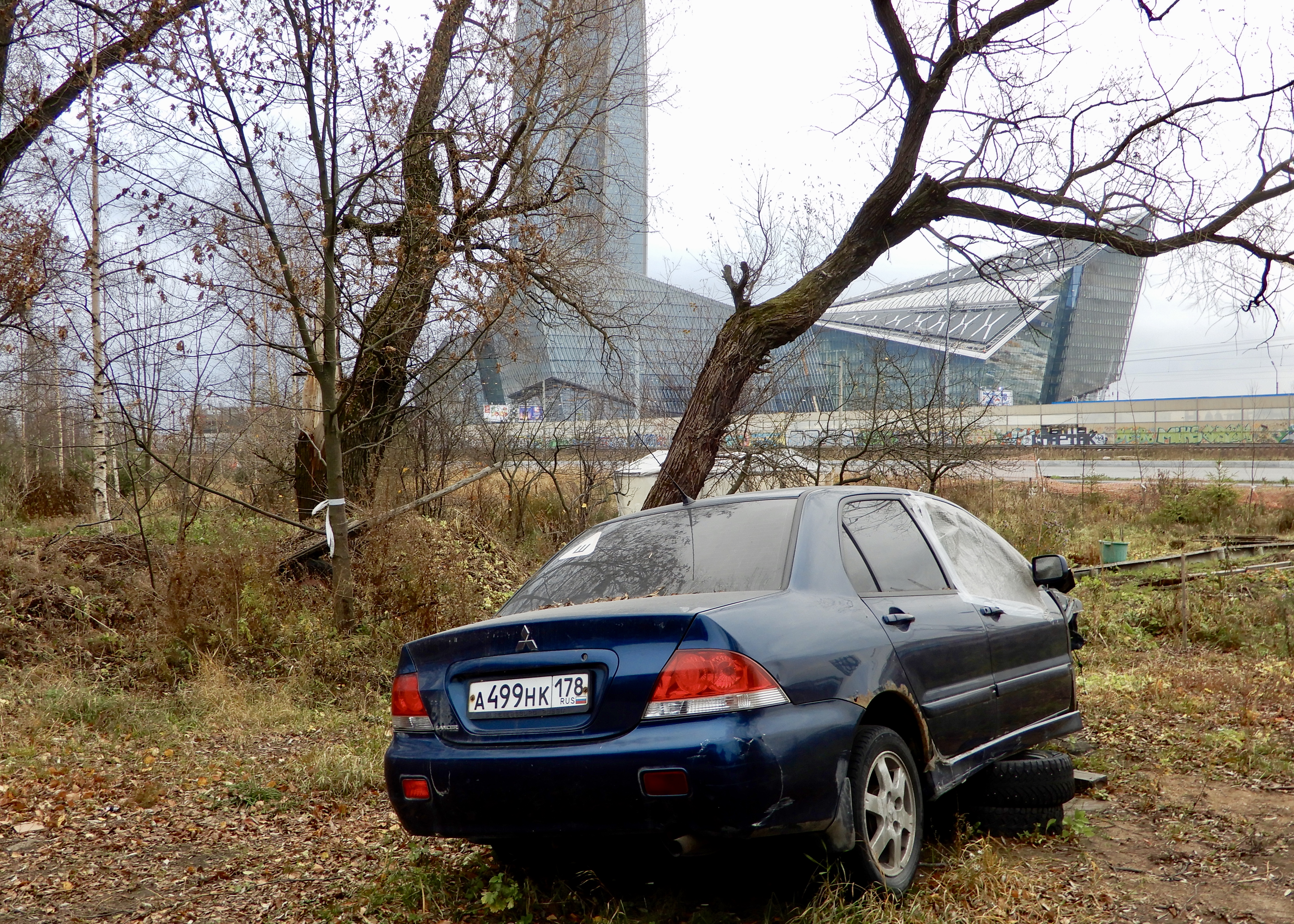
Photo and translation by the Russian Reader

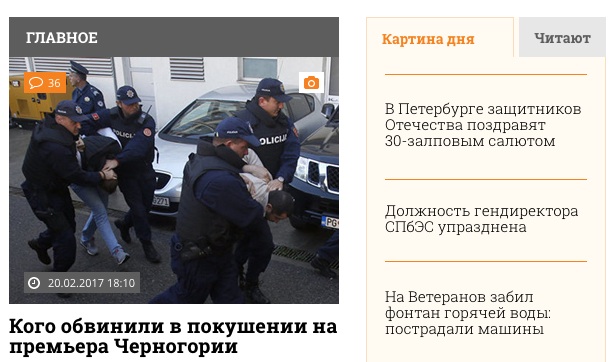
Defenders of the Fatherland

fatherland-defenders

Front page of St. Petersburg news website Fontanka.ru on the morning of 21 February 2017. The lead story is headlined, “Who Is Accused of Attempting to Kill Montenegro’s Prime Minister?” On the other hand, today’s most popular story is, allegedly, “Defenders of the Fatherland to Be Congratulated with a 30-Gun Salute.”

_________________

Russia law on killing ‘extremists’ abroad
Steven Eke
BBC News
27 November 2016

A new Russian law, adopted earlier in the year, formally permits the extra-judicial killings abroad of those Moscow accuses of “extremism”.

In the wake of the death of ex-spy Alexander Litvinenko in London, the Sunday Telegraph has alleged that Russian spy agencies – “emboldened” by the new law – have carried out a number of such targeted killings.

In July, the upper chamber of the Russian parliament – the Federation Council – approved a law which permits the Russian president to use the country’s armed forces and special services outside Russia’s borders to combat terrorism and extremism.

At the same time, amendments to several other laws, governing the security services, mass media and communications, were adopted.

The overall result was to dramatically expand those defined as terrorist or extremist.

Along with those seeking to overthrow the Russian government, the term is also applied to “those causing mass disturbances, committing hooliganism or acts of vandalism”.

Much more controversially, the law also defines “those slandering the individual occupying the post of president of the Russian Federation” as extremists.

Specific law

Russian lawmakers insisted that they were emulating Israeli and US actions in adopting a law allowing the use of military and special forces outside the country’s borders against external threats.

But the Russian law is very specific in that it permits the president – alone, and apparently without consultation – to take such a decision.

The only proviso is that he must inform the Federation Council within five days.

At the same time, he is not obliged to disclose the location of the operation, which units are involved, or the timescale for its execution.

Memorial, one of the oldest and most-respected Russian human rights groups, reacted strongly to the new law.

In an open letter addressed to Vladimir Putin, it accused the Russian leader of sanctioning extra-judicial executions.

It said the country’s “highest leaders” had turned a blind eye to the activities of “death squads” in the North Caucasus for some years. And, it predicted, with the adoption of the new law, those activities would now be seen in other countries too.

‘Poison umbrella’

The case of Mr Litvinenko has led to an outpouring of conspiracy theories, many of which suggest he was killed by a Russian secret service, of which there are several.

But in reality, there have been only a very small number of killings by poison of Russia’s opponents abroad.

Indeed, the last known case abroad of this type of execution was of Georgi Markov, the Bulgarian dissident assassinated by “poison umbrella” in London in 1978.

Many years later, during the perestroika era, a retired KGB general admitted that he had provided the toxin.

Such events were, however, widespread inside the Soviet Union during the terror of the 1930s to 50s.

The 1958 trial of Pavel Sudoplatov – a lieutenant general in the Soviet secret service, who was closely involved in the execution in Mexico of Trotsky – heard how toxins were “illegally tested” on a large number of prisoners who had been sentenced to death.

In more recent years, there is convincing evidence that an extra-judicial killing was carried out by Russian special forces in Qatar in 2004 when the former Chechen separatist president, Zelimkhan Yandarbiev, was blown up by a car-bomb.