
Source: “The World in Brief,” The Economist, 15 February 2025
Today, there was one happy man in the Kremlin. Vladimir Putin banked his legacy on an all-out war that, at one point, looked all but lost for him. But he waited long enough to see the tides change in his favor.
Three years in and hundreds of thousands of deaths after, the U.S. president is calling Putin, offering peace talks on Russia’s terms.
Hi, my name is Oleksiy Sorokin, I’m the deputy chief editor of the Kyiv Independent, and this is the latest issue of our Russia-themed newsletter.
Today we will talk about how Russia is about to win the war.
It’s a topic of debate when authoritarian Russia began morphing into a totalitarian state, but Feb. 24, 2022, is a point that finalized this transformation. A point of no return.
The all-out war was supposed to be quick. It was supposed to be a victory of a new world order and of a new Russia, once again a force that would decide the fate of the world, a force that people would fear.
Taking Kyiv, installing a new Russian-controlled government, and forcing Ukraine to recognize Crimea, Donetsk, and Luhansk as Russian was to be achieved within months, if not days.
The country Putin attempted to subjugate, however, was fiercely resisting. Something that Russian political and military leadership didn’t expect and didn’t prepare for.
Yet, over and over, Russian President Putin was bailed out by the West.
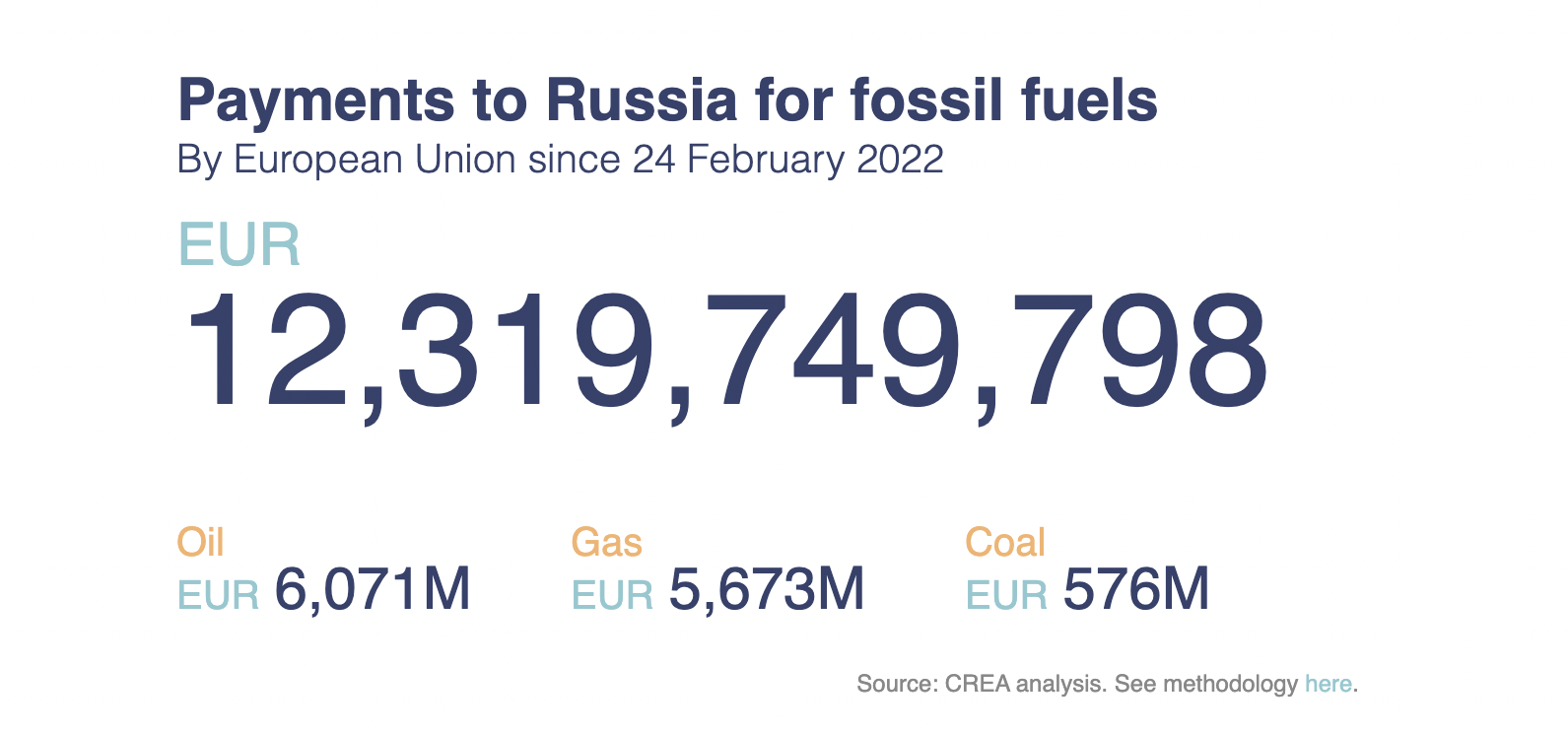
In 2022, Russia was making fortunes on selling off its energy resources to the West. When Russian troops were murdering civilians of Mariupol and nearing Kyiv, Moscow’s war chest was being replenished by Europeans.
The slow phasing out of Russian energy resources in the West allowed Russia to iron out its pivot to the East, building a formidable shadow fleet to transport its energy resources to anyone willing to buy.
When Russia began to lose ground and prepare for a Ukrainian counteroffensive, the U.S. was slowing down military shipments, giving Moscow further breathing room.
Seeing that the West was unwilling to support Ukraine to the fullest and was willing to allow Russia to continue, Russia, well, continued.
Russian leadership doubled down, increasing attacks on Ukraine, making committing war crimes a state policy, and simultaneously choking all forms of dissent at home.
Ukrainian civilians and prisoners of war were tortured and often murdered, and children from occupied territories were abducted.
Domestically, Russia outlawed speaking against the war, with people receiving hefty prison terms for criticising the invasion.
For the majority, however, the state made sure their economic well-being and daily routines remained unchanged, allowing ignorance to flourish. The Russian economy was doing fine.
All this made Putin confident. He knew that time played in his favor. The U.S. would surrender, and Europe would be in no position to object. He was right.
While on the campaign trail, Donald Trump had made it clear that he has little interest in continuing to support Ukraine’s fight against Russia.
His comments of ending the war in “24 hours” were a figure of speech, but it was clear that some sort of peace plan would be presented by the incoming administration.
Russia listed its demands, Ukraine listed theirs. Both waited. The fighting went on along the front line.
Russia was in a better position to negotiate. The West’s unwillingness to truly stop Russia, especially if it meant causing any sort of inconvenience at home, allowed it to regroup and begin a major offensive, ongoing to this day.
What came next was too good to be true… for Russia.
On Feb. 11, U.S. Defense Secretary Pete Hegseth began his European tour. Off the bat, he made public the U.S. position concerning the upcoming peace talks.
Hegseth said, “Returning to Ukraine’s pre-2014 borders is an unrealistic objective,” and that NATO membership for Ukraine is not an option, effectively agreeing with Russia’s demands.
Then, Trump called Putin.
“We both reflected on the great history of our nations and the fact that we fought so successfully together in World War II, remembering that Russia lost tens of millions of people,” said Trump following the call, parroting the Kremlin’s favorite line of the huge sacrifice Russia undertook in a war that ended 80 years ago, and how it is for whatever reason relevant today.
“As we both agreed, we want to stop the millions of deaths taking place in the war with Russia/Ukraine. President Putin even used my very strong campaign motto of ‘common sense’,” Trump added.
“We agreed to work together, very closely, including visiting each other’s nations. We have also agreed to have our respective teams start negotiations immediately, and we will begin by calling President Zelensky of Ukraine, to inform him of the conversation,” he went on.
The next day, Trump proposed to return Russia to G7, the intergovernmental political forum of the most developed democratic countries from which Moscow was kicked out following the start of its war in 2014.
Russian officials and pro-war public figures were openly excited about Trump’s moves.
“The movement that has begun is the result of the heroic work of our fighters and the principled position of Vladimir Putin, who speaks of openness to negotiations but firmly defends Russia’s national interests,” said lawmaker Evgeniy Revenko, deputy head of Putin’s United Russia party.
“Zelensky’s days are numbered, and Trump’s arrival at the Victory Parade in Moscow no longer seems like a fantasy,” he added.
“The phone call between Putin and Trump will go down in the history of world politics and diplomacy. It is not a breakthrough yet, but perhaps the first step towards one. I am sure that in Kyiv, Brussels, Paris, and London, they read Trump’s lengthy commentary on his conversation with Putin with horror and cannot believe their eyes,” said Russian Senator Aleksey Pushkov.
I can’t believe I’m saying this, but I agree with Mr. Pushkov.
Following the call, the Kremlin said, “We, of course, understand that our main counterpart in this process is Washington.”
And here we are today. It took three years, but Russia is where it wanted to be from the start — at a table with the U.S. deciding the fate of the world without the world’s consent.
Putin will push for more, seeking to squeeze the most out of Washington, and give nothing in return.
Russia would demand to keep the territories it controls, and most likely try to take the ones it doesn’t. According to Russia’s new constitution, Russia sees Ukrainian Crimea, and four oblasts — Donetsk, Luhansk, Zaporizhzhia and Kherson — as its own. Russia doesn’t have full control of any of the four.
With NATO off the table, other demands might be thrown at Trump, reducing Kyiv’s army or legalizing Russian language and influence in Ukraine.
Whether the U.S. will agree, and most importantly, whether Kyiv and the EU will go by the agreements that Moscow and Washington are set to achieve behind their backs, remains to be seen. There’s a strong chance that they won’t.
But overall, the sun is now much brighter for Putin than it was just a few days ago.
Eleven years of fighting against Ukraine, three years of all-out war and thousands of war crimes committed, Putin isn’t a pariah anymore. His worldview is on track to become mainstream, and it’s the leader of the free world who is leading him back to the table.
Source: Oleksiy Sorokin, “WTF is wrong with Russia” (newsletter), Kyiv Independent, 13 February 2025
In this week’s bulletin: Russia used US banks to dodge sanctions/ Private military companies at war/ Crimean 2024 human rights report/ Further evidence of Russian torture, execution of prisoners, fabrication of evidence and withholding of medical aid in occupied areas/ New wave of detentions in Crimea/
News from the territories occupied by Russia:
Young people who have quit the occupied areas: “It’s like being freed from a horrible stench” (Ukrainska Pravda, 9 February)
Stadiums under occupation: sports facilities in Donbas today (Ukrainska Pravda, 7 February)
Russia uses medical torture to fabricate its ‘trial’ of disabled 74-year-old Volodymyr Ananiev (Kharkiv Human Rights Protection Group, February 7th)
Russians refuse to sell insulin and other vital medicines to Ukrainians without Russian passports, reports Ukrainian intelligence (Ukrainska Pravda, February 7th)
How can Ukraine solve the problem of documents from the occupied territories? Human rights defenders share their vision with international partners (Zmina, February 7th)
A janitor, a cook, an informer — who is being tried for collaborating with the enemy? (Kharkiv Human Rights Protection Group, February 6th)
Russian FSB carry out new terror raids and arrests by quota in occupied Crimea (Kharkiv Human Rights Protection Group, February 6th)
Human rights and humanitarian legal norms: 2024 review (Crimea Human Rights Group, 5 February)
Viktor Dzytsiuk was almost tortured to death in occupied Donbas. Now Russia is continuing his torment (Kharkiv Human Rights Protection Group, February 5th)
ZMINA took part in a discussion on the cultural decolonisation of Crimea (Zmina, February 4th)
Russian FSB uses shoddily faked video to charge 63-year-old woman abducted from occupied Ukraine with ‘terrorism’ (Kharkiv Human Rights Protection Group, February 3rd)
First prosecution in Crimea for “childfree propaganda” (Crimea Human Rights Group, 2 February)
The situation at the front:
Russian forces advance on Pokrovsk (Meduza, 5 February)
News from Ukraine – general:
Support for war victims: human rights defenders presented new roadmap of draft laws (Zmina, February 5th)
Defying Odds In Ukraine (They Said So, February 4th)
Ukrainian Holocaust survivor: Hitler wanted to kill me as a Jew. Putin is trying to kill me because I’m Ukrainian (Kharkiv Human Rights Protection Group, February 3rd)
How Ukraine lost faith in the Red Cross and UN (Kyiv Independent, January 22nd)
Ukraine: Bikis, our feminist year (Europe Solidaire Sans Frontières, January 20th)
Ukraine: And yet he remained a human (Europe Solidaire Sans Frontières, January 4th)
War-related news from Russia:
Draft exemptions as Russians know them are ending (Meduza, 6 February)
Rebranding private military companies for the war in Ukraine (Posle.media, 5 February)
Support fundraisers for Solidarity Zone’s recipients in court (Solidarity Zone, 5 February)
Russia used US banks to send billions to Turkey, dodging sanctions (Kyiv Independent, February 3rd)
The Russian far right: “an affinity for violence brings them together” (Posle.media, 29 January)
Analysis and comment:
US Aid, Russia and Ukraine (The Russian Reader, 4 February)
A girl from the burnt village: the story of Maria Nevmerzhytska (Commons.com.ua, 3 February)
Statement by human rights organisations: another wave of searches and detentions of Crimean Tatars (Crimean Human Rights Group, 2 February)
Research of human rights abuses:
Prison medicine: ways to humanize it (Kharkiv Human Rights Protection Group, February 7th)
UN monitors report sharp increase in executions of Ukrainian POWs, and point to Russian officials’ effective incitement to kill (Kharkiv Human Rights Protection Group, February 7th)
The Centre for Civil Liberties Participated in the First World Congress on Enforced Disappearances (Centre for Civil Liberties, February 6th)
“I Urge You to Make Every Effort to Release Ukrainian Prisoners of War And Unlawfully Detained Civilians ” Maksym Butkevych at the UN Security Council (Centre for Civil Liberties, February 6th)
“Crimes Against Peaceful Civilians Warrant Your Action” The Center for Civil Liberties Appealed to PACE Members (Centre for Civil Liberties, February 6th)
Upcoming events:
Saturday 15 February, 11.0 am — 4.0 pm, Conference: End the Russian invasion and occupation. National Education Union, Mabledon Place, London, WC1H 9BD. Register here.
Saturday 15 February, 11.0 am – Palestine solidarity demo. To join the Ukraine-Palestine solidarity contingent, with our banner, “From Ukraine to Palestine – Occupation is a crime”, meet outside Banqueting Hall, corner of Whitehall and Horseguard Avenue, London SW1A
Saturday 22 February, 12.00 , Demonstrate at the Russian embassy. Assemble 12 noon – St Volodymyr statue, W11 3QY Rally 1pm – Russian embassy, W8 4QP. Flyers are available for distribution – email info@ukrainesolidaritycampaign.org and ask for them.
==
This bulletin is put together by labour movement activists in solidarity with Ukrainian resistance. To receive it by email each Monday, email us at 2022ukrainesolidarity@gmail.com. To stop the bulletin, reply with the word “STOP” in the subject field. More information at https://ukraine-solidarity.org/. We are also on twitter, Bluesky, Facebook and Substack, and the bulletin is stored online here.
Source: News from Ukraine Bulletin 133 (10 February 2025)
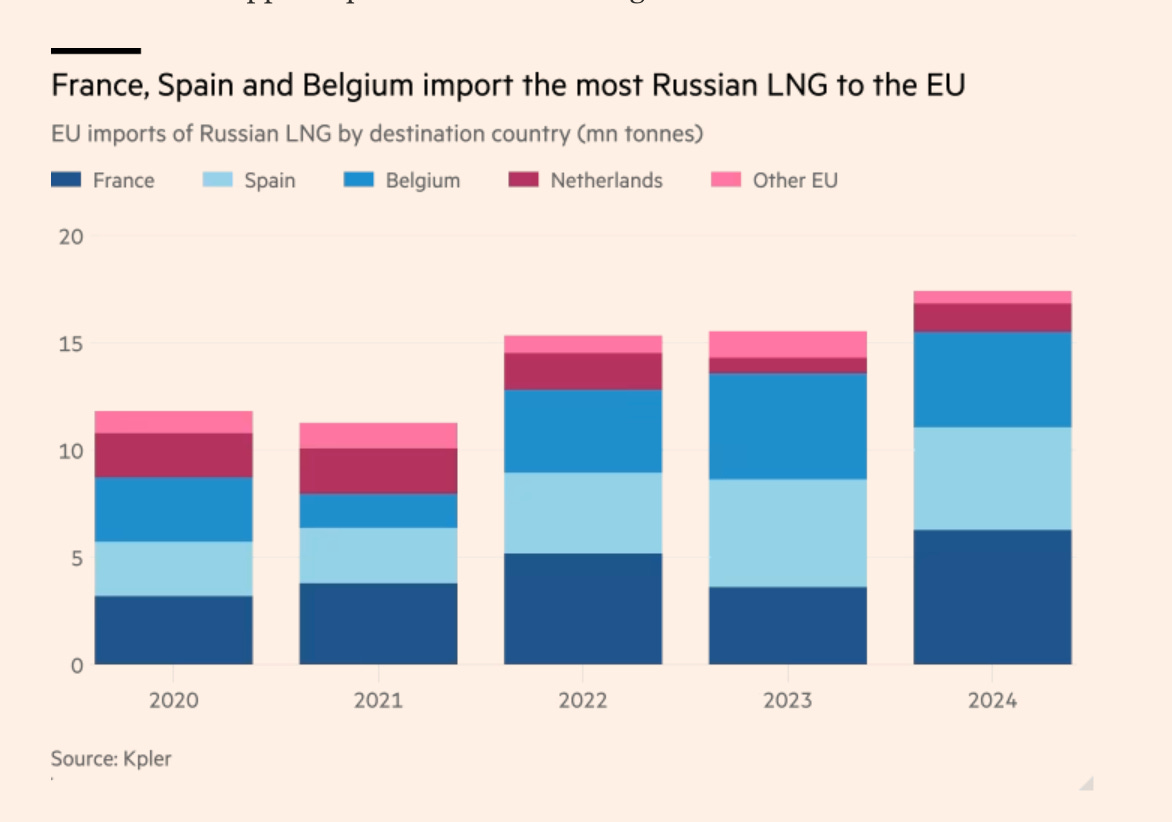
Europeans still like cheap Russian LNG
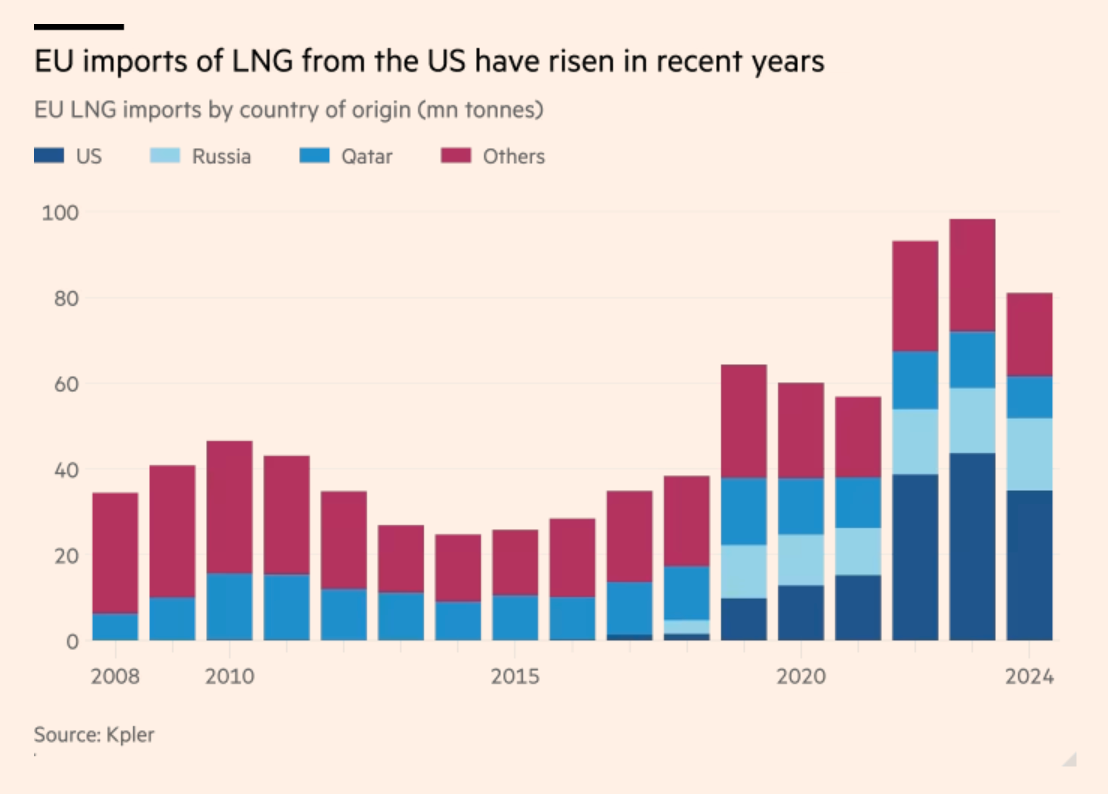
France, Spain and Belgium are the biggest buyers
Source: FT
Russia’s full-scale invasion of Ukraine in 2022 prompted a refugee crisis in Europe. News footage showed people piling onto trains and into cars, desperate to escape the threat of bombs and Russian occupation. In Kharkiv, a taxi driver named Sergii told me how in those chaotic early days of war, he had helped evacuate people as Russian missiles turned his bustling neighbourhood of Saltivka into a ghost town.
“I survived by praying to God,” Sergii said, pointing to the icon of the Virgin Mary dangling from his cab’s rearview mirror. “I helped people with no money get out of Saltivka, because people with money had already left.” He narrowly avoided death himself, he added, explaining a rocket had destroyed his apartment as he went out to his cab to retrieve the mobile phone he’d left on the front seat.
Nearly seven million people have now fled Ukraine. The majority have settled in European countries, many of which responded to the war by waiving visa requirements for Ukrainian refugees. Around 250,000 came to the UK, which decided not to fully lift restrictions but to instead introduce two emergency visas: the Ukraine Family Scheme and the Homes for Ukraine scheme.
At their outset, both visas granted Ukrainian nations the right to live, work and study in the UK for up to three years. Now, as the third anniversary of Russia’s invasion rolls around, anybody who arrived in the early days of the war is about to see their right to remain expire.
Yet this week, many Ukrainians faced the prospect that they may never be able to return to their homes. US President Trump announced he had spoken to his Russian counterpart, Vladimir Putin, to begin peace negotiations that risk handing over occupied regions of Ukraine to Russian control.
Residents of Ukrainian towns and cities previously liberated from Russian control, such as Bucha and Izium, have spoken about the reign of terror and cruelty they endured under occupation, including torture, rape, summary executions and false imprisonment. Should the peace deal go ahead on Putin’s terms, Ukrainian refugees in the UK face an increasingly uncertain future, with those whose homes are in the occupied territories potentially unable to return.
But even before the announcements from the White House and the Kremlin, the UK’s visa schemes have long presented problems for the vulnerable Ukrainians they are supposed to support.
“Before the full-scale invasion, I had a normal life,” Nastya*, aged 24, told openDemocracy “I worked in a supermarket and a fabric factory. Everything was absolutely good. And then on 22 February 2022, the war started.”
At the time, Nastya lived in Uzhorod, a city near the Slovakian border. As missiles battered the country’s major cities and the Russian forces occupied cities such as Izium and Mariupol, committing war crimes in Bucha and Irpin, she decided to flee with her husband.
“It was a stressful time,” she admitted. “I did not know what the future would be and my family were scattered around the world, some in England, some in Germany and some in Ukraine.”
Nastya and her then-husband travelled to Germany, where her mother was living, before coming to the UK on the Ukraine Family Scheme in August 2022. “It was hard to get a job in Germany, especially as I don’t speak German,” she explained. “I didn’t want to live on benefits, I wanted to support myself and live independently. I had heard in the UK there were opportunities for work, so I relocated.”
Nastya and her husband’s visas took only a few days to be approved, and the pair moved in with her sister-in-law in Leeds, where Nastya found a job in a local factory. “The work was hard and physical with lots of heavy lifting but I was earning some money which is good,” she said.
After three months in the UK, Nastya discovered she was pregnant with her first child. It was happy news, but it came as her marriage was falling apart. “It was quite difficult,” she said. ‘My husband was very sad and there were a lot of horrible moments. I decided to separate from him and go to Germany to be with my mother to have the baby.”
Nastya gave birth to a beautiful baby girl, who shares her bright brown eyes and dark hair. While she had wanted to be with her own mother during the birth, as a newly single mum Nastya was keen to return to the UK, where her father and grandmother were living, to get a job, support her daughter, and start a new life.
She had assumed that as she had the right to live and work in the UK, her daughter would be able to join her on the same family visa scheme.
But what Nastya did not realise is that while she was caring for her newborn in Germany, the Conservative government had been quietly restricting Ukrainians’ right to enter the UK. The family visa scheme had been closed and Ukrainians were no longer allowed to sponsor fellow refugees to arrive on the Homes for Ukraine visa.
Now, if Nastya wanted to come to the UK, she would have to leave her daughter behind.
War in Europe
When the Homes for Ukraine scheme was launched in 2022, members of the British public could open their homes to Ukrainian refugees in exchange for an initial monthly payment of £350 from their local council, while Ukrainians who successfully applied for the scheme were granted the right to live, study and work in the UK for three years.
But in February 2024, the then-Tory government brought in a series of changes. It halved the length of time a new Ukrainian applicant would be able to stay in the UK to 18 months, and amended the rules so that only people with British citizenship can sign up to become hosts. At the same time, it cancelled the family visa scheme, meaning Ukrainian nationals living in the UK can no longer sponsor family members to join them.
These changes have effectively made it impossible for Ukrainian nationals in the UK to help loved ones to settle here to escape the war. Now, Ukrainians wanting to come to the UK are reliant on there being an available British citizen who will take them in. But this, too, has suffered changes that have made it a less appealing prospect for many hosts.
In November, the Labour government announced all British citizens signed up to the Homes for Ukraine scheme will be paid £350 a month, regardless of how long they have been hosting. Households who have been hosting for more than a year are currently paid £500 a month.
Even before this announcement, the number of hosts was in decline, according to openDemocracy’s analysis of government data. In the third quarter of 2023, 100,061 households in England received the monthly ‘thank you’ payment, but by the third quarter of Q3 2024, this had fallen to 48,533 households, the lowest number since the full-scale war began.
This decrease in hosts was also apparent in our review of Homes for Ukraine Facebook pages. While at the start of the war, posts from Ukrainians looking for sponsors received multiple comments from potential hosts, these days they often garner no responses or are met with ‘jokes’, with one commenter saying: “I’d rather be in Mykolaiv than London”. Others respond telling those who wish to relocate to the UK from another European country, like Nastya, that the scheme is not for them: “People in the UK would prefer to sponsor people who are in Ukraine and need to be saved from war.”
“Instead of putting more and more administrative barriers in front of people fleeing war, the UK government must show it can match the solidarity and empathy shown by the people of the UK,” said Alena Ivanova, committee member of the Ukraine Solidarity Campaign, which is organising a march to the Russian embassy in London to mark the third anniversary of the full-scale invasion.
“We know that the vast majority of Ukrainians in the UK are vulnerable women, small children and elderly people who carry significant trauma as a result of Russia’s brutal war. The least we as a country can do is not put them further at risk and increase their anxiety but help them settle and rebuild their lives,” Ivanova added.
Those who arrived in the UK through either the Homes for Ukraine or Ukraine Family Visa scheme in the early days of the war are about to see their right to remain expire. But with the conflict ongoing, they can extend their visas via the Ukraine Permission Extension Scheme.
While this extension is undoubtedly needed, the process for obtaining it is fraught – and may put vulnerable people at risk of falling out of the system.
People needing an extension can apply only when they have 28 days or less left on their right to remain, which may impact their ability to work or be housed, with landlords and employers nervous about accepting Ukrainians who may not have the legal right to be in the country. Those who miss the extension window are at risk of becoming undocumented and therefore will be considered to be in the UK illegally. Although the war means it is unlikely these people will be deported, they would be unable to work or access housing, and are at risk of being removed in the future.
And applications for extensions can only be made from within the UK – a problem for women like Nastya in Germany, or for anyone visiting family in Ukraine.
Polling by the Office for National Statistics found that while the majority of Ukrainians are aware of the visa changes and the need to apply for an extension, a small minority of mainly vulnerable refugees, such as the elderly or young, are not.
Uncertainty is also built into the extension scheme. People will be able to extend their right to stay in the UK by only 18 months, half the three years they were initially granted. If they stay for the full term, a Ukrainian refugee’s total residency in the UK will have been four and a half years – six months short of the five years that a person must have continuously lived here to be eligible for the right to settle permanently.
There is also uncertainty for those British nationals hosting Ukrainians. If their guest is granted an extension, their host will need to reapply for thank you payments.
openDemocracy asked the UK government how it plans to deal with the temporary nature of the visas should the conflict continue for another 18 months. We also asked what plans they have in place should a peace deal cede Ukrainian territory to Russia, with those fleeing the occupied regions unable to return home. They did not respond.
‘I feel loneliness’
Nastya had always planned to return from Germany to the UK with her daughter. Here, she could work and have her own home where she, her daughter and her new partner, who is also Ukrainian, could live as a family.
Now, the changes to the visa schemes have cut her and her daughter off, leaving her living in limbo. She and her daughter face a choice: living in Germany where she struggles to find work and faces eviction from her refugee accommodation in the coming year, or returning to Ukraine which endures daily bombardment by Russian bombs and drones.
“In Germany, I face going into a refugee camp, which is no place to raise a child,” Nastya warned. “My mother lives in a separate city and so we cannot see each other regularly.”
Worse, the heartbreak of being separated from her father and grandmother has been devastating.
“They have never had the chance to meet their granddaughter and great-granddaughter,” she said, the pain of separation clear in her voice. “I have not been in touch with them face to face, and they would really like to meet. I want to see my father and grandmother and it is impossible.”
The changes to the visa schemes have left women like Nastya experiencing a double displacement. First, the full-scale invasion forced them from their homes in Ukraine. Now, changing government policy has separated them from family members in the UK.
“I have cried a lot,” said Nastya. “I feel loneliness, it is so hard that I can’t put it into words. I am crying a lot but I don’t want to blame anyone. If I would receive a visa for my daughter it would be really nice and I would be able to meet my family.”
Nastya has some hope. Last month, the Labour government partially reversed the changes made by the previous administration, allowing Ukrainians to bring their children to join them in the UK, a change described as a “welcome step in the right direction,” by Mubeen Bhutta, British Red Cross director of policy, research and advocacy. The charity has supported Nastya and her family.
“Our teams have supported people who had been unable to reunite with young children,” she said. “We’ve seen their pain and suffering and know this will mean a lot to families who have been torn apart. However, even with these changes many family members will remain separated.
“It is still very difficult for displaced Ukrainians to help elderly parents or partners find safety in the UK. It is vital that the government addresses these obstacles and helps more Ukrainians reunite with their loved ones.”
Nastya, who has a legal right to be in the UK, can now apply for an extension and for her daughter to join her. Her partner, however, must find a British national to sponsor him.
“It is really hard to be a refugee,” she said. “It is impossible to see a future for Ukraine. It would be really nice to go to the UK to work, to rent a flat, to pay taxes. This is what I need, simple things to be satisfied. I want my daughter to be happy, to have a good education.”
*Names have been changed to protect identity