The incident involving Lucia Timofeyeva (pictured) took place in an Omsk city jitney. Photos courtesy of Oleg Malinovsky and Lucia Timofeyeva. Courtesy of NGS55.ru
Male Jitney Passenger Hits Female Pensioner on Head for Speaking Her Native Language He rudely demanded that the woman speak Russian, and when she refused, he punched her NGS55.ru
September 24, 2020
On September 21, 66-year-old Lucia Timofeyeva was going home on the No. 51 jitney in Omsk. The ethnic Tatar woman was talking on the phone in her native language with a friend. But the ethnic Russian man seated behind her didn’t like it.
“I was talking calmly and quietly, my back turned to the window. I was talking to an old woman, and since she couldn’t hear well, maybe sometimes I spoke louder, I don’t know. The man tapped me on the shoulder, roughly, and said, ‘Either speak Russian or shut up!’ He was a tall palooka. I looked at him and said, ‘Go to hell! Why can’t I speak my own language?’ started talking again. He hauled off and punched me in the head. He was wearing knuckledusters probably because there is a bruise on my head and it still hurts,” the pensioner told NGS55.ru.
Timofeyeva threatened to report the man to the police, but he got up from his seat and was ready to continue the dust-up. Frightened, the woman decided to calmly travel to her stop. However, the aggressive man got out of the bus with her. She recognized her assailant as a forty-year-old gardener at the local gardening co-op.
“My relatives decided that we should not the matter go. I wanted to calm down, though. My daughter took me to the police, and they took my statement, but told me to wait until the district police officer returned from sick leave. I still need to gave my injuries officially certified. I have a bruise. It hurts especially when I comb my hair,” the woman said, adding that her family wanted to deal with the assailant themselves, but she dissuaded them, hoping for a legal resolution to the situation.
The press service of the interior ministry’s regional office confirmed to NGS55.ru that Lucia Timofeyeva had given them a statement.
The woman added that she had never been in such situations in her life, nationalism was alien to her, and she had had an ethnic Russian husband. All she wants from the man who assaulted her is for him to admit his guilt and apologize to her. So far, however, he has not taken any action.
“I sometimes get on the bus and Caucasians and Armenians are speaking their own languages. Would he have said anything to them, I wonder? I don’t think so. He would have kept his mouth shut. But he was quick to raise his hand against a woman,” she noted.
Thanks to Elena Vilenskaya and RFE/RL for the heads-up. Translated by the Russian Reader
Report to UN on Racial Discrimination in Russia Banned Takie Dela
August 17, 2017
Russian federal media watchdog Roskomnadzor has placed a report to the UN on racial discrimation in Russia on its list of banned information, reports the SOVA Center.
In June 2015, the Yelniki District Court in Mordovia ruled the report information prohibited for dissemination. On August 11, the page on the Human Rights in Ukraine website containing the report was registered on Roskomnadzor’s list of banned materials, reports SOVA.
“The ruling itself has not been published, and we are unaware of the court’s arguments. In order for a court to rule information prohibited for dissemination in Russia, it must contain matter previously deemed extremist by a court. Of course, the report on racial discrimination contained no such matter, so it is completely unclear in this case what triggered the lawsuit and the court’s ruling,” SOVA’s press service commented.
The report was compiled by the Memorial Human Rights Center with the assistance of twenty-five Russian NGOs involved in counteracting racism and discrimination. It was submitted to the UN Committee on the Elimination of Racial Discrimination.
The report discusses the discrimination or promotion of discrimination against Meskhetian Turks, Chechens, and Romani. It also criticizes Russian authorities for insufficient efforts to counteract discrimination and creating appropriate mechanisms for counteracting discrimination.
In 2016, the Russian Federal Justice Ministry declared SOVA Center a “foreign agent.” SOVA Center staff do not consider their work political, the alleged determining criterion for ruling a Russian NGO receiving foreign funding a “foreign agent.”
Thanks to Maria Turovets and Mari Davtyan for the heads-up. Translated by the Russian Reader
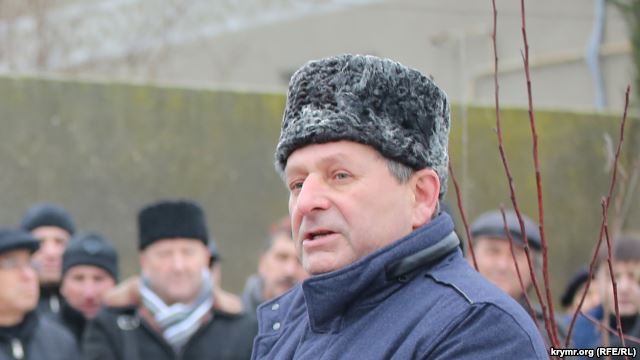
Ahtem Chiygoz, a member of the Mejlis of the Crimean Tatar People who has spent the last year and a half in jail on trumped-up charges of “organizing rioting” and “destruction of property.” Photo courtesy of 112 UA and RFE/RL. See the second article, below, for details
FADN Called on to Protect Ethnic Russians
Irina Nagornykh Kommersant
July 27, 2016
Nine percent of Russian citizens feel they are discriminated against ethnically. In some regions, for example, Tuva, such citizens constitute as many as twenty-six percent, and they hail from the Russian-speaking population. These figures were arrived at by pollsters commissioned by the Federal Agency for Ethnic Affairs (FADN), Igor Barinov, the agency’s head, said yesterday at the Terra Scientia camp. Barinov promised to protect the ethnic Russian population in such regions, and said next year the agency planned to earmark 170 million rubles [approx. 2.3 million euros] on grants for projects in the field of interethnic relations.
Barinov cited the results of a сlassified Georating survey conducted by the Public Opinion Foundation (FOM) while speaking to young people at the Terra Scientia Russian Education Youth Forum on the Klyazma River on the last day of a session that brought together young experts in the field of interethnic relations. According to Barinov, the poll was conducted in June at the FADN’s behest. Pollsters discovered that, on average nationwide, nine percent of the population experienced ethnic discrimination. In certain regions, however, such as Karachay-Cherkessia and Tuva, the situation was more tense. In Tuva, twenty-six percent of citizens complained of ethnic discrimination.
According to Barinov, the number coincided with the number of Russian speakers resident in Tuva, which means we can assume it was this segment of the population who felt they were ethnically discriminated against. Barinov was asked who would protect the interests of ethnic Russians. According to some young people in the audience, ethnic Russian were not as well organized in defending their interests as other ethnic groups in Russia. Barinov cited the fact that 115 million ethnic Russians resided in the Russian Federation, which constituted eighty percent of the country’s population, and in places where the ethnic Russian population predominated, as in Central Russia, this assistance was social and economic in nature. But in regions like Karachay-Cherkessia and Tuva, he promised to protect ethnic Russians.
“We have the authority,” he stressed.
Responding to the same question, Magomedsalam Magomedov, who oversees ethnic relations in the presidential administration, said the “Russian people’s historical mission [was] to unite Russia’s ethnic groups,” and the outcome was the “emergence of a unique civilization whose national leader is President Vladimir Putin.”
“None of the ethnic groups in Russia can feel good if the Russian people feels bad,” concluded to Mr. Magomedov.
According to Barinov, next year the FADN plans to allocate around 170 million rubles on grants for projects in the field of ethnic relations.
“If everything is okay with the budget. We’re at the head of the Finance Ministry’s queue,” he added, reminding the audience that the FADN is awaiting the transfer of the part of the Federally Targeted Program for developing Crimea that concerns the rehabilitation of ethnic groups repressed during Soviet times.
Campers will receive several grants in the amounts of 300,000, 200,000, and 100,000 rubles to support existing interethnic policy projects in the country’s regions from the camp’s organizers: the Russian Federal Public Chamber, Rosmolodezh (Russian Federal Agency for Youth Affairs), and the presidential administration’s Office for Domestic Policy. Moreover, the FADN plans to summarized suggestions made by the campers on concepts for celebrating National Unity Day (November 4), including the brand Russian Braid, which would weave together all the peoples of Russia, comics about different ethnic groups on buses, video clips in airports, and the project Travel with Purpose, which would involve ethnic youth exchange tourism. Session participants plan to appeal to the present not to limit the celebrations to one day a war, but to declare an entire “year of national unity.”
Translated by the Russian Reader. Thanks to Sergey Abashin for the heads-up
________
Who Is Ahtem Chiygoz? The Story of a Crimean Tatar Political Prisoner
Ehor Vasylyev 112 UA
July 29, 2016
A Case That Will Last for Years
Ahtem Chiygoz was arrested on January 29, 2015, as part of the so-called February 26 case. That day he went to the State Investigative Committee in Crimea for questioning, and in the evening the illegitimate Kyiv District Court of Simferopol sentenced him to three months in police custody.
Chiygoz was charged under Article 212.1 of Criminal Code of the Russian Federation: organization of riots accompanied by violence and destruction of property.
Russia accuses activists of being involved in the “riots” on February 26, 2014, which arose near the Crimean parliament during two rallies, one held by the supporters of Ukraine’s territorial integrity , another, by activists of the party Russian Unity.
Since Chiygoz’s arrest, the Crimean courts have been periodically extending his time in police custody. (The last time it was extended until October 8, 2016.)
From March 8 to March 11, 2016, Chiygoz was a hostage: a so-called judge of the Crimean Supreme Court, Galina Redko, arbitrarily (extrajudicially) extended his time in jail.
In addition to Chiygoz, other Crimean Tatars have been charged with involvement in the “riots”: Ali Asanov, Mustafa Degermendzhi, Eskender Kantemirov, Arsene Yunusov, and Eskender Emirvaliev.
The first two have been in police custody for over a year. Another two men, Eskender Nebiev and Talat Yunusov, have already been convicted and sentenced to probation.
In February 2016, two years after the events, the court decided to re-investigate the case. Chiygoz, Asanov, and Degermendzhi were forced to remain in custody.
On July 20, the preliminary hearing began, but it was closed to the public. The Supreme Court of Crimea proposed to divide the case and try Chiygoz separately from the other defendants.
“There are 80 injured parties and witnesses: the case could drag on for years. The court usually questions one or two witnesses a day,” says one of Chiygoz’s lawyers, Emil Kurbedinov.
An Alien Land
Russian prosecutors accuse Ahtem Chiygoz of acts carried out in Ukraine by a Ukrainian citizen against other Ukrainian citizens. Russian prosecutors have prosecuted only Crimean Tatars.
The prosecution is trying to assert the right of the Russian justice system to react to the February 26 rally, which was allegedly directed against Russian interests. The prosecutor general says Russian Unity had a special permit for holding a rally, while the Mejlis did not have such a document.
In addition to violence during the riots, Chiygoz is accused of destruction of property.
“Unidentified Crimean Tatars rushed into the Crimean Parliament, damaged and destroyed its property in the amount of 9,730 rubles,” claims one of the court documents. However, a few hours after the incident, armed Russians occupied the Crimean Parliament and also damaged property.
Why Chiygoz?
“Ahtem Chiygoz at first took a moderately radical position. The prosecutor’s office called him a man ‘in charge of the Mejlis power bloc.’ In winter 2014, he openly expressed the quite radical position that we should not recognize anything,” noted First Deputy Chairman of the Mejlis Nariman Jalal.
In fact, Chiygoz’s position coincides with the opinion of Ilmi Umerov, who is known as an experienced, fairly moderate politician. Ilmi Umerov is quite close to Chiygoz. They both belong to the Bakhchisarai wing of the Mejlis.
“In 2014, we organized many pickets, along the roads, near the military units. Ahtem was actively involved in organizing these events,” says Umerov.
Chiygoz was warned about avoiding “extremist activity,” and some people even complained about him to the Russian FSB. However, Chiygoz did not stop his work, and a month before his arrest, he attended a meeting between Crimean leaders Mustafa Dzhemilev and Refat Chubarov and Ukrainian President Poroshenko.
“Chubarov had five deputies, and Ahtem was the main one,” Umerov explains.
Dzhemilev and Chubarov were refused entry to Crimea as a part of a Russian plan. The Mejlis should be headed by a collaborator. Ahtem Chiygoz was the main obstacle to implementing this plan.
“The Russians believed that Chiygoz encouraged them to rebel. That was why they decided to remove him. At the same time, Chiygoz has been a ‘show’ victim: do not stick your heads out, otherwise your fate will be the same,” stresses Nariman Jalal.
But the plans to co-opt the Mejlis have failed.
“It was a miscalculation. They thought Chiygoz was a kind of central link. They failed to realize the majority of the members of the Mejlis took the same position as Chiygoz; they did not want to be co-opted,” adds the First Deputy Chairman of the Mejlis.
Chiygoz called upon all Crimean Tatars to harshly boycott compatriots who collaborated with the occupying power.
“Different challenges have befallen our people. And we deal with them with honor! No one can break us with prisons or camps! We are not afraid of searches and arrests! We cannot be fooled by puppets! Crimea will never be without the Crimean Tatars,” Chiygoz has written from prison.
And his name is etched in gold in the history of Crimea.
The original of this article was published, in Russian, by Ukrainska Pravda. I have lightly edited the heavily abridged English translation, above, to make it more readable. TRR

 The incident involving Lucia Timofeyeva (pictured) took place in an Omsk city jitney. Photos courtesy of Oleg Malinovsky and Lucia Timofeyeva. Courtesy of NGS55.ru
  Screenshot from Roskomnadzor website