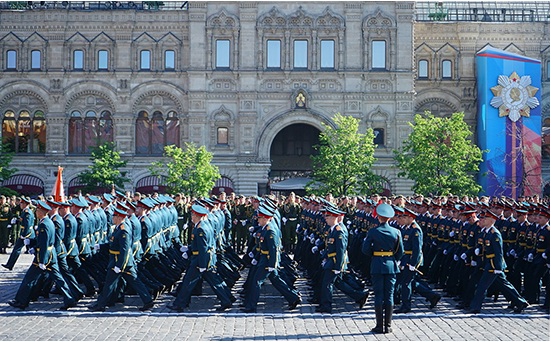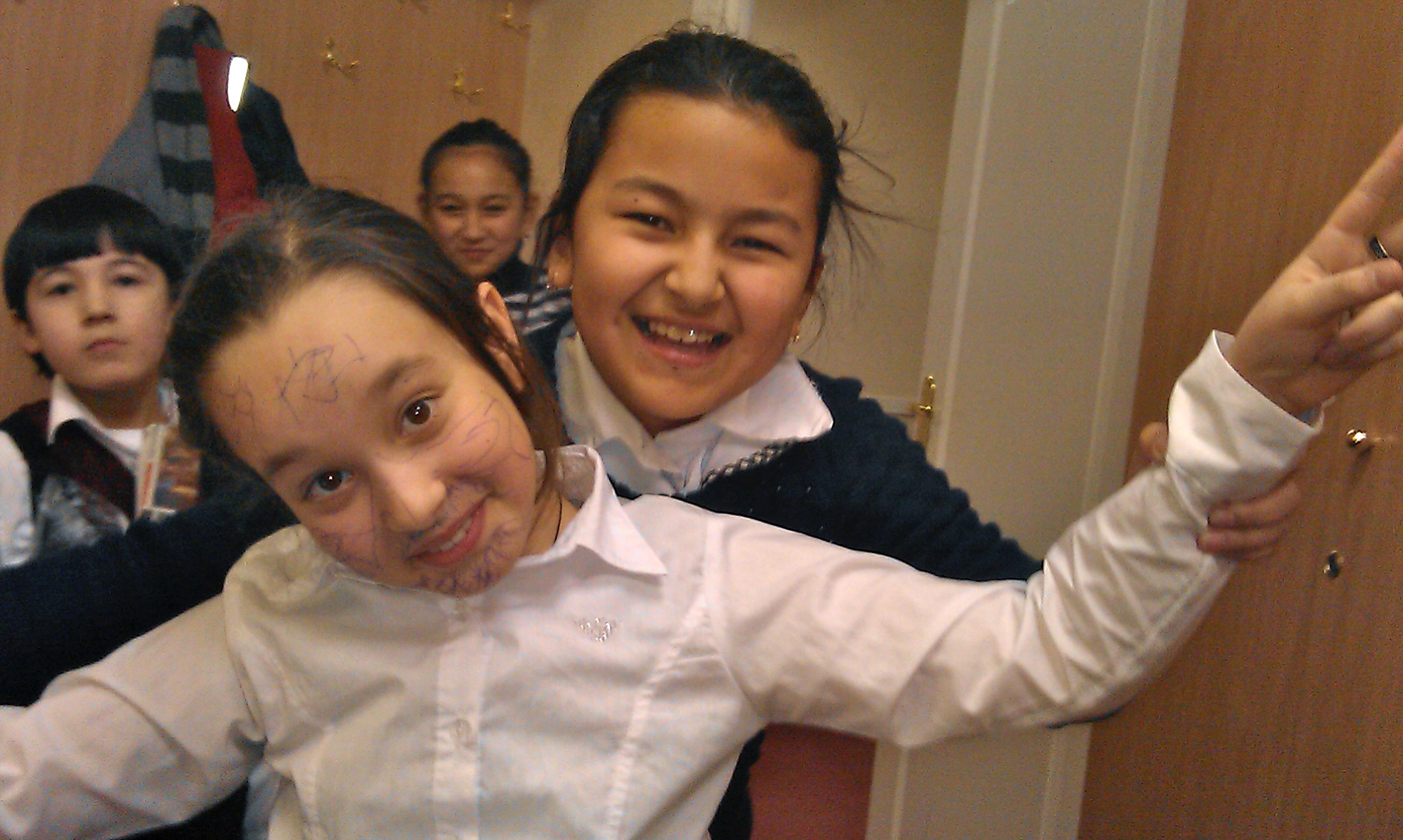
My pupils at the St. Petersburg Jewish Community Center’s RFL/RSL (Russian as a Foreign Language/Russian as a Second Language) program for immigrant children), 2016. This was the day we let our hair down. \\\ TRR
Living in circumstances in which evil is consciously perpetrated every day, it is difficult to keep getting bent out of shape over stupidity and injustice. This is also true of the new law prohibiting migrant children without a proficient command of Russian from attending school — a completely outrageous law that has caused little public outrage. I feel the need to write about it, and yet I sense the utter futility of arguing against it.
When I was at art school, we had our own local confrontation with the authorities: they dreamed of banning coil water boilers and other heating devices because they were a fire hazard. We dreamed of keeping them because of the fact that we were working in our studios late at night, which is inevitable if you are studying to be an artist. The authorities shamed us, they threatened us with expulsion, and they confiscated our boilers, but the boilers inevitably reappeared. This is an example of how you can’t solve a problem through bans without providing a solution. If the director, for example, had identified some place on the floor where water could be boiled, it is likely that many people would have stopped boiling water in their studios.
This applies to the populist bill as well. Teaching children who do not speak Russian is an actual problem. Our country has a rather complicated curriculum even in elementary school, which, of course, cannot be successfully navigated by someone who does not understand everyday vocabulary. I’ve been told that some teachers just give children plasticine out of hopelessness: if they’re sitting and molding things from playdough, at least they won’t be a bother to anyone else.
So here is a simple answer to this problem: let’s ban these children from going to school. They can go to school only after they have learned Russian.
The question immediately arises: where will they learn Russian? Do we have an extensive network of educational organizations with readymade programs (even ones for which parents would have to pay) for teaching Russian to children and teenagers, where they can be sent immediately after failing the language proficiency exam? No, there is no such network. Perhaps it will emerge one day, but it doesn’t exist right now.
But we have the know-how of other countries which have been trying to solve similar problems for a long time. We can choose something suitable based on foreign know-how, such as allocating extra classes, hiring visiting teachers, and instituting adaptation classes. But a ban is not a solution.
Besides, bans hit the most vulnerable groups the hardest. Loving parents will find a way to help their children with adaptation by paying for courses or tutors. Those for whom no one cares, those for whom school is the only chance to change their lives, will be left out. And it is not necessarily a matter of their turning to crime, although the rule that if you don’t want to invest in schools you’ll have to invest in prisons is inexorable. It will affect girls, for example: if they can read and write a bit (so the story goes) that’s enough for when they’re married.
Most importantly, children don’t choose to move to or choose a foreign country. It’s not their fault that they don’t know a new language. So why are you punishing them?
In fact, they are being punished for being newcomers, for being strangers. A clear xenophobic message is packed inside this entire caper: these migrants shouldn’t come to Russia, and if they do come (someone after all has to work for cheap), they shouldn’t drag their families here. Legislators are not worried about schoolteachers (who really do have it tough), but about smoking out all the “aliens” from our country. That’s how the matter actually stands. And that’s why all reasonable arguments are more or less useless.
Source: Natalia Vvedenskaya (Facebook), 12 December 2024. Translated by Thomas Campbell
Russia has banned children who do not speak Russian from being admitted to schools. This is a completely inhumane decision which could have terrible consequences.
For two years I taught Russian at the Russian Red Cross, where I had two groups of children and one group of adults. The adults were mostly women from Syria, Afghanistan, and Yemen, and they were often learning Russian from scratch and were unable to study it elsewhere.
But the children whom I taught came from a nearby school. Our lessons were supplementary Russian lessons to speed up their integration. And after six months they were already speaking Russian perfectly well.
The usual situation for children whose parents have come to Russia to work is seeing their parents at home only at night, when they hardly communicate, because the parents have to work like crazy to earn the bare minimum for survival, to pay for housing, food, and a work permit.
If these children are not able to go to school, they stay at home and play on their phones or tablets all year long. At best they go for walks in the yard. (Often these children get into trouble, suffering burns and other injuries, because they are left to their own devices.) It is impossible to learn a language on your own at their age, nor do migrant workers have the money to pay tutors to come to their homes and teach their children Russian.
I don’t understand why the Russian government is doing this. Why are they now, in an apparent effort to save money, cancelling these children’s futures, their prospects, their opportunities?
So that in a few years we have a group of young people who can’t read and write? To reinforce racism? To reinforce the social divide — one set of occupations for locals, another set for migrant workers?
The very notion that there are certain others who are not supposed to study in mainstream classes unless they know the language is harmful to the locals as well. It is vital that children see other children with special needs, with immigrant backgrounds and other experiences of life.
At that age, language is easiest to learn at school, and ethnically mixed classes are a wonderful experience for children for later life. I know what I’m talking about: I live in emigration with my children. My youngest son has always been in multi-ethnic classes, and he has no concept of “us” and “them.” (It was funny: in the first grade he had a friend with whom he played all year long, but it was only at the end of the year that Rodion found out his friend’s ethnicity.)
Poor children, poor adults: what a mess our lawmakers have made of things. Recently it was Human Rights Day, and every time I think about it, I realize that migration is dangerous terrain where human rights lead a piecemeal existence.
Source: Daria Apahonchich (Facebook), 11 December 2024. Translated by Thomas Campbell
Russian lawmakers voted Wednesday to ban migrant children from attending school unless they pass a Russian language proficiency exam.
The lower-house State Duma passed the bill in a 409-1 vote.
“Before enrolling the children in school, there will be mandatory checks of their legal status in Russia and their Russian language proficiency,” Duma Speaker Vyacheslav Volodin said.
The new rules will take effect on April 1, 2025, after upper-house Federation Council senators vote for the bill and President Vladimir Putin signs it into law.
Volodin claimed 41% of migrant children experienced “difficulties” with Russian language skills at the start of this school year.
The latest ban comes amid renewed anti-migrant sentiment following the deadly Moscow concert hall attack in March, which was claimed by the Islamic State and allegedly carried out by citizens of Tajikistan.
The fallout from the attack included police raids and deportations of migrants, a majority of whom come from poor former Soviet Central Asian republics.
Volodin said the Duma had passed a total of 14 bills aimed at “improving” Russia’s migration policy and combating illegal immigration since the start of 2024.
The draft law banning the enrollment in school of immigrant children who do not speak Russian has caused a flurry of outrage, its critics claiming that the decision will establish an insurmountable barrier to the integration of immigrants in Russia. However, if we shift our perspective and look at the bill not in a normative but in a positivе light, it pursues a quite rational goal — to institutionalize the exclusion of immigrants from Russian society. Their integration is not only seen as needless by the authorities and a considerable number of citizens (and yes, not only Russian citizens, but also citizens in many other countries), but is seen as an extremely undesirable process. That is, the presence of migrant workers as such is generally regarded as an unavoidable evil, but at the same time the political preferences are such that migrant workers should not be granted any rights at all while all possible obligations (including military service) should be imposed on them. Thus, the goal of policy toward migrant workers is to hire them only for unattractive jobs and pay them the less the better, never grant them or their children citizenship, never provide them with any social benefits (such as pensions and insurance), and if they squeak, hit them the full range of possible penalties. From this point of view, educating the children of migrant workers only generates needless complexities toward achieving this goal.
Source: Vladimir G’elman (Facebook), 12 December 2024. Translated by the Russian Reader