NTV Lies

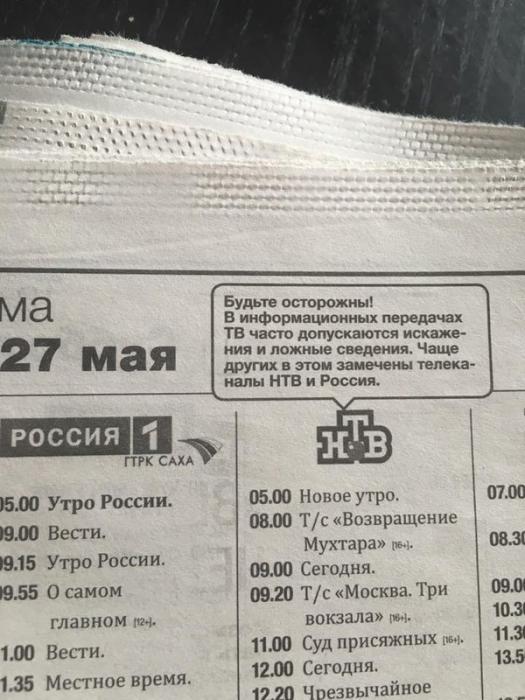
Warning in TV listing next to NTV logo: "Be careful! TV news programs often commit distortions and false information. This tendency has been most often been remarked on NTV and Rossiya." Photo courtesy of mstrok.ru
Warning in TV listing next to NTV logo: “Be careful! TV news programs often commit distortions and false information. This tendency has been most often been remarked on the channels NTV and Rossiya.” Photo courtesy of mstrok.ru

Hygienic Modification
Regional newspapers warn readers about “false information on NTV”
Grani.ru
June 8, 2016

Beginning June 8, up to a hundred regional newspapers, most of them members of the Alliance of Independent Regional Newspapers (ANRI), will publish in their TV listings a warning next to the logo of TV channel NTV that it spreads false information. Valery Bezpyatykh, editor-in-chief of City News, a newspaper published in Redva, Sverdlovsk Region, and one of the organizers of the protest, explained their plans to TV Rain.

According to Bezpyatykh, he vetted the text of the appeal to ANRI members with lawyers before sending the letter, in which he asked members to note in their TV listings for NTV that the channel broadcasts “distorted information or propaganda” under the guise of journalism.

Bezpyatykh estimated that between twenty and forty newspapers could join the protest this week, but by the next week the number could grow to one hundred.

The protest was inspired by the newspaper Evening Yakutsk, which in late May printed a note next to NTV’s logo, warning that the channel committed “distortions and false information” on the air. The note appeared in the newspaper after the film Debtors of the State Department, which claimed the newspaper received funds from foreign sources linked to the US State Department, was aired. The film also mentioned other media outlets, including Tula News Agency, the Tomsk channel TV2, and Chelyabinsk Worker newspaper.

ntv_01
Excerpt from the TV listings in the June 8, 2016, edition of the Redva City News. The warning read, “Be careful! You might get distorted information or propaganda in the guise of journalism on NTV. Details on page 2.” Image courtesy of redva-info.ru

The Public Board on Complaints against the Press has labeled the NTV film a “mendacious denunciation” in which “manipulative techniques for impacting the minds of viewers” were used. The board supported the view of expert Svetlana Shaikhitdinova, who argued the NTV film was an “information product created by spin doctors in order to discredit the directors of Russia’s regional media.”

NTV has repeatedly broadcast made-for-TV films attempting to expose the Russian opposition. The most controversial were Anatomy of a Protest and Anatomy of a Protest 2, shot in 2012. Russian law enforcement authorities filed criminal charges based on claims made in Anatomy of a Protest 2.

In April 2016, the channel aired the film Kasyanov’s Day, based on illegal footage of members of the opposition.

NTV has been on the air in Russia since 1993. It is part of the Gazprom Media Group holding, owned by Gazprombank.

Translated by the Russian Reader. Thanks to Comrade VZ and Gabriel Levy for the heads-up
Russian Folk Art

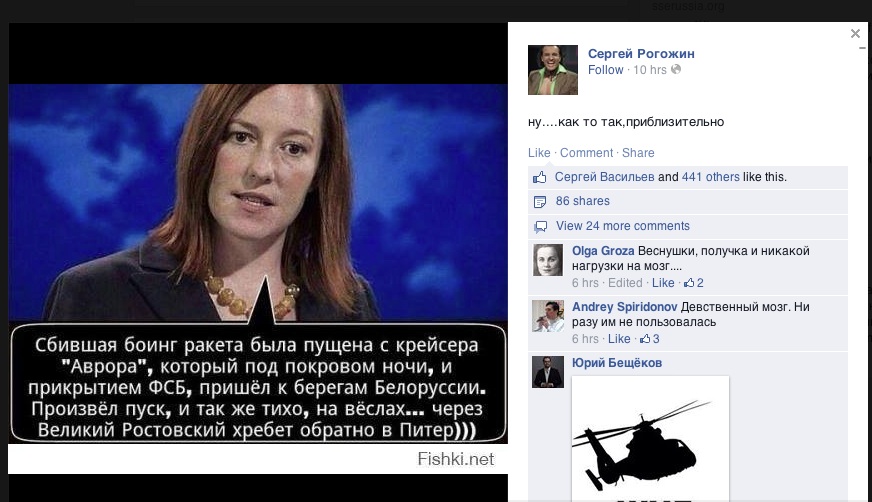
Here is an amazing bit of “folk art” I just captured on Facebook. What’s amazing about it is that it turns on their head all the impossible contortions that Russian state and mainstream media, and segments of Russian social media have been going through, over the past week, to befuddle the Russian public as to who might have shot down Flight MH17 (as described here, for example, by the indispensable Peter Pomerantsev), attributing them instead to US State Department spokesperson Jen Psaki. In the past couple months, Psaki has been elevated by the “pro-Russian” crowd (meaning the same state/”grassroots” media synergy behind the contortionist act) into a Great Satan figure, emblematic of American stupidity and ignorance.
folk art

The missile that shot down the Boeing was launched from the cruiser Aurora, which, under the cover of night, and escorted by the FSB, arrived on the shores of Belarus. It launched the missile and just as quietly rowed back, via the Great Rostov Ridge, to Petersburg.

__________

On the so-called Psaking phenomenon:

Jen Psaki became one of the favorite targets of the Russian media. RG.ru published an article entitled “Jen Psaki found mountains in Rostov Oblast.” The article attributes direct quotes supposedly obtained by journalist Matt Lee about Ukrainian refugees to Russia, whom Psaki was said to have referred to as “tourists traveling to enjoy Rostov’ mountains.” Matt Lee promptly denied ever having such a conversation with Psaki, asserting that the claims in the article were false. In spite of Lee refuting claims in the article, the same allegations were regurgitated by Komsomolskaya Pravda and other news outlets, some of which attributed the fake quotes to Associated Press. Lenta.ru published an apology to Jen Psaki for re-printing the said false claims. None of the other outlets apologized, but instead went on to pontificate about Psaki’s prior commentary, continuing to attack her credibility.

43

__________

While society at large is complicit in this hysteria, to say the least, it cannot be stressed too many times how much of this “folk wisdom” about current affairs and “popular support” for whatever way the Putinist line is bending, has been generated either by state media outright or by covert paid commentators (i.e., Internet trolls), operating out of offices like this in the Petersburg suburb of Olgino:

Local reporters have infiltrated a covert organization that hired young people as “Internet operators” near St. Petersburg and discovered that the employees are being paid to write pro-Kremlin postings and comments on the Internet, smearing opposition leader Alexei Navalny and U.S. politics and culture.

Journalists from the MR7.ru website and the Novaya Gazeta newspaper have reacted to a posting by St. Petersburg local Natalya Lvova, who wrote on the Russian VKontakte social network about an interview she attended on Aug. 30 at what she described as a “posh cottage with glass walls” in Olgino, a village in St. Petersburg’s Kurortny District.

According to Lvova, the office occupying two rooms reminded her of an “internet club with lots of computers and people.” Employees in one room wrote blog posts for social networks, while those in the other room specialized in comments.

“To my question about a technical task — what exactly should be written in the comments — a young guy, a coordinator, told me, briefly and clearly, that they were having busy days at the moment and that yesterday they all wrote in support of [Moscow acting mayor Sergei] Sobyanin, while ‘today we shit on Navalny,’” she wrote on her VKontakte page.

According to Lvova, each commenter was to write no less than 100 comments a day, while people in the other room were to write four postings a day, which then went to the other employees whose job was to post them on social networks as widely as possible.

Employees at the company, located at 131 Lakhtinsky Prospekt, were paid 1,180 rubles ($36.50) for a full 8-hour day and received a free lunch, Lvova wrote.

source: St. Petersburg Times