Serial Denouncer Denounced

Ivan Abaturov (social media image via RFE/RL)

Social anthropologist Alexandra Arkhipova conducted an investigation and concluded that Anna Korobkova, renowned for her numerous denunciations of people advocating anti-war stances, is probably a pseudonym of Ivan Abaturov, a journalist from Yekaterinburg. The BBC Russian Service has published the results of Arkhipova’s research.

Arkhipova assembled more than seventy letters, addressed to various institutions and agencies, in which Korobkova accused doctors, teachers, human rights activists, and journalists of “discrediting” the Russian army and called for them to be brought to justice. Among the denouncer’s victims are a doctor at a clinic who made a comment to [banned opposition channel] TV Rain, the mother of an enlisted soldier killed in the war, and Arkhipova herself. In one case, a student was expelled from a university after it received a denunciation alleging that he had been involved in “unauthorized protest rallies.”

In early December 2024, Arkhipova found a page about Korobkova on Wikipedia. With the assistance of linguists, she did a comparative analysis and found that the author of the Wikipedia article was probably the same person who had written the denunciations signed by Korobkova.

Arkhipova and the investigative journalists were able to identify the author of the Wikipedia article. It turned out to be a journalist from Yekaterinburg, Ivan Abaturov.

Abaturov, as the article points out, had already been at the center of a whistleblowing scandal. In the summer of 2022, Sergei Erlich, director of the publishing house Nestor History, said that Abaturov had allegedly detected “false information about the USSR’s actions during the Second World War” in one of his company’s books. Consequently, law enforcement officials visited Nestor History’s offices.

Abaturov himself has never concealed his attitude to denunciations. In 2019, he wrote on social media that “a journalist under Stalin was a walking prosecutor’s office” and that he wanted to be one too.

When asked by a BBC correspondent whether he had been writing denunciations under the name “Korobkova,” Abaturov replied on VKontakte: “Hello. You are mistaken.” Consequently, he stopped replying to messages, and the BBC was unable to reach him by phone.

Since the beginning of their country’s full-scale war with Ukraine, Russians have filed 2,623 complaints with law enforcement agencies about anti-war statements made by their fellow citizens, the investigative journalism website Important Stories (iStories) calculated in June on the basis of open source data. So-called LGBT propaganda (487 complaints) and Russophobia (250 complaints) ranked second and third, respectively, as grounds for denunciations.

According to Important Stories, seventy percent of the complaints were written by subscribers of the anonymous Telegram channel Mrakoborets, which specializes in tracking down anti-war activists. The channel’s daily norm is a minimum of three complaints on its pages on the social networks VKontakte and Odnoklassniki (“Classmates”). Yekaterina Mizulina, head of the Safe Internet League, had personally written 148 denunciations, while sixty were penned by pro-Kremlin activist Vitaly Borodin.

Source: “The serial denouncer ‘Korobkova’ turns out to be a male journalist from Yekaterinburg,” Radio Svoboda, 26 December 2024. Translated by the Russian Reader. Thanks to Darya Apahonchich and Comrade Koganzon for the heads-up.


[…]

In the autumn of 2022, executives at the Russian Academy of National Economy and Public Administration (RANEPA) received a letter signed “Anna Vasilievna Korobkova.” It began as follows: “I fully support the special operation of the Armed Forces of the Russian Federation on Ukrainian territory. I am against all violations of the law.”

The letter concerned an interview that Alexandra Arkhipova, who had worked for many years as a senior research fellow at RANEPA, had given to the channel TV Rain, which had been designated a “foreign agent” by Russian authorities. (At the time of the interview, the TV channel had not yet been designated an “undesirable organization.”)

In her denunciation, “Korobkova” asked the university to dismiss Arkhipova for “immoral misconduct,” which, in her opinion, consisted in the fact that in the interview with TV Rain she had “disseminated false information discrediting the Special Military Operation [sic] on Ukrainian territory.” Korobkova also suggested that the university send the evidence against Arkhipova to the prosecutor’s office.

“Korobkova” was outraged that Arkhipova did not interrupt TV Rain presenter Anna Nemzer when the latter had called the “special military operation” a “war” (“thus showing she agreed with Nemzer’s false opinion”), mentioned Facebook without mentioning that it had been designated an “extremist organization” in Russia, and uttered the phrase “before the war I would ask.”

“This is a lie, as there is no war,” the letter said.

Upon seeing the text of the denunciation, Arkhipova was surprised by how long and detailed it was. Korobkova’s letter took up two pages, and even the time codes for the points in the interview at which Arkhipova had said certain things that angered Korobkova were noted. As a folklorist and social anthropologist who works extensively with different texts, Arkhipova was struck by the structure of the denunciation and the specific language in which it was written.

“I was reading this denunciation to friends, discussing it as a phenomenon of contemporary political culture, when one of my colleagues looked at me sadly and took a crumpled piece of paper out of his pocket. He unfolded it and read aloud a denunciation. It had the same wording, and was also signed ‘Anna Vasilievna Korobkova,'” Arkhipova tells the BBC.

[…]

Source: Amalia Zataria, “‘I want to be a walking prosecutor’s office’: who hides behind the identity of serial denouncer ‘Anna Korobkova’?” BBC Russian Service, 26 December 2024. Translated by the Russian Reader
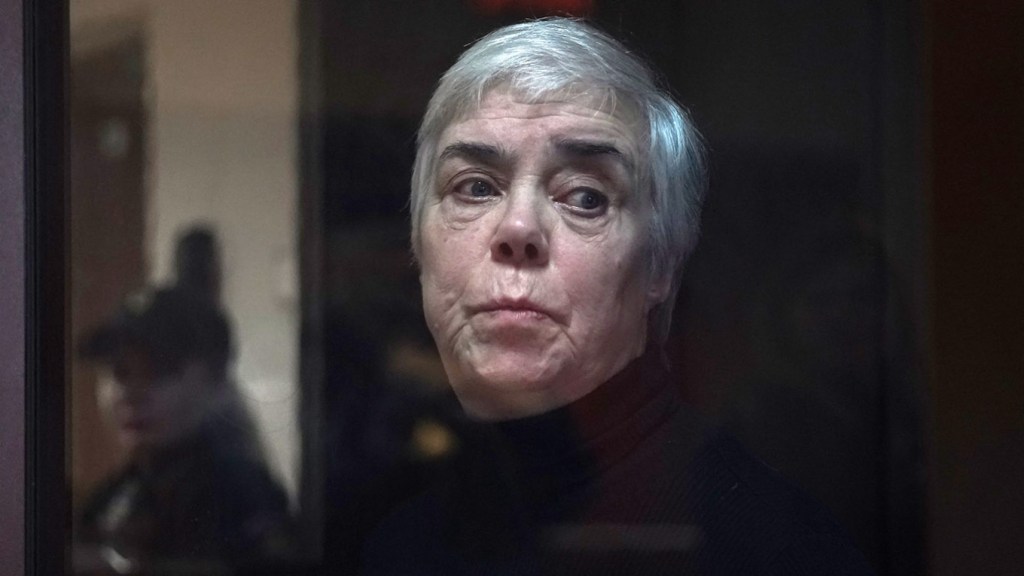
A Milestone (Nadezhda Buyanova)

Nadezhda Buyanova. Photo: Tatyana Makeyeva/AFP, via Moscow Times

A pediatrician has been imprisoned on the strength of a denunciation by her patient’s mother. The pediatrician allegedly insulted the boy’s father, who had been killed in the war. There were no witnesses to the conversation, and it seems that the decisive factor in the verdict was the pediatrician’s birthplace — Lviv. Only recently I published the file of the criminal case against my great-uncle, who had allegedly spread rumors about the fall of Soviet regime among children at an orphanage. There, too, the accused’s background was an important point of the accusation: the arrested man’s father had once been a prosperous peasant. It was obvious to the investigators (and this was explicitly stated in the verdict) that the status of “kulak’s son” was in itself proof that the charges were true.

Lo and behold we’re back where we started: a person born in Lviv is guilty of course and must have said what they have been accused of saying.

I don’t know why we should measure things off in terms of milestones on the road to a familiar hell, but this is certainly a milestone.

Source: Natalia Vvedenskaya (Facebook), 13 November 2024. Translated by the Russian Reader


A Moscow court on Tuesday sentenced a pediatrician to five and a half years in prison for criticizing the war in Ukraine during a patient visit earlier this year.

Nadezhda Buyanova, 68, was found guilty of spreading “fake” information on the Russian army under wartime laws used to silence dissent.

“I believe this is absurd,” she said in court Tuesday, moments before Judge Olga Fedina announced her sentence.

Buyanova was arrested in February after the ex-wife of a soldier who was killed in Ukraine, Anastasia Akinshina, said she had criticized Russia’s role in the conflict during an appointment.

Several of Buyanova’s supporters, mostly medical professionals, shouted “Shame on you!” in the court as the sentence was announced.

“We must empathize with one another and love others,” Buyanova said in court. “But there is no paradise on earth, there is no peace on earth.”

She protested her innocence throughout the trial.

“I am a pediatrician. I do not regret a single day,” Buyanova said.

Buyanova was prosecuted despite there being no public evidence that she criticized the war. Akinshina’s seven-year-old son testified against Buyanova in court.

Source: AFP, “Russian Doctor Jailed 5.5 Years for Criticizing War During Patient Visit,” Moscow Times, 12 November 2024


Monday, 18 November, 6 p.m.  “Political prisoners in Russia and the Occupied Territories of Ukraine”. 

Panel discussion with Sergei Davidis (Memorial), Evgeny Zakharov (Kharkhiv Human Rights Protection Group), Bill Bowring (Birkbeck, University of London) and Judith Pallot (Gulag Echoes research project / University of Oxford).

At: Montague Lecture Centre, Graduate Centre, Queen Mary University of London, 327 Mile End Road, London E1 4NS. Also on line, via Zoom.

All welcome. Event organised by the Queen Mary University, London, Centre for Eurasian, Russian and East European Studies. Register on Eventbrite here.

Source: Ukraine Information Group

The Asch Conformity Experiments

Back in the 1950s, experiments were conducted that purported to demonstrate how difficult it is for one person to resist the opinion of a group. These were [Solomon] Asch’s famous [conformity] experiments.

The subjects were asked to compare the length of lines. The correct answer was obvious, but it was “decoys” in the group who answered first, and they all pointed to another line as the right one. Consequently, most people conformed with group’s opinion and answered the question incorrectly. But if at least one of the decoys had been instructed to answer differently than the others (although not necessarily correctly), most of the subjects were able to assert their own opinion.

A friend told me how she had unwittingly found herself inside an Asch experiment. She was an independent observer on an elections commission in which all the other members were attempting to falsify the results. They put the ballots for one candidate into a stack with the other candidate’s ballots. My acquaintance tried in vain to protest. She said that her principal emotion was not indignation, but the terrible thought that, maybe, there was something wrong with her. It seemed to her that she was going crazy: it could not be that all these people were doing “wrong” so calmly and confidently.

That is why the authorities are going after pro-peace posters and anti-war quotes by Leo Tolstoy, and that is why draconian fines and criminal penalties have been introduced for voicing opinions other than the official ones. That is why all the opposition media have been shuttered. Because the existence of even one public voice contradicting the “unanimous choir” enables thousands of other people to maintain their own common sense. (For those of you who do not like the opposition and opposition politicians, remember that this holds true even if the contradictory voice is “wrong.”)

Many people are now afraid to speak out publicly, not only because of the possible punishments, but also because of the effect demonstrated by Asch’s experiments. It’s scary to stand alone against everyone. That is why it is so important to support each other (“a like is also a help” :) and, at least, voice one’s opinion in private conversations with each other, if not publicly. It will help someone not to go crazy.

Source: Natalia Vvedenskaya, Facebook, 8 April 2022. Image courtesy of Wikipedia Translated by the Russian Reader


Marina Dubrova, an English teacher on the Russian island of Sakhalin in the Pacific, showed an uplifting YouTube video to her eighth-grade class last month in which children, in Russian and Ukrainian, sing about a “world without war.”

After she played it, a group of girls stayed behind during recess and quizzed her on her views.

“Ukraine is a separate country, a separate one,” Ms. Dubrova, 57, told them.

“No longer,” one of the girls shot back.

A few days later, the police came to her school in the port town of Korsakov. In court, she heard a recording of that conversation, apparently made by one of the students. The judge handed down a $400 fine for “publicly discrediting” Russia’s Armed Forces. The school fired her, she said, for “amoral behavior.”

“It’s as though they’ve all plunged into some kind of madness,” Ms. Dubrova said in a phone interview, reflecting on the pro-war mood around her.

With President Vladimir V. Putin’s direct encouragement, Russians who support the war against Ukraine are starting to turn on the enemy within.

The episodes are not yet a mass phenomenon, but they illustrate the building paranoia and polarization in Russian society. Citizens are denouncing one another in an eerie echo of Stalin’s terror, spurred on by vicious official rhetoric from the state and enabled by far-reaching new laws that criminalize dissent.

Source: Anton Troianovski, New York Times, 9 April 2022. Read the rest of this disturbing article by clicking on the link. Thanks to Comrade SG for the timely heads-up.

How to Get Fired from Your Job in Russia

Historian Alexei Petrov. Photo courtesy of Radio Svoboda
Historian Alexey Petrov. Photo courtesy of Radio Svoboda

Historian Alexey Petrov Fired from Irkutsk State University
Radio Svoboda
November 16, 2016

Alexey Petrov, deputy dean of the history department at Irkutsk State University has been fired from his job, allegedly for engaging in public activism to the detriment of his work as an educator. As Petrov reported on Facebook on Wednesday, his work book* was brought directly to his workplace.

Petrov heads the regional branch of Golos, a grassroots organization that combats electoral fruade. He is also renowned as organizer of the project Walks through Old Irkutsk.

The dismissal has come in the wake of an inspection of the university by the prosecutor’s office, which was instigated by the so-called Trade Union of Independent Citizens, our correspondent reports. Two complaints were sent to the prosecutor’s office. The first complaint, which was anonymous, states that Petrov, deputy dean of the ISU history department, publicly presents and promotes insufficiently patriotric views during his lectures. The second letter, signed by Sergei Poznikov, focuses on the historian’s absences from the deans’ offices at the university during working hours and his frequent trips overseas.

The complaints against the “excessively liberal-minded historian” were made to the prosecutor’s officer after the Russian Congress of University Vice Chancellors for Morale and Discipline, in October, at which a program for assessing the “protest potential” of students and professors was presented.

* “Every person working for an employer in Russia is issued a work book by the person’s original employer. A work book contains the record of a person’s employment history, dates of employment, as well as other information. Employers have the duty to keep and timely update an employee’s work book while the employee is working for the employer. On the employee’s final day of employment with an employer, the employer must complete and return the employee’s work book, against the employee’s signature.” Source: Multitran

Translated by the Russian Reader. Thanks to Comrade AT for the heads-up