Day of Knowledge

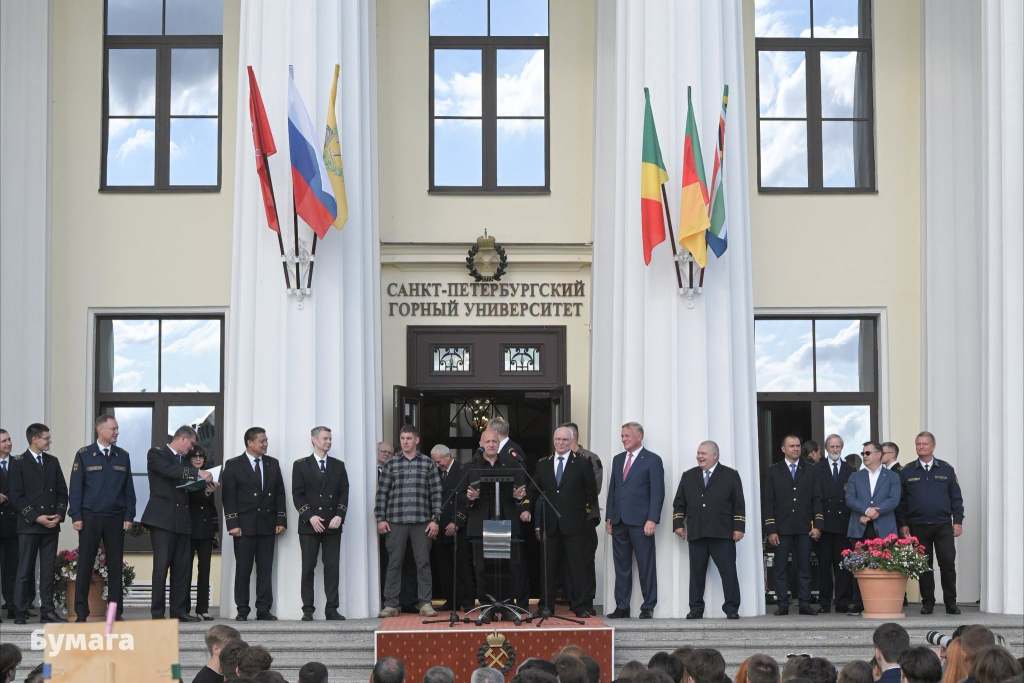
Zakhar Prilepin addressing an assembly at Petersburg’s Mining University. Photo: Bumaga

Zakhar Prilepin speaks at Mining University welcome assembly

Zakhar Prilepin was introduced as a “writer and participant in the Special Military Operation,” but was mistakenly referred to as “Prigozhin,” so he corrected the master of ceremonies, our correspondent reports.

Prilepin told the students that emigrating after receiving an education at the Mining University would be an act of treason.

“If you take your knowledge beyond the borders of this country, beyond the bounds of our national science, you will betray all those who stand beside you. I hope there is no one here like this, but some of you might secretly be thinking, ‘I was born so intelligent, I am so wonderful and gorgeous, and basically I’m entitled to everything, that I’ll just pack my bags and go off somewhere where they’ll pay me more for my brains.’ Please understand that this is a treachery against those people who have conquered and cultivated this vast expanse,” Prilepin declared.

Prilepin was the third to speak, after Rector Vladimir Litvinenko and one of his vice-rectors. On stage, the writer stood next to Litvinenko.

Source: Bumaga (Facebook), 1 September 2026. Translated by the Russian Reader


A wave of false bomb threats triggered mass evacuations at schools, kindergartens, hospitals and museums across at least nine Russian regions, local officials and media reported Tuesday.

In the Leningrad region, Governor Alexander Drozdenko said “a dozen” schools, kindergartens and hospitals responded to bomb scares. The hoaxes came amid Day of Knowledge celebrations that mark the start of the new school year every Sept. 1.

“We can’t ignore these threats, even though we understand the enemy’s goal to… ruin the holiday for children and adults,” Drozdenko wrote on Telegram, likely a reference to Ukraine.

St. Petersburg and Leningrad region police told the Fontanka.ru news outlet that “more than 100 institutions” received false threats.

In Moscow, at least four museums, including the Pushkin State Museum of Fine Arts, evacuated visitors or temporarily closed for what they called “technical reasons.”

A government building in the Far Eastern Zabaikalsky region and a number of hospitals in the central republic of Tatarstan were also reportedly evacuated.

Fake bomb threats were also reported across the Ural Mountains, the Yamal-Nenets autonomous district, the Orenburg region and the Krasnoyarsk region.

Mass bomb threats, which the Kremlin referred to as “telephone terrorism,” have periodically plagued Russian cities in the years before and since the full-scale invasion of Ukraine.

Source: “Bomb Threats Force Evacuations at Russian Schools,” Moscow Times, 1 September 2026


Prilepin greeted the 2014 ‘Russian Spring’ with delight as the realisation of long-held hopes for a resurgence of Russian power. He hailed the Crimean annexation as a vital turning point in Russia’s post-Soviet history, marking an end to the dominance of what he called the ‘hysterical’ domestic media coverage of the Russian military campaigns in Chechnya and Georgia, and expressing the hope that ‘the Crimean story will give a kind of super-brutal revolutionary impulse inside the country, so that it undergoes a metamorphosis’. Prilepin has been actively involved in the Donbas conflict, initially as a war correspondent and as an activist organising charity rock concerts in aid of the pro-Russian side and delivering humanitarian supplies to the local population. From 2015 to mid-2018 Prilepin was employed as adviser tothe head of the self-proclaimed Donetsk People’s Republic (DNR), Aleksandr Zakharchenko; in a move that has prompted speculation and conspiracy theorising when, Prilepin, citing health problems, left Zakharchenko’s service a few weeks before the latter was assassinated in August 2018. Apparently on commission from Kremlin ‘grey cardinal’ Vladislav Surkov, Prilepin published a popular biography of Zakharchenko in 2016.

In early 2017 Prilepin’s involvement in the war moved to another level after he announced that he was forming his own battalion to fight in the Donbas for the DNR. This led to his being hailed in the newspaper Moskovskii komsomolets as not just both writer and soldier, but also ‘perhaps, a prophet’; the popular tabloid Komsomol’skaia pravda described him as a ‘hero of our time’ for the 2000s, and the‘Byron of Donetsk’. Other commentators predicted that Prilepin would write ‘the first great novel’ about the war in the Donbas, which ‘our children and grandchildren will use to study the history of the second decade of the 21st Century’. Prilepin followed up his announcement with an online videoclip in which he held up a peace sign and delivered a mock-serious speech about the writer’s duty to oppose war, before tearing up the peace sign and ordering his men to open fire on Ukrainian positions.

Source: Julie Fedor, “Spinning Russia’s 21st Century Wars: Zakhar Prilepin and His ‘Literary Spetsnaz.’” The RUSI Journal, vol. 163, no. 6 (December 2018): 20–21. https://doi.org/10.1080/03071847.2018.1562015.

Day of Knowledge: “It’s Not Scary to Die for the Motherland”

In twenty regions of Russia, a school pupil’s start-of-the-year supplies costs more than the average monthly per person income.
This schematic map of the country show how much of the average per capita income has to be spent to ready a pupil for the school year.
Source: Unified Interagency Statistical Information System (EMISS), Russian Federal Statistics Service (Rosstat); calculations by iStories

About one hundred thousand Russians have signed a petition to the president demanding that they be paid 10 thousand rubles [approx. 163 euros] for children’s school expenses as was the case in 2021.

But instead of Russian families, this year parents of schoolchildren from the parts of Ukraine occupied by the Russian army will receive 10 thousand rubles each, while Russian citizens are being expressly told to go to war so that they can afford to send their child to school.

We calculated how much it would cost to send off a pupil to school in Russia’s regions, and we talked with the parents of schoolchildren.

What we learned:

In twenty regions of Russia, buying everything needed for school costs more than the average per capita income for a whole month. For example, in Tyva, one family member has an average income of 15.5 thousand rubles [approx. 253 euros] per month.

This money is usually spent on the bare necessities: food, clothing, medical treatment, transport and other needs. A schoolchild’s kit in Tyva costs almost 24 thousand rubles [approx. 393 euros] — money that parents don’t know where to get. In another fourteen regions, more than ninety percent of income will be spent on school-related expenses.

Parents told iStories that many goods, especially clothes and notebooks, have risen in price twofold or more. And yet, wages have not increased, and some parents have lost their jobs altogether due to sanctions.

Many parents have had to take out loans for everyday needs (this is corroborated by the data: before the start of the school year, the number of applications for consumer loans increased by 20%) and scrimp on vacations.

Prices have increased by thirty percent, but I have no salary, so I’ve felt the difference enormously. The option that I found this year is credit cards. And we scrimped on vacation, of course. It has become quite expensive to take the children somewhere and liven up their leisure time. Whereas earlier I could afford to spend the weekend with my children somewhere in a holiday home in the Moscow Region, now we choose places without an overnight stay, and we take food along with us.

[…]

You take shoes for physical education, light sneakers. The kids hang out in them all day [anyway], so you save money on school shoes.

[…]

I tried to tell [the children] that war is always a very bad thing, that you should aways try to negotiate.

Natalia, Moscow, who is raising a son and a daughter, both in school

On average, I spent around 35-40 thousand rubles [approx. 660 euros] on everything. Clothes have become much more expensive compared to last year, and the quality has become worse. […] I am now on maternity leave, raising the girls alone. I get alimony. We have spent all the new allowances for children between 8 to 17 years old on school expenses. […] I think we will cope with it all. Everything will end and be fine — [the war] will not affect us in any way. I think that everything is being done here [in Russia] so that we do not feel the effect of special military actions.

Elena, Novgorod Region, who is raising two school-age daughters

In which regions of the country does a schoolchild’s kit cost more than the average per capita monthly income?

Could the Russian state afford to cover the expenses for all 15 million Russian schoolchildren?

Source: iStories, email newsletter, 29 August 2022. Translated by the Russian Reader


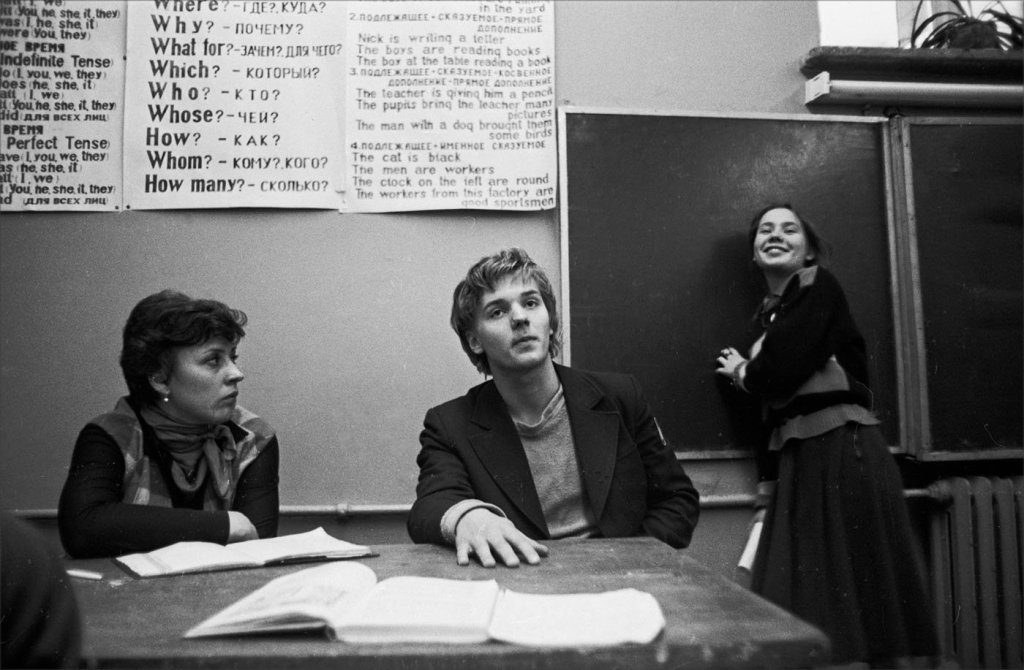
Igor Stomakhin, from the series When we leave the schoolyard… Moscow, 1980s

My street exhibition will open on the fence of Danilovskaya Alley on September 4 at 1 p.m. as part of the project #SundayKhokhlovskyStandoffs. Photos from my Moscow cycle of the 1980s–1990s will be presented. At 2 p.m., I will give a tour of the show beginning with an account of the capital in that vivid period when Soviet stagnation was replaced by Gorbachev’s perestroika. The defenders of Ivanovo Hill will treat guests to tea from a samovar, so you can bring sweets to share. Address: Kolpachny Lane, between house no. 7 and house no. 9.

Source: Igor Stomakhin, Facebook, 1 September 2022. Click the link to see a dozen more photos from Mr. Stomakhin’s poignant perestroika-era Moscow school series. Translated by the Russian Reader


“It’s not scary to die for the Motherland.”
“Conversations about what matters” — mandatory lessons on love for the Motherland — have been introduced in Russian schools. During these lessons the war in Ukraine will be discussed.
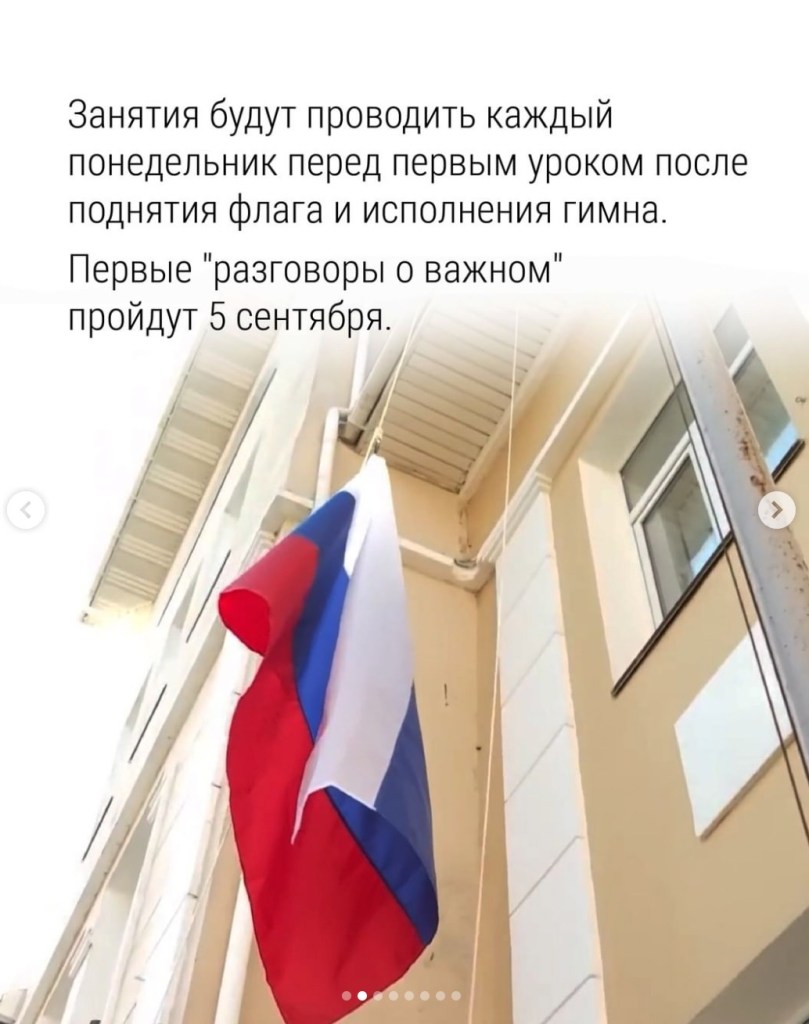
The lessons will be held every Monday before first period after the raising of the flag and the national anthem.
The first “conversation about what matters” will take place on September 5.
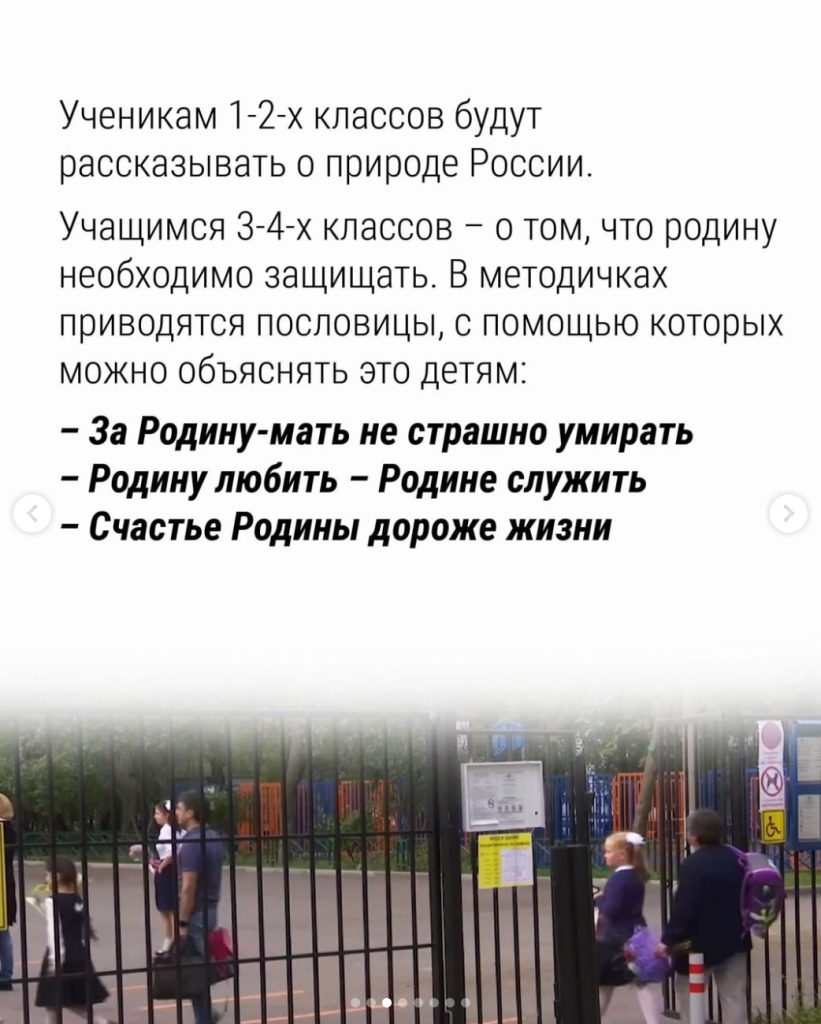
Pupils in the first and second grades will be told about nature in Russia. Pupils in the third and fourth grades will be told about how it is necessary to defend the Motherland. The teaching manuals cite proverbs that can be used to explain this to children: “It’s not scary to die for the Motherland,” “Loving the Motherland means serving the Motherland,” and “The happiness of the Motherland is more precious than life.”
On September 12, pupils in grades 5–11 will be told about the war in Ukraine. “We also see manifestations of patriotism nowadays, especially in the special military operation,” it says in the course packet.
And to pupils in the tenth and eleventh grades, the instructors, as they conclude the conversation about the “special operation,” should say the following parting words: “You cannot become a patriot if you only spout slogans. Truly patriotic people are ready to defend their Motherland under arms.”
Attending the “conversations” is presented as mandatory. If pupils skip them, instructors are advised to have a talk with their parents. If talking to them doesn’t do the trick, instructors are advised to cite the law, which states that the school curriculum consists of lessons and extracurricular activities.
By law, pupils may skip extracurricular activities at the request of their parents. Teachers are afraid, however, that in the case of the “conversations about what matter” school administrators will be keeping a close eye on attendance.
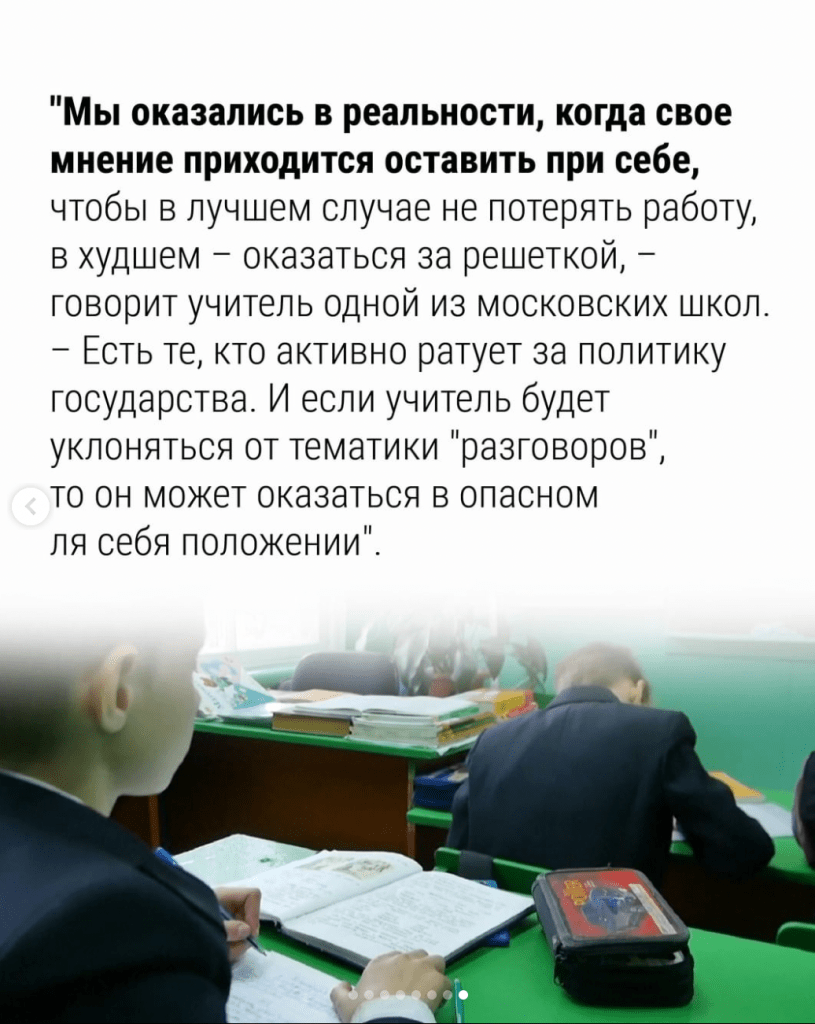
“We find ourselves in a reality in which you have to keep your own opinion to yourself to avoid losing your job, at best, or ending up behind bars, at worst,” says a teacher in one Moscow school. “There are those [teachers] who actively support state policy. If a teacher diverges from the subject matter of the ‘conversations,’ he might find himself in a dangerous situation.”

Source: Current Time TV (Radio Svoboda), Instagram, 1 September 2022. Translated by the Russian Reader

Continue reading “Day of Knowledge: “It’s Not Scary to Die for the Motherland””

Back to the Basics

Today, September 1, is the Day of Knowledge — the first day of school — in Russia and some other post-Soviet countries. As it happens, it was sometime around the Day of Knowledge thirty-one years ago that I began studying Russian. My first Russian teacher was a Hungarian woman named Zsuzsa, at Portland State University. She was only the first of many wonderful guides to the language over the next five or six years (the time it took me to achieve relative fluency), including Nora, Sergei, Zoya, and an amazing Chinese grad student who explained Russian grammar — in Russian (speaking English in class was forbidden at UDub) — better than anyone I’ve ever met; all the lovely, patient and generous lecturers and instructors at the Herzen Institute, who were selflessly dedicated to their profession at a time when working conditions for teachers in Russia couldn’t have been worse; the incomparable Katya Vidre, who introduced me to the work of Alexei Khvostenko and Sergei Dovlatov and so many other things; and countless other Russians, especially the cast of bohemians who helped me with my thesis project, a translation and line-by-line commentary of Joseph Brodsky’s long poem “Predstavlenie.”

Although you might not always guess it from this blog and its prevailingly grim subject matter, learning (and reading) Russian has been immensely liberating. Becoming a Russian reader and speaker has made me a different person, a person capable of seeing the world, however darkly or brightly, through other eyes.

I was reminded of this tremendous gift and the sheer joy of plunging into a new language by the four “Russian pedagogical moments” below. I hope they inspire some of you to learn Russian. At very least, you can read through this post and learn your first twenty-seven words and phrases in the language. ||| TRR

_______________


“V or B? Fill in the missing letters.” This is a worksheet made by the RFL teacher extraordinaire Natalia Vvedenskaya for the immigrant children she teaches at the St. Petersburg Jewish Community Center. The words are banan (“banana”), yabloko (“apple”), vaza (“vase”), kolbasa (“sausage”), divan (“couch,” “sofa”), sobaka (“dog”), rebyonok (“child”), and morkovka (“carrot”). This was originally posted on Ms. Vvedenskaya’s Facebook page.

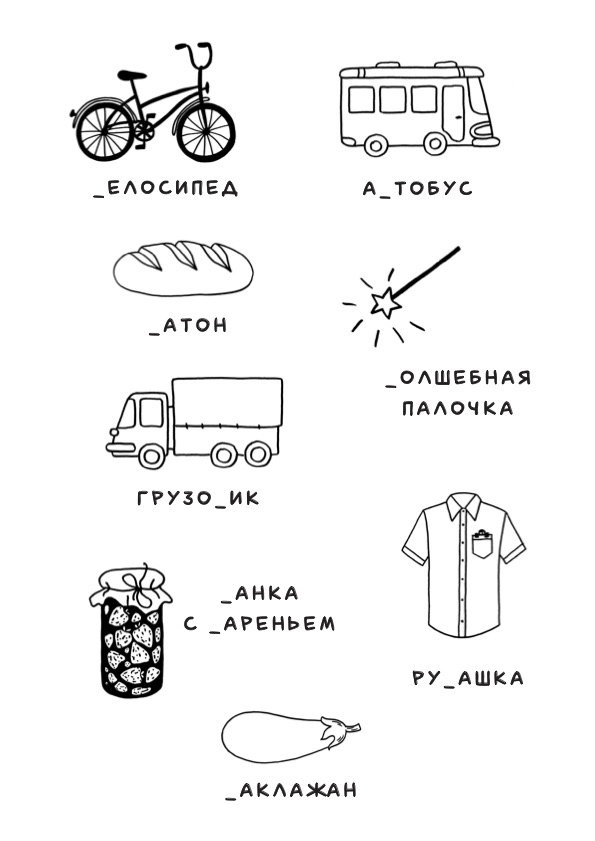
The words and phrases on the second page of the worksheet are velosiped (“bicycle”), avtobus (“bus”), baton (“baguette”), volshebnaya palochka (“magic wand”), gruzovik (“truck, lorry”), banka s vareniem (“jar of jam”), rubashka (“shirt”), and baklazhan (“aubergine, eggplant”).

_______________

Some of Bridget Barbara’s favorite Russian words are arkhiologicheskikh (“archaeological”), zharko (“hot”), delala (“[a female subject] was doing/did”), kavychki (“quotation marks”), prikol’no (“cool”), kuda (“to where”), sovremennyi (“modern,” “contemporary”), ping-pong (“ping-pong”), bifshteks (“beef steak”), and dostoprimechatel’nosti (“sights,” “landmarks”).

_______________

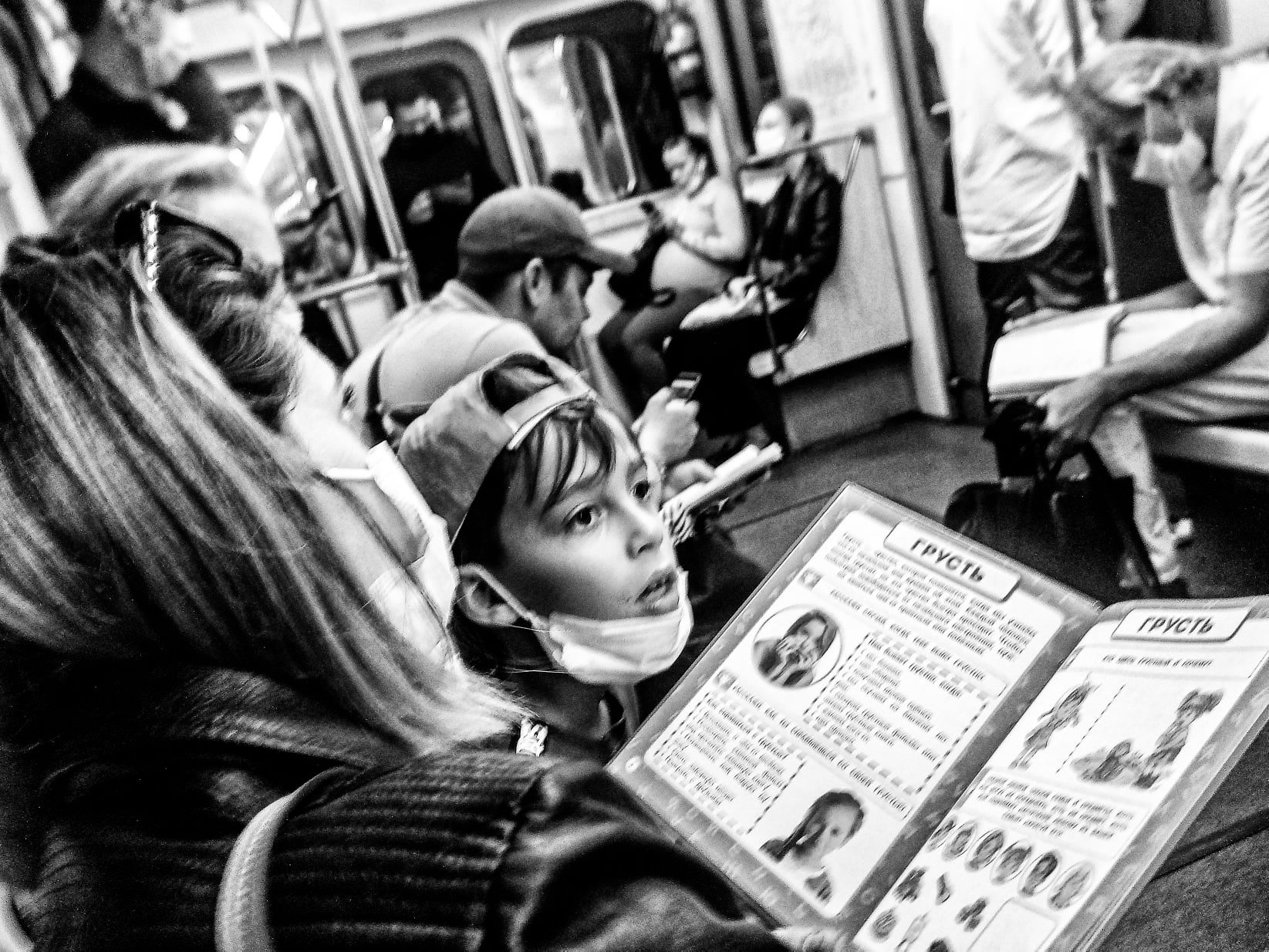
Vadim F. Lurie, “Russia for the Sad.” Posted on the photographer’s Facebook page on August 13, 2021, and reproduced here with his kind permission. The textbook in the photo is open to pages headed with the word grust‘, “sadness.” As Mr. Lurie informs me, “The boy is examining a special book about emotions and discussing it with his mother.”

_______________

Natalia Vvedenskaya playing language bingo with her pupils at the St. Petersburg Jewish Community Center. She writes: “We discussed transport today. Bingo is still the best game for all levels of knowledge of the language and ages. Only it’s very exciting. The screaming is fearsome.”