Teachers’ Day in Bryansk

A martial dance performance, given, allegedly, at the recent Teachers’ Day celebration in Bryansk

Source: Kolokol XXI (Telegram), 6 October 2024


Distinguished teachers awarded for their many years of work and achievements

On October 5, the country and the Bryansk Region celebrate Teachers’ Day. This is the day when our teachers are thanked and given flowers, and concerts and matinees are organized in their honor.

Celebrations were also held at Prep School No. 27 in the Bryansk Region’s Fokino District. District head Alexander Gavrilov, Department of Education director Alevtina Andreyeva, and others made welcoming speeches.

All of them noted the importance of pedagogical labor, and the huge role which educators and teachers play in the life of every individual. Distinguished teachers were given awards for their many years of work and for their achievements.

A warm atmosphere and positive emotions reigned at the event. The festive mood was supplied by artists from the Railroaders Cultural Center and the village of Belye Berega.

Source: Marina Frolova, “On eve of Teachers’ Day in Bryansk, celebrations held at Prep School No. 27,” Bryansk bez formata, 3 October 2024. Translated by the Russian Reader


“Happy Teachers’ Day!”

On October 3, on the eve of Teachers’ Day, a festive event was held in Bryansk to honor the region’s pedagogical workers — teachers, educators, master trainers, and continuing education instructors. The event was held at the Yuri Gagarin Bryansk Regional Governor’s Palace of Children’s and Youth Creativity. Among the honored guests were Valentin Subbot, chair of the Bryansk Regional Duma, and Alexander Bogomaz, head of the region, as well as representatives of the government, trade unions and educational organizations.

Teachers’ Day is a holiday celebrated in Russia on October 5, coinciding with World Teachers’ Day. The quality of education is annually improved, innovative technologies are introduced, new schools are built, and modern educational centers are opened annually in the Bryansk Region. These achievements have been recognized at the federal level and generate favorable conditions for teachers and students.

In his address to the teachers, Governor Alexander Bogomaz, who himself grew up in a family of teachers, emphasized the importance of their profession. He noted that, thanks to the supreme professionalism and wisdom of teachers, patriots ready to serve their Motherland were being brought up in the Bryansk Region.

The Governor also touched upon the issue of awarding teachers. Seven years ago, the law on awarding the title “Honored Educational Worker of the Bryansk Region” was adopted, but only three such titles are awarded per year. The head of the region proposed increasing this number to ten, taking into account the difficult conditions in which teachers work, especially in border areas. This decision would be a well-deserved recognition of their contribution to the development of education in the region.

Source: Yulia Sumner, “Teachers honored on eve of Teachers Day in Bryansk,” Moi Bryansk, 3 October 2024. Translated by the Russian Reader. The emphasis is mine.


Prices for flowers have skyrocketed in Bryansk in the run-up to Teachers’ Day. This holiday, like March 8, is one of the key days for the flower business. The same picture is observed throughout the country.

According to Izvestia, the average check for a bouquet for Teachers’ Day comes to about three thousand rubles (approx. 28 euros), while the demand for flowers has increased by thirty percent. They note an increase in flower sales on online platforms as well.

The newspaper writes that consumers are increasingly choosing more expensive and complex arrangements, including original bouquets and mono bouquets.

A “teacher’s” bouquet in Bryansk will cost between two and three thousand roubles, on average. Roses, especially bush roses and peonies, as well as chrysanthemums and lilies are traditionally popular on Teachers’ Day.

Earlier, we reported that the Governor of Bryansk Region had proposed amending the regional law on awarding the honorary title “Honored Educational Worker of the Bryansk Region.” The head of the region said that he considers it fair to increase the number of awards to ten per year, as the teachers of the region do a tremendous job.

Source: “Flower prices in Bryansk predictably increase before Teachers’ Day,” Bryanskie novosti, 4 October 2024. Translated by the Russian Reader


The Russian government has submitted a draft federal budget for 2025 and budget projections through 2027 to the State Duma. Although it is called a “draft” budget, no major changes will be made to it, of course. Budget revenues are supposed to increase by 11.6%, while expenditures will rise by only 5.2%. However, before this happens, both revenues and expenditures will grow, especially expenditures: up to 39.4 trillion rubles, against the planned 36.7 trillion.

A year ago, approximately the same people in the government were determined to curb military expenditures in 2025, hoping to end the war in Ukraine. Now it is clear that the war may not end in 2025 either, so the projections for the next two years do not provide for a significant reduction in defense spending. In 2025, 32.4% of Russia’s money will be blown up, buried, shot, crushed, pulverized, etc.: 13.49 trillion rubles! In last year’s forecast, defense spending also took a huge chunk — 29.4% (10.77 trillion rubles) — but it was still not that much.

Projected Russian federal budget expenditures for 2025, in trillions of rubles. “National defense” tops the list, at 13.49 trillion rubles (approx. 128 billion euros), while education (ОБРАЗОВАНИЕ) warrants a meager 1.58 trillion rubles (approx. 15 billion euros). Source: Kommersant, via the Moscow Times Russian Service

Economist Igor Lipsits argues that it will be quite difficult for the financial authorities to cope with this task. It’s not that they won’t find the money; it’s that the conditions under which they find the money will hurt the populace. But the populace is no stranger to that!

As they say, to buy something you don’t need, you have to give something up. The list of things that will have to be given up includes support for Russia’s regions, and money for them has in fact been cut. Although they won’t get any money, they will have their budget debts canceled. The Jesuitic twist here is that they probably wouldn’t pay them back anyway. That’s the practice. In other words, that’s how the federal government supports the regions.

Another funny thing is that the funding for civilian drones has been cut. On the one hand, this is understandable: what do they need civilian drones for? They need military drones! On the other hand, this money has been partially used to finance “voluntary” designs, which subsequently, again in a voluntary fashion, make their way to the front and play a quite significant role there.

If we return to the revenue part of the budget, as usual, almost a third of it derives from oil and gas revenues. Oil and gas analyst Mikhail Krutikhin explains that not all is rosy with these revenues; they may even go downhill. The fact that some of the most unprofitable Russian companies are state-owned gives some insight into what the prospects for taxing Russian business might look like. And when analysts speak about dividends from oil companies, they argue that they will decrease. The trend, as described by oil and gas experts, is that prices will decline in 2025.
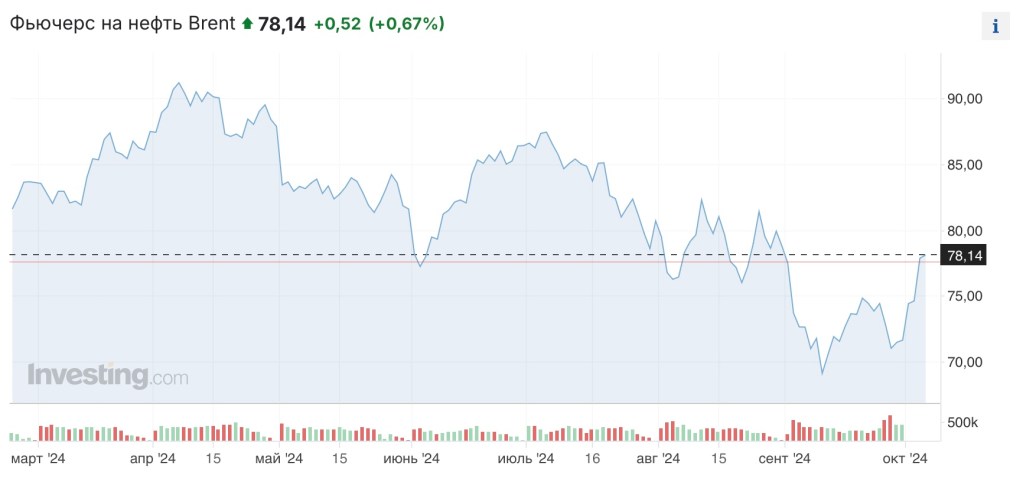
Brent Oil Futures, March 2024–October 2024. Source: Investing.com, via Moscow Times Russian Service

Prices probably would have continued to fall, but then Israel launched a war against Hezbollah, and oil reacted sensitively, triggering a rise in futures prices.

Source: Moscow Times Russian Service, weekly newsletter, 6 October 2024. Translated by the Russian Reader

Nastiness Is a Warm Gun: The Kremlin’s Cowboys

bd1bf37b99A Miratorg worker tending calves. Courtesy of Readovka

Business Russian Style, or, What is Miratorg, and What Do You Eat with It?
Dmitry Zhuravsky
Readovka
April 30, 2019

How Did a Company Importing Meat from Brazil End Up Getting Most of Russia’s Agricultural Subsidies? 
Miratorg’s own website identifies it as the largest agribusiness investor in Russia. The company is owned the Linnik twins, Viktor and Alexander. Viktor serves as the company’s president. It was Viktor Linnik who, last week, proposed tightening controls on the luggage of people entering Russia and increasing penalties for the illegal import of meat-based products. Today, he encouraged Russians to stop thinking about Parmesan cheese and start thinking more about the country’s growth. To rub it in, he dubbed everyone disgruntled with such proposals “blowhards.”

We should point out right off the bat that the fact Prime Minister Dmitry Medvedev’s wife’s maiden name is Linnik is only a funny coincidence, one which the Linnik twins have never tired of mentioning when they are interviewed by journalists.

The facts back this up. Blood relatives of the Russian state’s second most important person could not have established a giant agribusiness company that keeps all its accounts and founding capital outside Russia.

One hundred percent of Miratorg’s shares are owned by Cypriot offshore companies: 99.99% by Agromir, Ltd. (despite its Russian acronym, the company is registered in Nicosia), and 0.01% by Saudeid Enterprises, Ltd. (also registered in Nicosia).

Nevertheless, Miratorg is on the Russian federal list of so-called backbone companies and, since 2015, due to Russia’s self-imposed ban on meat and produce imports, it has been dubbed a strategic company. These regalia allow the Cypriot-based company to obtain loans from Vnesheconombank at discounted rates, which means it borrows part of its operating capital by drawing on the future pensions of Russians. (We published a detailed analysis of this scheme in a previous article.) It also means Miratorg can apply to the government for subsidies to pay back these selfsame loans.

A Success Story
Considering Viktor Linnik’s current circumstances, Miratorg’s origins appear laughable. The company was initially established to import meat from Holland and Brazil to Russia. To make the job easier, two years after the company was founded, in 1997, Miratorg opened a subsidiary in the Kaliningrad Sea Fishing Port, through which it imported meat to mainland Russia. Miratorg did business this way for nearly ten years. In 2005, it purchased a stake in two BelgoFrance-owned pig farms in Belgorod Region. The import company was transformed into a full-fledged agribusiness.

Kaliningrad Sea Fishing Port. Courtesy of Readovka
Miratorg went on to co-found a farm in Kaliningrad Region. A little later, it moved into Bryansk Region, which has become the company’s second home.

It was also in 2005 Miratorg was chosen to be involved in the National Priority Projects, a program for growing “human capital,” announced by Vladimir Putin on September 5, 2005. Until Dmitry Medvedev was elected president, the program, which included promoting the agricultural sector as one of its priorities, was overseen by the current Russian prime minister. Since 2008, when Medvedev was inaugurated president, the agricultural growth program has had its own line item in the federal budget.

Current Realities
Miratorg is currently Russia’s largest meat producer. According to Kontr.Focus.ru, an online service for assisting in doing due diligence on potential clients and business partners, Miratorg, Ltd., has founded thirty-six subsidiaries in eight regions of Russia. In 2017, the company produced 415,000 tons of pork, 114,000 tons of poultry, and 82,000 tons of beef.

Russia’s regions regard Miratorg as a valuable investor whom nearly any governor would be glad to welcome into his neighborhood. According to Miratorg’s website, the company has made a total of 200 billion rubles in investments. The advent of an agricultural market player of this caliber in a region means a guaranteed inflow of money from the federal budget in the form of subsidies from the government’s agricultural sector growth program and  Miratorg’s own investments.

On paper, Miratorg is a real find for regions heavily dependent on federal government subsidies. Aside from the federal agricultural subsidies it brings with it, Miratorg contributes to regional budgets through the land it leases. Its farms provide jobs while they are being builty and after they are brought on line. In addition, it pays taxes in the regions. The company is not a burden but a blessing, or so it would seem.

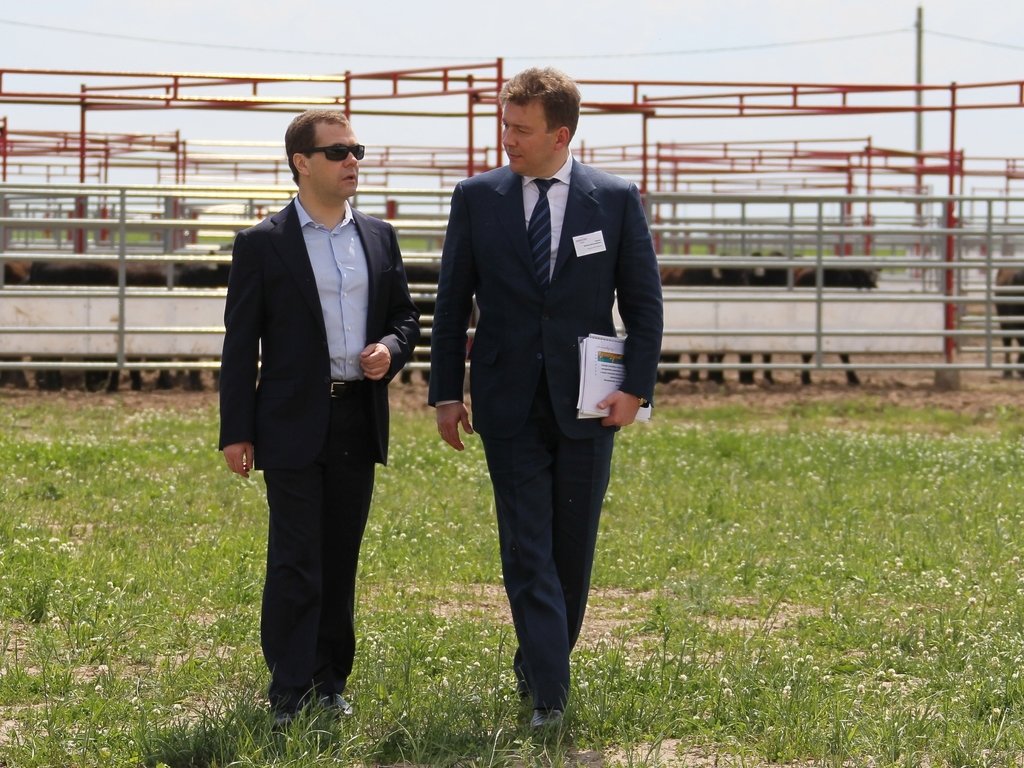
Russian Prime Minister Dmitry Medvedev and Miratorg President Viktor Linnik. Courtesy of Readovka

Taking advantage of its status, Miratorg moves confidently around Russia. In the regions, it has become accustomed to acting suddenly and brazenly. The company often receives land under indefinite gratuitous bailments by order of the federal government, whose decrees are personally signed by Prime Minister Medvedev.

Miratorg usually acts in full compliance with the law, although the effects of how it does business trip up regional governments. After three years, the land it leases free of charge is transferred from regional ownership to Miratorg’s ownership.

Last summer, the Bryansk Commercial Court adjudicated a conflict between the Bryansk Meat Company (Miratorg’s local subsidiary) and the Bryansk Regional Government. Miratorg tried to prove that members of a district council had violated the law by refusing to sell them land they had been leasing. According to law, a company that has leased agricultural land for three years has the right to purchase it and continuing farming it. Only two conditions must be met for the deal to go through: the relevant regulatory authorities must have no objections, and the land must be used for its original purpose.

The Bryansk Meat Company had complied with these terms, but local councilors had not signed off on the deal. Originally, they had agree to lease the land to the investor. Later, Miratorg’s subsidiary decided to trick the council and buy the land. Consequently, the local council was not paid the rent promised to it and did not profit from Miratorg’s presence in the district.

Instead of a lease, the local council was offered a one-time payment, which is transferred to the council’s accounts when the investor buys the land. Bryansk Meat Company’s farm occupies thirteen parcels of land totaling 7,398,700 square meters. Under the terms of the sale of the parcels to Miratorg, the average assessed value of one square meter of land is a mere 1.6 rubles. It is a great deal for Miratorg, but not for Bryansk Region.

We found reports of similar law suits ongoing between Miratorg and local governments in other regions of Russia.

Nastiness Is a Warm Gun
Since 2009, Miratorg has also confidently been colonizing Kursk Region. Its investments there began with the Pristen District, but currently the company operates in thirteen districts in the region. Its facilities in Kursk Region include the Pristen Pig Farm, Blagodatnoye Agricultural Enterprise, Renaissance Farm, Fatezh Lamb, and Miratorg Kursk, Ltd. According to Miratorg’s figures, it invested 17 billion rubles on its agribusiness facilities in Kursk Region between 2009 and 2017. In the Pristen District, it built two pig-breeding facilities with three sites each, while in the Oboyan District it built two pedigree breeding units.

Currently, Miratorg is building what will be Europe’s largest refrigerated slaughterhouse with a capacity to process 4.5 million head of hogs or 400,000 tons of meat in slaughter weight. Miratorg has also been building seven pig farms in two other districts in the region.

3fe1ac38af.jpgA billboard showing Miratorg’s assets in Kursk Region. Courtesy of Readovka
Why has Miratorg invested so much in Kursk Region? For the same reason it has invested heavily in Smolensk, Bryansk, Kaluga, Kaliningrad, and other regions in Russia. The Russian federal budget supports domestic industrial agricultural enterprises with subsidies. Some of the federal government’s assistance is earmarked for the largest players in agribusiness, the strategic, “backbone” companies we mentioned earlier. Some of the assistance is filtered through regional government budgets, where it is meant to boost small companies and support local producers. When Miratorg sets up a subsidiary in a region, it automatically grabs the lion’s share of federal subsidies for itself.

In Russia, there are no limits on the subsidies a particular agricultural holding company can receive. By using the subsidiaries it has established in the regions, a national agribusiness company can qualify for regional subsidies. For example, in 2016, the Bryansk Meat Company was awarded 98% of all subsidies earmarked in the federal budget for promoting agriculture in Bryansk Region.

At the same time, Miratorg has been officially designated as a strategic, “backbone” enterprise. Accordingly, the company and its subsidiaries also receive subsidies for pursuing particular projects. Since 2014, Vnesheconombank has lent Miratorg $871.5 million to expand meat production. Thanks to sleights of hand such as this on, in 2016, Bryansk Meat Company left not only farms in Bryansk high and dry in terms of financing but also farmers nationwide by hogging 90% of all subsidies earmarked for agriculture. The total amount of subsidized loans was 33.6 billion rubles, and this financing was obtained by a single Miratorg subsidiary for a single year.

The company has been feeding off this program since it was founded in 2005. Miratorg has received hundred of billions of rubles in subsidies over this period.

The more subsidiaries it gets, the more lines of credit Miratorg can receive. The story  of its rise to the top bears a strong resemblance to the way Yevgeny Prigozhin built his school cafeteria catering monopoly in Moscow. There is one signal difference, however: whereas Concord Catering’s contract implies that Prigozhin’s food production facility does the work for which it was contracted and pays back its debts out of the profit generated by the facility, some of Miratorg’s loan agreements contain an interesting loophole. It can fulfill its obligations to Vnesheconombank one of two ways, either the way Concord Catering does it, by paying back its debts out of its profits, or by selling off its founding shares in its subsidiaries to pay off its loans. Meaning, hypothetically, Miratorg can rid itself of some of its subsidiaries.

Where Do Miratorg’s Profits Go?
Considering the billions in government subsidies it receives annually, Miratorg and its owners do not even have to run a good business to live high on the hog. According to open sources, Miratorg’s profits shrunk fivefold in 2016, amounting to a mere five billion rubles, despite the fact the company received several tens of billions of rubles in subsidies from the Russian federal government.

Nevertheless, Miratorg is the main supplier of meat for huge fast food chains such as McDonalds and Burger King. It has also launched its own cafes and supermarket chain. Miratorg’s profits, which are incomparable to the subsidies paid to the company, end up not in Russian bank accounts, but in offshore accounts in Cyprus.

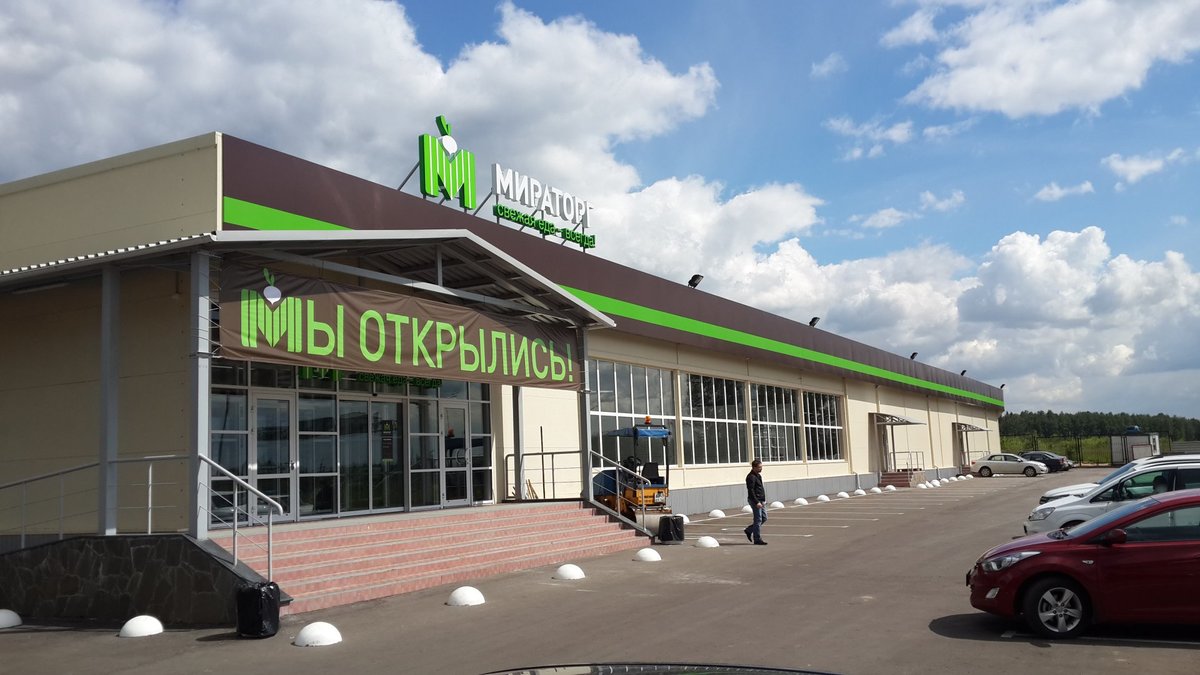
d79d3fe745.jpgA  Miratorg supermarket, newly opened somewhere in Russia. Courtesy of Readovka
Miratorg’s operations do not resemble an attempt to promote Russian agriculture, but rather a scheme for spiriting federal money out of the country. Given Miratorg is the industry leader in terms of land assets and government support, it should also have come to monopolize supermarket shelves. Its status as a strategic enterprise and the subsidies it receives simply oblige it to aspire to this end. The government’s plan was to have Miratorg replace all the imported meat banned from supermarkets with domestically produced meat.

Instead, Miratorg annually receives several hundreds of billions in subsidies allocated by the government to support the country’s agriculture. Miratorg spends the money to purchase land, which it uses, along with shares from its regional subsidiaries, as collateral to obtain more loans.

Ultimately, instead of building a successful business and resurrecting Russian domestic agriculture according to the government’s plan, Miratorg merely filches money from the federal budget. As long as it keeps feeding the “Cypriot butchers,” real hardworking Russian farmers will have to get by without substantial assistance. Eventually, the whirligig of subsidies could lead to the complete collapse of Russian agriculture as such.

Thanks to Anna Klimenko for the heads-up. Translated by the Russian Reader

Annals of Import Substitution: Ricotta Days

Because of the severe if not crippling margarine deficit in this district of the ex-capital of All the Russias, I have been reduced to buttering my toast with ricotta.

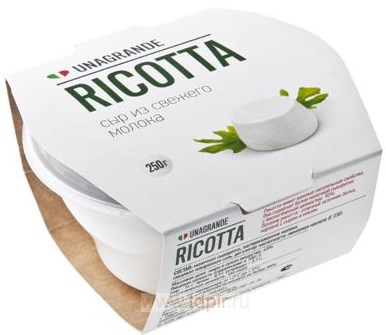
Pictured, above, is Unagrande Ricotta, my preferred brand, and the brand all the shops in my neighborhood (half of which are Dixie chain supermarkets) seem to have in stock all the time, suddenly.

Despite the Italian-sounding name, however, and Unagrande’s cutesy-pie Italian-tricolor-as-heart logo, it is manufactured not in Italy, which as an EU member, is subject to Putin’s anti-sanctions against the import of most EU produce to Russia.

What has bitten Russian taste buds especially hard has been the sudden absence of decent cheese, which, before the Putin regime decided to rule the world, had been imported to Russia in large quantities, mostly because the majority of domestic Russian cheeses were neither particularly tasty nor plentiful.

Crimea-is-oursism changed all that.

Russians traveling abroad now consider it their patriotic duty to stock up on cheese before heading back to the Motherland, where they will consume it with relish themselves or, since Russians like to share, to divvy up among their friends or have a cheese-tasting party. Likewise, Europeans welcoming friends from the Motherland have been known to serve their country’s finest cheeses before and after dinner.

There are even black market Estonian and Finnish cheese outlets, practically operating in broad daylight, in the farther flung corners of the city. A friend of mine has bought such zapreshchonka (banned goods) in these establishments, usually housed in inconspicuous kiosks, on several occasions.

No, my daily ricotta is produced not in Italy, as the name and the packaging insistently suggest, but at 130 Lenin Street in the town of Sevsk, in the far western Russian region of Bryansk.

Despite its exalted status as the new ricotta capital of Russia, Sevsk is a modest town whose population, according to the 2010 census, was 7,282.

To their credit, however, the Sevskians produce their delectable Unagrande Ricotta from whey, pasteurized cream, and salt. That’s it.

Unagranda Ricotta contains zero percent of the detestable and environmentally ruinous palm oil that other Russian cheese manufacturers have pumped into their cheeses, also bearing European-sounding names, to make up for real milk and cream, which have been in short supply and are more expensive, of course.

So I doff my cap to the honest dairy workers of Sevsk, who have managed to produce a delightful 250-gram tublet of perfectly edible and utterly non-counterfeited ricotta, which sells for 144 rubles (a bit over two euros) at my local Dixie.

I would still like to know, however, what has happened to all the margarine. TRR

Image courtesy of planetadiet.com