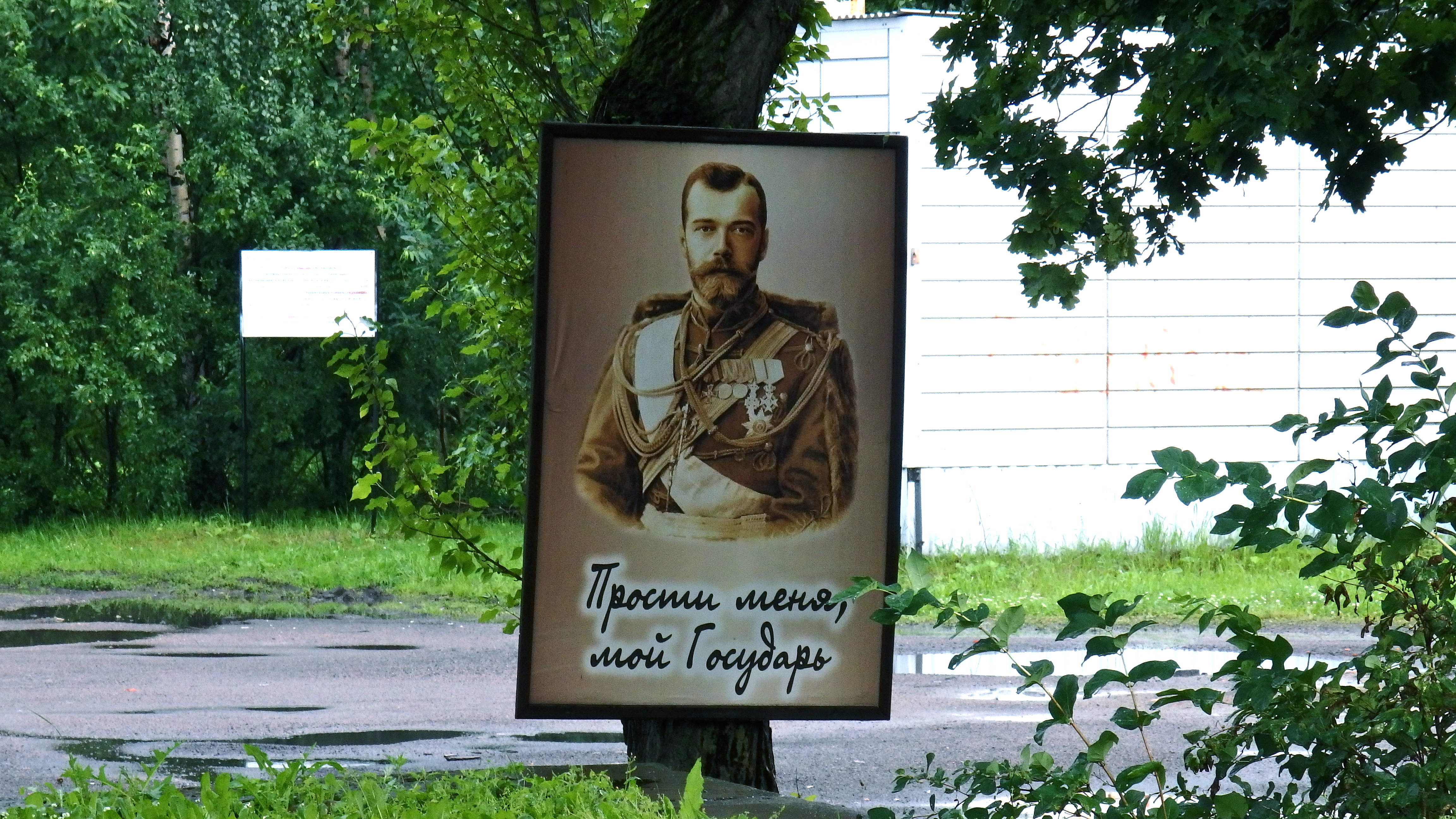
“Emperor Nicholas II. A grateful Russia.” Alexandrovka Station, Pushkin, Petersburg, July 10, 2016. Photo by the Russian Reader“Forgive me, My Sovereign.” Alexandrovka Station, Pushkin, Petersburg, July 10, 2016. Photo by the Russian Reader
Nicholas II
Russian czar from 1894 to 1917. His reign was marked by a violent struggle against the revolutionary movement, the war against Japan (1904), which was followed by the first Russian Revolution (1905–06), and Russia’s participation (1914–17) in World War One, which culminated in the Revolution of the spring of 1917 and the removal of Nicholas II from the throne. At the outset of his reign the Jews, like other Russian circles, hoped that the new czar would change the extreme reactionary and antisemitic policy of his father Alexander III. This hope was, however, soon disappointed. The czar, whose education at the hands of Konstantin Pobedonostsev had made him an indubitable Jew-hater, regarded the Jews as the principal factor in the Russian revolutionary movement. He favored anti-Semitic statesmen, rejected any attempt to change the anti-Jewish laws in spite of the advice of some of the leading statesmen of his court (such as Sergei Witte and Pyotr Stolypin), and took under his aegis the violent anti-Semitic movement the Union of Russian People (popularly known as the Black Hundreds), and other organizations formed in reaction to the liberal and revolutionary organizations. The pogroms against the Jews, which were at first due to the free hand given to anti-Jewish incitement and the rioters, were later directly perpetrated by the police and the army, as part of the campaign against the revolution. The Beilis blood libel trial in Kiev, which was designed to set off renewed persecutions of the Jews, was inspired by the czar. Although no new anti-Jewish laws were passed during the reign of Nicholas II, the administrative pressure which accompanied the pogroms encouraged hundreds of thousands of Jews to emigrate to the U.S. and elsewhere.
Alexander Mikhailovich (center), a co-founder of Sorok sorokov (“Multitude”), a militant Russian Orthodox organization that Patriarch Kirill has identified as his personal “guard”
Right-Wing Saints
Nikolay Mitrokhin
October 26, 2015 Grani.ru
Last week at a meeting of the Holy Synod of the Russian Orthodox Church (ROC), three decisions were adopted that illustrate the further transformation of church leadership into a fascist-type extreme right-wing organization.
The rank of bishop was awarded to Archimandrite Tikhon (Shevkunov), abbot of the Sretensky Monastery in Moscow, who is closely linked to Black Hundreds-like organizations. For the last fifteen years, at least, his public and political reputation had prevented him from moving up into the ranks of the church’s “generals,” despite his successes in advocacy (the Sretensky Monastery’s publishing house is the largest in the ROC) and close ties to the Russian state establishment. Now decency has been cast to the wind, and the path to a big church career has been opened to him.
In another decision, the Synod formed a joint commission of the Russian and Bulgarian Orthodox Churches on the issue of canonizing Archbishop Serafim (Sobolev) of Bogucharsk. It has been emphasized that the commission was created at the personal behest of Patriarch Kirill, who on May 5 sent a formal request to the head of the Bulgarian Orthodox Church. An émigré from Russia and, subsequently, one of the leaders of the Bulgarian Orthodox Church, Serafim is known not only as the man who practically founded modern Bulgarian monasticism. He also penned many xenophobic essays (just like Putin and Nikita Mikhalkov’s favorite philosopher Ivan Ilyin) that mixed the Russian nationalism of his day with a hatred of other faiths. In the 1930s, he vigorously campaigned against the theologians of the St. Sergius Orthodox Theological Institute in Paris, insisting on rejecting all forms of ecumenical cooperation. And of course, like the other so-called Karlovites, the European bishops of the ROCOR (Russian Orthodox Church Outside of Russia), he actively collaborated with the Nazis. This did not stop him, as a Russian patriot, from collaborating just as successfully with the Stalinist regime after the war.
Sobolev’s most prominent Russian disciple and protégé was the young émigré priest known to us as Archpriest Vsevolod Spiller. To a large extent swayed by the ideas of his teacher, he returned in 1949 from Bulgaria to Moscow, where as deputy head of the Department of External Church Relations he was an influential church official. But then his ideas came into conflict with the political reality and, maintaining his post as prior of the Church of St. Nicholas in Kuznetsy, he became an equally influential figure in unofficial church life. In particular, he vigorously supported resistance groups within the church, which attempted to reconcile right-wing views with human rights rhetoric in order to gain greater autonomy for the clergy and the ROC as a whole.
A group of young disciples from the Moscow intelligentsia formed around Spiller. In the early 1980s, they were ordained as priests, and by the middle of the decade they had begun to confront their own former comrades who had chosen a more liberal vision of the church’s future. During perestroika, they founded the most successful ecclesiastical education project of the new era, St. Tikhon’s Orthodox Theological Institute, and in the early 2000s, as a result of a large and successful intrigue, they became the leading ideological faction within the ROC. Members of this faction have held a variety of leadership positions in the church and still control at least two posts at the overall church level. One of these clerics is Archpriest Dmitry Smirnov, head of the Patriarchal Commission on Family and Youth Affairs. Smirnov is known for his aggressive xenophobic and extremist rhetoric (and his involvement in at least one major violent protest action), and he virtually acts as the church’s liaison with the extremist group God’s Will.
There is no doubt that the prospect of Archbishop Serafim’s canonization and, therefore, the church’s blessing to republish and promote his works is the handiwork of St. Tikhon’s Institute, now known as St. Tikhon’s Orthodox University of [the] Humanities, especially since the university’s rector, Archpriest Vladimir Vorobyov, one of Spiller’s principal disciples, is on the canonization commission.
Finally, the third ideologically significant accomplishment of the Synod was the resolution it adopted in connection with the report made by Archpriest Vsevolod Chaplin, chair of the Synodal Department on Church and Society Relations, on “proposals for countering neopaganism.”
“[We] consider concerns about the increasing spread of neo-paganism in countries for which the Moscow Patriarchate is canonically responsible, including the cultural and information sectors, reasonable. [We] emphasize the need to work more vigorously on the overall church and diocesan levels in order to refute the neo-pagan errors. This works must be conducted primarily with young people, with communities of athletes and sports fans, members of military-patriotic clubs, law enforcement officers, and persons in places of incarceration,” wrote the Synod in its resolution.
This is a response to the clear failure in recent years of the Moscow Patriarchate’s efforts vis-à-vis “socially congenial” categories of young people. Despite the patriarchate’s desire to harness the energy of right-wing extremists and militarists in the youth subcultures to its own advantage by implementing the concept of military sports clubs in the parishes (there are definitely two or three such clubs in every region), it has become more and more obvious that the ROC’s “sluggish” stance did not satisfy its “flock” of extremists. Emblematic in this regard was the sensational renunciation, in 2013, of Russian Orthodoxy by Alexander Povetkin, a boxer popular among Russian nationalists, and his virtual conversion to neo-paganism as publicly demonstrated by the tattoos and amulets on his body.
Obviously, the ROC’s balanced position the Ukrainian conflict and its rejection of public anti-Ukrainian rhetoric has also caused dissatisfaction among patriotically minded right-wing radicals and facilitated their rejection of the church’s leadership. No wonder that Vsevolod Chaplin, whom the neo-Nazi gang BORN had considered as a candidate for assassination “for betraying the interests of the Russian people,” is now so worried about the religiosity of football hooligans, policemen, and convicts.
But maybe, in this case, the Moscow Patriarchate really is concerned about the morality of young people? This could be admitted as a possibility if the patriarchate and the patriarch personally had not hired those very same right-wing football hooligans and neo-Nazis as their personal bodyguard. Nor in the text of the Synod’s decision is there a single word of condemnation of “sports fans.” After all, they create idols and worship them, which is a direction violation of the commandment “Thou shalt not make unto thee any graven image.”
Alexander Mikhailovich (center) and his comrades from Sorok sorokov (“Multitude”)
In my opinion, these decisions by the Synod, which hammer away at the same point, are symptoms of the fascization of the church’s leadership. In this case, “fascization” is an academic term describing the process by which a subject of public space is indoctrinated with a certain set of ideas and practices. When it was under the authority of the communist regime, the ROC was frozen in terms of its ideological evolution for seven decades and is now going through the same stages that the major Christian churches of Europe went through during the twentieth century. If the “pre-modern” mystical obscurantism of the Black Hundreds had dominated under Alexy II, Kirill’s ROC has shifted into the phase of modernist fascist experiments, typical of Europe during the 1920s and 1930s. Statements by church leaders about the role of the “national leader,” the desired “unity of the people,” the sacred duty of war, and the special rights of collective subjects, which are more important than individual rights, and even the particular focus on young people are all phenomena from that earlier era and its rhetoric, just like militarized youth organizations in ecclesiastical communities.
Everything having to do with the Russian profession of fascism and other versions of right-wing radicalism, which was quite popular in the Russian émigré community of the 1920s and 1930s, is thus only welcomed in the church at the moment. The Synod’s recent decisions testify to this fact.
While it is a big problem for the church, “fascization” is not of paramount importance to society. The church is too small in terms of numbers [of parishioners] and too fragmented in terms of organization and ideology for these processes, which primarily affect the church’s administrative apparatus, to have a real impact on Russian politics on the federal and even local levels. However much some in the church leadership would enjoy commanding strictly serried ranks of militants, there are fewer and fewer people who would want to join the ranks of these militants, especially just for the heck of it. Therefore, there are many more generals in this army than soldiers.
Meanwhile, the process of fascization, despite its unacceptability to modern society, has a variety of consequences. By itself, fascism was for its time a revolutionary movement, a form of catch-up modernization. It brought with it not only anti-democratic and xenophobic impulses but also the destruction of obsolete social institutions and barriers. It paved the way for new technologies, and provided means of social mobility and opportunities for young people.
In this regard, the work of Patriarch Kirill and his team does not appear so straightforward. The ideological component of Kirill’s reign and his blunders in the realm of information policy have overshadowed to outside observers the efforts made by the patriarch and his supporters within the church over the past five years. Reform of the ROC’s administrative apparatus (the establishment of the Supreme Church Council, changes to the number and function of departments), the creation of quasi-democratic institutions (the Interconciliar Assembly, ecclesiastical courts, congresses of various categories of clergymen), the unification of church law, a significant increase in the number of bishops, and, finally, the retreat from old-fashioned ways of confessing the faith (i.e., the fight against eldership, mysticism, superstition, and flagrant ethnic and confessional xenophobia) and a policy of actively recruiting educated young people all have laid the foundations for the ROC’s further transformation into a more modern church.
For an enormous number of rank-and-file (and not so rank-and-file) priests and lay people, it is not that all the games with black-shirted militants and the flagrant Russian nationalist rhetoric are completely unacceptable, but rather that they are absolutely trivial compared with other truths and values they associate with Russian Orthodoxy. Daily concerns about Sunday school, soup kitchens for the homeless, and, finally, their own wallets are much more important to them than the ideological “deviations” of the Moscow Patriarchate’s leadership. Especially because, even within the church, the leadership has been incapable of ensuring that brains are being washed in the right direction, much less clearly signaling its wishes.
Thus, the real needs and concerns of these people in a modern, post-industrial society make it possible to express very different priorities in the work of Russian Orthodox communities than as seen by the higher-ups. Sooner or later (it is a matter, here, not of years but of “five-year plans”), these priorities will obviously come to be at odds with the church’s ruling elite and its small groups of radical supporters on the ground. And then the ROC will have its own version of the Second Vatican Council, “post-Gulag theology,” priests organizing pancake feeds for aggressive congregants, and all the other things modern Russian society expects from the ROC.
Anti-Maidan Actions Shouldn’t Make Putin Feel Secure, Vishnevsky Says
Paul Goble
February 22, 2015 Window on Eurasia
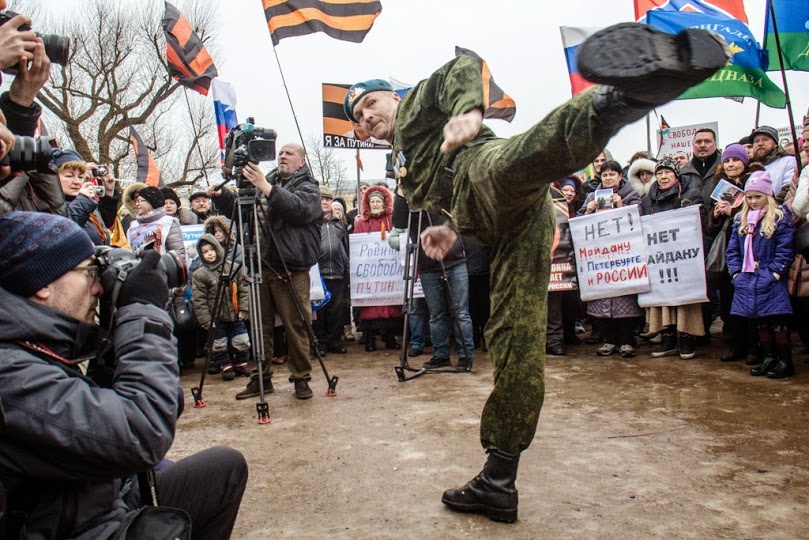
Staunton, February 22 – The Kremlin-organized Anti-Maidan demonstration in Moscow should not make Vladimir Putin feel secure because it was in reality an updated version of the Day of the Black Hundreds, Boris Vishnevsky says, groups organized by the tsarist regime to show support for the autocracy but that later did nothing to defend it.
Just as a century ago, demonstrators paid for by the regime or pushed to take part by their employers or officials went into the street to “denounce the revolution, praise autocracy, demand the preservation of the existing order and destroy ‘the enemies of the tsar and Fatherland,’” the Yabloko St. Petersburg city deputy says.
In its current incarnation, “the heirs” of the Black Hundreds denounce the Maidan, praise Putin and demand the destruction of ‘the Fifth Column,’” led by notorious Stalinists, supporters of Chechen leader Ramzan Kadyrov, and demonstrating by their slogans – including “’Putin is Better than Hitler’” – their level of sophistication.
Also like their tsarist-era predecessors, the Anti-Maidan organizers are spectacularly unfortunate in identifying themselves in this way, as becomes obvious, Vishnevsky says, if one compares the Maidan and the Anti-Maidan and if one considers how the Black Hundreds groups behaved when push came to shove — and how the Anti-Maidan people are likely to.
In Kyiv, people came into the Maidan “to drive out a corrupt regime.” In Moscow, they “came to the ‘Anti-Maidan’ in order to express their loyalty and support to the powers that be.” They did not demand the regime meet its obligations to the people but only and instead that “the power not change.”
That may sound good to Putin and his backers, Vishnevsky continues, but he ought not to be too encouraged by this. That is because “when his power begins to shake, not one of those who came to the ‘Anti-Maidan will come out in his defense” – just as a century ago, “not one of the Black Hundreds types came out to defend the tsarist power.”
But if Putin does not care to look that far back in time, he might consider a more recent example, the St. Petersburg deputy says. None of those who had shouted “’Glory to the CPSU!’” or denounced “’the crimes of American imperialism’” came out to defend the communist regime when it began to fall apart.
Indeed, he suggests, like their predecessors, those in the Anti-Maidan who “equate Putin with Russia” and swear that they will ‘not give him up’” will betray him among the first. If Putin doesn’t believe that” – and he probably doesn’t – “then let him ask Yanukovich,” an even more recent victim of the delusion of those in power about how much support they have.
But there are more reasons for Putin to be worried. The extremist slogans on offer in the Anti-Maidan action, including anti-Semitic tropes that also link it with the Black Hundreds of the end of the Russian Imperial period, the lack of support from those whose names were invoked, and the small size of Anti-Maidan actions outside of Moscow should be of even greater concern.
As Forum-MSK.org points out today, the workers of the Urals Wagon Factory (Uralvagonzavod) who Putin sees as symbolic of his support among Russia’s silent majority and who were referred to be speakers at yesterday’s event in Moscow are anything but enthusiastic about him and his policies.
Lacking new orders, that plant is cutting back production plans and laying off workers, a situation that is replicated at many industrial sites around the Russian Federation and that hardly is an advertisement for the successes of the Putin regime or a reason for workers to give it more than lip service support.
Outside of the Moscow ring road, there were a number of Anti-Maidan actions. But because the PR needs of the regime were largely satisfied by the 35,000-person crowd in Moscow that could be shown on television and because the regional governments now lack the resources to do more, they were very small, in some cases no more than a handful and in others only a few dozen or a few hundred.
The Kremlin may not care a lot about the size – few in the Moscow media and even fewer Western reporters will cover anything outside of the capitals – but it probably should be worried that those taking part were in many cases the very Russian nationalist extremists it has been prosecuting and that their slogans were even more extreme than those in Moscow.
Moreover, the Kremlin’s PR specialists may be nervous about what happened when regional media picked up on that: In many cases, they were not afraid to say that “the meeting in support of Putin … failed.” That is exactly what a Karelian news agency did.
In Petrozavodsk, the republic capital, the agency said, a meeting had been scheduled as part of “an all-Russian action ‘in support of national leader Vladimir Putin’” with slogans like “’It is [time] to drive out ‘the fifth column.’” But in the event, Vesti.Karelia.ru noted, “only 15 people” came out in behalf of those ideas.
It may be that the men in the Kremlin won’t take notice of this; but there is no question that the people of Karelia will.