In the (Solidarity) Zone

Russia: 19-year sentences for anti-war arson protest

Report by Solidarity Zone

The Central District Military Court at Yekaterinburg, in Russia, yesterday (10 April) handed down 19-year prison sentences to Roman Nasryev and Aleksei Nuriev, for firebombing an administrative office building where a military registration office is based.
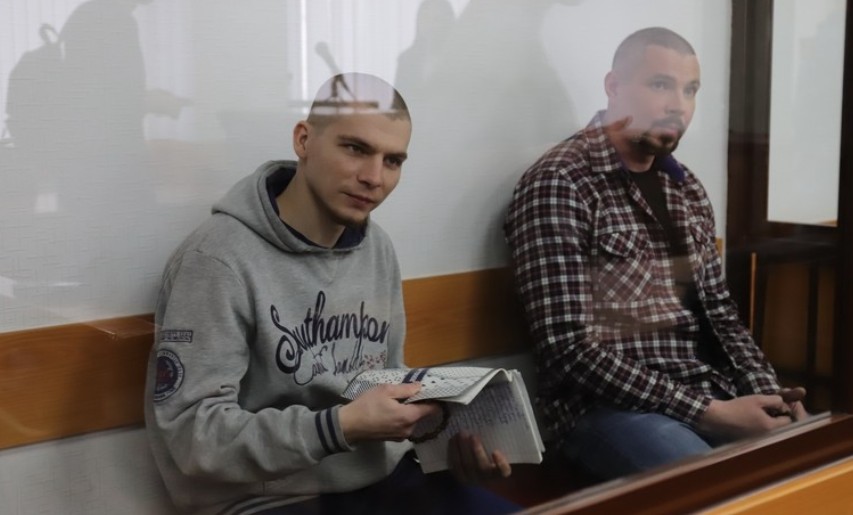
Roman Nasryev (left) and Aleksei Nuriev in court. Photo from The Insider

Roman and Aleksei will have to spend the first four years in prison, and the rest in a maximum-security penal colony.

This is the most severe sentence handed down so far for anti-war arson.

Roman and Aleksei received this long term of imprisonment because their actions were defined as a “terrorist act” (Article 205.2 of the criminal code of the Russian Federation) and “undergoing training for the purpose of undertaking terrorist activity” (Article 205.3). The latter Article carries a minimum term of 15 years.

The arson attack that Roman and Aleksei carried out – in reaction to the mlitary mobilisation, and to express their opposition to the invasion of Ukraine – was no more than symbolic. A female security guard was able to put out the fire, with a blanket and a few litres of water. There was damage to a window and some linoleum.

In court Roman Nasryev said:

I decided to carry out this action, because I did not agree with the [military] mobilisation, the “Special Military Operation” and the war as a whole. I simply wanted to show, by my actions, that in our city there is opposition to mobilisation and the “Special Military Operation”. I wanted in this way to make clear my opposition; I wanted my voice to be heard.

Solidarity Zone believes that this type of anti-war arson is not terrorism. That definition is politically motivated, and directly linked to the fact that the Russian government has unleashed a war of aggression against Ukraine.

□ Translated from Solidarity Zone’s Telegram feed. The original asks people to send letters and parcels to Roman and Aleksei in prison. If you are not a Russian speaker and you want to send them a message, there is no point in sending it directly. You can send messages to peoplenature@protonmail.com and I hope to be able to pass them.

More on Russian political prisoners

□ Who is Roman Nasryev? – The Russian Reader

□ “Azat means free.” – Posle Media

□ “We are few and we can’t cope with the stream of repression” – Avtonom.org

□ Solidarity Zone translations on The Russian Reader

□ Happy birthday, Kirill Butylin – People & Nature. (This includes links to more information about Solidarity Zone and Russian political prisoners in English.)

Source: People & Nature, 11 April 2023. Thanks to Simon Pirani for permitting me to reprint this post here. ||| TRR
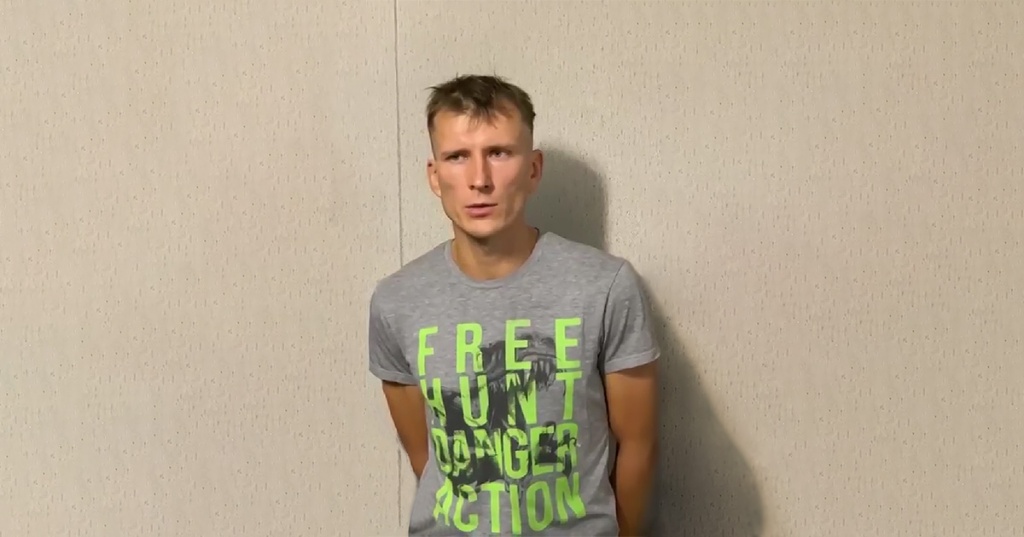

Pavel Korshunov

The case of Pavel Korshunov, accused of “terrorism” over anti-war arson, sent to trial

Pavel Korshunov was detained in the city of Togliatti, Samara Region, as if he were a particularly dangerous criminal — a large number of Interior Ministry special forces soldiers were involved in his capture. But, according to investigators, all that Pavel did was set try and set fire to the Togliatti city administration building the day after the mobilization was announced. In a video posted online by the security forces, Korshunov states that he wanted to impede the mobilization.

Before his arrest, Pavel worked at a boathouse. Citing sources in the security forces, the media also write that Korshunov had previously taken part in protests.

Pavel has been charged with “committing a terrorist act” (per Article 205.2.b of the Russian Federal Criminal Code) and “vandalism” (per Article 214.2 of the Russian Federal Criminal Code). He faces from twelve to twenty years in prison if convicted.

On April 7, his case was submitted to the Central District Military Court in Samara. It will be tried by a three-judge panel chaired by Igor Belkin. There is not yet any information about exact trial dates on the court’s website.

Source: Solidarity Zone (Facebook), 9 April 2023. Translated by TRR


Boris Goncharenko

Help a teacher from Krasnodar accused of terrorism!

On the night of October 6, persons unknown set fire to the military enlistment office in the city of Goryachy Klyuch, Krasnodar Territory. The next day, the security forces detained two suspects — Bogdan Abdurakhmanov, a 27-year-old native of Minsk, and Boris Goncharenko, a 34-year-old man from Krasnodar.

Abdurakhmanov and Goncharenko were initially charged with “attempted destruction of property” (per Article 30.3 and Article 167.3 of the Russian Federal Criminal Code) and thus faced no more than three years and nine months of imprisonment if convicted. The FSB intervened in the case, however, and the charge was changed to “committing a terrorist act” (per Article 205.2 of the Russian Federal Criminal Code). Bogdan and Boris now face from twelve to twenty years in prison.

Goncharenko graduated from Kuban State University. After graduating, he taught history, social studies, and philosophy at various educational institutions. At one time he worked as a manager for the Garant and Konsultant Plus legal information portals.

Boris does not support Russia’s aggression in Ukraine, and after the outbreak of the full-scale war, he was very worried about the fate of the conscripts, including his former and current students.

Goncharenko does not consider himself guilty of “committing a terrorist act.”

Why torching military enlistment offices is not terrorism

Solidarity Zone has found a lawyer to defend Boris Goncharenko and made a down payment on their fee so that they may begin working. On March 29, we announced a campaign to raise the 250 thousand rubles necessary to pay the lawyer’s fees in full during the investigation phase of the case. To date, less than one fifth of the amount of money needed has been raised.

We urge you to support our fundraiser with donations and reposts!

💳 Sberbank card:
2202 2025 4750 6521 (Vasily)

🪙 PayPal: solidarity_zone@riseup.net (mark it “for Goncharenko” and designate the payment in euros if possible)

🥷 Cryptocurrency (be sure to email us at solidarity_zone@riseup.net if you transfer cryptocurrency to support Boris Goncharenko):

Monero:4B1tm6boA5ST6hLdfnPRG2Np9XMHCTiyhE6QaFo46QXp6tZ7Y6nJjE43xBBTwHM84bWwexR8nS4KH36JHujjc1kC8j2Mx5e
Bitcoin: bc1qn404lrshp3q9gd7852d7w85sa09aq0ch28s3v4
Ethereum: 0x7CE361fA7dAb77D028eaEF7Bbe2943FDF0655D3E
USDT (TRC20): TRcCUHKSMY7iLJPvbDxLc6ZnvAud72jTgj
Other altcoins: https://nowpayments.io/donation/solidarityzone

You are not violating any Russian laws by participating in the fundraiser. We have not been deemed “foreign agents” or an “extremist” or “terrorist” organization by the authorities, and raising money to pay a lawyer’s fees is not prohibited in Russia yet. ☺️

Source: Solidarity Zone (Telegram), 6 April 2023. Translated by TRR
The Fire in Uryupinsk and Elsewhere

Guryanov Sergei @Segozavr
A man backed his car up to the building housing the draft board [conscription office] and began tossing Molotov cocktails. 100 square meters were destroyed by fire. Uryupinsk, Volgograd Region, Russia, 26.09.2022
.

Source: Twitter. Translated by the Russian Reader. “The name of this town is known to many Russian people as a synonym for ‘backwater town.’ This usage became widespread after the popular Soviet film Destiny of a Man. The film was based on a short story by Mikhail Sholokhov, and Uryupinsk was the place of the action, shown as an inconspicuous provincial town.”


A screenshot of the visuals in Mr. Stupin’s original post

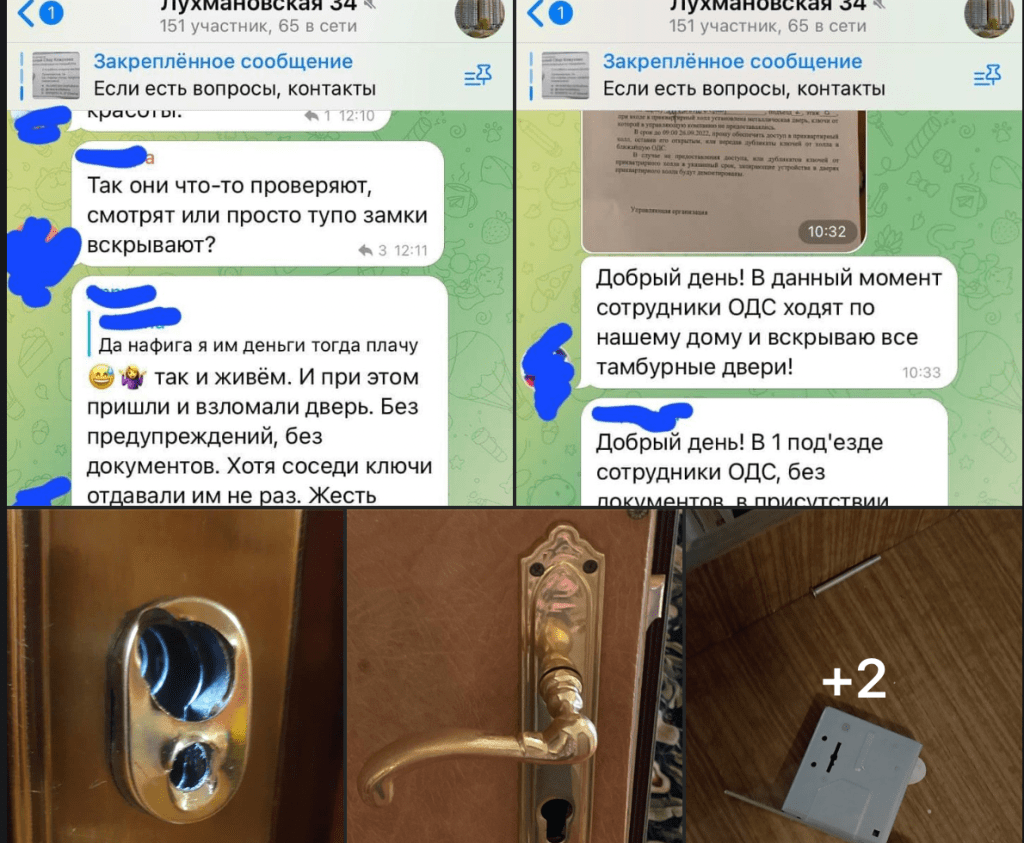
In Moscow’s Kosino-Ukhtomsky district, housing authority employees and police officers, without showing their IDs, have been breaking open front doors in the staircases of residential buildings in order to serve residents with summonses to the military enlistment office! Some residents have already been issued threats that the electrical wires to their apartments will be cut if the men do not open the door to receive a summons!

Source: Yevgeny Stupin, Facebook, 26 September 2022. Thanks to Alexander Kynev for the heads-up. Translated by the Russian Reader


A telephone call I got yesterday from a female acquaintance has made me think about the economic consequences of the “mogilization” [literally, “grave-ization,” a play on the word “mobilization”]. I confirmed her fears that her son would be among the first to be mobilized. And that they would come looking for him first at his registered address, then at his workplace. Consequently, the solution to his problem would be to quit his job and go live somewhere in the boondocks for a year, even if there was no work there.

And now look — not only those who are called up will vanish from workplaces, but also those who dodge the draft. To get the three hundred thousand men declared [by Putin as the goal of his “partial mobilization”], they have to slap the asses of at least a million men with draft notices and dragnets. I’m not an economist and I cannot even estimate numerically what kind of blow to the country’s GDP will be caused by the withdrawal of at least half a million employees.

By the way, the mobilized must be fired [by law]. It is not very clear whether their jobs will be kept for them in any way. But [officially] they will not be listed as on leave, but as having been called up from the reserves to military training camps. They will simply be dismissed from their jobs, and they will have to be paid in full.

Really simple vacancies can be filled by migrants from Central Asia, but it is another matter whether they will go and fill them. Currently, the exchange rate has been maintained at a level that is favorable to migrant workers, but as soon as the volume of imports grows (and it will grow: there will be other sources, gray market goods/parallel imports, and so on), this rate will inevitably begin to sink. Consequently, the economy will take a simultaneous triple hit around December:

1) On December 5, a complete ban on the delivery of Russian crude oil to the EU will come into effect;
2) hundreds of thousands of people will be laid off in October, November, and December;
3) and the exchange rate will go crazy.

By the way, state-funded and quasi-state-funded organizations will face the biggest problems. Petersburgers are no stranger to it, but the snow will definitely not be removed this year, either.

That’s my economic forecast for you. It’s going to be a clusterfuck, my fellow Russians.

Source: Vladimir Volokhonsky, Facebook, 22 September 2022. Translated by the Russian Reader


Yesterday, Vladimir Putin announced a “partial” mobilization, which is actually a total mobilization. His decree sets no restrictions on age, qualifications, regions, and the number of people mobilized. Already today, we see that everyone is being called up.

Source: Navalny LIVE, YouTube, 22 September 2022. Annotation translated by the Russian Reader. The video has already been viewed over 2.6 million times since it was posted. It has no subtitles in English, but the message from the lawyer in the video is clear and simple: there is no such thing as a “partial” mobilization, so all draft-age men must avoid being called up and serving at all costs, especially since Russia’s “special operation” in Ukraine is illegal and criminal.

Monetochka, “Burn Burn Burn”

The stats don’t lie, alas
Surveys and forms
Bad numbers, a hard year
But I sing in vain

I replace fabric with foil
Paste a bandage on my webcam
You can’t swing a cat without hitting
The wall-to-wall government

It’s gray and dressed in designer jeans
An absurdity, a caricature
It’s funny: culture has ended
In a multicultural country

The lights are out, the coffin’s made
And I’m cloud sad
In the land of Yesenin’s poems
Art is finished

(Refrain)
Now there’s only ash on the ground
Dig and search where you like, not a soul around
Burn, my country, burn
Don’t put it out, oh, don’t put it out, don’t put it out

The piano in the city park
Is really quite upset
Someone terrible bangs on it
A blue note blacker than night

A boondocks Banksy roams there
In a black hoodie
The lines he spray-paints on the corners
Are the words to this song

The rap of Moscow parties
And northern suburbs blackens
While in my black robe I pray
And my God hears: amen

God sees the shining cross
But I know it won’t help
For there are few too white spots
On my black skin

(Refrain 2x)
Now there’s only ash on the ground
Dig and search where you like: not a soul around
Burn, my country, burn
Don’t put it, oh, don’t put it out, don’t put it out

_______________________________________

Monetochka
VK
August 9, 2019

PREMIERE!

💿💿💿

Monetochka, “Burn Burn Burn”

News about the forest fires in Russia appears in our news feeds less and less frequently, but the problem has not gone away. Today, August 9, the peak of the forest fires was recorded, and yet firefighters are battling the blazes in only seven percent of the affected areas. We have to deal with his problem not only by taking emergency measures but also by engaging in year-round prevention. Volunteer forest fighters tell children and adults about the fires and help extinguish outbreaks at the early stages. But they lack money for training and doing their jobs.

All the money raised when people listen to this track on streaming services will go to purchase backpack pumps, spray guns, and navigators. It will also cover other vital expenditures in Greenpeace Russia’s campaign to combat fires in natural areas, including amending school textbooks, some of which have been found to give erroneous advice on extinguishing and preventing fires.

From August 16, the new track will be available on all other venues. As soon as we get the first stats on the number of listens, we will start helping out financially. Reports will be posted here and on other social networks.

Let’s make the world better together. 💚

For more details, go to https://pomo.sh/monetochka

monetochka-burning

On August 9, Valentin Tarabrin commented, “These fires are a cover-up for illegal deforestation. Millions of hectares are being cut down. Open Google Map and you will see nothing is left of Siberia. These fires are deliberate arson.”

Image courtesy of Monetochka’s VK wall. Translated by the Russian Reader

Chop It All Down!

Chop It All Down! Molotov Cocktails versus Woodland Defenders in the Town of Zhukovsky
Maria Klimova
Mediazona
July 13, 2016

Photo by Fyodor Karpov

Over the past month, several environmentalists in the Moscow Region town of Zhukovsky fighting against the illegal logging of trees to make way for construction have suffered at the hands of persons unknown. Two of them have had their cars set on fire and burned, while a female activist had a Molotov cocktail thrown at her windows. Municipal authorities see no reason to worry yet, although the victims are certain someone has been trying to intimidate them.

Around four o’clock in the morning on June 15, a Molotov cocktail was tossed at the windows of the flat occupied by Zhukovsky activist Olga Deyeva, who lives on the first storey of a block of flats. Hearing a bang, which set off the alarms of cars parked in the yard, she looked out the window and saw shards of glass on the pavement. What turned out to be a broken bottle was wrapped in electrical tape and a thick layer of solvent-soaked cloth. According to police summoned to the scene by Deyeva, the persons unknown had failed to ignite the cloth, which had been soaked in a flammable liquid. According to Deyeva, the assailants had aimed at her window but had missed, and the bottle had hit the window frame.

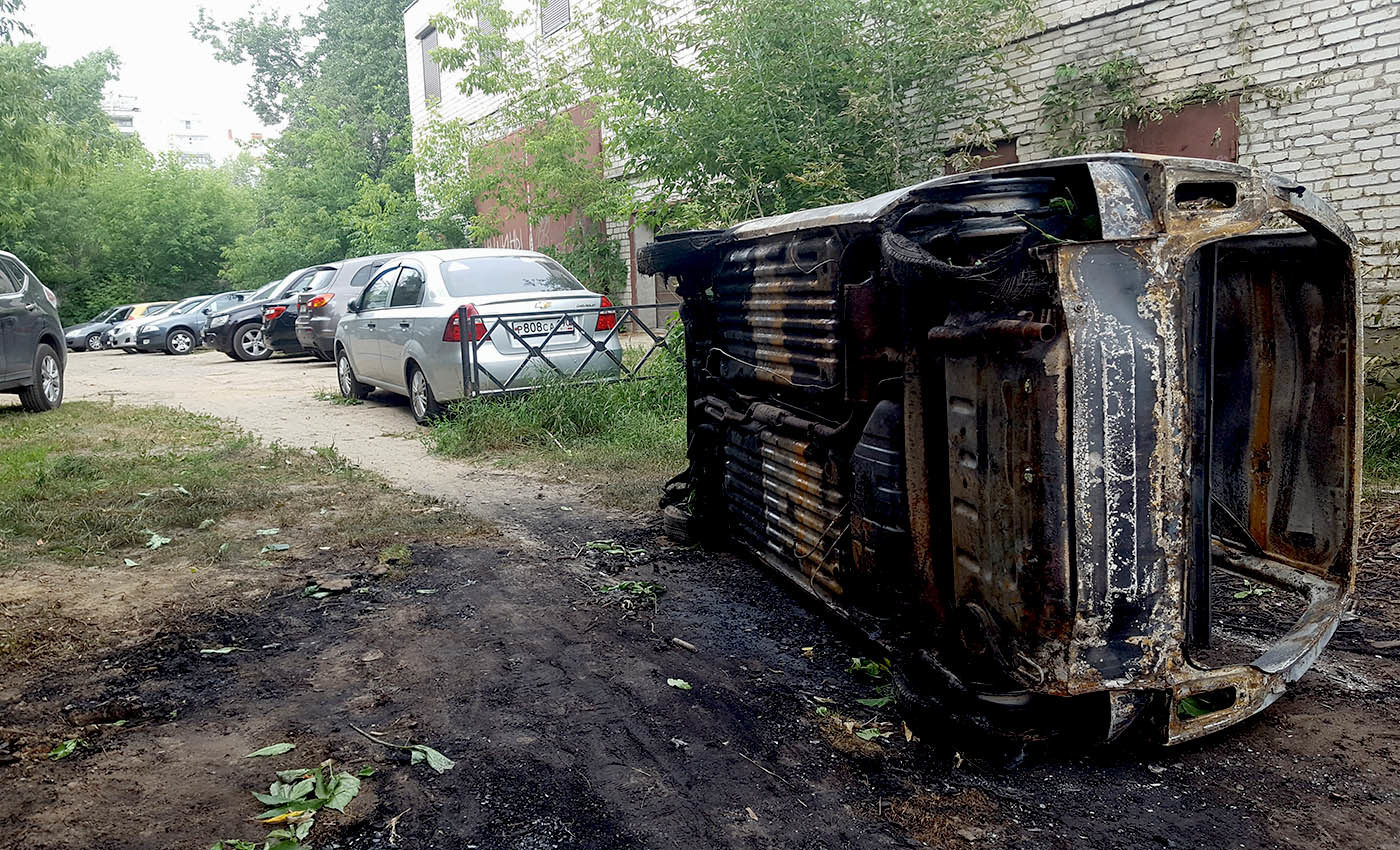
A week and a half later, on June 27, a Ford Focus owned by Mikhail Yuritsin, an environmentalist and member of the grassroots organization Lyubimy Gorod (Beloved City), was torched and burned. According to Yuritsin, he heard the loud sound of glass being broken at around three in the morning, looked out the window, and saw his car burst into flames. Yuritsin was unable to extinguish the fire, and the car was completely destroyed. Cars parked next to it were mildly damaged, as firefighters arrived quickly on the scene.

In addition, a car used Svetlana Bezlepkina, a Yabloko Party member who sits on the Zhukovsky city council, was torched in the early hours of July 7.  Although the car was registered to the council member’s sister-in-law, Bezlepkina often used it herself.

“Yes, I have used the car. I used it for business when I needed, and everyone knew it. You couldn’t think of anything more cynical: my brother and sister-in-law had their wedding that day. After celebrating at a cafe, they came home and parked the car, and during the night it was torched. Then the police showed up, took our testimony, and that was all. They didn’t really take a hard look at anything. On the other hand, what do you expect from a police force who back in the day guarded loggers chopping down a forest,” said Bezlepkina.

A suspicious incident happened the same day to Fyodor Karpov, leader of the Yabloko Party’s Zhukovsky branch. Persons unknown torched an abandoned car, which had recently been left outside the gate to his garage.

Karpov related the sequence of events.

“The abandoned car drifted around the yard for two weeks, and then it ended up in front of my gate. I gently shoved it away from the gate, but on a day I was attending a court hearing on illegal construction in the forest, it was torched.”

Except Karpov, all the victims are plaintiffs in a lawsuit against Zhukovsky city hall and businesswoman Irina Gorodnova, who has been given permission to build a consumer services center on Nizhegorodskaya Street and a children’s center on Semashko Street. Both lots slated for construction are located on woodlands in the city limits.

Local residents began vigorously fighting to save their woodlands in 2012, when the authorities announced the construction of an access road from the M5 Ural Highway that would pass through the Tsagov Forest. When workers began clear-cutting a twelve-hectare site, grassroots protests erupted throughtout the city, and activists set up a camp in the woods, later dispersed by private security guards. The protesters proposed several alternate routes for the road. Several months later, Sergei Shoigu, who had recently been appointed governor of Moscow Region, intervened in the conflict. He criticized the actions of the Zhukovsky authorities and spoke of the need for dialogue with the public, but his statements had no impact on the situation. The access road to the city was built through the forest.

1109928 02.05.2012 Плакат в лагере защитников Цаговского леса в Жуковском. Гражданские активисты-экологи протестуют против вырубки леса для строительства новой трассы. Артем Житенев/РИА Новости
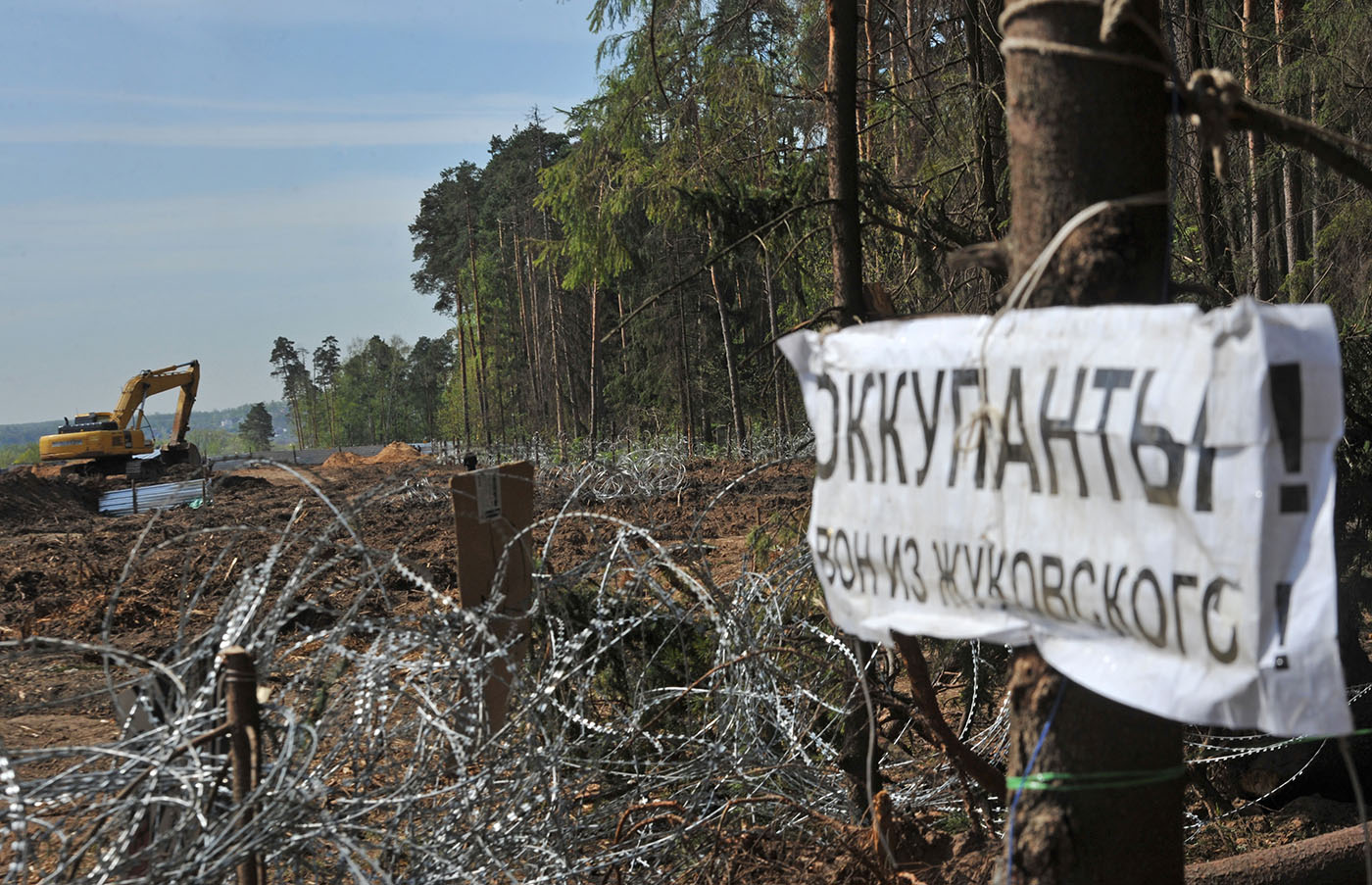
A placard in the camp of people defending the Tsagov Forest in Zhukovsky, May 2, 2012. The placard reads, “Occupiers! Get the hell out of Zhukovsky.” Photo: Artyom Zhitenyov/RIA Novosti

A year after the conflict over clear-cutting in the Tsagov Forest broke out, Alexander Bobovnikov, mayor of the city, lost his post. He resigned after a meeting with Andrei Vorobyov, who had succeeded Shoigu as governor of Moscow Region. Andrei Voytyuk was elected to Bobovnikov’s post. In 2013, protests against logging in Zhukovsky broke out again when it transpired that municipal authorities had issued long-term leases to woodland lots. 5,000 square meters of woodland were allocated for construction of a consumer services center on Nizhegorodskaya Street, while another lot measuring 6,000 square meters was allocated for construction of a leisure center in the woods near the railroad station. Activists entered into a prolonged legal battle with city hall and the potential developer.

“According to the documents, in 2010, Natalya Lebedeva, head of Stimul-K, Ltd., obtained preliminary permission to rent the lot. But Lebedeva herself claims she never came to Zhukovsky in 2010, and signed no rental agreement. In 2012, she decided to get rid of the company and she transferred it to another person so he would close it. But he failed to do this and, apparently, used the company. Later, the lot was transferred to Gorodnova,” explains Olga Deyeva.

According to Deyeva, permission to lease the lot had been issued, apparently, by Stanislav Suknov, Bobovnikov’s deputy, who served as acting mayor of Zhukovsky for a couple of months in 2013.

“We have been trying to prove in court there was no preliminary agreement to rent the land. The paperwork was drawn up after the fact so as not to violate the city’s General Development Plan, adopted in 2012,” explains Deyeva.

The right to rent the woodland lots now belongs to businesswoman Irina Gorodnova. Zhukovsky activists are afraid municipal authorities might try and bypass the 2012 General Development Plan and rezone the woodland lots to permit construction of residential buildings and shopping centers on them. That, ultimately, was what happened to the lot on Nizhegorodskaya Street. Without holding public hearings and without involving city council members, the Zhukovsky City Court rezoned the area from recreational use to residential use and thus suitable for redevelopment. Immediately after obtaining the construction permit, Gorodnova also obtained a permit from municipal authorities to fell deadwood. According to Deyeva, however, workers cut down healthy pine trees while clearing the deadwood.

“When this came to light, Gorodnova batted her eyes and said, ‘I don’t know how it happened. I was abroad at the time.’ Policemen guarded the logging process. Ultimately, the ‘illegal’ loggers were not located and punished, but the story made such a big splash that Gorodnova was unable to open the consumer services center she had built on the lot. On the basis of this violation, the municipal authorities went to court and terminated the lease on the land,” says Deyeva.

Now it was Gorodnova’s turn to go to court. She demanded the court recognize her ownership of the consumer services center, and in October 2015, Zhukovsky City Court granted her claim. Activists asked city hall to appeal the decisions, but the local authorities failed to do this.

“City hall was not about to challenge the ruling. They could not even explain why. So now we have been handling the litigation ourselves,” explains city council member Bezlepkina.

The appeal hearing has been scheduled for July 25.

The status of the second woodland lot, on which Gorodnova’s company had planned to build a leisure center, has not yet changed. It is still zoned for recreational uses, where it is forbidden to erect any structures.

In February 2015, however, activists discovered large round holes in the bark of pine trees on the site of a planned clear cutting. The holes had been presumably made with a drill. A total of seventy-eight trees had been damaged in this way. Local residents marked each of the trees with green paint and photographed them, subsequently filing a complaint with the police. After an inspection was carried out, police refused to open a misdemeanor investigation. Staff at the Zhukovsky municipal environmental and land management technologies department had assured police there was no danger of the trees weakening and dying. Many of the damaged pine trees that once grew on the lot slated for development have now indeed died. The forest’s defenders believe they were damaged deliberately. Developers thus decided to get rid of trees that were preventing them from launching construction.

According to Valentin Ponomar, who has been representing Gorodnova’s interests in court, the land plot rented for construction of the leisure center is now not being used by anyone in any way.

“The lease runs out soon, in 2017. During this time, the city has to issue a construction permit. There is no permit at present, just as there are no plans to build the children’s center,” Ponomar explained to Mediazona.

According to Ponomar, without such permission, the development company cannot commence construction in a green belt zone. Moreover, city authorities cannot issue such a permit due to the land plot’s status. Ponomor was unable to explain why his client concluded an agreement with the city on such conditions.

In an interview with Mediazona, Zhukovsky Mayor Andrei Voytyuk said he was unaware of the arsons of the urban activists’ cars, although he had heard about the Molotov cocktail thrown at Deyeva’s window.

“I’ll tell you this. If they had wanted to set fire to her, they would have done it,” the mayor commented on the incident.

He expressed his willingness to meet with the urban activists victimized by criminals.

“They can meet and talk with me if they wish, but so far no one has reached out to me,” said Voytyuk.

Bezlepkina is certain the torching of the cars will never be investigated.

“Now it is a matter of intimidation, but no one knows how far it might go. Our families are fearful. They have asked us not to attend the court hearings. They are afraid they might be in danger,” says the city council member.

The case of the Molotov cocktail tossed at Deyeva’s window has been assigned to the local beat cop.

“I went to see him, but, apparently, they are not planning to make any complicated moves in this connection. There was no damage either to my health or my flat. So I wouldn’t rule out the police will be working in keeping with the principle ‘No body, no case,” Deyeva admits.

Translated by the Russian Reader

Burning Down the House

Pop singer Seal performs for Ramzan Kadyrov, Jean-Claude Van Damme, and other VIP guests at
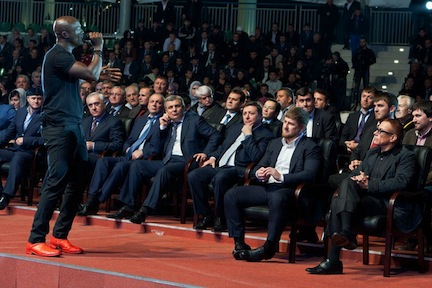
Pop singer Seal performs for Chechen leader Ramzan Kadyrov, Jean-Claude Van Damme, and other VIP guests during a ceremony to mark Kadyrov’s 35th birthday and City Day celebrations in Grozny, Chechnya, October 5, 2011.

“Chernovik”: Man Who Complained to Putin about Kadyrov Has House Burned Down in Chechen Village of Kenkhi
Mediazona
May 13, 2016

According to Chernovik, the house of local resident Ramazan Dzhalaldinov, who had complained to Vladimir Putin about the Chechen authorities, had his house burnt down late on the night of May 12 in the village of Kenkhi, in Chechnya’s Sharoy District.

As Dzhalaldinov’s wife told Chernovik, around midnight, masked men entered the house. They said they had come to rescue them. The women and three daughters were put in a car, but later were thrown out under a bridge.

“And the house was set on fire. Residents of the village have been forbidden to say anything on the topic under threat of their houses being set on fire,” she said.

A few weeks ago, Ramazan Dzhalaldinov recorded a video appeal to President Vladimir Putin in which he spoke about the poor living conditions in the villages, the houses left destroyed after the two military campaigns of 1994-1996 and 1999, and the corruption of local officials. After posting the video, Dzhalaldinov left the republic.

In late April, the other villagers corroborated Dzhalaldinov’s complaints to a correspondent for TV Rain. Afterwards, villagers who had spoken with the reporter were detained by Chechen security forces.

On May 6, Ramzan Kadyrov, acting head of Chechnya, visited the village of Kenkhi and spoke with several residents, who once again confirmed what Dzhalaldinov had related in his video message.

Kadyrov promised to repair roads and tower complexes in three months, supply the village with natural gas lines, and build mosques in the Sharoy District.

After Kadyrov’s visit, Grozny TV aired a report in which it was claimed that “residents of the village publicly condemned the conduct of [their] countryman” Ramazan Dzhalaldinov.

Village of Kinkhi, Sharoy District, Chechnya

Translated by the Russian Reader. Photos courtesy of Human Rights Foundation and Panoramio.