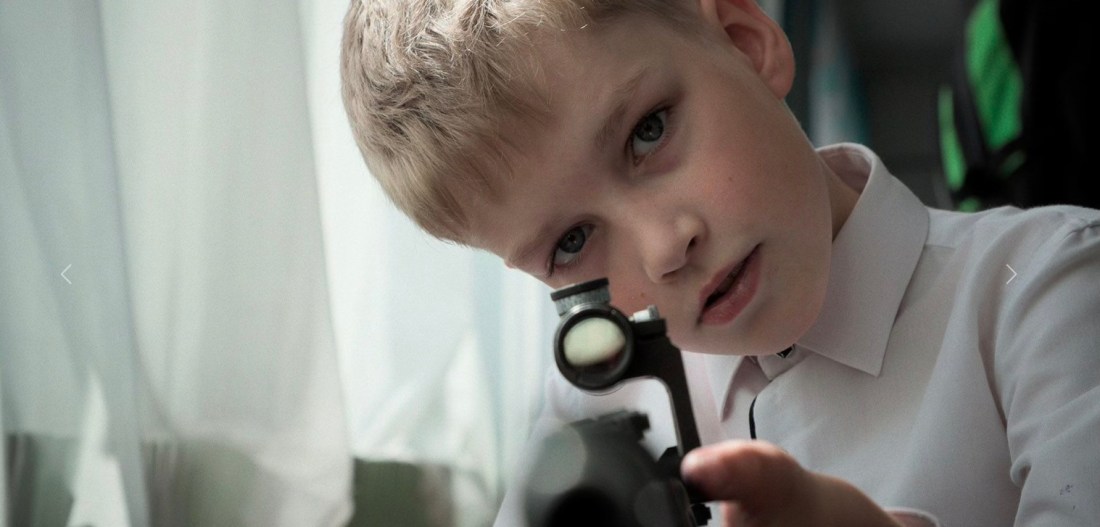
Mr. Nobody and His Critics

Nobody About Nothing

Russian films don’t win Oscars every time out, so I finally made up my mind to watch the movie Mr. Nobody Against Putin. It turned out that the film wasn’t about a school, the war, Russia, or Putin—it’s Pavel Talankin’s film about himself. The film begins with him and ends with him. He’s in almost every scene in between. And it goes on like that for ninety minutes.

I don’t know if you can call a film a documentary when the vast majority of its scenes are staged. I suppose you can, but the Academy’s members know best. I’m not a film critic, and my opinions are purely those of an amateur. I’m a mere viewer.

I was amazed by how tacky the self-promotion was. I mean, it is just off the charts. Here comes the protagonist, taking what he calls a “super risk”: he tapes the letter X on the school’s windows over the letter Z. He claims that the X is a symbol of protection for Ukrainian refugees. (?) And here he is, secretly but on camera, ripping the Russian flag from the school’s roof, as witnessed by a cameraman* and Talankin himself. And there he is getting a haircut—a charming, intimate detail, certainly vital for understanding the current state of affairs Russia’s regions. When the toilets in the school’s bathroom flashed on screen, I feared that Talankin would be in the starring role there too, but that didn’t happen, thank God.

It’s funny that Talankin has arranged the books in his home by the color of their spines, and it’s even funnier that, while looking every bit the diehard undergrounder and following the orders of a mysterious overseas handler, he messes around with hard drives that must be smuggled out of the country. We’re living in the twenty-first century, so what prevents Talankin from uploading at least a few gigabytes of video footage to the cloud or transferring it via FTP, instead of lugging the hardware through customs? But I get it: that would not be cinematic, and the documentary would have suffered.

Whether the documentary suffered because Talankin filmed children and adults without informing them of his objective is a question for the Academy’s members. Perhaps this is acceptable in the American cinema, but journalists are obliged to honestly tell interviewees on whose behalf they are interviewing them and to what end.

I’m not arguing with the fact that Talankin’s film won an Oscar. If Barack Obama got a Nobel Peace Prize for the color of his skin, and Bob Dylan got a Nobel Prize in Literature for his songs, then why shouldn’t Pavel Talankin get an Oscar for a docudrama about Pavel Talankin? It’s all good.

Something else makes my blood boil. It’s not even the profanity that is liberally sprinkled throughout the film. That’s just how the characters express their folksiness. I get that. What makes my blood boil is the extraordinary ease with which Talankin switches from serving the regime as a propagandist to a new job on a new project. Before he was hired to make the film, he faithfully played the despicable role of a Putin propagandist, organizing and filming pseudo-patriotic productions on orders from his superiors. He sends reports to the Ministry of Education. He reshoots when the first take doesn’t turn out. He corrects the teacher who repeatedly fails to pronounce the word “denazification”—and again, he does take after take. Everything has to look perfect. That’s the job. He gets paid for it.

It would be fine if Talakin didn’t get it, like the moronic history teacher who garners so much screen time in the film. But no, Talankin gets it all. He films what he himself calls “show lessons.” He admits that he works in propaganda: “It wears me out.” While filming a pro-war car rally he laments, “I have to play by their rules.” Why does he have to play by their rules? Is there no other way for him to make a living? He cannot fail to realize that he’s just as much an obedient cog in the propaganda machine as the history teacher. Only Talankin’s caliber is smaller, and his threads are thinner. He doesn’t explain why he has to play by their rules. But it’s obvious anyway, and there’s a universal explanation for it: honest work pays less and demands a heavier workload. The entire propaganda machine in an authoritarian regime is based on this. There’s always a way out if you want out.

But then something clicked, Talankin’s fortunes changed, and now all the video footage he had painstakingly compiled was put to a new use. Up until that point, he had worked in the field of pro-government propaganda; now he would work to expose it. Why not kill two birds with one stone? Everything must be put to use, not a single frame should be wasted.

People sometimes do suddenly acknowledge the harmfulness of their work and make a complete U-turn. Such things do happen, thank God. But if they do it sincerely, and not for opportunistic reasons, their conscience torments them over their past deeds; they suffer, and they seek to atone for the past through their new endeavors. They don’t gloss over the mistakes they have made in life. Such people are instantly recognizable: they do not flaunt their rewards, they take no delight in newfound fame, and they often pay a heavy price for the new path they have gone down. Talankin’s is a different case entirely. His is merely an elegant segue from one cushy job to another. In that sense, we can certainly congratulate Mr. Nobody on his success.

* Podrabinek’s is the only review of Mr. Nobody Against Putin which I’ve read that mentions the mysterious second cameraman (who is clearly a consummate professional), although they were apparently on location in Karabash for months on end. In the film’s credits, they are identified only as “Anonymous,” but their palpable presence is not otherwise mentioned or explained, not even in the film itself. ||||| TRR

Source: Alexander Podrabinek (Facebook), 18 March 2026. Translated by the Russian Reader


MR.NOBODY AGAINST PUTIN?

Many years ago, as a graduate student at UMICH in Ann Arbor, I took two semesters on Nabokov with the late Omri Ronen – one of the most extraordinary intellectual experiences I had there, and that’s saying something.

We spent a great deal of time on Lolita, especially its dialogue with Dostoevsky’s “cult of feelings,” and on Humbert Humbert as a “romantic” yet profoundly unreliable narrator. Ronen often emphasized that while it is natural to sympathize with a narrator who claims to be in love, Nabokov refuses to do the reader’s ethical work for them. Humbert Humbert is a criminal who destroys Lolita’s life – something she herself makes clear by the end (“He broke my heart. You merely broke my life.”) The reader’s task is not to be disarmed by his rhetoric, but to remain morally alert and to imagine the experience of his victim.

Watching Mr. Nobody Against Putin and reading its reception, I could not help but think just how thoroughly this lesson seems to be missed by those celebrating the film and its narrator, who is every bit part and parcel of the phenomenon he set out to document.

The film centers overwhelmingly on Pavel Talankin’s feeeeeelings, granting them disproportionate narrative space, something not uncommon in Russian films about Russia. His attachment to Karabash and its people, to the textures of Russian life (the ugly Soviet prefab panel blocks that have gained a somewhat romantic vibe among the younger Russians, the harsh winters, etc.) is rendered with great sympathy. So too is the school environment. But Talankin’s commitment to “loving” the bleak, the outwardly ugly, and the brutal is not just an aesthetic quirk — it’s a moral stance. What is strikingly absent in all of it is Ukraine and its people, which is only briefly mentioned as a destination, not a society under attack. Russian children are not just being indoctrinated to volunteer, to be mobilized, and to die, they are being prepared to kill and that is what they do in Ukraine — something, which is not even once mentioned.

There is also an obvious schism between the reality Talankin documents and the way he interprets it. In his account, he appears to be the only figure with agency — the only one capable of making meaningful choices — while everyone else is stripped of agency and reduced to a passive recipient of propaganda. Even the sinister history teacher, the school’s most zealous and vicious propagandist, is described as “brainwashed.” But if that is the case, who, exactly, is doing the brainwashing? These are the very people who inculcate cynicism, cowardice, and doublethink in their students, they are actors in this process, not victims, and they do have moral choices, just like everybody else. (It is also worth noting that the community is neither visibly poor nor destitute — undercutting the familiar explanation that people volunteer to kill because poverty leaves them no choice.)

Again, this is not just an aesthetic imbalance, but also a moral one, with the focus remaining on “our” suffering, “our” losses, “our” children, not what we and these children have done to others. As a result — just as Omri Ronen warned his sophomore Nabokov students — the aggressor is sentimentalized, and his perspective eclipses that of his victims.

P.S. I also watched Ksenia Sobchak’s documentary about so-called “black widows” — women who marry Russian soldiers, often under dubious circumstances (with grooms heavily intoxicated), and later claim substantial compensation after their deaths. In contrast to Pavel Talankin’s film, it’s really hard to sympathize with any of the people on the screen. Sobchak’s role within the Kremlin’s propaganda ecosystem is well documented; what is worth briefly noting here is how thoroughly this story (and Russian “society” at large) is framed as a story about women: as caregivers, opportunists, con-artists, bereaved wives, or negligent, alcoholic mothers and grandmothers who affect the fates of men, entirely at their disposal.

Men, by contrast, are consistently infantilized, cast as troublemakers, drifters, habitual drinkers, and absent fathers with no clear purpose in life. But invariably “nice”: women say (posthumously) that they are sorry for them (again, barely a reference to what these men did to Ukrainians). In this framing, war supplies these men what their civilian lives lack: purpose, agency, a “heroic”, manly identity, a sense of belonging, and a handsome income – leaving behind, in the end, something for the women to remember them by.

Source: Ksenia Krimer (Facebook), 18 March 2026. Thanks to Alexandr Wolodarskij for the heads-up.


Hello! This week we cover how Oscar-winning documentary, Mr. Nobody Against Putin, went down inside Russia, and why it’s caused a stir among both the Kremlin’s backers and its critics.

Russians fight over Mr. Nobody

Earlier this month, Russia won the Best Documentary Oscar for the first time in more than 80 years. Well, sort of. The statuette went to Mr. Nobody Against Putin, a Danish-Czech production directed by Pavel Talankin, a young teacher from a small town in the Urals, who documented pro-war propaganda inside Russia’s school system. Western critics were enthusiastic about its take on the militarization of schools amid the invasion of Ukraine. Russian officials and propaganda outlets were, unsurprisingly, not so keen on the film. But interestingly, even some anti-war campaigners have criticized the movie, accusing Talankin of making a shallow diatribe that did not advance our understanding of Russia’s wartime propaganda machine.

The documentary tells the story of educator and school videographer Talankin and his school in Karabash, a small industrial town of about 10,000 people in the Urals region of Chelyabinsk. Talankin, now 35, was a highly respected teacher in his hometown. In 2018, he won the regional “Leader of the 21st Century” competition, his students won an award at a local festival for a movie shot under his direction, and in 2021 the town’s mayor praised a virtual model of Karabash that Talankin’s students had created in Minecraft.

After Russia’s invasion of Ukraine, Talankin was assigned to film propaganda lessons in which children were taught Kremlin talking points about the war’s supposedly noble aims, and the unfairness of the West towards Russia. Talankin and US documentary filmmaker David Borenstein got in touch via an online advert in Russia seeking people whose lives had been changed by the invasion. The videographer offered to use the footage he was obtaining as part of a joint documentary. Talankin carried on working and then eventually smuggled hard drives containing two-and-a-half years of footage out of Russia. 

The clips from the propaganda lessons — called “Conversations about Important Things” in Russia — were the centerpiece of the film. In one scene, a teacher, reading a propaganda script, struggles to pronounce the words “denazification” and “demilitarization”, two of the official reasons the Kremlin gave for its war. In another, a history teacher (the film’s main antagonist) tells children how in the near future France and Britain will soon face economic collapse as people there are already starving due to sanctions on Russia. Another scene shows mercenaries from the now defunct private Wagner militia advising children how to throw grenades.

What Talankin showed from one school in a provincial town is the same as what’s happening in thousands throughout Russia. After the invasion of Ukraine in 2022, the state embraced mass propaganda in education. Lessons with war veterans were already commonplace, as were issuing Kremlin-approved justifications for the 2014 annexation of Crimea and the seizure of Ukrainian territory. Watching the film, it’s easy to imagine how the exact same “Conversations about Important Things” are happening right across Russia on a daily basis from Moscow to Vladivostok.

The award was [a] surprise, with US film The Perfect Neighbor going into the Oscars as the favourite. According to renowned Ukrainian producer Alexander Rodnyansky, Mr. Nobody Against Putin won out for its portrayal of a “dumbing down mechanism” that could be applied in multiple countries. 

However, despite winning the most prestigious documentary prize on offer, there are many who are openly critical of the film — and they are by no means limited to supporters of the war and Putin’s regime. Several recurring complaints crop up. They include that Borenstein compiled the movie “for export” — targeting foreign audiences and festival juries — and that its success closed the door for any chance of a more powerful study of what is happening in Russian schools. In Russia, everybody knows about propaganda in educational institutions (for example, we wrote about it here) and, to them, this film does not offer anything new or go deeper than what has been widely reported. Doubters also say the film suffers from artificiality — especially in Talankin’s monologues. Some scenes, such as the tearing down of a Russian flag or the posting of the “Z” symbol backing the invasion in school windows — seemed staged to many critics.

Respected fact-checker Ilya Ber published a detailed analysis with several complaints that was widely shared on Russian-language Facebook groups. The claim that UNESCO described heavily polluted Karabash as the “dirtiest town on Earth” is not backed up by any documents and is simply an urban myth circulated in the Russian press. The film portrays children being checked with metal detectors as a symbol of a military dictatorship when, in fact, it’s standard procedure in Russian schools ahead of final exams and has nothing to do with the war. Finally, Ber questioned the underlying narrative that Talankin was in danger. He worked in a school where everyone knew his views, nobody denounced him and after the Oscars, pirated copies of the movie are widely available on VK, Russia’s equivalent of Facebook that is closely watched and de facto controlled by the authorities. 

The filming of children without parental consent for use in the documentary is another sore point — and the one that Russia has officially latched on to. From an ethical point of view, all subjects should provide documented consent to take part in filming, and minors cannot be filmed without the permission of their parents or guardians. This is precisely the argument the Russian authorities are using and the Presidential Human Rights Council filed a complaint with the Oscars organizers alleging violation of children’s rights.

On the other hand, Talankin was not filming secretly. Children and parents knew they were being filmed for both the local education ministry and for his own projects. “It’s funny that all these years he would come around, film us, and say we would be on the BBC. We laughed at him like he was an idiot. And now he’s going to the Oscars. I don’t think he really believed it himself,” said one graduate of the school, speaking before the awards ceremony. “I knew they were filming me because we often had conversations on camera and it was some kind of lifestyle thing. I didn’t see anything wrong with it,” said another.

Of course, the film has many fans. Movie critic Ekaterina Barabash (who fled Russia while under house arrest for criticism of the authorities) noted that it was well made and gave a unique view inside the regime. Fellow critic Anton Dolin wrote that nobody had ever depicted the workings of propaganda with such chilling clarity. Political analyst Alexander Baunov felt that the fact Talankin filmed in the town where he was born, raised and had been living and working made his testimony especially valuable.  

In Karabash, they prefer not to mention the film. According to Talankin himself, “a year ago, when the film came out, FSB officers came to the school and said: ‘This man wasn’t here, this film never existed. You don’t comment on the film, you don’t talk to this man,’”. He said that he’s considered a traitor in the town — a view shared by some propaganda outfits (1,2). 

Most national pro-government media outlets have simply ignored the film, which was Russia’s first documentary Oscar for more than 80 years (in 1943 the award went to Moscow Strikes Back). Russian online movie service Kinopoisk, operated by IT giant Yandex, chose not to translate the film’s title into Russian in its live coverage of the Oscars ceremony. 

Why the world should care

Despite all the criticism, Talankin managed to show Western audiences something that they had not seen before: exactly how brainwashing works in Russian schools. To Russian viewers, this was no surprise. Reports of propaganda lessons still frequently appear on school social media pages and in news roundups.

Source: Denis Kasyanchuk, “Everybody Against Mr Nobody,” The Bell, 24 March 2026. Translated by Andy Potts. The Bell‘s always informative and sometimes thought-provoking biweekly newsletters used to be free and were delivered to my inbox in whole. Last year, though, they went behind an extravagantly expensive paywall ($189 for a yearly subscription), and I have ignored them. But I was already prepping this omnibus post when a sneak preview of this week’s first newsletter popped into my email, and I couldn’t resist spending one dollar on a one-month trial subscription (which will revert to $18.90 monthly at trial’s end).

The Russian Reader will never be paywalled over, although it does bleed money like a sieve and is in need of your financial support. I have exactly one active donor, NK, who has faithfully and encouragingly sent me twenty dollars every month for the last three years. Why should they keep doing all the heavy lifting on their own? ||||| TRR
I Apologize

Once upon a time, apologizing on camera was a Chechen and Belarusian practice. Since the outbreak of full-scale war, the Russian authorities have also adopted this method of putting pressure on dissenters, especially in music and pop culture. Here are some examples from the last year.

Underdog and La Virgen bars

To whom: the police.

For what: for holding a charity event to aid Ukrainians.

Quote: “We apologize, including to all law enforcement officers who had to be involved in these events because of us and waste their time.”

Did it help: Yes, the security forces have left the bars alone.

Rapper Scally Milano

To whom: Yekaterina Mizulina, head of the Safe Internet League.

For what: for mentioning drugs in his songs.

Quote: “We have to be role models, but ones with the right values. I urge all performers to be responsible. The moment has come to change everything for the better, and I want to have an impact on this.”

Did it help: Yes, Mizulina gave the rapper another chance: he had his a picture taken with her and deleted some of his songs from streaming services. The security forces stopped disrupting his concerts.

Rapper Loqiemean

To whom: to everyone.

For what: for protest songs.

Quote: “I spent time in prison. More precisely, I spent five days under arrest in a pretrial detention center. On this occasion, I have to shore up my opinion about the complaints about the pots.* I was wrong: I should not wish harm to my army, because the army is inseparable from the people. And I am an inseparable part of this people.”

Did it help: yes, apparently. Roman Khudyakov (which is the rapper’s real name) has stopped making public appearances, however.

*[In a video recorded on 23 March 2022, Loqiemean is shown baking meat in clay pots and saying that he would like those who bombed an apartment building in Odessa to be cooked in clay pots. On 1 May , Yekaterina Mizulina posted this video on her Telegram channel, captioning it as follows: “But we definitely do not need such concerts in Russia. Let him perform at home in his kitchen.”]

Singer Charlotte

To whom: the police.

For what: for anti-war statements and burning his passport.

Quote: “I was mistakenly obsessed with false information [voice-over: “Why were you brought here?”] I had a misfire in understanding what was happening.”

Did it help: no. Charlotte has been charged on four criminal counts, including “disseminating fake news about the Russian army” and “discrediting the Russian army.” He’s now under arrest in a pretrial detention center.


Charlotte, “Posh or Not” (2019):
“When I see a person, I look into their eyes
It doesn’t matter what you look like
It’s important what you’re talking about
When I don’t see a person, I look up at the sky
It doesn’t matter what I look like
It’s important what I’m talking about”

Blogger Nastya Ivleeva, singer Philip Kirkorov, rapper Vacìo, and others

To whom: everyone.

For what: for an “almost naked” party, at which the guests were dressed scantily; Vacìo even came wearing only a sock over his penis.

Quotes:

Vacìo: “I want to say that I don’t support LGBT people in any way and didn’t want to make any propaganda about it. I condemn LGBT supporters. I apologize for offending the feelings of other people and for being involved in such a terrible video at such a difficult time for our country.”

Philipp Kirkorov: “I went through the wrong door. Yes, I knew about the event, had received an invitation, promised to come and came, but I didn’t know about the nature of the events that would take place behind that door. And so I left.”

Ksenia Sobchak: “I can tell you for sure for myself, my friends, I definitely did not want to offend anyone. If someone is offended by my appearance, I apologize for it.”

Did it help: We don’t know yet. It seems that the backlash against Ivleeva and her guests is still underway.

Source: WTF (Mediazona) email newsletter, 28 December 2023. Translated by the Russian Reader


Hüsker Dü, “I Apologize” (1985)

MOSCOW, Dec 28 (Reuters) – A rapper who attended a celebrity party with only a sock to hide his modesty has been jailed for 15 days, sponsors of some of Russia’s best known entertainers have torn up their contracts, and President Vladimir Putin is reported to be unamused.

An “almost naked” party at a Moscow nightclub held at a time when Russia is engaged in a war with Ukraine and the authorities are pushing an increasingly conservative social agenda, has provoked an unusually swift and powerful backlash.

A video clip of Putin’s spokesperson listening to an explanation from one of the stars who attended has been circulating online. Baza, a news outlet known for its security services contacts, has reported that troops fighting in Ukraine were among the first to complain after seeing the footage and that photographs of the event reached an unimpressed Putin.

Dmitry Peskov, Putin’s spokesperson, on Wednesday asked reporters to forgive him for not publicly commenting on the burgeoning scandal, saying: “Let you and I be the only ones in the country who aren’t discussing this topic.”

Maria Zakharova, a spokesperson for the Russian Foreign Ministry, said that the event had “stained” those who took part, but that they now had a chance to work on themselves, according to the Ura.ru news outlet.

The fierce backlash from the authorities, pro-Kremlin lawmakers and bloggers, state media, and Orthodox Church groups has been dominating the headlines for days, displacing stories about rising egg prices and allowing people to let off steam by railing against the show-business elite instead.

The party, in Moscow’s Mutabor nightclub, was organised by blogger Anastasia (Nastya) Ivleeva and attended by well-known singers in their underwear or wearing skimpy costumes who have been staples on state TV entertainment programmes for years.

DOUBLE APOLOGY

Ivleeva, who has since become one of Russia’s most recognised names, is seen in one clip showing off an emerald-studded chain around her backside worth 23 million roubles ($251,000) at a time when some Russians are struggling to get by.

She has since issued two public apology videos for the event which spanned Dec. 20–21.

In the second tearful apology, released on Wednesday, Ivleeva said she regretted her actions and deserved everything she got but hoped she could be given “a second chance.”

Nastya Ivleeva’s second social media apology for the “almost naked” party, posted on Wednesday

Her name has since disappeared as one of the public faces of major Russian mobile phone operator MTS, the tax authorities have opened an investigation that carries a potential five-year jail term, and a Moscow court has accepted a lawsuit from a group of individuals demanding she pay out 1 billion roubles ($10.9 million) for “moral suffering.”

If successful, they want the money to go to a state fund that supports Ukraine war veterans.

“To hold such events at a time when our guys are dying in the (Ukrainian) special military operation and many children are losing their fathers is cynical,” said Yekaterina Mizulina, director of Russia’s League for a Safe Internet, a body founded with the authorities’ support.

“Our soldiers on the front line are definitely not fighting for this.”

Many of the party’s famous participants have recorded apologies, including journalist Ksenia Sobchak whose late father Anatoly was once Putin’s friend and boss.

SOCIAL CONSERVATISM

The scandal comes at a time when Putin, who is expected to comfortably win another six-year term at a March election, has doubled down on social conservatism, urging families to have eight or more children, and after Russia’s Supreme Court ruled that LGBT activists should be designated as “extremists.”

Nikolai Vasilyev, a rapper known as Vacio who attended wearing only a sock to cover his penis, was jailed by a Moscow court for 15 days and fined 200,000 roubles ($2,182) for propaganda of “non-traditional sexual relations.”

Other more famous names have had concerts and lucrative state TV airtime cancelled, contracts with sponsors revoked, and, in at least one case, are reportedly being cut out of a new film.

The scandal has angered those who support Russia’s war in Ukraine.

Standing outside the Bolshoi Theatre on Thursday, Nadezhda, one Moscow resident, told Reuters she was outraged and thought those who took part should be punished and not shown on TV anymore.

“If you’re partying at least don’t film it,” she said. “At such a difficult time (for Russia), they should at least be ashamed. Aren’t they ashamed before those who are fighting for us?”

Alexander, another Muscovite, said those who attended had not broken any law and were free to do as they pleased at what was a private event.

But one woman who said her nephew had lost both legs in combat wrote in a post to the League for a Safe Internet that the stars should pay for prosthetic legs for her relative and others to make amends.

“That would be a better apology,” the unidentified woman wrote.

($1 = 91.6205 roubles)

Source: Andrew Osborn, “Russian stars’ semi-naked party sparks wartime backlash,” Reuters, 28 December 2023


In her first social media post about the scandalous party, released five days ago, Nastya Ivleeva wasn’t apologetic or teary-eyed at all. ||| TRR


The situation around the “naked party in Moscow,” in the course of which the Russian patriotic crowd has canceled many quite pro-regime figures, quite tellingly illustrates the degradation of Russian society. Previously, there were two realities: the reality of official propaganda, and a parallel reality in which there was “contemporary art,” “kinky parties,” and Knife magazine.” In exchange for symbolic loyalty to the regime, one could gain comparative individual freedom.

Now that time has come to an end. There will be no individual freedom even for the chosen ones. The only freedom that remains for Russians is the freedom to vote for Putin and the freedom to apologize to Kadyrov.

There is something incredibly funny about the fact that Russian culture, after all its sobbing about imaginary [culture] “cancellation” [on the part of the west], has finally joyfully taken the plunge and canceled itself.

Source: Aleksandr Wolodarskij (Facebook), 28 December 2023. Translated by the Russian Reader

A Hard Rain


The main problem with TV Rain is that neither its staffers nor its defenders really understand what the problem with it is.

It is especially funny when people who have been stumping for years for “situational cooperation with the regime in the Kremlin for good ends” are outraged by the revocation of TV Rain’s license.

Sooner or later, they’ll get round to you, too.

“Moderate law-abiding protest” in Russia isn’t worth anything at all, basically. Its value is negative, rather. It does not give one the moral high ground and does not empower one to write off errors. On the contrary. And those who want to continue the policy of compromise shouldn’t be offended that no one regards them as a real opposition and sees no value in them.

[TV Rain’s broadcast was revoked] not because “there are such laws in Latvia”, or because “they are traumatized due to the occupation,” or because [the Latvians] suffer from “Russophobia.”

[It happened] because the real value of “moderate” oppositionists who even in exile remain loyal to the pro-regime “silent majority” is close to nil.

Since they do nothing to bring Russia’s defeat closer even by a second, they perform no important political, humanitarian or military function.

They are thus useless.

Source: Aleksandr Fukson, Facebook, 6 December 2022. Translation and photo by the Russian Reader


The “[TV] Rain Case” has wound up sadly, at the end of the day. After the revocation of its license, the channel’s editorial team had a good opportunity to apologize once again to the audience, to the large group of Russian opposition media located in Latvia, and to the Latvian government and the European Union as a whole, which have been supporting Russian media in exile, and to announce that the editorial team hopes that the license would be restored.

But that’s not what happened. What did happen was much, much worse. Moscow imperial haughtiness came pouring out of all the cracks. For Moscow journalists are “citizens of the world,: and so they are empowered teach other peoples to respect human rights, including “freedom of opinion.” [TV Rain editor-in-chief] Tikhon [Dzyadko] shot off his mouth about the “absurd decision” for some reason. It’s just a mystery: Tikhon is smart, after all, and all of them are quite sensible there, and TV Rain is an essential media institution and does its job well. Why do they have to talk arrogantly to the government of Latvia?

Over the last twenty-four hours, TV Rain’s liberal well-wishers have written tons of disparaging, mocking posts about Latvia, which “is trampling” [on the rights of Russians], etc. They say that it is impossible to relocate there, that the folks in the former outskirts of our empire don’t like us. Well, no fucking wonder, eh?! No, we shall never get over this haughtiness. You knock yourself out trying to argue that it is possible to “recycle experience” and stop this haughtiness, when — oops! —all your work is nullified. Apparently, those who say that we just have to raze the whole MSK down to the foundations are right. Otherwise, there will be no life for anyone.

Source: Alexander Morozov, Facebook, 6 December 2022. Translated by the Russian Reader


It’s impossible, of course, to look at all the Russian chutzpah about “Latvia helped Putin today.”

In the summer, Latvia transferred 200 million euros worth of weapons and uniforms to Ukraine. This is just from what I remember offhand. They also sent six self-propelled howitzers and six helicopters. For Latvia’s small military budget, this is a lot, in relative terms.

What has the Russian opposition sent to Ukraine? Their fervent greetings? The demand not to offend them on the internet? Maxim Katz’s program?

Latvia has already done much more for [a Ukrainian] victory than all the TV Rains and Katzes combined, just millions of times more.

Source: Dmytro Raevsky, Facebook, 6 December 2022. Translated by the Russian Reader


Latvia’s decision Tuesday to withdraw the broadcast license of independent Russian television channel Dozhd caused disbelief and anger among the media outlet’s journalists and soul-searching among other Russian journalists in exile.

The Baltic country’s media watchdog said in a statement announcing the revocation that Dozhd posed “threats to national security and social order” following a series of fines issued over the outlet’s coverage of the war in Ukraine.

“I’ve been fighting for all these years to remain human in any situation… [but] I feel like a disgusting scoundrel,” Dozhd co-founder Natalia Sindeeva said between sobs in a video posted to her Telegram channel after the announcement. 

“The entire TV channel is at stake.”

While Dozhd has yet to announce its response, the Latvian decision poses difficult questions for other independent Russian media outlets forced into exile in the wake of Moscow’s invasion of Ukraine. 

Dozhd was one of a group of independent Russian media outlets that re-established themselves abroad after the passage of repressive wartime censorship laws earlier this year, with many congregating in the Latvian capital. 

Other independent Russian media outlets based in Riga include Meduza, the BBC Russian Service, and Novaya Gazeta Europe.

“It’s a very bad sign for journalists,” said one reporter from a Russian-language media outlet that moved to Riga after the start of the war who requested anonymity as he had been told not to comment on the Dozhd situation. 

“Journalists obviously cannot go back to Russia where they are threatened with criminal prosecution. But they are also unlikely to be able to work quietly in Latvia.”

Many would “think of moving to another country as soon as they have the opportunity,” said another Russian journalist in Latvia who also requested anonymity. 

Dozhd first came under fire when anchor Alexei Korostelev last week asked TV viewers to send information on Russia’s drafted soldiers and mistakes during the mobilization. The channel was subsequently fined for displaying a map showing annexed Crimea as part of Russia and for calling the Russian Armed Forces “our army.”

Some Ukrainian and Latvian commentators interpreted Korostelev’s words as an expression of support for Russian troops in Ukraine. 

The Latvian authorities opened an investigation into Dozhd on Friday, saying that “the statements made in the program are directed against the interests of Latvia’s national security.” The Latvian National Electronic Mass Media Council (NEPLP) on Tuesday also called for a ban of Dozhd’s YouTube channel in Latvia.

Latvia’s State Security Service urged the authorities on Tuesday to bar Korostelev from entering the country, adding that it also warned Dozhd editor-in-chief Tikhon Dzyadko of possible “criminal liability in case of committing criminal offenses.”

“Today’s decision is absurd and it has nothing to do with common sense,” said Dzyadko during Tuesday’s live news show.

“When you are switched off the air for far-fetched reasons for the first time — it is perceived as a tragedy,” Dzyadko said, referring to the channel’s removal from Russian cable packages in 2014.

“When eight years later you are called a threat to the national security of Latvia — it is perceived as a farce,” he said.

Dozhd — which started broadcasting from Latvia in June after its staff fled Russia — said it would continue to broadcast on its YouTube channel. The channel also has offices in Tbilisi and Amsterdam. 

Korostelev, who was fired by Dozhd for his words, said on Friday that they had been no more than “a slip of the tongue.” 

Despite his protestations, his words have caused widespread anger, however.

“When ‘good Russians’ are helping ‘bad Russians’ — can the world finally understand that they are all the same?” Ukrainian Culture Minister Oleksandr Tkachenko wrote on Telegram on Friday.

Over the weekend, at least three journalists resigned from Dozhd to show their solidarity with Korostelev, while others told The Moscow Times that the current situation reminded them of the crackdown on opposition media in Russia and would ultimately only help Moscow push its pro-war narrative.

“It was the worst thing we could do in that situation… I want to say sorry,” Sindeeva said in an emotional video statement on Tuesday after the revocation of the license, in which she also asked the fired journalists, including Korostelev, to return.

International media watchdog Reporters Without Borders (RSF) urged Latvia on Tuesday to rethink its decision. 

“Dozhd is one of the few independent channels with Russian journalists broadcasting to the Russian-speaking public,” Jeanne Cavelier, the head of RSF’s  Eastern Europe and Central Asia desk, said in a statement. 

“The withdrawal of its license would be a serious blow to journalistic freedom, independence and pluralism.”

Some Ukrainian officials also expressed their support for Dozhd. 

“They explained their position absolutely clearly, that their position is anti-war and pro-Ukrainian,” Ukrainian President Volodymyr Zelensky’s adviser Mykhaylo Podolyak said on Tuesday.

Latvia’s decision to revoke Dozhd’s license would make it harder to report “truthful and objective information for Russian-speaking audiences,” a Russian journalist in Latvia, who requested anonymity, told The Moscow Times. 

“That is exactly what the Kremlin is trying to achieve.” 

Source: “Latvian Decision to Revoke Russian TV Station’s License Sparks Fear, Disbelief,” Moscow Times, 6 December 2022

A Simple Wager

Aleksandr Fukson (Wolodarskij)
Facebook
February 12, 2022

I would suggest that Russian nationals with more or less decent political convictions make a simple wager with themselves.

If war does begin, you transfer one monthly salary to help the Ukrainian Armed Forces and then continue to transfer one-fifth of all your income until hostilities cease. You don’t believe that war is possible, do you? So you’re not risking anything at all, are you?

If you’re not willing to make such a simple wager, it means you’re not really sure about anything. In that case you shouldn’t pretend to be military experts. If you’re not willing to oppose your own government in any way, shape or form (I get it: you’re worried about prison sentences, torture, etc.) just keep quiet.

This also applies to non-Russian nationals, by the way. It’s just that “optimism” is especially annoying when performed by citizens of the aggressor nation, because it doesn’t look like optimism. It looks like a personal disavowal of responsibility.

Thanks to George Losev for the heads-up. Photo and translation by the Russian Reader