
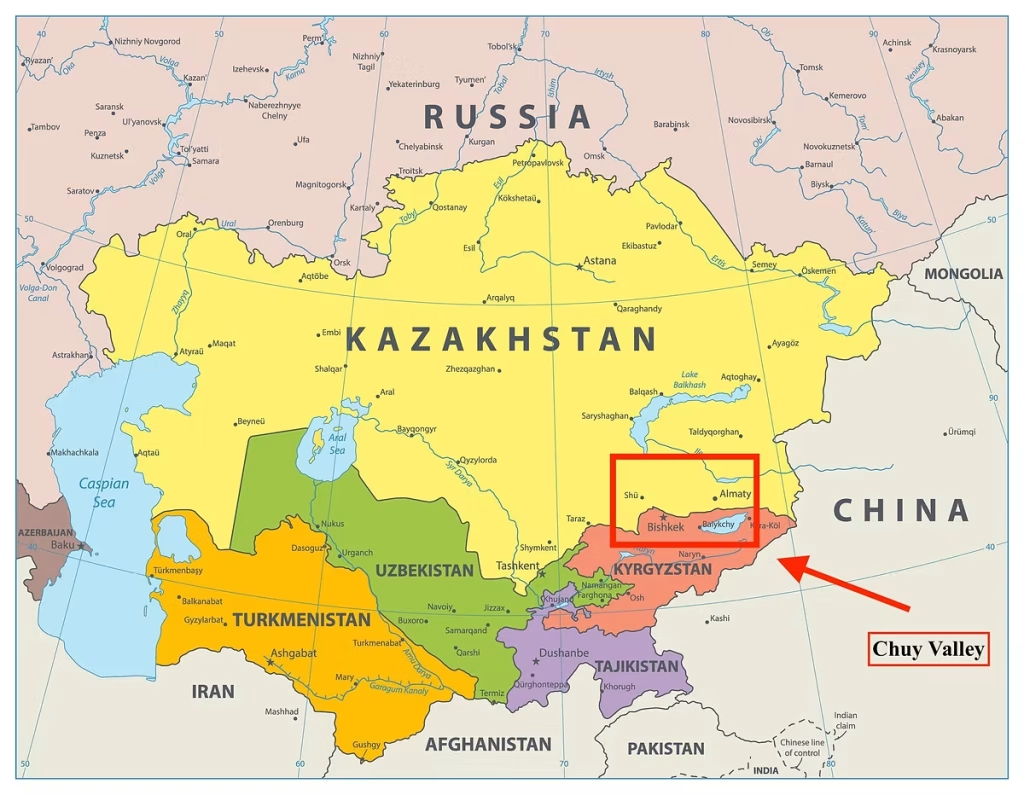
When Sadyr Japarov took power in Kyrgyzstan in 2020, he was a young, energetic nationalist president determined to build his own authoritarian power vertical—the first leader to pull it off since Askar Akayev. For decades the country had been notoriously unstable: storming parliament was practically a standard feature of the political repertoire.
Japarov had already begun edging closer to Moscow before 2022, but Russia’s full-scale invasion of Ukraine handed him a historic opportunity. Kyrgyzstan quickly became one of the Kremlin’s main cryptocurrency hubs for shadow trade. The scheme was orchestrated by Ilan Shor, the fugitive Moldovan oligarch notorious for the “billion-dollar theft” from Moldova’s banking system. At the same time, Moscow and Shor built a propaganda network in the country under the brand “Eurasia.”
Yet loyalty to Moscow has so far delivered Bishkek surprisingly few tangible dividends. Kyrgyz citizens working in Russia face the same harassment and discrimination as other Central Asian labor migrants. The only concrete assistance the Kremlin has provided is a few hundred school buses and plans to build nine Russian-language schools.
The War and “Our Own”
Which post-Soviet state drew markedly closer to Moscow after Russia’s full-scale invasion of Ukraine? Georgia immediately comes to mind—and for good reason. After years of rule by the “Georgian Dream” party, society proved unable to resist a corrupt system that had steered the country toward Moscow. Politicians warned citizens that any show of solidarity with Ukraine could turn Batumi into another Mariupol. Today Prime Minister Irakli Kobakhidze openly recounts how he was pressed to open a “second front” against Russia, even as the Georgian Border Police simultaneously denies entry to both anti-war Russians and residents of Crimea and Donbas carrying Russian passports.
But there is another mountainous nation that has followed a strikingly similar path. Once the most volatile and politically turbulent state in Central Asia—where pro-Russian and pro-Western media and NGOs coexisted—Kyrgyzstan has transformed into a textbook post-Soviet autocracy.
You can still enter Kyrgyzstan on a Russian internal passport, but if you are an opposition activist the authorities may simply hand you back. The human-rights project “Ark” advises its clients not to remain in the country even temporarily. This is not standard practice among Moscow’s formal allies: in Kazakhstan, the odds of avoiding deportation are noticeably better, and local activists are far more willing to assist Russians.
A telling case is that of a young Kyrgyz man named Samat. He held dual citizenship—his parents had obtained Russian passports while he kept his Kyrgyz one. After completing compulsory military service in 2019, he signed a contract with Russia’s Defence Ministry and failed to terminate it before the war began, despite trying. In March 2022 he managed to flee back to Bishkek. Smart cameras linked to the CIS wanted-persons database spotted him at the airport. He was arrested and taken to a pre-trial detention center in Bishkek. What happened to him next is unknown; no media outlet ever followed up.
Ironically, local residents who volunteered to fight for Russia—whether as regular contract soldiers or Wagner mercenaries—have also ended up behind bars. Outcomes vary. Askar Kubanychbek uulu was sentenced to ten years for mercenaryism but was released on a three-year probation period. He promptly returned to Russia and signed another Defence Ministry contract.
Such legal contradictions are common across Central Asia, but they have flourished most extravagantly in Kyrgyzstan thanks to pervasive corruption and a weak judiciary. Even so, Bishkek still maintains a certain distance from Moscow’s direct orders. In Tajikistan, for example, not a single citizen has been charged with mercenaryism for fighting in Ukraine; the prosecutor-general explained last year that anyone who accepts Russian citizenship must “observe the requirements and obligations of that state.”
Reliable data on Central Asians recruited into the Russian army come from the Ukrainian project “I Want to Live“: Uzbekistan (4,955), Tajikistan (3,489), Kazakhstan (2,420), Kyrgyzstan (1,474), and Turkmenistan (581). The relatively modest Kyrgyz figure reflects simple demography—a small country with a modest population. Yet by every other measure of loyalty, Kyrgyzstan now ranks among Moscow’s most reliable post-Soviet partners, second only to Belarus.
Just Don’t Irritate Them
In the first days after the invasion, every Eurasian state felt the ground shift. Even in Central Asia, where leaders usually comment on global affairs only in the vaguest terms, governments were forced to take a position.
Japarov, then in office for barely a year, chose the safest possible tone. “The situation is complex and has worsened in recent days,” he told parliament. “We are a small country with no influence to stop the conflict, so we must remain neutral. We are already seeing rising food and fuel prices and a stronger dollar. In these difficult times we need unity.”
He repeated the “small country” line in an April interview with the state news agency Kabar. That appears to be Bishkek’s genuine stance: no hidden agenda, no double game. Claims that Japarov “condemned Kyiv’s failure to implement the Minsk agreements” or “supported Russia’s decisive actions” should be left to the Kremlin’s press service.
Kyrgyzstan’s version of neutrality, however, has its own flavor. Compare it with neighboring Kazakhstan, where President Kassym-Jomart Tokayev consistently affirms international law and maintains contact with Volodymyr Zelensky. Even after the lavish welcome he gave Putin in Astana in May 2022—calling the Russian leader’s mission “fateful for the Russian people and the Russian state”—Kazakhstan’s position could still be described as neutrality, albeit with a clear northern tilt.
In Bishkek, neutrality is simpler: do nothing that might annoy those who can make life difficult. Above all, that means Moscow and Beijing. The Japarov government regards relations with those two capitals as the only ones that truly matter.
Kyrgyzstan cannot expect serious Western investment anytime soon, so it has little to lose by keeping its head down. Besides, Japarov built his political career in large part by confronting Western capital. One of his signature achievements was the nationalization of the Kumtor gold mine from Canada’s Centerra Gold. The mine passed fully under state control in 2022, though experts question how effectively the new owners are running it.
Japarov has continued tightening state oversight of foreign investment, limiting the list of deposits open to foreigners and drafting a new Mining Code. Curiously, he has proposed using British law to resolve disputes; a special International Dispute Resolution Centre based on UK rules opened in February 2025 in the Tamchy investment zone on Lake Issyk-Kul.
Had Japarov’s background been different, he might have joined the conversation about rare-earth metals that Donald Trump loves so much. But at the first Central Asia-US summit in Washington, the Kyrgyz president was noticeably more restrained than his colleagues. While Tokayev told Trump he was “sent from above” and Uzbekistan’s Shavkat Mirziyoyev declared that only the American president could stop the war in Ukraine, Japarov spoke through a Kyrgyz-language interpreter and focused on the digital economy and artificial intelligence—both in the main session and in his brief one-on-one meeting with Trump.
Among the issues raised by Sadyr Japarov was hydropower—in particular, preparations for launching the Kambarata hydroelectric power station. Mining was conspicuously absent from his remarks. That is hardly surprising: Kyrgyzstan has virtually no remaining deposits attractive enough for the kind of large-scale joint ventures Donald Trump prefers.
The Authoritarian Turn
Kyrgyzstan’s growing distance from the West has allowed its new elites to extract maximum value from Russia while consolidating domestic power without apology. Japarov’s rise in 2020 marked the republic’s decisive shift to a rigid vertical of power and full-blown authoritarian rule. According to Freedom House, Kyrgyzstan was still rated “partly free” in 2019 with a score of 38 out of 100. It has since fallen to 25 points—firmly in the “not free” category.
During this period the country adopted a new constitution that dramatically expanded presidential authority, along with a law on non-commercial organizations that many describe as a local version of Russia’s foreign-agent legislation. The logic is identical: any NGO receiving foreign funding must register as a “foreign representative” and be placed on a public list. The registry went live in September 2024 but has grown slowly—starting with three organizations and now standing at just five. For now, NGOs apply for inclusion themselves. The law is also easily circumvented by re-registering as a limited-liability company (OOO), the Kyrgyz equivalent of an LLC.
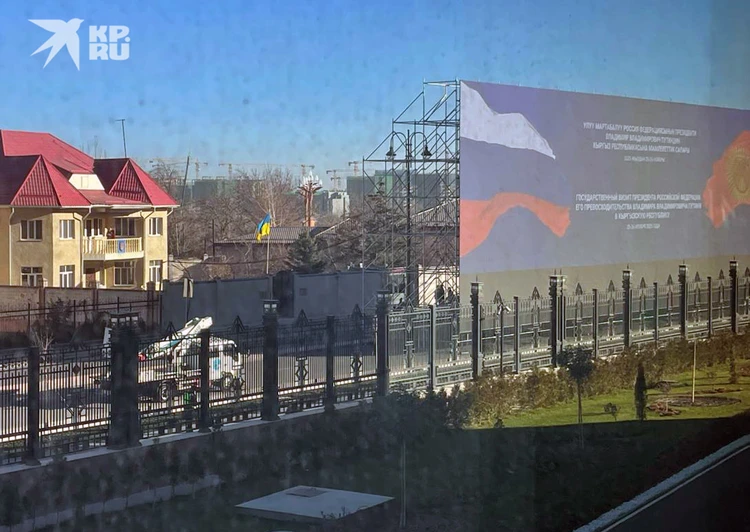
A vivid illustration of Bishkek’s loyalty to Moscow came during Vladimir Putin’s visit to Bishkek in November 2025. The new presidential residence sits next to the Ukrainian embassy. To ensure that Putin, walking along the avenue to the main entrance, would not see the Ukrainian flag—and that Ukrainian diplomats would not see the leader of the aggressor state—authorities erected a massive screen directly in front of the embassy. It displayed the flags of Russia and Kyrgyzstan along with greetings to the Russian president.
The Kremlin’s Financial Hub
Kyrgyzstan’s self-proclaimed “neutrality” has turned the country into a convenient instrument for Moscow to evade Western sanctions, including in the military-technical sphere. Setting up a legal entity in Kyrgyzstan is straightforward—especially an LLC. Russian businesses no longer need local partners; they can simply incorporate their own company and route transactions through it. Corrupt customs procedures and notably liberal currency and cryptocurrency regulations only add to the appeal.
In 2022, Kyrgyz exports to Russia jumped 2.5 times to $920 million. The subsequent surge never materialized; trade volumes stabilized. By the end of 2025, exports had actually declined 13.4 percent. Analysts attribute the drop to a deliberate reduction in re-exports.
Western sanctions began hitting Kyrgyz firms in 2023, when the U.S. Treasury added Weitmann Handeln Allianz LLC—a supplier of computers to Russia—to its list. Other equipment exporters followed, but banks only came under fire in 2025.
The first and most prominent target was the state-owned Keremet Bank. According to the U.S. Treasury, it assisted Russia’s Promsvyazbank (PSB) with overseas operations. PSB is the financial backbone of the Russian military and defense industry; its chairman is Pyotr Fradkov, son of former prime minister and ex-SVR chief Mikhail Fradkov.
The same Treasury notice mentioned another notable name: Moldovan oligarch Ilan Shor. After siphoning roughly a billion dollars from Moldova’s banking system, Shor relocated to Russia and threw himself into political projects. He has worked with PSB since at least 2024, using the bank to funnel money into Moldova ahead of elections. It was therefore no surprise that Keremet appeared in the same schemes.
Later, the Financial Times published an investigation into the ruble-pegged stablecoin A7A5, created by PSB specifically to circumvent sanctions. Trading in the coin took place on Grinex, an exchange registered in Kyrgyzstan. In April 2025 the exchange suffered a cyberattack that wiped out roughly a billion rubles’ worth of user funds. By then, its ties to both PSB and Shor were an open secret. Project head Oleg Ogienko had stated in February that up to 10 percent of Russia’s foreign-trade settlements flowed through the coin.
A parallel instrument with a similar name also exists: the payment agent A7, another PSB-linked project that allows businesses and individuals to transfer money abroad without SWIFT. Its CEO is likewise Ilan Shor.
After the U.S. sanctions, Britain and the European Union followed suit against Keremet. London also targeted two other Kyrgyz banks—Capital and the Eurasian Savings Bank—along with the state brokerage firm and a virtual-asset issuer. The same institutions (plus Tolubay) appeared in the EU’s 19th and 20th sanctions packages.
The most significant consequence of the EU’s 20th package for Kyrgyzstan was the introduction of sectoral restrictions: the bloc now prohibits exports of CNC machine tools and data-transmission equipment (switches and routers). This is the first such precedent and could have a noticeable deterrent effect on the willingness of regional states to provide Russia with technical assistance. While Kyrgyzstan itself has few high-tech industries, the restrictions could deliver a serious blow to neighboring Kazakhstan and Uzbekistan.
According to Moldovan outlets Rise Moldova and IPN, Shor has become deeply embedded in Kyrgyz elites; President Japarov himself has reportedly used aircraft from Shor’s companies. The Russian investigative outlet Proyekt claims that Roman Abramovich serves as Shor’s patron within Russian elite circles. It was with Abramovich’s backing, the outlet asserts, that Shor launched both the A7 project and the large-scale sanctions-evasion scheme built around cryptocurrency in Kyrgyzstan.
The Humanitarian Dimension
When asked about helping Russia circumvent sanctions, Kyrgyz officials usually respond with flat denials. Last year President Japarov reframed the issue in familiar terms—combating “foreign agents.”
“We suggested that Ambassador [of the United States] Vigeri invite independent auditing firms to examine Keremet and Capital banks, review the results together, and then make a decision,” he declared. “They refused… They simply claimed to have certain information. But we know perfectly well where it comes from. It comes from local NGOs and our internal adversaries who send them anonymous false reports.”
There was one notable exception. Speaking at SPIEF-2025, Temir Sariyev, chairman of Kyrgyzstan’s Chamber of Commerce and Industry, openly acknowledged that “when the special military operation began, the first country that extended a hand without fear was the Kyrgyz Republic. Others followed later. This prompts Russia to regard the KR as its most reliable partner—in both business and politics. Reliability is a very rare and scarce commodity.” Sariyev did not spell out the nature of the assistance, but everyone in the room understood: he was referring to the provision of loopholes for gray imports and parallel financial transactions.
Such candor is driven by straightforward pragmatism. Bishkek had hoped that loyalty would bring tangible benefits for Kyrgyz labor migrants in Russia. Officials have repeatedly complained that EAEU membership has not delivered the expected advantages—particularly access to medical care and schooling for children.
The introduction of mandatory Russian-language testing made the situation worse for all children with foreign citizenship living in Russia. Kyrgyz representatives raised the issue without success. From next year onward, Russia is imposing even stricter rules on migrants, with an exemption granted only to citizens of Belarus. In all regions except Moscow and Moscow Oblast, the hiring of foreigners will be permitted solely through organized, targeted recruitment programs.
At the same time, Moscow announced in 2023 plans to build nine joint Russian-Kyrgyz schools in Kyrgyzstan with mixed teaching staffs. Three are promised for 2027. Any mention of the project reliably irritates Russian nationalists, yet the Kremlin uses the rapprochement with Bishkek to bolster its image among the Kyrgyz population as well.
It is in Kyrgyzstan—according to the limited polling available—that public solidarity with Moscow over Ukraine is highest. A 2024 Paper Lab survey found that 36 percent of respondents blamed Ukraine for the war, 14 percent blamed Russia, and 13 percent blamed the United States. These figures largely reflect media consumption patterns: Russian outlets dominate the foreign-media landscape. In 2024 Bishkek launched the pro-Russian television channel Nomad, which is linked to both Ilan Shor and RT and is headed by a former RT employee.
Another Shor project, the non-profit organization Eurasia, has also expanded significantly. In other post-Soviet states it has mainly organized propaganda tours for young people, flying selected students and schoolchildren to Moscow for lectures by pro-Kremlin speakers. In Kyrgyzstan, thanks to the authorities’ accommodating stance, the organization has been able to operate locally. Bishkek now boasts an Eurasia Park, a Russian-language support center, and a network of social stores under the same brand. In September 2024 the organization donated 50 school buses to rural districts.
The newest objective of ANO Eurasia in Kyrgyzstan is the creation of a unified educational space with Russia. The initiative, according to Kyrgyz officials, came from Bishkek rather than Moscow—and specifically from President Japarov. At SPIEF-2025, First Deputy Prime Minister Daniyar Amangeldiev stated: “Vladimir Vladimirovich supported the initiative of our president. I know that ANO Eurasia is already working on this issue; let us define our joint next steps.”
One practical outcome appears to have been the recent meeting of the Russian-Kyrgyz expert-consultative council on history, organized in Moscow by the Russian Military-Historical Society. Scholars from both countries discussed the content of school textbooks and clashed sharply over whether the period of Russian imperial rule in Central Asia should be described as the “colonization” of the Kyrgyz people. The Russian side, as expected, insisted on alternative wording—”administration” or “administrative measures”—that the Kyrgyz scholars found unacceptable. Academician Abylabek Asankanov remarked: “You are setting us an extremely difficult task—to abandon the word ‘colony.’ That is very hard to do.”
Such friction was predictable. Despite Bishkek’s calculations that closer ties with Moscow would solve financial problems and provide protection, nationalist and anti-imperial sentiments remain strong in Kyrgyzstan. They are also an important part of Sadyr Japarov’s own political brand. In April, for example, he promised to rename the remaining villages that still bear Russian names—only for his press service to disavow the statement the following day.
In seeking to consolidate personal power in a traditionally turbulent country, Japarov has bet on Moscow as a source of external legitimacy. While some of his efforts have been appreciated in the Kremlin, he should not count on serious long-term support. Years of experience have shown that the Kremlin never clings to any particular politician in Kyrgyzstan; it assumes the country is already firmly within Russia’s orbit. Yet by his actions Japarov is helping Moscow entrench itself still more deeply in the republic.
The combination of Russian propaganda among the population and the corrupt ties linking local officials and banks to Russian structures provides a sufficiently reliable guarantee that Kyrgyzstan will remain the most pro-Putin country in Central Asia for the foreseeable future. The price is secondary sanctions and the risk of falling behind in the development of genuinely competitive economic sectors.
Source: Roman Chernikov, “Putin’s Outpost in Central Asia,” Riddle Russia, 6 June 2026
In his 1986 novel Plakha, translated into English as The Scaffold, Chingiz Aitmatov, Kyrgyzstan’s great writer, tells the story of Avdiy Kallistratov, an idealistic young man who joins a group of drug smugglers travelling to a remote corner of Central Asia. To Kyrgyzstan, to be precise, where large swathes of cannabis grow wild in the picturesque Issyk-Kul region.
Aitmatov describes in vivid detail the brutal process of harvesting and trafficking the drug by a criminal group. But how close is this depiction to reality?
This is a question I put to Gulzat Botoeva, Associate Professor of Criminology at Swansea University and an expert on illegal economies in Eurasia, including cannabis production in Kyrgyzstan. We discuss how the harvesting began, who benefits from it, and how local authorities respond to the phenomenon. Is there any incentive in Kyrgyzstan to legalise the crop?
Here is a list of Gulzat’s publications on the topic:
Botoeva, G. (2014). Hashish as cash in a post-Soviet Kyrgyz village. International Journal of Drug Policy, 25(6), 1227-1234.
Botoeva, G. (2019). Use of language in blurring the lines between legality and illegality. In Governance Beyond the Law: The Immoral, The Illegal, The Criminal (pp. 67-83). Cham: Springer International Publishing.
Botoeva, G. (2021). Multiple narratives of il/legality and im/morality: The case of small-scale hashish harvesting in Kyrgyzstan. Theoretical Criminology, 25(2), 268-283.
• Botoeva, G. (2015). The monetization of social celebrations in rural Kyrgyzstan: on the uses of hashish money. Central Asian Survey, 34(4), 531–548. https://doi-org.mpc.idm.oclc.org/10.1080/02634937.2015.1092742
This article focuses on the embeddedness of hashish production in the local economy of Toolu, a village in Kyrgyzstan. It explores how transformations in social relationships and the monetization of gift giving put constant pressure on families to find cash in a semi-subsistence agricultural economy. Although not produced on an industrial scale in the community, hashish is used as a cash crop in times of deficit. Based on a mixed-methods study combining ethnographic fieldwork with survey data, I show how the hashish economy is intertwined with different forms of reciprocal relationships based on gift-giving practices and the monetization of social relationships. In doing so, I illustrate how the hashish economy is embedded in local livelihoods and shapes emerging forms of economic morality in Kyrgyz society.
Source: EBSCO Host
This documentary is an ethnobotanical and cultural exploration. It does not promote or facilitate the sale of cannabis or cannabis-related products. In Episode 3, the expedition moves deeper into Kyrgyzstan’s highlands as the Strain Hunters cross paths with one of Central Asia’s most iconic cultural gatherings — the world-famous Nomad Games. Set against the dramatic mountain landscape, the games offer a rare glimpse into the traditions, skills, and nomadic heritage that have shaped life in this region for centuries. Leaving the celebrations behind, the team continues their journey into increasingly remote terrain. As they explore valleys and high-altitude environments shaped by wind, cold, and time, the Strain Hunters encounter some of the most promising wild cannabis populations of the expedition — plants that show clear adaptation to their harsh surroundings. Through careful observation and documentation, the team identifies ancient landrace traits that reflect cannabis’ long history in Central Asia. These encounters represent a key moment in the journey, deepening our understanding of cannabis diversity and reinforcing the importance of preserving rare genetics before they disappear. This expedition is brought to you by Green House Seed Co. and GH Medical, continuing our mission to explore the planet, preserve rare genetics, and document cannabis culture worldwide.
Source: Strain Hunters and Green Seed Co (YouTube), 25 December 2026
BISHKEK — Kyrgyz cannabis is reputed to be among the most potent in the world, making it a lucrative cash crop for drug traffickers.
It appears ironic, then, that a homegrown addiction specialist in Bishkek wants marijuana to be legalized to reduce the number of Kyrgyz drug addicts, fight organized crime, and increase tax revenues.
Jenishbek Nazaraliev, a former presidential candidate who opened Bishkek’s first private narcology clinic in 1993, wants the Kyrgyz government to consider a pilot program for the legal production of cannabis near Lake Issyk-Kul.
Rivaling the potency of marijuana from Afghanistan, international experts say cannabis is already being harvested by about two-thirds of all the families in Kyrgyzstan’s Issyk-Kul and Chui regions.
Pot plants grow wild on thousands of hectares of land there. During the first eight months of 2013, up through the annual August harvest, Kyrgyz authorities say they destroyed more than 154 tons of cannabis in the Issyk-Kul region alone.
Nazaraliev says more effective regulation over the production and sale of marijuana is an issue that eventually must be tackled by the government.
He says the illegal drug market in Kyrgyzstan is now “fully controlled by the black economy.”
Nazaraliev also argues that the producers, sellers, and consumers of cannabis could be better controlled — and that the government would bolster its tax revenues — if pot were legalized.
But Kyrgyzstan’s State Drug Control Service disagrees. Authorities there say winning the battle against drug traffickers is the key to social stability and development in Kyrgyzstan.
And they argue that legalization won’t rein in organized criminal traffickers because Kyrgyz-grown cannabis is exported through a network that extends far beyond Kyrgyzstan’s borders — a smuggling route for illegal Afghan cannabis, opium, and heroin that passes through Kyrgyzstan on its way to Russia and the European Union.
Naked Harvest
RFE/RL’s Kyrgyz Service has spoken with villagers in the Tiup and Ak-Sui districts around Lake Issyk-Kul who are involved in the harvest and sale of Kyrgyz cannabis.
For centuries, cannabis has been harvested in Central Asia by horsemen who would ride naked through wild cannabis patches and then scrape the resin from their skin and the hair of their horses.
But most villagers around Lake Issyk-Kul now harvest the drug by rubbing cannabis plants between their palms to get a layer of black resin that they scrape off with a knife and package in matchboxes.
Local dealers buy the drugs from the harvesters and then sell them to bigger dealers who tour the area, forwarding their purchases abroad through international trafficking channels.
Kyrgyz villagers who harvest cannabis every August make no secret about paying bribes to police who turn a blind eye.
For their part, local police tell RFE/RL it would be impossible to eradicate a trade that is integral to the survival of so many people.
Former Kyrgyz Vice President and Prime Minister Feliks Kulov — who also headed the National Security Service — suggested during the 1990s that state-managed cannabis farms near Lake Issyk-Kul could help the authorities control drug production in the country.
But Kulov’s proposal was derailed by critics who cited the negative experiences of opium growers in Afghanistan.
Nazaraliev, the narcologist who wants the authorities to reconsider legalization, ran in Kyrgyzstan’s 2009 presidential election under the campaign slogan “Everything is Within your Reach.”
He is now asking the authorities in Bishkek to consider whether “progressive European countries” and U.S. state governments that decriminalize marijuana care more about the health and welfare of their citizens than Kyrgyzstan.
Source: “Addiction Doctor Wants Kyrgyzstan To Legalize Pot,” RFE/RL Kyrgyz Service, 7 January 2014