I’ve spent most of the last 48 hours doomscrolling through people’s reactions to the destruction of the Voting Rights Act by the Supreme Court. The people I follow most regularly have split into predictable camps. There are people like me and Adam Serwer who are trying to put the court’s decision into the larger context of the long-standing white hostility to Black voting rights and Black political power. There are the folks like Ian Millhiser who have tried to explain the immediate legal effects of the court’s unconscionable decision. The activist set is taking some time to digest what has happened and plan for next steps, with some vowing to “fight” and ultimately “win” in some fashion.
Predictable, too, has been the reaction from the right. White supremacists and, to the extent there’s a difference, Republicans have been giddy. I read one particularly risible piece of trash in National Review crowing about how the Supreme Court’s decision will allow Republicans to gerrymander away Black political power while stopping Democrats from restoring that power. I think that legal analysis is wrong. But what struck me was not the stupidity of the argument but how happy they were to make it.
That happiness, from whites, is something that most of the articles and analyses, including mine, have failed to capture sufficiently. It is as distressing to me as the actual decision and the terrible results that will result from it.
The Voting Rights Act was once considered a pillar of American democracy—so much so that it was extended and expanded in 1982 by President Ronald Reagan. It was reauthorized in 2006 by President George W. Bush, and that reauthorization passed the Senate 98–0. In just 20 years, the VRA has gone from being such a mainstay of the democratic project that even dyed-in-the-wool conservatives didn’t dare vote against it to something that barely hooded mouthbreathers at National Review are happy to trash.
I don’t really know how to process that information. It’s not just that we’re going back to a Jim Crow state of affairs—it’s that white people are happy about it. As if the 60 years of post-apartheid America that were ushered in by the VRA were just an unfortunate detour, and now white people can get back to their preferred route.
Republicans always want you to believe that they’re not racist “in their hearts,” that they just happen to prefer a set of policies that coincidentally result in inequality, oppression, and less opportunity for non-white Americans. But this reaction to the death of the VRA proves they’re lying. They hate Black people, and they hate Black people who have political power most of all.
And now, they’re happy to finally be able to take that political power away.


Is there even one series with a cover like this (you know what I mean) that actually has good ratings? Why on earth are they making THIS????
Source: Ororo.tv. Racist comment translated by the Russian Reader, who has unfortunately read and heard thousands of such comments in Russian during his thirty-plus years on the Russia desk. ||||| trr
John Watson and Sherlock Holmes’ fates intertwined one last time in the Season 2 finale of Watson, which serves as a series finale as the CBS medical drama has been canceled.
In the closer, as Watson (Morris Chestnut) traveled with Mary (Rochelle Aytes) to Baltimore to get surgery for the glioblastoma that had been causing his Sherlock visions all season, a disoriented Holmes — in the flesh — was admitted to the Holmes Clinic in Pittsburgh. When Watson got word, he abandoned his surgery plans and returned to treat his friend. He deducted the cause of Sherlock’s illness but the delay of his own life-saving surgery cost him, and Watson suffered a debilitating seizure.
He eventually woke up and professed his love to Mary who reciprocated. With his surgeon coming to Pittsburgh, the finale ended with Watson in the OR and a vision of him and Mary living at 221B Baker Street in London, the future he had laid out for them in their heart-to-heart hours earlier. (In the Sherlock Holmes lore, the brilliant detective shared his apartment at the famous address with Watson.)
Speaking to Deadline, Watson creator/executive producer Craig Sweeny addressed how he approached the finale and its ending and provided one explanation for the Baker Street flashforward.
“The season finale was tricky to write in that, even while we were filming it, we didn’t know if the show was coming back or not,” he said.
CBS’ cancellation decision came after Watson had wrapped production on Season 2.
“We opted to treat it mostly as a season finale, with a coda appended that nods to a possible future for Watson and Mary,” Sweeny added. “The coda, set at Baker Street, has several possible interpretations — among other things, it could be a fantasia Watson is seeing as he’s on the operating table in what may be his dying moments. I have my own interpretation but prefer not to comment on it beyond what’s on the screen so audiences can make up their own minds.”
At the time of the Watson January 2025 series premiere, Sweeny told Deadline that he had built the show on the presumption that Sherlock is dead. “I don’t want to be held to that if there’s some great story that presents itself, but I don’t believe that we’re ever going to feature Sherlock as an ongoing character in the show Watson at this time,” Sweeny said back then.
Following the Season 2 finale, Sweeny explained to Deadline how the idea of bringing Sherlock onto the show started and evolved — from a hallucination stemming from Watson’s brain tumor to a real person — and what the Season 3 plan for the Watson/Sherlock storyline was.
“In Season 3, Watson would also have been Sherlock’s doctor treating ongoing complications from the ailment that plagued Holmes at the end of Season 2,” Sweeny said. “We originally conceived the Watson/Holmes storyline to have Holmes exist only as a delusion in Watson’s head as a means for Watson to learn about his glioblastoma, but quickly revised those plans after we saw what Robert Carlyle brought to the role of Sherlock Holmes. Watson’s Holmes and Watson were fun to write and watch, and so we devised a way for Sherlock to be present in the real world.”
The Season 2 finale of Watson left storylines open-ended for the young doctors too, including the ongoing investigation into Beck’s death, the search for Sasha’s birth mother and Sasha (Inga Schlingmann) breaking up with Stephens (Peter Mark Kendall). Season 3 would’ve wrapped their fellowship arcs.
“The heart of Watson was the cases, so if we had come back we would have continued to hunt the strange and amazing scientific outliers that made up our strongest episodes,” Sweeny said. “Of course, medical fellowships last three years, so a major theme of season three would have been exploring what would have happened to Ingrid, Stephens, Adam, and Sasha at the end of their Fellowships and how many new doctors would be worked into the mix.”
Sweeny took the opportunity of the Watson finale to reflect on the series’ two-season run.
“We had a lot more to say with the show, so of course it’s sad we won’t be making any more,” he said. “But I’m grateful that we got to write and produce 33 episodes. I love to write procedurals with cases that are set at the edge of what humans know, and Watson gave me and our team the chance to do that every week.”
Sweeny previously spent five years on CBS’ Sherlock Holmes/Dr. Watson procedural Elementary, most of them as executive producer. He went on to acknowledge Watson executive producer Dr. Shäron Moalem, who “shared insights from decades working in genetics and was singularly important in crafting cases set on the vanguard of what’s possible.”
Sweeny also praised the work environment on Watson and its No.1 on the Call Sheet.
“Making Watson for two seasons was a rewarding experience for the producers, cast, and crew. We had tight-knit communities in Los Angeles and Vancouver,” he said of the series, which was written in Los Angeles and filmed in Vancouver. “I’ve been blessed to have career highlights and happy experiences on shows, but I’ve never known anything quite like the warm and collegial vibe that prevailed on Watson. I’m especially grateful to Morris Chestnut for his role in making that happen. When Morris was considering the role, we met for coffee and talked about the environment we both hoped to foster. His tireless leadership and example helped make the Watson set a happy experience for everyone who worked there.”
As he closes (prematurely) the chapter on Watson, Sweeny chooses to focus on the positive.
While thanking the “special group of people” who worked on the series, his producing partners, the cast, the writing staff, the casting and post departments, he said, “Naturally, all of us mourn the loss of the show and the community around it while also being grateful for the opportunity to make as much Watson as we did.”
Source: USA Today (YouTube), 15 May 2026
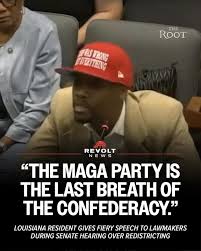
IN A WORLD OF MIKE JOHNSONS — BE A MARSHAWN  An angry Louisianan, known only as Marshawn [sic], gave an impassioned speech in a state Senate hearing this week in the lead-up to the vote to eliminate a majority Black district that — until last week — was protected by the VRA.
If you watch ONE THING today — let it be this 
“I have no doubt in my mind that the map’s gonna pass,” Marshawn said. “If y’all can give us less than zero seats, you would do it. Y’all do this under the orders of somebody that said the Civil Rights Act was harmful to white people, that it caused reverse racism.”
“You showed us what you want to do. And I believe the country as a whole is rebuking your party. Y’all are in a death spiral. That’s why y’all have to redistribute. That’s why y’all have to cheat. That’s why Trump got to go to Texas and say he was entitled the five more seats. It’s because y’all know what y’all doing is abhorrent.”
“So I’m positive y’all gonna be okay with the maps. But the beautiful thing is, the children that y’all have made and the people that’s younger than y’all don’t support none of this racism that y’all want. The MAGA party is the last breath of the Confederacy. And I’ll be happy to see millennials and Gen Z bury y’all. There will be no more of your party. The midterms gonna come, y’all gonna get wiped out. Trump gonna get dragged out of the White House and I’m gonna love every second.”
“Because y’all loved every second of the suffering that he caused to everybody in this country and worldwide. We starvin’ Cuba. We bomb Nigeria. We holding Zimbabwe and Zambia hostage for the minerals. We don’t want to give them AIDS support. The pro-lifers that say all life is special, y’all letting kids die of AIDS. What part of your Bible say that?”
“Point out the scripture. I think everybody would love to see it. And we would love to see y’all in the midterms.”
MIC. DROP.
Source: Christina Lorey (Facebook), 16 May 2026
In September 2022, Zambian officials were notified that one of their citizens had been killed in action, in Ukraine. Lemekhani Nyirenda’s death has sparked interest in Russia’s continued presence in Africa and how Africans are treated within Russia’s borders. Nyirenda’s death is one recent example of how Russia — and, before it, the Soviet Union — used and abused Africans to create their reputations as anti-imperialist and anti-racist states. There is a growing amount of literature being written on Soviet-African relations, particularly on Soviet interests and engagement on the African continent as a foreign policy concern. Yet less attention is being paid to the African experience within the Soviet Union. The experiences of African citizens reveal the paradoxical nature of Soviet anti-racist ideology and praxis. While the USSR recruited and welcomed thousands of African students to study technological and scientific disciplines to fight the legacies of imperialism in their home countries, Soviet citizens often treated the Africans in their midst with disdain and hostility.
This December will mark the 60th anniversary of the death of an African student in Moscow. The Ghanaian citizen Edmund Assare-Addo, who was studying medicine in Moscow, was found dead on a country road on the outskirts of the Soviet capital in 1963. As the historian Julie Hessler has shown, the contested death of Assare-Addo marked a watershed for Soviet-African race relations. It sparked one of the USSR’s largest protests since the 1920s, with some 500 African students marching through Moscow. Many of them arrived from St. Petersburg (then known as Leningrad) and other Soviet cities to participate. Wearing traditional Russian fur caps with ear-covering flaps, they gathered by the Kremlin’s gates, holding up signs saying, “Stop Killing Africans” and “Moscow, a second Alabama.”
While the Soviet media was relatively silent about the unrest, Western media covered the African student protests widely. Students interviewed by the New York Times on Dec. 19, 1963, complained of regular harassment by Soviet citizens and physical assaults. There was a discrepancy between the ideal of an anti-racist, multinational Soviet society and the existence of Black Africans within its borders.
Race relations between Black residents and students in the Soviet Union and their white (Slavic-presenting) counterparts are difficult to trace. As the USSR did not use race to categorize or organize society, it is hard to know how many African students studied there. Soviet citizens, however, were categorized within the ethno-federal state by “nationality,” with categories like “Jewish” or “Tatar.” Yet there was a clear ideological rejection of race and racism.
What we do know is that thousands of Africans moved to the Soviet Union, beginning in the 1950s, to gain access to Soviet higher education and military training. Generally, 1957 is seen as a turning point in the Soviet approach toward Africa and Africans.
In the 1920s and ’30s, African Americans were a focal point for Soviet anti-racist ideological practice. Dozens of African Americans moved to the Soviet Union for better economic opportunities and the chance to experience life in a country that officially condemned racism. The writer and poet Langston Hughes was the most famous of these visitors. His early writing on his experience reflected the hope that African American visitors to the USSR held for a society that actively struggled against racism. Other African American visitors, such as Homer Smith and Paul Robeson, lived in the Soviet Union for years, where they enjoyed special privileges as representatives of the “oppressed class of workers and an oppressed race,” according to the Sixth World Congress of the Communist International in 1928. The combination of foreignness (Americanness) and Blackness worked to the advantage of Black Americans. I would argue that, because African Americans were Americans, they were not only representatives of some of the most oppressed workers, but also of a pantheon of modern industrial developments — the United States.
There were considerably fewer Africans present in the Soviet Union during the early Stalinist era, yet those who were there did notice the difference between how the USSR talked about imperialist oppression and how it depicted Africans. The historian Woodford McClellan’s study of Black students at the Communist University of the Toilers of the East (KUTV), a training academy in Moscow during the 1920s and ’30s, includes an example of Black African students taking issue with the depictions of Africans and Black people in Soviet public media and discourse. For example, some objected to the portrayal of Blacks through Blackface in plays, while others complained of being called “monkey” and the prevalent juxtaposition of Black Africans with apes and monkeys in theaters. My research on early Soviet children’s books up through the late 1930s reveals that, even in one of the most experimental periods in Soviet artistic production, Black people — specifically Africans — were often depicted as wild, animalistic figures far removed from modernity.
It was following the 1957 International Youth Festival in the Soviet Union that one could see the impacts of these depictions in Soviet children’s and popular culture. There were visible tensions between Soviet citizens and the Africans in their midst. African students recruited to study in the USSR received benefits and opportunities unavailable to Soviet people. They received stipends from the government, had more freedom of movement around and outside the Soviet Union, and could shop at foreign stores that were off-limits to most Soviets. Coupled with these privileges was the fact that foreign students from the global south often had different curricula from their Soviet counterparts, focusing on transferable skills they could implement when they returned to their home countries. Return was key in the eyes of Soviet officials. African students were not allowed to remain in the USSR for extended periods after completing their studies. In her essay describing her 1976 trip to the Soviet Union, the African American writer and feminist Audre Lorde noted the difference between her lodgings in a first-rate hotel and a shabby hostel where some African and Asian participants in a conference were housed.
So how did the Soviet Union get to the situation in December 1963 in which African students accused their Soviet hosts of racism and, worse, of killing one of their own? In accounts from the 1960s to the Soviet collapse in 1991, African students described carrying knives to protect themselves and being called racial slurs by their Soviet classmates. When Assare-Addo died, rumors swirled. African students alleged he was killed because of his interracial romance with a white Soviet woman. Such relationships were not unusual for the time. As Harold D. Weaver has written when detailing his experiences as a Black American in the Soviet Union in the 1970s, there were numerous sexual escapades between African men and Soviet women. This was one of the touchstones of racial strife between Soviets and Africans, particularly between men: the assumption that African men were taking white Soviet women (and most African students and residents in the Soviet Union were men). Clearly, anti-racist ideology reached its limits when it replicated long-standing Western stereotypes of Black men as violators of white women.
Interracial relationships and, worse, interracial sex, were stigmatized throughout and after the Soviet era. Research by the sociologist Charles Quist-Adade on mixed-race, Afro-Russian children in the late 1980s and early 1990s highlights the racist undertones of Soviet views of interracial romances between Soviet women and African men. His respondents and their white, Soviet mothers describe regular public and private hostility toward them. Soviet women who had romantic engagements with African men were called prostitutes and shamed by their families and communities.
Worse was the treatment of Soviet women who became pregnant with mixed-race children. Women reported being pressured to end their pregnancies or give up their children for adoption to make their lives easier. Soviet women generally were not allowed to follow their African partners to their homes on the African continent, so those who chose not to terminate their pregnancies were often forced to raise their children alone, with little social support.
Some heartbreaking testimonies include childhood ostracization in school, name-calling and feelings of rejection throughout their school years. Yelena Khanga, an Afro-Russian television presenter and producer, is known for her work on the early 2000s daily talk show “The Domino Effect.” In an interview with NPR, she shared her feelings of isolation and loneliness among her Soviet classmates. Her Russian boyfriend even referred to her as his “little monkey” as a racialized term of endearment.
Compounding these feelings of isolation were the continued depictions of Africans as wild and Africa as a dangerous place. A popular Soviet children’s cartoon from 1970, “Katorok,” features a song, “Chunga Changa,” which depicts Africans as jet-black, barely human figures who commune with wild animals while dancing. Worse, the song’s lyrics include a recitation of the stanza “chew coconuts and eat bananas.” What kind of feelings could these depictions engender toward Africans? Moreover, as waiting lines for basic consumer goods grew longer and few had access to foreign goods, the privileges of African students and visitors aggravated public hostilities against them. Ultimately, a general attitude of “how can these people come here and live better than we do, on our dime, when they are so underdeveloped and behind?” flourished.
The collapse of the Soviet Union in late 1991 represented a nadir for Africans living in the newly formed Russian Federation. Suddenly, they found themselves the unwanted guests of a government that no longer existed. They began to bear the brunt of anger about the Soviet system. Beatings, verbal assaults and murders of Africans, among other visible minorities, exploded. The 2010s were a harrowing period for any visible minority in Russia, as stabbings and physical assaults became commonplace in the major cities of Moscow and St. Petersburg. [Actually, the peak of this “harrowing period,” in St. Petersburg at least, was the late 2000s — trr.] Quist-Adade’s respondents described being harassed in the street and told they had AIDS because they were mixed-race (or had a mixed-race child).
Most recently, Africans and Afro-Russians have decried the racism and discrimination they face daily. From racial slurs to discrimination in housing, Black people struggle for equality in the Russian Federation. Lemekhani Nyirenda’s odyssey of studying in Russia, only to be accused of drug trafficking and sentenced to 9 1/2 years in a Russian prison, is the latest example of Black people’s hardships in Russia. That Nyirenda’s death occurred in Russia’s brutal campaign in Ukraine while Russia is courting additional African support is the culmination of the decades-long tension between ideology and praxis in the Soviet Union and Russia toward Africa and Africans.
The conception of Africans as representatives of “backward” countries needing Russian material aid has continued and flourished in the latter years of Vladimir Putin’s rule. Nyirenda’s death, allegedly as a member of the Wagner Group of Russian mercenaries, is ironic because it is this same group that has boots on the ground across the African continent, extracting precious minerals and resources at the expense of Africans.
The experiences of Africans and African Americans in the Soviet Union are often flattened into a single “Black” experience. However, African Americans were treated better than people from Africa and were respected by their Soviet counterparts as representatives of the United States, the USSR’s most significant competitor and a model of industrial modernity. Moreover, Africans were representatives of countries that were seen as the little brothers of the Soviet Union in the quest to decolonize and liberate the Third World. Africans were in the USSR to learn skills to improve their home countries, which were often depicted as wild and backward. Unfortunately, these assumptions about Black Africans led to Afro-Russians’ ostracization in the late Soviet era and beyond. From throwing bananas at Black soccer players to wearing Blackface in ballet performances, some of the worst stereotypes of Blackness continue to thrive in the Russian Federation. The collapse of the Soviet Union did not end one form of internationalism in which the Soviet Union and its successor, the Russian Federation, participated — which is that of global anti-Blackness.