Victims Too

For years, survivors of Assad and Russia’s chemical attacks in Syria were silenced. Today, we uncovered shocking evidence that many of these witnesses were forcibly taken to Moscow and pressured to lie – part of an extensive cover-up by the Russian state.

Now, with Assad no longer in power, these survivors are free to speak. In this video, they reveal the horrific reality of the chemical attacks – scenes of unimaginable suffering, children foaming at the mouth, and entire families wiped out.

As someone living in Ukraine, I’ve witnessed Russia’s war crimes firsthand – from white phosphorus to targeted civilian attacks. The patterns of brutality are clear, stretching from Syria to Ukraine.

This story exposes the disinformation campaign that echoed globally, amplified by figures like Aaron Maté and platforms like RT. But the truth matters now more than ever.

Watch as the survivors share their experiences and shed light on the true scale of Russia’s actions – crimes that continue to affect lives across multiple continents.

Source: Caolan Robertson (YouTube), 5 January 2025. Thanks to Michael Karidjis for the heads-up.
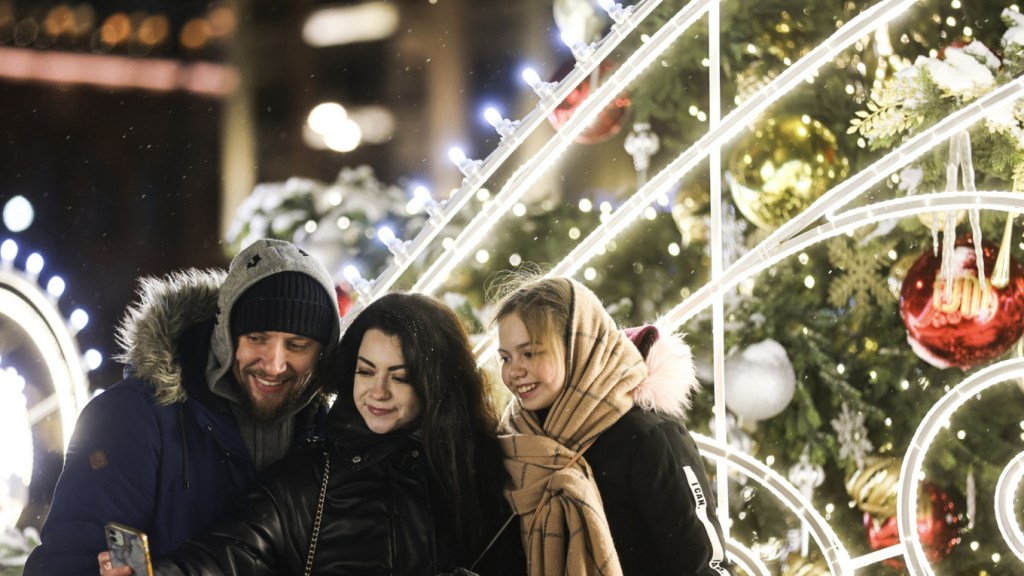

“Muskovites [sic] celebrating the New Year on Teatralnaya Square.” Photo: Yevgeny Messman/TASS (via Moscow Times)

Victimhood can be a tricky thing. Nobody doubts that ordinary Ukrainians are victims of this war. Russia’s political opposition, in exile, prison or dead, are also viewed as victims. But what of the country’s silent majority? What of the millions who stayed in Russia, kept their heads down and focused on living their ordinary lives, rather than the war and the online space it occupied?

Many things have changed in Russia since 2022. But one of the main constants has been the average Russian citizen’s desire for peace and ending the war. The majority have not been militantly opposed to or cheering the war effort on. Instead, they have been focused on living in the present, trying to salvage what remains of normality and longing for its imminent return – what some are calling the silent majority.

They are not happy with the war or satisfied with the current situation and have few ways of expressing that. Many do feel guilt on a certain (very private) level.

One thing hard not to notice in Russia throughout the conflict is how that silent majority has simply hunkered down and carried on. The war is very much in the background now. When I leave my building every morning, the same middle-aged man is defrosting his car, mothers are walking with strollers and children are heading to the local school.

When you eavesdrop on their conversations or stop to say hello, they sound normal – not like indoctrinated quasi-fascists, as some scholars are suggesting. They sound like any other school child whose teacher is just trying to get through the copious material thrown at them by the school director. The mothers just want their children to grow up in safety and comfort. Cheering on an expensive war pushing up the price of baby food is hardly a means of achieving that.

The war may come to an end in 2025. Negotiations are likelier than at any point since early 2022. And make no mistake, a peace agreement is inevitable. When the war ends, however, on whatever terms, Russia and its population of 146 million will still be there. It will not disappear or suddenly go away. The man defrosting his car as I write these words is not likely to have a huge epiphany when it does. His life has hardly changed since 2022. The increased number of women publicly wearing hijabs in our city is not doing so as a passive sign of resistance.

By living here, watching life unfold how it does, the more one cannot help but think something that many in the West will find unpopular. The war is not their fault. Tens of millions of innocent Russians are victims too. Their freedoms have been curtailed, their movements and opportunities restricted. Did they deserve that by virtue of where they were born? A classic liberal would argue not.

Like millions across the world, the average Russian is just trying to feed and raise their families, and get through the month. Many colleagues in academia have questioned from the comforts of the West, their tenured positions and with nothing to lose why many Russians do nothing to oppose the regime. What they neglect when arguing from their moral high ground is that those people I spoke of earlier do have a lot to lose being critical online. They have about as much power to topple the regime and change its course on the war, as the average Westerner does.

There will be blame to go around. Russian officials and the security apparatus, who carried out the decisions to invade Ukraine and suppress its own population, are obvious contenders. On the Ukrainian side, President Volodymyr Zelensky and his generals will have to answer for decisions they made. Kyiv’s Western allies clearly could have done more to support Ukraine, yet did not. 

Russia’s silent majority will not want to be blamed and they must not be. They personally did not harm anybody or choose the war. Unlike routine acts of everyday life, the war was not their personal fault or responsibility. Collective guilt is too controversial; thousands protested, millions left and staying silent was, in its own way, an act of defiance by refusing to enter the discourse. Guilt by association is also not a tenable position. Not every Soviet citizen was responsible for the Stalinist Terror. Not every Russian citizen can be responsible for the war, especially not on the basis that they refused to cheer on Ukraine and their own country’s defeat.

Blaming those who are faultless will only cause resentment where there was none to begin with. In the long term, it will not make the world safer or more peaceful. Then comes one of liberal democracy’s sore spots that Ukraine, Georgia and even Moldova will have to reckon with on its European journeys: those people in the silent majority will still have a right to have an opinion – as will the pro-Russian segments of their populations. Dismissing these views or people will not make them, nor those in power, more rational.

If the West were serious, it would try to reach out to Russia’s silent majority, who can be won over. The Russian population at large do not hold the same positions as those in and around the Kremlin currently. Most of the population wants Russia to be an open, peaceful country, especially to the West. Make no mistake, westerners, their companies, money and popular culture will be welcomed back with open arms one day. Moreover, this part of Russian society will want to be welcomed back, too. Not doing so only will push the Kremlin into a closer alliance with the likes of China and North Korea.  

Moreover, it is absolutely naive to assume that Russia’s social and economic problems will be fixed automatically by the sudden absence of Putin and the return of democracy. Although it stands a much better chance, we have been here before and there is no guarantee of success. Democracy will need to involve this silent majority beyond Moscow and the big cities – felt on the local level – seen to be actually working and fixing the people’s problems. If not, that silent majority will simply resign themselves, remaining disillusioned and ambivalent.

Gleb Pavlovsky once predicted what the end of the Putin regime would look like: it would collapse in a day and be replaced by something exactly the same. He may be proven right. If he is, that is the fault of those in power, not Russian society.

Source: Anonymous, “Russia’s Silent Majority Are Victims Too,” Moscow Times, 1 January 2025. This is not a parody, apparently, although it reads like one. ||| TRR


Pretrial Detention Center No. 2 in Taganrog (Rostov Region) was a place where, until 2022, minors, women, and mothers with children were detained. After the outbreak of full-scale war in Ukraine, Russian security forces cleared the detention center to make room for Ukrainian army soldiers and other prisoners of war, including the defenders of the Azovstal steel plant.

Pretrial Detention Center No. 2 gained a reputation as a gruesome torture camp for Ukrainian detainees. Many POWs in other detention centers are threatened with being sent to Taganrog and so forced not to oppose the prosecution. Few people have come forward to talk about the torture.

The story of Ukrainian Dmytro Lisovets was one of the first indications that the detention center in Taganrog had been turned into a torture camp. Lisovets had tried to flee with his family from occupied Mariupol, but failed to get through a filtration point in the Rostov Region. A former member of Ukrainian volunteer units, Lisovets was sent to the Taganrog detention center without being assigned any procedural status.

Lisovets’s lawyer told Mediazona that the Russian authorities “don’t pull any punches with the Ukrainians in this detention center”: “They burst into the cells in masks and beat everyone indiscriminately.” His client was also beaten and tortured in order to force him to admit that he had been involved in the hostilities. Consequently, Lisovets was sentenced to sixteen years in prison.

Once they were detained at Taganrog pretrial detention center, the Ukrainians were completely cut off from the outside world. According to one of the lawyers defending the prisoners, they were not allowed to talk to their clients in private, only in the presence of a police investigator. Moreover, the detention center staff forced the detainees to sign papers waiving their right to communicate with their defense lawyers.

The detainees were able to talk about the torture only after they had been transferred to other pretrial detention facilities.

“We were thrown from the back of KamAZ trucks—our hands tied and eyes blindfolded—and forced to line up against the wall under a hail of blows, where the beatings continued with hands, feet, batons and electric shockers,” one of the captured Ukrainians told his lawyers.

He also said that “at the offices” (that is, during interrogations) he would be bound with a leather belt, placed on the floor, and have a sandbag placed on his chest to make it harder for him to breathe. He would then be beaten with a rubber truncheon and tortured with a stun gun. “It was during such ‘procedures’ that [the Russians] extracted confessions of ‘war crimes,'” the Ukrainian wrote.

There were also mass beatings, including during rare walks outside in the yard. “At every turn of the walking route, a special forces soldier was stationed and was obliged to hit [the prisoners] with a stick,” said one of the convicts. Some officers were “humane” and did not beat wounded prisoners ands prisoners ofter fifty. “The attitude toward us in captivity depended on who was on duty in the prison. There were wardens who would beat all the prisoners,” said Yuriy Hulchuk, an Ukrainiian marine who spent time in Pretrial Detention Center No. 2.

There was no decent food in the detention center either. One of the defense lawyers of the Ukrainian prisoners, speaking on condition of anonymity, said that once a day the wardens “would feed them cabbage broth and quarters of black or white bread.” Ukrainian military officer Artem Serednyak was detained at the Taganrog detention center from September 2022 to the summer of 2023, during which time he lost twenty-two kilograms.

One of the prisoners calls Pretrial Detention Center No. 2 “hell with all its demons,” where it is scary to return: “Even the definition of ‘concentration camp’ would be too mild for Pretrial Detention Center No. 2,” he said. Human rights activists say that there was also sexualized violence against prisoners at the detention center: for example, prisoners had rubber truncheons shoved up their anus.

It was not only military personnel who were locked up in the detention center. For example, Ukrainian journalist Victoria Roshchyna, who was detained by the Russians in the occupied part of Donetsk Region, was sent to the Taganrog pretrial detention center for a year. She died last year: presumably, she was about to be exchanged for Russian prisoners. She did not have time to provide details about her life in the detention center. It is only known that Roshchyna was held in solitary confinement from May to September 2024.

The Russian authorities have not reacted in any way to the reports of torture. Russian human rights commissioner Tatyana Moskalkova visited the pretrial detention facilities where Ukrainian prisoners are held, but she did not report poor detention conditions either. Human rights activists say that the administrators of the detention centers would get ready for such inspections. “[T]hey prepared for this day: everyone was given new clothes, the grass was painted, the lawns were trimmed, and so on. They even gave them [the Ukrainian prisoners] biscuits, which they were extremely happy about, because the usual diet was very meagre,” [Irina Soboleva], one of the lawyers defending Ukrainian prisoners, says.

Source: “There is a torture prison for Ukrainians in Taganrog,” WTF? newsletter (Mediazona), 9 January 2025. Translated by the Russian Reader


In the age of forever war, the use of mercenaries, paramilitary forces, and irregular troops have become increasingly common on the battlefield. But now Russia is resorting to luring unwitting civilians from Yemen and other countries across Asia with little to no military experience to fight alongside its troops in the war in Ukraine.

As reported by Ali Younes, a recruitment network run by a high-ranking Yemeni political and military official with ties to the Houthi government is tricking young Yemeni men desperate for jobs into signing employment contracts for work in Russia, only for them to find once they arrive that they cannot leave and are forced into military training camps and sent to the frontlines.

As the war in Ukraine approaches its fourth year with no end in sight, Russia has turned to recruiting unwitting young men from Yemen and other Arab countries to fight alongside its troops on the front lines. The men are lured under false pretenses, they tell Drop Site News, with promises of lucrative jobs and opportunities for migration, unaware that they are being forcibly recruited as mercenaries to fight in a foreign war despite having little to no military experience.

Two men who fell victim to the scheme told Drop Site they found out they were being sent to fight with the Russian army in the Ukraine war only once they had landed in Russia. Drop Site obtained a copy of an employment contract, corroborating photos and video, and spoke with a human rights organization that has documented the practice.

Mohamad, a Yemeni national who declined to give his last name for security reasons, said he was working in a restaurant in Oman in July when he was approached by Abdul Wali Al Jabri, a high-ranking Yemeni political and military official. Mohamad said they told him about job opportunities in Russia with a good salary and a hefty signing bonus and that he would be working for a civilian company according to his skills. He was eventually convinced to sign up through a company that recruits laborers in Yemen and Oman owned by Al Jabri, who is a general in the Yemeni armed forces of the Houthi government and a member of parliament in Sanaa.

Mohamad said the agreement between the Yemeni recruits and Al Jabri was a monthly salary of $2,500 with a signing bonus of $20,000. A copy of an employment contract written in both Arabic and English obtained by Drop Site lists the Al Jabri General Trading & Investment Co. SPC and Abdul Wali Al Jabri as the company representative. The contract outlines the company’s role in arranging for jobs in Russia “in the military, security, or civil field, based on…qualifications, experience, and capabilities” and says the contract ends after the signee “obtains Russian citizenship.” Mohamad said he was never told that he would be sent to fight for the Russian army in Ukraine and there is no indication in the contract.

Al Jabri has a fee built into the contract, whereby the signee is obliged to pay him $3,000 upon getting employed in Russia. Al-Jabri did not respond to repeated messages of inquiry from Drop Site for this story. However, Al Jabri did respond to questions posed by Tawfik Alhamidi, a Yemeni lawyer and human rights defender based in Geneva, Switzerland who runs the SAM Organization for Rights and Freedoms, and has documented the forced recruitment of poor young Yemeni men into Russia’s war with Ukraine.

Al-Jabri defended the practice to Alhamidi, saying he owns a “travel company” and that people in Yemen have asked him to “arrange for them to travel to Russia and join the army in order to obtain Russian citizenship and earn money to spend on their families back in Yemen.”

He dismissed criticism, adding that “he obtained a Russian approval for the Yemeni men to travel to Russia with good salaries but some political parties in Yemen who are currently fighting Ansar Allah [the Houthis] became worried that they might lose their soldiers to go fight with Russia and therefore created a social media storm over this issue.”

In September, Mohamad traveled to the Russian city of Nizhny [sic] via Dubai. He shared a video of himself with Drop Site on the plane, holding his boarding passes. He and a group of around 20 Yemeni men stayed in Nizhny for 24 hours before being shipped to the city of Rostov, a command base for the Russian army near the frontlines with Ukraine. They also discovered that their salaries were just $300 a month with a meager signing bonus.

Mohamad said that in both Nizhny and Rostov the Yemeni men were met by Russian soldiers. Mohamad said that they were forced to sign another contract, written in Russian, that obliged them to serve in the Russian military. “We were forced to sign contracts in the Russian language that we didn’t understand to serve in the Russian military,” Mohamad said. “We were very afraid.”

He said that in Rostov his group protested to the Russian officers that they didn’t want to fight in the war and demanded to go back to Yemen but they were prevented and ended up being forced to stay in Russia for months where they were forced into military training camps. Mohamed also shared a photo of a Yemeni recruit in full military fatigues and combat gear holding an assault rifle and another of a dog tag written in Cyrillic.

“We were trained by an Arabic-speaking Egyptian Russian military officer who told us that we are in Russia to fight for the Russian army and that we will be deployed to the front lines and not working as civilians,” Mohamad said. He said in the camp he met many men from Iraq, Syria, and Sudan and elsewhere receiving military training. Mohamed was finally able to return to Yemen at the end of October and he spoke to Drop Site from Sanaa.

Another video shared by Mohamed [sic] with Drop Site shows a group of about 10 Yemeni men inside a tent with wooden bunk beds in Nizhny. In the video, one man says, “We came from the sultanate of Oman for civilian work, everyone according their skills,” pointing to each one in turn, he adds, “This man is a metalworker, this man works with hydraulics, this man is an electrician, this man is a driver, this man works with electrical equipment. We are all civilians who work civilian jobs.” He goes on to say they were taken from the airport to Nizhny and they were “terrorized by armed soldiers and forced to sign contracts.” Pointing to a pile of camo backpacks on the floor, he says they were being taken to a training camp. “We are civilians and we know nothing of this,” he says in the video and calls on the Yemeni government to help them. “We are sons of Yemen and we fell into a trap.”

Drop Site also communicated via WhatsApp messages with Jalal, another Yemeni man recruited by the same network who is currently deployed as a soldier fighting for Russia in Ukraine. He told Drop Site he was lured into coming to Russia to escape poverty with the promise of a large salary and signing bonus as well as Russian citizenship. He said he ultimately decided to stay and fight in the war in the hope that he could earn enough money to be able to return to Yemen with savings as well as to possibly obtain Russian citizenship.

Alhamidi characterizes the recruitment practice as exploitative and a human rights violation.

“Dire poverty conditions in Yemen enabled human trafficking and recruitment networks to proliferate and lure young men to go to Russia under false promises of civilian work and high salaries,” Alhamidi told Drop Site, adding that Yemen’s laws contain many loopholes that [allow] Yemeni nationals to join foreign armies as mercenaries without being criminalized. “This has enabled powerful men in Yemen with connections to the Houthi government and Russia to mislead hundreds of young men into traveling to Russia to fight in Ukraine.”

report by SAM published in November based on interviews with several Yemeni nationals who who were recruited by Al-Jabri and traveled to Russia titled, “With False Promises of Jobs and Attractive Salaries: Recruitment Networks Force Yemeni Youth into the Russia-Ukraine War,” found that: “The forced recruitment of Yemeni youth into the Russian-Ukrainian war through coercive networks constitutes a clear violation of international humanitarian law and human rights and rises to the level of human trafficking… The organization reported that once recruits arrive in Russia, they are subjected to severe abuses, including being forced to fight under harsh and inhumane conditions, being deprived of food and medical care, and suffering injuries or death from indiscriminate shelling on the battlefronts.”

According to Alhamidi, Al Jabri has traveled to Russia numerous times and has obtained visas to Russia for thousands of Yemenis to lure them into traveling there and forcing them into military training camps, though it is unclear how many have actually made the trip.

Similar recruitment networks in other countries have lured unwitting civilians to Russia with promises of work or other opportunities and then forced them to serve in the Russian army. One human trafficking network in India sent dozens of Indian nationals to Russia for combat training before being deployed to the front. Citizens of Nepal and Sri Lanka have also been illegally recruited in similar ways to fight for Russia in Ukraine.
Source: Ali Younes, “Russia is luring unwitting Yemeni civilians to fight in Ukraine,” Drop Site, 10 January 2025

Making Women Visible: Russian Language Classes for Immigrants and Refugees in Petersburg

apa-1
Darya Apahonchich with students during class. Photo by Anna Shevardina. Courtesy of Radio Svoboda

“Making Women Visible”: Why Female Immigrants Stay at Home for Seven Years
Karina Merkurieva
Sever.Realii (Radio Svoboda)
March 7, 2020

“My husband and children and I came to Russia from Afghanistan over eight years ago. At first, I had no time to learn the language: I had to help the children and work at home, and then I was unable to find suitable courses. So this is only my second year studying Russian,” says Suraya.

Since she is shy about speaking Russian, she agrees only to a written interview. She has been studying Russian for a second year at courses for female immigrants and refugees in Petersburg. Classes are held at Open Space, a co-working space for social activists, and at two libraries. Groups are divided into several levels according to how well the students speak Russian.

In February, project organizer Darya Apahonchich announced the launch of a new group for beginners. According to her, she saw the need for such courses in 2018, when she worked for a similar project run by the International Committee of the Red Cross.

“There were classes for children and adults. I taught Russian as a foreign language. The only problem was that only those who had official immigrant or refugee status could attend. In Russia, not everyone obtains this status. Another thing was that the course was limited in time. Not everyone was able to get the necessary minimum of Russian under their belt in this time,” Apahonchich says.

The group she led mostly consisted of women over the age of thirty.

“Young women who come to Russia at an earlier age and go to university have one set of opportunities. As soon as a woman becomes a mother, her set of opportunities decreases dramatically,” Apahonchich adds.

At one of the classes, a new student from Syria decided to join the group. In order for the students to get acquainted, Apahonchich suggested that everyone introduce themselves by telling what country they had come from, how long they had lived in Russia, and how long they had been studying Russian. It transpired that nearly all the women in the class had lived in Russia around seven years, but had only begun to study the language. According to them, they had no opportunity to study Russian before: they had to raise children. Working outside the home was not the custom in their native countries, so their husbands had not allowed them to take language classes.

apa-2A lesson in Darya Apahonchich’s group. Photo by Anna Shevardina. Courtesy of Radio Svoboda

“I was very shocked at the time. These women’s children have basically grown up in Russia: they know Russia on the level of native speakers, and make jokes more easily in Russian than in their native languages. The women have found themselves linguistically and culturally isolated, however. They stayed at home all those years. They didn’t even have a place to learn the language,” says Apahonchich.

When the Red Cross courses were coming to an end, Apahonchich suggested to the women that they should not quit their studies, but continue studying Russian elsewhere. They leapt at the suggestion.

“I realized that those woman would go back to their families, and that would be the end of their introduction to the Russian language. I didn’t want to let that happen,” she recalls.

Other groups and new teachers have subsequently emerged. The project currently encompasses four groups at different levels of proficiency. Classes are taught by eight volunteer teachers. Some of them, like Apahonchich, majored in Russian language pedagogy at university, while others are native Russian speakers with humanities backgrounds and experience teaching history or Spanish, for example.

“I wanted to create a horizontal structure in which each teacher could organize their own groups and take responsibility for the learning process,” says Apahonchich.

As a result, the teachers work autonomously: they find venues for holding classes on their own, and decide with their groups what topics would be interesting to discuss in class.

In her group, for example, Apahonchich focuses not only on teaching the Russian language, but also on the legal aspects of life as an immigrant in Russia. During classes, her students read brochures on how to behave if you are faced with aggression from the police, how to get a job, and how to rent an apartment without falling victim to fraud.

“Our all-female collective discusses issues related to health and doctor visits,” says Apahonchich.

According to Suraya from Afghanistan, this is one of her favorite topics.

“I also like to read texts about Russia and Petersburg, and discuss the weather and family. I really need this vocabulary when I pick up my daughter from kindergarten or go to the clinic. In the clinic, however, I often encounter aggression. The people at reception shout at me if I don’t immediately know what to say,” Suraya explains.

While the courses are more aimed at teaching Russian, the instructors sometimes also talk to the female immigrants about women’s rights.

“Right now, the easiest way, I think, to get women out of linguistic and cultural isolation is to get them into the world of work. That way they could learn Russian more quickly, adapt socially, and make new friends. At the same time, we have before our very eyes the example of women from Central Asia who come to Russia to work and eventually find themselves separated from their families. That is the other extreme. For the time being, I just want these women to stop being invisible. Currently, the majority of the Russian populace doesn’t even suspect how many female immigrants live in cultural isolation in their country,” says Apahonchich.

According to the UNHCR, about 220,000 refugees and persons with temporary asylum status were registered in Russia in 2019. Most of those people came from Afghanistan, Ukraine, Syria, and Yemen.

Thanks to Darya Apahonchich for the heads-up. Translated by the Russian Reader

Refugees

“Everything There Is like a Horror Film Now”:
Young Refugees Talk about War, Fleeing Home, and Living in Russia

Filippo Valoti-Alebardi
Furfur
October 19, 2016

Armed conflicts in the Middle East and instability in parts of Africa and South Asia have led to one of the largest immigrant crises since the Second World War. According to Frontex, 1.82 million refugees arrived in Europe in 2015, and another 173,761 people arrived in Europe by sea in the first part of 2016. Russia has found itself on the sidelines in terms of most migrant flows. Only one route, which runs through Russia’s land borders with Norway and Finland, was used for the transit to Europe. According to RIA Novosti, around 6,000 people traversed this route between October and December 2015.

The Russian Federal Migration Service (FMS) claims there are very few people with refugee status in Russia, less than eight hundred. Basically, people who seek refuge here can count only on temporary refugee status, which is valid for one year. But if a person manages to obtain it, no one can guarantee it will be renewed in the future. Furfur met with four young refugees and wrote down their stories of fleeing their home countries and living in hiding in Russia.

hasan

Hasan, a 20-year-old refugee from Syria

I left Aleppo three years ago. In 2012, the civil war came to our city. All the state institutions closed, except for some hospitals. I stopped going to school and almost never left my house. Everything was topsy-turvy in Aleppo then: government troops might be in one district, while the opposition was in the next. Life was hard but bearable. The financial crisis was not as bad as now, and my family had some savings. We were bombed, but not like during the Islamic State’s offensive. The electricity didn’t work, but we had a generator. The water was severely rationed, but it was enough.

Almost as soon as fighting broke out, I was forbidden to leave the house. I was not yet threatened with conscription, but my parents feared I could be recruited, killed or kidnapped, since I was the oldest son in the family. The other members of the family also tried not to leave our flat without a very good reason. We just sat at home and waited for it to all be over.

In the summer of 2013, an acquaintance of my father’s helped me get a work visa to Russia, and I left Syria. The person worked here in a sewing factory where there were many Syrians. He met me at the airport and took me to Losino-Petrovsky, where I still live. I immediately started worked in the sewing workshop. My father had been a tailor, so I already had some skills.

During the fifth month of my stay in Russia, I applied for refugee status. The [UNHCR] helped me prepare the papers for the FMS, where I had to have an interview. I was asked about my family’s financial state, whether I had served in the army, and about my political stance. A few months later, I received temporary refugee status, but it lasted for only a year.

I lived in Moscow Region and worked in the workshop. I tried to keep in touch with my family and friends. One day, a friend called me and said our house had been bombed and everyone had been killed. So only two members of my family, which had consisted of eleven people, have survived: my sister, who got married and lives in Istanbul, and I.

When my refugee status ended, I went to the FMS and asked for an extension. This time round, my case was handled by a different officer. He also asked me questions about my origins, financial state, and political stance, but then he asked why I had not gone to Iran, Turkey or Europe. I said I liked it here. I also told him that, over the past year, my mother,  brother, and all my brothers and sisters had died, except one. I was given a certificate, valid for one month, and then I was turned down. I was told the situation in Syria had normalized, that I was in no danger and could return home safely. But I had nowhere to return: my home and family were gone.

I was given three months to appeal against the refusal. I made four attempts to appeal it, but to no avail. Finally, I went to a Syrian man who said he had friends with pull. He promised to help me for 70,000 rubles [approx. 1,000 euros]. Ultimately, however, I was turned down once more, and never saw the guy again. Now I am in Russian illegally, and for the time being I have managed to avoid problems.

The police often stop me under the pretext of checking my papers, but they have a pretty good attitude to Syrians. Previously, when my papers were in order, they would haul me down to the precinct and take my fingerprints before letting me go. The situation has now become more complicated, and I often have to bribe them. It is usually not in Moscow where the police check my papers, but in Losino-Petrovsky itself. The local police are well aware of where the migrants live and work. They know our routes and when we get off work. So at least one or twice a month they detain one of us.

I rarely leave my own neighborhood. I work six days a week, twelve hours a day, and have almost no free time. But when I have the time and energy, I go play football with my friends, either in Noginsk or Moscow. I speak almost no Russian. At work, I get by with Arabic and a few words in Russian, since I work with Syrians, Tajiks, and Uzbeks. I sometimes chat on the phone with my sister in Turkey and with friends who have left Syria and gone to Turkey and Europe. I used to really miss my family and my home in Syria, but not anymore. I have lost my family and simply see no point in life. I even think it would have been better had I been with my family the day the bomb fell on my house. It would have been better to die with them than to hear about their deaths over the telephone.

yasmin

Yasmin, an 18-year-old refugee from Yemen

This is the second war my parents have fled. My father is half Vietnamese, half Yemeni. My mother is a Vietnamese Muslim. When the war between the US and Vietnam ended, they found themselves in a refugee camp in Yemen, which is where they met. My mom was seventeen then, the same age I was when I came to Russia.

Life in Yemen had always been hard for our family. Because my father speaks Arabic poorly and cannot write it, he could never count on a good job. On the streets, people would always point at us and say, “Look! There go the Chinese.” Everything got complicated after the 2011 revolution. Some government offices ceased to function, and foreign companies gradually left the country. A year later, the German firm for which my father worked as a driver closed its office, and he lost his job. It was hard to find another job. Ultimately, my older brother had to quit school to support us. He spoke the best Arabic in our family.

War broke out in Yemen in 2014, but we were affected by it only in 2015, when the heavy bombardment began. We lived in the city of Taiz, but our house was not far from a rebel camp, so the planes targeted our neighborhood. We took our things and left for Sanaa, the Yemeni capital, to stay with relatives. It was much safer there, and we livef peacefully for two weeks or so, but then the bombing recommenced.

In Sanaa, we lived near the Russian Embassy. After one of the bombing raids, we went there to ask for help. The embassy officials told us a Russian Emergencies Ministry (MChS) plane would be leaving [soon]. They explained where to go and when, but they did not promise we would be taken aboard. On the right day, we arrived at the appointed time at the airport, where we saw a team of [Russian] rescuers. They put our family on the plane. We had no visas, but we had passports. All the others who wanted to go had no papers and were left behind.

There were lots of Russian citizens on the plane with us, but there were also Yemenis, Syrians, and even a few Americans. We made a stopover in Djibouti, and there we were given the right to choose: stay behind or fly on to Russia. Since we had no family in Djibouti or other countries, we decided to fly to Russia. First, we were taken to a military airport, and then to a civil airport, where we had to wait for a consul. He gave us ten-day entry visas and ran off.

We did not know a word of Russian or English, we had no money, and we were hungry.  I don’t know what we would have done if it had not been for the Syrian who was on the plane with us. He spoke Russian and interpreted for us. Then he gave us two hundred dollars and ordered us a taxi to the Yemeni embassy. For some reason, the taxi driver took us to the Egyptian embassy, not the Yemeni embassy, and on top of that he made us pay him fifty dollars, not thirty dollars, as we had agreed. But it was a good thing the guard at the embassy spoke Arabic, since it was cold and we had no idea where we were. He called us a cab to take us to our embassy, and the next driver, an Egyptian, did not even charge us.

At the embassy, we were given a room where we lived for approximately two months. During this time we put together papers for obtaining refugee status, which we applied for at the [UNHCR] offices and the FMS. Later, the Vietnamese ambassador came to see us. He helped us get a room at the Hanoi Moscow Hotel, where we have been living ever since.

Our application for refugee status has been turned down twice. We have appealed the decision and are now awaiting the outcome. We need the status in order to be able to work and somehow organize our lives in a new place, because for over a year we have been living solely due to support from the Vietnamese. We have nowhere else to go. The war and bombing are still going on in Yemen, and there is almost nothing left of our home and neighborhood in Taiz. Everything there is like a horror film now.

didie

Didier, a 23-year-old refugee from the Democratic Republic of the Congo

Before leaving Congo, I lived in Kinshasa, our country’s capital, and was studying psychology. I left not because I was starving, but because I feared for my life. When my father died, I could not even go home to mourn and bury him. Instead, I am here, but I don’t know how much time I have left in Russia.

In 2015, I attended a rally against changes to the electoral system that would have enabled the president to serve another term. It was a major protest rally, for which a thousand and a half students and staff from my university showed up. The authorities responded by sending in the army, police, and large army trucks to kettle the protesters. The police and soldiers shot to kill. At some point, we were herded into a corner where nothing was visible, everything was covered in flames. Twelve people were killed between January 19 and January 25. Two of them were my friends. We were at university together.

The best thing that happened to many people involved in the protests was that they simply disappeared. I managed to hide from the police at the place of some acquaintances. I could not go back home or to the university, because secret service officers were surveilling the demonstrators. They were especially interested in the people who had incited university students and staff to take part in the protests. I was a ringleader, and at the time I was already a member of Congo’s second largest opposition party.  I did not want to leave the country, but my parents insisted. They were worried about me, since a lot of people were disappearing at the time.

Why did I leave for Russia? I knew people who had friends with connections and helped me get the necessary papers. This took a while, but the situation got worse and I had to leave urgently. I left Congo on a night flight after convincing the police I was somewhere else. In Russia, I had the contacts of the people who had helped me get a student visa. The first six months, I lived in the place of a friend who had gone home, and then I lived at the People’s Friendship University, where I met a lot of people and was advised to go to the Civic Assistance Committee. They helped me obtain temporary refugee status, which is issued for a year, and now I am trying to extend it.

There is a small Congolese diaspora in Moscow, but I do not communicate with them. I do not want to disseminate information about myself. I deliberately limit my dealings with other people, and I do not maintain contact with people from the Congolese opposition movement. I know that people in the Russian opposition are also detained, and I am scared my country’s authorities might send an official extradition request. In Congo, I would definitely go to prison.

Russia is a “white” Africa. People here live in greater safety than back at home, but you are also unable to assemble and protest. You fear the police, who help implement the policy of dictatorship. Nevertheless, in Russia, you can find a job easily, you can buy a flat, and get a loan. The government thinks about its people at least a little, but not in Africa. The regime has complete forgotten about people. The president works only to benefity his own family. He stuffs his pockets and takes holidays in the States and Canada, while the populace suffers. Only officials, the people who stuff his pockets, live well. They should all be in prison. God needs to descend and free my people.

People in my country continue to protest, but they are few and the police arrest them, including members of our party, which they are trying to bleed to death. Some of my comrades have left the country, while many have been arrested.

I would like to go back to Congo to fight for human rights and give people back freedom of speech and the right to vote. I want to give them the ability to speak their own mind freely. I can tell you that right now in Congo women are being raped, people’s heads are being cut off in markets, and people are being shot at.

More than ten million people have been killed in my country to date. It is the most dangerous country in the world for women: there are a huge number of rapes, and war is going on almost all the time. But if you dare talk about it, you are lost. Most of the people who can talk about it are in Europe. They upload short videos to the Internet and talk about the atrocities occurring in Congo, but if they went home they would be detained immediately.

And that is why I would like to tell Mr. Putin personally what is actually going on there. Our situation resembles the one in Syria right now, if it is not worse, but everyone talks only about Syria, and not about Congo. You white people in Russia, Europe, and the States, you are well aware of what is happening in Africa, but your governments would rather not doing anything about it. They only support the criminal regimes that rule our countries, getting money from them or investing in them. The whole world buys our diamonds: France, Belgium, and the US. Even you Russians are involved in diamond mining in Congo, which is always accompanied by war. Many people are afraid to talk about it, because they are afraid of disappearing. But I am not one of those people. I like telling the truth.

muhamed

Muhammad, 28-year-old refugee from Syria

I am from the city of Kobanî, on the border with Turkey.  I am a Kurd, and I left Syria five years ago, in 2011. I had just finished my military service when opposition rallies took place in Syria. It was all quite peaceful, and the situation in Kobanî was calm, but I sensed something serious was going to happen and decided it would be better to leave the country. I worked in the clothing industry, and a friend of mine invited me to Russia. I got help getting a yearlong business visa: that was how I ended up at the fabric in Noginsk. Initially, I came just to sit things out, but it has dragged on for five years, and there is no telling how much longer it will last. The first year I lived on a visa, and then I went to Egypt  to extend it. Subsequently, Egypt changed the rules of entry for Syrians, and I was unable to do the same thing a second time.

‏Meanwhile, Syria has shifted into a state of war. One of my little brothers was captured by Islamic State when he was traveling with other schoolchildren to take exams. He was freed several days later, but I lost contact with my relatives when fighting broke out in the Kobanî area. There were heavy battles near the city, and my family were forced to flee to Turkey. Some of my second and third cousins stayed behind to fight Islamic State. Ten of them were killed, and my brother was seriously injured.

‏All this time, I was working and living in Russia, trying to formalizing my status as a refugee, but I was not having any luck. I would come somewhere with papers, but I would be sent first one place, and then another. An appointment would be made for me, but then it would be postponed: I would be told to come back in fifteen days, and then in ten days. I was once told to come at nine in the morning. I came half an hour early, but to no avail. I was told the queue was already too long and I had better come the next day. But they could not see me the next day, since I had been in the previous day’s queue and had not shown up, allegedly. They toyed with me like this for several months. I decided to ask the [UNHCR] for help, but nothing changed. During the nine months I was going to the FMS, I was unable to file an application for refugee status. Finally, I gave up and stayed on illegally. ‏

I met a Lebanese man who promised to help solve the problems with my papers if I went to work for him at a construction site. I went, but my problems were not solved. Instead, the police caught us. They beat us up right at the construction site. There were even some reporters with policemen, but they were told to turn their cameras off. We were thrown on the ground and beaten on the feet. They beat us so badly I could not walk normally for five days or so. They wanted us to sign some papers. We did not know what was in the papers, because they were in Russian, but we were forced to sign. After that, they stopped beating us and took us to court. We were not provided with an interpreter and so we did not understand most of the proceedings. I do remember, however, that the judge tried to find out what was up with us. He could see we were in a bad way. But we were unable to tell him what had happened, and the policemen told the judge that we were just tired from working.

‏After that, I returned to the factory and started working night shifts, since there are fewer chances the police will catch you. However, I am still sometimes detained on the streets anyway. I always try and have money with me to pay the police off. Usually, I take a five-hundred-ruble note with me: that way they cannot take too much. But I rarely go outside. I work almost seven days a week, and I have no energy to do anything else after a shift of twelve to fifteen hours. I only sleep and work, and the money I send to my family: they need it more. I would like to be near them, but we Syrians now need visas to get into Turkey, and I cannot get one anywhere. Nor can I return to Syria. I have no one in Kobanî, and there is almost nothing left of the city.

Furfur thanks the Civic Assistance Committee and translators Igor Farafonov, Alexander Khodunov, and Muhammad Haled for their help with this article. Translated by the Russian Reader. Thanks to Sergey Abashin for the heads-up

Read more about the treatment of Syrian and other refugees in Russia:

Refugees from Yemen in Dead End

Emergencies Ministry Flights Brought Yemeni Refugees to Russian Dead End 
Elena Srapyan (Civic Assistance Committee)
refugee.ru
January 29, 2016

Refugees from Yemen, who came to Russia in April 2014 aboard Emergencies Ministry (MChS) flights, have found themselves in a desperate situation. As they have attempted to gain asylum in Russia, they have run not only into bureaucratic hurdles but also deliberate resistance from migration service officers. Thus, instead of being received during office hours on January 11 at the Moscow office of the Russian Federal Migration Service (FMS) on Kirpichnaya Street, the Waqidi family was taken to the immigration control department and threatened with expulsion for overstaying.

The family became refugees in April of last year, when armed conflict erupted in Yemen, and many countries began evacuating the civilian population from the country. Russia was also involved in this operation. MChS planes delivered several hundred people to Moscow. Among them were nationals of other countries as well as Yemeni nationals who planned to seek asylum.

It was then that an MChS plane took on board Amina Hassan Hadi Mohamed Waqidi, her husband Mohamed Abdo Naji, their nine-year-son Abdul Karim Mohamed Abdo, and seventeen-year-old daughter Yasmin Mohamed Abdo. They arrived in Moscow on April 23, 2014.

Nobody gave the Yemenis any advice on how to obtain asylum status. Instead, the Waqidis found out everything on their own and applied for asylum at the appropriate time. On August 3, however, the FMS refused to grant refugee status in Russia to any members of the Waqidi family.

In November, Amina and Yasmin first applied for temporary refugee status. But instead of accepting their applications, FMS officers transported the women to the Izmailovo District Court. The court, in turn, returned the matter to the local FMS office, underscoring the fact the family had arrived on an MChS plane from Yemen and had already, at the time of the hearing, submitted an application for temporary asylum to the head of the FMS Moscow office.

Amina and Yasmin finally submitted their documents on November 10. Yasmin’s passport was taken and she was issued a certificate stating her application for temporary asylum was under review. Her mother, who was not issued the same certificate, was asked to submit translations of several documents. Amina also had no luck during the interview, either. Here it would be appropriate to mention that Amina is originally from Vietnam. While Yasmin easily got through the interview at the FMS office with assistance from an Arabic translator, her mother, who speaks only her native Vietnamese fluently, was not provided with a Vietnamese translator. The interview was nevertheless conducted in December, but in Arabic, which Amina speaks quite poorly.

Молодой Ясмин совсем недавно исполнилось, но она уже хорошо знакома со взрослыми проблемами беженцев в России.
Yasmin Wadiqi. Photo courtesy of Civic Assistance Committee

By the new year, the translated documents, certified by the UNHCR, were ready. On the first working day of January, Yasmin and Amina went once again to the FMS Moscow office on Kirpichnaya to secure the certificate. Without certificates that their documents were under review, the Yemenis would be vulnerable to police, who periodically detain migrants for violating their terms of stay, whereas FMS-issued certificates would attest to the legality of the Waqidi family’s presence in Russia.

But strange things began to happen on Kirpichnaya Street. Instead of issuing the certificate to Amina, FMS officers summoned an immigration control officer. He took the certificate and her mother’s passport from Yasmin, went into Office No. 104, where the refugees were planning to submit documents, and reemerged with two passports. He took them upstairs to Yuri Yevdokimov, head of the department for refugees and displaced persons. The Yemenis were then taken to the FMS immigration control department at Sadovnicheskaya Street, 63.

Laila Rogozina, head of the Civic Assistance Committee’s community liaison office, contacted the immigration control department on Sadovnicheskaya and suggested the officers there familiarize themselves with the text of the United Nations 1951 Convention Relating to the Status of Refugees.

“I picked up the telephone and told the man on the other end of the line to read Article 31.* He read it and said, ‘Well, everything is clear. I will give them back their passports and let them go wherever they like,'” recounted Svetlana Gannushkina, chair of the Civic Assistance Committee.

Indeed, there had been no grounds for sending Yasmin and Amina Waqidi to the immigration control department. Their applications were in the midst of processing, and they had applied for asylum in due time, so it had been unlawful to confiscate Yasmin’s certificate and take her and her mother’s passports.  The passports were returned to the women and they were released.

“What was once a trend has become a regular practice,” concluded Svetlana Gannushkina. “When people come to the FMS Moscow office to file asylum applications, Mr. Yevdokimov immediately calls immigration control to come and get them. They are written up for having violated Russian federal migration rules, and the asylum seekers are taken to court. Whereas earlier this happened only to those people who had been in Russian illegally for long periods and, according to the migration service, intended to be legalized by submitting an asylum application, now it applies to everyone, both new arrivals and even those whose applications are already in process. This practice has led us to accompany every refugee [to the FMS]. Otherwise, we run the risk of finding our applicants later at the Special Detention Facility for Foreign Nationals (SUVSIG), without their even having had the chance to apply for asylum.”

Gannushkina discussed the Waqidi family’s case with both Svetlana Pleshakova, deputy head of the Moscow migration service, and Valentina Kazakova, head of the citizenship department at the Russian FMS. Both officials agreed that the refugees had been treated improperly. Amina and Yasmin then went to see Marina Kapustina, deputy head of the department for refugees and displaced persons. She issued application processing certificates to both women.

“Maybe Mr. Yevdokimov should also read the 1951 Convention and the Russian federal law ‘On Refugees’?” Gannushkina commented. “It is important to note here that this is a matter of people who not only arrived from a dangerous region but were brought here by Russian MChS planes. You get the impression that our foreign and domestic policy are totally inconsistent. People arrive from a war zone, where their lives were definitely in danger, and it is obvious they are going to apply for asylum. However, the Moscow migration service apparently has no access to geographical information or reports from other agencies about how the people came to Russia, and tries to avoid doing any work to this end.”

Translated by the Russian Reader

*Article 31 (United Nations 1951 Convention Relating to the Status of Refugees)

Refugees Unlawfully in the Country of Refuge

1. The Contracting States shall not impose penalties, on account of their illegal entry or presence, on refugees who, coming directly from a territory where their life or freedom was threatened in the sense of article 1, enter or are present in their territory without authorization, provided they present themselves without delay to the authorities and show good cause for their illegal entry or presence.

2. The Contracting States shall not apply to the movements of such refugees restrictions other than those which are necessary and such restrictions shall only be applied until their status in the country is regularized or they obtain admission into another country. The Contracting States shall allow such refugees a reasonable period and all the necessary facilities to obtain admission into another country.