April Fools’ Day

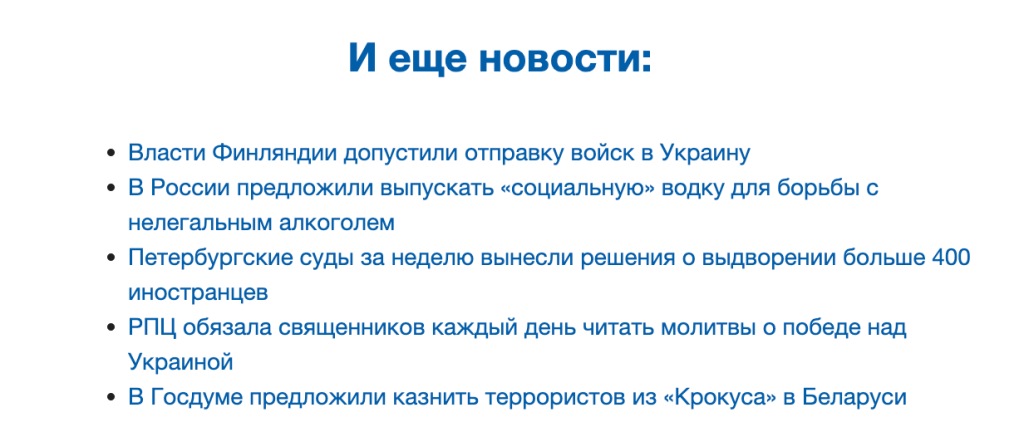
And more news:

Source: Moscow Times Russian Service daily newsletter, 1 April 2024. Translated by the Russian Reader. Unfortunately, none of these headlines is a joke.


State Duma (Russia’s lower chamber of parliament) Maria Butina has proposed an option that would allow the Russian authorities to implement the previously voiced threat to execute those involved in the Crocus City Hall terrorist attack.  Agenstvo news agency says she has proposed to extradite the Crocus City Hall terror attack suspects to Belarus, which maintains the death penalty.    

“Unfortunately, the tragedy has become common to us, because citizens of Belarus also died there.  I am quite knowledgeable about your legislation, including the death penalty, which is maintained [in Belarus].  In this case, it is the murder of two or more persons, therefore you have exactly the same right to try these people as the Russian Federation,” MP Butina was quoted as saying.

“I think that discussions are already underway among the competent authorities.  If they count on the fact that, since Russia has imposed moratorium on the death penalty they will be able to escape this type of punishment, then let’s wait and see, because negotiations are underway,” Butina was cited as saying in an interview with Belarus 1 TV Channel.    

Pervy Otdel (First Department) lawyer Yevgeny Smirnov told Agenstvo that “indeed, the Russian legislation allows, on the basis of an international agreement, to extradite people who committed a crime in the territory of Russia to another country.”  

According to him, “if a request arises from Belarus, the agreement with it will have priority over Russian norms.”

“However, in the case of at least one accused — Alisher Kasimov, who rented out the apartment to other defendants – it is impossible, because he has Russian citizenship,” Smirnov noted.  

Belarus still maintains the death penalty. 

Capital punishment is a legal penalty in Belarus. At least one execution was carried out in the country in 2022.  Also known as an Exceptional Measure of Punishment it has been a part of the country’s legal system since gaining independence from the Soviet Union on August 25, 1991.  The current national constitution prescribes this punishment for “grave crimes.”  Later laws have clarified the specific crimes for which capital punishment can be used.  The death penalty can be imposed for crimes that occur against the state or against individuals.  As of 2021, Belarus is the only country in Europe that continues to carry out the death penalty.   

Maria Butina (born November 10, 1988) is a Russian politician, political activist, journalist, and former entrepreneur who was convicted in 2018 of acting as an unregistered foreign agent of Russia within the United States.[

While residing in Washington, D.C., Butina was arrested by the FBI in July 2018 and charged with acting as an agent of the Russian Federation “without prior notification to the Attorney General.”  In December 2018, she pleaded guilty to felony charges of conspiracy to act as an unregistered foreign agent of Russia.  In April 2019, a federal judge sentenced her to 18 months in prison.  She served around five months at Tallahassee Federal Correctional Institution.  Her 9-month pretrial prison term was counted towards her sentence.  She was released and deported back to Russia in October 2019.  She publicly denied being a Russian spy.  In 2021, she was elected to the State Duma as a member of United Russia.  
Source: “Russian MP proposes to extradite Crocus City hall terror attack suspects to Belarus,” Asia-Plus, 1 April 2024

Dmitry Kalugin: It’s Saturday

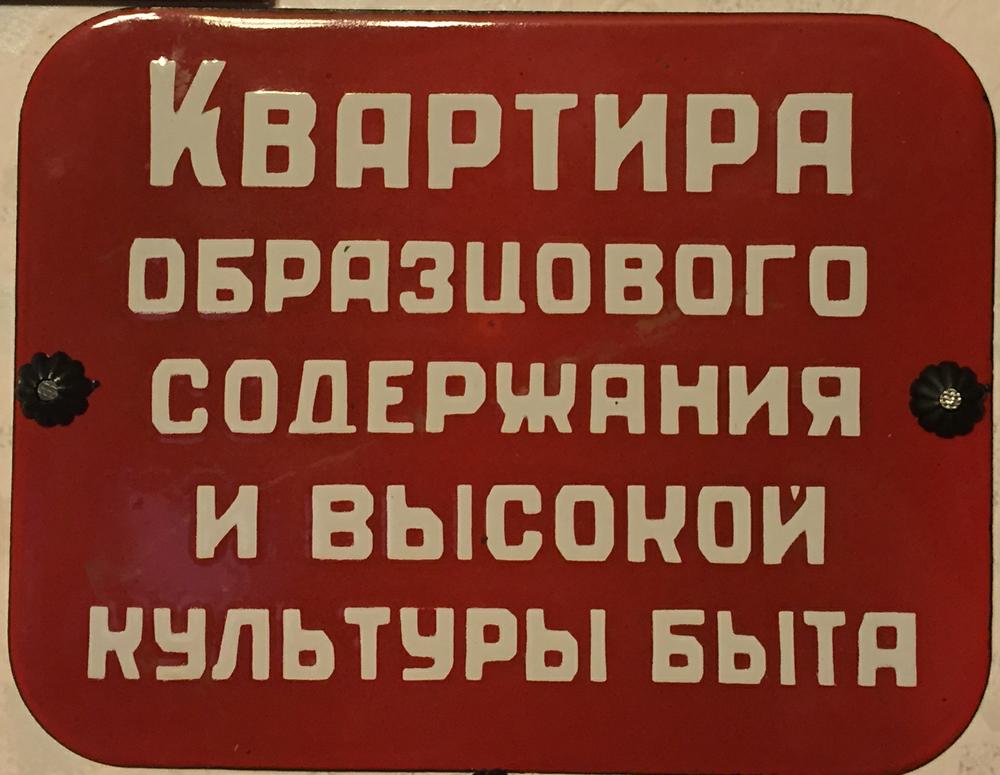
idly maintained flat“Ideally maintained apartment and refined household.” Photo courtesy of Collectionerus
Dmitry Kalugin
Facebook
November 24, 2018

When I lived in a communal apartment on Nekrasov Street, a man nicknamed Vitek was my neighbor for a while. The other neighbors did not like him, because he was a “new guy.” A factory worker, he struck a rather coarse pose among the other tenants of our “Ideally Maintained Apartment.”

In the evenings, Vitek got into the habit of eating a bowl of cabbage soup or borscht in the kitchen, washing it down with a quarter-liter bottle of vodka. Then he would go to bed. He would get up early in the morning and head again to the factory, returning home only in the evening.

At the weekend, he would not show his face in the kitchen. A pot of soup was brought to his room, where he “would do his thing,” as a famous satirist put it.

Sometimes, Vitek liked chewing the fat about life. He mainly did this with me, since no one else talked to him.

“Do you know,” he would ask me, “the difference between the intelligentsia and the working class?”

He went on without listening to what I said.

“How many days are there in the intelligenstia’s week?”

“I don’t know. Seven?”

“That’s right: seven. You go to the movies, you go to the theater, you watch television. You think Vitek is stupid? That he doesn’t see anything? He sees everything. There are only two days in my week, you see, Monday and Friday. And then it’s suddenly Monday again.”

My point is that today is Saturday.

Translated by the Russian Reader. Thanks to Dmitry Kalugin for his kind permission to translate and publish his feuilleton on this website. This is his sixth contribution to our salmagundi.

What Russia Means to Me

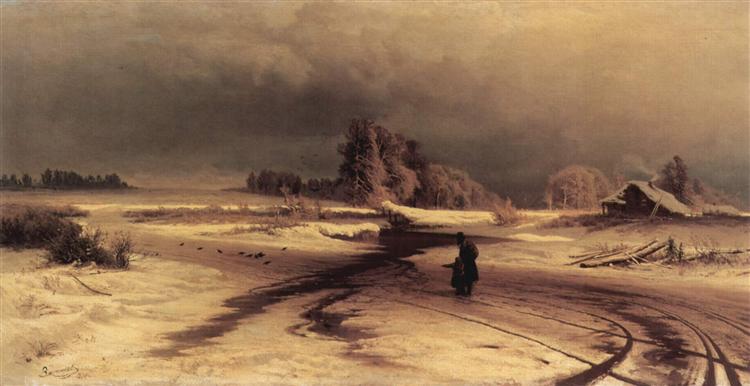
Fyodor Vasilyev, The Thaw, 1871. Oil on canvas, 107 x 53.5 cm. Image courtesy of Wikiart

A Circus, Psychopaths, and a Great Power: We Found Out What You Associate Russia With 
Guberniya Daily (Petrozavodsk)
June 14, 2016

On Friday [June 10], on the eve of Russia Day, we asked what you associate our country with. We suggested more or less decent answers and waited for the results to roll in. Ultimately, we learned that many of you associate our country with “a circus,” “psychopaths,” and “corruption.” And also with Putin. We got the impression that the respondents lived in different countries: some had it all bad, while others, on the contrary, had it all good. That is why a serious discussion, numbering over a hundred comments, broke out below the survey. So let us have a look at what many people associate Russia with.

First, the results of the survey:

opros
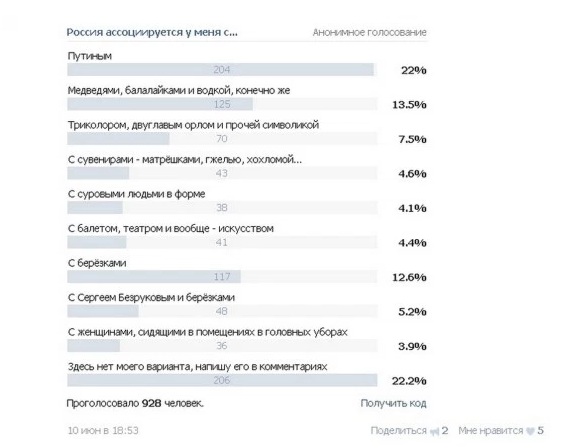
“I associate Russia with . . .” Putin: 204 votes, 22%; Bears, balalaikas, and vodka, of course: 125 votes, 13.5%; The tricolor, the double-headed eagle, and other symbols: 70 votes, 7.5%; Souvenirs: matryoshka dolls, Gzhel ceramics, Khokhloma tableware, etc: 43 votes, 4.6%; Stern men in uniform: 38 votes, 4.1%; The ballet, the theater, and the arts generally: 41 votes, 4.4%; Birch trees: 117 votes, 12.6%; actor Sergei Bezrukov and birch trees: 48 votes, 5.2%; Women wearing hats inside: 36 votes, 3.9%; My answer is not listed here; I’ll write it in the comments: 206 votes, 22.4%. A total of 928 people voted on June 10, 2016

As you can see, the answer “Putin” came in first place, “Bears, balalaikas, and vodka,” second, and “Birch trees,” third. It was in the comments that things got complicated.

Here are just a few of your answers (the original spelling and punctuation have been preserved):

I would like to associate it with birch trees. But, alas, I associate  it with Krushchev-era blocks of flats [khrushchovki] and Brezhnev-era blocks of flats [brezhnevki] ))

With a complete lack of prospects for a decent life.

Brezhnevki. Photo courtesy of Guberniya Daily

A country where happiness is forever in the future.

Where can I answer “with a total f–ing mess”?

With beautiful girls

With bad roads and a country where it is extremely hard to find a good job (even with a university degree)

The Motherland, just the Motherland

With a slave mentality, neo-feudalism, the lack of a future, vatniks,* and a huge ego trip about its “greatness”

Recently, only with “seagulls,” cellos, and Panama hats . . .**

alas, I feel like splitting from here like Peter the Pig, a typical post-Soviet space with khrushchovki and rutted roads and yards that have not been repaired since Soviet times

With psychopaths.(

With people who work and earn less than a living wage.

With corruption, drunkenness, and parasitism . . .

Motherland, history, childhood,  family . . .

Minus all the sarcasm and crap written [here]. MOTHERLAND to me is MOM, CHILDHOOD AS A YOUNG PIONEER, THE COMMUNIST YOUTH LEAGUE, BIRCH TREES AND LAKES, SAYING FAREWELL TO KINDERGARTEN IN THE VILLAGE OF SNEZHNOYE, AND THE SIMPLE PRIDE THAT I AM A RUSSIAN

With a strong country!!! And Putin. 

Strange that nearly everyone answers in the present tense.=) Or is that how we should answer? Then,  apparently, I didn’t understand the question.  The country is ancient and large, with a difficult destiny and history. Loving the Motherland . . . in my view you love it no matter who rules it. True, then your love manifests itself differently at different times. What you cannot take away from it is the natural beauty and the people . . . The people in this country are still good. The times are often complicated. But you can get through them by looking at the beauty of nature and the spiritual beauty of people.=) Something like that.

To answer simply and cornily, Russia is the place where I learned to walk and talk. But to answer the question from the viewpoint of a person who is a citizen of Planet Earth: Russia is a multiethnic, multi-party country. It has become the rage in Russia to say what one thinks about Putin, about world politics and foreign policy. I am afraid it will soon become a ritual, like the morning conversation about the weather among the English.

Kickbacks and dog and pony shows.

With the permafrost.

With poverty

* vatnik = “Russian patriot and nationalist (An outspoken follower of Putin, who aims to compensate his meaningless life by glorifying the motherland. This insulting term derives from the name of an iconic Soviet padded uniform jacket issued during WWII.” Source: Multitran.ru

** A reference to Russian Prosecutor General Yuri Chaika (his surname means “seagull” in Russian), recently reappointed to another five-year term despite substantial allegations of corruptions against him and his family, and cellist Sergei Roldugin, implicated as Putin’s bagman in the Panama Files.

Translated by the Russian Reader. Thanks to Comrade VZ for the heads-up

Obsolete

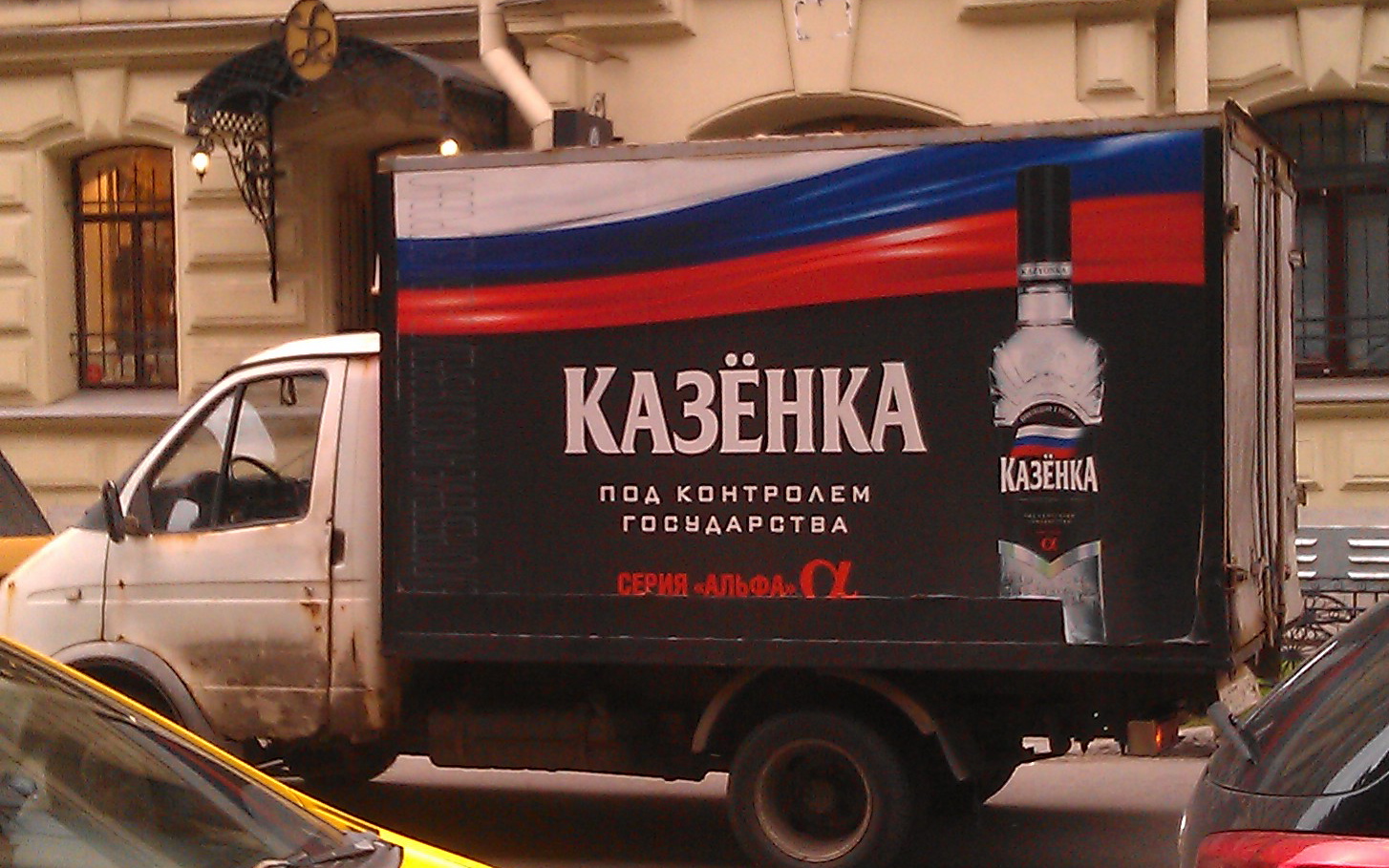
IMAG5786“Kazënka: Under State Control. Alpha Series,” Petrograd, September 29, 2015. Photograph by the Russian Reader

kazënka
1. fem., obs.
Grain vodka, whose sales were a state monopoly in Russia until 1917; government vodka.

2.fem., obs.
State shop for sale of kazënka (cf. 1).

3. fem., obs.
A room on a riverboat for the proprietor or his proxy (until 1917 in Russia).

Source: Yefremov’s New Dictionary of the Russian Language