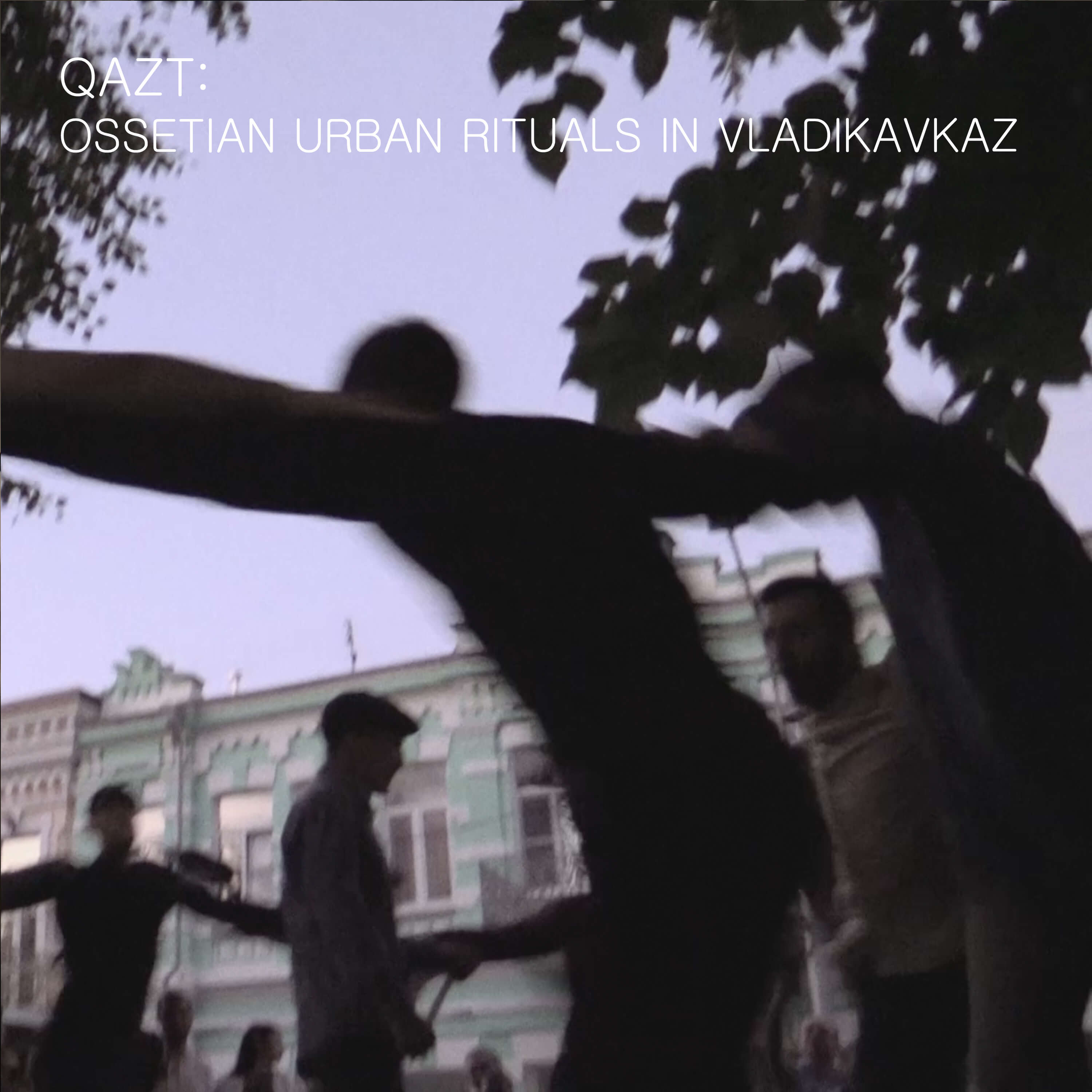
Today is my birthday, and I can think of no better birthday present than Qazt: Ossetian Urban Rituals in Vladikavkaz, a 46-minute documentary film released earlier today by Tbilisi-based Ored Recordings, whose remit is “traditional and local music from the Caucasus and beyond.” The film comes hot on the heels of Ored’s release of the eponymous album a week ago.
Nothing would make me happier today than if you watched the film and listened to the album, which I’ve pasted into this post, below. If you like what you hear, see, and read, support Ored’s vital mission by sending them what you money can afford and downloading the Qazt digital album or any of the other releases in the label’s growing back catalogue. Thanks! ||| TRR
Qazt is a traditional game among the Ossetians. It is a ritualistic, musical, dance, and social space that forms on various festive occasions. During the qazt, young people would socialize, boys would showcase their courage, and they would compete in various heroic and joyful activities. In 2020, we traveled to Vladikavkaz to explore the urban qazts, make a documentary film, and issue this release. We were interested in qazt as a new cultural phenomenon, an event of urban culture, and a modern form of Ossetian self-organization.
Filmed by Tamerlan Vasil’ev (and Muhamed Eley)
Audio release on Ored Recordings
Special thanks to Alik Puhati
Ored Recordings 2023
Source: Ored Recordings (YouTube), 10 August 2023
Qazt is a traditional game among the Ossetians. It is a ritualistic, musical, dance, and social space that forms on various festive occasions.
During the qazt, young people would socialize, boys would showcase their courage, and they would compete in various heroic and joyful activities.
Analogues of qazt can be found among other peoples in the Caucasus. For example, among the Circassians, such festive dances are called dzhagu. The semantics of the Ossetian word “qazt” and the Circassian “dzhagu” are even the same — “game.”
In 2020, we traveled to Vladikavkaz to explore the urban qazts, make a documentary film, and issue this release. We were interested in qazt as a new cultural phenomenon, an event of urban culture, and a modern form of Ossetian self-organization.
During the pandemic years, traditional dances on the streets of Vladikavkaz became a noticeable event — qazts were covered by Caucasian media and Ossetian bloggers. We were invited to film the event by Alik Pukhaev, the author of the Rajdian blog.
In 2020, qazts seemed to be a growing initiative. This youth movement had it all: a vibrant cultural component, moderate protest, and an orientation towards the future, rather than a romantic desire to return to the past, where everything was considered better, purer, more authentic, and more national.
The qazts were organized not by officials who often do things formally, nor by the elderly, who are used to scolding the youth and imposing what they consider to be the authentic traditions of their people. No, this new cultural movement was led by young people who equally loved Ossetian culture and some global elements — like rock music or hip-hop. What was even more important is that the organizers did not draw boundaries between their local and global identities, between the traditional and the modern.
Qazts in the center of Vladikavkaz became part of urban culture, something that not only ethnographers but also urbanists from fancy magazines would write about in the future. The urban dances and songs struck a balance between preserving Ossetian culture and Caucasian solidarity. Initially, Ossetian students were inspired by Circassian festivities in Nalchik and decided to create something of their own.
It is important to note that at weddings in North Ossetia, Circassian and Chechen dances are very popular. According to Ossetian cultural activists, sometimes they are even too popular. Despite their desire to build horizontal connections with their neighbors and avoid getting trapped in provincial ethno-patriotism, the organizers of the qazts noticed that foreign cultural elements were becoming more popular than local ones, and many traditional dances were being forgotten.
Therefore, their project had specific rules: only Ossetian songs were allowed to be performed, and only Ossetian dances were allowed to be danced. All the other variety was appreciated but could be done on another occasion.
They also had a dress code: men were not allowed to dance in shorts, and women were not allowed to wear trousers. Some people criticized this approach on social media. Working with traditional culture is often associated with conservatism, so some viewed the effort to dress the audience in a certain way as backward.
On the other hand, one could compare this practice to dress codes at raves. It would be unfair to label a Berghain bouncer as a backward traditionalist if they don’t let someone in for not adhering to the techno dress code.
“It’s not a return to the past; we were creating a new culture for ourselves and others. We were trying not only to introduce Ossetian songs and dances into the urban environment but also to rethink our own culture. In the past, each dance had its context, which might not be understood in Vladikavkaz today. That’s why it’s important to come up with new meanings,” explained one of the qazt initiators, Tamu Berozti.
People of different generations – from children to grandparents – attended the qazts and embraced what the youth offered them. These evening gatherings in the city park or on the central avenue of Vladikavkaz provided many with an answer as to why all these songs about past heroes and dances with strange meanings were important. Or rather, the question “why?” did not arise because qazt had become a natural form of uniting people with similar identities.
The youth didn’t just bring culture to the public sphere, where people literally encountered Ossetian language and music while strolling through the city. For a while, the qazts managed to break the monopoly that academic and exemplary song, and dance ensembles had built. Qazt deliberately distanced itself from a staged show. It was not choreography for the audience, but a way to spend time together and, in the long run, negotiate with each other.
Since the release was recorded and the film was shot, three years have passed. In 2020, the main concern was the pandemic, which forced people to seek new ways of living together and uniting. Today, the main context in which the North Caucasus and other regions included in the Russian space live is war. The issues of preserving identity, culture, and solidarity have become even more acute.
It’s difficult to say why the qazts didn’t become a new driving force, a space for reflection, or simply a viable cultural phenomenon. They emerged brightly, attracted attention, and slowly faded away.
Perhaps the general fatigue of the main participants played a role: in the North Caucasus, musicians often expect overwhelming success and recognition after their first successful events, but over time, they lose enthusiasm and feel discouraged.
Maybe some tensions among the main organizers contributed to it – it was evident that they had disagreements on various issues. Or against the backdrop of a general depressive atmosphere in the region after 2022, they all became tired and engaged in other projects. More intimate and with clear structure – like the Ragon traditional music ensemble and the Uatsamonga choir.
In any case, there was no cultural revolution, and the qazt remained a ghost of a possible future.
However, its influence is still felt. Street concerts with Ossetian-language indie music in Vladikavkaz have increased. The Ragon group is releasing its second album and actively performing at festivals.
In the Rajdian blog, there was a post about a tweet from a dissatisfied Ossetian from the diaspora in Turkey:”Cultural youth is not the necessary generation for the continuity of ethnic identity. We need a political youth,” commented a descendant of migrants.
Many active young people in the North Caucasus share this view, perceiving music and dances as entertainment and distraction from problems. While we dance and sing approved songs joyfully, our languages are disappearing, and social problems are increasing more and more.
Initiatives like the Vladikavkaz qazts could have become an example of music aimed not only at entertainment but also at solidarity.
And the fact that our new release is once again about something from the past proves that cultural identity without a civic position is insufficient for gradual and confident development.
Film by Tamerlan Vasiliev will be out soon
Recorded on August 2020 in Vladikavkaz
Sound and mixing: Timur Kodzoko
Cover photo: Tamerlan Vasilyev
Cover art: Milana Khalilova
Liner notes: Bulat Khalilov
Translation: Bella Mirzoeva
Special thanks to Alik Puhati