Armen Aramyan: Russians Are Not Chimpanzees

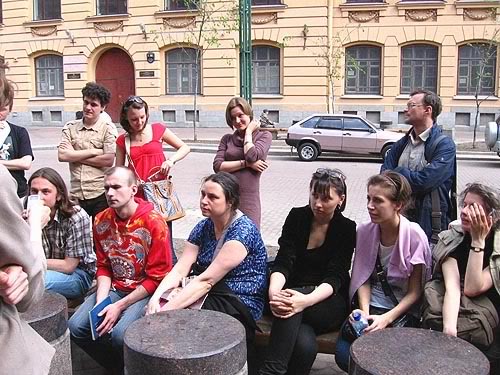
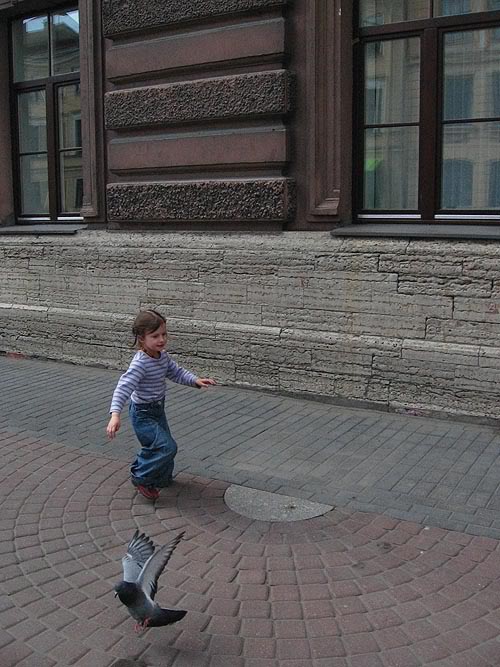
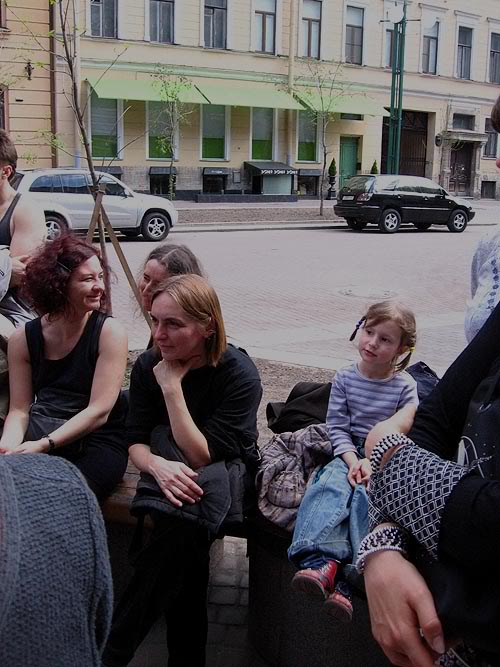
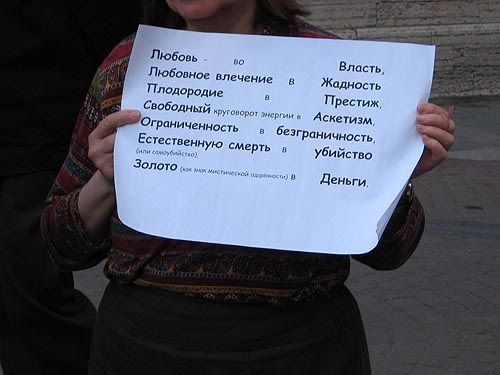
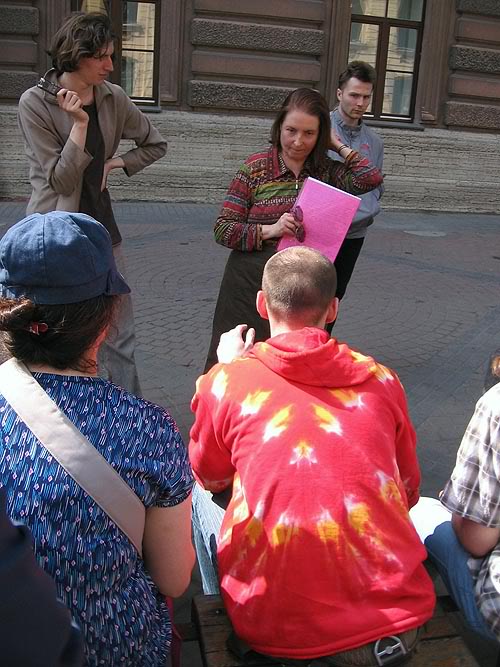
These are scenes from a May 2008 session of Petersburg’s Street University, a grassroots undertaking that I helped launch in response to the Putin regime’s sudden, underhanded shutdown of the nearby European University in February 2008. I unearthed these snapshots from my long-dormant Photobucket account, about whose existence I was reminded by an email from the service that I found by accident in my spam folder whilst working on this post earlier this morning. I think it’s a nice illustration of the point made, below, by Armen Aramyan, who must have been nearly the same age as Tasya, the little girl in the second and third pictures, when I took them. If the war can be stopped and Russian society can be salvaged in the foreseeable future, however, it will require a lot more than creative “sociology,” the right combination of critical theories, the power of (“progressive”) positive thinking, and hypervigilant discursive gatekeeping. At minimum, it will require a massive manifestation. This would be different in kind and magnitude from the current instances of grassroots resistance that Mr. Aramyan enumerates below, which are almost entirely the work of lone individuals, not the actions of a seriously mobilized grassroots or, much less, of a more or less widespread and vigorous “anti-war movement.” ||| TRR


Hi, this is Armen Aramyan!

On Monday, iStories published a column by its editor, Roman Anin, in which he laments the moral degradation that “has engulfed not only the so-called elites, but also society.” He claims that the majority of Russians support military aggression, and that the political system is in such decline that we can make predictions about Russia’s future by invoking the discourse of primatology.

“Human DNA is 99% the same as the DNA of chimpanzees, whose entire polity revolves around the alpha male. While the alpha male is young and strong, he keeps the whole pack at bay, manages the distribution of resources, mates with all the females, and severely punishes those who question his authority. But as soon as the alpha male begins to age and show signs of weakness, a fierce war to take his place ensues. […] In my opinion, the Russian political system today is not much different from the power arrangements in chimpanzee troops.”

There is no grassroots resistance in the Russia about which Anin writes. There is no torching of military enlistment offices, no teachers who refuse to conduct propaganda lessons, no activists who assist Ukrainians in getting out of Russia. There are no people prosecuted for speaking out and acting against the authorities. There are only big shots who divvy up the loot behind closed doors.

But activists and anti-war resistance do exist, and [some] sociologists have claimed that the pro-war segment of Russian society is a small minority that is averse to political action of any kind.

Why do we continue to encounter such remarks?

I would suggest calling the worldview that informs such remarks Naive Anti-Putinism, or NAP.

NAP sees Russia as a fringe country. The processes in it can be explained only through allusions to fantasy novels, such as dubbing Russia “Mordor,” from The Lord of the Rings, or referencing the Harry Potter universe. (Have the images from fantasy novels run out and we are now on the Planet of the Apes?) Russia is so unique that there are processes taking place in it that don’t exist anywhere else (with the possible exception of North Korea). This Russia suffers from a patriarchal regime and a total absence of democratic institutions. (That is, power belongs to individual groups and their leaders, who do not rely on any institutions). The enlightened achievements of European democracies have not yet reached Russia, and so now we are doomed to live amidst an endless Games of Thrones (to invoke yet another fantasy novel comparison). In this system, all that remains for us is to analyze what intrigues the different Kremlin clans are pursuing.

Resistance, grassroots movements, the struggle for democracy, and revolution are impossible in this reality. So, all that naive anti-Putinists are capable of doing is resorting to moral critiques delivered from a superior position and continuing to admonish us that the common folk in Russia are bad, having failed to accept the enlightened achievements of European democracies. If there is no democracy [in Russia], [that is because] the ordinary folk simply don’t want it. That is NAP’s entire explanatory arsenal.

Naive Anti-Putinism does not envision the possibility of change in Russia, much less revolution or the destruction of Putin’s elite. It is a readymade scheme that enables certain groups in society to make peace with reality and continue to watch the new season of Game of Thrones.

For example, if you are a businessman or an IT worker who relocated [to another country] after the war’s outbreak and invested all your resources in adapting to a new place (most likely — quite successfully), you probably don’t really want to figure out how to build democracy in Russia and support the grassroots resistance.

But you can also imagine another situation: you are a researcher who has spent a great deal of time and effort investigating how the power elite throws bags of money around. Probably, at some point, you might imagine that there is nothing else besides this cynical redistribution of the loot.

Alexander Zamyatin, in a discussion of the emigration on the podcast This Is the Base, makes a great point: “You can’t be a gravedigger of the old regime while grieving for its missed opportunities.” We can speculate for a long time about NAP’s origins, and why many members of the anti-war movement espouse this position.

But if we want to end the war and build democracy in Russia, we need to think differently. Even if we imagine that this is impossible right now, do we really think that democracy is altogether impossible in Russia? And if it is possible, what would it look like in reality? What movements would be needed to make it happen? How would they gain power? How would this power be redistributed and how to make sure that it is not abused? These are the questions that should concern all of us members of the anti-war movement on a daily basis.

Centuries of class, colonial, and gender oppression led to the emergence of strong theories elucidating the structure of power in modern societies. The crises of the nineteenth century spurred the elaboration of theories about class and capitalism. Representattives colonized peoples, as well as their allies in the West, formulated theories about how imperialism and colonialism function. Activists and theorists of women’s movements offered accounts of how gender dominance operates in modern societies.

If we reject the entire legacy of critical theory, as many NAPpers do, then we need to propose something else. But this something is definitely not primatology or allusions to Harry Potter. But one might have to read other books to to find this something else.

P. S. But also do not assume that the animal kingdom — and in particular the political systems of primates — is so primitive. Usually, reducing people to animals is a conservative move whose purpose is to show that human relations are grounded in competition and the struggle for survival, in which the strongest win. I recommend reading this essay by the anthropologist David Graeber, in which he argues that this is not at all the case.

Source: Armen Aramyan, DOXA Anti-War Newsletter #313 (10 January 2023). Mr. Aramyan is one of the editors of the online anti-war magazine DOXA. In April 2021, he and three other editors of the then-student magazine were sentenced to two years of “correctional labor” (i.e., community service) over a video questioning whether it was right for teachers to discourage students from attending rallies protesting opposition leader Aleksei Navalny’s incarceration. Translated by the Russian Reader
For Sobchak

sobchak poster

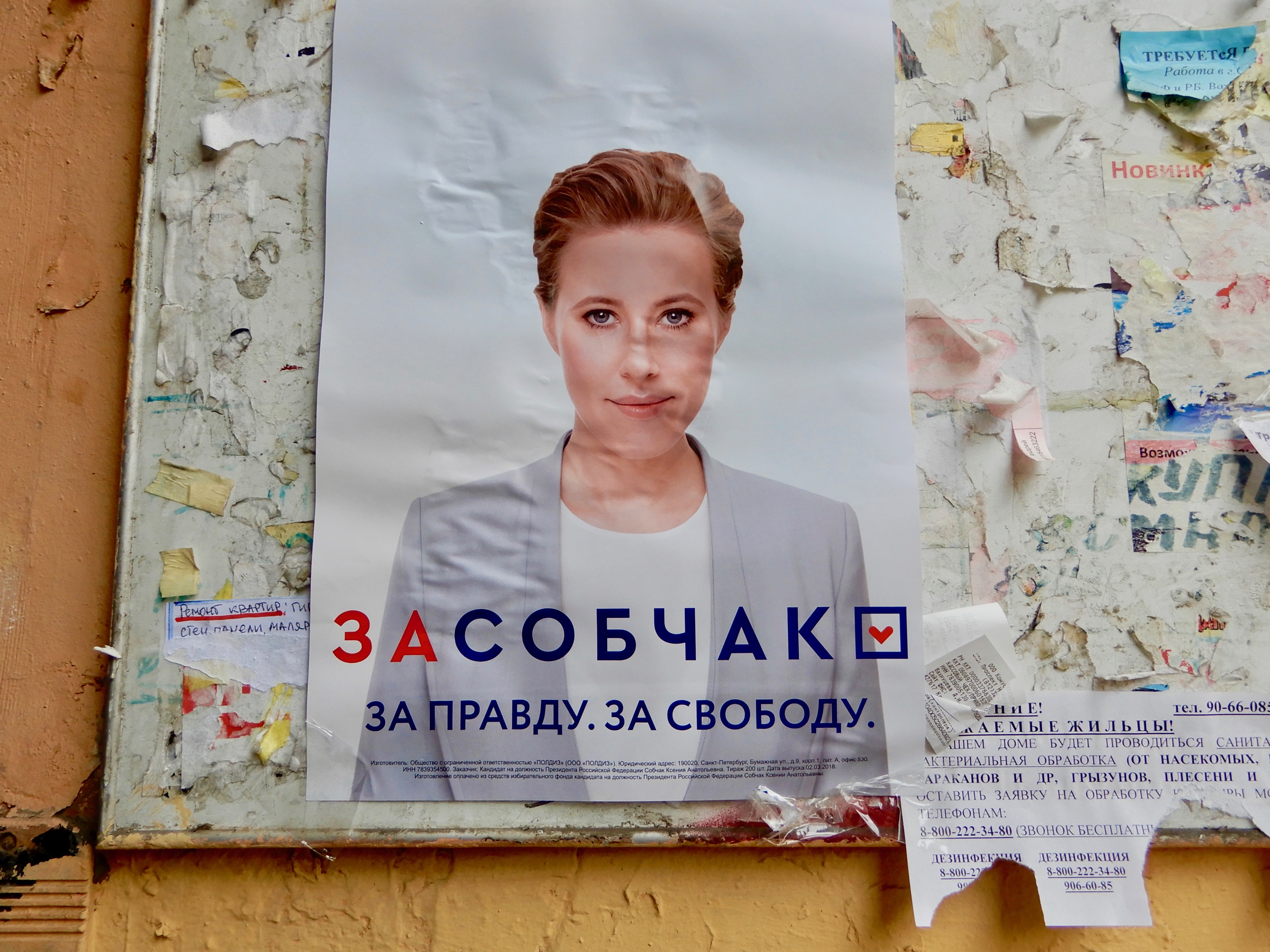
This is literally the only Ksenia Sobchak campaign poster I have seen in Petersburg since the Russian presidential campaign officially kicked off.

The poster, which reads, “For Sobchak. For Truth. For Freedom,” was half hidden in the gateway of a residential building on a street in my neighborhood when I photographed it a week ago today.

I imagine the people working in the city’s housing maintenance and street cleaning services have standing orders to tear down any and all “visual agitation” on behalf of the other so-called candidates (each and every one of them vetted and approved by the Kremlin) running in the so-called Russian presidential election, an utterly rigged farce scheduled for this Sunday, March 18.

The world’s largest country should be ashamed to conduct important national business in such a creepy, petty fashion, but until the self-declared heir apparent to the Romanov throne and his gang of crooks and thieves are chased out of town, there can be no movement on that front, alas.

Or any other front, for their matter, even though I have lots of friends on the left here who think the country is pullulating with “social movements” unfairly ignored by the general populace. To their mind, the rank-and-file Ivans and Natashas currently gumming up the future socialist works should magically learn about these nearly invisible social movements and just as magically support them, without my friends the leftists having to build and deploy anything that resembles even the shadow of an effective grassroots political organization that could reach out to the allegedly benighted Russian rank and file, enlighten it, and give it a doable road map to a better future.

One of the few people in Russia who understands something about political organization and tactics, Alexei Navalny, has been leading a boycott of the presidential election or what he calls a Voters Strike. For their pains, the election boycott activists, most of them young Russians, have been increasingly targeted in a crackdown by Russian security services and police. The plan seems to be to put as many of them as possible in jail on trumped-up charges and keep them there until after March 18, at the least.

My friends on the left, who claim not to like Navalny for his nationalist views, but really resent him because he knows a thing or two about national grassroots political organizing, while they seemingly know next to nothing about it, although they talk about it incessantly, are in no hurry to express their solidarity with the mostly “liberal” activists who have been mowed down by the Kremlin’s dragnet. (In Russia, “liberal” is a powerful swear word employed by leftists and rightists alike.) Their sense of solidarity extends only to those people who more or less share their political views and their lifestyles.

The most shameful thing is how many seemingly intelligent Russians are sanguine about this desperate state of affairs and think talking seriously about domestic politics (although they are often, on the contrary, extraordinarly keen to talk about politics in other countries) is like holding forth in great detail at a swanky dinner party about your daily bowel movements. TRR

Civilization Won’t Be Destroyed by Extraterrestrials: On the Possible Merger of Russia’s Two Largest Libraries

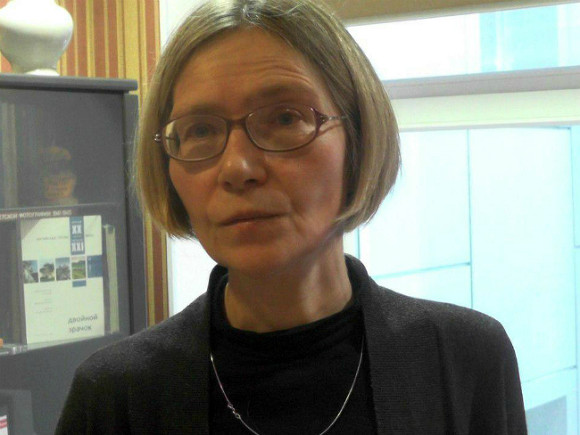
Tatyana Shumilova. Photo courtesy of Rosbalt

Civilization Won’t Be Destroyed by Extraterrestrials
The consequences of merging Russia’s two largest libraries would be disastrous, argues the Russian National Library’s Tatyana Shumilova
Alexander Kalinin
Rosbalt
February 1, 2017

The idea of merging Russia’s two biggest libraries was proposed to culture minister Vladimir Medinsky by their directors, Vladimir Gnezdilov (the Russian State Library in Moscow, aka the Leninka) and Alexander Visly (the Russian National Library in Petersburg, aka the Publichka). The proposal has hardly garnered universal approval. The country’s leading authorities on librarianship have sent a letter to President Putin asking him to stop the merger from going ahead. They have been supported by Russian philologists and historians.

Tatyana Shumilova, chief bibliographer in the Russian National Library’s information and bibliography department, spoke to Rosbalt about how staff there have related to the possible merger with the Russian State Library, and whether the issue has been broached with them.

What are the possible consequences of merging the country’s two biggest libraries?

Our library would simply cease to exist in its current shape. Many people have made much of the fact that the RNL’s executive director Alexander Visly has said the changes would not give rise to a new legal entity. Of course, they wouldn’t. One legal entity would remain: the RSL. So everyone realizes it’s not a merger that is at issue, but a takeover.

So we could equate the words “merger” and “destruction” in this case?

Yes, definitely. A merger would be tantamount to the death of our library here in Petersburg. After the RNL became a branch or appendage of the RSL, our work with readers would cease to be funded. We would not be able to provide them with the full scope of services. Plus, we would have to switch to the RSL’s system, and that would be undesirable. We are told the catalogues in both libraries are structured on the same principle. That is not true. There is a big difference between them. It would be quite complicated to restructure the system. The different approaches to librarianship should be preserved.

Moscow has the administrative resources. The government is located in the capital, as is the Culture Ministry. Moscow and Moscow Region are the home of the RSL, the Russian Institute for Scientific and Technical Information (VINITI), the Russian National Public Library for Science and Technology, the State Historic Public Library of Russia, and the Russian State Library for Foreign Literature (aka the Inostranka). And, until recently, the Institute of Scientific Information on Social Sciences of the Russian Academy of Sciences (INION RAN) was running at full steam. But the Northwest Federal Region has only two major libraries, the RNL and the Library of the Russian Academy of Sciences (aka the BAN). After a merger, there would be one.

I understand that, after the merger, publishers would not have to send an obligatory copy of their books to the RNL. Only Moscow would get new books?

That is one of the cost-saving measures. Allegedly, money would not have to be spent on two sets of obligatory copies. It would be enough to have one hard copy and a digital copy. But the outcome would be that Petersburg would simply stop receiving most new books. It’s a rather cynical cost-cutting measure that would affect only our library, not the RSL, which was founded much later than the RNL. And all because it’s located in Moscow. No one says it outright, but it’s clear anyway.

But the RNL would still get a digital copy.

I really don’t understand the idea of sending a digital copy instead of a hard copy. We have a huge number of readers who for medical reasons cannot and should not use a computer. Why should we deprive them of hard copies? It’s simply indecent. Besides, we know what natural disasters electronic resources are prone to. A blackout, a power surge in the network, a server failure, and everything is lost. A library should not be dependent only on one type of resource.

People who take far-reaching, momentous decisions like to base them by alluding to the know-how of other libraries and even other countries. But nowhere do national libraries receive only digital copies of printed matter. You can probably merge libraries in Denmark, but the Russian Federation is a different country, a much larger country with a much larger population. Although the name would stay the same, the RNL would in fact cease being a national library. We already have municipal and neighborhood libraries in Petersburg. People come to us as a last resort, when there is nowhere else to go.

Nor is anyone probably really aware that digital copies relate not only to books but to magazines and newspapers as well.

Apparently, the shots are being called by people who don’t read and don’t go to libraries. Just how did the culture minister write his dissertations and books? By using the Internet? Or did someone else do it for him?

Where did the idea to merge the libraries come from?

Rumors about the merger have been circulating for a long time. They are all we have to go on, for no one has said anything officially. It’s still too early to draw any conclusions from the available facts. Now no one denies that merger talks are underway. Earlier, apparently, they were too busy to reveal this, or maybe they were ashamed or embarrassed. But now they’re not ashamed anymore.

After the Soviet Union collapsed, Vladimir Zaitsev, the then-director of the Publichka, was worried about the library’s potential plight. That was when the name Russian National Library was coined. Lots of people didn’t like it, but Zaitsev thought it would give us stability and protect us from attacks. As we see now, it didn’t work for long. The opportunity to save millions of rubles has now been identified as grounds for merging the libraries. Indeed, you could probably calculate the worth of the books and the real estate by eye. But how do you evaluate the intangible assets? How many people have been educated here? How many people, from university students to scholars, have grown up here? They wrote their dissertations and books here. If you write a research paper based on more than two sources, you are going to need a library. This is serious work.

It is believed the RNL’s current director Alexander Visly was sent to Petersburg on a “temporary assignment” in order to merge the two libraries. Do you agree?

Officials rarely condescend to explaining the reasons for their actions directly. They believe they should not be accountable to the taxpaypers. No one has announced anything to us officially. But talk of a possible merger started after Anton Likhomanov left the director’s post at the RNL in early 2016. Visly wasn’t the only person tipped for the vacancy, after all. The director of the Lermontov Interdistrict Centralized Library System, in Petersburg, and the director of the National Library of the Republic of Karelia were identified as possible candidates.

Several months passed between Likhomanov’s departure and Visly’s arrival. We don’t know what was discussed during that time. Apparently, there was some kind of horse trading underway. According to the rumors in Moscow, Visly really didn’t want to move to Petersburg, but he was nevertheless talked into going in order to perform certain functions. The fact that an executive director has not yet been appointed at the RSL, and they only have an acting director, causes one to reflect grimly on the subject.

Indeed, Visly has not taken an interest in day-to-day affairs in Petersburg. He is busy with construction, renovating the Lenin Reading Room, and he has visited the cataloguing and acquisition departments. By the way, officials have been saying the functions of these departments overlap at the RNL and RSL. So he hasn’t been dealing with the library as a whole, although he is the executive director and should be responsible for everything that happens in the RNL. Apparently, this circumstance has been agreed upon with someone. No one would reproach him for it.

Has the issue of the possible merger been discussed with RNL staff?

There have been no meetings on the topic with the workforce, and none are planned. No one keeps us in the loop. There are no general staff meetings.  There is the practice of informational meetings, to which the heads of the departments and units are invited. My comrades once expressed a desire to take part in one such meeting, but they were simply booted out. Staff members only talk about the merger amongst themselves.

What do they say?

Very little that is positive. Everyone fears for his or her future. But what can rank-and-file library staffers do? Some signed the letter supporting the library, while others didn’t. Some have signed a petition. What else can we do?  We need large-scale outside support, but how do we get it? People know very little about the merger of the libraries, after all. Even if they wanted  to  find out about the consequences of the mergers, where would they look? Yandex News. And what would they find there? News about fires, missing schoolchildren, pedestrians run over by cars, and people falling from tall buildings. There is almost no news about culture.

And how do we explain to university lecturers, university students, and schoolchildren what could happen to the library? How do we convince them that the problem concerns them, too? Even university students come to us for textbooks, because the university libraries are shortchanged when it comes to new acquisitions of books. But our customers, people to whom provide information, include the St. Petersburg Legislative Assembly, the Investigative Committee, the FSB, the Interior Ministry, and other organizations. So it turns out they could not care less, either. Or they naively believe nothing will change. Maybe they don’t understand the consequences?

Have you thought about organizing a protest rally?

Few library staffers would attend such a rally. Everyone is scared redundancies will kick off, and his or her department will be eliminated. There is the chance of winding up on the streets. There are people working here who went through the hungry 1990s on miserly wages. At least they were paid regularly. Director Vladimir Zaitsev, who constantly traveled to Moscow and literally sat in the minister’s waiting room, deserves the credit for that.

So a lot of people would not attend a rally. No one wants to lose their job. Take a look, for example, at how many people came out to defend St. Isaac’s Cathedral. A lot fewer than could have come out.

People today are surrounded by informational noise. They hear about Crimea, Ukraine, and America. Old ladies at bus stops don’t discuss cultural issues, but US Presidents Obama and Trump. Everyone in Russia is totally confused.

What consequences would the merger have for readers? For example, one of the plusses that has been mentioned is that people with RNL cards would be able to use the RSL in Moscow.

Initially, readers would have no sense of any change. They just wouldn’t understand anything. After all, we would continue to acquire some new books. Qualitative negative changes build up unnoticed. They’re not visible immediately. In Germany in 1933, not everyone realized immediately what exactly was happening, either.

Aside from the issue of conservation and security, replacing hard copies with digital copies would cause yet another exodus of readers, especially elderly people, who often don’t like or cannot read e-books. Indeed, many young readers, when you suggest they use a digital source, reply, “I don’t need your Internet. I came here to read books.” Reducing the numbers of live readers to a minimum would probably lead to the next step: closing the library altogether. “Why keep you open?” officials would say, “Nobody visits your library.”

As for a single library card for the two libraries, there wouldn’t be much advantage to it. RNL readers can easily get a card for the Leninka, and Leninka readers can easily get a card for the RNL. It’s a snap: you just need your internal passport. You don’t even have to bring a photograph to the registration desk anymore.

So is there any way out of the situation, or is the RNL’s takoever inevitable?

I don’t want to accept the fact it could happen. But RNL staff are hardly in a position to do anything. They have almost no influence on the situation. Respected people, prominent scholars and cultural figures, have to speak out, people with whom the authorities have to reckon. As it is, only Arkady Sokolov and Valery Leonov, out of the entire Petersburg library community, have spoken out on the topic. None of the museums or universities have openly supported us. It is sad.

I don’t think the city could solve the problem by talking the library under its wing. That would only delay its death. The city could not fund the RNL properly. I don’t know what other options we have for saving the library. We have let the moment passs when we could have looked for sponsors to support us financially.

What do RSL employees think of the merger?

They are silent because the merger wouldn’t affect them. They would continue to function as before and do the same things they did earlier, such as acquiring the obligatory copies, hard copies and digital copies, of everything published in Russia. The negative consequences would only affect us, meaning the Russian National Library.

The most concise definition of culture is this: culture is the transmission of tradition. Breakdowns in the production, concentration, and reclamation of the national heritage (a process in which libraries are an inalienable and quite important component) have led to the collapse of civilizations throughout history. Then people go looking for the extraterrestrials who flew in and destroyed everything. The perpetrators are actually much closer.

Translated by the Russian Reader. Thanks to Comrade VZ for the heads-up

UPDATE. Sadly but predictably, the Russian National Library has now decided to dismiss Tatyana Shumilova from her job there for granting this frank interview to Rosbalt, although ostensibly, as follows from the letter below, dated 3 February 2017 and signed by E.V. Tikhonova, acting director of the RNL, she is threatened with dismissal for, allegedly, being absent from work for four hours and thirteen minutes on 30 January 2017. Thanks to Comrade VA for this information and the scan of the letter. TRR

16388258_1765605920131726_5540994598165898435_n

UPDATE 2. Today, February 7, there have been corroborated reports that Tatyana Shumilova has been summarily dismissed from her job at the Russian National Library in Petersburg. TRR