The other day, I closed my Facebook accounts and pages, I hope for good.
Part of the reason I closed them was that a New York City writer whose books and opinions I admire greatly, and who has a huge following on Facebook, wrote a mean-spirited and divisive post on Facebook condemning “the Heartland,” meaning the middle part of the United States.
She labeled the place “heartless” and “dangerous” on the basis of her cursory perusal of an “interactive” map of the 2016 US presidential election results, published in the New York Times.
While the map she cited is certainly worth studying and full of surprises, I imagine the writer saw only red, literally and figuratively, and blew a fuse.
I doubted out loud, in the comments, whether the writer knew much about the “heartless, dangerous” Heartland. On the contrary, I know a great deal about it, since I was born and grew up there.
She did not respond to my petty, eminently ignorable objections nor did most of her thousands of self-satisfied, bien-pensant followers, certain that the “heartless, dangerous” (and completely imaginary) “Heartland” had irrevocably damaged their beautiful souls and beautiful lives in Clintonia.
But as reporter Issie Lapowsky and map expert Ken Field argue in an article published on July 26 by WIRED (“Is the US Leaning Red or Blue? It All Depends on Your Map”), there are maps, and then there are maps. For example, there is this map, devised by Mr. Field.
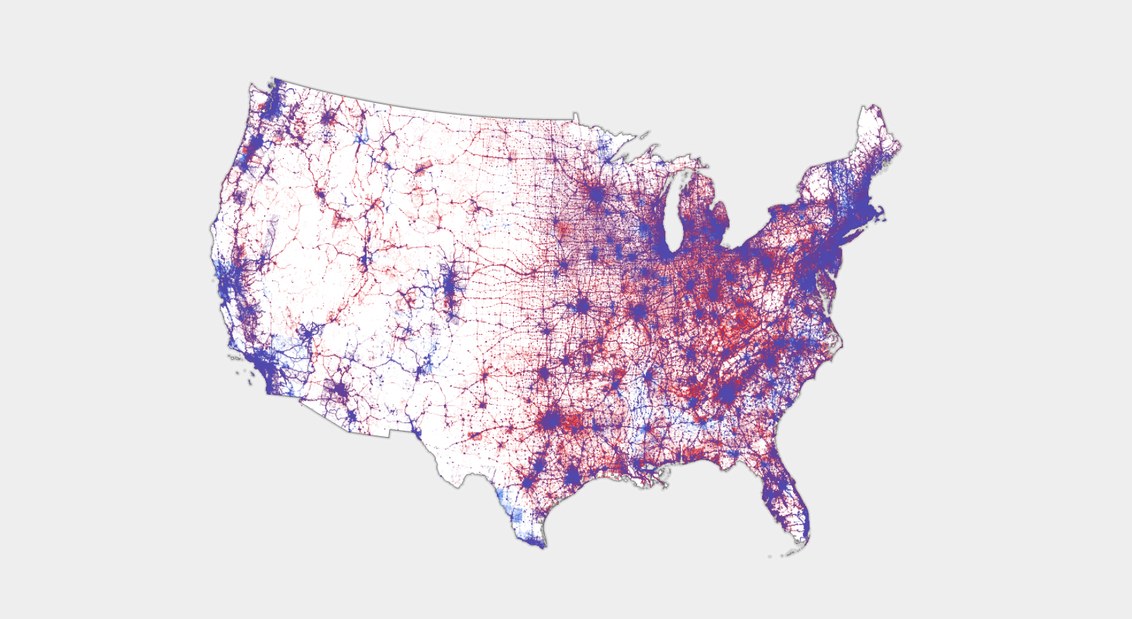 Ken Field, “Presidential election 2016: dasymetric dot density.” Courtesy of WIRED
To Field, there’s no such thing as a totally comprehensive map, but he says, “Some are more truthful than others.” The so-called dasymetric dot density map is one of them. The term “dasymetric” refers to a map that accounts for population density in a given area. Instead of filling an entire state or county with the color red or blue to indicate which party won, Field uses red and blue dots to represent every vote that was cast. On this particular map from 2016, there are roughly 135 million dots. Then, rather than distributing the dots evenly around a county, he distributes them proportionally according to where people actually live, based on the US government’s National Land Cover Database. That’s to avoid placing lots of dots in, say, the middle of a forest, and to account for dense population in cities.
Taken together, Field says, these methods offer a far more detailed illustration of voter turnout than, say, the map in Yingst’s tweet. That map uses different shades of red and blue to indicate whether candidates won by a wide or slim margin. But by completely coloring in all the counties, it gives counties where only a few hundred votes were cast the same visual weight as counties where hundreds of thousands of votes were cast. So, the map looks red. But on the dasymetric dot density map, it’s the blue that stands out, conveying the difference between the popular vote, which Clinton won, and the electoral college vote, which Trump won.
Why do I bring this sad business up on a website dealing with “news and views from the other Russias”?
Over the last several years, I have been fighting a similarly invidious myth about Russia and Russians. To wit, Vladimir Putin is incredibly popular, as conclusively shown, allegedly, by dicey “public opinion polls” and rigged elections, and his “base” is in the “Russian heartlands,” which are, apparently, just as “heartless” and “dangerous” and stupid as the US “Heartland,” and similarly prone to throw their electoral weight behind a tyrant, unlike, we are meant to imagine, the smart sets in Russia’s two capitals, Moscow and Petersburg.
I have been at great pains to show a discursive apparatus I have dubbed the “pollocracy” produces the results that both Putin’s quasi-fascist supporters and faux-liberal detractors need to cling to their respective security blankets. In the case of the so-called liberals, the security blanket consists in the notion that the world’s largest country is largely inhabited by woefully ignorant yahoos who have laid waste to any chance at building a democracy in the Motherland. As viewed by their opponents, the fake “patriots” in Putin’s camp, the same heartland yahoos are the country’s “pious,” “conservative” core and the source of the Putin’s ruling elite’s self-produced mandate to rule the country till kingdom come and particularly badly.
Seventy percent of why I do this website is to show that Russia actually consists of lots of other Russians and lots of other Russias that belie the dodgy “findings” of pollsters and the lazy clichés reproduced ad nauseam by Russian and international reporters, “Russia experts” (nearly all of them resident somewhere other than Russia), politicos, and spin doctors to prove a self-serving conclusion they arrived at long ago without bothering to find out whether it was true or not.
It’s not true. Just as it is emphatically not true the US “Heartland” is “heartless” and “dangerous.” Or maybe it and its mythical Russian counterpart, the “Russian heartlands,” are heartless and dangerous part of the time, but not all of the time and everywhere and on the part of every single woman, child, man, dog, and cat who live there. Nor, vice versa, are the alleged oases of high intellect and liberalism where pollsters, reporters, and opinion leaders (such as the well-known New York writer who, railing and trembling like the Prophet Jeremiah, condemned the place where I was born and grew up to the fires of hell) congregate, cities like New York, Los Angeles, Moscow, and Petersburg, utterly free of meanness, menace, vice, crime, bad governance, popular indifference, ignorance, and support for tyrants.
What does this have to do with abandoning Facebook? First, I spent an inordinate amount of time trying to produce a quasi blog there that would complement and promote this website. Since I am nobody, however, more or less nobody was interested in what I wrote.
They did, however, hang on every word written by people like the New York writer, who, having achieved a modicum of fame, felt no compunction about compounding a rank prejudice about a huge part of her own country and all the people who live there.
So, I have found Facebook an incredibly dispiriting place to try get out my word, a word very few of my so-called friends, real and virtual, wanted to hear, much more wanted to share and spread with their own friends.
Second, the continuing crackdown on bloggers and social media users in Russia has meant that fewer and fewer Russians are willing to write anything interesting on Facebook and its Russian ripoff, VK. Judging by my own real friends, more and more of them have either been observing total radio silence or retreating into the little cubbyholes known as Telegram channels, where they are invisible and inaudible to all the world except their own clique. Since one important feature on this website has been translations of the pithy, thought-provoking things Russian activists and just plain Russians have posted publicly on Facebook and other social media, I was left staring at a once-overflowing well going drier by the minute.
Third, WordPress gives its bloggers some crude but decent tools to see where their readers are finding out about their blogs and blog posts. Over the last two years, as my readership here as continued to climb, the share of those readers who were turned onto my website or particular posts through Facebook has shrunk, meaning that my own friends, real and virtual, have been less likely to share my posts with their friends than complete strangers have been to look up Russia-related topics on the internet and find their way here.
So, rather than continue to pine for support from actually hostile liberal and leftist opinion leaders whose only interest in my Facebook posts and blog posts was to scavenge them for news and ideas they would instantly pass off as their own thoughts and finds without crediting me, I have decided to live without them in order to more fully embrace you, my anonymous, ever more numerous, faithful readers.
In any case, this website will continue to be promoted on Twitter, Google+, Tumblr, and Ello, as before, so it is not as if I am doing a disappearing act. I just wanted to stop pretending I had friends in places where I did not have them. {TRR}