Court Extends Yuri Dmitriev’s Arrest

dmitrievyuri-semnasem
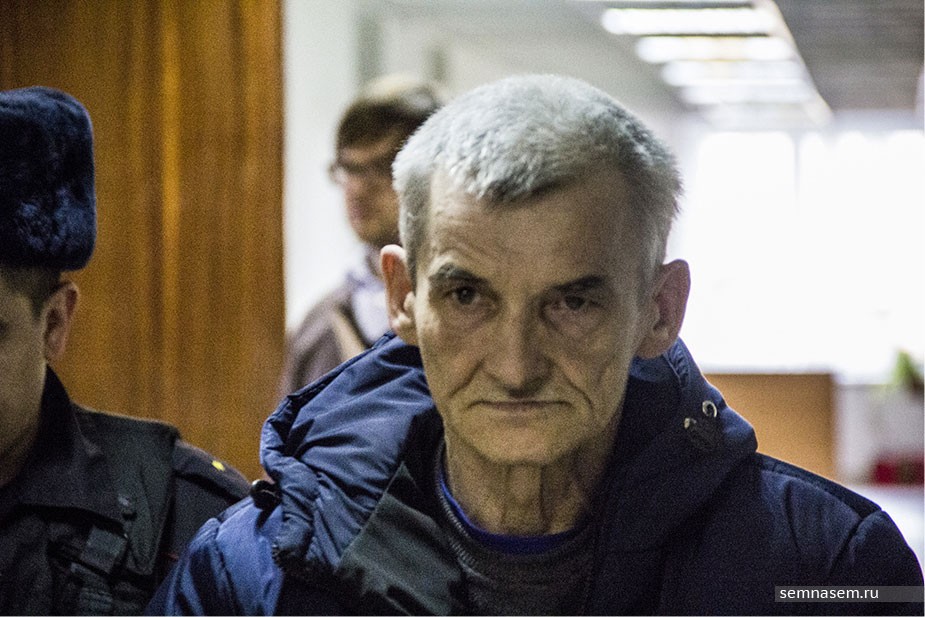
Russian political prisoner Yuri Dmitriev

Court Extends Yuri Dmitriev’s Arrest to Late January
Chernika
October 12, 2017

Yuri Dmitriev, head of the Karelian branch of Memorial, will remain in police custody until next year. Judge Marina Nosova made this ruling on October 11 as part of the criminal case against the famous historian and researcher of the Stalinist Terror, who has been charged with producing pornography featuring his foster daughter. The prosecution had petitioned the court to extend Dmitriev’s arrest for three months. The defense, however, plans to appeal Judge Nosova’s ruling in the Karelia Supreme Court.

Judge Nosova also rejected an appeal made by Dmitriev’s defense counsel to disqualify  the forensic experts who have been evaluating the photographs of Dmitriev’s foster daughter, which are the main evidence in the criminal case. As Chernika reported earlier, the previous findings, reached by analysts from the Center for Sociocultural Expertise, who concluded the snapshots were pornographic, were smashed to smithereens by Dr. Lev Shcheglov, president of the National Institute of Sexology, who drew the attention of both the court and the public to the fact that the forensic experts in the Dmitriev case were not professionals, but an art historian, a maths teacher, and a pediatrician. Consequently, the court ordered a new forensic examination from the so-called Federal Department of Independent Forensic Expertise, based in Petersburg. It has transpired, however, that this “department” is an ordinary firm, founded with the minimal amount of charter capital.

Moreover, Novaya Gazeta v Sankt-Peterburge has claimed the pompously named firm is registered in a flat on Srednayaya Podyacheskaya Street in Petersburg. The firm was recommended to the court by Petrozavodsk prosecutor Yelena Askerova.

_____________________________________________________

  • Yuri Dmitriev, head of the Karelian branch of Memorial, was jailed late last year. He has pleaded not guilty, calling the case against him a “set-up.” 
  • According to Dmitriev’s defense attorney Viktor Anufriev, the photographs found on the historian’s computer, which are essentially the main evidence against him, are not pornographic, but a record of the child’s health.  Anufriev also claims that shortly before Dmitriev’s arrest someone broke into his flat and turned on his computer. Subsequently, an anonymous complaint against Dmitriev was filed with the prosecutor’s office, and Dmitriev was detained soon thereafter. 
  • Many famous politicians, writers, actors, filmmakers, and musicians have voiced their support for Dmitriev, including Lyudmila Ulitskaya, Vladimir Voinovich, Dmitry Bykov, Andrei Zvyagintsev, Venyamin Smekhov, and Boris Grebenshchikov.

Translated by the Russian Reader. Photo courtesy of 7X7/Barents Observer.

Read my previous posts on the Dmitriev case:

Show Trial

Police Show Up to Evening in Support of Political Prisoners
Grani.ru
March 30, 2016

Police showed up at the Moscow cafe Dozhd-Mazhor, where an evening in support of political prisoners had been scheduled. Our correspondent reported that around fifteen officers entered the space, inspected it, and then went outside to the entrance and proceeded to ID everyone leaving the cafe.

Later, police tried to detain activist Habib Poghosyan. They claimed an APB had been issued for his arrest on suspicion of theft. Poghosyan refused to show the officers his internal passport, while they demanded he go with them to a police station. After several minutes of negotiation, the police officers left. The play started a little late.

Show Trial, a fantasy play about how Ildar Dadin‘s upcoming appeals hearing should turn out, and the itinerant exhibition {NE MIR} took place at the Moscow club Dozhd-Mazhor on March 29. Video by Vladimir Borko

“We believe that Ildar’s trial was a show trial, and so we decided to stage Show Trial, with a prisoner of conscience as the defendant. We will show people how such trials should be conducted, not only Ildar’s trial but also the trials of other political prisoners, including Darya Polyudova and Ivan Nepomnyashchikh, whose appeals are pending, and Dmitry Buchenkov and Pyotr Pavlensky, who are under investigation. We will also be recalling Alexei Sutuga, Alexander Kolchenko, and other people in prison on trumped-up charges for their beliefs,” said the evening’s organizers.

In addition to the performance, the art cafe hosted an exhibition dealing with the topic of unlawful arrests and trials. Poets and bard singers performed after the play.

Dadin’s appeals hearing will take place at 10 a.m., March 31, in Moscow City Court. Attorney Henri Reznik will represent Dadin at the hearing.

The hearing, which had begun on March 23, was postponed because the panel of judges had not been informed whether the defense had examined the minutes of the trial, and the defense had not been provided with audio recordings of the hearings.

On December 7, 2015, Judge Natalia Dudar of the Basmanny District Court sentenced Dadin to three years in a minimum security prison under Article 212.1 of the Criminal Code (repeated violations at rallies). However, the prosecutor had asked the court to sentence the activist to only two years in a minimum security prison. Dadin was accused of involvement in “unauthorized” protest rallies on August 6, August 23, September 13, and December 5, 2014.

It was the first guilty verdict handed down under the new law, which was inserted into the Criminal Code in 2014.

During his closing statement at the trial, Dadin said the article under which he had been charged was deliberately unconstitutional, “criminal, and political,” and has been designed to crack down on activists.

Translated by the Russian Reader. Thanks to Comrade VZ for the heads-up

Alexander Kolchenko and Oleg Sentsov Are Hostages

On Kolchenko and Sentsov’s Sentences
August 26, 2015
www.shiitman.ninja

179003Alexander Kolchenko and Oleg Sentsov

It is important to realize that the sentences that Kolchenko and Sentsov received are a fiction.

No one actually takes the charges against them seriously.

Even the most loyal Putinists do not take the charges seriously. What terrorism? What does the Right Sector have to do with any of this?

Kolchenko and Sentsov are hostages. Their being held in a Russian prison is an act of intimidation directed at the Crimeans who stayed home but could have fought back. Their being held in prison is an act of intimidation directed against all the people of Ukraine and those Russian citizens who could have supported them.

The trial was a fiction. The verdict is a fiction. That is why I reacted without emotion to the sentences, although I understand the shock felt by many comrades, among whom there are close friends of both Kolchenko and Sentsov. Twenty years and ten years in prison? The Russian judges could have give them sentences of forty years and twenty-five years. Or given both of them life sentences. Or given them each six months in prison, then retried the case. Or they could have not announced the verdict at all, but just laughed and made faces. Or mannequins dressed in judicial robes could have replaced the judges. Nobody would have noticed the difference.

Kolchenko and Sentsov are in prison as long as the Russian Federation is ruled by Putin’s repressive, aggressive authoritarian regime. They cannot be freed using lawyer’s tricks. They cannot be freed via “diplomatic channels.” They can be freed only by defeating Putinist Russia. Or if it “defeats” itself by choking on its own rage and madness.

And when that happens, it will not matter a whit what numbers have been written in Kolchenko and Sentsov’s sentences. It doesn’t matter what the judges whip up in Savchenko’s sentence. The release of the hostages does not depend on the actions of lawyers. It depends on politicans and military men. And, in part, on the price of petroleum.

As soon as the “Russian bear,” who has turned out to be a rabid rat, finally kicks the bucket, all the regime’s hostages will be freed.

Translated by The Russian Reader. As is nearly always the case, my opinions might not coincide entirely with those expressed by the authors whose texts I translate and post here. But it has been strange to read the angry reactions of leftist progressive Russian comrades to this particular text given the almost total lack of any visible, public solidarity with Sentsov and Kolchenko on their part.

I won’t even go into the haziness they and many other “ordinary” “apolitical” Russian citizens experience when figuring out who to blame for the whole mess in Ukraine. But this is the privilege all imperialist, metropolitan peoples enjoy: pretending not to know or understand what is being done in their name somewhere else in the world.

_________

Russia’s Sentsov–Kolchenko case “an absolutely Stalinist trial”
Halya Coynash
August 21, 2015
khpg.org

The prosecutor has demanded 23 years for Ukrainian film director Oleg Sentsov, and 12 years for civic activist Oleksandr Kolchenko in a case with no crime and where all evidence was obtained through torture. Russian human rights activist Zoya Svetova likens this to Stalinist repression, not a court trial.

Svetova has seen a huge number of trials over the last 15 years, but nothing like the “absolutely insane hearing” on Aug 19. She can’t remember a case where, with no elements of a crime, or criminal (terrorist) acts, the prosecutor should be seriously demanding 23-year and 12-year sentences. This, the fact that everybody expects the court on August 25 to convict two innocent men, and much more, she says, is reminiscent of Stalinist repressions where people were arrested for nothing.

Sentsov is charged with leading a ‘terrorist organization,’ Kolchenko of taking part in it and involvement in one specific firebomb attack on a pro-Russian organization active in helping Russia seize control of Crimea in 2014.  There is no evidence that an organization even existed, and the only specific charge against Kolchenko is one that has not previously been classified by any Russian court as ‘terrorism.’

“The prosecutor is demanding 23 and 12 years for people accused of crimes they didn’t commit. Today Sentsov and Kolchenko’s lawyers clearly demonstrated that there are no elements of a crime in this case, nor any criminal act. On August 19, 2015, I saw a totally Stalinist trial. Three judges were sitting there, a real ‘troika,’ with cold, virtually dead eyes who were listening to the prosecutor and the lawyers,” Svetova writes here.

Another of the disturbingly Stalinist features of this case has been the fixation on some demonized organization, in this case the far-right and nationalist Right Sector. Russia has constantly exaggerated this organization’s role in both Euromaidan and subsequent events in Ukraine.  There was even a Russian media attempt on the night of the Ukrainian presidential elections on May 25, 2014, to claim distortion of the election result after the Right Sector candidate gained a pitiful 0.9% of the votes. It was therefore no surprise that five days after those elections, the FSB should have claimed that it had uncovered a supposed Right Sector ‘terrorist plot.’  It has never produced any evidence at all, nor did any of the witnesses for the prosecution even demonstrate a clear understanding of what the Right Sector is, although they were all convinced it was dangerous, etc.  There is nothing to link Sentsov, the left-wing and anarchist Kolchenko or Gennady Afanasyev with the far-right organization. In court on Wednesday, the prosecutor Oleg Tkachenko changed their story, saying that Sentsov and Kolchenko are not accused of membership in Right Sector, but of having “taken on the ideology of this organization as a guide for action.” What this means remains a mystery since the court has not demonstrated any interest in seeking clarification on this subject or with respect to the numerous other discrepancies in the prosecution’s case.

At the final hearing on Wednesday, the defence demolished all of the charges against the two men, then Dmitry Dinze, Sentsov’s lawyer, read out the account given by Gennady Afanasyev of how he had been tortured to get him to testify against Sentsov.

As reported, Afanasyev and Oleksy Chirniy were arrested at the same time as Sentsov and Kolchenko.  Their ‘confessions’ and testimony are literally all that the charges against Sentsov are based on. It is therefore of critical importance that Afanasyev retracted his testimony on July 31, stating that it had been given under duress.  He then spoke for the first time to a lawyer not provided by the investigators and gave a detailed account of the torture applied immediately after his arrest, and also the pressure placed on him to repeat this testimony in court. As well as threats against him, a FSB officer who appeared at the prison warned him that his mother “could have an accident” if he didn’t cooperate.

All of this information was read to the court. The judges simply looked down and did not react in any way, and the prosecutor continued to demand 23 and 12 years.  It should be stressed that the details in Afanasyev’s account fully coincide with those given by Sentsov, and Chirniy is also known to have told the Ukrainian consul that he had been forced to ‘confess.’

Unlike the players in this modern-day show trial, the renowned Memorial Human Rights Centre has taken Afanasyev’s account seriously.  On August 19, it issued a statement recognizing Afanasyev as a political prisoner and warning of the danger he is now in. This follows a similar statement and damning assessment of the ‘trial’ of Sentsov and Kolchenko.

Sentsov’s final statement was, as all previous statements, courageous and moving. So too was Kolchenko’s, who spoke of the fact that the court had heard about the use of threats and torture by the FSB against Sentsov and Afanasyev.

“It’s interesting that people using such methods to obtain testimony have no qualms about accusing us of terrorism.”

He called the charges against them fabricated and politically motivated, and said that this trial, like those against Nadiya Savchenko, the Bolotnaya Square protester, and others are aimed at extending the life of the current regime.

“Yet throwing us in prison, this regime speeds up its end, and those people who still yesterday believed in law and order, today, watching such trials, have lost that faith. And tomorrow or the day after tomorrow, those people who are part of the 86 percent [supposedly supporting President Vladimir Putin – HC] will overturn this authoritarian regime.”

Kolchenko noted that, in the letter read out to the court, Afanasyev said that the FSB officer had told him that the day he gave testimony in court would be the most important day in his life.

“Seemingly, Afanasyev took those words to heart and interpreted them in his own way. I was very taken with this great and powerful act of his.”

Gennady Afanasyev is in danger; Oleg Sentsov and Oleksandr Kolchenko are facing long sentences on preposterous charges.  And Russia is descending into a frightening Soviet tradition in which people are tortured for ‘confessions’ with neither the prosecutor nor the judges even batting an eyelid when this is demonstrated to the world.

Please write to all three men!

The website of the Solidarity Committee with the Crimean Hostages will try to get messages to them.

solidarityua.info

In the first box, write one of the following names one at a time:

Олег Сенцов (Oleg Sentsov)

Олександр Кольченко (Oleksandr Kolchenko)

Геннадий Афанасьев  (Gennady Afanasyev)

Then in the next box, write your name.

The next box asks for a telephone number if you wish to give it. An email address is, however, needed (the fourth box).

Finally, in the fifth box, write your message.

The key aim is to ensure that all three men know that they are not forgotten. The following would be quite sufficient (if you do write in Russian, please avoid anything controversial or overly political).

Мы восхищаемся Вашим мужеством и надеемся на Ваше скорое освобождение.

Спасибо, что нашли в себе силы остаться честным с самим собой.

Держитесь!

(We admire your courage and hope for your speedy release. Thank you for finding the strength to remain true to yourself. The last word is a word of support, like “take care!”)

The question under the last box asks whether you are on social networks: yes, no, in that order (or leave it blank)

Then hit SEND.

Thanks to Comrade SP for the heads-up. I have lightly edited the text to make it more readable.

Alexei Gaskarov: “If the Way to Freedom in This Country Runs through Prison, We Are Ready to Go”

The verdicts on the second group of defendants in the Bolotnaya Square case will be announced in Zamoskvoretsky Court in Moscow on August 18. The prosecutor asked the court to sentence Alexander Margolin and Alexei Gaskarov to four years in prison; Ilya Gushchin, to three years and three months in prison; and Elena Kokhtareva, to three years and three months suspended, with four years of probation. All four defendants have been accused under Article 212 Part 2 (involvement in rioting) and Article 318 Part 1 (use of non-threatening violence against a public official) of the Russian Federal Criminal Code.

On August 4, 28-year-old antifascist Alexei Gaskarov made his closing statement in court. This is the complete text of his speech.

gaskarov-Feldman-3-600x400Alexei Gaskarov

The so-called Bolotnaya Square case has been symbolic in the sense that through it the public sees how the authorities interact with the opposition, with those people whose viewpoint differs from the general line.

The first thing I wanted to talk about is something that was not addressed in the trial, but which I think is important: why on May 6, [2012,] despite everything, so many people decided to be involved in certain events, rather than simply stand another two or three hours in queues, and ultimately did not permit themselves to be beaten with impunity.

The May 6 demonstration was the seventh major event staged by the opposition [during the 2011–2012 fair elections protest movement]. Whereas earlier, before December 2011, a few thousand people attended protest rallies I had witnessed, when you-know-who said the idea of rotating governments was not the best thing for Russia, the core group of protesters increased significantly. And these people did not go organize riots, but went to observe elections in order to understand and record the way the political processes that occur in our country are legitimated.

kohtareva-11-600x400Elena Kohtareva

Everything fell into place on December 4[, 2011, when parliamentary elections were held in Russia]. Despite the fact that the institution of elections had been destroyed much earlier, the large group of people who went to the polls as observers saw how the legitimacy of the current government was shaped. I myself was an observer at those elections, and what we saw was quite straightforward. Indeed, it is a strange situation when you are trying to find at least one person among your acquaintances who would say they voted for United Russia. In fact, such people did not exist: there was no mass support for the government. When they tried to counter the Bolotnaya Square protests with an event on Poklonnaya Hill in support of the current government, they could not gather more than a thousand people.

This subject itself was extremely important, but unfortunately it was not sufficiently popular with the authorities. Fair elections are still the only legal way of changing the political system, and once it has been changed, you can solve social and economic problems. A huge number of people took to the streets. There was almost no reaction on the part of the authorities. The protests were peaceful, the protesters were numerous, and it was obvious the demands they made and the problems they talked about were real, but instead we saw only a reluctance to engage in dialogue and, at some point, flagrant mockery.

A lot of people now do not like what thuggish characters in Ukraine are calling people from Southeast Ukraine. But here in Russia the same thing happened: when people came out on Bolotnaya Square, the country’s president called them Bandar-log and made many other unflattering comparisons. We were told we amounted to only one percent, that only one hundred thousand people in a city of ten million came out to protest, that it meant nothing at all. But later, when they actually allowed a fair poll, as happened during the [September 2013] mayoral election in Moscow, it turned out it was not one percent, but forty percent, a significant segment of society. And I would like to say that we should be glad on the whole that the events on Bolotnaya Square happened as they did.

In all developed democratic countries, protest rallies, the opportunity to express points of view that differ from that of the authorities, generate political competition, which enables countries to find the best way of developing. By the way, certain problems in the Russian economy began precisely in the third quarter of 2012, because it is impossible to build a stable economic and social system when you completely demotivate and exclude such an essential part of society. And it was obvious that this part of society was essential.

The first signal that comes from our case: does the right to protest, which exists in all developed countries, exist at all in Russia? As we see now, Russia has been deprived of this right.

And the second signal, which it is impossible to ignore: has the rule of law survived in Russia? Individuals must be protected from the actions of the authorities not only by a system of checks and balances but also by the possibility of appealing directly to the law in the way in which it is worded. I think this can be seen in our case. There is Article 212 of the Criminal Code: it may be poorly worded, but it is worded the way it is. And it is wrong, I think, to raise such obvious questions at the trial stage, because the law is worded quite clearly. We read a lot of commentaries to the Criminal Code and nowhere did we find that the corpus delicti of “rioting” could be defined alternatively, based on the evidence listed in the charges. Nevertheless, this has been consistently ignored. Even in those decisions entered into the case file, this subject was roundly rejected.

In and of itself, the rule of law is the most important of the institutions that protect the rights of individuals from the state. And, of course, we cannot ignore the selective application of the law to citizens. I realize that Russian law is not based on precedent, but it is impossible not to notice that if, for example, you are a nationalist, block roads, and set fire to shops, but refrain from speaking out against the actions of the authorities, you are only guilty of disorderly conduct. If you go to protest rallies where people shout, “Putin is a thief!” you are, accordingly, liable to serious criminal charges.

guschin-Feldman-3-600x400Ilya Gushchin

There is one last point following from our case to which I would also like to draw attention. I think a signal is being sent: if you are loyal to the authorities, you will enjoy the most favorable conditions; if you are disloyal, you will go to jail. This concerns the evaluation of the actions of demonstrators and the actions of police. It is too obvious that not all the police behaved as they should have behaved. I understand this was not specifically the matter in dispute in our case, but not a single criminal case has been opened against the police. Practically speaking, they have tried to turn the police into a caste of untouchables as part of our case. When there was a public debate on the Bolotnaya Square case, the same phrase always came up: “You cannot hit police.” Even in our group of thirty people charged in the Bolotnaya Square case, only three people actually struck police officers. And yet the whole complexity of this situation was primitivized through a single phrase: “You cannot hit police.”

margolin-svoboda.org-3-600x400Alexander Margolin

But it seems to me this way of posing the question dismisses and completely destroys any criticism of the government. We cannot forget that many terrible things have happened in our country (for example, during the Great Terror [under Stalin in 1937-38]), that people in uniform committed all these crimes, and everything they did was legal for all intents and purposes. But now they tell us there should be no critical rethinking of this situation, that it is necessary to stupidly obey the thesis that was endlessly repeated during discussion of our case.

The main thing I would like say, your honor, is that I really would not want it to happen that, after our trial, speaking of the law as an expression of the principle of justice became a sign of bad taste. I would hope that our trial did not pursue any other political objectives that have been imposed on it, that have been set for it—and all that is in the case files—but that we be judged for the things we really did. But if, in this country, the way to freedom runs through prison, we are ready to go. That is all.

Originally published, in Russian, at Grani.ruPhotos courtesy of Bolotnoedelo.info.

Afterword (copied from People and Nature‘s first publication of this translation)

On July 24, two other defendants in the Bolotnaya Square case, the left-wing activists Sergei Udaltsov and Leonid Razvozzhayev, were each sentenced to four and a half years in prison on charges arising from the May 6 demonstration. Supporters of Alexei Gaskarov and the other three defendants being sentenced this month fear similarly harsh penalties on August 18.

Solidarity makes a difference in such cases. While the Russian government claims to be championing “antifascism” in Ukraine, it is sending antifascists and other oppositionists in Russia to jail for long periods. The more support for these activists from antifascists internationally, the better.

Please copy and republish this article; demonstrate or protest however you can; write to the Russian embassy; and look on the Free Alexei Gaskarov site and the May 6 Committee site.

Update. On August 18, Alexei Gaskarov and Alexander Margolin were sentenced to three and half years in prison; Ilya Gushchin, to two and a half years; and Elena Kokhtareva, to a suspended sentence of three years and three months including three years’ probation.

A Fiancee’s Diary: At the Bolotnaya Square Trial

Originally published (in Russian) at:
http://www.snob.ru/profile/27375/blog/64533
http://gaskarov.info/post/59772586016

subscriber_454431

Anna Karpova
A Fiancée’s Diary: “The defense’s question is disallowed since it is irrelevant to the case”
August 30, 2013

I already find it trying either to write or read about the Bolotnaya Square case. The trial began in early June. The court hearings are held three times a week, Tuesday through Thursday, from eleven-thirty in the morning to six or seven in the evening, but each new hearing is a repeat of the previous ones, the same combination of utterances by the judge and state prosecutor, except in a different order. “The defense’s question is disallowed a) as stated; b) since it is irrelevant to the case; c) as repetitive.”

I would not be following these events so closely myself did they not concern me personally. But my fiancé, Alexei Gaskarov, is under investigation and in police custody, and I have no choice but to monitor the “Trial of the Twelve” carefully in order to gauge my chances of seeing Alexei freed as soon as possible.

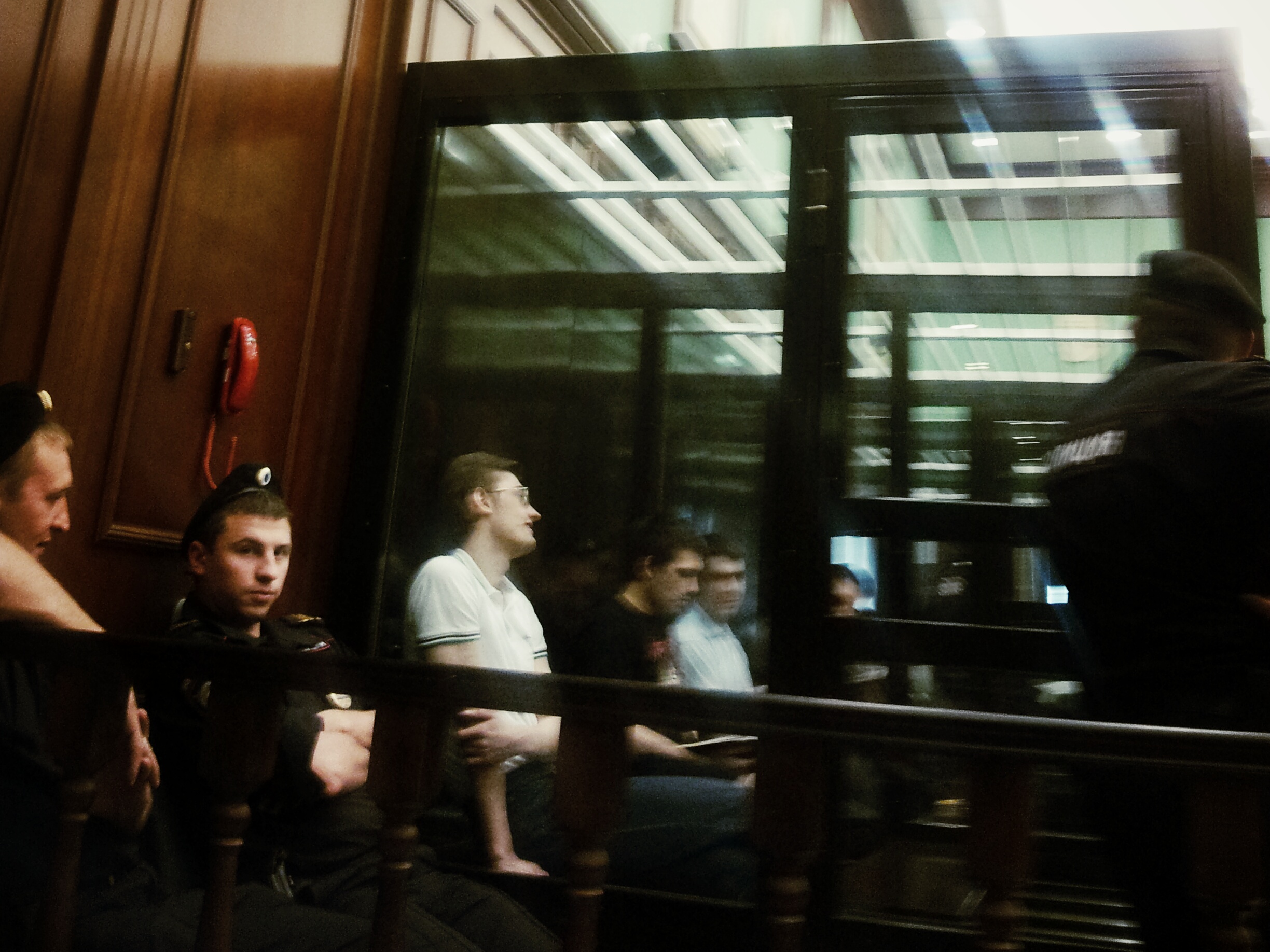
All this time I have deliberately avoided going into the courtroom at the Moscow City Court where the Bolotnaya Square case is being heard, preferring to watch the live broadcast in the court hallway or observe the circus from the press balcony. If I had the chance not to go to the court hearings in Alexei’s case, I would skip those as well. It is one thing to talk with the emotional parents of the prisoners outside the courthouse and see photos of the defendants in the press, but quite another thing to see relatives and loved ones silently communicating through the glass of the “aquarium” in which the defendants are caged during the hearings, and realize they have had no other means of supporting each other for over a year now.

Yesterday, August 29, I went to the trial to keep Tanya Polikhovich company. It was the birthday of her husband, Alexei Polikhovich, one of the twelve defendants. Alexei’s dad, Alexei Polikhovich, Sr., happily greeted us in the hallway of the court.

“Alexei already celebrated his birthday with the guys in the cell as best he could. They drank soda pop from the pretrial detention facility store, and he blew out three lit matches. Why three? Because he has turned twenty-three!”

A bailiff opened the door and ushered relatives into the courtroom. Although Alexei Gaskarov is not among the first twelve defendants, Alexei Polikhovich, Sr., put his arm around my shoulders and led me to the seats near the dock. The guys in the dock pressed themselves against the glass and waved to their loved ones, smiling. Stepan Zimin was particularly glad to see his girlfriend Sasha. She had come to the trial for the first time: she was no longer considered an official witness in the case, something that had prevented her from attending the hearings. Sasha and Stepan made eye contact and kept their eyes on each other until the very end of the hearing, which would be disrupted by people in the gallery. (But more on that later.)

Yaroslav Belousov, Andrei Barabanov and Denis Lutskevich were seated in the dock closest to where I was sitting. Alexei Polikhovich sat in the farthest section of the dock. Tanya attracted his attention by waving to him. Then she unfolded a t-shirt with Dandy the Elephant emblazoned on it. Polikhovich gave a two thumbs-up sign: the t-shirt was a birthday present for him. Lutskevich kept his eyes glued on his lovely mother, Stella. Throughout the hearing they would surprise me with their amazing ability to hold a conversation merely by glancing at each other. Andrei Barabanov was looking at other people in the gallery, because his girlfriend, Katya, is unable to attend the hearings: she is an official witness in the case.

a6f62022c6ef135f3dd63c3831be8f39While I was examining the animated faces of the guys in the dock, Judge Natalya Nikishina entered the courtroom. As always, defendant Sergei Krivov addressed her.

“I have a motion I haven’t been allowed to enter for two days running!”

“Shut up, Krivov,” the judge cut him off.

“No, listen, you have to hear my motion!”

“I am cautioning you for causing a disruption in the courtroom, Krivov!”

“And I’m cautioning you for not hearing my motion!”

Then the testimony of the sixth “victim” in the case, riot police officer Alexander Algunov, began: the case file contains a medical certificate stating that his right hand was injured during the alleged “riots” on May 6, 2012, in Moscow, during a sanctioned opposition march. I stopped listening to Algunov’s monotonous, muddled testimony and looked back to the dock, making eye contact with Lutskevich. Denis smiled broadly, and I wrote the phrase “Gaskarov says hi!” in big, block letters in my notebook. I tried to quietly raise my postcard so the guys would see it, but the bailiffs noticed it as well. “Well, now they’ll kick me out of the courtroom,” I thought, and a bailiff, dressed in black, moved towards me. I put the notebook away and got a warning. The bailiff took up a spot next to the glass cage, blocking my view of the guys, but they leaned forward and, peering from behind him, waved at me and smiled.

While this was going on, the state prosecutor was asking to hold a police lineup right in the courtroom, despite the fact it violated court rules.

“Do you see the person or persons who assaulted police officers among those present in the dock?”

The lawyers jumped up from their seats. Defense attorneys referred to the sections of the law under which the procedure could not be carried out in court. Chin propped on her hand and smiling, Judge Nikishina slowly said, “Algunov, answer the prosecutor’s question.”

Algunov “recognized,” as he put it, “the man in the t-shirt,” nodding towards Krivov, then he also pointed out the two female defendants, Alexandra Naumova (née Dukhanina) and Maria Baronova. After which he told the court how protesters had, allegedly, shouted “Let’s go to Red Square!” and “Let’s take the Kremlin!”

As always, Makarov, who is defending Krivov, was completely prepared to cross-examine the victim, but as the hearing entered its sixth hour, people in the court gallery interrupted his cross-examination. Two young women jumped up on their seats and began singing “Bella Ciao,” the Italian Anti-Fascist Resistance song. But they did not succeed in unfurling a small banner congratulating Alexei Polikhovich on his birthday: six men in plain clothes grabbed them and removed them from the courtroom, along with everyone else in the gallery, including the relatives. Artyom Naumov, husband of Alexandra Naumova, recognized two of the men as people who had carried out a search at Alexandra’s apartment.

Everyone was now standing in the hallway, and the parents were upset. It would have been better to stage the unsuccessful performance after the hearing was over. Alexandra Naumova left the courtroom, and the judge announced a recess until next Tuesday.

Before leaving, Judge Nikishina remarked, disgruntled, that come September, hearings should be held five days a week to get this over quickly.

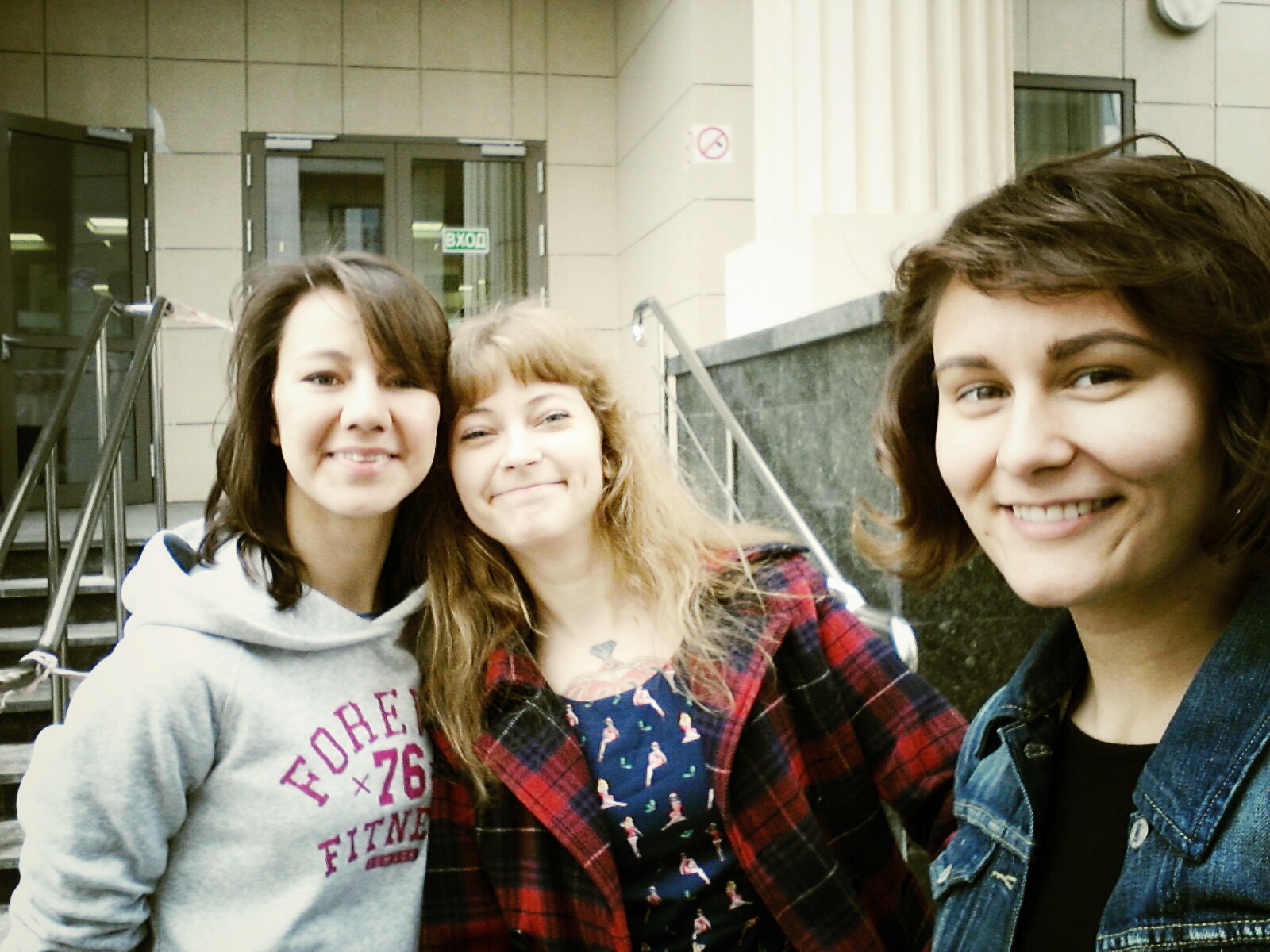
From left to right: Sasha (Stepan Zimin’s girlfriend), Tanya Polikhovich, Anna Karpova