I usually don’t agree with the smart-alecky overread leftish folks who start crying “Orientalism! Orientalism!” whenever they see travelogues and anthropological essays “from the real Russia” like this one, but here I am tempted to join them.
I am also astonished the editors at the Guardian don’t understand the difference between “brutal” living and “brutalist” architecture, of which per se there is no more in Petersburg than anywhere else in the world.
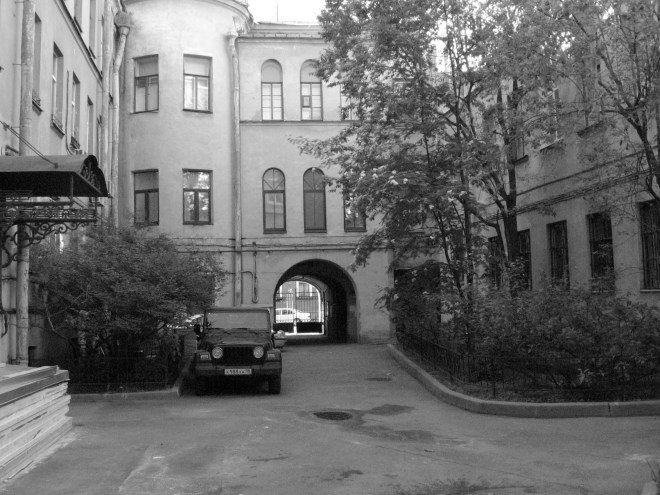
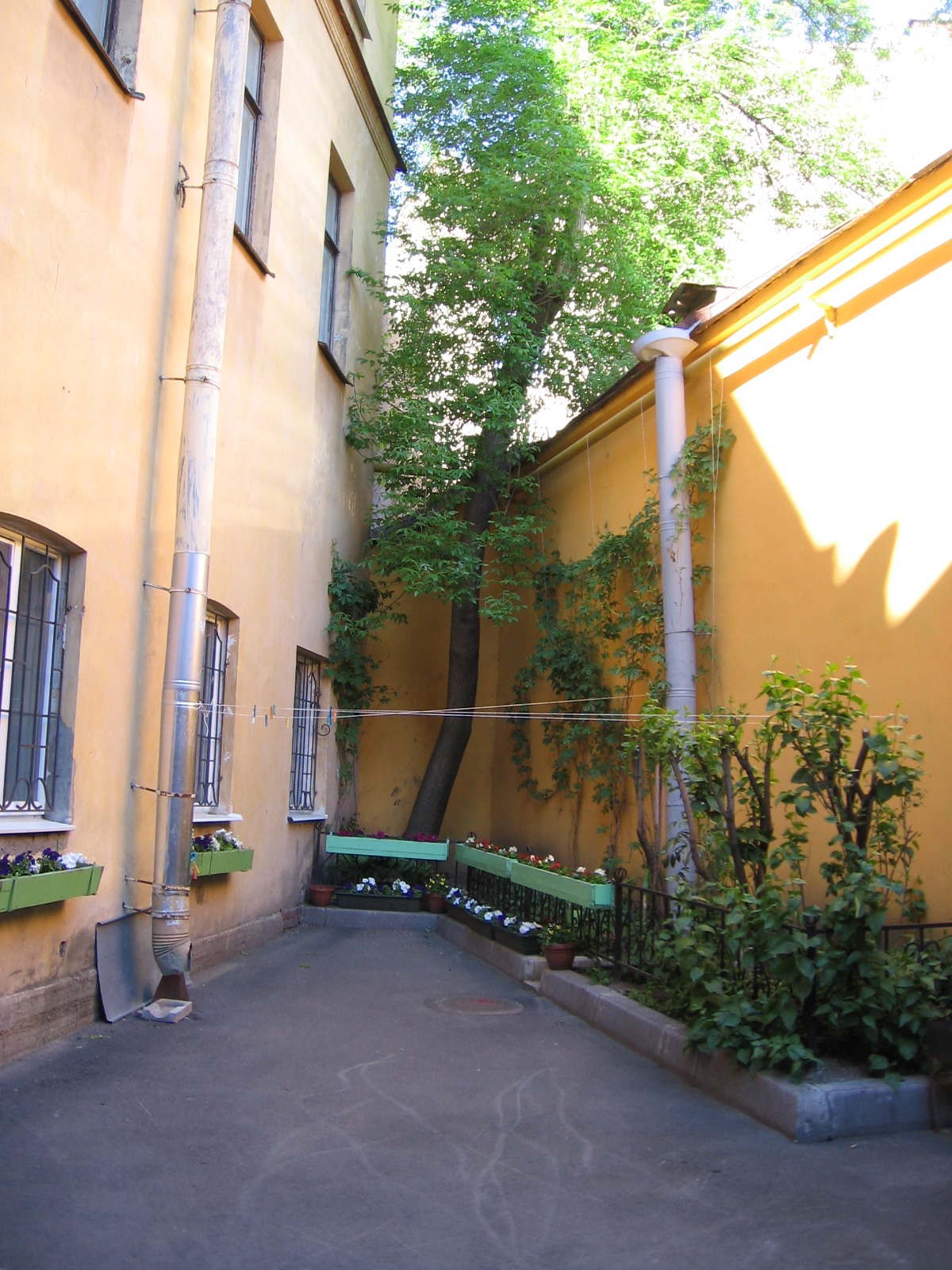
This is not to mention that “dvors” (courtyards) usually don’t have “rooftops,” at least not in this regional ruin-porn capital.
More importantly, self-avowed “urban decay” devotees like the whiz-bang art photographer from the Guardian are sorely missing out on the much more interesting and inspiring, but infinitely more complex and often tragic story of how the city’s residents have been fighting at the grassroots over the past ten years to preserve its classical, spectacular skylines and numerous architectural treasures as well as the often pleasantly green courtyards in its non-neoclassical, “brutalist” districts. But to tell that story you have to see Petersburgers as more than disempowered, colorful props in your personal post-ideological, neo-romantic visual fantasy.
At some point, art—and solidarity—means putting down the camera. Or pointing it in a direction other than immiseration and defeat. Such angles exist in abundance everywhere, even in lowly Petersburg. // TRR
Photos by the Russian Reader
____________
Here are a few glimpses of the real modern city of Petersburg and the people who have been fighting for it.
Fyodor Chistyakov and Nol (Zero), “Lenin Street.” Live performance on Petersburg TV, 1991
You ask me why sometimes I’m silent,
Why I don’t laugh, why I don’t smile.
Or, vice versa, why I joke grimly,
And grimace just as grimly and madly.
It’s just that I live on Lenin Street
And I freak out from time to time.
It’s just that I live on Lenin Street
And I freak out from time to time.
What do you want from a sick mind?
In childhood kind folk pounded nails into my head.
At school they douched my ears and mouth.
So I got the useful knowledge I needed.
After all, I was born and raised on Lenin Street,
And I freak out from time to time.
After all, I was born and raised on Lenin Street,
And I freak out from time to time.
It’s just that I live on Lenin Street
And I freak out from time to time.
It’s just that I live on Lenin Street
And I freak out from time to time.
How I hate and love my motherland,
And there’s really nothing surprising here, comrades.
She’s so blind, deaf, and ugly,
But I have nothing else to love.
And that’s how I live on Lenin Street,
And I freak out from time to time.
And that’s how I live on Lenin Street,
And I freak out from time to time.
It’s just that I live on Lenin Street
And I freak out from time to time.
It’s just that I live on Lenin Street
And I freak out from time to time.
The work of a St Petersburg musician who lived a wild life, was thrown into prison and then a mental asylum before joining the Jehovah’s Witnesses is now on general release. “Polundra” (“Stand from under”), the 1992 recording of the now defunct and much missed local rock band Nol, fronted by Fyodor Chistyakov, has finally found its way onto cassette and CD. Nol (Zero) was formed in the fall of 1985, making its debut at the Leningrad Rock Club in December 1986. By that time they had a home-produced tape called “Music of Rough Files,” featuring styles varying from traditional rock and roll to art rock.
The group provided a striking contrast to St Petersburg’s other leading rock bands. Most of them were dominated by 30-year olds, while the two original founding members of Nol were only 16. The trend of the day was to write philosophical and metaphorical lyrics, but Nol’s songs were distinctly street-level. The band’s leader Fyodor Chistyakov turned out to be the original folk poet, writing lyrics about what he saw around him at that time — food shortages, over-populated communal flats and shameless Soviet propaganda. Still he was dealing with these subjects in his own very unique way. The song “A Fairy-tale About Sausage” explored the sexual dimension of this then much sought after foodstuff. “Tools Ahead!” again combined sex with workshop terminology. “School of Life” was a parody on military marches. Later Chistyakov moved on to write more mature and dramatic material. Chistyakov’s singular and somewhat out-of-tune singing and the fact that he played button accordion — an instrument totally ignored by local rock musicians at that time — made the band stand out. The fresh folk-punk spirit of the resulting mixture has invited belated comparison with the Pogues, who originated at roughly the same time.
No other Russian band could really compete with Nol in terms of energy. Legend has it that at one concert Chistyakov played so vigorously that he tore his accordion in two. Performances given by Nol in the late eighties invariably attracted crowds of shouting fans. The band was featured in Western documentaries on Russian rock music and was invited to play in Germany, Ireland, France and Finland. The success of Nol led to the formation of several groups, which followed the same formula. The most interesting and popular is Ukrainian band Vopli Vidoplyasova (VV), which combines punk rock with Ukrainian folk music. And its leader, Oleg Skripka, also plays button accordion. Nol folded in 1992 when the fast living and excesses of his rock lifestyle led Chistyakov first to the infamous Kresty prison and then to a mental asylum. As was recently reported, Fyodor Chistyakov joined Jehovah’s Witnesses, and has subsequently refused to have anything further to do with rock-n-roll.
Polundra CD and cassettes, as well as Nol’s previous release, Pesni o bezotvetnoy lyubvi k rodine, are available from local music shops and music kiosks.
Editor’s Note. Fyodor Chistyakov resumed his musical career in 1997.
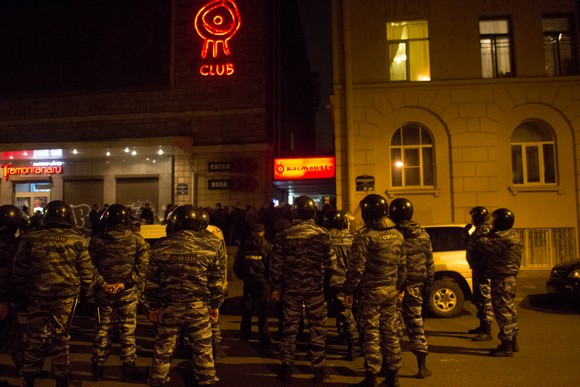
OMON police standing outside the Kosmonavt club, the venue of the canceled concert by Cannibal Corpse, on Sunday night. Photo by Sergey Chernov for The St. Petersburg Times
Eighteen music fans were detained Sunday as hundreds protested against the last-minute cancellation of a Cannibal Corpse show outside the Kosmonavt music club in St. Petersburg. The organizer, the Moscow-based agency Motley Concerts, claimed the cancellation was caused by unspecified “technical reasons,” but the fans believed it was done under pressure from the authorities.
The American death metal band’s St. Petersburg concert was set to be the last in their eight-date Russian tour in support of their 13th studio album, “A Skeletal Domain.”
Although the band’s five previous Russian tours went ahead without any problems, this year’s tour was marred by controversy caused by a massive campaign of formal complaints from Orthodox activists about alleged “Satanism” and “extremism” in Cannibal Corpse’s lyrics. Out of the eight planned concerts, the band managed to play only four.
On Oct. 11, the band’s concert in Moscow was canceled when people were already in the venue. Before that, a concert in Ufa scheduled for Oct. 5 was canceled when the venue abruptly closed “for technical reasons.” On Oct. 10, Cannibal Corpse’s concert in Nizhny Novgorod was shut down by armed masked police officers 30 minutes after it had started. A number of fans were detained and taken for compulsory drug tests. In a petition to the head of administration of Nizhny Novgorod, fans wrote that the true reason for the anti-drug operation was to stop the concert, which they believe was an act of censorship, which is prohibited by the Russian constitution.
Neither the organizer nor the venues in the four cities admitted any pressure from authorities and the band did not make any statement about the cancellations.
On Sunday, fans were not let into the venue even though it was supposed to open at least an hour before the concert’s scheduled 8 p.m. start. When asked, the guard at the doors said both the public and guests would be allowed to enter “later.”
When several hundred stood around Kosmonavt 25 minutes before the scheduled start, a young man brought a notice from the organizers and read it aloud. It said the concert had been canceled for technical reasons but ticket holders were welcome to a signing session with the band and to spend an evening in the venue.
The notice then went from one person to another until a fan set it on fire to cheers from the crowd.
Despite the invitation, the doors were still closed, leading disappointed fans to crowd around near the entrance. Soon they were chanting the band’s name as well as profane insults toward Moscow Orthodox activist Dmitry Tsorionov, also known as Enteo, and Legislative Assembly deputy Vitaly Milonov, whom they saw as responsible for the cancellation. The fans criticized the Kremlin’s current policies of isolation from the West and promotion of traditionalism.
One fan shouted an offensive anti-President Vladimir Putin slogan while another commented sarcastically about the official line of Russia “rising from its knees.”
“I would not love the Russian Orthodox Church more for this,” one fan said.
People discussed how they had been waiting for months for the concert and bought expensive tickets, while others had come from other cities and had to take days off from their jobs and find a place to stay in St. Petersburg.
Although there had only been one police vehicle parked near the venue initially, OMON riot police started to arrive at the site at 8:15 p.m. Bottles flew at the officers while people expressed their disappointment and outrage at the treatment. Cannibal Corpse’s music played loudly from one of the cars parked near the venue.
The OMON police retreated into their truck to put on helmets and take batons but did not immediately intervene, instead maneuvering in the street near the venue, blocking and unblocking it, as bottles kept coming and various fans protested in different ways. People flooded the street and passing cars had their tires pierced by broken glass.
The first arrests occurred at around 8:30 p.m., when a dozen officers rushed at two fans standing at a distance from Kosmonavt, beat them with batons and dragged them to the police vehicle. A video posted by a fan showed them apparently being beaten with a baton inside the vehicle as well. An hour later there were much fewer people in the street, with some heading home and others lining up for the signing session in the venue, which eventually started to let people enter, although very slowly after multiple checks.
According to the police, the 18 detained fans were charged either with “disorderly conduct” or with “being drunk in public,” offenses that are punishable by fines or up to 15 days in prison.
On August 2, 2013, Russian Paratroopers Day, Kirill Kalugin, a Petersburg university student, took to the city’s Palace Square alone to protest the country’s new anti-gay laws. He was immediately set upon by reveling paratroopers (or as he himself suggested, by national activists masquerading as paratroopers), an incident captured on video by Petersburg news web site Paper Paper.
Kalugin returned to Palace Square this year on August 2 to protest Russia’s increasing militarism and imperialist misadventures in Ukraine. He was roughly detained by police some fifteen seconds after attempting to unfurl a rainbow flag emblazoned with the slogan, “My freedom defends yours.” Despite the fact that Kalugin held his anniversary protest right next to Manifesta 10’s provocative metallic Xmas tree, his protest has so far gone unremarked by progressive humanity (i.e., the international contemporary arts community) and the foreign press.
The interview below was published in August 2013 on the local Petersburg news web site Rosbalt three weeks after Kalugin’s first protest on Palace Square. Unfortunately, it hasn’t lost any of its timeliness, especially given the total absence of an anti-war movement in Russia and the singularity of Kalugin’s bravery and insight.
__________
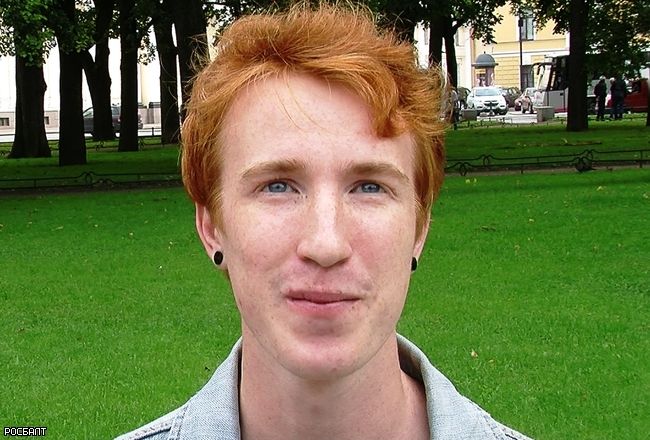
Saint Petersburg State University student Kirill Kalugin is half the age of his eminent opponent, Petersburg Legislative Assembly member Vitaly Milonov, although he is also a redhead. But hair color is not the only thing the outspoken homophobe and outspoken gay have in common. Both claim they love their motherland Russia and will never leave it.
Rosbalt’s Yevgeny Zubarev met with Kalugin in the city center, on Arts Square. It’s a safe place because it is always chockablock with police. There were also lots of police on Palace Square on August 2, [2013], when Kalugin came there alone and unfurled a rainbow flag, but even a platoon of riot police was not immediately able to wrest him away from an agitated crowd dressed in striped shirts for Russian Paratroopers Day.
— Why did you do it, Kirill? Weren’t you frightened?
— I was frightened. Actually, there were supposed to be four of us out there, but then I ended up going out alone. If there had been several people, the police could have charged us with holding an unauthorized rally, but this way it was a solo picket, which doesn’t require permission. As soon as I unfurled the rainbow flag, men in [traditional Russian paratrooper] striped shirts grabbed me. But I don’t think they were paratroopers: I had seen many of the assailants earlier at anti-LGBT protests. I think they were nationalist activists masquerading as paratroopers. The police pulled me from the crowd and put me in a car, but we couldn’t leave right away: the crowd blocked the car, demanding that the police give me up. The riot police intervened and cleared a path, and I was taken to the 78th police precinct.
— What did police charge you with? How were you punished?
— I don’t understand it myself. At first they wouldn’t let me make a phone call. The sergeants behaved rudely, and I couldn’t figure out what my status was, whether I had been detained, arrested or was considered a suspect. Right there at the police station one of the detained paratroopers rushed me: he wanted to beat me up, but the police held him back. Then the brass arrived and everything immediately changed: the police started talking with me politely. It turned out I wasn’t being charged with anything. They even let me file an assault complaint. But how that case has turned out, I don’t know: it has been twenty days, but I have had no word from the police.
— After this incident, Russian Orthodox patriots wrote several petitions to Saint Petersburg State University demanding your expulsion.
— I’m a student in the physics department, specializing in medical physics and bioengineering. It’s a tough department, and there is a lot of studying to do. What matters to the deans is that students take all their exams and tests on time, but they are unconcerned about their private lives. Generally, it is not kosher in the scientific community to tell people how they should behave in the intimate realm. So I’m confident all these petitions are pointless.
— Your family must have seen how you were beaten on Palace Square on the Web or on TV. What was their reaction?
— I was born to an ordinary Russian family in the town of Krasnoturyinsk in the Urals. My father is an officer in the Russian armed forces, my mother, a philologist. After the 2008 crisis, life in our town got really bad and we moved to Petersburg, where I finished high school, enrolled at the university, and began to live separately from my family. It was only then I told my parents I was gay. My parents were upset, especially my father, but they recognized my right to live as I see fit. My brother also said it was my choice. When I went out on Palace Square, they heard about it in the media. They called me and were worried, of course. But I assured them I was not in danger.
— How many times have you been beaten up in Petersburg for being gay?
— Never, except for the incident at Palace Square. My classmates at university and my employers at the restaurant where I work part time as a bartender do not care what I do in bed. Of course, after this incident I could have been recognized on the street and beaten up, but that hasn’t happened yet.
— There are thousands of commentators on the Web who are sure you went out on Palace Square to secure the right to emigrate to the west as a discriminated person.
— I don’t intend to leave Russia. I am sure all these homophobic laws will be repealed sooner or later, and all Russian citizens will be able to live normally regardless of sexual orientation. There were similar laws in Sweden thirty years ago, and gays were persecuted throughout the world the way they now are in Russia. But then the situation changed. I am sure that Russia also has to follow this path, and so I’m not going to leave. But change doesn’t happen by itself—people have to take to the streets and speak out about this problem.
— Why do you act alone? There are lots of public organizations in Russia that support gays. Many of them receive foreign grants. You could get this money to fight for equality and all that, no?
— I don’t want to. I’ve had offers to join various organizations like that, but I don’t want to. I’m not a politician. I just don’t want there to be discrimination against people like me. Besides, it is easier for the state to punish organizations than lone individuals. Organizations are more vulnerable. What are they going to do with an ordinary guy like me?
— When you finish university you’ll find that jobs in your scientific specialty are poorly paid and dead ends. This is another reason, aside from sexual orientation, for going abroad.
— I still won’t leave. I know how things are going with financing for science in Russia, but I don’t want to leave. In the end, there are grants given to scientists for in-demand research. And in fact, Russia is changing for the better; the situation is improving in science, too.
— You have the opportunity to address Rosbalt’s thousands of readers. What would say to all these people?
— I would appeal to people like me. Don’t sit quiet as mice. At least come out. Let your loved ones know that you exist.
— Why can’t you sit quiet and keep a low profile? Why do you come up with these public protests during which you can be beaten or even killed? After all, there is no practical sense to them.
— Can I quote Goethe? “He alone deserves liberty and life who daily must win them anew.”
— How old are you?
— Twenty-one.
Originally published, in Russian, by Rosbalt on August 22, 2013. Photo courtesy of Rosbalt
__________
Explaining his protest [on August 2, 2014], Kalugin said it was directed against both the lack of civil freedoms and the growing militarism in Russia during the ongoing conflict in Ukraine.
“The suppression of any civil freedoms and the growth of imperial chauvinism in Russia are interconnected, and the issue has one and the same root,” he said.
“As long as there remains at least one group that is seen as ‘second-rate people’ in the country, the rest cannot call themselves free. Even if they enjoy some preferences now, this system can hit them, too, sooner or later.
“All this has grown so much that it has already started spreading into the neighboring states. The same people, who cried ‘Death to gays’ and hailed the laws banning ‘gay propaganda’ and restricting public assemblies, ended up shouting ‘Crimea is ours’ and going to Donetsk and Luhansk.”
Airborne Troops Day in St. Petersburg is known for the large number of airborne veterans gathering in the city center, drinking, swimming in fountains and, at times, getting out of control, with the police usually ignoring any misconduct.
Kalugin said that he chose to stage his protest on that day because he sees the festivities as the “climax of militarism and chauvinism.” He said it was also his reaction to homophobic jokes, where LGBT people were mockingly invited to hold their protests on Airborne Troops Day—the underlying notion being that they would be immediately be beaten by homophobic airborne veterans.
“It’s an old joke from the times when LGBT pride events were held in Moscow, [Moscow’s anti-gay ex-mayor Yury] Luzhkov used to say that he would only agree if it was held on Aug. 2,” Kalugin said.
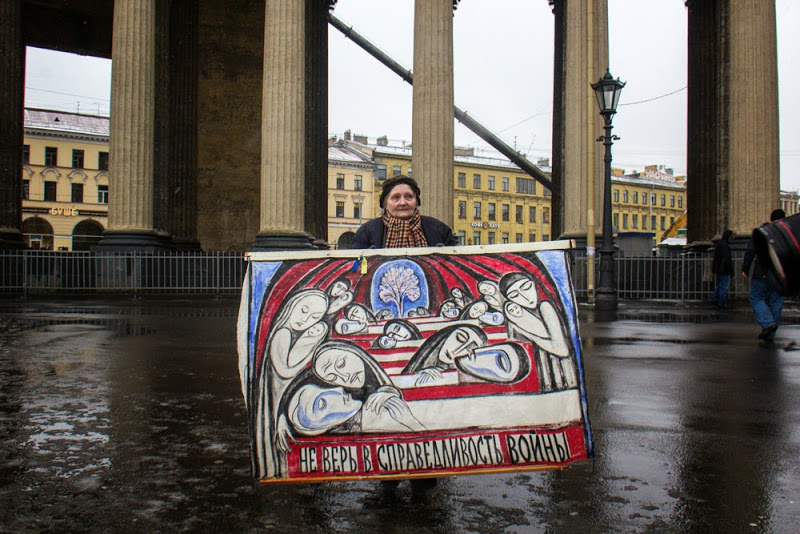
Artist Yelena Osipova holds a poster that reads, “Don’t believe in the justice of war,” during an unauthorized anti-war protest outside Kazan Cathedral in Petersburg on March 15, 2014. Photo by Sergey Chernov. See the rest of his photos from the protest here.
A Hollow War
Sergey Chernov St. Petersburg Times
October 17, 2008
Condoleezza Rice, allegedly, has banned Yury Grymov’s new film, but is it all just a cheap, blog-led PR stunt to drum up publicity?
Local channel 100TV opened its evening newscast on Wednesday last week with a report that Moscow director Yury Grymov’s film Strangers (Chuzhiye) had been banned in the U.S. The film is due for release in November, and critics suggest this “news” was part of the publicity campaign for the film, which kicked off last week. The channel itself was hard pressed to name its source, claiming it arrived by e-mail from a news agency.
“Grymov’s film Strangers has been banned in the U.S.,” said the newscast’s presenter. “Condoleezza Rice’s staff has not recommended it for distribution.”
“Most likely, this has something to do with the anti-American mood of the picture, which would be inappropriate in view of the upcoming presidential elections in America.”
It is unlikely that the station’s claims have any real basis. The U.S. Secretary of State’s purview does not include monitoring either new Russian films or, more to the point, giving recommendations to U.S. film distributors.
The report was, however, in tune with anti-American sentiments in the Russian media, which have been on the rise in the aftermath of the war in Georgia. TV100 did not provide any sources for their report.
The report ended with a fragment of a tape-recorded telephone conversation with Grymov, a TV ad maker turned feature-film director. He described the news as a “surprise.”
“I think this is nonsense, but everything is possible. I don’t know anything about it for certain yet,” he said.
The 100TV report also aroused suspicions because, as a Google News search revealed, there was no mention of the subject, or even of Grymov, in the international media.
100TV editor-in-chief Andrei Radin did not respond to an e-mail inquiry sent on Oct. 9, but when called on his cell phone on Thursday he said he “did not know” the source of the information.
Yekaterina Dodzina, 100TV news editor and the evening newscast presenter (whom Radin referred to), said the news came by e-mail from an agency, although she does not remember the name of the agency.
“We were surprised as well, but we checked it with Grymov and his assistant,” she said by phone on Thursday. However, Dodzina said she did not verify the information with anyone in the U.S. or with U.S. officials.
According to the film’s official website, Strangers is set in a war zone in a third-world country. The plot involves doctors from a U.S. charity organization who become responsible for some terrible crimes as the film unfolds.
“Viewers will see how the American nation tries to instill its morals in another world but at the same time it doesn’t understand one simple thing—there is no such thing as one’s ‘own’ morals. Since morals are one and the same for all,” states the film’s English-language press release.
The news was picked up by several publications, most of them web-based. All of them referred to different sources for their information.
Gazeta.ru quotes the RIA Novy Region news agency, which, in turn, refers to “news agencies that quote Condoleezza Rice’s staff.”
Research has revealed that the news originated on Internet forums and was subsequently cross-posted in several blogs.
Russian entertainment website Life.ru refers directly to “Condoleezza Rice’s staff,” adding that “censorship as such does not exist in American film distribution but in this specific case the U.S. State Department recommended that U.S. film companies not distribute Strangers within [the U.S.].” Life.ru is published by OAO News Media, which also publishes the tabloids Zhizn and Tvoi Den.
The website also added that the U.S. Department of State had previously not recommended Michael Moore’s Fahrenheit 9/11. In reality, Moore’s film had a general release in the United States in June 2004. It became the highest-grossing documentary of all time on its first weekend in release, taking in $21.8 million.
However, at least two publications soon deleted the news from their websites, although they did not publish corrections or disclaimers. The local edition of Argumenty I Fakty newspaper published an article entitled, “Condoleezza Rice Is Unhappy About Grymov’s Film Strangers,” on its website on Oct. 9. When accessed on Saturday, this page was blank. Cinema website Film.ru also later removed its article on the apparently fake controversy.
But it was in the blogosphere where the story gathered real force. There, the news was reposted dozens of times after the initial report on TV100.
The most persistent blogger on this front was Alexander Korsunov, who writes under the nickname “jordan_korsun.” Korsunov uploaded the video link from 100TV to the popular Livejournal.com community “ru_politics,” and he was especially active in responding to the comments and misgivings of other bloggers. In several postings, he corroborated the veracity of the report, claiming that American film distributors obey the recommendations of the U.S. State Department.
Research on the web has shown that Korsunov works in public relations and has himself been involved in the blogosphere advertising campaign for Strangers.
On Livejournal.com, the business offer that Korsunov made to Ruslan Paushu, who blogs under the nickname “goblin-gaga,” was found.
“Do you remember how you and I tried to launch a campaign against Ukraine over the ‘gas war,’” Korsunov wrote to Paushu on Sept. 30.
“I want to invite you to take part in a PR campaign [in the blogosphere]. Grymov is releasing a new film, Strangers, about American doctors, Arabs, and the Russian military. The film is patriotic and ideological, especially in connection with the [war in] South Ossetia. […] If [you’re] interested, please write to [inform me] about your conditions […] and come to the pre-release screening.”
Last year, Paushu was identified by Vedomosti newspaper as one of two bloggers who launched an infamous advertising campaign for Utkonos, a Moscow store chain. Several popular Livejournal.com bloggers almost simultaneously made similar postings advertising the chain.
Dozens of popular bloggers were caught placing Utkonos ads in their postings. According to Vedomosti, Paushu said the postings were commissioned by an advertising agency that he declined to identify. He added that bloggers are usually paid $50 to $300 for covert product placements in their blogs.
In a posting to another blogger (the deleted comment is available in the cache of search engines), Korsunov confessed that there was a budget for advertising Strangers in the blogosphere.
“There is a budget for PR, not especially large, but I think the stance of the film is close to yours and you’ll find it interesting,” he wrote.
Further research showed that the news originated in two places, a Canadian website (where it was later deleted) and an Arabic-language forum. There, the report, which had apparently been translated into Arabic from Russian by a computer program, was still available as of Thursday. In another discussion on Livejournal.com, which took place on the afternoon of Oct. 8, several hours before the 100TV evening newscast, Korsunov referred to the Arabic version as the “original.”
Korsunov first achieved a modicum of fame in 2005, when, as a 22-year-old student, he launched the website Skaji.net. Now defunct, it was described as a source of political news independent from the Kremlin. “Information is the first step toward democracy,” he said in an interview with The Moscow Times at the time.
Film critic Stanislav Zelvensky, who writes for Afisha, arguably Russia’s leading listings magazine, said the news that Grymov’s film had been banned in the U.S. could easily be part of the film’s advertising campaign.
“When I first saw, or rather read this [on the web], I thought it was an advertising campaign,” he said. “It looks like a publicity stunt.”
Zelvensky said film companies occasionally hire bloggers to advertise a movie, but more often their own publicists do the work.
“I’ve read all this, but it’s not clear who was paid and who was not,” he said.
“Actually, they do not pay many people. Usually, it’s someone who works for the film company itself. This person launches a blog, or starts to write to Internet film communities about what a wonderful film it is.
“To put it crudely, there is a girl on salary who sits and types postings to endless numbers of silly [Live Journal] communities. ‘Such-and-such a film is being released, and I would love to see it. Guys, do you know what it’s about?’”
However, such stunts like the one probably used to advertise Strangers help film companies economize on their advertising budgets, according to Zelvensky.
“It’s clear that there’s a certain advertising budget in any case, and a portion of it can go to blogs,” he said.
“But it’s more effective when some copywriters come up with something like this, and it spreads all by itself, and then, when you realize that it’s fake, it’s already all over the place.”