All of Ukraine Belongs to Ukraine

Prescott Avenue, Monterey, California, 23 June 2025. Photo by the Russian Reader

In this week’s bulletin: Risks in Ukraine’s citizenship lawTrade union house grab/ Life under occupationStop Seapeak campaign/ War & dependent state formation in Ukraine/ More evidence of Russia’s indoctrination of small children/ Massive increase in Russian attacks on civilians

News from the territories occupied by Russia:  

Political prisoner Rustam Sheikhaliev turns 46, his sixth birthday behind bars (Crimea Platform, 22 June)

Banned from home for 40 years: deportations are Russia’s latest move to ‘cleanse’ Ukraine (The Guardian, June 21st)

7-year-olds in occupied Ukraine taught how to become part of Russia’s war machine (Kharkiv Human Rights Protection Group, June 20th)

Crimean sentenced to 17 years ‘for planning to blow up a Russian military helicopter’ (Kharkiv Human Rights Protection Group, June 20th)

Russian threat to co-founder of Crimea Human Rights Group (Crimea Human Rights Group, 19 June)

Russian court ignores abduction and torture, increasing huge sentence against Ukrainian for trying to rescue his mother (Kharkiv Human Rights Protection Group, June 19th)

Russia sentences 19-year-old Ukrainian to 8 years for ‘spying for Ukraine’ as a young boy  (Kharkiv Human Rights Protection Group, June 19th)

New legislation formalizes Russia’s brutal isolation of Crimean Tatar and other Ukrainian political prisoners (Kharkiv Human Rights Protection Group, June 17th)

How Putin rules in occupied Ukraine (Workers Liberty, June 16th)

Life Under Occupation (Alter Pravo, May 2025)

Life Under Occupation (Alter Pravo, April 2025)

News from the front:

Sumy defences stabilised: weekly war report (The Insider, 21 June)

News from Ukraine:

Speeches in the Verkhovna Rada: Expropriation of the trade union house (European Network for Solidarity with Ukraine, 20 June)

Kyiv Mayor Vitali Klitschko: The President’s Rival (Meduza, 17 June)

UN monitors report massive increase in Russian attacks on civilians throughout Ukraine (Kharkiv Human Rights Protection Group, June 16th)

Over 1,900 tonnes of harmful substances released into air over Kyiv and oblast in two days of Russian attacks (Ukrainska Pravda, June 16th)

Ukraine bracing for ‘painful’ reduction in US military aid after Hegseth announces cuts (Kyiv Independent, June 11th)

War-related news from Russia:

St Petersburg Economic Forum: an economic reality check (Meduza, 20 June)

Russian anti-war volunteer sentenced to 22 years (Novaya Gazeta Europe, 20 June)

How a network for selling sex with teenagers to the rich and powerful was built in Russia (iStories, 19 June)

Court claims show Russian casualties: The wave of the missing (Mediazona, 5 June) 

Analysis and comment:

Migration Policy of Ukraine: Legal Regulation and European Integration (Opora, June 20th)

Risks in Ukraine’s draft law on multiple citizenship (Crimea Human Rights Group, 17 June)

Position of human rights defenders: the draft law on multiple citizenship creates threats for residents of the occupied territories (Zmina, June 17th)

Volodymyr Artiukh and Taras Fedirko: War and dependent state formation in Ukraine (Berghahn Journals, 2025)

Housing Needs and Prospects for Social Housing in the Kalush Hromada (Cedos, June 19th)

Research of human rights abuses:

ZMINA highlights the need for accountability at Central and Eastern Europe Security Forum in Warsaw (Zmina, June 17th)

ZMINA joined the development of the Roadmap for the investigation of crimes against humanity committed by Russian forces in Ukraine (Zmina, June 16th)

International solidarity:

Australia sanctions on Russian “shadow fleet” (Crimea Platform, 17 June)

Russian fossil fuel exports: Stop Seapeak campaign (Ukraine Solidarity Campaign Scotland, 16 June)

Upcoming event:

Thursday, June 26th, from 7:30 to 9:00 PM GMT, online. Report back from solidarity visits to Ukraine. Speakers: Mike Kearney (NEU Ukraine Solidarity Network); Rui Palma (Ukraine Solidarity Campaign Steering Committee). Register for Zoom link.

==

This bulletin is put together by labour movement activists in solidarity with Ukrainian resistance. To receive it by email each Monday, email us at 2022ukrainesolidarity@gmail.com. To stop the bulletin, reply with the word “STOP” in the subject field. More information at https://ukraine-solidarity.org/. We are also on TwitterBlueskyFacebook and Substack, and the bulletin is stored online here

Source: News from Ukraine Bulletin 151 (23 June 2025)


If you are one of the few who still believe that the Russian dictator Vladimir Putin is interested in peace, please watch a few of the video clips from his performance at the St. Petersburg International Economic Forum last week.

Vladimir Putin at the 2025 St. Petersburg International Economic Forum. With English subtitles. Source: Michael Rossi

And then you will know the truth.

Here is Vladimir Putin summed up in 6 lies, all delivered within 48 hours last week.

LIE 1: “All of Ukraine belongs to Russia.”

FACT: Just go read international law, please. It really is that simple. Or ask the Ukrainians. End of discussion.

Putin’s words, the laughing and applause in the audience, the admiring smile of the ‘interviewer’ — three and a half years into the invasion — everything screams ‘red flag, attacking dictator!’ Not least because Putin’s words this week are simply a continuation of his ‘history thesis’ published in the Summer of 2021, six months before he invaded Ukraine; claiming that Russians and Ukrainians are one, and should live together within one state. Russia.

As we now know, in February 2022, Putin went on to show his ‘love’ for Ukrainians in a rather abusive way: something a la ‘you agree with me, my dear brothers and sisters, that we are one – or I will invade, murder, torture, rape and kill you, and then you will realize that we are one.’

This is, as they say in Russian, a man who is going ‘va-bank’ – for broke (‘ва-банк’).

LIE 2: Putin says that he wants to end the war as soon as possible.

“Believe me, we also want to end the war, and as soon as possible. And better – peacefully, if we could agree,” Putin said in St Petersburg.

FACT: This one is simple. The Russian dictator has broken no less than 26 ceasefires since he first invaded Ukraine in 2014. That’s every single one that has ever been agreed in 11 years.

In St. Petersburg, Putin was asked directly about the large-scale Russian offensive towards the city of Sumy in North-Eastern Ukraine. Ukraine says that Russia has amassed 60,000 troops less than 30 km from the city and all through May and June, village after village north of the city has fallen to the Russian army, edging still closer to Sumy itself.

“We have no objective to take Sumy,” Putin answered, “but in principle I do not rule it out…” Does that sound to you like a man who is keen on ending the war?

As it happens, last week marked 100 days since Ukraine accepted Trump’s proposal of an unconditional ceasefire. Putin still has not. 100 days. Instead, the Russian dictator has used those 100 days to increase the bombardment of residential areas in Ukrainian cities, often sending 4-500 drones with bombs per night. Most nights that kills 6 or 8 people, but every so often, like this past Tuesday in Kyiv, the human toll is even bigger: a drone and bomb onslaught in the early hours of Tuesday, 30 people died in their beds and 170 were injured.

That is all you need to know about Putin wanting to end the war. Or not.

LIE 3: Putin says that the Russian strikes are not on residential areas but on defense industry targets.

“The strikes were not on residential areas but precision strikes on military-industrial facilities,” Putin explained this week about the bombing of Kyiv that killed 30 people and injured 170. He has repeated such ‘explanations’ dozens and dozens of times after other horrific terror bombings.

FACT: All you need to do is watch the video.

You do not need to be a military expert to see that the Russian drone/bomb goes straight into a residential block of flats, not a military-industrial facility.

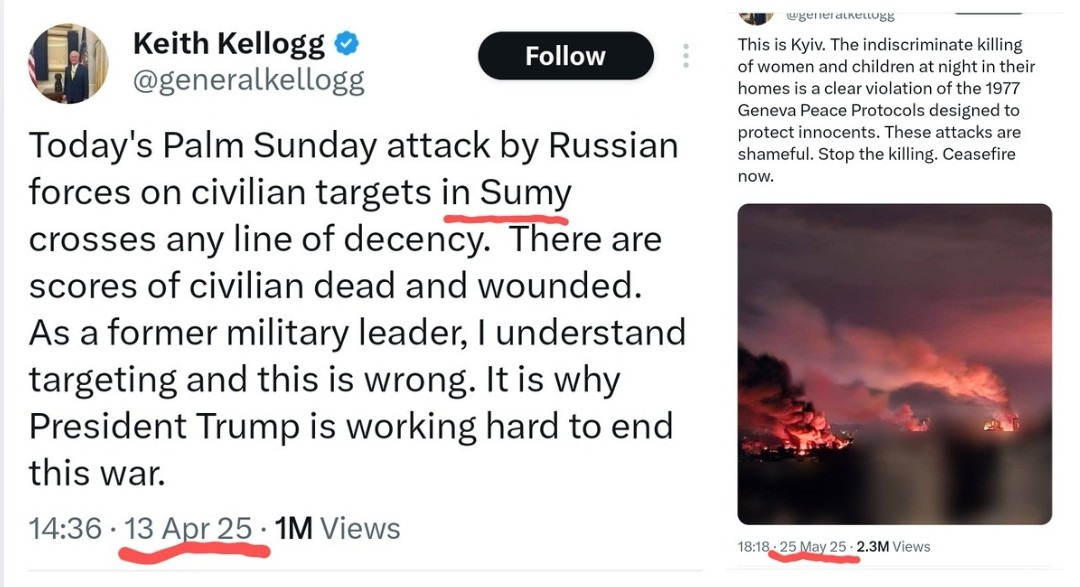
You do need to be an idiot to believe that this is not on purpose. In fact, the only person I have heard explaining such attacks as not being on purpose is — you guessed it — the U.S. President. On Easter Sunday, Russia bombed the central market square in the town of Sumy, in north-eastern Ukraine — using cluster ammunition and hitting church-goers and people on their way to celebrate Easter with their families. As a result, 31 people died. But Donald Trump explained that he had been informed that Russia had simply made a “a mistake”.

All independent experts agree that over the past months, Russia has increasingly targeted playgrounds, market squares, hospitals and residential neighborhoods. Hell, all you need to do is watch the videos being published every single morning of killed and injured Ukrainians being carried out from the rubble in their pajamas and nightgowns.

Trump’s own envoy to Ukraine, retired general Keith Kellogg tweeted is in no doubt.
LIE 4: Putin says that he is ready to meet Zelensky

“We are ready to meet… I am ready to meet with everyone, including Zelensky,” Putin said in St. Petersburg.

FACT: Putin has several times shied away from meeting the Ukrainian President, most recently in Istanbul in May where Zelensky challenged Putin to a face-to-face meeting: “There is no point in prolonging the killings. And I will be waiting for Putin in Türkiye on Thursday. Personally.

But Putin decided not to meet his much younger counterpart — who has lots of hair, no belly, no botox, dynamic, and great international press and sympathy.

LIE 5: Putin questions Zelensky’s legitimacy

“Why am I saying this?” Putin wondered aloud in St. Petersburg. “We don’t care who is negotiating, even if it’s the current head of the regime. I’m ready to meet – but only if it’s the final stage. The signature must come from a legitimate government. Otherwise, the next government will just throw it all in the trash.”

FACT: Where does one start on this one? A brutal, corrupt dictator who has been in power in Russia since 1999, and during that period has killed all signs of democracy, free expression and media, not to say most of his political opponents … accuses a popularly-elected president (Zelensky got 73% of the vote in 2019) of being illegitimate. Because he postponed elections that were supposed to have taken place in 2024, but couldn’t – because said dictator had invaded his country.

In other words, Putin will negotiate with Zelensky, he claims, but then retain the right afterwards to negate the agreement as illegitimate.

Alternatively, Putin wants to force elections in Ukraine — which would lead to instability. Of course. That is exactly why Putin wants elections. The logistics and security challenges would be insurmountable: This is a country and population in the middle of the most traumatic period in its history, with one-third of the population (12–14 million people) having been forced to flee their homes, 20% of their country occupied and hundreds of thousands of people killed and injured. Imagine running a political campaign and elections under such circumstances. Forced upon them by their invading neighbor and the country the Ukrainians thought was their main ally.

There is nothing surprising in an old KGB-hand like Putin trying this one, he has nothing to lose. The surprising thing is that Trump and several members of his administration agree with the Russian dictator that Zelensky is illegitimate and must hold elections before a peace deal can be signed. Why, oh why would you say something like that, Donald, if you really wanted to see peace in Ukraine?

LIE 6: Putin calls the Ukrainian revolution 2014 “a coup”

FACT: Sorry, Vova, I was there on the square in 2013–14, pretty much every single day for several months. There is no polite way of saying this – you are full of shit. Не пизди, Вова!

This was a true, popular uprising, involving millions of Ukrainians all over the country. The proof is in the pudding: 11 years later, it is easy to find Ukrainians who were on the Maidan during those months who today are disappointed with the outcome of the revolution. Too many of the old fat cats stayed in power, the fight against corruption has been too slow. But none of these people – millions – who saw what happened, who actually participated, call it “a coup”.

They were there. They did it. They know.

The fact is that today, 11 years after Putin invaded Ukraine for the first time, and three years and four months after he invaded Ukraine for the second time, it is difficult to find anybody who believes in his lies. Unless they are paid by the Kremlin.

Source: Michael Andersen, “Only a fool would believe that Putin wants peace,” Two Grumpy Old Men on Ukraine, 23 June 2025


Ukrainian officials have reacted with outrage to comments made by Vladimir Putin on Friday in which he told delegates to the St Petersburg International Economic Forum that “all of Ukraine is ours”.

Addressing the annual showcase for Russia’s economic development in St. Petersburg, Putin threatened a Russian nuclear response should Kyiv deploy a so-called “dirty bomb” — despite admitting that there was no evidence it was considering doing so — and portrayed the ongoing invasion of Ukraine as a defensive necessity.

Bluntly denying Ukraine’s sovereignty, Putin repeated the long-standing Kremlin narrative that Ukrainians and Russians were “one people,” a claim that has been repeatedly rejected both by Ukraine and the international community.

Putin went on to confirm that Russian forces were carving out a 10–15 kilometre buffer zone inside Ukraine’s Sumy region, following a seven-month-long incursion into Russia’s neighbouring Kursk region by the Armed Forces of Ukraine. Though he denied that Russia planned to occupy the city of Sumy itself, Putin added pointedly that he didn’t “rule it out”.

Raising the spectre of nuclear escalation, Putin warned of a devastating Russian response should Ukraine deploy a so-called “dirty bomb”, which combines conventional explosives with radioactive material, despite the fact that Ukraine is not known to possess such a device — a fact Putin himself acknowledged.

Such an attack “would be a colossal mistake on the part of those we call neo-Nazis in today’s Ukraine,” he said, adding that it “might be their last mistake”.

“Our nuclear doctrine states that we always respond to threats in kind. Therefore, our retaliation would be extremely harsh — and most likely catastrophic for both the neo-Nazi regime and Ukraine itself,” Putin continued.

Responding to the comments in his nightly address to the nation on Friday, Ukrainian President Volodymyr Zelensky said that they proved Putin had no intention of negotiating a ceasefire and that “Russia wants to continue the war,” adding that Ukrainian forces were successfully repelling Russian attacks in the Sumy region

Other Ukrainian officials also condemned Putin’s remarks, with Foreign Minister Andrii Sybiha describing his statement as “deranged” and saying that the Russian leader had shown “complete disdain for US peace efforts.”

“While the United States and the rest of the world have called for an immediate end to the killing, Russia’s top war criminal discusses plans to seize more Ukrainian territory and kill more Ukrainians,” Sybiha wrote on X.

Despite Russia’s continuing international isolation, Putin also claimed that the country’s economy remained strong, noting that GDP had grown by more than 4% annually over the past two years, poverty had dropped to 7.2%, and that unemployment had fallen to a historic low of 2.3%.
Source: Emilia Kurilova, “Outrage in Kyiv as Putin tells St. Petersburg International Economic Forum ‘all of Ukraine is ours,’” Novaya Gazeta Europe, 21 June 2025

Funny Things Happened at the Forum

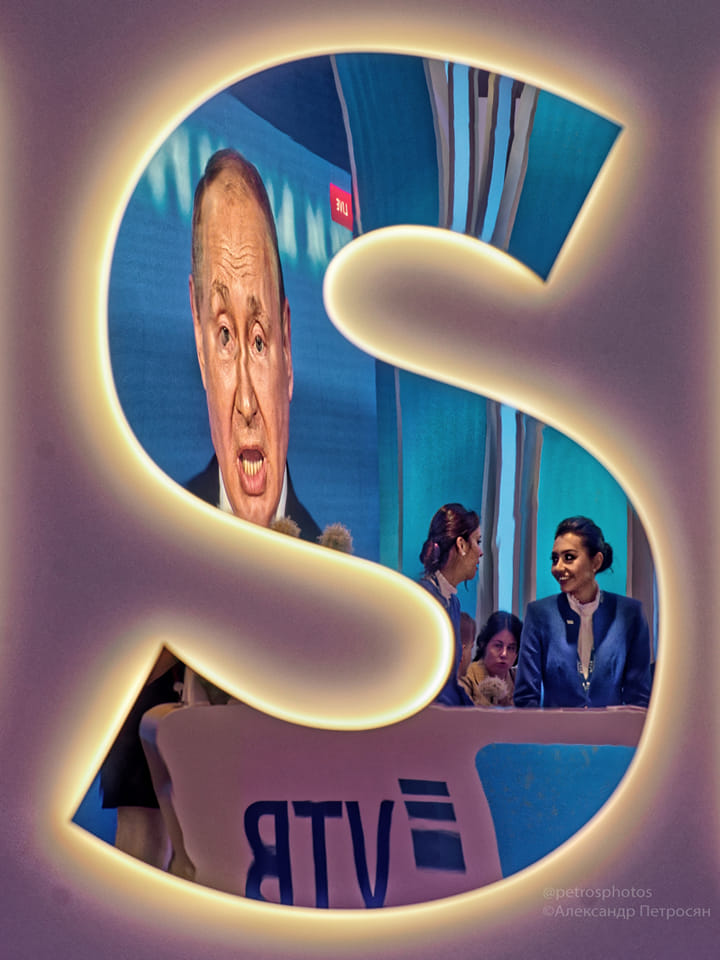
The phenomenal Petersburg photographer Alexander Petrosyan snapped this hyperrealist folk-conceptual photo at this week’s international economic forum in Petersburg, where the honored guests include the Taliban and the “president” of one of the fake Donbas “people’s republics.” There has been a lot of coverage of the remarks made at the forum by this snapshot’s ostensible subject. I have excerpted one article about them, below. This excerpt is followed by my translation of an interview with Sergei Khestanov about the forum and the broader Russian economic outlook in the light of the war and western sanctions.


As is traditional, the forum was dominated by a plenary session involving Putin. Earlier in the week, Peskov announced that Putin would make “an extremely important speech”. A couple of days later, he went out of his way to insist that the president was not about to announce a mobilization. It’s unclear why this was necessary – it’s no longer early March when this rumor was widespread.

The speech itself (which lasted for almost 90 minutes) contained no surprises. Putin spoke Friday about how “crazy sanctions” were not hurting the Russian economy, but, instead, causing pain for the Western countries as they wrestle with a crisis caused by an ill-conceived coronavirus response. “Our special military operation has nothing to do with it,” Putin said. More than once, Putin insisted the Russian economy remained open for business and reaffirmed his belief that the West would come to its senses and that Western companies would soon return to operating in Russia as normal.

But the most interesting part was when the moderator, Margarita Simonyan (head of state-owned RT and a prominent hawk on Ukraine) began putting questions to Putin and Tokayev. Along with the president of Armenia, Tokayev was one of only two heads of state to travel to the forum. It was painfully clear that Tokayev’s presence was repayment for Putin’s support back in January when troops from the Russian-led Collective Security Treaty Organization (CSTO) helped to re-impose order in Kazakhstan and, at the same time, marginalize Tokayev’s predecessor, Nursultan Nazarbayev.

However, Tokayev’s gratitude knows some bounds. That was apparent two days before he shared the stage with Putin when he gave an interview to state-owned Rossiya 24 in which he confirmed that his country would fully comply with Western sanctions on Russia.

Judging by what followed, Putin was aware of that interview. The highlight of the session was Putin’s attempt to pronounce his colleague’s name and patronymic – Kassym-Jomart Kemelevich. In January, when Kazakhstan was at the center of international attention as a result of civil unrest, Putin was already struggling with this difficult – but not impossible – name and twice uttered something incoherent. This time, at the start of his speech, Putin got it right – but during the Q&A session he again referred to Tokayev as “Kemel-Zhemelevich”, prompting a highly suspicious look from his supposed ally (this is clearly visible in the video).

Tokayev’s answers to Simonyan’s questions were far from the platitudes of an ally and some of what he said ran directly counter to Putin’s position. Diplomatic and courteous (Tokayev is a former UN Deputy General Secretary), the Kazakh president told Putin:

  • Kazakhstan “takes sanctions into account” (a response to a question from Simonyan suggesting the West must be pushing Kazakhstan to stop cooperation with Russia).
  • No economy can successfully pursue a policy of self-reliance and import substitution.
  • Ukraine’s accession to the European Union must be accepted as a new reality, even though its economy is in a dreadful condition.
  • The U.S., and the West in general, are not in the throes of a major crisis. At present, the U.S. economy is “modern and dynamic.”
  • That there are some Russian politicians, journalists and cultural figures who make “absolutely incorrect statements about Kazakhstan” and other states and “sow discord between our peoples.” This is likely to refer to occasional calls in the Russian parliament to protect the Russian-speaking population of Kazakhstan, which is concentrated in the north of the country. Such pronouncements are very reminiscent of the rhetoric in Russia about the Donbas region of eastern Ukraine.
  • Finally, without prompting, Tokayev dismissed the possibility of Kazakhstan recognizing the People’s Republics of Donetsk and Luhansk. He dismissed the republics – recognized by Russia – as “quasi-state entities.”

You can watch the whole of the plenary session here, or read a transcript here.

The scandal continued Saturday when Kazakh media reported Tokayev had turned down the Order of Alexander Nevsky bestowed on him by the Russian government. The official reason was that Kazakhstan’s president is not permitted to accept honors from foreign countries while in office – Russian state-owned media devoted half a day to reporting this explanation.

Source: “Showcasing Isolation,” The Bell, 19 June 2022


The St. Petersburg International Economic Forum (SPIEF) wrapped up this weekend. The feelings it generated are complicated. On the one hand, there was a heated discussion of the forum in social media; on the other hand, it was mainly not economic news that was discussed, but the juicy scandals that happened at the forum. Does the international forum have a future in the face of total western sanctions? And have the speeches at the SPIEF made it clearer what will happen next with the Russian economy? We talked about this with Sergei Khestanov, a well-known economist who has developed dozens of financial theories and techniques. He also serves as an adviser on macroeconomics to the CEO of Otkritie Investments.

Judging by the discussion of SPIEF on social media, the hottest guests were the Taliban (an organization that is banned in Russia) and Philipp Kirkorov. Is this due to the exoticism of their being at the economic forum or the absence of significant guests?

— The Taliban were just a kind of exotic highlight, I think. By the way, they were not particularly visible in the latter part of the forum. There weren’t many notable guests, really, but then again there hasn’t been an abundance of such guests for many years. What was unusual was that some guests of the forum (Russians, by the way) were asked not to advertise their participation and to wear name tags that did not spell out their companies and positions, lest they be hit by sanctions. From the economic point of view of, it doesn’t mean anything, but it is a quite interesting reflection on how the forum is seen.

Was western business represented at the forum in general?

— It was practically absent. Many [western businessmen] simply cannot attend without spoiling their reputations, even those who have not yet abandoned the Russian market.

And what was interesting from a substantive point of view?

— In terms of the forum’s substance, I would draw attention to the statement made by [Sberbank chief] Hermann Gref that the Russian economy would be able to reach the level of 2021 in ten years. That’s quite a frank recognition of the state of our economy. Vladimir Putin’s statement about banning audits of businesses is also welcome if the number of such audits is really reduced. However, it bothers me that they have been talking about this for so many years [without doing anything about it.]

Putin also announced a reduction in the preferential mortgage rate to seven percent.

— Volumes of orders have been falling in the construction industry, so we need to support it. And since, as a rule, the construction industry is closely affiliated with local and, sometimes, regional authorities, the desire to support it is quite understandable. Plus, the industry is a multiplier, so helping it helps the metals industry, manufacturers of cement, lumber, and so on. However, the decline in volumes is not yet tremendous, so nothing terrible would happen without help, but nor do I expect the support to trigger a boom.

There is another danger here: real estate prices in Russia, especially in the megacities, are overheated. if the decrease in mortgage rates is not coupled with an increase in down payments, we could end up with a mortgage bubble. And then, under certain unfavorable circumstances, of which there might be many going forward, we could face a terrific downturn in prices and a serious mortgage crisis. I would not say that the danger is great now, but it cannot be ignored.

Wait, what collapse? What crisis? It followed from Vladimir Putin’s speech that we have been successfully coping with western sanctions. Supposedly, foreign exchange earnings are so great that they almost equaled the volume of the frozen portion of Russian gold and foreign exchange reserves.

— Russia is bursting with money that it cannot digest because of import restrictions and the threat of frozen accounts. It turns out that money has been earned, but what to do with it? It isn’t possible to use it constructively. And this madness with shoring up the ruble is due to the fact that there is no demand for non-cash payments: exporters need controls, but they cannot sell currency. So, it’s like a pear is dangling in front of you, but you can’t eat it.

But Central Bank head Elvira Nabiullina in her speech suggested a way out for exporters: they should focus on the domestic market.

— Those are pretty words, but most exporters have been working for the domestic market for a long time. The problem is that the domestic market’s capacity is limited. For oil and petroleum products, for example, domestic demand accounts for about a quarter of current production. That is, if we refocus on the domestic market, we need to cut production threefold. Will that make things better?

Export industries perfectly satisfy domestic demand, and everything else is exported. This also applies to the metals industry, both ferrous and non-ferrous metals, and the oil industry, and the petrochemical industry. Nizhnekamskneftekhim, the world’s largest producer in its class of raw materials for plastics, supplies its products to both the domestic and foreign markets, but only a very small portion of what it produces goes to the domestic market, because such is the demand.

And, for example, aluminum and titanium are used mainly in aircraft construction. Given current conditions in the domestic market, they can be used, at best, to make kvass cans.

— Exactly. The domestic Russian market is simply not able to absorb everything produced by exporters. So, this call to pivot to the domestic market is like that joke. “Bunnies, become hedgehogs, so the foxes won’t eat you.” “Great, but how do we do it?” “I don’t know — I’m a strategist, not a tactician.”

To be fair, Nabiullina had also talked about structural adjustment in the past.

— What the Central Bank head said about structural adjustment is right, but it doesn’t make much sense yet. Unless we note the speech made by [Alexei] Kudrin, who said that it would take two to three months to develop a strategy. I consider him one of the most serious public figures in terms of macroeconomic analysis, so his words carry a lot of weight for me. Two or three months is a realistic amount of time, I think. It would bring us to the beginning of autumn, and all over the world at this time, business picks up after the summer lull. Plus, statistics for macroeconomic indicators will have been reported, and the relevance of the data will have increased. So I’m eighty to ninety percent in agreement with him.

 But what don’t you agree with?

— My main disagreement is that, since the sanctions have not yet ended, the effectiveness of strategies is low. No matter how good a plan is, it will have to be changed quickly and often. Moreover, so far most of the sanctions have impacted imports, and that is not so terrible. Of course, it’s sad that Ivan Sixpack can no longer buy a new smartphone, but this has little effect on the economy. Export sanctions are much more serious when it comes to filling the state coffers. But I think it’s too early to talk about them before next year.

Well, so far, Ivan Sixpack does not seem to be suffering much. Many people say that the sanctions are not really hurting us.

— Since demand has dropped a lot, people are under the illusion that nothing terrible has happened. But by the second half of September, I think that stocks in the warehouses will be exhausted, and it will become clear what is happening with durable goods.

— Especially with spare parts for cars. This topic is now of concern to many people. A friend of mine is now glad that she didn’t buy a foreign car, as she had originally wanted, but a Russian-assembled Renault.

— She shouldn’t be too glad. Some of the spare parts for inexpensive Russian-assembled foreign cars are made in Russia, but only some. The rest are imported.

— So, we will have to establish a shuttle trading business for the delivery of spare parts.

— Maybe, but the whole business will be tedious, time-consuming and, accordingly, much more expensive. As in the 90s, people will have to buy cars that Russian spare parts fit. They will have to learn how to do their own repairs. In Soviet times, I went abroad to buy a used car with cardboard templates in tow to determine whether the wheels from a Lada would fit it, whether the filters would fit. I knew how to re-rivet brake pads. Basically, I can fix anything on a car, except the carburetor. Most of the motorists of that time could do the same. Maybe they couldn’t do everything, but they could do the most basic things like cleaning the spark plugs and changing the oil and filters. Those were the necessary skills. But nowadays, many people don’t even know how to change tires.

— They’ll have to learn. Once again the menfolk will gather in garages on weekends, although many people don’t have their own garages anymore. They only have spaces in multi-story parking lots, and you can’t repair a car there.

— And the skills have been lost. Of course, a parallel import market will be established, and people will learn how to do repairs, but it will be difficult for motorists. It will become immensely more expensive and more difficult to maintain a car.

— Speaking of cars. Industry and Trade Minister Denis Manturov announced plans to resume production not only of the Moskvitch, as discussed by Moscow Mayor Sergei Sobyanin, but also of the Volga and even the Pobeda. The latter, by the way, was produced in the 50s. Is the [Russian] car industry really that bad off? What about the Chinese? Wouldn’t they help us? After all, they are switching to electric vehicles. Could they transfer the production of internal combustion engines to Russia?

— As I understand it, Manturov was actually talking about reviving the brands, not the cars of that generation themselves. Because if there is a demand for classic Ladas now, it’s not very big. In the back country, the fact that they can be repaired easily is appreciated. But all the other cars [of the period] were total tanks. I used to drive a Pobeda back in the day. It really, you know, encourages you to develop your shoulder muscles, because turning the steering wheel involves great physical exertion. The brakes are the same way.

But what they probably have in mind is producing new models under those brands, maybe even stylized to look like the old ones. Aesthetically, the Pobeda is beautiful — it’s just hard to drive it. The Volga 21 is beautiful, and so are the Moskvitches up to the 412 model. And if you also give it a two-tone paint job, like the Moskvitch 403, you could make a very popular model. Volkswagen also produced an updated replica of the Beetle.

 And how will they make them?

— They will probably buy the platforms from the Chinese, or [the Chinese] will even supply the assembly lines. Then designers will be commissioned to come up with designs, maybe even stylized to look like Soviet cars. And so the brands will be reborn.

— In conclusion, let’s return to the guests at SPIEF. In terms of foreign leaders, Kazakhstan President Kassym-Jomart Tokayev attended the forum. Chinese President Xi Jinping also made a short speech via video link. There is probably no point in asking whether SPIEF can now claim the role of the “Russian Davos.” I wanted to ask you abpit something else. Given the current conditions, is there any point to this event?

— Tokayev, I think, just couldn’t help but show up. Everyone paid attention to how he spoke relatively harshly about the DPR and the LPR. Of course, he is a professional career diplomat and spoke in such a way that you can’t find fault with him, so it’s quite difficult to extract any one definite message from his speeches.

— What about when he said that Kazakhstan had no choice but to support western sanctions?

— But this is quite obvious: he didn’t say anything new. It is clear that the economy of Kazakhstan cannot fight a consolidated decision by the western economies. This would not only be difficult, but also not really necessary. So, where its own interests are not affected, Kazakhstan can help Russia — but no more than that. By the way, the Chinese have the same attitude towards us.

Is that why Xi Jinping not only did not come to SPIEF, but was also brief in his video message?

— There is not much to talk about in the current circumstances. So it’s not that Xi didn’t want to talk. There was nothing in particular for him to talk about. It is clear to everyone that the Russian economy is not doing very well. So, our corporations signed contracts with each other, which they happily reported before going their separate ways.

The question of whether SPIEF should be held is another matter: the degeneration of such forums is not only a Russian problem. The Davos forum has also been experiencing a lack of serious ideas. Ten years ago, the substantive part of it was much larger, but nowadays everyone is for all the good things and against all the bad things. And all other [economic] forums face similar problems: a lack of substance and a focus on narrow subjects. So, what is happening with the Petersburg Forum is not unique.

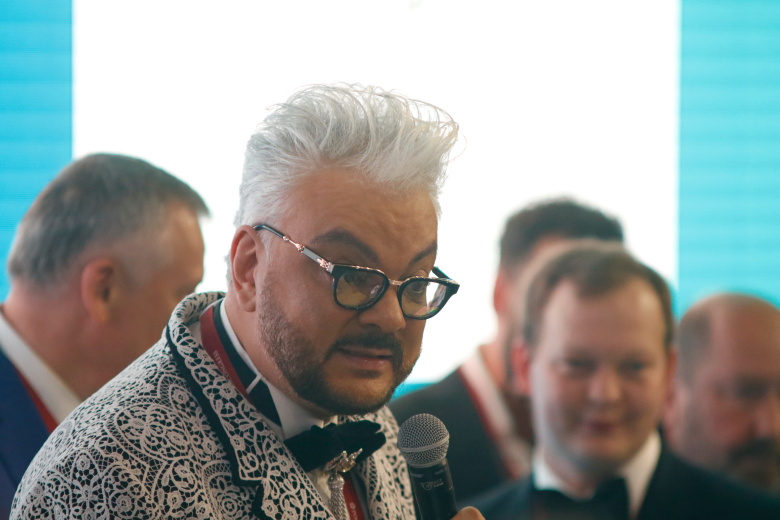
Russian pop singer Philipp Kirkorov at the 25th St. Petersburg International Economic Forum
Photo: Maksim Konstantinov/Global Look Press. Courtesy of Republic

It’s hard to say what the reason is for this. Maybe the format has worn out its welcome. As in art, there is a fashion, a trend, and then times, traditions, and tastes change, and the format goes away. Maybe it is due to the fact that the world economy has been slowing down. When the forums were interesting, the economy was growing; intense economic processes were underway, and reforms were being undertaken in the countries of the former USSR and Eastern Europe. But now there is stagnation everywhere, even in the IT field, about which I know a thing or two. What can I say? Moore’s law has been disproven! The number of transistors on a single chip no longer doubles every eighteen months. So, this is a universal problem. I don’t know whether this trend is reversible or permanent, but for the time being it’s like this. Do you remember the Central Committee plenums in Soviet times? The “resolutions” that were “submitted for consideration” and instantly “approved”? The long tedious speeches about nothing? It’s all coming to look a lot like that.

Source: Tatyana Rybakova, “‘Do you remember the Central Committee plenums in Soviet times? It’s all coming to look a lot like that’: Sergei Khestanov on the St. Petersburg Economic Forum and the future of the economy,” Republic, 19 June 2022. Translated by the Russian Reader

947 Foreigners Deported during “Cleanup” of Petersburg for Economic Forum

All those utterly disempowered Tajik and Uzbek maintenance workers, janitors, yard sweepers, construction workers, taxi bus drivers, petrol pumpers, car wash wallahs, tire changers, and subway ventilation shaft dwellers (?) apparently threatened to disrupt the mighty Saint Petersburg International Economic Forum.

As a friend of mine commented, “Now we know what ‘strengthening of immigration control’ means. It is telling that the economic forum is used as a pretext to mask the [real] economy itself.”

During “Cleanup” of Petersburg for SPIEF, 947 Foreigners Deported
June 17, 2015
Fontanka.ru

Almost a thousand people have been deported from Russia during a “cleanup” of Petersburg for the Saint Petersburg International Economic Forum, which starts tomorrow, June 18. Regional units of the Federal Migration Service carried out large-scale raids on apartments and hotels in search of suspicious foreigners.

As Fontanka.ru has learned, the cleanup had been planned several months ago and had been underway since April in eight districts of the city, those that will host SPIEF events. In addition to Vasilyevsky Island, immigration control has been strengthened in the Central, Petrograd, Admiralty, Moscow, Kirov, Krasnoe Selo, and Pushkin districts.

As a result of more than two thousand raids by the regional FMS office, 947 foreigners were expelled and deported for various violations of immigration laws. Simultaneously, more than ninety crimes involving drugs and weapon trafficking, as well as documents forgery, were solved. Nearly six thousand police charge sheets for administrative violations were issued, and the amount of fines imposed on foreigners was in excess of nine million rubles [approx. 147,000 euros].

The FMS’s Petersburg and Leningrad Region office confirmed to Fontanka.ru that the planned actions had been implemented in advance of the SPIEF.

According to the information made available to us, during the cleanup of Vasilyevsky Island, not only were abandoned buildings and buildings under construction checked but so too were taxi bus stands, service stations, tire shops, car washes, and subway ventilation shafts.