Native Tongues

The percentage of schoolchildren in the Russian Federation studying in native tongues other than Russian halved between 2016 and 2023. Instruction in thirty-eight languages ceased altogether. Experts argue that this situation was caused by a whole slew of problems, including a downturn in interest in native languages, a decrease in the number of lessons taught in them, a shortage of teachers, and an estrangement from foreign partners due to sanctions.
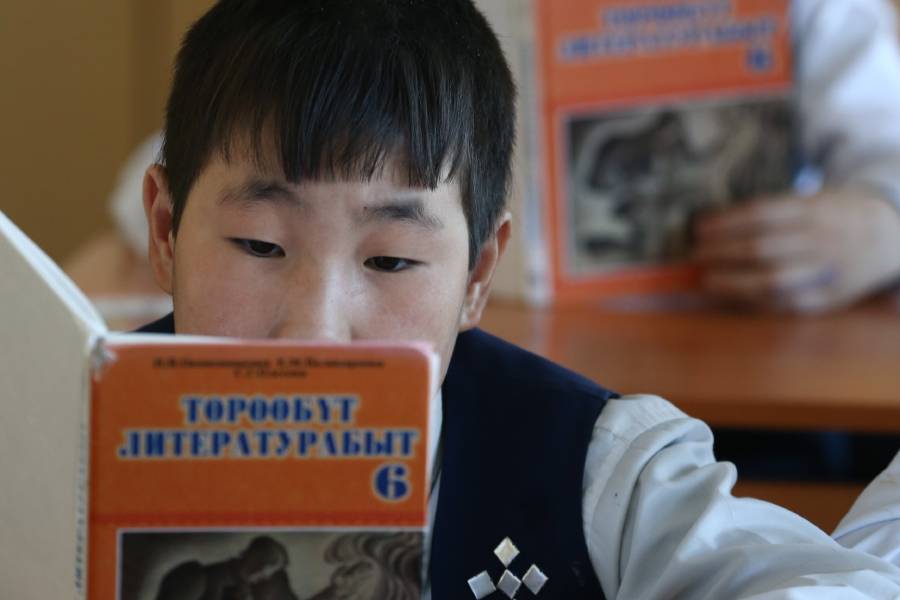
Pupils at a rural school during a Yakut literature lesson. Photo: Alexander Ryumin/TASS

According to the Institute of Linguistics of the Russian Academy of Sciences, there are 155 living languages in the Russian Federation, thirty-seven of which have the status of official languages in the republics, meaning that they should be used in those regions on an equal footing with Russian. In Russia’s comprehensive education system, native languages are studied in three forms: as separate subjects, as electives, or as complete substitutes for Russian in all classes.

Based on data from the Ministry of Education, Takie Dela has calculated that between 2016 and 2023, the percentage of schoolchildren who study entirely in their native languages fell from 1.98 to 0.96 — the lowest figure for this period. The number of such pupils fell from 292,000 to 173,500, although the number of children in school increased by 3.2 million over those same seven years.

The share of those who studied native languages at clubs decreased from 0.7 to 0.4 percent. During the same period, the share of pupils who were taught their native languages as a separate subject increased from 10.41 to 10.56 percent. But the overall engagement of children in learning their native tongues decreased from 13.08 to 11.92 percent.

During the same period, instruction in thirty-eight languages, including Altai, Buryat, and Ingush, ceased completely. In 2016, there were still children in Russia who studied general subjects in those languages. There were no more such pupils left by 2023.

“Where the language is spoken at home, it provides an opportunity to master the written norms. This is vital to preserving people’s identity, to making them feel comfortable in society,” says sociolinguist Vlada Baranova.

According to the law, learning a native language in Russia is voluntary, so it is up to parents to decide how exactly it will be taught to their children and whether it will be taught at all.

Margarita Kilik, chair of the Association of Teachers of Native Languages of Kamchatka, argues that the decrease in the number of pupils studying their own languages is due to the desire of parents. “Fewer and fewer people are staying in the region,” she says. “They are leaving to study in the big cities, in Moscow and St. Petersburg. So there is simply no need for mother tongues.”


Which languages Russian schoolchildren studied as mother tongues in 2023. Drag your cursor arrow over each circle to see the total number of children who were studying that particular language as a native language. By clicking the “cog” icon in the lower righthand corner, you can access two sets of toggles that alter the map: 1) Форма изучение (“Form of instruction”), which shows whether a language was taught as a separate subject (pink) or used as a language of instruction (powder blue); and 2) Сколько детей узучают язык (“How many children study the language”), which alters the map to visualize the relative weight of the numbers and percentages of children who studied languages other than Russian in 2023. Source: Ministry of Education of the Russian Federation/Takie Dela.


And yet, interest in mother languages persists and often awakens with age, when it is more difficult to learn them, Kilik concedes. Natalia Antonova, editor-in-chief of the Karelian-language newspaper Vedlozero Windows, agrees with her. “It is difficult to get schoolchildren interested in something, especially studying minority languages. Often people who have already matured, whose parents have passed away, have regrets that they have been left without a linguistic thread linking them,” she says.

According to census data cited by the To Be Accurate project, the number of speakers of all of the Russian Federation’s official languages except Russian, Chechen, Tatar, and Tuvan declined between 2002 and 2020. But many textbooks of minority languages are designed for children who can speak them, even though the textbooks themselves have not been updated for a long time.

“Children who don’t know their native languages enter school. There are good textbooks structured to teach [these] languages as foreign languages, but these are more exceptions,” says Baranova.

In the Russian Federation, native languages are studied mainly in elementary and middle schools, while in grades 10 and 11 most teenagers switch to Russian, according to statistics from the Ministry of Education. “Graduates need to sit for the Unified State Exam, and general subjects taught in native languages won’t help them much,” says Vladislav Savelyev, a former Yakutia Education Ministry official.

Initiatives by the regions to produce a Unified State Exam in their native languages were never adopted. Meanwhile, the number of hours allocated for studying native languages at school has been reduced, activists have pointed out. “These issues are regulated by the federal educational standards, and, of course, the number of hours for teaching Yakut has been reduced in favor of priority subjects, such as mathematics,” says Savelyev.


Instruction in native languages in the Russian Federation. The numbers of children who studied in 2016–2023 in their native languages is indicated by the lavender bars, while their percentage within the overall school population is shown by the pink line and dots. Source: Ministry of Education of the Russian Federation/Takie Dela.


Savelyev also notes that schools are switching to a five-day school week and “optional” subjects like mother tongues are the first to have their hours cut from school schedules.

Another reason why the languages of Russia’s peoples may eventually disappear is the shortage of teachers specializing in them. According to data from the Institute for Statistical Research and Knowledge Economics at the Higher School of Economics, the number of native language teachers in Russian schools fell from 22,000 in 2009 to 15,500 in 2023. There are even fewer who can teach mathematics and history in languages other than Russian. “Seventy percent of the school teachers in the Koryak Autonomous District are from other regions. How can they know our languages? The situation is the same in many other regions,” Kilik points out.

The circumstances surrounding the teaching the official languages of the republics and the languages of minority Indigenous peoples differ greatly, however.

“We have several such languages in the Kamchatka Territory, and some of them even belong to different [linguistic] groups. A significant number of the teachers of these languages, as well as the speakers, are at least fifty-five to sixty years old. Who will teach the languages when they retire?” wonders Kilik.

Some languages, such as Aleut, have disappeared altogether in Kamchatka: Russia’s last speaker of the language, Gennady Yakovlev, died in 2022. Russian Aleuts used to cooperate with American Aleuts in preserving their language and culture, but this has now become impossible. “There are obstacles on both sides: our side says that America is an enemy country, while their side imposes sanctions on Russia,” says Kilik.

The situation is similar in Karelia, the only republic in the Russian Federation where the language of the titular nation does not have official language status. This is due to the fact that the Karelian alphabet is based on the Latin alphabet, while official languages in Russia must be written in the Cyrillic script alone.

According to official statistics, less than 500 children study the Karelian language at school, while 340 children study Vepsian. Instruction in these languages has been preserved only at specialized university departments and partly in kindergartens, says Antonova. “There are a couple of dozen kindergartens where the native language is learnt. But it’s more about the showy aspect of the language used in songs, costumes, and festivals,” she adds.

Since the Soviet Union collapsed, Russian Karelians have been assisted by Finnish Karelians in studying and preserving the Karelian language: textbooks have been published jointly, and language courses have been held jointly. “The break with Finnish organizations will certainly affect the opportunities for learning the Karelian language. Although it is not so noticeable yet, because little time has passed,” Antonova explains.

According to Antonova, Karelian is currently studied in clubs and courses at libraries, language centers and NGOs. Some of these organizations even receive state support, she adds.

Russian law obliges the state to preserve the languages of the peoples living in the Russian Federation and to promote their study.

‘This is a very divergent movement, and the situation depends very much on the region. In some places the authorities support languages, while in other places, on the contrary, they see their widespread use as going hand in glove with ethno-nationalism. But the policy is generally more aimed at Russification and reducing the use of minority languages,” explains Baranova.

Baranova notes that there is a downside to the fact that studying mother tongues is voluntary, as stipulated by law. In villages inhabited by speakers of endangered languages it is often possible to muster only one first grade class, and it will always be a Russian-speaking class.

“Because there will always be parents who want their child to be taught in Russian, and this is also their free choice. You can, of course, try to defend your position and demand that the school provide for another first grade class in the other language, but you’ll come across as suspicious and dangerous,” says Baranova.

Antonova also says that it has become more difficult to assert one’s linguistic rights.

“If campaigning for language revival was a common trend in the nineties, nowadays you can be accused of extremism and separatism, and the authorities will regard you with suspicion.”

Despite all this, there are ways to study native languages in Russia, says Baranova.

“Other forms and grassroots initiatives that get children and adults involved in using the language in different areas are also effective. They turn out to be a good way to keep the language alive.”

Source: “’Suspicious and dangerous’: schoolchildren in Russia now half as likely to study in their native languages,” Takie Dela, 9 September 2024. Translated by the Russian Reader
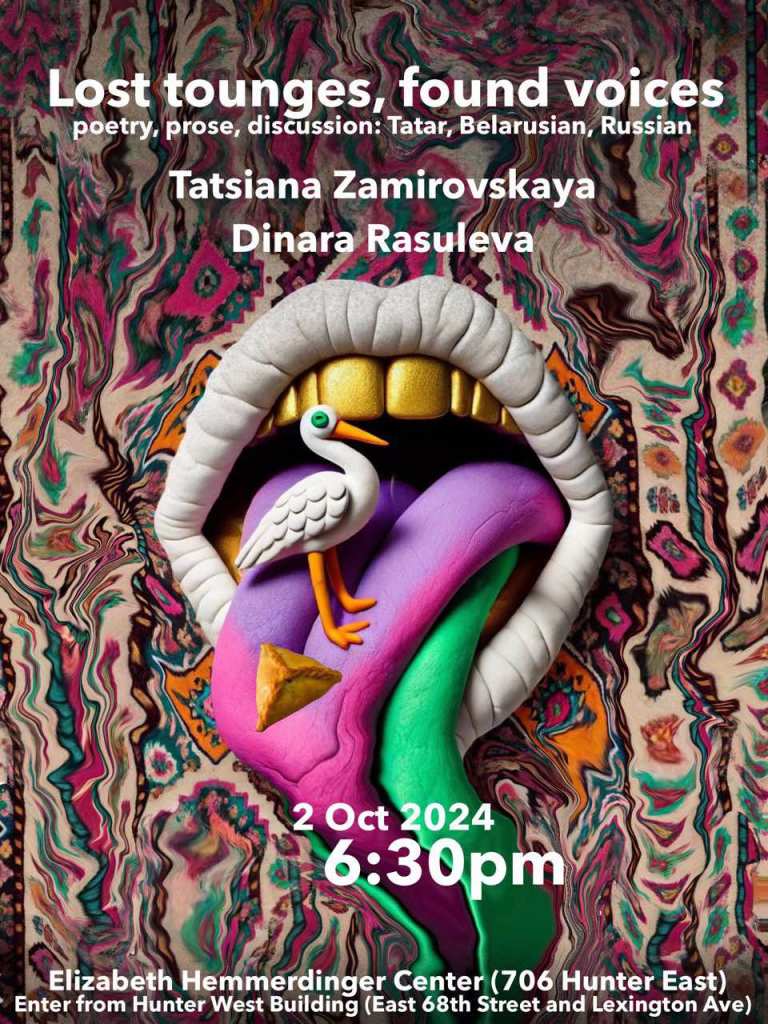

DINARA RASULEVA & TATSIANA ZAMIROVSKAYA
“Lost Tongues, Found Voices, Decolonizing Languages: A Multilingual Reading and Conversation”
Wednesday, October 2, 6:30 pm
Hunter College CUNY
Elizabeth Hemmerdinger Center (706 Hunter East Bldg)
Free and open to the public

Join Belarusian writer Tatsiana Zamirovskaya and Tatar poet_ess Dinara Rasuleva for a discussion on the loss and revival of languages. Dinara will talk about why languages of indigenous peoples colonized by Russia fade and how they are being brought back, sharing her translingual poems from the Lostlingual research series. Tatsiana will talk about why some Belarusian writers write in Russian, while still remaining Belarusian-identified authors, about her experience writing in a mix of Russian and Belarusian, and the challenges of translating colonized voices accurately. Both writers will reflect on the intersections of language and identity in their lives and works.

Dinara Rasuleva (she/they) is a poet_ess based in Berlin and born in Kazan, Tatarstan. She writes in Tatar, Russian, English and German — the languages she uses everyday. Dinara’s poetry was described and analyzed as decolonial and feminist writing, as expressionist poetry and performance poetry. In 2020 Dinara started a feminist writing laboratory for russian-speaking immigrant FLINTA community. In 2022 their first book of poems Su was published by Babel publishing house. Since 2022 Dinara started the Lostlingual Project, an investigation of the loss of her native Tatar language through translingual abstract poetry. In 2023, in collaboration with Berlin library Totschka, Dinara started TEL:L laboratories: writing in native forgotten or stolen languages.

Tatsiana Zamirovskaya is a Belarusian author who moved to Brooklyn in 2015. She writes metaphysical sci-fi about memory, ghosts, hybrid identities and borders between empires and languages. She is the author of three collections of short stories and a novel Deadnet, published in Moscow in 2021, receiving great critical acclaim and shortlisted for several Russophone literary awards. She is a recipient of fellowships from Macdowell, Djerassi and VCCA. Currently Tatsiana is finishing her new collection of short stories about women going through unbearable events and how these events influence language and perception. She currently writes in belarusified Russian, russified Belarusian and broken English.

Directions: At the reception desk of the Hunter West Building, please present your ID to get a pass. From there, take the escalator to the 3rd floor, turn right and walk across the sky bridge to the Hunter East Building, then take the elevator to the 7th floor. Hemmerdinger Center is at the end of the hallway past the turnstiles.


Follow Tamizdat Project on YouTubeFacebook and Instagram! To learn more about us, download our brochure

Tamizdat Project is a 501(c)(3) not-for-profit organization with a tax-exempt status: donations and gifts are deductible to the extent allowable by the IRS. You can donate online, via Venmo (@Tamizdat-Project), PayPal or Zelle using our email tamizdatproject@gmail.com, or by check. Please don’t hesitate to contact us, and thank you for your support! 

Source: Tamizdat Project newsletter, 21 September 2024
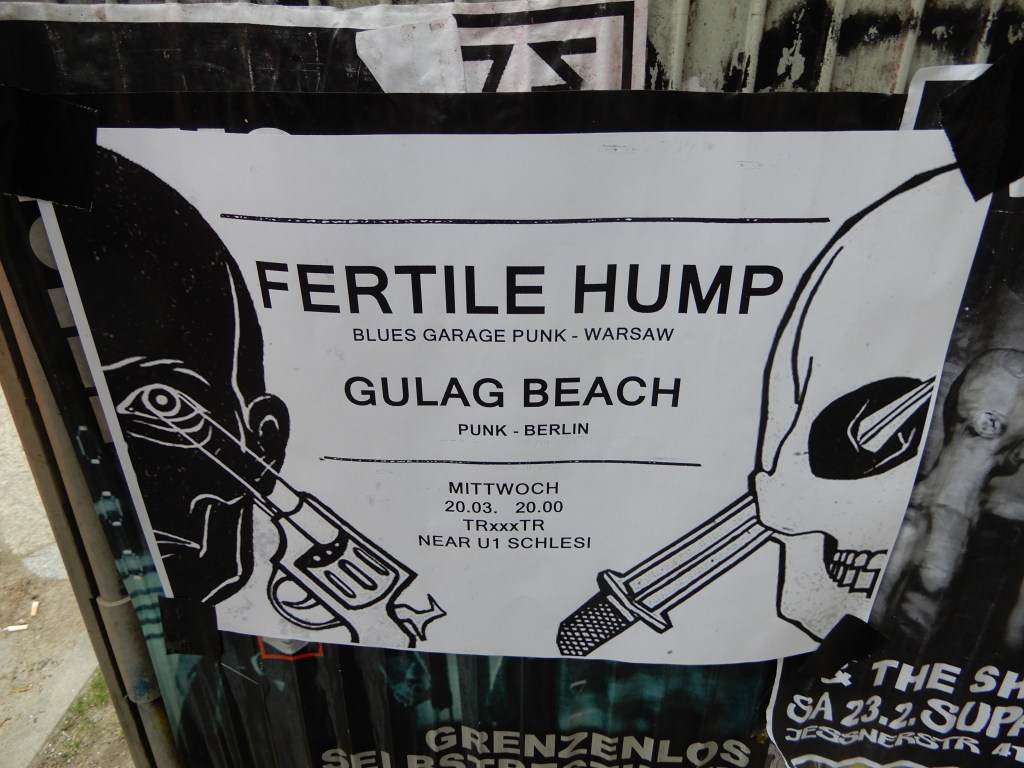
Spiker vs. Speaker

Why bother to find the right word in Russian when the wrong word in English will do?

Текст «К каким последствиям для общества приводят войны» автор Лиза Шапатина писала долго, потому что нужно было найти хороших спикеров [spikerov], нужно было составить хорошую рыбу и нужно было структурировать текст так, чтобы было понятно, просто и интересно. И ей это удалось!

Author Liza Shapatina took a long time to write the text “What consequences wars have for society,” because she had to find good speakers, she had to make a good outline, and she had to structure the text so that it was clear, simple and interesting. And she succeeded!

Source: Liza Tyurina, Help Needed Foundation email newsletter, 1 March 2023. Translation by TRR

The right Russian word in this case would have been собеседник [sobesednik] — meaning, “source,” “informant,” “interlocutor” — instead of the now absurdly overused Anglicism спикер [spiker], which not so long ago, in the 1990s, referred only to the chairs of the UK House of Commons and the US House of Representatives, and occasionally, by analogy, the chair of the Russian State Duma. Now it used not only to denote parliamentary chairs the world over, but also, absurdly, “speakers” at conferences and other public events, and now, apparently, anyone who speaks or with whom one speaks, although the implied corresponding verbal form спикить (instead of, depending on the context, говорить, выступать, беседовать, докладывать, etc.) has not yet come into use, thank God. ||| TRR


Berlin-Friedrichshain, 1 March 2019. Photo by the Russian Reader

Russian President Vladimir Putin has signed legislation that bans government officials from using foreign words in official documents and correspondence as well as while carrying out their duties.

“When using Russian as the state language of the Russian Federation, it is not allowed to use words and expressions that do not correspond to the norms of modern literary Russian language,” the law published Tuesday said.

The exception, according to the law, is the use of “foreign words which do not have widely used corresponding equivalents in Russian.”

A list of foreign words that can be used will be compiled by a government commission and will be published separately, the Kommersant business daily reported.

A number of Russian political figures vowed to protect the Russian language from Western influence due to what they called “Russophobia” and “attacks on everything connected with Russia.”

Source: “Putin Signs Law Banning Officials from Using Foreign Words,” Moscow Times, 1 March 2023

Farida Kurbangaleyeva: My Personal Denazification

The Russian government and pro-Kremlin media say that the aim of Russia’s current war against its neighboring country is the “denazification” of Ukraine. But Farida Kurbangaleyeva argues that Russia’s government has in fact performed “denazification” earlier as well—on the “non-Russian” peoples living in the Russian Federation.

Farida Kurbangeleyeva

Chukcha tatarskaia—“you Tatar Chukchi”—an unknown woman wrote to me via Facebook. To put it mildly, she had not liked my post about the aftermath of the Russian occupation in Bucha and decided to deliver me the knockout punch with an irrefutable argument. For her, this argument was my ethnicity, and this is understandable: there is nothing more shameful for a member of the “state-forming people” than being a Chukchi, or a Tatar, or a Ukrainian yokel. That is, there is nothing more shameful than not being Russian.

This incident made me think of the “denazification” that Putin has used to justify his military invasion of Ukraine. In spite of his plan, from the start of the full-scale war many people started talking about how about Russia itself needed to be denazified—and I completely agree with this. But this is not the end of the story.

What Putin is calling “denazification” is not a struggle against Nazism, but the desire to destroy national identity, to eliminate the Ukrainians as a people. This is why in the occupied territories, as the Ukrainian authorities report, Ukrainian-language books have been removed from libraries and burned, and the study of Ukrainian has been canceled in schools. Where there is no language, there is no culture, no identity, no people. Meanwhile, in Russia, other peoples have been similarly “denazified” already. With more or less bloodshed, but in any case, quite successfully.

My personal denazification began shortly after my third birthday—when I first went to nursery school. At that age I spoke fluently in my native Tatar. One of my relatives loves to recall me energetically explaining the pictures to her from my book about the surrounding world: Менә бу әшәке гөмбә, ә менә бусы — әйбәте. (Mena bu ashake gumba, a mena buse—aibate: “This is an inedible mushroom, and this one is good.”)

I have to admit that it would be hard for me to repeat the stunt now. The nursery-school teachers had been given strict instructions: Soviet children should only have one language—Russian. Everything else was the devil’s work, forget it.

The denazification worked—by the first grade I still understood Tatar, but already had a hard time speaking it. That’s how I am now: I can understand everything being said to me, but I switch to Russian to reply. Why waste time fumbling for the right words?

For many people, Tatar language was a much-despised subject at school. And it’s not surprising: you knew that there was absolutely no reason to study it. People rarely spoke it at home, and in some places not at all, and it was unlikely to come in handy in the future either. Some of my Tatar classmates didn’t even go to Tatar language classes, preferring to take local history classes with the Russian kids instead. That is, they practically didn’t know their native language at all.

This was the late Soviet period, when the myth of the “friendship of peoples” and equality was still actively promoted. “Look at what a good student Farida is,” my teacher Anna Viktorovna would say to my classmate Roma. “Even though she’s a Tatar girl.”

I suppose that my mother had also encountered the same sort of approving motherly intonation at her first job at a nursery school (when she was just out of school and hadn’t yet entered Kazan University as a physics student). One of the other teachers—a woman from a Russian village—would tenderly refer to my mother as “my little chaplashka.”[The chaplashka is a typical Tatar skullcap, but it can be used as a condescending term for Turkic peoples.] At around the same time you could regularly hear people on the Kazan trams saying, “Hey you there! Quit talking in your language!”

But I digress. These are my memoirs, not my mother’s.

I can say that nearly all of my urban Tatar agemates—people who were kids in the 1980s—are a linguistically handicapped generation. Speaking Tatar was awkward and embarrassing. The primary native speakers at this time were people from the villages. Of course, there was also the urban Tatar intelligentsia, but it was so thin and fragile that one almost never heard Tatar spoken in the cities. Except maybe in the national theater.

Because of this, when the republic declared its “sovereignty” in the 1990s and Tatar became a required subject, the majority of the people who came to teach it in schools and universities were  villagers. Many of them spoke Russian with a strong accent, lacked a certain confidence and even dressed more poorly than their colleagues in physics, algebra, or English. People treated them correspondingly, referring to them condescendingly as “Soviet farm workers” [kolkhozniki].  

It’s hard to imagine anyone yelling at their schoolkid for getting a D in Tatar. What’s more, some parents openly admitted to encouraging their kids not to study it. No one was worried about the final grade report—by the time graduation rolled around, they would get all As and Bs. Who would want to ruin someone’s life over a pointless subject? The same situation held in the technical schools and universities.

The time came for us to become parents ourselves. What could we say to our kids in the “mother tongue”? At best a few primitive phrases. The grandparents would try to make up for lost time, but “lost” is the key word here.

I’ve observed the following scenario several times. At the playground, a group of mothers gangs up on the mother of a “late-speaking” child. “It’s all because you speak two languages at home. That’s not right, you have to pick,” they say. Some of these “instructors” themselves send their kiddos to “early development schools” where the kids are taught English as early as possible—either from the moment the child starts turning over, or maybe when it can lift its head. After all, everyone knows that the earlier you start learning a second language, the better.

Meanwhile, the Russians in Tatarstan are very tolerant Russians. They’re long since used to Tatar names and holidays, and mixed marriages. They know the words isanmesez [исәнмесез] (hello), rakhmat [рәхмәт] (thank you), and sometimes even say Alla birsa [Алла бирсә] (God willing) as a joke. When I left for Moscow, I realized that in other regions the problem isn’t just that Russians don’t want to learn the languages of ethnic minorities. Russia is both a multi-ethnic and a xenophobic country.

My experience working as an anchor on TV channel Rossiya was pretty revealing. It was 2007. Alexandra Buratayeva and Lilya Gildeyeva [who are ethnic Kalmyks and Tatars, respectively] had already made their names on national television, but the negative wow-effect was nevertheless plain to see. Online, I would periodically run into requests like “get rid of that churka” [a racial slur mostly used for people from the Caucasus and Central Asia] or questions like “What, you couldn’t find a Russian woman? Where are the Katyas, Mashas, Natashas?”

My colleagues mostly treated me with decency and goodwill. Well, if you don’t count the entertaining questions like whether I’d been on the Hajj or eaten horsemeat. Or the kinds of questions every member of an ethnic minority gets, like:

“What is your Russian name?”

“This is my only name.”

Rage, negotiation, unwilling acceptance.

I know of many cases when a Fidail has become a Fedya [Ted], a Gulnur., a Gulya, and a Kamil, a Kolya [Nick]. Even closer to home, my grandmother, Khadicha Fazleyevna, lived for fifty years in a communal apartment where she was known as “Auntie Katya.” My friend, an Avar named Maryan, told me that when she was studying at the Russian State University for the Humanities in Moscow, she usually told people her name was Marianna. She thought that people would be nicer to her that way. One girl from her circle of university friends would periodically say to her, “Gosh, you’re so normal—just like us.”

I remember that once a Sberbank employee, holding my Russian Federation-issued passport and reading out my full name, asked me what my citizenship was. That the principal of the school my daughter went to wasn’t sure that her intellectual capacity was the same as her Muscovite agemates: “Southern children (!) achieve physical maturity more quickly, but sometimes lag intellectually.” A midwife in a Moscow birth center asked me whether newborns are swaddled in my country.

One time my wallet was stolen in a mall. The first word uttered by the policeman who came to investigate was “Darkies?” [churbany]. I was stunned, because in my understanding no defender of public order has the right to utter this word. I replied, “It was two women of Slavic appearance,” which obviously stunned the policeman in turn.

My second cousin Azamat was unable to rent an apartment in Moscow. As soon as they heard his name over the phone, Muscovites would ask, “What are you, an Uzbek?” and hang up. He didn’t have time to tell them about his excellent job or steady salary at Sberbank. He was able to rent only through people he knew.

To expand my examples beyond my personal life, I called all my non-Russian friends. I didn’t have to make any effort to seek anyone out or ask insistently for comments. These are all stories of just “one degree of separation.”

Ibragim, a Kumyk born in Grozny (Chechnya): “Once I submitted my papers for a foreign-travel passport and couldn’t get it for eight months. I was told repeatedly that it wasn’t ready yet. In the end I just sat down in the office of the passport officer and declared I wouldn’t leave until I got my passport. The man clearly hadn’t expected such audacity. He thought for a while and then took my passport out of his desk.”

Artur, a Chechen born in Grozny: “We fled Chechnya during the First Chechen War. I went to a bunch of different schools. When I was in the fifth grade, we lived in Cherkessk. One time in class, people started talking about Chechens, and the teacher said, looking right at me, ‘You’re basically all terrorists, you need to be isolated.’ When I started at university, I couldn’t get a job. I didn’t become a waiter at a cafe, a salesman at a store, or someone handing out advertisement flyers [like other university students]. A few years ago, I was barred from entering a Moscow nightclub on New Year’s Eve. The security guy looked at my passport and refused to let me in. When I asked him to explain why, he said, ‘No comment.’”

Alexandra, a Buryat from St. Petersburg: “I never wanted to go down into the subway, where people always gave us dirty looks. One time I was riding with my whole family and heard someone say, ‘They’re breeding up a storm.’ Another time I was walking toward the escalator and a stranger started to shoulder me out of the line. I kept going, so then he shoved me aside roughly and said, ‘You should always let Russians ahead of you! Got it?’”

Alexandra was one of the organizers of the initiative Buryats Against the War in Ukraine. She asked Russia-based subscribers to talk about examples of xenophobia they’d encountered living in Russia. She’s been getting messages for over a month now. Reading them, Alexandra nearly stopped sleeping. One time she wrote me at three in the morning to say she (and many of her respondents) needed a therapist.

But getting back to my Tatars and my denazification. A few years ago, Tatar language was once again made optional as a school subject in Tatarstan. It was happily dropped not only by Russians, whose pressure had largely caused the law to be passed, but also by many Tatars. Why bother? Everyone knows that there’s absolutely no point: almost no one speaks Tatar anywhere, and there’s unlikely to be any need for it in the future. At least at this point in history, speaking Tatar at home isn’t forbidden. The idea was just that: “Speak it at home” and even “How terrible that they used to forbid that.”

Thanks a lot, but “speaking at home” is also a road to nowhere. It also means the loss of language, just dragged out a bit. I can confirm this through the example of some Russians I know who have lived in the Czech Republic for many years.

Here’s a mother who delights in her fifteen-year-old daughter: “You wouldn’t believe it! She wrote a card to her grandma yesterday without making a single mistake!” That is, the girl speaks Russian very well (because they speak it at home), but the grammar is a real problem for her. This girl’s children will speak Russian a bit worse and barely be able to write. The grandchildren will speak in broken Russian and tell their friends that their grandma was Russian. Cool, right?

Without systematic lessons and academic programs, textbooks and teaching aids, courses and constant practice, a language cannot be preserved. All the more so if it’s optional. Imagine if people studied Russian in schools as an elective. Or chemistry, or algebra. Would many students want to take these subjects? Losing a language when it’s “study it if you want to” is just a matter of two or three generations.

No one among my Russian friends who were born and raised in Tatarstan knows Tatar or is planning to learn it. As an illustration, I offer a few sample conversations with my girlfriends. Both are cultured, educated women and highly empathetic. They would never call me a “Tatar Chukchi.”

Dialogue No. 1 (which took place prior to the reversal of the Tatar language requirement in schools):

“Tatar’s on the schedule every day, I’m so sick of it! Katya (her daughter, whose name has been changed) gets so exhausted by it. I wish they’d get rid of it already!”

“And what will you do if they get rid of it?”

“I want them to bring in English, and Italian would be good too. I’d love for her [Katya] to go to university in Italy.”

“But it’s not like all the kids are going to go do that. Many of them will spend their whole lives in Tatarstan.”

“So? What do they need Tatar for?”

“To talk with their friends, for instance. Listen, wouldn’t you like to know Tatar, so you could speak it with me? I speak Russian with you, after all.”

“You got to be kidding! Isn’t that an awfully big sacrifice to make—studying Tatar just so I can talk with you?”

Dialogue No. 2, quoted as a monologue (it was delivered after Tatar was made non-obligatory):

“Thank God, they got rid of Tatar. When I think back on my school days I just shudder (she utters in Tatar the phrase ‘My homeland is the Republic of Tatarstan,’ purposefully mispronouncing the words). They should just make them take local history instead. At work I have a ton of Russian colleagues who used to live in Kazakhstan. They have a hard time getting Russian citizenship here. They have to take a Russian-language exam if you can believe it. But in Kazakhstan they’re really mistreated—they’re forced to learn Kazakh. I even thought lucky my grandparents came here to build the KAMAZ [auto factory] instead of Baikonur [a cosmodrome built in Soviet Kazakhstan]. Otherwise, I’d be suffering—having to learn Kazakh or trying to get Russian citizenship.”

Just a minute! My grandparents didn’t go anywhere to build factories. And my other grandparents didn’t either. They spent their whole lives living on this land. And before that, for centuries, their grandparents lived on the same land. They spoke, read, and wrote in Tatar. Until the moment when someone decided to administer and regulate this process—to denazify the Tatars, you might say.

Yes, Putin started using the term, but he didn’t start the process, of course. The policy of stan “foreigners” was pursued under the Russian Empire as well and hit a high point during Soviet times. Over the past one hundred years, the Tatars have had their alphabet changed twice. Before the Bolshevik coup and for a little while afterwards, Tatars wrote and read in Arabic. This writing system was left alone even when the gate of Lyadsky Garden in downtown Kazan sported a sign saying, “No musicians or Tatars allowed.”

In the late 1920s, Tatar was switched to yañalif—an alphabet based on the Latin one, and then in 1939 to Cyrillic—by the way, easily the most inconvenient option for Tatar phonetics. Consequently, Tatars were cut off from an enormous store of literature, poetry, philosophical and religious works written using the Arabic script. And, by extension, from their own history and culture.

My father, who was born in 1940, spent his childhood and youth in the Old Tatar district—a low-lying part of Kazan where Tatars historically lived. Now this neighborhood has been transformed into a colorful tourist trap with a gaudy ethnic flair. But we have to remember that before 1917 Tatars didn’t have a choice: they did not have the right to live in the prestigious upper part of the city.

According to my papa, when he was growing up in the neighborhood, not a single Russian lived there who didn’t know Tatar. And around mid-century there were quite a few Russians living there. His childhood friends Polina and Katya would switch to Tatar every time they wanted to keep secrets from their mother, who didn’t know Tatar. This means that places spared the denazification process saw wonderful results—a genuine, not sham, friendship of peoples. With true equality, mutual respect, and the preservation of ethnic identity.

Nowadays this tale sounds fantastical, and I can’t find an answer to my question: why did those Russians not mind speaking Tatar, and where did those Russians go? I also have a feeling of guilt for not putting enough effort into developing and preserving the language in my own family. I think I should have hired a tutor. I think I should have bought a self-instruction manual. I think I should speak with my elderly parents more often. At least now, at least a little. And even in a sloppy way, I should still try to speak Tatar with my kids.

So, there is a grain of truth in what the unknown woman on Facebook said. In some sense I really am a “Tatar Chukchi”—an incomprehensible hybrid, a person without kith or kin and without a language, trying to seize hold of her roots before they wither away.

And what will happen later, when Ukraine prevails in the war with Russia, securing both a moral and a physical victory? What will happen when the Ukrainians liberate the occupied territories, when they bring Ukrainian back into the schools, when they publish wonderful new books written in Ukrainian? And when Russia (I really want to believe this) will truly and finally be free? What will happen, not with the Ukrainians, of course, but with us—the denazified Russian-dwelling chebureks? I hope I’m wrong about this, but I think I know what will happen.

I recently stumbled across an openly xenophobic comment on Facebook. The thread was discussing the sanctions that the US government was afraid to implement against Alina Kabaeva. One of the contributors wrote, “What do they expect from her? She’s a typical Tatar woman: husband, kids, family. It doesn’t take a lot of brains to do that.” This comment was liked by someone with whom I share a few dozen friends, someone who’d posted lots of fiery statements against the war in Ukraine.

When I expressed astonishment in response, the Facebook-friend posted a bunch of smile emojis and wrote, “Sorry.” But when I noted that I didn’t find it funny at all, his tone changed abruptly. He wrote repeatedly that he was “speaking with me as an equal” and advised me to “not be stuffy and blow things out of proportion.”

Thus, we non-Russians will go down with this warship. We’ll go where the free Ukrainians—who speak their native language at home, and at school, and at work, and wherever they want—sent it.

We’ll head for the bottom along with our country’s liberal civil society, which will genuinely rejoice over Ukraine’s victory, and then set about building “the beautiful Russia of the future.” But a few things in this new Russia will stay the same. No one there will force anyone to study non-native or pointless languages. After all, this is a violation of rights and freedoms and is basically non-democratic. There will be fewer and fewer people trying to study them on their own. Those who wish to can speak them at home or take elective classes. And not blow anything out of proportion. Those who attempt to get uppity about it will be declared ethnic nationalists and Russophobes.

You’re hearing this from me, the “Tatar Chukchi.”

Source: Farida Kurbangaleyeva, “My Personal Denazification,” Holod, 28 May 2022. Translated by the Fabulous AM. Photo (above) courtesy of Wikipedia. Farida Kurbangaleyeva (Фәридә Корбангалиева/Färidä Qorbanğälieva) worked as a presenter of the program “Vesti” (“The News”) on the Rossiya channel until 2014 and, later, as a presenter on the channel Current Time. Now an independent journalist, she lives in Prague.