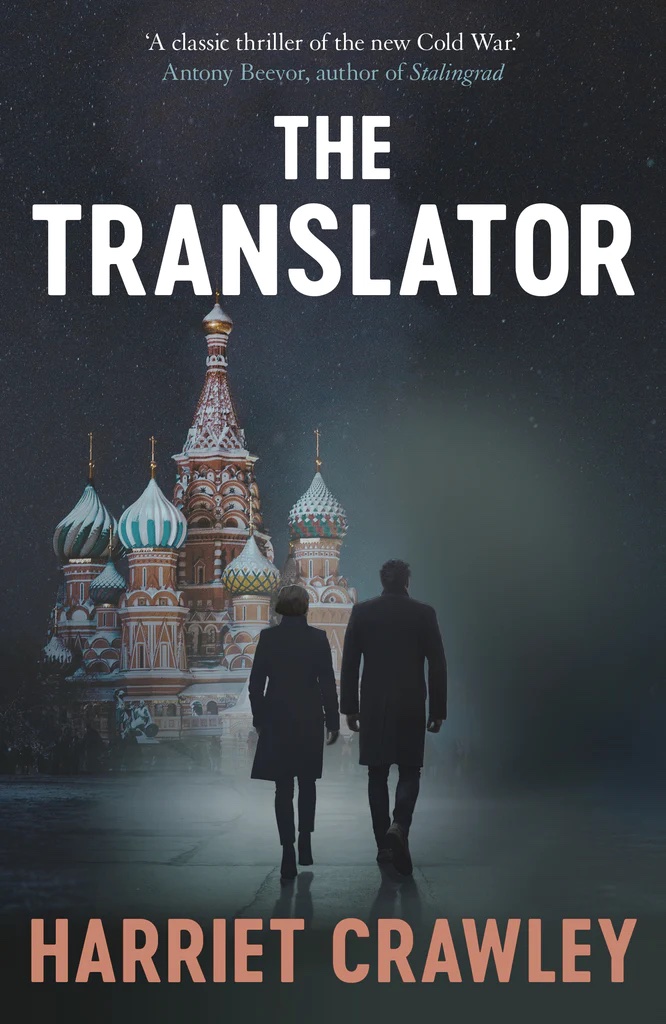
The Translator

This is the fantasy:

At a pinch he could do the same in French, but French specialists were two a penny, and, in any case, Russian was his thing. He loved the Cyrillic alphabet, the byzantine grammar, the soporific, sensuous sound of the Russian language. And once, he had loved a Russian woman.

[…]

“Let’s get some sleep,” said Hyde. “Tomorrow… sorry, make that today, you need to be on top form. The briefing book is right here.” Hyde tapped the file on the table. “Are you up to speed on the current jargon? Post-truth and alternative facts and all of that? What’s fake news in Russian?”

Feykoviye novosti,” Clive said without missing a beat. “But the purists are up in arms. Feykoviye is not a Russian word. It’s an anglicization. They think it should be lozhniye novosti. Lying news.”

[…]

Then he focused on the job in hand. The mental preparation was always the same, a limbering up of the mind, a rigorous testing of himself. He went through various linguistic exercises, tossing English words and phrases into the air like tennis balls, then hitting them across the net in Russian. It was natural, effortless; he felt completely at ease in either language.

[…]

“Clive was member of our Russian book club on the fourteenth floor of the UN,” Marina said, looking at Hyde.

“I was,” said Clive, looking straight at Marina and taking in every detail of a face he had done his best to forget for over a decade. He had also forgotten the particular musicality of her English, which gave her away as a foreigner. Now and then her “o” was slightly too long and her “r” was a little too hard, and sooner or later she would forget an article,* just as she had a moment ago. Her English was almost perfect. But not quite. It was all part of her infinite charm.

[…]

“Alexei had this thing about grammar. Said I had to speak clean Russian. Clean… That was his pet word. ‘Use the instrumental and not the fucking accusative.’”

[…]

After making love, they would lie in bed and smoke and talk about their favourite writers. They showed off to each other, Marina reciting Pushkin, Clive quoting Shakespeare, and then vice versa, switching effortlessly from English to Russian and back again. They chucked proverbs and abstruse words at each other until they dissolved in laughter.

Source: Harriet Crawley, The Translator (London: Bitter Lemon Press, 2023). Cover image courtesy of Bitter Lemon Press

* But check out the abuse and misuse of articles on display here, of all places:

HARRIET CRAWLEY, “THE TRANSLATOR”. IN CONVERSATION WITH SIR RODRIC BRAITHWAITE

  • Tuesday, 2 May 2023, 7:00 pm —8:30 pm
  • 5a Bloomsbury Square, London, WC1A 2TA, United Kingdom

Join us to hear Harriet Crawley discuss her latest novel, a love story and political thriller, with the former British ambassador to Russia, Sir Rodric Braithwaite. The Times has included The Translator in its list of “the best new thrillers”, and the reviews praise author’s descriptions of the everyday life in Moscow, her ability to create suspense, and the political relevance of the plot at the time when the Russian state has once again become a major geopolitical threat.

[…]

The Translator tells a story of two interpreters, one British and one Russian, who embark on a quest to protect vital communication infrastructure connecting the UK and the US from sabotage by Russian special operations forces.

Source: Pushkin House. The emphasis is mine. ||| TRR


While this is a bit closer to the often harsh reality:

Kill the Translator: A Song of Inadequacy


He’s the mad dog of letters, the scrivener of sin.

He stays up nights with dictionaries and gin.

He studies Icelandic with a six-fingered Finn.

            He’s the translator.


He trampled your iambs, desecrated your prose.

He mangled your message and stepped on your toes.

His syntax is suspect, his Swahili a pose.

            Maim the translator.


Your essay’s in tatters, your short story in ruins.

He rendered 'tomato' as 'the mating of loons'.

And tomorrow he’ll english your poem out of tune.

            Harm the translator.


It matters quite little whether he’s stout, thin, or black,

Venetian, Guatemalan, or from Hackensack:

Send him Derrida by mail, and an ounce of crack.

            Suicide the translator.


Stop the presses in Cape Town and summon the cops.

Make a pass at his mother, toss a spear at his pop.

And dare he protest, quote him Lacan till he drops.

            Crush the translator.


Rip his Oxford to shreds, set his grammars on fire.

Break all his pencils, call Nabokov a liar.

Instead of advances, blow him curses by wire.

            Unhinge the translator.


He’s a cheat and a fraud and the foe of good sense.

Promise him the heavens, but repay him in pence.

'Traduttore traditore,' they say, and hence:

            Kill the translator.

Source: The Russian Reader, St. Petersburg, October 1996. The poem was inspired by an incident (one of dozens) in my early career when I was paid a pittance to translate the catalogue for a show of contemporary Russian art in Finland. A few months later, I got a notice from the Finnish tax authority which made it plain that, officially at least, I had been paid several times that amount by the host museum, but the Russian curators had pocketed the difference, thinking I would be none the wiser.

If you don’t want this website and its free, unique, eye-opening content to be maimed, harmed, crushed, suicided, killed, or unhinged, show your support today by liking, commenting, sharing, or donating (via Stripe or PayPal — you’ll find the forms and links in the sidebar). It’s vital for me to know that there are actual people out there who value my unpaid labor of love, which is now in the midst of its sixteenth year. I’ve received only $137 in donations so far this year, alas. That’s not enough financial support for me for to keep doing this much longer, considering that last year, for example, my overhead costs alone were $1,620 (for internet, hosting, and online subscriptions), against only $1,403 in donations for the entire year. ||| TRR

Yevgeniy Fiks: Mother Tongue (London)


unnamedYevgeniy Fiks, Still from the video Thematic Language, 2018

MOTHER TONGUE by Yevgeniy Fiks

9 March—11 May 2019

Private view, 8 March 2019, 7:00–8:30 pm

Panel Discussion, 8 March 2019, 6:00–7:00 pm with Yevgeniy Fiks, Juliet Jacques, Sarah Wilson, and Dan Healey 

BOOK HERE

Pushkin House, 5A Bloomsbury Square, London, WC1A 2TA | Free Entry

Exhibition opening hours
Thursday, Friday, 11:00 am–5:00 pm
Saturday, 1:00 pm–6:00 pm

Press Release PDF

Grad and Pushkin House are proud to present Mother Tongue/Родная Речь, the first London solo exhibition by New York-based Russian artist Yevgeniy Fiks, exploring historical gay Russian argot or slang. This coded language dates back to Soviet times and can be compared to Britain’s polari, the jargon used in the past by gay and other subcultures.

Through this exhibition Fiks elevates this themed language into a poetic code, celebrating its wit and nuance. Mother Tongue/Родная Речь reclaims and celebrates Soviet-era Russian gay argot as a unique cultural phenomenon and gives a historical context to today’s post-Soviet LGBTQ community whose language partially evolved from it.

The exhibition takes the form of an installation, recreating the environment of a classroom, equipped with a blackboard, alphabet charts, texts books, and a language instructional video, designed as formal introduction to the vocabulary and usage of the argot.

Soviet era pleshki or cruising sites are presented in a series of photographs of Moscow, many of them famous tourist destinations, devoid of people and subverting standard perceptions of the city.

Fiks envisions the language of the pleshka as a complete and distinct language, separate from standard Russian. A semi-humorous instructional video gives a lesson in how to use and construct phrases from this themed language. Like polari, Soviet gay slang contributed to the sense of the separate identity of queer communities of the time, and allowed users to communicate openly about things that could have seen them excluded from mainstream society, or even imprisoned. Thus it was a defence mechanism that provided safety.

The exhibition is accompanied by the recently published Mother Tongue/Родная Речь, a book by Fiks, both about, and written in, Soviet-era Russian gay argot. In the book, this is conceptualised as a literary language fit for the production of high culture, including written literature. The book includes a linguistic introduction to Soviet-era Russian gay argot and a collection of conceptual poetry written by Fiks in that language.

Since the collapse of the Soviet Union and the beginning of the globalisation era in the 1990s, a cosmopolitan (mostly Anglo-American) gay slang has fused with Soviet-era gay speech, and many original Russian queer terms that were used before the 1990s have been replaced with Anglo-American borrowings, diluting the unique Soviet culture of sexual and gender dissent. After decades of persecution and attempts to eradicate sexual and gender non-conformity, male homosexuality was decriminalised in Russia in 1993. The period between 1993 and around 2013 was characterised by slow and difficult improvements to the conditions of gay life in Russian. This modest progress was interrupted, and is in the process of being reversed, with the introduction in 2013 of the so-called gay propaganda law, which ushered in a new wave of state and social homophobia. At the same time it led to LGBTQ issues in Russia becoming central to public debate in an unprecedented way.

Artist’s statement by Yevgeniy Fiks
I define my position, as a post-Soviet artist, as having the responsibility to raise a proper understanding and critical reflection of Soviet history in order for post-Soviet societies to move forward. My works are based on historical research, usually of forgotten and unresolved 20th century micro-historical narratives. Some of these topics include the shared histories of the Red and Lavender scares during the McCarthy era in the USA; communism in modern art; Soviet LGBT history, and the African, African American, and Jewish diasporas in the Soviet Union.

About the artist
Yevgeniy Fiks was born in Moscow in 1972, and has been living and working in New York since 1994. Fiks has produced many projects on the subject of the post-Soviet dialogue in the west, among them: Lenin for Your Library? in which he mailed Lenin’s Imperialism: The Highest Stage of Capitalism to one hundred global corporations as a donation to their corporate libraries; Communist Party USA, a series of portraits of current members of Communist Party USA, painted from life in the Party’s national headquarters in New York City; and Communist Guide to New York City, a series of photographs of buildings and public places in New York City that are connected to the history of the American Communist movement. Fiks’s work has been shown internationally, including exhibitions in the United States at Winkleman Gallery and Postmasters Gallery in New York, Mass MoCA, and the Philadelphia Museum of Art; Moscow Museum of Modern Art and Marat Guelman Gallery in Moscow; Sala de Arte Público Siqueiros in Mexico City; and Museu Colecção Berardo in Lisbon. His work has been featured at the 2008 Biennale of Sydney, the 2011 Moscow Biennale of Contemporary Art , and the 2015 Thessaloniki Biennale of Contemporary Art.

About Pushkin House
Pushkin House is an independent arts charity specialising in Russian culture. Our programme encourages open-minded, explorative discussion. It was founded in 1954 by two generations of émigré Russians, to create a welcoming meeting place for the enjoyment, understanding and promotion of Russian culture in all its forms, and for the exchange of views in a lively, informal atmosphere, with freedom of speech a core principle.

About Grad
Since opening its first base in 2013 at London’s Fitzrovia, Grad has operated as a Kunsthalle, a platform and forum for debate while researching, curating, commissioning, and producing over a hundred critically-acclaimed projects. Equally known for its historical shows and contemporary exhibitions exploring urgent social realities, Grad instigates intellectual inquiry and builds connections amongst artists, individuals, and communities from different continents and cultures. Grad challenges cultural bias and preconceptions, and champions an experimental, interdisciplinary approach with a focus on new media and technologies.

Press contacts
Ksenia Afonina, ksenia.afonina@grad-london.com, 020 7637 7274, info@grad-london.com