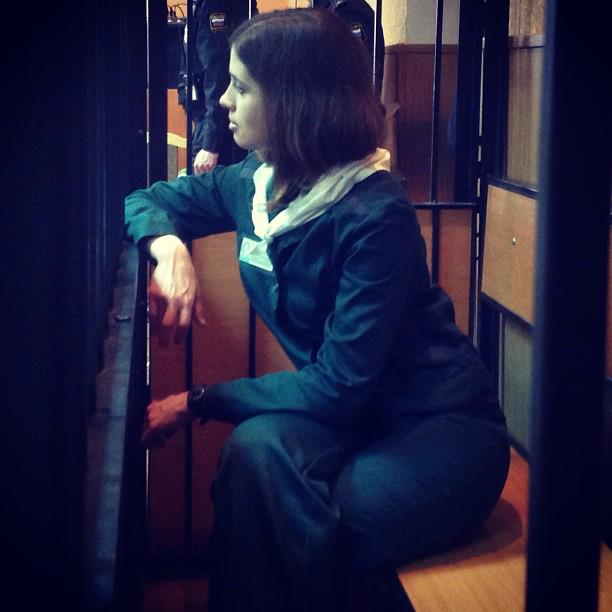
Tolokonnikova and Alyokhina on the Sentsov-Kolchenko Verdict

Masha Alyokhina
August 25, 2015
Facebook

“I don’t know what is worth doing if you cannot die for it,” said Sentsov.

“We are discussing narrow questions,” said the judge, interrupting him.

Our “twofer” was piddly shit compared with this. Just imagine being locked up in a prison colony not for two autumns, but twenty, and for just as many winters. Sentsov is a single father who has been sentenced to twenty years in a maximum security prison by Russia.

His sister says, “We fear Oleg will be forgotten.”

If convicts in Russia can be forgotten by those on the outside, inside they can be killed. I hate this system under which it is so easy to kill.

The anarchist Kolchenko was sentenced by Russia to ten years hard time.

We must not forget them. They laugh at the verdict of a country that took them hostage.

Ten and twenty years in prison.

Hang in there, please, we are with you.

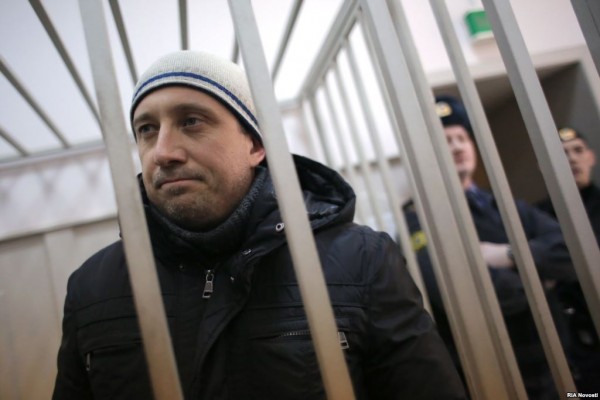
11889477_1182943075054229_5283665799208464809_nAlexander Kolchenko and Oleg Sentsov

__________

Nadya Tolokonnikova
August 25, 2015
Facebook

“Well, what did you need to go and do that for? You’re a young, pretty girl, and what have you got yourself into? When you get out, who’s going to remember you? Who’s going to want you, silly goose? Why are you so stuck on politics?”

Coppers and screws always talk this way, because they don’t understand how someone could not break down and admit their guilt. After all, if you confess, they promise to reduce your sentence.

Oleg, you will get out earlier, of course. And whatever they say to you in there, we will not forget you.

Translated by the Russian Reader. Photo courtesy of Masha Alyokhina

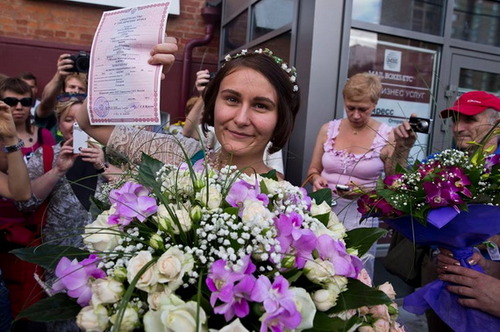
Anna Karpova: My Wedding Night

My Wedding Night
Anna Karpova
August 7, 2014
Snob.ru

tumblr_inline_n9y746ltjl1si8br2

“And now, the newlyweds can seal their union with a kiss.”

Lyosha and I had long ago stopped listening to the young woman from the registry office and were already sealing our union.

I reluctantly let go of Lyosha’s hands so he could hug my parents and his parents. Our mothers were hiding faces moist with tears behind bouquets.

“Let’s leave the young people alone for a few minutes.”

Everyone left, closing the transparent door of the room where prisoners meet with lawyers. The guard peeked shyly through the glass, and the smell of fresh bread wafted in from the corridor: there is bakery on the first floor of Butyrka prison.

“You’re so cool when I touch you, so . . . real.”

“I love you very much.”

“I love you more.”

We didn’t talk much. We cuddled each other and winced at every rustle, afraid the guard would come in to take my husband away.

I clung to Lyosha as if it would slow down time.

“What should I do tonight when I leave and you stay here? How should I finish this day?”

I had been tormented by this question since we had set the date for the wedding.

“Go out with someone, but if you’re tired, go home to the cat.”

“And what will you do?”

Lyosha laughed.

“You all ordered me a festive meal, so I’m going to eat.”

There was a guilty knock at the door. A prison officer informed us our time was running out.

“When we get out of prison—I mean, when I get out—I will hold you for days on end.”

I cried and buried my head in Lyosha’s shoulder. My husband had been calm all this time.

“My heart is going to leap from chest now,” he suddenly said.

We embraced our parents and the staff from the Public Oversight Commission who had come to the jail to congratulate us. Thanks to them we have photos of the wedding ceremony. Lyosha was being led away—without handcuffs, but under guard.

Now I was going to leave the place, but Lyosha was staying here. A chill emanated from the walls, and behind me countless doors slammed shut. The sound was like the sound of a guillotine’s blade falling.

Now I was going to get out of there and bawl. I would not go out with anyone. I would not go home to the cat. I would sit down on the steps of the remand prison. Better yet, I would lie down on the steps, and I would wallow there until they let Lyosha go. The leaves would fall from the trees, then it would snow, then it would melt, and the branches on the trees would bud, but I would still be lying there, because my life was over.

Everything turned out exactly the opposite. Rather than lying down and dying, I came to life. Despite the period of mourning I had declared, the people who came were so sincerely happy for me that I started to feel happy for myself. I went out, and then I went home to the cat, and I wasn’t left alone for a minute, because everyone knew and understood I was horrified by the fact I didn’t know to how end this day.

At home, the first thing I did was hug Jean-Paul, the huge teddy bear that Lyosha had given me for my twenty-third birthday. If you pinch his paw, he says clever things. On the day of my wedding, he said, “Love means conceding the person you love is right when he’s wrong.”

I had imagined my wedding night differently. Anya, one of my future bridesmaids at my future, real wedding on the outside, was falling asleep on a nearby couch.

“Hey, what do I do with my ‘wedding’ dress? I was wearing it when the guard led my husband away down the corridors of Butyrka prison.”

“Nothing terrible happened today. I haven’t seen you so happy in a long time. Put that dress on more often.”

blog_entry_621251

Anna Karpova married antifascist activist Alexei (“Lyosha”) Gaskarov on August 6 in the Butyrka remand prison in Moscow. Tomorrow, August 18, Gaskarov is scheduled to be sentenced with the second group of defendants in the Bolotnaya Square case. Read his closing statement at their trial here. Images courtesy of Snob.ru and Gaskarov.info.

UPDATE. On August 18, Alexei Gaskarov was sentenced to three and half years in prison.

Alexei Gaskarov: “If the Way to Freedom in This Country Runs through Prison, We Are Ready to Go”

The verdicts on the second group of defendants in the Bolotnaya Square case will be announced in Zamoskvoretsky Court in Moscow on August 18. The prosecutor asked the court to sentence Alexander Margolin and Alexei Gaskarov to four years in prison; Ilya Gushchin, to three years and three months in prison; and Elena Kokhtareva, to three years and three months suspended, with four years of probation. All four defendants have been accused under Article 212 Part 2 (involvement in rioting) and Article 318 Part 1 (use of non-threatening violence against a public official) of the Russian Federal Criminal Code.

On August 4, 28-year-old antifascist Alexei Gaskarov made his closing statement in court. This is the complete text of his speech.

gaskarov-Feldman-3-600x400Alexei Gaskarov

The so-called Bolotnaya Square case has been symbolic in the sense that through it the public sees how the authorities interact with the opposition, with those people whose viewpoint differs from the general line.

The first thing I wanted to talk about is something that was not addressed in the trial, but which I think is important: why on May 6, [2012,] despite everything, so many people decided to be involved in certain events, rather than simply stand another two or three hours in queues, and ultimately did not permit themselves to be beaten with impunity.

The May 6 demonstration was the seventh major event staged by the opposition [during the 2011–2012 fair elections protest movement]. Whereas earlier, before December 2011, a few thousand people attended protest rallies I had witnessed, when you-know-who said the idea of rotating governments was not the best thing for Russia, the core group of protesters increased significantly. And these people did not go organize riots, but went to observe elections in order to understand and record the way the political processes that occur in our country are legitimated.

kohtareva-11-600x400Elena Kohtareva

Everything fell into place on December 4[, 2011, when parliamentary elections were held in Russia]. Despite the fact that the institution of elections had been destroyed much earlier, the large group of people who went to the polls as observers saw how the legitimacy of the current government was shaped. I myself was an observer at those elections, and what we saw was quite straightforward. Indeed, it is a strange situation when you are trying to find at least one person among your acquaintances who would say they voted for United Russia. In fact, such people did not exist: there was no mass support for the government. When they tried to counter the Bolotnaya Square protests with an event on Poklonnaya Hill in support of the current government, they could not gather more than a thousand people.

This subject itself was extremely important, but unfortunately it was not sufficiently popular with the authorities. Fair elections are still the only legal way of changing the political system, and once it has been changed, you can solve social and economic problems. A huge number of people took to the streets. There was almost no reaction on the part of the authorities. The protests were peaceful, the protesters were numerous, and it was obvious the demands they made and the problems they talked about were real, but instead we saw only a reluctance to engage in dialogue and, at some point, flagrant mockery.

A lot of people now do not like what thuggish characters in Ukraine are calling people from Southeast Ukraine. But here in Russia the same thing happened: when people came out on Bolotnaya Square, the country’s president called them Bandar-log and made many other unflattering comparisons. We were told we amounted to only one percent, that only one hundred thousand people in a city of ten million came out to protest, that it meant nothing at all. But later, when they actually allowed a fair poll, as happened during the [September 2013] mayoral election in Moscow, it turned out it was not one percent, but forty percent, a significant segment of society. And I would like to say that we should be glad on the whole that the events on Bolotnaya Square happened as they did.

In all developed democratic countries, protest rallies, the opportunity to express points of view that differ from that of the authorities, generate political competition, which enables countries to find the best way of developing. By the way, certain problems in the Russian economy began precisely in the third quarter of 2012, because it is impossible to build a stable economic and social system when you completely demotivate and exclude such an essential part of society. And it was obvious that this part of society was essential.

The first signal that comes from our case: does the right to protest, which exists in all developed countries, exist at all in Russia? As we see now, Russia has been deprived of this right.

And the second signal, which it is impossible to ignore: has the rule of law survived in Russia? Individuals must be protected from the actions of the authorities not only by a system of checks and balances but also by the possibility of appealing directly to the law in the way in which it is worded. I think this can be seen in our case. There is Article 212 of the Criminal Code: it may be poorly worded, but it is worded the way it is. And it is wrong, I think, to raise such obvious questions at the trial stage, because the law is worded quite clearly. We read a lot of commentaries to the Criminal Code and nowhere did we find that the corpus delicti of “rioting” could be defined alternatively, based on the evidence listed in the charges. Nevertheless, this has been consistently ignored. Even in those decisions entered into the case file, this subject was roundly rejected.

In and of itself, the rule of law is the most important of the institutions that protect the rights of individuals from the state. And, of course, we cannot ignore the selective application of the law to citizens. I realize that Russian law is not based on precedent, but it is impossible not to notice that if, for example, you are a nationalist, block roads, and set fire to shops, but refrain from speaking out against the actions of the authorities, you are only guilty of disorderly conduct. If you go to protest rallies where people shout, “Putin is a thief!” you are, accordingly, liable to serious criminal charges.

guschin-Feldman-3-600x400Ilya Gushchin

There is one last point following from our case to which I would also like to draw attention. I think a signal is being sent: if you are loyal to the authorities, you will enjoy the most favorable conditions; if you are disloyal, you will go to jail. This concerns the evaluation of the actions of demonstrators and the actions of police. It is too obvious that not all the police behaved as they should have behaved. I understand this was not specifically the matter in dispute in our case, but not a single criminal case has been opened against the police. Practically speaking, they have tried to turn the police into a caste of untouchables as part of our case. When there was a public debate on the Bolotnaya Square case, the same phrase always came up: “You cannot hit police.” Even in our group of thirty people charged in the Bolotnaya Square case, only three people actually struck police officers. And yet the whole complexity of this situation was primitivized through a single phrase: “You cannot hit police.”

margolin-svoboda.org-3-600x400Alexander Margolin

But it seems to me this way of posing the question dismisses and completely destroys any criticism of the government. We cannot forget that many terrible things have happened in our country (for example, during the Great Terror [under Stalin in 1937-38]), that people in uniform committed all these crimes, and everything they did was legal for all intents and purposes. But now they tell us there should be no critical rethinking of this situation, that it is necessary to stupidly obey the thesis that was endlessly repeated during discussion of our case.

The main thing I would like say, your honor, is that I really would not want it to happen that, after our trial, speaking of the law as an expression of the principle of justice became a sign of bad taste. I would hope that our trial did not pursue any other political objectives that have been imposed on it, that have been set for it—and all that is in the case files—but that we be judged for the things we really did. But if, in this country, the way to freedom runs through prison, we are ready to go. That is all.

Originally published, in Russian, at Grani.ruPhotos courtesy of Bolotnoedelo.info.

Afterword (copied from People and Nature‘s first publication of this translation)

On July 24, two other defendants in the Bolotnaya Square case, the left-wing activists Sergei Udaltsov and Leonid Razvozzhayev, were each sentenced to four and a half years in prison on charges arising from the May 6 demonstration. Supporters of Alexei Gaskarov and the other three defendants being sentenced this month fear similarly harsh penalties on August 18.

Solidarity makes a difference in such cases. While the Russian government claims to be championing “antifascism” in Ukraine, it is sending antifascists and other oppositionists in Russia to jail for long periods. The more support for these activists from antifascists internationally, the better.

Please copy and republish this article; demonstrate or protest however you can; write to the Russian embassy; and look on the Free Alexei Gaskarov site and the May 6 Committee site.

Update. On August 18, Alexei Gaskarov and Alexander Margolin were sentenced to three and half years in prison; Ilya Gushchin, to two and a half years; and Elena Kokhtareva, to a suspended sentence of three years and three months including three years’ probation.

Show Your Solidarity with Russian Political Prisoners: Russian Embassy, London, February 23, 2 p.m.

URGENT CALL FOR SOLIDARITY!!!

Stop the Show Trials! Free Political Prisoners in Russia!

While the Russian government celebrates the closing of the Olympics in Sochi, in Moscow, eight arrested activists are found guilty after two years of show trials. Pressure from the international community has already helped to amnesty several people. Let’s show our solidarity with political prisoners! Let’s stop the show trials and persecution of activism in Russia!

We will meet near the Russian Embassy on the day of the Olympics closing ceremony, 23 February, Sunday, 2 PM. Come and join us!

Background:

Following mass demonstrations in 2011-12, Russian police arrested dozens of activists – socialists, anarchists, human rights campaigners, ecologists, as well as ordinary citizens who oppose the Putin regime. This is exemplary punishment aimed against a wave of social movements that has been energising a new generation of post-Soviet activists. The demonstration on 6 May 2012 was a legally sanctioned rally that took place on Bolotnaya Square in Moscow. However, it ended with brutal police violence and mass arrests. Of thousands who protested against mass election forgeries, hundreds were kettled by police. More than a dozen of them have been kept in pre-trial detention for over a year.

More info here:

http://6may.org/en/

http://www.theguardian.com/world/2014/feb/21/anti-kremlin-putin-protesters-guilty-verdict-court

http://en.wikipedia.org/wiki/Bolotnaya_Square_case

Address: 6/7 Kensington Palace Gardens, W8 4QP
Picket will take place on the BAYSWATER ROAD (Google Map often gives a view on the park)

“Decent People Rub Prince Lemon the Wrong Way”: Sasha Dukhanina’s Closing Statement at the Bolotnaya Square Trial

Alexandra Naumova (née Dukhanina, usually referred to as Sasha Dukhanina), born 1993, was the first person to be arrested in the Bolotnaya Square case, launched by the Russian authorities after a sanctioned opposition march in downtown Moscow on May 6, 2012, the day before President Putin’s re-inauguration, ended in clashes with police. Dukhanina-Naumova was detained at the Occupy Arbat protest camp in Moscow in late May 2012 and has been under house arrest since that time.

Dukhanina-Naumova and her co-defendants Sergei Krivov, Alexei Polikhovich, Artyom Savyolov, Denis Lutskevich, Andrei Barabanov, Stepan Zimin and Yaroslav Belousov are charged with involvement in mass riots and assaulting police officers. At the January 22, 2014, hearing in the case, prosecutors asked the presiding judge, Natalya Nikishina, to sentence each of them to between five and six years in prison.

Dukhanina-Naumova is specifically accused of throwing chunks of asphalt, one of which, allegedly, struck a police officer, slightly bruising him, and splashing a soft drink (kvass) from a liter-size bottle.

A photograph of a riot cop dragging Dukhanina-Naumova away by the neck on May 6, 2012, taken by famed opposition blogger and photographer Rustem Adagamov (aka Drugoi), himself now in exile, has become, perhaps, the most famous image of the “riots” that took place in Moscow that day. Many opposition activists and independent observers have claimed that what happened was in fact a provocation on the part of the authorities aimed at demoralizing the opposition and selectively punishing those who had tried to spoil Putin’s repeat “coronation” by publicly protesting.

adagamov-dukhanina drag

Before her arrest, Dukhanina-Naumova was a student at Moscow State University, where she majored in translation and interpretation. An anarchist, she had been involved in such causes as the defense of the Tsagovsky Forest, near Moscow, and Food Not Bombs.

On December 19, 2013, four other defendants in the case, Maria Baronova, Vladimir Akimenkov, Nikolai Kavkazsky and Leonid Kovyazin, were released under an “amnesty” that has been regarded by many as a gesture meant to defuse domestic and foreign criticism of the Putin regime’s concerted attacks on human and civil rights, NGOs, gays and lesbians, migrant workers, and opposition activists.

In any case, this amnesty did not fool the several thousand people who marched in Moscow on February 2, 2014, demanding the release of Dukhanina-Naumova and the other Bolotnaya Square defendants.


Dukhanina-Naumova made the closing statement, below, during the final hearing in the trial, on February 5, 2014, in Moscow.

After Dukhanina-Naumova and her co-defendants had finished making their closing statements, Judge Nikishina announced she would read out the verdict in the trial on February 21, 2014. This is two days before the end of the Sochi Olympics, President Putin’s wildly expensive showcase of his personal triumph over man, nature, and budgetary common sense.

__________

Closing Statement by Alexandra Dukhanina-Naumova at the Bolotnaya Square Trial, Zamoskovoretsky District Court, Moscow, February 5, 2014

At first I thought that this whole trial was a crazy mistake, the result of some mix-up. Now, after hearing the prosecutor’s speeches, and considering the length of the prison terms they are asking for us [Bolotnaya Square defendants], I’m starting to see that what the authorities want is revenge. They want revenge because we were there and saw how things really were. We witnessed who instigated the stampede, how people were beaten, and the unjustified violence. They are getting revenge on us for not bowing down to them and repenting for our nonexistent crimes, neither during interrogations nor here, in the courtroom. They are also avenging me for not helping them further their lies, for refusing to answer their questions.

73502

These are serious crimes that carry a penalty of six years in a penal colony. There is no one else who has earned such a severe punishment, just us. They’re afraid of the real criminals—they imprison the strangers who get in their way while they wouldn’t lift a finger against their own. It is up to you, Your Honor, to decide whether to pay for furthering their happiness—promotions, stars, and medals—with our lives.

Why six years? What are these “no fewer than eight targeted throws” I supposedly dealt? Where did they come from? Whom was I aiming at and whom did I hit? Eight different police officers? Or did I hit the two men they’ve painted as the victims eight times? If so, how many times did I hit each of them? Where are the answers to these questions? Isn’t it up to them to describe the attack in detail and prove their case before putting me in prison? After all, this isn’t fun and games; it’s six years of my life at stake. Otherwise, it isn’t even lies, but mendacious demagoguery unsupported by facts, a game played with a human life in the balance. And if they had 188 videos and not eight, would they allege that there were 188 throws?

You’ve seen the two riot police officers who were my so-called victims. Each one of them is two or three times my size, and on top of that, they were in body armor. One of them felt nothing, and the second one was not injured by me at all and has no grievances. Is this the “rioting” and “violence” that have earned me six years of incarceration?

I almost forgot about the kvass. The bottle alone gets me five years, and the eight targeted blows get me the last one. At least let them say so, that way at least I’ll know the price of kvass. They should also tell me where my “mass rioting” ends and my “violence toward the authorities” begins. What’s the difference between the two? I still haven’t understood the charges against me: what did I burn? What pogroms? What destruction of public property? What does any of this have to do with me? What did I blow up? What did I set on fire? What did I destroy? Whom did I conspire with? What’s the evidence? Am I getting four years in accordance with Article 212 just for being there? Is my mere presence at what began as a peaceful demonstration the “rioting” that I was involved in? All I did was show up.

Take a look at these people. They’re not murderers, thieves or con artists. Putting us all in prison is not only unjust, it’s criminal.

Many people have given me the opportunity to repent, apologize, say what the investigators want me to say, but you know, I don’t find it necessary to repent, let alone apologize, to these people. In our country, it’s widely accepted that they are absolutely untouchable despite the well-known cases of their involvement in drug trafficking, prostitution, and rape. Just a few days ago, that happened in the Lipetsk Region.

The narrative of the charges pinned on us isn’t just funny; it is absurd and based solely on the testimony of the riot police officers. What does this mean, that if a person has epaulettes they’re a priori honest and holy?

Your Honor, in the course of the past eight months of this trial, you’ve received such substantial evidence of our innocence that if you send us all to the camps, you will be ruining our lives and futures for nothing.

Is the government really so determined to make an example of us that it is willing to take this step? Letting a pencil pusher, rapist or policeman off for [inaudible] is a matter of course: they’re untouchable, one of your own. We, on the other hand, can handle a prison term. Who are we, after all, we’re not even rich? For some reason, I am convinced that even in prison I will still be more free than any of them because my conscience will be clear, while those who remain on the outside continuing their so-called protection of law, order, and freedom will live in an unbreakable cage with their accomplices.

I can admit to making a mistake. If I were truthfully presented with facts and it were demonstrated to me that I had done something illegal, I would confess to it. However, no one has done any such thing: all I’ve witnessed are lies and brute force. You can suffocate someone with force, drag them [inaudible] and all of this has already been done to me. But lies and violence can’t prove anything. Thus, no one has proven my guilt. I am sure that I am right and that I am innocent.

I’d like to close with a quotation from Gianni Rodari’s Cipollino:

 “My poor father! They’ve thrown you in the pen with thieves and bandits.”

“Hey now, son,” his father tenderly interrupted him. “Prison is chock full of honest people!”

“Why are they in prison? What have they done wrong?”

“Absolutely nothing, son. That’s why they’re in here. Decent people rub Prince Lemon the wrong way.”

“So getting in prison is a great honor?” he asked.

“That’s how it seems. Prisons are built for people who steal and kill, but in Prince Lemon’s kingdom, it’s all topsy-turvy. The thieves and murderers are in his palace, while honest citizens fill the prisons.”

Translated by Bela Shayevich. Originally published, in Russian, on Grani.RuPhotograph of Alexandra Dukhanina-Naumova courtesy of Dmitry Bortko

Nadezhda Tolokonnikova: Day Two of the Hunger Strike

PC-14, Day Two of the Hunger Strike

Thank you to everyone who did not remain indifferent to the slave-like living and working conditions in this penal colony and who spoke out in support of me and my demands.

Yesterday, at 9:30 in the evening, I was transferred to a solitary confinement cell, which PC-14’s warden, Colonel Kulagin, calls a “safe place.” I opposed the transfer because I do not consider my being put in a “safe place” an adequate solution to the problem. My relations with my fellow inmates are fine when the administration isn’t attempting to artificially turn them against me. Problems arise for me when the administration uses certain inmates to intimidate me and try and force me to keep my mouth shut, for instance, by threatening to “fuck [me] up and kill [me].”

The greatest threat to my welfare comes from the prison administration. Especially now, when I am breaking through the informational blockade, writing about the illegal conditions in the prison that no other PC-14 inmate has dared to speak openly about for fear of finding herself under incredible duress for the remainder of her time in prison.

In solitary confinement, I am alone against the administration. To me, this does not seem like a safe place.

It is incredibly cold in solitary confinement. It’s an old method, well known to camp administrations since Soviet times. They make the solitary confinement cells so cold that punishment turns into torture. The only difference between myself and someone who is forced into solitary as punishment is that I do not have to wear a special orange uniform. I can keep my regular prison clothes. But even five layers of sweaters do not protect me from the piercing cold.

I am writing on a cold, narrow bench. I am not allowed to sit on the bed, and especially forbidden from lying on it. It is very hard to sit in the cold all day while on hunger strike. My body temperature is low and I’m dizzy. The light is cold and dim, and the water in the faucet is cold, too. This is what solitary confinement is like.

I believe that in order to avoid further persecution from the PC-14 administration, I need to be transferred to another prison colony. It’s clear to me that the camp administration here will spend the remaining five months of my incarceration taking revenge on me for creating problems for them.

Nadezhda Tolokonnikova
Solitary Confinement Cell, PC-14
September 24

Translated by Bela Shayevich

Nadezhda Tolokonnikova: Why I Am Going on Hunger Strike

On Monday, September 23, I am declaring a hunger strike. This is an extreme method, but I am absolutely convinced it is my only recourse in the current situation.

The prison wardens refuse to hear me. But I will not back down from my demands. I will not remain silent, watching in resignation as my fellow prisoners collapse under slave-like conditions. I demand that human rights be observed at the prison. I demand that the law be obeyed in this Mordovian camp. I demand we be treated like human beings, not slaves.

It has been a year since I arrived at Penal Colony No. 14 [henceforth, PC-14 — Trans.] in the Mordovian village of Partsa. As the women convicts say, “Those who haven’t done time in Mordovia haven’t done time at all.” I had heard about the Mordovian prison camps while I was still being held at Pre-Trial Detention Center No. 6 in Moscow. They have the harshest conditions, the longest workdays, and the most flagrant lawlessness. Prisoners see their fellows off to Mordovia as if they were headed to the scaffold. Until the last, they keep hoping: “Maybe they won’t send you to Mordovia after all? Maybe the danger will pass you by?” It didn’t pass me by, and in the autumn of 2012, I arrived in the prison country on the banks of the Partsa River.

My first impression of Mordovia was the words uttered by the prison’s deputy warden, Lieutenant Colonel Kupriyanov, who actually runs PC-14. “You should know that when it comes to politics, I am a Stalinist.” Colonel Kulagin, the other warden (the prison is administered in tandem) called me in for a chat my first day here in order to force me to confess my guilt. “A misfortune has befallen you. Isn’t that right? You’ve been sentenced to two years in prison. People usually change their views when bad things happen to them. If you want to be paroled as soon as possible, you have to confess your guilt. If you don’t, you won’t get parole.” I told him right away I would work only the eight hours a day stipulated by the Labor Code. “The code is the code. What really matters is making your quota. If you don’t, you work overtime. And we’ve broken stronger wills than yours here!” Colonel Kulagin replied.

My whole shift works sixteen to seventeen hours a day in the sewing workshop, from seven-thirty in the morning to twelve-thirty at night. At best, we get four hours of sleep a night. We have a day off once every month and a half. We work almost every Sunday. Prisoners “voluntarily” apply to work on weekends. In fact, there is nothing “voluntary” about it. These applications are written involuntarily on the orders of the wardens and under pressure from the inmates who help enforce their will.

No one dares disobey (that is, not apply to go to the manufacturing zone on Sunday, meaning going to work until one in the morning). Once, a fifty-year-old woman asked to go back to the dorm zone at eight p.m. instead of twelve-thirty p.m. so she could go to bed at ten p.m. and get eight hours of sleep just once that week. She was not feeling well; she had high blood pressure. In response, a dorm unit meeting was called, where the woman was scolded, humiliated, insulted, and branded a parasite. “What, do you think you’re the only one who wants more sleep? You need to work harder, you’re strong as a horse!” When someone from the shift doesn’t come to work on doctor’s orders, they’re bullied as well. “I sewed when I had a fever of forty Centigrade, and it was fine. Who did you think was going to pick up the slack for you?”

I was welcomed to my dorm unit by a convict finishing up a nine-year sentence. “The pigs are scared to put the squeeze on you themselves. They want to have the inmates do it.” Conditions at the prison really are organized in such a way that the inmates in charge of the work shifts and dorm units are the ones tasked by the wardens with crushing the will of inmates, terrorizing them, and turning them into speechless slaves.

There is a widely implemented system of unofficial punishments for maintaining discipline and obedience. Prisoners are forced to “stay in the local until lights out,” meaning they are forbidden to go into the barracks, whether it is fall or winter. [The “local” is a fenced-off passageway between two areas in the camp — Trans.] In the second unit, where the disabled and elderly live, there was a woman who ended up getting such bad frostbite after a day in the local that her fingers and one of her feet had to be amputated. The wardens can also “shut down sanitation” (forbid prisoners to wash up or go to the toilet) and “shut down the commissary and the tearoom” (forbid prisoners to eat their own food and drink beverages). It’s both funny and frightening when a forty-year-old woman tells you, “So we’re being punished today! I wonder whether we’ll be punished tomorrow, too.” She can’t leave the sewing workshop to pee or take a piece of candy from her purse. It’s forbidden.

Dreaming only of sleep and a sip of tea, the exhausted, harassed and dirty convict becomes obedient putty in the hands of the administration, which sees us solely as a free work force. So, in June 2013, my monthly wages came to twenty-nine rubles [approx. sixty-seven euro cents]twenty-nine rubles! Our shift sews one hundred and fifty police uniforms per day. Where does the money made from them go?

The prison has been allocated funding to buy completely new equipment a number of times. However, the administration has only had the sewing machines repainted, with the convicts doing the work. We sew on obsolete and worn-out machines. According to the Labor Code, when equipment does not comply with current industry standards, production quotas must be lowered vis-à-vis standard industry norms. But the quotas only increase, abruptly and suddenly. “If you let them see you can deliver one hundred uniforms, they’ll raise the minimum to one hundred and twenty!” say veteran machine operators. And you cannot fail to deliver, either, or else the whole unit will be punished, the entire shift. Punished, for instance, by everyone being forced to stand on the parade ground for hours. Without the right to go to the toilet. Without the right to take a sip of water.

Two weeks ago, the production quotas for all prison work shifts were arbitrarily increased by fifty units. If previously the minimum was one hundred uniforms a day, now it is one hundred and fifty. According to the Labor Code, workers must be notified of a change in the production quota no less than two months before it is goes into effect. At PC-14, we just woke up one day to find we had a new quota because the idea happened to have popped into the heads of the wardens of our “sweatshop” (that’s what the prisoners call the penal colony). The number of people in the work shift decreases (they are released or transferred), but the quota grows. As a result, those who remain have to work harder and harder. The mechanics say they don’t have the parts to repair the machinery and will not be getting them. “There are no spare parts! When will they come? What, you don’t live in Russia? How can you ask such questions?” During my first few months in the manufacturing zone, I nearly mastered the profession of mechanic, out of necessity and on my own. I would attack my machine, screwdriver in hand, desperate to fix it. Your hands are scratched and poked by needles, your blood is all over the table, but you keep on sewing. You are part of an assembly line, and you have to do your job alongside the experienced seamstresses. Meanwhile, the damned machine keeps breaking down. Because you’re the newcomer and there is a lack of good equipment in the prison, you end up with the worst equipment, the most worthless machine on the line. And now it’s broken down again, and once again you run off looking for the mechanic, who is impossible to find. You are yelled at and berated for slowing down production. There are no sewing classes at the prison, either. Newcomers are immediately plunked down in front of their machines and given their assignments.

“If you weren’t Tolokonnikova, you would have had the shit kicked out of you a long time ago,” say fellow prisoners with close ties to the wardens. It’s true: other prisoners are beaten up. For not being able to keep up. They hit them in the kidneys, in the face. Convicts themselves deliver these beatings and not a single one of them happens without the approval and knowledge of the wardens. A year ago, before I came here, a Gypsy woman was beaten to death in the third unit. (The third unit is the “pressure cooker”: prisoners whom the wardens want subjected to daily beatings are sent there.) She died in the infirmary at PC-14. The administration was able to cover up the fact she had been beaten to death: a stroke was listed as the official cause of death. In another block, new seamstresses who couldn’t keep up were undressed and forced to sew naked. No one dares complain to the wardens, because all they will do is smile and send the prisoner back to the dorm unit, where the “snitch” will be beaten on the orders of those same wardens. For the prison warden, managed hazing is a convenient method for forcing convicts to totally obey their lawless regime.

A threatening, anxious atmosphere pervades the manufacturing zone. Eternally sleep-deprived, overwhelmed by the endless race to fulfill inhumanly large quotas, the convicts are always on the verge of breaking down, screaming at each other, fighting over the smallest things. Just recently, a young woman got stabbed in the head with a pair of scissors because she didn’t turn in a pair of pants on time. Another tried to cut her own stomach open with a hacksaw. She was stopped from finishing the job.

Those who found themselves at PC-14 in 2010, the year of smoke and wildfires [throughout Russia — Trans.] said that when the fire would approach the prison walls, convicts continued to go to the manufacturing zone and fulfill their quotas. Because of the smoke you couldn’t see a person standing two meters in front of you, but, covering their faces in wet kerchiefs, they all went to work anyway. Because of the emergency conditions, prisoners weren’t taken to the cafeteria for meals. Several women told me they were so horribly hungry they started keep diaries to document the horror of what was happening to them. When the fires were finally put out, prison security diligently rooted out these diaries during searches so that nothing would be leaked to the outside world.

Sanitary conditions at the prison are calculated to make the prisoner feel like a disempowered, filthy animal. Although there are hygiene rooms in the dorm units, a “general hygiene room” has been set up for corrective and punitive purposes. This room can accommodate five people, but all eight hundred prisoners are sent there to wash up. We must not wash ourselves in the hygiene rooms in our barracks: that would be too easy. There is always a stampede in the “general hygiene room” as women with little tubs try and wash their “breadwinners” (as they are called in Mordovia) as fast as they can, clambering on top of each other. We are allowed to wash our hair once a week. However, even this bathing day gets cancelled. A pump will break or the plumbing will be stopped up. At times, my dorm unit has been unable to bathe for two or three weeks.

When the pipes are clogged, urine gushes out of the hygiene rooms and clumps of feces go flying. We’ve learned to unclog the pipes ourselves, but it doesn’t last long: they soon get stopped up again. The prison does not have a plumber’s snake for cleaning out the pipes. We get to do laundry once a week. The laundry is a small room with three faucets from which a thin trickle of cold water flows.

Convicts are always given stale bread, generously watered-down milk, exceptionally rancid millet and only rotten potatoes for the same corrective ends, apparently. This summer, sacks of slimy, black potato bulbs were bought to the prison in bulk. And they were fed to us.

One could endlessly discuss workplace and living conditions violations at PC-14. However, my main grievance has to do with something else. It is that the prison administration prevents in the harshest possible way all complaints and petitions regarding conditions at PC-14 from leaving the prison. The wardens force people to remain silent, stooping to the lowest and cruelest methods to this end. All the other problems stem from this one: the increased work quotas, the sixteen-hour workday, and so on. The wardens feel they have impunity, and they boldly crack down on prisoners more and more. I couldn’t understand why everyone kept silent until I found myself facing the mountain of obstacles that crashes down on the convict who decides to speak out. Complaints simply do not leave the prison. The only chance is to complain through a lawyer or relatives. The administration, petty and vengeful, will meanwhile all the means at its disposal for pressuring the convict so she will see that her complaints will not make anything better for anyone, but will only make things worse. Collective punishment is employed: you complain about the lack of hot water, and they turn it off altogether.

In May 2013, my lawyer Dmitry Dinze filed a complaint about the conditions at PC-14 with the prosecutor’s office. The prison’s deputy warden, Lieutenant Colonel Kupriyanov, instantly made conditions at the camp unbearable. There was search after search, a flood of disciplinary reports on all my acquaintances, the seizure of warm clothes, and threats of seizure of warm footwear. At work, they get revenge with complicated sewing assignments, increased quotas, and fabricated defects. The forewoman of the neighboring unit, Lieutenant Colonel Kupriyanov’s right hand, openly incited prisoners to sabotage the items I was responsible for in the manufacturing zone so there would be an excuse to send me to solitary confinement for damaging “public property.” She also ordered the convicts in her unit to provoke a fight with me.

It is possible to tolerate anything as long as it affects you alone. But the method of collective correction at the prison is something else. It means that your unit, or even the entire prison, has to endure your punishment along with you. The most vile thing of all is that this includes people you’ve come to care about. One of my friends was denied parole, which she had been working towards for seven years by diligently overfulfilling quotas in the manufacturing zone. She was reprimanded for drinking tea with me. Lieutenant Colonel Kupriyanov transferred her to another unit the same day. Another close acquaintance of mine, a very cultured woman, was thrown into the pressure-cooker unit for daily beatings because she had read and discussed with me a Justice Department document entitled “Internal Regulations at Correctional Facilities.” Disciplinary reports were filed on everyone who talked to me. It hurt me that people I cared about were forced to suffer. Laughing, Lieutenant Colonel Kupriyanov said to me then, “You probably don’t have any friends left!” He explained it was all happening because of Dinze’s complaints.

Now I see I should have gone on hunger strike back in May, when I first found myself in this situation. However, seeing the tremendous pressure put on other convicts, I stopped the process of filing complaints against the prison.

Three weeks ago, on August 30, I asked Lieutenant Colonel Kupriyanov to grant the prisoners in my work shift eight hours of sleep. The idea was to decrease the workday from sixteen to twelve hours. “Fine, starting Monday, the shift can even work eight hours,” he replied. I knew this was another trap because it is physically impossible to make our increased quota in eight hours. So the work shift would lag behind and face punishment. “If they find out you were the one behind this,” the lieutenant colonel continued, “you definitely will never have it bad again, because there is no such thing as bad in the afterlife.” Kupriyanov paused. “And finally, never make requests for everyone. Make requests only for yourself. I’ve been working in the prison camps for many years, and whenever someone has come to me to request something for other people, they have always gone straight from my office to solitary confinement. You’re the first person this won’t happen to.”

Over the following weeks, life in my dorm unit and work shift was made intolerable. Convicts close to the wardens incited the unit to violence. “You’ve been punished by having tea and food, bathroom breaks, and smoking banned for a week. And now you’re always going to be punished unless you start treating the newcomers, especially Tolokonnikova, differently. Treat them like the old-timers used to treat you back in the day. Did they beat you up? Of course they did. Did they rip your mouths? They did. Fuck them up. You won’t be punished for it.”

I was repeatedly provoked to get involved in conflicts and fights, but what is the point of fighting with people who have no will of their own, who are only acting at the behest of the wardens?

The Mordovian convicts are afraid of their own shadows. They are completely intimidated. If only the other day they were well disposed toward me and begging me to do something about the sixteen-hour workday, they are afraid even to speak to me after the administration has come down hard on me.

I made the wardens a proposal for resolving the conflict. I asked that they release me from the pressure artificially manufactured by them and enacted by the prisoners they control, and that they abolish slave labor at the prison by reducing the length of the workday and decreasing the quotas to bring them into compliance with the law. But in response the pressure has only intensified. Therefore, as of September 23, I declare a hunger strike and refuse to be involved in the slave labor at the prison until the administration complies with the law and treats women convicts not like cattle banished from the legal realm for the needs of the garment industry, but like human beings.

This is an extensive revision of the translation, by Bela Shayevich, originally published here.

The original Russian of Ms. Tolokonnikova’s letter can be read here, among other places.

The Argument Nadezhda Tolokonnikova Wasn’t Allowed to Make at Her Parole Hearing

tolokonnikova-udo3

Yesterday, April 26, 2013, a district court in Zubova Polyana, Mordovia, denied imprisoned Pussy Riot activist Nadezhda Tolokonnikova’s request for parole. According to Radio Free Europe/Radio Liberty, Judge Lidiya Yakovleva agreed with arguments made by prison authorities that it would be “premature” to release Tolokonnikova given that she “had been cited for prison rules violations and expressed no remorse,” and had not participated in such prison activities as the “Miss Charm Prison Camp 14 beauty contest.” Judge Yakovleva made her ruling without allowing the defense to make a closing argument, thus allegedly violating the Criminal Procedure Code. Tolokonnikova had written her statement out in advance. The translation below is of the Russian original as published in full on the web site of RFE/RL’s Russian Service (Radio Svoboda). Photos courtesy of the Free Pussy Riot Facebook page.

_____

“Has the convict started down the road to rehabilitation?” This is the question asked when a request for parole is reviewed. I would also like us to ask the following question today: What is  this “road to rehabilitation”?

I am absolutely convinced that the only correct road is one on which a person is honest with others and with herself. I have stayed on this road and will not stray from it wherever life takes me. I insisted on this road while I was still on the outside, and I didn’t retreat from it in the Moscow pretrial detention facility. Nothing, not even the camps of Mordovia, where the Soviet-era authorities liked to send political prisoners, can teach me to betray the principle of honesty.

So I have not admitted and will not admit the guilt imputed to me by the Khamovniki district court’s verdict, which was illegal and rendered with an indecent number of procedural violations. At the moment, I am in the process of appealing this verdict in the higher courts. By coercing me into admitting guilt for the sake of parole, the correctional system is pushing me to incriminate myself, and, therefore, to lie. Is the ability to lie a sign that a person has started down the road to rehabilitation?

It states in my sentence that I am a feminist and, therefore, must feel hatred towards religion. Yes, after a year and two months in prison, I am still a feminist, and I am still opposed to the people in charge of the state, but then as now there is no hatred in me. The dozens of women prisoners with whom I attend the Orthodox church at Penal Colony No. 14 cannot see this hatred, either.

What else do I do in the colony? I work: soon after I arrived at Penal Colony No. 14, they put me behind a sewing machine, and now I am a sewing machine operator. Some believe that making political-art actions is easy, that it requires no deliberation or preparation. Based on my years of experience in actionism, I can say that carrying out an action and thinking through the artistic end-product is laborious and often exhausting work. So I know how to work and I love to work. I’m no stranger to the Protestant work ethic. Physically, I don’t find it hard to be a seamstress. And that is what I am. I do everything required of me. But, of course, I cannot help thinking about things while I’m at the sewing machine (including the road to rehabilitation) and, therefore, asking myself questions. For example: why can convicts not be given a choice as to the socially useful work they perform while serving their sentences? [Why can they not chose work] in keeping with their education and interests? Since I have experience teaching in the philosophy department at Moscow State University, I would gladly and enthusiastically put together educational programs and lectures using the books in the library and books sent to me. And by the way, I would unquestioningly do such work for more than the eight hours [a day] stipulated by the Russian Federation Labor Code; I would do this work during all the time left over from scheduled prison activities. Instead, I sew police pants, which of course is also useful, but in this work I’m obviously not as productive as I could be were I conducting educational programs.

In Cancer Ward, Solzhenitsyn describes how a prison camp detective stops one convict from teaching another convict Latin. Unfortunately, the overall attitude to education hasn’t changed much since then.

I often fantasize: what if the correctional system made its priority not the production of police pants or production quotas, but the education, training, and rehabilitation of convicts, as required by the Correctional Code? Then, in order to get parole, you would not have to sew 16 hours a day in the industrial section of the colony, trying to achieve 150% output, but successfully pass several exams after broadening your horizons and knowledge of the world, and getting a general humanities education, which nurtures the ability to adequately assess contemporary reality. I would very much like to see this state of affairs in the colony.

Why not establish courses on contemporary art in the colony?

Would that work were not a debt, but activity that was spiritual and useful in a poetic sense. Would that the organizational constraints and inertia of the old system were overcome, and values like individuality could be instilled in the workplace. The prison camp is the face of the country, and if we managed to get beyond the old conservative and totally unifying categories even in the prison camp, then throughout Russia we would see the growth of intellectual, high-tech manufacturing, something we would all like to see in order to break out of the natural resources trap. Then something like Silicon Valley could be born in Russia, a haven for risky and talented people. All this would be possible if the panic experienced in Russia at the state level towards human experimentation and creativity would give way to an attentive and respectful attitude towards the individual’s creative and critical potential. Tolerance towards others and respect for diversity provide an environment conducive to the development and productive use of the talent inherent in citizens (even if these citizens are convicts). Repressive conservation and rigidity in the legal, correctional, and other state systems of the Russian Federation, laws on registration [of one’s residence] and promotion of homosexuality lead to stagnation and a “brain drain.”

However, I am convinced that this senseless reaction in which we now forced to live is temporary. It is mortal, and this mortality is immediate. I am also certain that all of us—including the prisoners of Bolotnaya Square, my brave comrade in arms Maria Alyokhina, and Alexei Navalny—have the strength, commitment, and tenacity to survive this reaction and emerge victorious.

I am truly grateful to the people I have encountered in my life behind barbed wire. Thanks to some of them, I will never call my time in prison time lost. During the year and two months of my imprisonment, I have not had a single conflict, either in the pretrial detention facility or in prison. Not a single one. In my opinion, this shows that I am perfectly safe for any society. And also the fact that people do not buy into state media propaganda and are not willing to hate me just because a federal channel said that I’m a bad person. Lying does not always lead to victory.

Recently, I got a letter containing a parable that has become important to me. What happens to things different in nature when they are placed in boiling water? Brittle things, like eggs, become hard. Hard things, like carrots, become soft. Coffee dissolves and permeates everything. The point of the parable was this: be like coffee. In prison, I am like that coffee.

I want the people who have put me and dozens of other political activists behind bars to understand one simple thing: there are no insurmountable obstacles for a person whose values  consist, first, in her principles and, second, in work and creativity based on these principles. If you strongly believe in something, this faith will help you survive and remain a human being anywhere.

I will surely use my experience in Mordovia in my future work and, although this will not happen until completion of my sentence, I will implement it in projects that will be stronger and politically larger in scale than everything that has happened to me before.

Despite the fact that imprisonment is a quite daunting experience, as a result of having it we political prisoners only become stronger, braver, and more tenacious. And so I ask the last question for today: what, then, is the point of keeping us here?

tolokonnikova-udo2

Translated by The Russian Reader