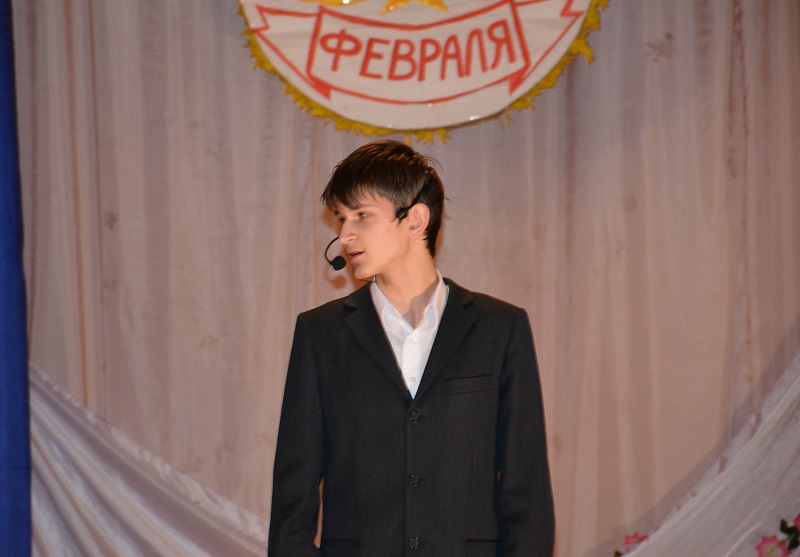
Life’s Rich Pageant: The Case of Yan Sidorov

Yan Sidorov. Photo courtesy of Memorial Human Rights Center

Minus one:Yan Sidorov, a former political prisoner in the Rostov Case, has volunteered for the war.

Sidorov served four years in prison in the Rostov Case, in which the court decided that two posters and thirty leaflets were evidence of “attempted organization of mass disturbances.” The Memorial Human Rights Center recognized him as a political prisoner.

Yan was released from prison a year ago, and he had planned to work in human rights protection. There were no vacancies in human rights organizations, however, and so he had to get a job as a food delivery courier.

Yan socialized with many leftist and liberal activists, but he also maintained relations with the red-brown National Bolsheviks.

Apparently, the latter were nicer to him. Several mutual friends have informed me that Yan Sidorov has joined the ranks of Eduard Limonov’s Other Russia and gone to the front.

I still don’t get how the National Bolsheviks degenerated from a flamboyant opposition party into the vanguard of the Kremlin regime. The late Limonov was always an imperialist, however.

But how — how?! — former political prisoners become defenders of Putin’s dictatorship, no one seems to understand. As one of my cellmates used to say, “Everyone has gone off their fucking gourd!”

Well, before he starts shooting, it’s not too late for him to change his mind. Maybe he will shake himself free of this delusion after all.

Source: Ivan Astashin, Facebook, 27 October 2022. Translated by the Russian Reader


Russian human rights activist Yan Sidorov is facing the prospect of three years under harsh probation conditions, when he is released next week from the penal colony where he has spent the last two years, Amnesty International said today.

Yan Sidorov is a prisoner of conscience, whose attempts to hold a peaceful protest in 2017 resulted in an imprisonment at a Dimitrovgrad penal colony after he had spent two years in pre-trial detention. He is set to be released on 3 November, but on 29 October Dimitrovgrad City Court will hear a request by the authorities to impose a severely restrictive probation period.

“Russian authorities are sending a clear signal to all young activists that participation in peaceful protests can come at huge personal cost. Yan Sidorov has already served four years in prison; he may now have to spend three more under strict police surveillance, forbidden to go out after 10 pm and banned from travelling outside the Krasnodar region,” said Natalia Zviagina, Amnesty International’s Moscow Office Director.

“The Russian penitentiary authorities must immediately withdraw their request to impose additional arbitrary restrictions on Yan Sidorov and release him unconditionally. Yan Sidorov has done nothing but exercise his rights to freedom of expression and peaceful assembly, and this outrageous campaign of punishment must end.”

Background

Two weeks ahead of Yan Sidorov’s release from penal colony IK-10 in Dimitrovgrad (Central Russia), the penitentiary administration requested that the court impose a three-year probation period on him. Conditions include obligatory biweekly registration at the local police station and a curfew between 10 pm and 6 am; Sidorov would also be banned from leaving his native Krasnodar region, and banned from attending or participating in any mass events. The Dimitrovgrad City Court will hear this case on 29 October. On 15 October, the penal colony authorities accused Yan Sidorov of violation of the prison regime regulations – allegedly for not attending morning workout – and placed him in a punishment cell for seven days.

In October 2019, Yan Sidorov and his friend Vladislav Mordasov, who spent almost two years in pre-trial detention, were found guilty of “attempted organization of mass disturbances”, and each sentenced to more than six years imprisonment for organizing a peaceful protest in November 2017. The protest was in support of dozens of people in Rostov-on-Don (Southern Russia) who had lost their homes in mass fires. Their sentences were subsequently reduced to four years on cassation. Vladislav Mordasov serving his sentence in IK-9 penal colony in Shakhty (Rostov-on-Don region) is due to be released on 3 November as well.

Source: “Russia: Prisoner of conscience Yan Sidorov faces further restrictions after release,” Amnesty International, 28 October 2021

Sergey Yermakov: Protest Duckies and the Actionism of Fact

a21474785_0
Inflated rubber duckie at June 12, 2017, anti-corruption protest rally in Petersburg. The duckie was later detained by police. Photo courtesy of The Poke

Sergey Yermakov
Protest Duckies and the Actionism of Fact

The final performances by Voina’s so-called Petersburg faction could be termed “actionism of fact” by analogy with “literature of fact,” a project the LEF mob tried and failed to realize in the 1920s.

Voina took ordinary actions from the repertoire of protest and resistance, actions requiring no special skills—turning over a police car, torching a paddy wagon, dousing policemen with urine—and simply did them in their performances.

What happened to the performances due to their actions?

First, the performances simply were carried out, like ordinary actions, bereft of aesthetic and symbolic depth. (We will bracket the question of Alexei Plutser-Sarno’s defamiliarizing press releases.) “They really did it.”

Second, the actions were glorified by the very fact they were performed by the actionists. They were bathed in an aura of glory, but note that this aura was totally colorless. It had no density whatsoever, and it produced no distortions in the albedo. This was because the actions were as commonplace as could be, actions available to everyone, actions to which nothing was added except their execution. (Well, yes, and the group’s signature.)

The actionist readymade (or “readydone”) and actionism of fact, unlike the classic artistic readymade, have no need of a special aesthetic space, such as a museum. Unlike literature of fact (if this literary project had actually been implemented in the twenties), actionism may well avoid the traps of language and representation.

Voina thus directly took on the issue of politically effective action. There is a certain actionist Platonism to it, but if we bypass Plato (no matter how we regard the violence of his gesture) we cannot ask ourselves about art’s attitude and access to politics.

In the Republic, Plato does not suggest banishing all poets for fobbing off the phantom of excellence (εἰδώλων ἀρετῆς) on citizens instead of virtue (i.e., the thought of action). He would let the non-mimetic poets, who glorify the gods and sing the praises of good men (ἐγκώμια τοῖς ἀγαθοῖς), stay in the city. Voina’s Petersburg faction non-mimetically sang the praises not of citizens themselves, but certain actions as such, simply by performing them. Their implicit message was something like: Look, this is up for grabs for everyone, and yet if you carry out this glorious deed, you will not be unoriginal and overshadowed by us, because this is basically something anyone could do. This is a kind of democratic and non-hierarchical political Platonism.

Voina did these performances before the May 6, 2012, clashes between protesters and police on Bolotnaya Square in Moscow. They seemingly had offered the demos who took to the streets a possible repertoire of elementary actions. (Of course, the total number of such actions is much greater, and not all of them are either criminal or so primitive. What matters in this case is only the dimension itself.) But the demos did not heed their call, preferring to play at making witty posters, from the December 2011 rally on Sakharov Avenue to this day, and exchanging anti-regime memes in the social networks. (That is, the circumstances are in some way symmetrical to the exile of the poets. In this case, however, the demos itself has turned its back on genuinely political artists, immersing itself in the carnivalesque mimesis of the meme.) By rejecting the dimension of the glorious deed, however, the demos has refused to be itself, because it is eventful, rather than substantial, in contrast to the phantasm of the ethnos.

It took Pyotr Pavlensky half a dozen performances to get close to the place where Voina had arrived in the spring of 2011, that is, in order to torch the front door at FSB headquarters in Moscow. In many ways, the performance was a step backwards, for example, when it came to the question of withdrawal. The guerillas of Voina insisted on retreating in a well-conceived way and unexpectedly returning to strike again. (This is the only worthwhile “We’ll be back!” It is a far cry from Navalny and Co.) But Pavlensky, in many respects by way of accommodating an aesthetic impulse, stood his ground to the bitter end. He has thus proven to be a more direct follower of the National Bolsheviks than Voina when it comes to this issue.

So Voina is still waiting for its demos and valiant citizens back in the spring of 2011, scornfully gazing at rubber duckies, meme politics, and witty anti-Kremlin t-shirts.

Translated by the Russian Reader. Sergey Yermakov is a professional translator who was involved in several of Pyotr Pavlensky’s performances. My thanks to Mr. Yermakov for his kind permission to publish this essay here.

March 3, 2007 (March of the Dissenters, Petersburg)

the_dissenters_march_in_st-_petersburg_march_3_2007
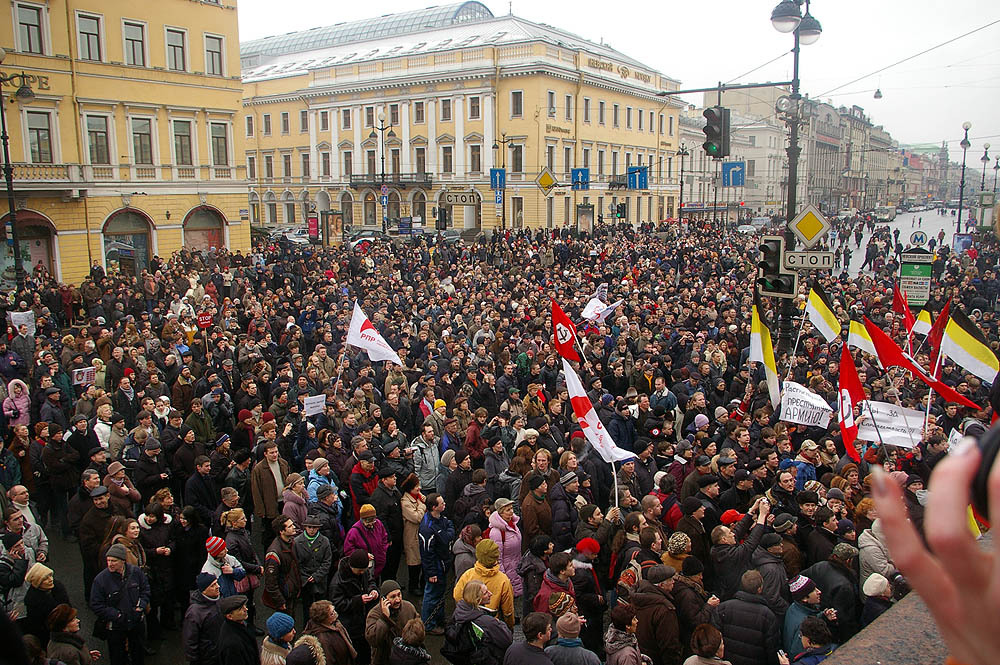
Anti-Putin protesters gathered on Nevsky Prospect in Petersburg next to the old City Duma building, March 3, 2007. Photo courtesy of Wikipedia

A comrade reminds me that today (March 3, 2017) is ten years to the day from the first March of the Dissenters in Petersburg (March 3, 2007), in which thousands of anti-Putin protesters who had been kettled by riot police on Ligovsky Prospect near Insurrection Square broke through the police lines and marched, nearly unimpeded and without anyone’s “authorization,” all the way down the Nevsky to the old City Duma building, where various “ringleaders,” including the then-fearless and inspiring local politician Sergei Gulyaev, several Natsbols (during their “liberal” phase, now long since forgotten), and Garry Kasparov tried to mount the steps to give speeches, which they did with more or less success until the riot cops infiltrated the huge crowd gathered around the Duma and dragged them away to paddy wagons.

Needless to say, it was a wonderful day, one of the most memorable in my life, and a rare manifestation of real grassroots people power in a city whose populace is too often prone to wait for the cops to give them permission to stand in a dirty, invisible corner of town and hold up their handmade placards, which will be seen by no one except their mostly fairweather friends on Facebook.

If you weren’t there that day, but could have been, you made a big mistake, for which, I suspect, the gods of Ingria will never ever forgive you.

A great time was had by all. Really. TRR

Thanks to Comrade Oregon for the heads-up