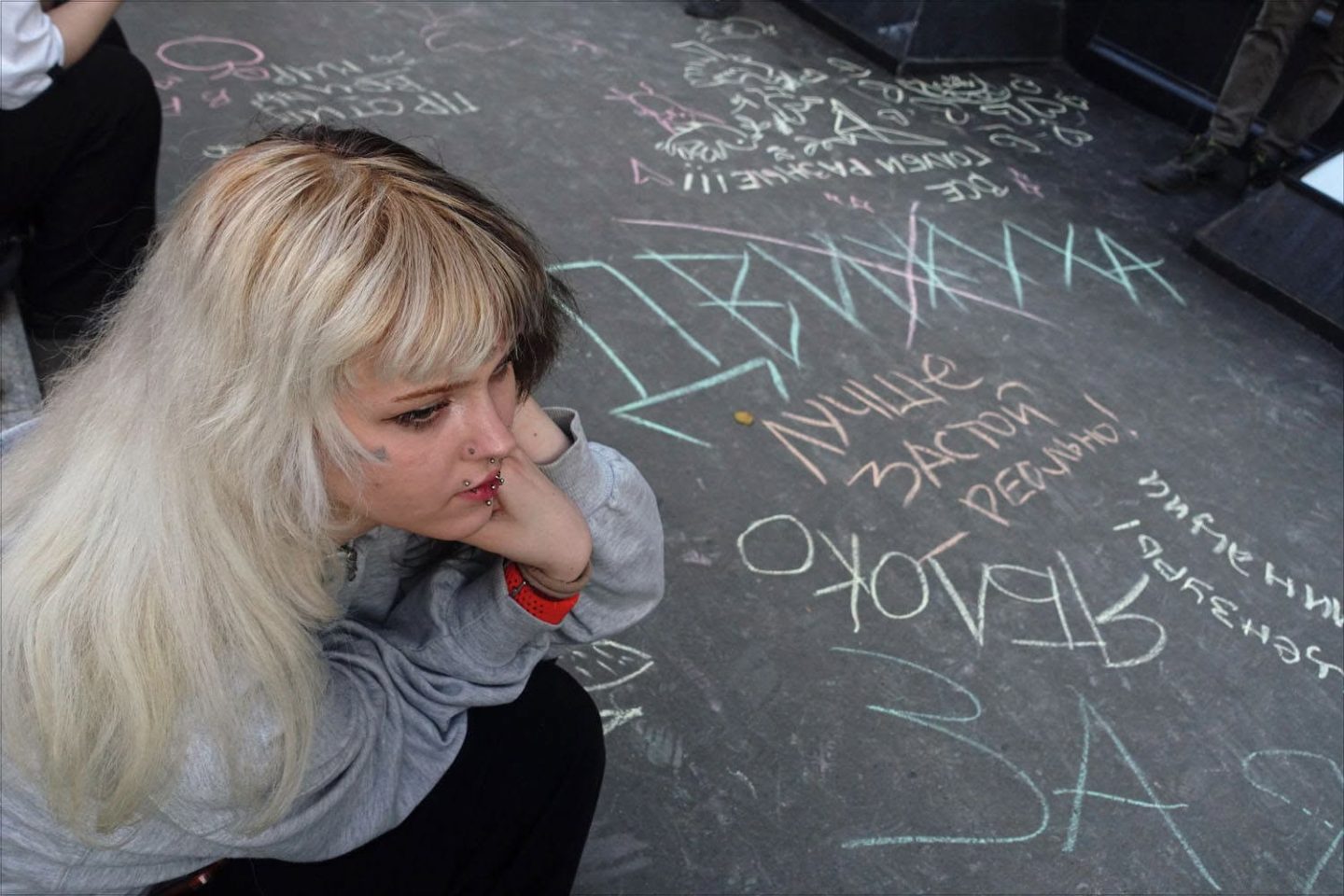

Photo by Vadim F. Lurie, reproduced here with his kind permission
Victory Day is a memorable holiday for every citizen of St. Petersburg! During the celebration of the Great Victory, each of us remembers the heroic deeds of our grandfathers. In keeping with a long-established tradition, many musicians dedicate their concerts to this important date.
On May 15, the Lensovet Palace of Culture will host “Echo of Victory,” a soulful solo musical performance by Dmitry Pevtsov and the Pevtsov Orchestra.

“Echo of Victory” is a new themed concert in which poems and songs of the war years and the best songs of Soviet and modern composers will be performed. The program will feature such songs as “Airplanes First of All,” “From Dawn to Dawn,” and, of course, everyone’s favorite song, which has become a symbol of the celebration of May 9—”Victory Day”!
We invite everyone to the “Echo of Victory” concert on May 15 at the Lensovet Palace of Culture. Let’s remember the great songs of that heroic time and once again feel proud of our great nation!
Directed by Denis Isakov
Duration 1 hour 40 minutes (without intermission)
Source: Bileter.ru. Translated by the Russian Reader
The Russian authorities and Russian propagandists have been competing with each other to recreate something outwardly similar to the Soviet system in our country. The message to Russian society is simple: we are different, we have a different path, don’t look anywhere else, this is our destiny — to be unlike everyone in the world. And yet there are more and more traits of our country’s yesterday in its tomorrow.
For some reason, the speakers at the Knowledge educational forum, starting with Prime Minister Mikhail Mishustin, called directly for Russia’s self-isolation. Mishustin demanded that we achieve independence from foreign designs in the information sphere. The word “independence” has been increasingly used to mean isolation and breaking ties.
Deputies in the State Duma have proposed re-establishing the mandatory three-year “repayment through job placement” for university graduates, and prohibiting those who have not served in the army from working in the civil service.
With Ella Pamfilova, head of the Russian Central Elections Commission, on hand as a friendly observer, Uzbekistan held a referendum on April 30 to decide whether to adopt a new constitution that would grant the current president, Shavkat Mirziyoyev, the right to de facto lifelong rule by lengthening presidential terms from five to seven years and nullifying Mirziyoyev’s previous terms. The ballot, which involved digital technologies, produced a turnout of 84.54%, and according to preliminary data, 90.21% of voters said yes to the amendments, which would change two-thirds of the Constitution, while 9.35% of voters voted no, and 0.49% of the ballots were disqualified. Although democratic procedures were seemingly followed, Uzbekistan is moving away from democracy.
Something makes us see Pamfilova’s visit to Uzbekistan not only as a trip “to strengthen friendship and cooperation,” but also as a completely practical exchange of know-how in organizing such referendums. Only by adopting a new constitution can the first and second chapters of the current Russian Constitution be amended, and it is the second chapter that enshrines civil rights and freedoms, we should recall.
Alexander Bastrykin, the prominent human rights activist and chair of the Russian Investigative Committee, has proposed adopting a new Russian constitution that would enshrine a state ideology, completely eliminate international law’s precendence over domestic law, and re-envision human rights as an institution alien and hostile to Russia, as something encroaching on its sovereignty. Uzbekistan’s know-how in voting on a new constitution will come in handy for the Russian Central Election Commission.
At seven o’clock this evening live on Citizen TV, we will talk about why, exactly, the Russian authorities are so enthusiastic about Soviet political practice and the Soviet style, and where such intentions can lead our country.
Source: Citizen TV (YouTube), 1 May 2023. Translated by the Russian Reader
Russian President Vladimir Putin agreed with the need [for Russia] to develop its own communication protocols instead of foreign TCP/IP to ensure the country’s technological sovereignty and independence.
On Thursday, the head of state held an event at the Rudnevo Industrial Park during which the specifics of the development of domestic unmanned aerial systems were discussed. In this context, Alexander Selyutin, board chair of the Technojet group, spoke about the “Internet from Russia” project.
After listening to the proposals, Putin turned to his aide Maxim Oreshkin.
“Maxim Stanislavovich, talk to your colleagues, then report back to me separately, we need to help. This is obligatory, because if you have advanced proposals, your own, of course, we need to do everything to support them. It means technological sovereignty, and better competitiveness, and independence. […] We will definitely help,” the president said.
Source: “Putin supports creation of Russian communication protocols as alternative to foreign ones: head of state held event at Rudnevo Industrial Park where specifics of developing domestic unmanned aerial systems were discussed,” TASS, 27 April 2023. Translated by the Russian Reader. Thanks to Lev Schlosberg for the heads-up.

Those wishing to take part in a virtual LDPR rally at the monument to Vladimir Zhirinovsky created in Minecraft have overloaded the server. The number of applications exceeded twelve thousand, LDPR’s press service informed us.
As Andrei Svintsov, a member of the LDPR faction [in the State Duma], noted, this is only the first such event. The Liberal Democrats plan to continue using [Minecraft] and other gaming platforms to communicate with voters and attract new supporters, becoming in fact “Russia’s first digital party.”
The MP also recalled that experts continue to work on the “Cyber Zhirinovsky” political algorithm, which was previously announced by the party’s current leader Leonid Slutsky.
Photo: Official LDPR Telegram channel
Source: TASS (Telegram), 1 May 2023. Translated by the Russian Reader
In late April, Judge Yevgenia Nikolayeva closed a court hearing at which it was decided how much time to give Alexei Navalny to examine the 196 volumes of the latest criminal case against him. According to the police investigator, this was necessary in order to protect investigatory privilege.
Navalny’s case is not unique. There have been other such decisions recently. Judges closed a court hearing on the killing of the blogger Vladlen Tatarsky, decided the fates of conscientious objectors without witnesses present, ruled on pretrial restrictions in absentia for journalist Ilya Krasilchik, and extended the arrest of politician Vladimir Kara-Murza.
Over the past five years, judges in Russia have increasingly closed court hearings to observers, journalists, and even relatives of defendants. Because of this, defense lawyers cannot inform the public about what happens in these proceedings. Mediazona reviewed the judicial statistics and discovered that, in 2022, judges ruled 25,587 times to hear cases in closed chambers. This was almost twice as often as in 2018, when judges decided 13,172 times to hear cases without outsiders present.
The Constitution actually guarantees that your case should be heard in open court, but there are exceptions. The principal exceptions are cases involving state secrets (which is why all treason and espionage trials are closed), cases against defendants under sixteen years of age, and cases involving sexual offenses. The statistics for all such cases have not changed much in recent years.
But there is one more exception — a trial can be closed to “ensure the safety” of the people involved in the proceedings and their loved ones. This extremely vague wording allows judges to close any court hearing. Judges make vigorous use of it, especially when hearing high-profile cases.
Here’s another example. In September, the Moscow City Court closed the hearing of an appeal against the verdict in the “fake news” trial of municipal district council deputy Alexei Gorinov, who had been sentenced to seven years in prison for an argument over a children’s drawing contest in which he had said that children were dying in the war in Ukraine The judge alleged that the court had received threats, and said that the hearing would have to be closed for the safety of the parties to the proceedings.
Russian judges may be following the lead of their Belarusian colleagues, who have learned how to conduct political trials without outside scrutiny. They cite covid regulations, or fill the gallery with persons unknown, or don’t let anyone except the relatives of the defendants in the courtroom. Russian courts have begun to use many of these methods. And the Belarusian courts can declare a hearing closed without explaining the reasons at all.
The authorities do not want people to know about political trials, to monitor these trials, or to support the accused. That is why, on the contrary, it is important for society today to talk about political prisoners and help them.
Source: I Don’t Get It email newsletter (Mediazona), 1 May 2023. Translated by the Russian Reader
A Russian version of the song by the French left-wing chansonnier Georges Moustaki. Translation: Kirill Medvedev. Guitar: Oleg Zhuravlev. Video: Nikolay Oleynikov
Don’t ask what her name is, she’s
Beloved and tender, but fickle
Very spunky, she’ll wake up and go forward
To a new life that shines and singsBullied and branded
Tortured and executed
Well, how much can she suffer!
And she rises up and strikes,
And spends many, many years in prison,
Yes, we betrayed her
But we only love her more and more
And so we want to follow her
Right to the endWhat her name is, don’t ask, my friend,
She’s just a mayflower and a wild fruit
She sprouts anywhere, like grass
Her path will take her wherever she wishesDon’t ask what her name is, she’s
Sometimes beloved, sometimes persecuted, but faithful
This girl that everyone is waiting for
Permanent revolution is her name
Original song by Georges Moustaki
Source: Arkady Kots Group (YouTube), 1 May 2023. Translated by the Russian Reader