Russia spent approximately 10.9 trillion rubles [approx. 118 billion euros] on military operations against Ukraine in 2025: this is five times the combined income of all Russians living below the poverty line. This estimation is based on Rosstat’s data (as of Saturday, March 14) on the country’s GDP (213.5 trillion rubles), as well as on a statement by Defense Minister Andrei Belousov, who reported at a Defense Ministry meeting that expenditures “directly related to the special military operation” (as the Russian Federation refers to its armed aggression against its neighbor) amounted to 5.1% of GDP. The combined income of all Russians living below the poverty line was less than two trillion rubles.
According to Rosstat, 9.8 million Russians lived below the poverty line in 2025; this is the first time the figure has fallen below ten million. Their percentage of the country’s total population thus decreased from 7.1% to 6.7%. The poverty line, as calculated by Russia’s federal statistics agency, stood at 16,903 rubles [approx. 183 euros] per month.
One-fifth of the cost of the war against Ukraine would thus technically suffice to completely eradicate poverty in Russia—simply by raising the incomes of the poorest Russians to the official poverty line.
Inflation for the poor
The methodology used to define the poverty line raises questions among experts. The index is based on the minimum subsistence level for the fourth quarter of 2020, adjusted for official inflation. For low-income citizens, however, real inflation is generally higher than the average.
TsMAKP (Center for Macroeconomic Analysis and Short-Term Forecasting), a think tank with close ties to the Russian government, calculates a separate metric,“inflation for the poor.” It is based on a simplified consumer goods basket which includes a minimal assortment of food, medicines, cleaning products, and housing and utility services, but excludes hotels and transportation. This metric regularly exceeds the average inflation rate for Russia.
TsMAKP calculates that that last year’s actual poverty line stood at 18,311 rubles per month for working-age Russians, 16,621 rubles per month for children, and 13,947 rubles per month for pensioners—which is sixty percent lower than last year’s average pension of 23,425 rubles per month.
Source: Sergei Romashenko, “Russia spent five times as much on the war as the combined income of all its poor people,” Deutsche Welle Russian Service, 14 March 2026. Translated by the Russian Reader
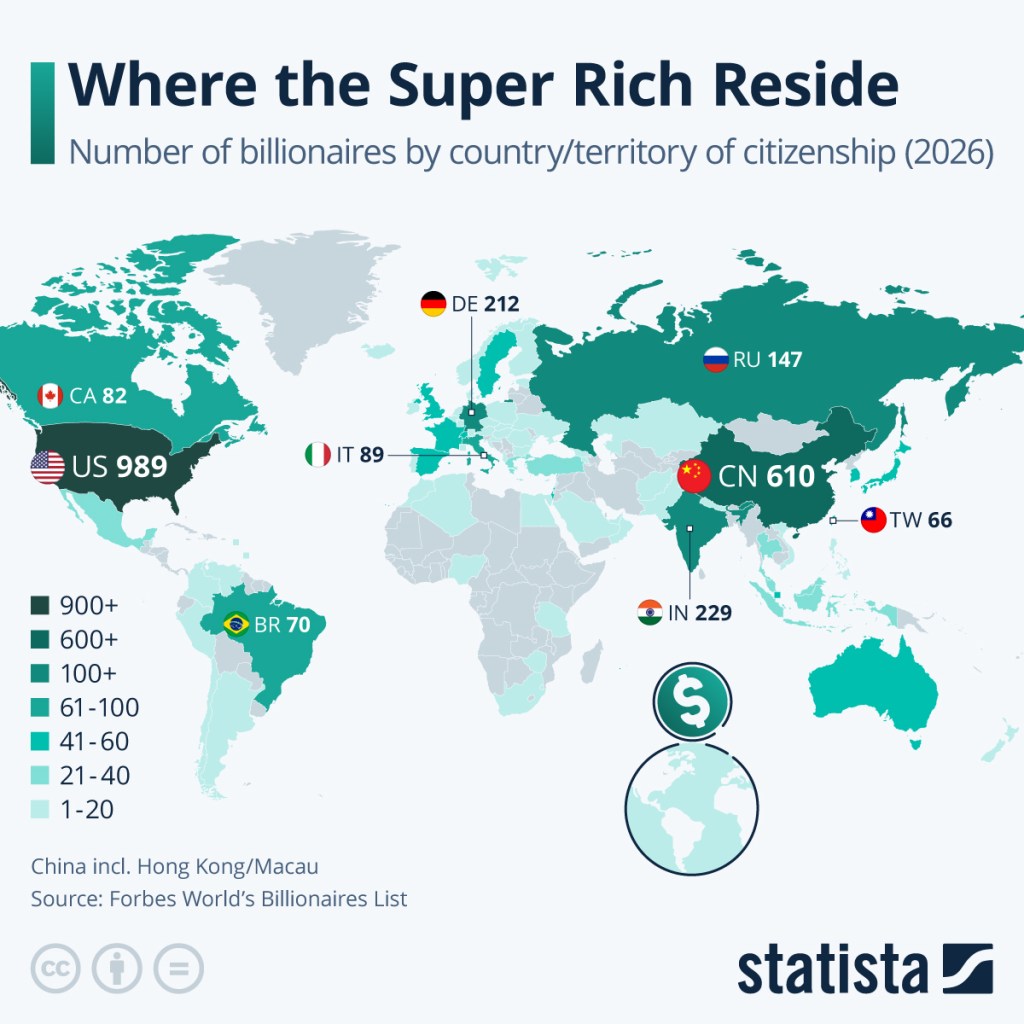
Source: Katharina Buchholz, “Where the Super Rich Reside,” Statista, 11 March 2026
Income inequality in Russia has reached its highest level in more than a decade, according to an analysis by the independent research group Yesli Byt Tochnim.
The state statistics agency Rosstat initially published and later removed the inequality measure known as the Gini Index from its January 2026 social and economic report, Yesli Byt Tochnim said.
The group said it was able to reconstruct the indicator using other publicly available data on income distribution.
According to its analysis, Russia’s Gini Index rose 2.2% over the past year, from 0.410 in 2024 to 0.419 in 2025, the highest level since 2012. On the scale, 0 represents perfect equality while 1 represents maximum inequality.
Income inequality in Russia has risen for four consecutive years and is now approaching the record highs of 0.421-0.422 recorded between 2007 and 2010, Yesli Byt Tochnim said.
President Vladimir Putin has set targets to reduce Russia’s Gini Index to 0.37 by 2030 and to 0.33 by 2036 — the final year he could remain in power under constitutional changes that reset presidential term limits.
Other data in Rosstat’s report also point to a widening wealth gap.
The share of total income going to the richest 20% of Russians rose from 46.9% to 47.6% over the past year, while the share earned by the poorest 20% fell from 5.3% to 5.2%.
The average income of the wealthiest 10% of Russians is now 15.8 times higher than that of the poorest 10%, up from 15.5 times a year earlier.
This week, Forbes included a record 155 Russians in its annual ranking of the world’s billionaires, marking the fourth straight year that the number of Russians on the list has increased. Their combined net worth was estimated at $695.5 billion.
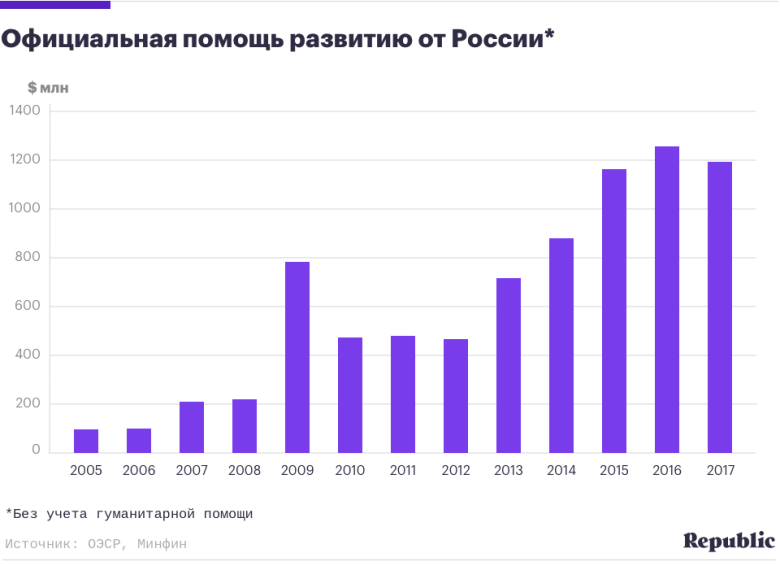 Russia’s Expenditures on Official Development Assistance (Excluding Humanitarian Aid), 2005–2017, in Millions of Dollars. Sources: OECD, Russian Finance Ministry. Courtesy of Republic