Remembering Navalny

There’s shoddy work everywhere. Even great publications suffer ridiculous failures.

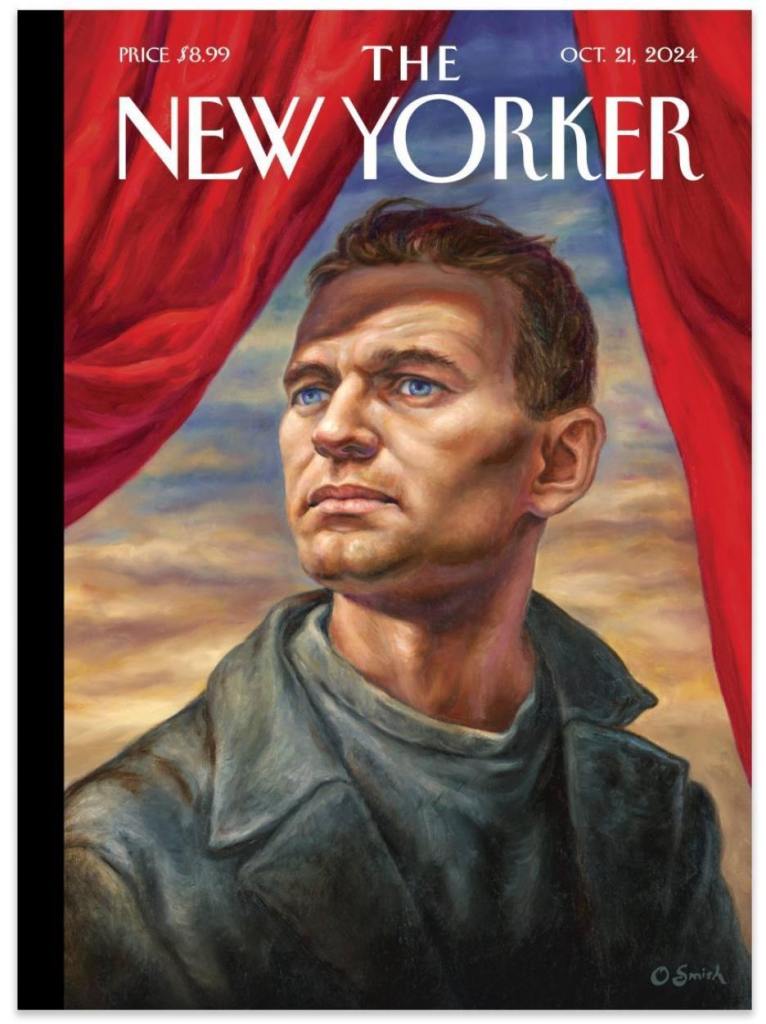
This is the cover of the new issue of the New Yorker.

What ridiculous crap.

(You can probably guess who that is supposed to be.)

Source: Sergei Parkhomenko (Facebook), 12 October 2024. Translated by the Russian Reader


I wouldn’t want Navalny to be remembered the way he has been remembered this past year.

I haven’t read the book Patriot yet, but I was quite upset by Mikhail Zygar’s review of it. Zygar compares Navalny to Jesus and concludes that by dying, Navalny bequeathed us an idea that would rid future generations of cynicism and teach them to believe.

This is feeble sentimentalization, in my opinion. Navalny didn’t not dream up any particular ideas. He called for action, not faith. The meaning of his sacrifice, in my mind, is practical and political, not abstract and ideological. It can and should benefit the current generation, not some future generation.

Navalny didn’t dream up a new ideal. The “beautiful Russia of the future” is a feeble image, but Navalny understood better than anyone how tyranny operates on the mechanical level. I often complain that the FSB understands better how Russian society functions than do opposition politicians, sociologists and psychologists. Navalny couldn’t be accused of this shortcoming.

He was the only person in Russian politics who talked about power relations as a two-way street. He didn’t talk about the enormous resources Putin has, but about the fact that we give Putin power. It is not the security services, the army and the tanks that give Putin power. We give Putin power.

This view evolved over the course of Navalny’s career, becoming more and more central. As time went by, it separated Alexei more and more from his colleagues in the opposition. Toward the end of his life, Navalny’s writings centered on the idea that power consists in consenting to obedience, in “obeying in advance.” We say to ourselves: I cannot disobey, because if I don’t obey, they will (notice me/file administrative charges against me/fire me/banish me from my profession/send me to jail/kill me).

“The only fear there should be is that we leave our homeland to be plundered by a pack of liars, thieves and hypocrites, that we surrender without a fight, voluntarily, both our own future and the future of our children.”

Only by obeying in advance can governing by unfulfilled threat be scaled up indefinitely, to a country of 140 million people, because this means of governing doesn’t require any resources. We obey without taking resources from the state. Putin’s estimates for the war in Ukraine include every dollar, euro, and pound spent on Ukraine’s defense. They are what counts against Russian budgets, not “faith in democracy” or “anti-war sentiment.” I understand Alexei’s decision to return to Russia in this sense; I see it as logical and unusually tenderhearted on the personal level. By returning to Russia, Alexei was able to provide Russians with one more example of tyranny’s limits: Putin never had power over Alexei. Had he stayed in Germany, Putin’s power would have extended to Navalny.

At the end of his life, Navalny did not call for faith, he called for deeds: “If your convictions are worth something, you must be willing to stand up for them. And if necessary, make some sacrifices. And if you are not willing, then you don’t have any convictions. You just think you do. But they are not convictions and principles. They are just thoughts in your head.”

Navalny was concerned not with the thoughts in our heads, but with whether our deeds matched our thoughts. I appreciate Christian philosophy, but I could never accept the postulate that a second of faith can save a person, no matter their actions — “Now thou shalt be with me in paradise,” and so forth. The Russian opposition, for as long as I’ve been watching it, wants to get to democracy approximately the same way the thief gets to paradise — by believing in it. The notion that we are democrats and decent because we believe in democracy while all remaining Russians are slaves and awful because they don’t believe in it is the main obstacle to democracy in Russia, in my mind, and the Koshchei’s egg of tyranny. A “democracy” in which only “democrats” have a stake and which only they want is an oxymoron that makes democracy impossible and tyranny in Russia perennial. Democracy cannot be for Muscovites alone. It cannot be built via media outlets in which only Petersburg and Moscow have a voice. It cannot be built without equal representation of activists, issues, and interests from other regions and ethnicities.

Late in life, Navalny hated talk about the “freewheeling ’90s” and the good Chekists/bad democrats dichotomy, which doesn’t prevent his supporters from remaining stuck in this selfsame paradigm.

“I hate the authors of the authoritarian [Russian] constitution, which was sold to us idiots as democratic, even then granting the president the powers of a full-fledged monarch. […] I hate the ‘independent media’ and the ‘democratic community,” which fully supported one of the most dramatic turning points in our new history — the fake presidential election of ’96.”

Navalny was able to cringe at his former self: “I repeat that back then I vigorously supported all that stuff. Not election fraud, of course — I didn’t like that even then — but I did everything I could to ignore it, and the general unfairness of the elections didn’t fluster me one bit. Now we are paying for the fact that in ’96 we thought that election fraud was not always a bad thing.”

Alexei started his career in Russia’s faux democracy project, which was unfair from the get-go. He entered politics as a “democratic nationalist,” desiring greatness and a better elite for Russia. It was within this same paradigm that he pursued the most successful project of his life: “fighting the regime by legal means.” By the end of his life, however, he came to realize that Russian power is held by a hypocritical elite which justifies its obedience by talking about white coats, and is not willing to share power. It is not even willing to think about being the equals of other Russians, let alone the equals of Ukrainians, for example.

This, in my opinion, is what Navalny left behind. It pains me to see how the legacy he left at such a high cost is being frittered away by films about traitors, stupid speeches, and sentimental religious comparisons.

Source: Vladimir Ponizovskiy (Facebook), 23 October 2024. Translated by the Russian Reader
North Korea Sounds Nice

Chulpan Khamatova, Sobchak Live, 6 June 2012

[Ksenia] Sobchak: You want your children to live in a stable country without revolution?

[Chulpan] Khamatova: Without revolution. It could be some kind of changes in mindset. Without revolutions. I don’t want revolution. I’m categorical on this point, because the heads of completely innocent people fly in revolution and all these wars. I don’t think it’s right. Both sides have to do their utmost to avoid this.

Sobchak: But would you accept any compromise for the sake of avoiding revolution? Figuratively speaking, I don’t know whether you have any notion of geopolitics or not, whether you understand what’s happening in North Korea. People eat grass, and there’s a city within a city where officials live, while [ordinary] people live a completely different life without electricity. It’s just that I’ve been there, and so I know what I’m talking about. To put it starkly, which would you choose—living in a country like North Korea, for example, or revolution?

Khamatova: I would choose North Korea. I don’t want victims. It means that the people who oppose this regime lack certain tactics, know-how, and wisdom, that’s all.

Source: “Chulpan Khamatova: ‘I’m afraid of lots of things,'” TV Rain, 6 June 2012. Translated by the Russian Reader. Thanks to Comrade Koganzon for reminding me of Ms. Khamatova’s untimely dalliance with Putinism and “stability” at all costs. She now lives in exile in Latvia, of course—not in Russia or North Korea, God forbid. ||| TRR


Russian holiday-goers are set to be the first known tourists allowed into North Korea since it closed its borders as a pandemic response in early 2020. A five-day jaunt was arranged by an agency in Primorsky Krai after the eastern region’s governor visited the hermit kingdom’s capital for talks. The countries pledged closer ties after a series of meetings in September.

Source: The Economist, “The World in Brief,” 12 January 2024


Friends, we apologize for replacing the video. The Zygar channel team reposted it due to a factual textual error, but the time codes remain the same.

Since I am a writer, I think that in the near future I will have to write a book which could be called The Empire Must Die, but only about another empire—Putin’s Russia.

And, of course, in this book one of the most important characters will be Chulpan Khamatova, the actress and co-founder of the Gift of Life charitable foundation.

She was one of the first to protest against the war with Ukraine and leave Russia.

Chulpan will talk about her life, starting the foundation, her encounters with Putin, and fighting for the lives of children, friends, and her own honor.

[…]

You can help children with cancer and donate an affordable amount to the Gift of Life Foundation: https://podari-zhizn.ru/ru.

00:00 – First meeting with Putin
09:57 – The germ of charity
13:30 – Anton Chekhov in the Kremlin
17:47 – Meeting Yuri Shevchuk
21:40 – The foundation’s first concert
24:31 – On medicine, doctors, and building a new hospital
26:41 – Putin and the PR move
30:22 – The Friendship Medal and the search for the missing money
33:20 – The relationship between Putin, the doctors and the clinic
36:53 – Canceling Matvienko and Gref’s speech
40:10 – Putin’s meeting with the creative intelligentsia
42:07 – Putin on democracy and freedom
45:24 – Chulpan, Putin, and the breast pump
48:48 – President Dmitry Medvedev in the lives of charitable organizations

49:44 – Medvedev’s meeting with foundations, the story about the hamsters and beads
1:01:51 – Putin’s election campaign
1:07:05 – “This clinic should be turned over to the doctors.”
1:09:57 – Decentralization of hospitals, opening the center in Yekaterinburg
1:14:50 – Bullying and depression
1:18:58 – “Chulpan chooses North Korea”: the problematic headline
1:25:50 – “If I chose North Korea, why didn’t I stay there?”
1:28:53 – Reorganizing the foundation”from a church into a McDonald’s”
1:31:32 – Unholy Chulpan and Dima Yakovlev’s Law
1:35:53 – One-on-one with Putin
1:44:23 – Petition for the annexation of Crimea
1:45:53 – Offer to become children right’s ombudsperson
1:54:44 – Kirill Serebrennikov and detention
2:01:22 – Last meeting with Putin
2:05:56 – “Should I be afraid?”
2:09:56 – War in Ukraine: 24 February 2023
2:16:23 – The difficulty of emigration

Source: ZYGAR (YouTube), “Chulpan Khamatova: North Korea, meetings with Putin, answering the haters,” 16 February 2023. Annotation translated by the Russian Reader

National Unity Day Fiction

Historical Fantasy
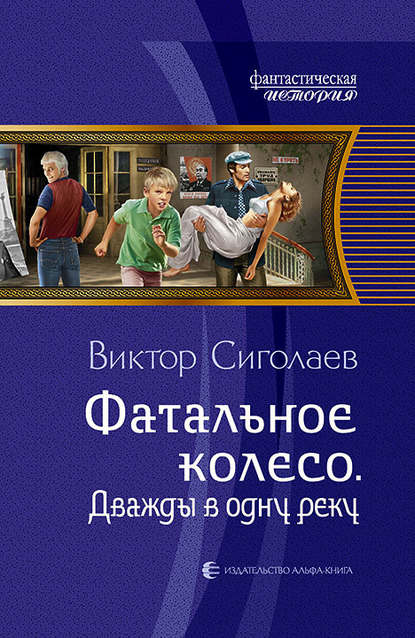
Viktor Sigolayev, The Fatal Wheel: Crossing the Same River Twice (Alfa Kniga, 2012)

No one understood how our contemporary, an officer in the reserves and a history teacher, ended up in his own past, back in the body of a seven-year-old boy, and back in the period of triumphant, developed socialism, when, as far as our hero could remember, there was a lot more joy and happiness.

That is how an adult imagines it, but it transpires all is not as perfect in the sunny land of Childhood as the memory would suggest. It transpires that here, too, meanness and greed exist. There are thieves, bandits, and scammers of all stripes, although you did not notice them earlier, when you were a child. But now you have to do something about it. Now you have to fight it, because evil knows no obstacles in time. Enemies—cruel and insidious, clever and merciless—have again emerged on the horizon. Besides, some of them seem incredibly familiar to our hero.

So, the seven-year-old hero, who has two university degrees, combat officer experience, and a memory singed by the hard post-perestroika years, launches his own tiny war, allying himself with none other than the USSR State Security Committee [KGB]. He unexpectedly finds new friends there, the kind of friends for whom you can risk your life.

Source: LitRes

Translated by the Russian Reader

_______________________________________

Putin’s Russia can’t celebrate its revolutionary past. It has to smother it
Catherine Merridale
The Guardian
November 3, 2017

November always brings a welcome holiday for Russians. The day off work is about some great historical event, but most use it to catch up with their families. On 7 November 2017, it will be exactly 100 years since Vladimir Lenin’s Bolshevik revolution, the one that people used to mark with anthems, weaponry and fireworks.

But this year’s official holiday commemorates not the revolution, but an uprising of 1612 against the Poles. National Unity Day was a tsarist invention that Vladimir Putin’s government relaunched in 2005. Marked on 4 November, its timing has been perfect. After three days on their sofas, will anyone really notice that there are no red flags?

The silence is like a dream in which the dreamer is being suffocated. Centenaries are special: everyone can count to 100. But so far Lenin and his comrades have not rated as much as a commemorative stamp. The man himself is still displayed – in a new suit – in the mausoleum on Red Square, but no one wants to talk about exactly what he did. The current Russian government makes ample use of history – no child is likely to forget the great patriotic war against fascism – but Lenin can’t be made to fit.

It is awkward enough, Moscow’s mandarins must think, that the Russian revolution was a people’s uprising against despotic rule, a fight against injustice and the gross excesses of the rich. With terrorism such a real threat, the Kremlin would be unwise to appear to condone violent revolt. Yet it can’t vilify a man whose corpse still lies in state, whose statue is a landmark in hundreds of towns. And what is it to make of Soviet power? If it condemns the Russian revolution, where does that leave Stalin and the people’s triumph?

So far the answer seems to be to keep things bland. Lenin, after all, is boringly familiar. If he will only stay that way, if young people decline to think, then even this annoying anniversary will pass. There are rumours that Russia’s new left may take to the streets this year to mark the anniversary with demonstrations, but most Russians under 50 regard the Soviet story as a dowdy relic, an embarrassment. The state wants it to stay that way, the province of those staunch old trouts who still sell apples outside metro stops. Its very language, “Soviet”, is an antique. It must be held back in the past, exiled along with dissidents, stretch nylon and bad teeth.

The Russian revolution was a moment when the veil of human culture tore. It was a season of euphoric hope, a terrifying experiment in utopia. It tested to destruction the 19th-century fantasy of progress. It was the work of tens of thousands of zealous enthusiasts.

Yet now their great-great-grandchildren are bored. This situation suits their government. A cloud of tedium hangs over any formal gathering that ventures to discuss the thing. Most choose the safest, dullest line. There is to be a round-table meeting held at [the] Smolny, for instance, the building from which Lenin launched the revolution, working around the clock. Scheduled for late November 2017, the theme will not be revolution but the centenary of Finnish independence.

I tried asking in the museums. The Russian state has preserved every relic of the revolutionary year, including Lenin’s pillow and his brother-in-law’s chess set. You can still run a finger around Stalin’s bath, the one that Lenin must have used before fleeing from Kerensky’s police. But nothing special has been planned, no big event, no cameras. The museum of Pravda, the Bolshevik party’s newspaper, is clearly short of funds. In Soviet times, schoolchildren visited in their thousands – it was part of their curriculum – but now the place relies on tourists.

To attract the schoolchildren back, the staff have been forced to adapt. “We call this the museum of tolerance,” my guide explained. “See? Everything in this room has come from somewhere in Europe. The typewriter there is German, the table is French.”

But mere avoidance doesn’t always work. A centenary of this importance is bound to be marked by someone; there has to be an official response. Ten months ago, the independent journalist Mikhail Zygar launched a website to track the events of 1917 as they unfolded, day by day. Belatedly, but with a considerably larger budget, the state-sponsored Russia Today responded with a handsome Twitter feed, lavishly illustrated with archival photographs and featuring imaginary tweets from some of the key figures of 1917. Both are useful resources, though neither has engaged with what the revolution means. That question haunts Red Square like Lenin’s ghost.

The Kremlin is saving itself for another anniversary next year. In July 1918 the Romanov family was shot. The solemn lessons of that crime are something everyone will understand. A strong state is what people need, the message goes, and Russia’s is a special one. Unlike the regimes of the west, it is not only patriotic but orthodox. That is why Nicholas II is now a saint and why his killing by the Bolsheviks was a martyrdom. Through him, right-thinking Russian people can remember every other martyr of the revolution that is now, thank heavens, safely past.

Victims unite a nation, everyone can grieve. In honour of the sacred dead (the millions, unspecified), a new cathedral has appeared in Moscow: vast, imposing, unavoidable. Help with the funds came from Putin’s close friend and confessor Bishop Tikhon Shevkunov.

In Russia now it is an idealised form of nationalism, not the people’s rule or social justice, that is feted and taught in schools. Russia is the new Byzantium, no longer proud to fly the red flag for the world.

There is one more anniversary that will not pass unmarked. The Cheka, Lenin’s feared secret police force, was founded on 18 December 1917. Its successors have included Stalin’s NKVD and the KGB of spy thrillers, but it will be the current lot, the FSB, who celebrate next month with the commemorative medals and champagne. As a lieutenant colonel in the service and its former boss, Putin could well be a star guest.

The fact that many of the revolution’s martyrs died at secret police hands is a mere detail. Lenin had no problem ordering the Cheka to carry out the wholesale execution of priests and the so-called bourgeoisie. By 1918 there were bodies piled up in the streets. But such truths are easily ignored. Shevkunov’s new cathedral to the revolution’s martyrs is itself a stone’s throw from the FSB headquarters on Lubyanka Square.

That just leaves Lenin and his ghost. In life a restless politician, dangerous and quick, he lies on Red Square like a stuffed fox: moth-eaten and obviously dead. As the heart of Moscow has been reinvented as an orthodox and ultra-Russian space, his mausoleum appears more and more anomalous. But though there is no wish to celebrate the man, a preserved corpse remains a tricky object to throw out. As a former Soviet citizen remarked to me: “We have certainly learned one thing from our history, haven’t we? You must be careful who you pickle.”

Catherine Merridale is a historian. Her latest book, Lenin on the Train, is published by Penguin.