
Yevgeny Korobov, a former officer of the Russian army, stands in the middle of the room dressed casually in a black shirt and light pants. The 30-year-old has been living in Astana, the capital of Kazakhstan, for almost three years.
He says that during this time seven or eight other deserters have stayed in his apartment.
“I try as best I can to help people like me. You don’t need to pay me, just live here, that’s all,” he says. “Who else will help them? After all, there is something that binds us. We are all deserters. We all ran.”
Just four years previously, Korobov was fighting in Ukraine from February to May 2022.
‘The war has begun’
Korobov had always wanted to be in the military, although his parents were postal workers. He studied at a military college in his native Krasnoyarsk, before joining the Russian army as “a young officer full of enthusiasm to serve”. His contract was to last until 2023.
His enthusiasm soon soured, however.
“During service in the army you encounter injustice and madness, and you begin to become completely disillusioned with everything, with how things are in Russia,” he says.
In early 2022, Korobov was sent to military exercises in the Kursk region, near the Ukrainian border. “I didn’t believe there would be a war, but we went there with anxiety,” he recalls.
He describes what he saw after crossing the border into Ukraine: “We drove through populated areas. People were living their lives, someone was refueling a car, someone was drinking coffee, someone smoking. And we’re driving. The war has begun.”
His brigade moved towards the capital Kyiv, stopping in the Brovary district east of the city.
This is the area where the Ukrainian prosecutor’s office says that Russian soldiers had carried out war crimes. [Investigations by the] outlets Meduza and Radio Liberty allege that soldiers of the 15th Brigade, where Korobov was based, had set up a torture chamber in a post office in the Kyiv region. Journalists also reported on the execution of at least five civilians by the same brigade.
Korobov claims that he personally did not witness war crimes, but heard about them from others. He says that his job was to escort rear columns, navigation and route reconnaissance during the war, and that therefore he was constantly on the move.
His brigade was near Kyiv until the end of March, after which he left the region when Russian forces retreated following the failed attempt to encircle the Ukrainian capital. As he retreated, Korobov saw destroyed Ukrainian towns. He says this caused him “horror and disappointment”.
Korobov says that the columns ran into ambushes by several Ukrainian forces.
“We had to fire back,” he recalls. “What else could we do? Die? Am I a good person if I died? I also wanted to live and wanted all my soldiers to return. What were we fighting for? For our lives. The Ukrainians had an enemy — us. We had two enemies — the Ukrainians and our own commanders.”
The ‘war hero’
At the end of 2022, just before he finally deserted and left Russia for Kazakhstan, Korobov was ordered by his commander in Moscow to appear on Russian television.
The show painted him as a war hero who had been injured in battle.
“Senior Lieutenant Yevgeny Korobov, together with his group, was escorting a rear column,” said the host of a popular evening talk show on Channel One. “They ran into an ambush. They fought superior enemy forces. They destroyed at least 15 militants and enemy equipment. They themselves had no losses.”
Korobov calls the story, first reported by the Russian defence ministry, fabricated. He says his unit did run into an ambush at the beginning of March 2022 in the Chernihiv region, but that the extent of the ordeal was greatly exaggerated.

“Fell into an ambush — yes. ‘Carefully prepared’ — hardly. Whether the enemy’s numbers were superior, I don’t know how many people were there or who was firing,” retorts Korobov.
After appearing in the media, he received a medal for courage for which Korobov says he “couldn’t care less”. “For an invented feat? For a war I didn’t want to take part in? I already didn’t want to serve in the army at all — I was just enduring until my contract ended.”
What Korobov does not dispute is that he was injured in Ukraine. During the course of the television interview, he is noticeably limping.
‘No way back’
Korobov was wounded in the leg in Donetsk in May 2022 after which he was evacuated and returned to Russia.
At the time, the command was issued to assault the village of Ozerne, near Lyman. “Only once were we able to get close to it; we were hit with everything possible, and during all the following assaults we couldn’t even approach,” says Korobov.
“At that point I already understood that there was no chance we would be allowed to go home. And that the only way to leave there was as dead or wounded.”
One day, their unit accidentally landed a drone on Ukrainian positions. Korobov says his unit of four people was sent to retrieve it and told by his commanding officer not to return without it — a mission that he describes as impossible.
“I understood that that was it, there was no way back,” he says. “And I opened fire on my own soldiers. I fired a burst into the ground. I wounded my guys. Then I wounded myself, shot myself. I provided first aid, and we crawled towards evacuation.”
This suggests that the injury that was reported and celebrated on the television program Let Them Talk was one Korobov inflicted on himself.
The BBC cannot independently verify Korobov’s account, although he provided photographs of his wounded leg.
Korobov and the remnants of his platoon were then evacuated from the frontline. He spent a month and a half in a hospital, then underwent rehabilitation.
Korobov wanted to serve out his contract in Russia until 2023, without returning to Ukraine. However, after the announcement of further mobilisation in September 2022, all contracts became indefinite. At the end of that year, he was informed that he would be sent back to Ukraine.
Looking for asylum
Korobov says that before leaving Russia he contacted the Go By The Forest project, which helps former Russian soldiers like himself who fear returning to the war in Ukraine. Activists then drew up a route for him to escape to Kazakhstan.
Soon he had packed a bag and left Russia.
A criminal case for desertion has since been opened against Korobov, and he faces up to 15 years in prison. Because of this, for the first months of life in Astana he hardly left the house.
Later, he found a job at a bar — illegally, because, as an asylum-seeker, he wasn’t permitted to work there.
“Kazakhstan has not granted asylum to a single Russian citizen yet, and I think it won’t,” says Korobov.
“We are waiting for a decision from European countries, especially from France, because at the moment it is the only country that has accepted Russian deserters,” he says.
Korobov understands the reluctance of Western countries to accept Russian deserters, but believes that this is one of the “effective ways of resolving the conflict: not only supplying weapons and imposing sanctions, but also giving Russians the opportunity to refuse to carry weapons, to refuse to fight.”
The BBC spoke to Artur Alkhastov, a lawyer from the Kazakhstan Bureau for Human Rights, who has been helping Russian deserters who fled to the country during the past three years. Part of the process is to verify the former soldiers, in order to prevent agents of the Russian security services from infiltrating the group.
He says verifying Korobov’s story was difficult and took time.
In his view, a Russian deserter today is in even greater danger than many other opponents of the war or political dissidents, because the Russian authorities see these former soldiers as traitors.
This puts Russian deserters in Kazakhstan and Armenia in a vulnerable position, because both countries host Russian military bases.
Korobov and other deserters can currently be protected from extradition to Russia because they hold the status of asylum seekers, but this does not protect them from the threat of abduction, Alkhastov explains.
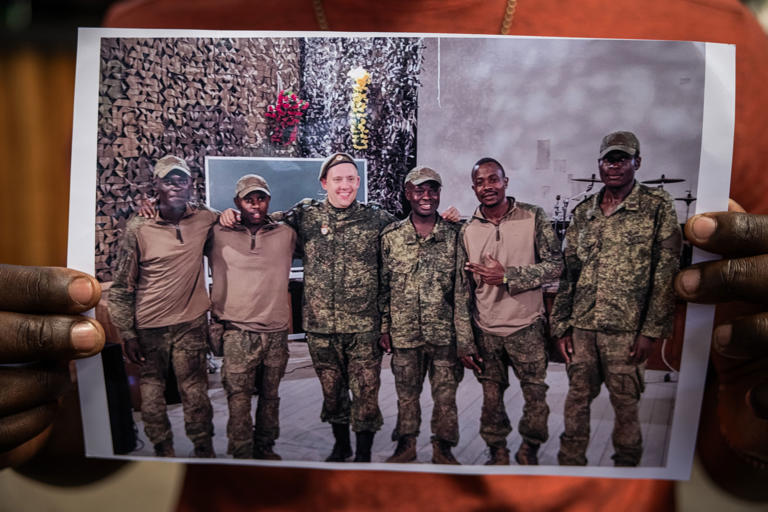
Hundreds of Kenyans have been recruited by the Russian military to serve on the front lines in Ukraine, according to former recruits and their families. Many have never returned.
Most men said they were tricked — offered civilian or “safe” security jobs in Russia, only to be handed a weapon and sent to the battlefield. Others were current or former soldiers who joined up as mercenaries, lured by promises of higher wages. The survivors described inhumane treatment by Russian commanders and harrowing scenes of slaughter.
While there have been isolated reports of Africans conscripted by Moscow to fight, The Washington Post uncovered an extensive clandestine pipeline stretching from Nairobi to the forests of eastern Ukraine. Russian recruitment in Kenya is more widespread, and more deadly, than previously reported, and the effort extends across the continent. The Post spoke to recruits or their family members in South Africa, Botswana, Tanzania and Nigeria, and it heard anecdotal accounts of fighters in Ukraine from eight other African countries, including Ghana, Zimbabwe and Cameroon — hidden victims of the largest European conflict since World War II.
The phenomenon is driven by two converging forces: economic desperation in Kenya, pushing young men to pursue vague promises of work thousands of miles from home, and the Russian military’s boundless appetite for fresh bodies, as it seeks to press its advantage in Ukraine without sending more of its own to die. In the middle are African recruiters, operating with direct or implicit help from political connections. Kenyan authorities have repeatedly urged young men to immigrate to Russia despite evidence that employment agencies are steering job seekers into combat.
This account is based on interviews with four Kenyans who fought in Ukraine — three of whom were wounded — and family members of nine other Kenyan recruits, including active-duty soldiers who traveled to Russia to join the military. Some came from specialized units run by military intelligence, or from the elite SPEAR team that guards the U.S. Embassy in Nairobi. The Post reviewed corroborating documents from the men sent to fight, as well as messages between recruiters and family members desperate for news of their loved ones.
Two of the injured Kenyans, neither of whom had military experience, said they were sent to fight in Ukraine with only a few days of training in a language they did not speak.
“They said: ‘Learn fast. We are taking you to the war,’” said the first man, whose hands were lacerated by shrapnel from a drone strike. He crossed rivers full of bodies on his first day, he said, and saw most of his party killed.
“I didn’t even see any people,” said the second Kenyan, who suffered burns to his head and hands in a separate incident. “It was just robots — drones — shooting at us.” Like others in this story, the men spoke on the condition of anonymity, fearing for their safety and for their fellow Africans still in the line of fire.
In November, Ukraine’s foreign minister said his government had identified 1,436 citizens from 36 African countries fighting for Russia.
“They are treated as second-rate, expendable human material,” Andrii Sybiha said in a post on X. Most, he added, “do not survive more than a month.”
Those who aren’t killed are often captured and imprisoned, survivors said, or wounded and prevented from returning home. Former recruits said those who refused to go to the front lines were threatened with arrest in Russia; others were deployed to deadly positions after their families talked to the media.
The Russian Defense Ministry did not respond to requests for comment.
The Kenyan government told The Post that it had learned of the recruitment schemes only through media reports three or four months ago, and that it was constrained by diplomatic norms. “Our ambassador [in Moscow] doesn’t have jurisdiction to leave his office and go into morgues,” said Hellen Gichuhi, Kenya’s secretary for diaspora welfare and partnerships. She declined to say how many Kenyans had asked the government about the fate of relatives in Russia, or how many Kenyans had been killed in Ukraine. “They are being recruited by rogue agencies,” she said.
Although some conscripts reported receiving salaries, most said their bank accounts were raided or frozen by recruiters. Many families said their loved ones simply went silent. A single WhatsApp group for relatives of missing Kenyans has nearly 100 members. Some have already had their worst fears confirmed.
Kenyan Grace Gathoni, 38, said her husband and the father of their four children, Martin Macharia, left for Russia on Oct. 21 after being promised a job as a driver or a cleaner. He was forced to sign a contract he didn’t understand, she said, and deployed to Ukraine.
When they last spoke on Nov. 19, she said, Macharia asked for her prayers. A week later, she saw his body on a Kenyan news bulletin.
Her 4-year-old keeps asking when he will return home, she said. The older ones know he’s not coming back.
The recruiters
Kenya, a longtime U.S. security partner in East Africa, is not growing fast enough to provide jobs for its population of 53 million. Young people struggle to find steady work; underfunded public schools and hospitals often lack staff and resources. Political graft is rampant.
President WilliamRuto has made exporting labor a central plank of his economic strategy, promising to send a million people abroad to work. Labor Minister Alfred Mutua visited Russia in June to highlight Kenyans who had found jobs there through an agency. Kenya’s prime cabinet secretary, Musalia Mudavadi, said in December that the two countries are discussing a labor treaty.
But The Post identified five Kenyan companies ostensibly recruiting for civilian jobs in Russia that instead funneled men to the front lines in Ukraine. Most prominent among them was Global Face, run by businessman Festus Omwamba, whom multiple families identified by name. Gichuhi, the diaspora welfare secretary, said most recruiters had been arrested and Global Face de-registered, although Omwamba was still at large.
Families also pointed to Edward Gituku, an associate of Omwamba who was arrested on human trafficking charges in September after 22 Kenyan men were detained while preparing to travel to Russia. Lawyer Danstan Omari, who initially represented Gituku, told The Post that his former client had admitted to sending more than 1,000 men to Russia, many of whom subsequently served in the military.
Eight Kenyans said they or their relatives had gone to Russia through Global Face, providing phone numbers registered to Omwamba, Gituku or other agency employees — and, in many cases, proof of payment to the recruiters. All said they were lured by the promise of civilian jobs, except for one man, a former Kenyan military recruit who said he knew he was being sent to fight.
The Post attempted to contact Gituku and Omwamba using numbers shared by families but was unable to reach them for comment. Global Face did not respond to emails seeking comment and appeared to have no physical offices in Kenya.
In April, Omwamba arranged for Oscar Khagola Mutoka, a 39-year-old veteran of Kenya’s U.S.-trained Ranger unit, and another local man to leave for Russia, according to Peter Shitanda Malalu, Mutoka’s cousin. Mutoka’s family last heard from him in June but kept sending messages; in January, they finally received a response from his phone. It was in Russian, from his former commander, saying he had been killed in August.
The message said “if we wanted the body, we can find it at the morgue in Rostov,” Malalu said. “We do not know if he was ever paid, but our family never received anything.”
The family shared that and other messages from the commander, including one in which he said that “compensation for the death of a soldier is granted to relatives who have citizenship of the Russian Federation” and in which he offered to bring Oscar’s body to Moscow’s airport. From there, he said, the family would be responsible for transportation costs.
In September, as Mutoka’s sister tried to trace him, she contacted a number registered to Omwamba. She received a reply saying he was in Russia and would follow up on Mutoka’s whereabouts, according to a voice note she shared with The Post. The last message from Omwamba’s number in January brushed off the family’s increasingly urgent pleas: “I do not want to be involved in your gossip,” he wrote on WhatsApp.
Another Kenyan woman, Risper Aoko Ouma, said her 39-year-old husband had flown to Russia in July on a flight arranged by Omwamba. A military veteran of 14 years, Duncan Otieno Juma was wounded almost immediately that month in a Ukrainian drone attack that killed another Kenyan and many other Africans, she said. He was then sent back to the front lines. She said she has not heard from him since August. When she asked a Global Face employee for news of her husband, she received a demand for money.
“How much are you ready to pay me?” the employee asked in a text message viewed by The Post.
More than a dozen African men were killed in October in the Kupyansk area of eastern Ukraine, Volodymyr Dehtyarov, a Ukrainian military public affairs officer, told The Post. Among the dead was a Kenyan man, whose passport he provided. The man’s family confirmed he had gone to Russia in September. They never heard from him again.
Kenyans are still making the journey, despite a growing awareness of their likely fate. A man who considered going to Russia but ultimately decided against it said two of his friends left on Dec. 27; immigration agents are watching out for men traveling to Moscow, he said, but it only means you have to pay an extra bribe.
The contract
One of the Kenyan recruits who made it back from Ukraine, a 32-year-old whose silver tooth flashed in a confident smile, now wears black gloves to hide the burns on his hands and a wool hat pulled low over burn scars on the back of his head. He said he paid Omwamba’s company and his employees a total of $390 for a civilian job in Russia.
Before he left, he said, he underwent a physical and met a man who identified himself as a member of the Russian Embassy in Nairobi. They gave him a contract in Russian to sign but refused to give him a copy, he said. He was told he’d be paid $2,650 per month for frontline work, $2,150 for a rear position away from the fighting and $885 for working back in Russia — still a small fortune in Kenya.
In August, he flew to St. Petersburg with three other civilians, all of whom were told they would work as security guards, and three former Kenyan soldiers. Despite having tourist visas, he said, they were taken by handlers to open accounts at Bank Saint-Petersburg, which is subject to U.S. sanctions. Then they were presented with new contracts — all offering frontline rates. None of them, he said, were given the option to stay in Russia.
“We said we need to translate this document, and we will sign it when we are satisfied,” the man recalled telling the Russian agent, but he was told there was no time. The men could either sign the frontline contract, the agent said, or repay the money they had spent to travel there.
“That’s what forced us to sign,” the recruit said.
A former member of Kenya’s armed forces now employed in the security sector said Omwamba’s company has recruited more than 50 military veterans whom he knew personally, including at least two who were working for a security company in the Middle East. Many had been killed, he said, citing accounts from his Kenyan contacts in Russia.
One recruit’s mother said he was a former military police officer who was working as a guard at the U.S. Embassy in Iraq when he was recruited by Russia. “He was my only son,” she said, showing a picture of a muscular man smiling on a beach. She paid nearly $3,900 to the recruiters to try to get him back, she said, but they took the money and he never came home. She doesn’t know if he’s alive.
Another person in the Kenyan security industry said he knew at least 32 active members of the military who had deserted to head to Russia. A woman said her 37-year-old brother, previously an inspector in the general service unit of the Kenyan police, had also made the trip, not realizing he was being recruited by the army. He sent an email upon arriving asking her to download a secure app so they could speak.
“He was in hiding,” she said. He was trying to escape, he told her. She never heard another word from him.
Michael Muchiri, a spokesman for Kenya’s police, told The Post that a key recruiter was arrested last year and that no serving officers had gone to Russia. The Kenyan militarydid not respond to requests for comment.
Sent to die
The 32-year-old recruit, along with 16 other Kenyans, a Guinean and several Cameroonians, undertook two weeks of training in shooting, navigation and fitness in Russian-occupied Ukraine, he said.
“We were told: ‘You are our machinery; you have to work like machines. … You must fight,’” he said. A fellow Kenyan nicknamed Mwas told him new conscripts all went in the same direction — “to the front line.” Mwas was killed shortly after they spoke, he said.
The man was among six Kenyans sent to fight; another six refused but eventually relented after they were threatened with arrest, he said.
On Sept. 16, his first day in combat, the 32-year-old, another Kenyan and three Russians were ordered to run across open ground to a forest. The area was mined, he said, and there were explosions. Their Russian guide shot at drones overhead and showed them how to navigate from dugout to dugout, he recalled, but the Kenyan began to lose his nerve when they came across a couple of Russian soldiers bleeding badly.
During their last sprint, he said, a drone fired explosives and bullets at them. The blast knocked him over and his backpack, stuck over his head, caught fire. One of the Russian soldiers was killed.
He was taken to a field hospital packed with wounded men, where he stayed for a week before being transferred by train to a hospital near St. Petersburg, he said. When doctors told him he was well enough to return to the front lines, he said, he hatched an escape plan. He asked that details not be divulged, as other injured soldiers might need similar contacts to get out, but he shared documents — including his medical report, Russian visa and a Russian military ID — to support his account. Before leaving the country, he managed to access his new bank account and withdraw about $5,000 from his promised signing bonus of $25,000.
At least, he said, he hadn’t come home empty-handed.
A 27-year-old Kenyan relayed a similar story: payments to Global Face staff, the offer of a civilian job and being taken by an agent to open a bank account after arriving in Russia. He had to sign a standing order giving the agency access to his account, he said. Later, when he tried to withdraw his money after being wounded, he was told his account was blocked. He provided a bank card, Russian military ID, medical records, photographs and other papers to support his account.
“The commanders said: ‘We have paid 1.5 million rubles to bring you here, so you’re in our hands,’” he said.
During his training in Rostov, he met about 30 other Kenyans, including a police officer from a paramilitary unit and a former soldier from the elite U.S.-trained long-range surveillance squad, he said — as well as men from Togo, Nigeria and Malawi.
“The trainers didn’t speak English. They just showed you how to shoot a gun,” he said.
In Ukraine, his group of 27 included five Kenyans, he said. They were ordered to sprint across open ground and cross two rivers, one swollen with bodies. Only he and another Kenyan survived the onslaught of Ukrainian drones, he said.
The recruit had injuries to his hands; the other man was wounded in the leg. They came across an injured radio operator, who messaged for help. None came. They spent another two days limping back to a Russian base.
The man said he was hospitalized with eight other wounded Kenyans, some South Africans and a Cameroonian. One had lost part of an arm; two had lost their legs.
“One man with no legs asked if he could go home,” he said, “and was told, ‘When your contract ends.’”
He escaped from the hospital, and then from Russia, he said. Since returning home, he has struggled to find work.
A third man who traveled to Russia in August said he and another Kenyan were given weapons but no training and ordered to carry heavy backpacks of rations to frontline positions in a Ukrainian forest.
When they reached the forward operating base, they were told to rest, the man said, then abandoned by the Russian soldiers they had resupplied. With no water, they drank from a river filled with corpses.
“We saw so many dead,” he said.
Source: Rael Ombuor and Katherine Houreld, “Kenyan job seekers were lured to Russia, then sent to die in Ukraine,” Washington Post, 2 February 2025. I have subscribed to the Washington Post for several years and have depaywalled this article as a public service. You can also access it for free here. ||||| TRR
