Image courtesy of alexandrinsky.ru via Delovoi Peterburg
Every Wednesday we tell you about an article that has proved the most interesting to one of our staffers.
Yulia Holtobina, manager of the Subscribers’ News project, has shared an article with us today.
Does modern society need cultural goods? In my opinion, they are simply necessary for people to grow spiritually and achieve inner harmony. Culture is the environment in which the life of the individual and the life of society take place. Culture makes a person a personality.
In our difficult time, people increasingly want to distract themselves, to get away from fatigue and the problems that have piled up. Theaters, cinemas, and museums are the cultural spaces where they can relax, feel joy, find positive energy and inspiration, and return to a stable life.
Delovoi Peterburg thus writes that the preferences of Petersburgers have not changed. People still enjoy going to theaters, museums, exhibitions, and St. Petersburg’s other cultural spaces.
Source: Delovoi Peterburg email newsletter, 16 November 2022. Translated by the Russian Reader
Theatergoers south of Moscow were held “hostage” and shot at by actors playing Ukrainian soldiers during an immersive play that glorifies Russia’s invasion of its neighbor, local media reported Tuesday.
Opening scenes from the production titled “Polite People” showed actors dressed in Ukrainian military uniforms violently capturing audience members and shooting them with what appeared to be prop assault rifles.
One female captive can be heard screaming “it hurts” and “let go” as the actors drag her onstage.
“Polite People” is a euphemism for the Russian soldiers without insignia who occupied Crimea before Moscow annexed the Ukrainian peninsula in 2014.
“The creators wanted to immerse the audience into the atmosphere of what Donbas residents had experienced for eight years,” the Kaluga region’s Nika TV broadcaster said, using the term for eastern Ukraine’s separatist-controlled Donetsk and Luhansk regions.
Actor Vilen Babichev, who portrays one of the Ukrainian troops, told Nika TV the play aims to show Russian audiences “the nature of the enemy that invaded our territories eight and a half years ago.”
President Vladimir Putin has justified Russia’s deadly invasion of Ukraine with unbacked claims that Kyiv is committing “genocide” against Russian-speaking residents of the Donbas.
“Polite People” is funded through a 10.1-million ruble ($165,000) Russian presidential grant.
Its author, Luhansk-based musician and film studio director Roman Razum, said the project aims to “create positive content to counteract negative content that carries an immoral ideology and counters the Russian cultural code.”
“We show that these aren’t just Ukrainian [soldiers], but fighters fully trained by NATO and supplied with weapons for many years,” Razum told Nika TV.
The play premiered in Kaluga on Monday following dates in occupied Luhansk and four Russian cities in late October and early November. It is expected to go on tour across a handful of other Russian cities until late November.
Source: “Russian Audiences Held ‘Hostage’ By Mock Ukrainian Soldiers in Pro-War Play,” Moscow Times, 9 November 2022
Is there room left in life for celebrating and if so, for what kind of celebrating? DP found out how the preferences of consumers of culture have changed this year.
The Social and Artistic Theater (SHT) told DP that its new season had got off to a good start. “I would say that audiences are going to the theater more, but the decision to go is made at the last moment. Our productions of Anne Frank, The Émigrés, and Cynics are now quite popular. Our classic production is still WITHOUT [An idiot], based on F.M. Dostoevsky’s novel The Idiot,” SHT director Alina Korol said.
No scarier than covid
The Bolshoi Puppet Theater (BTK) said that its audiences did not have any particular new preferences. There are traditionally sold-out performances at the theater, and less popular ones, but they have not noticed any new trends.
“After the start of the SMO, there was a drop-off in attendance that lasted a couple of months, maybe one and a half. If anything has changed post mobilization, it has been insignificant. But when a new wave of covid started in mid-September, many people began to get sick and the flow decreased,” the BTK’s sales department emphasized.
“People want to return to a stable life for at least a few hours, so they go to the theater. We almost always have full houses, and preferences have not changed,” commented Tatiana Troyanskaya, a public relations specialist at the Studio Theater. Among the favorites at the Studio are productions by the theater’s artistic director Grigory Kozlov (The Elder Son, Tartuffe, The Days of the Turbins, Quiet Flows the Don, as well as comedies (Our Avlabar; Dreams of Love, or the Marriage of Balzaminov), and productions for children.
Vladimir Kantor, the editor-in-chief of the magazine Petersburg Theatergoer and the head of the literary department at Saturday Theater, did not notice any new trends in the theater.
“I am familiar with the repertoire of other theaters, but I haven’t noticed any serious changes in audiences. Autumn and winter are the times when people traditionally go to the theater. I cannot mention any changes in the repertoire that can be described as trends. There were enough productions about war before the start of the SMO, as well as dystopias. I can’t name any productions about the new emigration at all,” he commented.
DP also sent requests for comment to several state theaters, including the Young People’s Theater (TYUZ) and the Alexandrinsky Theater, but did not receive responses. Meanwhile, the Alexandrinsky has removed Boris Akunin‘s name from the announcement of the premiere of One Eight Eight One. Akunin wrote the play specifically for the Alexandrinsky, but his name disappeared from playbills at the behest of the Ministry of Culture. Back in August, the audience received an email with a reminder about the upcoming premiere of One Eight Eight One — as “staged by Valery Fokin, with music by Vyacheslav Butusov, to the text by Boris Akunin.” A similar situation occurred in Moscow, at the Russian Youth Academic Theater (RAMT), where there are four productions of plays penned by the writer.
Akunin himself is aware of what has happened and does not condemn the theaters. “I sympathize with the heads of theaters… If a person has decided that the cause you serve is more important than damage to your reputation — this is a difficult choice from which you yourself suffer, but not your team and not your audience,” he wrote on his Telegram channel.
According to the writer, he has not demanded that uncredited productions be removed from the repertoire. On the contrary, they can go on until they are finally banned and even with no compensation to him. As Akunin noted, the Alexandrinsky Theater cannot pay him royalties due to sanctions.
Among private institutions, Beyond the Black River Theater and the City Theater declined to comment. On October 20, a performance of 1984 was canceled at the City Theater — as noted on its social media accounts, “for reasons beyond the theater’s control.” On October 31, the same production was presented to the audience in a new way: in a video format and featuring an encounter with the director and the actors. The theater’s management clarified that “this is probably the last time it would be possible to see 1984.” The theater also said goodbye to the anti-war production A Red Flower, based on the stories of Vsevolod Garshin.
Perennial classics
Petersburg museums did not respond to DP‘s questions about the changing preferences of its visitors. Official requests were sent to the Hermitage, the Russian Museum, and the Erarta Museum of Modern Art. The bookstores Subscription Editions and At the Top of the Voice and the bookstore chain Bookworm also declined to comment on the situation.
Alexander Prokopovich, editor–in-chief at the publishing house Astrel SPb, says that readers’ preferences had begun to change even before early February, during the pandemic, but the trends have persisted. According to him, classics and so-called longreads [longridy] — that is, literature that is demand at all times — have remained relevant, while speculative texts and fashionable literature [sic] have been losing ground.
“Readers reared their heads, rather, by remaining true to their interests in new titles; perhaps for obvious reasons, interest in new titles from the translated literature segment has increased. I have not encountered any restrictions. Writing is a strategic activity: it can take years to create a book, so it is not worth waiting for a sudden change in the subject matter of the fiction we publish. It is another matter that the events [of this year] are so emotionally charged that many authors have simply stopped writing. It is not our publishing housing that is in demand, but the books which we publish. Nothing has changed here: demand for them is determined by the quality of the texts. This has been the case in the past, and it will be the case in the future,” Prokopovich said.
Some authors claim that their works have disappeared from bookstores — for example, collections of poems by the poet Vera Polozkova. She left Russia in March. Over her fifteen-year career, Polozkova has written five books, published in a total of 280 thousand copies. On her social media accounts, the poet noted, “It would be strange to expect them [the authorities] not to touch the books after everything I’ve said and done.” She believes that she will be able to publish abroad either through crowdfunding or self-publishing [samizdat].
On the other side of the cultural barricades is RT editor-in-chief Margarita Simonyan. A month ago, the TV channel presented a collection of front-line poems, Poetry of the Russian Summer, but a few weeks later it transpired that Russian publishers were not willing to publish a book with the letter Z on the cover. Simonyan, on her Telegram channel, called it “a verdict on us all.”
Cinema depends on the weather
Cinemas were reluctant to comment on the situation. Aurora and Rodina did not answer DP’s questions, but Lenfilm did give an assessment of attendance factors. The cinema center’s management said that Lenfilm is difficult to compare with mass multiplex cinemas. “We show festival films, auteur cinema, and retrospectives. Therefore, aside from a general decrease in the number of viewers, the situation has not affected us so much, since our repertoire has stayed the same, and our audience has remained our audience. We are more dependent on the weather. After big news days, the attendance drops at first, but then it more or less levels off,” the studio commented.
Lenfilm also noted that its cinema center has been showing many Russian films. This year’s Lenfilm Film Club events have already featured screenings of Vladimir Kott’s Disobedient, Tatiana Kolganova’s Delayed Happiness Syndrome, and Ruslan Bratov’s Express.
Source: Alina Kizyakova, “Petersburgers looking for stability in theaters and books,” Delovoi Peterburg, 15 November 2022. Translated by the Russian Reader
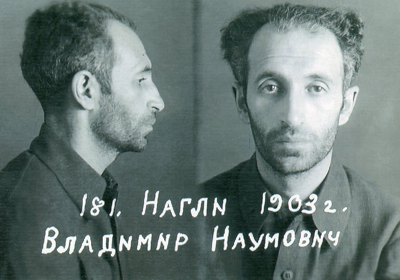
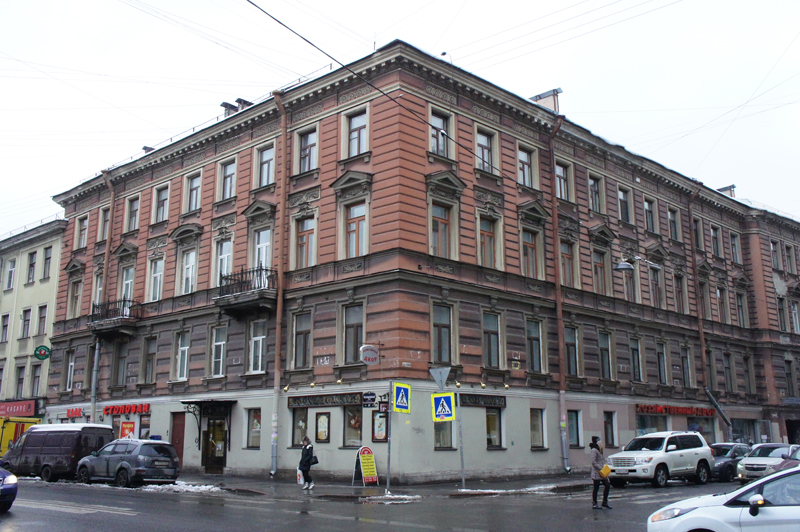
 “Here lived Vladimir Naumovich Nagly, theater director. Born 1903. Arrested 21 October 1938. Died 6 October 1940 in a prison camp in Kolyma. Exonerated in 1956.” Last Address memorial plaque at 38 Kolomenskaya Street in Petersburg’s Central District. Photo by the Russian Reader
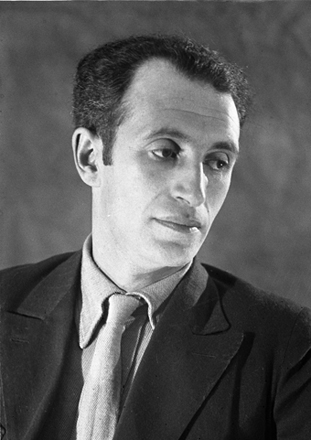 Vladimir Naumovich Nagly lived in the building in the 1930s.