When the Taxi Driver Asked Where You’re From

Eva Morozova, “When the taxi driver asked where you’re from”

When the taxi driver asked where you’re from

(If you’re not in the mood to explain why you still haven’t ousted the president)

[Image of Russian Federation foreign travel passport briefly flashes onscreen]

1. He, he, he! Huh?

2. Could you repeat your question? [in English]

3. Sorry, I don’t speak languages. [in English]

4. Artists have no nationality.

5. My ancestors came from the lower reaches of Transnistria.

6. From here and there, brother.

7. I’m not a fan of the concept of the state per se.

8. I’m from Rio de Janeiro.

9. When God made the earth, there were no borders.

10. From Siberia.

11. Look, a flock of pigeons!

[Pigeons drop the last passenger into “neutral waters.” Image of Russian Federation foreign travel passport flashes onscreen again.]

Source: Eva Morozova (YouTube), 28 June 2023. Translated, where necessary, by the Russian Reader. Thanks to Tatiana Kosinova for the heads-up and so much more.


@george.spb wrote the following comment when Eva Morozova posted the cartoon, above, on their Instagram page:

I always say that I am from Russia, even though I am [an ethnic] Georgian. I have never got a single unfriendly look. At most, they might somehow make a good-natured joke about it. All foreigners are well aware that not all people in Russia support the military action, especially those who have left. The only thing I won’t do is demonstrate Russian symbols or sing the Russian anthem until the war is over, a correct assessment of what happened has been made, and the perpetrators have been justly punished. I can’t change anything else; I was born there. And if a person is biased about it, then it’s not my problem anymore.

@intelligent_beauty_paris wrote:

It happened once here:
– Vous êtes d’où? – Where are you from?
– De la Russie. From Russia.
– C’est pas grave! / No big deal
/ It happens/ Don’t worry about it!

Source: eva__ morozova__ (Instagram), 27 June 2023. Translated from the Russian and the French by the Russian Reader


YALTA, Crimea, Aug 29 (Reuters) – In years past, Siberian Viktor Motorin could hop on a plane and arrive in Crimea just four hours later to relax at his holiday apartment. Now he must fly first to Moscow and then spend a day and a half on the train.

The war in Ukraine, now 18 months old, is making it harder for many Russians to reach their favourite summer haunts in the Black Sea region of Crimea, which Moscow seized and annexed from Ukraine in 2014.

And safety is a factor for some, especially after two major Ukrainian attacks since last October on the 19 km (12 mile) Crimean Bridge that links Russia by road and rail to the peninsula.

But after weighing up such concerns, Motorin, from the city of Khanty-Mansiysk in western Siberia, said he decided that making his annual trip was still a risk well worth taking.

“We calculated that it was reasonably safe, especially when my colleagues had already come here in June, early July. They said it was all calm here with no problems on the Crimea Bridge. The goods, the prices, everything is like before,” he said.

[…]

Source: “Russian tourism in Crimea is down, but many still shrug off risks,” Reuters, 29 August 2023


In 2022, the year when Russia’s full-scale invasion of Ukraine began, more than 4,300 people renounced their Russian citizenship, the highest such figure for the last three years. Among them were several major Russian businessmen, including [former] Troika Dialog CEO Ruben Vardanyan, venture capitalist Yuri Milner, and Tinkoff Bank founder Oleg Tinkov. However, the Russian Foreign Ministry said that the increase in “refuseniks” was due to the pandemic that raged earlier, claiming that “there are no particular changes in the numbers of requests to withdraw from Russian citizenship from abroad.” And the Russian Interior Ministry recently proposed reviewing the cases of people who have renounced Russian citizenship, that is, theoretically, a person’s citizenship could be forcibly reinstated. Farida Kurbangaleyeva talked to people who decided not to be Russian nationals anymore and found out why it mattered to them.

“If I have the sudden urge to live in Russia I’ll get a residence permit”

Andrei Kreinin, USA, renounced his Russian citizenship

I’ve wanted to emigrate to the USA since I was fifteen, when I saw the good old American movie Short Circuit 2. Spoiler alert: it ends with a scene of the main characters taking the oath of citizenship. I went to the States many times on a tourist visa, and in 2011 my family and I won a green card and moved to Chicago. In Moscow, I worked in telecommunications and I got a job in the same field in our new home.

The decision to renounce citizenship was made on February 25, 2022—after the brutal bombing of Kharkov, when people were hiding in the subway there. Firstly, because there is such a thing as a conscience, and secondly, my mother was born in Kharkov, and it was impossible for me to remain a Russian national. My family said, “We won’t do this. If you want to, do it, but then don’t pine for Russia.” I said I understood them perfectly. I had a couple of friends from Russia who called me bad words on social media, and I had to ban them. But mostly the attitude ranged from neutral to understanding: “It’s your business, Andrei.”

To renounce your citizenship, you need to do two main things—deregister your place of residence [in Russia, where everyone is required to register their place of residence] and get a paper stating that you owe no back taxes in the Russian Federation.

They say that it can be difficult to deregister remotely, so in June 2022 I flew to Russia. I took care of transferring my real estate and deregistering from my apartment. Basically, I covered all the important bases to the max. Before the trip, I carefully monitored the situation: I understood that there would be a mobilization. I actually thought it would be announced on May 9 [celebrated as Victory Day in Russia].

When I had collected all the paperwork, I took it to the consulate in New York. It did not go smoothly. About three months later, I received a letter saying my application had not been approved, because, according to the Interior Ministry’s databases, I was still registered—although I even had a stamp in my [internal] passport stating I had been deregistered. Consequently, I spent two or three sleepless nights, due to the time difference, trying to get through to the proper authorities in Russia. They said, “Send us your application again and a photo of the discharge stamp.” I sent them, and two days later I received a reply that I had been removed from the residence register.
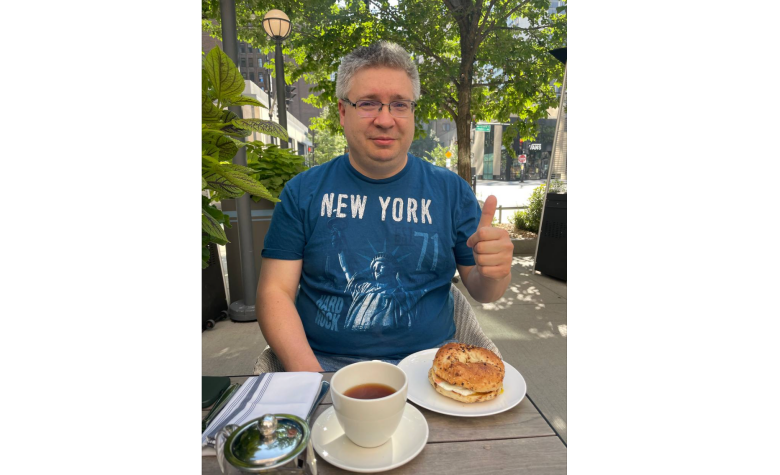
Andrei Kreinin
Photo courtesy of Mr. Kreinin via Republic

I forwarded the whole thing to the consulate again, hoping that they would accept the documents online. But they said, “No, you’ll have to come to New York again.” I went again, resubmitted [my application], and after another two and half months I was informed that my application had been approved. I was told to report to the consular department and hand over my [internal and foreign travel] passports, which I did.

I have heard that the [Russian] state does not like people like me, because it is one thing to renounce Russian citizenship in a country where it is a necessary condition for obtaining the local citizenship, for example in Germany or the Netherlands, and another thing when you could retain your Russian citizenship, but you renounce it of your own free will.

But I didn’t notice any particularly negative attitude on the part of the staff at the Russian consulate. They behaved absolutely normally.

When I was in Russia, I forgot to withdraw my military registration. I had to call the military enlistment office. “This is how it is, guys, I’m renouncing my citizenship,” I said. Surprisingly, they did not yell at me or call me a traitor to the motherland, although I expected it. They just said, “Theoretically, we don’t do this sort of thing, but as soon as you complete the procedure, send us your military registration card, a copy of the certificate of renunciation of citizenship, a copy of your US passport, and a written request to be removed from military registration.” There is no mail service between the US and Russia nowadays. I had to make use of different “private couriers”: there are special Facebook groups for [arranging pickups and deliveries of letters and parcels]. Three weeks later, a letter from the military enlistment office addressed to me arrived in Moscow, saying I’d been removed from the register.

I have now applied for a Russian visa, which is granted to US citizens for up to three years. Not that I was planning to go there, but, as the Ukrainians say, schob bulo [“just in case”]. Plus, my father is still in Russia. He has already sent me an invitation to me, but he says, “Just please don’t come.”

I have no plans to reinstate my Russian citizenship under any circumstances. If I have the sudden urge to live in Russia, I can easily get a residence permit. It’s more than enough for me.

As my experience in dealing with the Russian Federation shows, it is better, paradoxically, to be a foreigner—you have fewer obligations.

A residence permit grants a person the same privileges as citizenship [sic], except the right to vote. On the other hand, no one can force me to do military service. The civil service will also be closed to me, but I’ve never aspired to join it either in Russia or the US.

[…]

Source: Farida Kurbangeleyeva, “‘It is better to be a foreigner in the Russian Federation—there are fewer obligations’: seven stories of people who relinquished Russian citizenship,” Republic, 28 August 2023. Translated by the Russian Reader, who lived on a resident permit in Russia for many years and knows for a fact that Mr. Kreinin is dead wrong about the “privileges” of living there in that tenuous capacity.


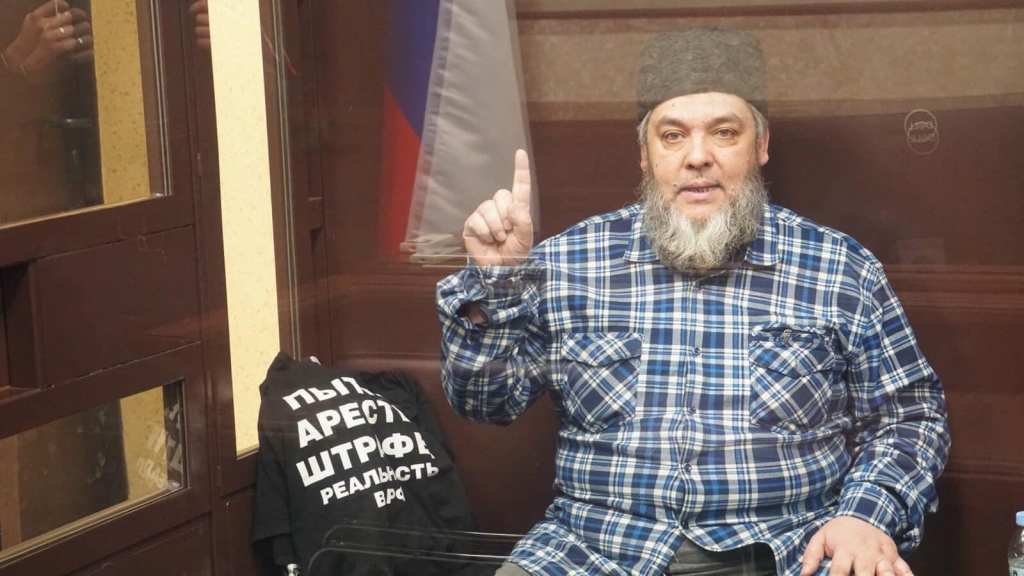
The grandfather of renowned Crimean Tatar historian Shukri Seitumerov was executed during Stalin’s Terror for supposed ‘counter-revolutionary terrorist propaganda’. Eighty years later, Russia’s FSB came for Shukri’s two elder sons, Seitumer and Osman Seitumerov, as well as his wife Lilia’s brother, with the ‘terrorism’ charges they faced no less politically motivated.  Such arrests and subsequent sentences of up to 20 years are part of Russia’s ongoing attack on the Crimean Solidarity human rights movement and are also simply ‘good for FSB statistics’.  For the next round of victims, armed Russian FSB burst into the Seitumerov home yet again at 4 a.m. on 24 August, this time taking Shukri and Lilia’s last son away from them.Abdulmedzhit Seitumerov is just 23 and became a father less than 2 months ago.

Armed and masked enforcement officers carried out multiple ‘searches’ in the early hours of 25 August, with six Crimean Tatars taken away.  All are now facing the huge sentences that have become a standard part of Russa’s most cynical conveyor belt of repression in occupied Crimea.  Ruslan Asanov (b. 1975); Remzi Nimetulayev (b. 1985); Seidamet Mustafayev (b. 1995); Abdulmedzhit Seitumerov (b. 1999); Ametkhan Umerov (b. 1986) and Eldar Yakubov (b. 1980) are Crimean Solidarity activists who had previously faced administrative prosecution for peaceful acts of solidarity with other political prisoners. 

This is one of the many identical elements in these cases which have been internationally condemned as politically motivated persecution.  The ‘armed searches’ are invariably carried out without the men’s lawyers allowed to be present, and with the FSB most often bringing the so-called ‘prohibited religious literature’ that they then claim to have found.  The men are generally forced to the ground, often in front of their terrified children, and then taken away as though criminals, although none is accused of any recognizable crime. 

The charges are equally predictable with the Crimean Tatars accused solely of unproven ‘involvement’ in Hizb ut-Tahrir.  This peaceful transnational Muslim organization was declared ‘terrorist’ by Russia’s Supreme Court in 2003, with the ruling passed in secret and probably politically motivated (making it easier for Russia to send refugees back to Uzbekistan where they faced religious persecution for involvement in Hizb ut-Tahrir).  No explanation has ever been provided for why an organization not known to have committed terrorist attacks anywhere in the world should be so labelled, and the organization has always been legal in Ukraine.  

Despite the lack of any grounds and in clear violation of international law which prohibits Russia from applying its legislation on occupied Ukrainian territory, Russia has been imprisoning Crimean Tatars (and a few other Ukrainian Muslims) on these charges since 2015.  The sentences have been getting longer and longer (up to 20 years), as Russia openly targets Crimean Solidarity journalists and activists speaking out about repression in occupied Crimea.

In all such ‘cases’, at least one man is invariably charged with the more serious Article 205.5 § 1 of Russia’s criminal code (‘organizing a Hizb ut-Tahrir group’), while the others face the lesser charge of ‘involvement’ in the purported ‘group’, under Article 205.5 § 2.  There is plenty of evidence from previous ‘trials’ that the more serious charge (carrying sentences of 17-20 years at present) are often laid in reprisal, for example, against Raim Aivazov for refusing to remain silent about the torture he faced from the FSB.  The men will likely also be charged with ‘planning a violent uprising’ (Article 278).  Once again, this is purely based on the 2003 Supreme Court ruling, with none of the political prisoners having ever been accused of actions or direct plans to commit any action aimed at ‘overthrowing the Russian constitutional order.’

The ‘evidence’ is as flawed as the charges.  It hinges on FSB-loyal ‘experts’ providing ‘assessments’ of innocuous conversations about religion, Russian persecution, etc. to fit the prosecution and ‘anonymous witnesses’, whose testimony cannot be verified, and who may have never met the men. 

Six families have been ripped apart, with children left traumatized and elderly parents facing never seeing their sons again.  

Russia uses such arrests and ‘trials’ as a weapon against the Crimean Solidarity human rights movement and as an instrument of terror and propaganda against Crimean Tatars who have from the outset demonstrated so clearly their identification with Ukraine.  The FSB are known to get promotion or bonuses for providing such ‘cases’ and can boast of ‘good statistics on fighting terrorism’.

Abdulmedzhit Seitumerov (b. 1999) was just 20 when the FSB came for his brothers, Seitumer Seitumerov (b. 1988) and Osman Seitumerov (b. 1992) and their uncle, Rustem Seitmemetov (b. 1973).  For his parents, this was already a terrible blow, especially since Russia illegally imprisons the men thousands of kilometres from their homes.  Now all three sons have been taken from them, and, if Russia is not stopped, Abdulmedzhit’s son Khamza, born on 5 July this year, will spend most of his childhood without his father.   Abdulmedzhit had been active in Crimean Solidarity, speaking out in defence of his brothers and other political prisoners.

Ametkhan Umerov (b. 1986)

The 37-year-old Crimean Solidarity activist was detained and fined in July 2019 for a picket in Moscow in support of four Crimean Tatar political prisoners.  He was one of 21 Crimean Tatars detained inh November 2021 for trying to stand outside an occupation ‘court’ during the appeal hearing in the case of three other political prisoners. Then in February 2022, he was jailed for several days for trying to attend a purportedly open (but political) ‘court’) hearing.

Ametkhan has three daughters and a son, all of them very young: Zamira (b. 2015); Khatidzha (b. 2017); Ali (b. 2019) and Zainab (b. 2021).

Seidamet Mustafayev (b. 1995)

Seidamet is just 28, but has faced several administrative prosecutions since 2017, when he was jailed for 10 days for taking part in what the occupation regime called an unsanctioned meeting (in fact, people standing outside in solidarity) during an armed search of the home of (now) political prisoner Seiran Saliyev.  In 2021, he was also detained and fined for having tried to stand outside an occupation ‘court’ during a political hearing.  In February 2022, he was also jailed for several days for trying to attend a purportedly open (but political) ‘court’) hearing.

Seidamet has four small children: Suleiman (b. 2014); Salsabil (b. 2016); Latifa (b. 2020) and Osman (b. 2023).

Remzi Nimetulayev (b. 1985)

Remzi was detained for the first time on 23 November 2021 when he came to the police holding unit in occupied Simferopol to greet lawyer Edem Semedlyaev, who had been jailed for 12 days for trying to carry out his professional duties.  Remzi was  jailed for 10 days.

He has five daughters: Aishe (b. 2009); Anife (b. 2019); Adile (b. 2013); Yasmina (b. 2016) and Alime (b. 2020).

Eldar Yakubov (b. 1980)

The 43-year-old was detained and fined on 25 October 2021 outside the Crimean occupation military ‘court’ during an appeal hearing against the sentences passed on three political prisoners.  

He has four daughters and two sons: Safiye (b. 2004); Khalid (b. 2008); Meryem (b. 2013); Khamza (b. 2017); Selime (b. 2018) and Asiya (b. 2021).

Ruslan Asanov (b. 1975) is also a Crimean Solidarity activist.
Source: Halya Coynash, “Russian FSB seize Crimean Tatar family’s last son in new wave of terror against Crimean Solidarity activists,” Kharkhiv Human Rights Protection Group, 25 August 2023

News from Ukraine Bulletin 58

Monterey, California, 6 August 2023. Photo by the Russian Reader

News from Ukraine Bulletin 58 (7 August 2023)

A Digest of News from Ukrainian Sources

In this week’s bulletin: An eyewitness account of the battle for Dmytrivka; plus how Russia is targeting Ukraine’s healthcare systemplus Russia’s indoctrination of Ukrainian schoolchildrenplus Russia’s use of sexual violence in the conflict.

News from the territories occupied by Russia:  

The Russians hunting for cheap flats in occupied Mariupol  (BBC, August 6th)

Russians brought into occupied Mariupol in hordes, with Ukrainians treated as second-class citizens  (Kharkiv Human Rights Protection Group, August 4th)

Savagely tortured Ukrainian political prisoner has spent nine years in Russian captivity  (Kharkiv Human Rights Protection Group, August 4th)

Armed terror and threats of imprisonment, or worse, if Crimean Solidarity journalist doesn’t stop reporting repression in Russian-occupied Crimea  (Kharkiv Human Rights Protection Group, August 3rd)

Kherson doctor killed in latest of almost one thousand Russian attacks on Ukraine’s healthcare system (Kharkiv Human Rights Protection Group, August 2nd)

Ukrainian children in occupied Crimea will be forced to learn how to ‘defend’ Russia in its war against Ukraine  (Kharkiv Human Rights Protection Group, August 1st)

Russia is illegally imprisoning over 500 Ukrainian medics in horrific conditions (Kharkiv Human Rights Protection Group, August 1st)

Statement of human rights organisations regarding the unlawful detention by Russian security forces of free listeners and Crimean journalists Lutfiye Zudiyeva and Kulamet Ibraimov (Centre for Civil Liberties, July 28th)

News from Ukraine – general:  

Every Field, Every Yard  (London Review of Books, August 10th)

Ukraine’s medics are calling for change – but nobody is listening (Open Democracy, August 3rd)

Ukraine’s NABU violates the rule of law  (Kharkiv Human Rights Protection Group, August 3rd)

The case against Georgiy Logvynskyi must be closed. An open statement  (Kharkiv Human Rights Protection Group, August 3rd)

Authorities should not persecute volunteers as the state relies on them during war – Danyil Popkov  (Zmina, July 26th)

Ukraine Workers’ Medical Aid  (Ukraine Solidarity Campaign, August 2023)

Analysis and comment: 

Russification in the Soviet Union after Stalin (Ukraine Solidarity Campaign, 6 August)

Russia has turned grain into a weapon: how Putin is exploiting hunger and deceiving Africa  (Ukrainska Pravda, August 4th)

I’m a Ukrainian leftist. This is why I support Boris Kagarlitsky  (Open Democracy, August 1st)

How Russian colonialism took the Western anti-imperialist Left for a ride (Salon, July 31st)

Research of human rights abuses: 

Apparent Russian Cluster Munition Attack (Human Rights Watch, August 4th)

Russian forces have used sexual violence as a weapon against Ukraine  (Tribunal for Putin, August 3rd)

When the sky is blacker than the Earth — the battle for Dmytrivka  (Kharkiv Human Rights Protection Group, August 3rd)

Over 24, 000 civilians killed, wounded, or missing, during 14 months of war  (Tribunal for Putin, August 2nd)

He dreamed of building a superhouse (Kharkiv Human Rights Protection Group, August 2nd)

‘Couple of men were sitting drinking tea in the kitchenette. A shell fell there and they were just torn apart’ (Tribunal for Putin, August 1st)

‘When Freedom Square was hit by a rocket, our house shook’  (Kharkiv Human Rights Protection Group, August 1st)

International solidarity: 

Confessions of Chechen fighters for Ukraine (The Insider, 4 August)

Building International Solidarity for Ukraine: Three Perspectives  (Posle, August 1st)

Welsh unions are supporting Ukrainian workers. We need more of this solidarity  (Open Democracy, July 31st)

==

This bulletin is put together by labour movement activists in solidarity with Ukrainian resistance. More information at https://ukraine-solidarity.org/. We are also on Twitter. Our aim is to circulate information in English that to the best of our knowledge is reliable. If you have something you think we should include, please send it to 2022ukrainesolidarity@gmail.com.

The bulletin is also stored on line here

To receive the bulletin regularly, send your email to 2022ukrainesolidarity@gmail.com. To stop it, please reply with the word “STOP” in the subject field.  

Juneteenth

A view of the fire watch tower on Snively’s Ridge, Garland Ranch Regional Park, Carmel Valley, California, 19 June 2023.
Photo by the Russian Reader

The supposed ‘trial’ has begun in Rostov[-on-Don] (Russia) of 22 Ukrainian prisoners of war, many of whom, though not all, are members of the Azov Battalion who were seized while defending Mariupol against the Russian invaders in 2022. Moscow is using a baseless, and post-dated, ruling claiming the Azov Battalion to be a ‘terrorist organization’ as its excuse for violating international law and trying men and women for defending their own country against an invading enemy. The photos from the first hearing on 14 June suggest that at least the Ukrainian men are being held without enough to eat and probably in conditions which are, in themselves, a breach of the Geneva Conventions.

This legal travesty is to take place at the same Southern District Military Court which has been passing politically motivated sentences against Crimean Tatar and other Ukrainian political prisoners since 2014.  That, however, is not the only similarity, since Russia is effectively using identical charges as those used to pass sentences of up to 19 years’ imprisonment against political prisoners from occupied Crimea, most of them Crimean Tatar civic journalists and activists.

The charges against the Ukrainian POWs are, firstly, of involvement in an organization recognized in Russia (and nowhere else) as ‘terrorist, under Article 205.5 of Russia’s criminal code.  All of the men and women, however, were taken prisoner before Russia’s Supreme Court declared Azov to be ‘terrorist’ on 2 August 2022, making the charges illegal even according to Russian law.  The second charge is more incredible.  All are accused of ‘actions aimed at violent seizure of power or violent retention of power and violation of Russia’s constitution’.  Even if, as is possible, the Russian Investigative Committee is claiming that the Ukrainians were seeking ‘to overthrow’ Russia’s proxy ‘Donetsk people’s republic’, this could still not begin to justify such a charge since Mariupol was not within this pseudo formation until Russia bombed and destroyed around 90% of Mariupol’s infrastructure in order to gain control of it.  Those convicted, and the ‘court’ in question invariably passes only those sentences demanded of it, face sentences of from 15 years to life imprisonment. 

It was originally reported that 24 men and women were to go on trial, however on 14 June, it was learned that two POWs — David Kasatkin and Dmytro Lablinsky — had been released in an exchange of prisoners.

Most reports call all of the 22 remaining members of the Azov Battalion, however the Russian newspaper Kommersant has indicated that several were either members of Ukraine’s National Guard or were seized in Mariupol, but had served in the Azov Battalion long before Russia’s full-scale invasion.  The eight (perhaps nine) women were, Kommersant asserts, cooks for the Azov Battalion and, purportedly, all signed ‘confessions’.  It is possible that those ‘confessions’, making it possible for claims that some ‘admit guilt’, are the reason why Russia has included them in the ‘trial’, as well as their assertion that they were only there because they needed a job, etc.

From the reports available, it would seem that many of those whom Russia has put on ‘trial’ should, in fact, be treated as civilians. Those who were defending Mariupol and the Azovstal Steelworks are prisoners of war who are protected, under the relevant Geneva Convention, from prosecution merely for taking part in hostilities.  The only exception is if they are found guilty of war crimes.  It is telling that Russia has thus far used its proxy ‘Donetsk and Luhansk people’s republics’ to stage any supposed ‘trials’ on war crimes charges.  These illegal entities are not recognized by the international community and one of the many reasons why Freedom House earlier rated the two entities together as almost on a par with North Korea was the total lack of rule of law and mechanisms for a fair trial.  There are absolutely no grounds for believing that the men sentenced to terms from 12 to 25 years by these quasi ‘republics’ were guilty of the crimes alleged, or indeed, that the supposed war crimes even took place.  Among these ‘sentences’ was the 13-year term of imprisonment against well-known human rights activist and journalist Maksym Butkevych.  He is known to have been denied access to a lawyer, and there is evidence that he was not even in Donbas when the ‘war crime’ was alleged to have taken place.

The farcical nature of such ‘court’ stunts was, in fact, seen and condemned by the international community when the so-called ‘Donetsk people’s republic’ ‘sentenced’ two Britons (Shaun Pinner and Aiden Aslin) and Moroccan Brahim Saadoun to death, claiming them to have been ‘mercenaries’ although all were contract soldiers in Ukraine’s Armed Forces and, unequivocally, prisoners of war.

Russia first showed its contempt for the lives of Ukrainian and other prisoners of war, and for international law, when, on 29 July 2022, as many as 50 Azovstal defenders and other Ukrainian POWs were killed in an unexplained explosion at the Russian-controlled Olenivka Prison.  While Russia followed its usual policy and blamed Ukraine, it also actively blocked investigations by the UN and International Red Cross which made sense only if they were behind this effective mass murder of men protected under international law.

The ’trial’ now underway is presumably for internal consumption as the images of emaciated Ukrainian prisoners of war are shocking, as is the cynical lawlessness of the charges against the Ukrainian men and women.

Source: Halya Coynash, “Russia begins illegal show ‘trial’ of Ukrainian POWs for defending Ukraine in besieged Mariupol,” Human Rights in Ukraine, 16 June 2023. Thanks to News from Ukraine Bulletin No. 51 for the heads-up.


This story starts — but certainly doesn’t end — in 19th century Maryland, when John Townshend updated his will.

Townshend grew convinced at the end of his life that God would punish him if he did not free the enslaved people he owned and give them all of his property. But Townshend’s relatives challenged his final wishes in court, arguing that his decision had been the result of a delusion.

That 1848 case was the first U.S. appearance of what became known as the “insane delusion rule,” which remains grounds for contesting wills to this day. And Townshend v. Townshend itself has been cited in at least 70 other cases across the country — from New Hampshire to California — over the years, as recently as 2007.

It’s one of thousands of cases involving enslaved people that lawyers and judges continue to cite as good precedent, more than a century after the 13th Amendment abolished slavery in the U.S.

Justin Simard, an assistant professor at Michigan State University’s College of Law, estimates there are about 11,000 such cases out there — and about one million more that use them to back up their arguments.

“I’ve done some analysis just with a sample of cases and concluded that 18% of all published American cases are within two steps of a slave case, so they either cite the slave case or cite a case that cites a slave case,” Simard tells NPR. “The influence is really, really extensive.”

Simard has spent years documenting them, with the help of some two dozen law students.

The result is the Citing Slavery Project, a comprehensive online database (and map) of slave cases and the modern cases that cite them as precedent. They expect to add the last of their nearly 9,000 collected cases to the website this summer.

The project aims to push the legal profession to grapple with its links to slavery, an overdue reckoning that Simard hopes will start with lawyers and judges acknowledging their use of the troubling precedents.

He says 80% of the time judges don’t mention that these cases involve slavery at all, either because they’re unaware or uncomfortable.

“We’re not saying don’t cite them,” he explains. “All I’m asking people to do is just don’t cite them without acknowledgement, without thinking through whether it actually makes sense to cite them, which I think is a pretty reasonable thing to ask.”

[…]

Source: Rachel Treisman, “Slave cases are still cited as good law across the U.S. This team aims to change that,” NPR, 14 June 2023

News from Ukraine Bulletin 27

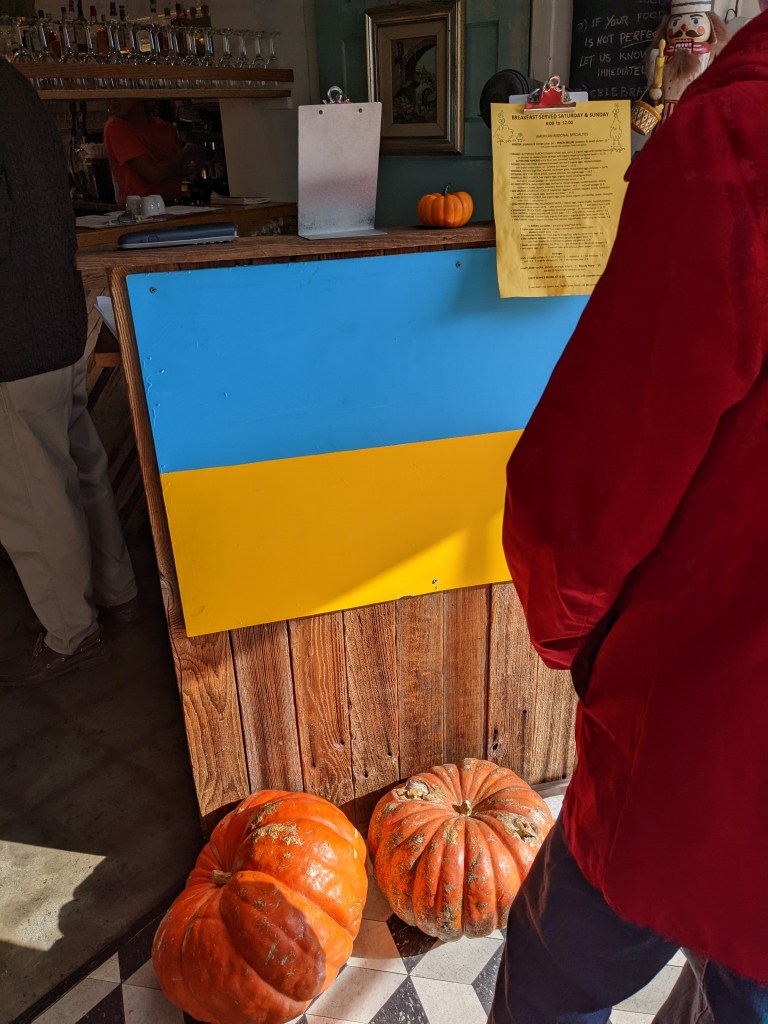
A Ukrainian flag at Il Vecchio Italian restaurant in Pacific Grove, California, October 2022. Photo by the Russian Reader

News from Ukraine Bulletin 27 (3 January 2023)

A Digest of News from Ukrainian Sources

News from the territories occupied by Russia:

Russia moves to legislate ‘impunity’ for all war crimes committed in occupied Ukraine  (Kharkiv Human Rights Protection Group, December 30th)

Crimean Tatar civic journalist sentenced to 11 years for refusing to collaborate with Russia’s FSB  (Kharkiv Human Rights Protection Group, December 30th)

Russians kidnapped 30 mayors, 7 of them went missing – Kyiv Mayor  (Ukrainska Pravda, December 30th)

Detention centre employee who helped torture Ukrainians found in Kherson  (Ukrainska Pravda, December 30th)

Abducted Ukrainian civic journalist sentenced to 7 years in brazen show of lawlessness in Russian-occupied Crimea   (Kharkiv Human Rights Protection Group, December 29th)

Russia plans to imprison soldier who admitted to murder and plunder in Ukraine – for ‘circulating fake news’  (Kharkiv Human Rights Protection Group, December 28th)

“She did everything so that Ukraine could see: Crimeans are still waiting for liberation”: human rights activists called Iryna Danylovych’s sentence fabricated (Zmina, December 28th)

Russians threatened to kill abducted Crimean Tatar’s family if he didn’t sign fake ‘confession’  (Kharkiv Human Rights Protection Group, December 28th)

News from Ukraine – general:

Life during wartime (Alice Zhuravel on Twitter, January 2nd)

Ukraine prepares to give free rein to property developers  (Open Democracy, December 28th)

14 tons of humanitarian aid delivered to Donetsk (Confederation of Free Trade Unions of Ukraine, 26 December)

Film about the working conditions of Ukrainian railway workers  (Spil’ne / Solidarity Collectives, December 27th)

Trapped in the Trenches in Ukraine  (New Yorker, December 26th)

Analysis and comment:

Special Issue on Ukraine  (Insurgent Notes, January)

“There is nothing cheaper in Russia than human life”  (Der Standard, December 31st)

Russia. Renaissance is not going to happen  (People & Nature, December 28th)

TikTok in service of FSB. How a social network for funny videos turned into a Kremlin propaganda mouthpiece  (The Insider, December 28th)

How Kremlin organizes pro-Putin rallies in Germany and why neo-Nazis participate  (The Insider, December 27th)

Multipolarity, the Mantra of Authoritarianism  (The India Forum, December 20th)

Making Sense of a Senseless Conflict in Ukraine? (Europe Solidaire, December 23rd)

Research of human rights abuses:

Homes and lives destroyed in northern Ukraine (Tribunal for Putin, 28 December)

Ukraine must ratify the Rome Statute now (Tribunal for Putin, 28 December)

“They put him in the basement, tortured him, and tore his tendons.” How Russia terrorizes ZNPP staff to keep a tight grip on the plant  (The Insider, December 22nd)

International solidarity:

Thanks to you  (Solidarity Collectives, December 29th)

==

This bulletin is put together by labour movement activists in solidarity with Ukrainian resistance. More information at https://ukraine-solidarity.org/. We are also on Twitter. Our aim is to circulate information in English that to the best of our knowledge is reliable. If you have something you think we should include, please send it to 2022ukrainesolidarity@gmail.com.

To receive the bulletin regularly, send your email to 2022ukrainesolidarity@gmail.com. To stop it, please reply with the word “STOP” in the subject field.  

News from Ukraine Bulletin 25

A pro-Ukrainian poster in the window of a home in Monterey, California, 18 December 2022. Photo by the Russian Reader

News from Ukraine Bulletin 25 (18 December 2022)

A Digest of News from Ukrainian Sources

News from the territories occupied by Russia:

Russians abduct about 40 children from Luhansk Oblast to Russia  (Ukrainska Pravda, December 16th)

Russian invaders abduct Melitopol lecturer in new wave of terror (Kharkiv Human Rights Protection Group, December 15th)

Unending torture of Crimean Tatar political prisoner for refusal to collaborate with Russia’s FSB  (Kharkiv Human Rights Protection Group, December 14th)

Children’s torture chambers found in liberated territories  (Ukrainska Pravda, December 14th)

Russians hold 232 residents of Zaporizhzhia Oblast in captivity  (Ukrainska Pravda, December 12th)

Russian invaders abduct Ukrainians in large numbers for grotesque ‘international terrorism trials’(Kharkiv Human Rights Protection Group, December 12th)

News from Ukraine – general:

3,000 miners trapped in mines after Russian missile strikes in Dnipropetrovsk Oblast  (Ukrainska Pravda, December 17th)

Number of child victims continues to rise: Russia has killed 450 Ukrainian children  (Ukrainska Pravda, December 17th)

Ukraine is fighting for freedom. That means protecting independent journalism  (Open Democracy, December 15th)

Law on the Media, Electoral Code, and Days of Silence as a Rudiment (Opora, December 14th)

Twenty percent of Ukraine’s population leave country because of war  (Ukrainska Pravda, December 14th)

Meet the Activists Arming Leftists on Ukraine’s Frontlines  (Novara Media, December 12th)

KVPU activities during #16daysofactivism  (Confederation of Free Trade Unions of Ukraine, December 12th)

“Had to crawl past severed arms and legs for a long time, can’t eat meat anymore”. How AFU fighters cope with PTSD  (The Insider, December 10th)

Analysis and comment:

No, privatisation should not be restarted after the war  (Spil’ne (Commons), December 14th)

The Left View on the Prospects of Peace Negotiations  (Sotsia’lnyi Rukh, December 12th)

Research of human rights abuses:

Russian propaganda media and ex-President guilty of direct incitement to genocide in Ukraine, report finds  (Kharkiv Human Rights Protection Group, December 13th)

Truncheons, stun guns, gas masks. A report from a Russian torture chamber in Izium  (Tribunal for Putin, December 13th)

==

This bulletin is put together by labour movement activists in solidarity with Ukrainian resistance. More information at https://ukraine-solidarity.org/. We are also on Twitter. Our aim is to circulate information in English that to the best of our knowledge is reliable. If you have something you think we should include, please send it to 2022ukrainesolidarity@gmail.com.

To receive the bulletin regularly, send your email to 2022ukrainesolidarity@gmail.com. To stop it, please reply with the word “STOP” in the subject field.  

News from Ukraine Bulletin 23

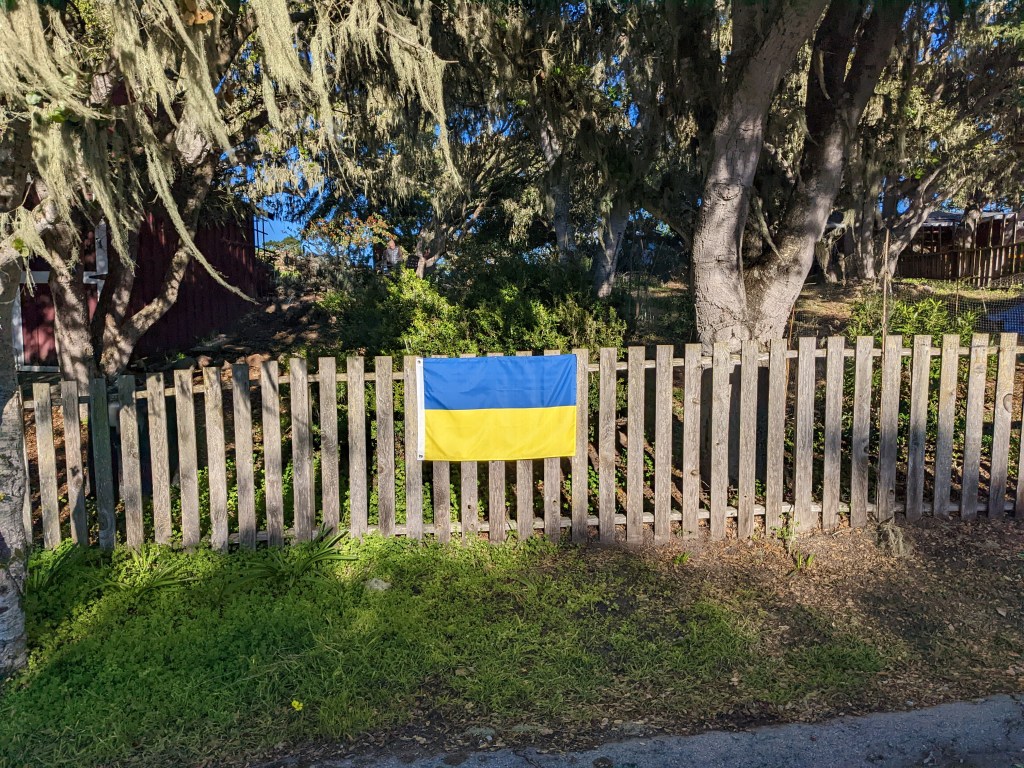
A Ukrainian flag on the fence of a home in Monterey, California, 14 November 2022. Photo by the Russian Reader

News from Ukraine Bulletin 23 (4 December 2022)

A Digest of News from Ukrainian Sources

News from the territories occupied by Russia:

Russian occupiers hand out draft summons to residents queuing for water in occupied Makiivka  (Ukrainska Pravda, December 4th)

‘Pensioner from Makariv witnesses the death of his grandson’  (Tribunal for Putin, December 2nd)

The Russians “amused themselves”, destroying Izyum’s old buildings  (Tribunal for Putin, December 2nd)

Russians deliberately beat Ukrainian haemophiliac, threaten to rape his 17-year-old sister in front of her father  (Kharkiv Human Rights Protection Group, December 2nd)

Children trained to be ‘Putin’s faithful soldiers’ in Russian-occupied Crimea  (Kharkiv Human Rights Protection Group, December 2nd)

Russia sentences Crimean Solidarity activist to 17 years for defending political prisoners  (Kharkiv Human Rights Protection Group, December 1st)

Russians forcibly deport 37 local residents from Kinburn Spit  (Ukrainska Pravda, November 30th)

Russian occupiers in southern Ukraine interrogate children who fail to attend Russian schools  (Ukrainska Pravda, November 30th)

Evangelical deacon and his son found murdered near Nova Kakhovka after being abducted by the Russians  (Kharkiv Human Rights Protection Group, November 30th)

The Southern District Military Court in Rostov-on-Don sentenced another Crimean Tatar activist – Marlen Mustafatev to 17 years in prison  (Lutfiye Zudiyeva on Twitter, November 30th)

Ukrainian poet and writer Volodymyr Vakulenko killed after being seized by Russian invaders (Kharkiv Human Rights Protection Group, November 29th)

Russian invaders abduct two Ukrainian Greek Catholic priests from Berdiansk and accuse them of ‘terrorism’  (Kharkiv Human Rights Protection Group, November 29th)

Threatened and starved: Russian sergeant tortured Donbas veterans in Katiuzhanka  (Ukrainska Pravda, November 28th)

Lecturer beaten, ‘tried’ and imprisoned in Russian-occupied Crimea for a Ukrainian patriotic song  (Kharkiv Human Rights Protection Group, November 28th)

Forcing Ukrainians to take up arms against their country is a war crime.” How Russia is mobilizing Ukrainians in occupied territories  (The Insider, November 12th)

News from Ukraine – general:

Ukrainians on the front line face a winter without warmth or light (Open Democracy, December 1st)

Ukraine’s nurses face brutal winter as health austerity collides with war  (Open Democracy, November 29th)

Dark times. How Ukraine is surviving without light, water, and heat  (The Insider, November 28th)

32,000 civilian properties and 700 infrastructure facilities have been damaged by Russians  (Ukrainska Pravda, November 27th)

Analysis and comment:

Thread in response to my thread about tankies and the Holodomor  (Taras Bilous on Twitter, December 2nd)

Economic Policy of Ukraine  (Luke Cooper on PeaceRep, December 1st)

Solidarity vital to expel Russia  (The Chartist, November 29th)

Together in Trouble: Social Policy for Just Reconstruction in Ukraine  (Spil’ne (Commons), November 28th)

Learning At The Teachers  (The Pensive Quill, November 27th)

Research of human rights abuses:

Abducted and tortured by the Russians, Kherson’s survivors tell their stories (Open Democracy, December 1st)

Ukraine 5AM Coalition will discuss in The Hague the mechanisms of holding Russia accountable for war crimes  (Zmina, December 1st)

‘Every second felt like eternity’: Inside the torture chambers of Ukraine’s occupied northeast (The Independent, December 1st)

Damage to historical monuments and religious buildings (24 February to 15 November 2022, Kharkiv Region)  (Tribunal for Putin, November 30th)

An appeal for support from Open Democracy:

@opendemocracyru  needs your help  (Tom Rowley on Twitter, December 4th)

==

This bulletin is put together by labour movement activists in solidarity with Ukrainian resistance. More information at https://ukraine-solidarity.org/. We are also on Twitter. Our aim is to circulate information in English that to the best of our knowledge is reliable. If you have something you think we should include, please send it to 2022ukrainesolidarity@gmail.com. To receive the bulletin regularly, send your email to 2022ukrainesolidarity@gmail.com.

News from Ukraine Bulletin 19

A Ukrainian flag flying from the balcony of the La Granja apartment building in Pacific Grove, California, 6 November 2022.
Photo by the Russian Reader

News from Ukraine Bulletin 19 (7 November 2022)

A Digest of News from Ukrainian Sources

News from the territories occupied by Russia:

Occupiers transfer their refuseniks to another underground detention camp, undress them and threaten their lives (Ukrainska Pravda, November 5th)

‘Dad, you have five days before they adopt us’ How a Mariupol father survived a Russian POW camp and traveled to Moscow to save his kids  (Meduza, November 4th)

Kherson residents describe reign of terror under Russian rule  (The Financial Times, November 4th)

Russian FSB attaches electric currents to genitals to force abducted Ukrainian to sign multiple ‘confessions’  (Kharkiv Human Rights Protection Group, November 4th)

Bodies of locals shot during Russian occupation are found in liberated Kherson Oblast (Ukrainska Pravda, November 4th)

Some villages in Kherson Oblast completely destroyed; authorities help with essential needs  (Ukrainska Pravda, November 4th)

Residents of occupied territories refuse to take Russian passports  (Ukrainska Pravda, November 4th)

Bodies of 868 civilians found in liberated cities and villages  (Ukrainska Pravda, November 3rd)

Russians take all ambulances, buses and fire engines from Kherson  (Ukrainska Pravda, November 3rd)

Russian Red Cross steals property from Ukrainian Red Cross in Crimea  (Ukrainska Pravda, November 3rd)

Raped pregnant woman: police expose two more invaders who tortured people in Kyiv Oblast  (Ukrainska Pravda, November 3rd) 

Russian FSB ‘find’ explosives because they couldn’t force abducted Ukrainian civic journalist to ‘confess’ to treason  (Kharkiv Human Rights Protection Group, November 2nd)

My 6-year-old girl’s hair turned grey. The story of a family from Mariupol who spent a month in a bomb shelter with 50 people  (Ukrainska Pravda, November 2nd)

Occupiers robbed the Havdzynskyi picture gallery in Nova Kakhovka  (Ukrainska Pravda, November 2nd)

Russians increase looting in occupied territories  (Ukrainska Pravda, November 2nd)

Interactive Map and Assessment: Verified Ukrainian Partisan Attacks Against Russian Occupation Forces  (Institute for the Study of War, November 1st)

Russian occupation regime deports 300 children from Russian-controlled territory of Zaporizhzhia Oblast (Ukrainska Pravda, November 1st)

Russian invaders install terror methods of censorship in occupied Zaporizhzhia oblast (Kharkiv Human Rights Protection Group, November 1st)

Young Crimean sentenced to 3 years after ‘confession’ almost certainly extracted through torture  (Kharkiv Human Rights Protection Group, October 31st)

News from Ukraine – general:

20% of Ukraine’s nature reserves and 3 million hectares of forests affected by war  (Ukrainska Pravda, November 6th)

Donetsk region was cut off electricity due to targeted shelling by Russian forces  (Confederation of Free Trade Unions of Ukraine, November 4th)

NGPU local union provides aid to defenders of Ukraine (Confederation of Free Trade Unions of Ukraine, 4 November)

Ukrainian families’ fury at silence over Russia-held POWs  (Open Democracy, November 1st)

Analysis and comment:

Ukrainian socialist Denys Pilash: ‘Russia will only negotiate if it suffers some defeats’  (Green Left Australia, November 3rd)

The right to resist invasion  (Labour Net, November 1st)

Research of human rights abuses:

How Russian soldiers ran a cleansing operation in Bucha (SF Gate, 4 November)

Crime Scene Bucha: how Russian soldiers ran a cleansing operation in a Ukrainian city (Associated Press Youtube channel, 4 November)

==

This bulletin is put together by labour movement activists in solidarity with Ukrainian resistance. More information at https://ukraine-solidarity.org/. We are also on Twitter. Our aim is to circulate information in English that to the best of our knowledge is reliable. If you have something you think we should include, please send it to 2022ukrainesolidarity@gmail.com.

To receive the bulletin regularly, send your email to 2022ukrainesolidarity@gmail.com. To stop it, please reply with the word “STOP” in the subject field.  

Yashar Shikhametov: 11 Years in Maximum Security for “Kitchen Conversations”

Yashar Shikhametov

⚡️ Another sentence: 11 years in a maximum security penal colony for a 52-year-old cook from Crimea

Today, the Southern District Military Court [of Russia] announced the verdict in the trial of Yashar Shikhametov, a Crimean Tatar, a cook from Sevastopol, and a political prisoner. He was charged with membership of the Islamist political party Hizb ut-Tahrir, which has been banned in Russia since 2003. In Ukraine and most countries of the world, however, the organization operates without any restrictions in terms of national legislation.

According to the case file, the accused had no weapons, explosives, or ammunition, did not plan to commit a terrorist act and did not call on others to carry out terrorist acts. There is no evidence that he was planning to overthrow the constitutional order of the Russian Federation and seize power. The case materials contain audio recordings on which religion and politics are discussed. In fact, this was the only evidence presented by investigators, along with the testimony of secret witnesses, which cannot be corroborated.

Shikhametov was was arrested on 17 February 2021, and then spent over a year and a half in a pre-trial detention center, where he suffered from many ailments. In July of the same year, his case was submitted to the military court of Rostov-on-Don. The trial of the case on the merits took place over the course of twenty-four hearings.

On August 14, 2022, Prosecutor Sergei Aidinov asked the court to sentence Shikhametov to eleven years of imprisonment in a maximum security penal colony, with the first four years of the sentence to be served in a closed prison.

The verdict issued by the Russian court today gave the prosecutor exactly what he had asked.

At yesterday’s court hearing, the political prisoner complained of feeling unwell. When the court suggested that he take part in the closing arguments, Shikhametov insisted on the need for a recess.

The court turned down the defense’s request to declare a recess.

Judge Alexei Magomadov deemed Shekhametov’s inability to take part in the closing arguments as a voluntary refusal to testify, despite the fact that the defendant had written a twenty-one-page-long closing statement for the hearing. He also turned down [defense] lawyer Alexei Larin’s request to postpone the hearing.

“Did we have a choice in 2014? I will tell you that it’s all true. Ethnically, we are Crimean Tatars; we are Muslim in terms of religion and culture, and we are citizens of Ukraine. Is this proof of my guilt? We do not hide, we do not hide it, but we declare it directly and everywhere. Is that a crime? But the FSB investigator cooks up this whole [case] with remarks made around the kitchen table, and by tormenting people and intimidating them with searches,” Shikhametov wrote in the [closing statement], which he was unable to deliver in court.

Source: Mumine Saliyeva, Facebook, 9 September. Photo courtesy of Crimean Solidarity. Thanks to Natalia Sivohina for the link. Translated by the Russian Reader


Shikhametov is from Orlinoye on the outskirts of occupied Sevastopol.  He earlier appeared as a defence witness in the political trial of Enver Seitosmanov, which may have been the reason that the Russian FSB turned their attention to him.  They added him, six years after the earlier arrests in 2015, to Russia’s first conveyor belt ‘trial’ of Crimean Muslims on charges of involvement in Hizb ut-Tahrir. The latter is a peaceful, transnational Muslim organization which is legal in Ukraine, and which is not known to have committed any acts of terrorism anywhere in the world.  Russia’s prosecutions, under ‘terrorism’ legislation, are based solely on an extremely secretive Russian Supreme Court ruling from February 2003, which declared the organization ‘terrorist’ without providing any grounds or explanation. Russia is increasingly using these charges as a weapon against Crimean Tatar civic activists and journalists, with men who have committed no recognizable crime being sentenced to up to 20 years’ imprisonment. The charges are a favourite with the FSB and their decision to arrest any particular person is a near 100% guarantee that their victim will be imprisoned and receive a huge sentence.

Shikhametov was charged under Article 205.5 § 2 of Russia’s criminal code with ‘involvement’ in a Hizb ut-Tahrir group.  This was seemingly the same fictitious ‘group’ which the FSB claimed that Ruslan Zeytullaev had ‘organized’ (a more serious charge) and that Ferat Saifullaev, Yury Primov and Rustem Vaitov were supposed to have been members of. Russia was still ‘testing the ground’ (and international reaction) in that case and all of the men initially received much lower sentences than required by legislation. The prosecution (or, more likely, the FSB) challenged the sentence against Zeytullaev until they got a 15-year sentence but did not appeal against the other three sentences (more details here). One difference now is that the prosecution almost invariably adds the charge (under Article 278) of trying to overthrow the Russian state. This charge is even more nonsensical, as not one of the men has ever been found to have any weapons, but does enable them to increase the sentence.

Both the earlier ‘trials’ and that against Shikhametov were, as the latter said, based on ‘conversations in the kitchen’ on religious and political subjects. These were sent to FSB-loyal ‘experts’ (from the Kazan Inter-Regional Centre for Analysis and Assessments) who provide the opinion demanded of them.

Russia’s FSB have, however, discovered that such prosecutions do not go to plan, primarily because of committed lawyers who insist on demonstrating the flawed nature of both the charges and the alleged ‘evidence’.  Although the convictions remain essentially predetermined, the men’s lawyers, as well as the important Crimean Solidarity human rights initiative, provide important publicity about the shocking methods used to fabricate huge sentences.

Armed and masked enforcement officers burst into Shikhametov’s home on 17 February 2021 and carried out ‘a search’, before taking the father of three away and imprisoning him. As in all such cases, lawyers were illegally prevented from being present. The officers claimed to have found three ‘prohibited religious books’. The books, which did not have any fingerprints on them, were in a cupboard holding coats and shoes which was a place, as Shikhametov himself told the court, that no practising Muslim would hold religious literature.

During one of the hearings, Shikhametov stated that he considered the real criminals to be those who planted ‘prohibited books’ in his home. Typically, the only outcome of this was that Shikhametov himself was removed from the courtroom. Shikhametov has been open in calling those involved in this prosecution and others “accomplices and criminals” and this was not the only time he was removed from the courtroom.

In July 2021, the FSB carried out an armed search and interrogation of Ferat Saifullayev (who had been released after serving his sentence).They threatened “to come back and find prohibited literature” if he did not give false testimony against Yashar Shikhametov.  During this interrogation, he was neither informed of his rights, nor told what his status (suspect, witness, etc.) was. Saifullayev signed the document thrust in front of him, but later stated publicly that he had only done so because of the pressure and threats against him. He insisted that this supposed ‘testimony’ should be excluded as having been obtained with infringements of the law and issued a formal complaint to the FSB in Sevastopol, naming senior ‘investigator’ Yury Andreyev. 

Prosecutor Sergei Aidinov was never able to explain how Shikhametov, working as a café chef was supposed to have ‘carried out ideological work’ or what such ‘work’ was.

All of this was ignored by presiding judge Alexei Magamadov, together with Kirill Krivtsov and V.Y. Tsybulik who actively took the side of the prosecution. Such bias was seen here, as in all other political trials of Crimean Tatars and other Ukrainians, in the use of ‘secret witnesses’. The only real ‘evidence’ in this ‘trial’ came from people whose identity was not known, and whose supposed testimony could not be verified. In all these trials, the judges invariably disallow questions aimed at demonstrating that the person is lying and that he does not in fact even know the defendant.  

Please write to Yashar Shikhametov! 

He will almost certainly remain imprisoned in Rostov until his appeal hearing. Letters tell him that he is not forgotten and send an important message to Moscow that their persecution of Crimean Tatars and other Ukrainian political prisoners is under scrutiny.

Letters need to be in Russian, and on ‘safe’ subjects. If that is a problem, use the sample letter below (copying it by hand), perhaps adding a picture or photo. Do add a return address so that the men can answer.

The addresses below can be written in either Russian or in English transcription. The particular addressee’s name and year of birth need to be given.

Sample letter

Привет,

Желаю Вам здоровья, мужества и терпения, надеюсь на скорое освобождение. Простите, что мало пишу – мне трудно писать по-русски, но мы все о Вас помним.

[Hi.  I wish you good health, courage and patience and hope that you will soon be released.  I’m sorry that this letter is short – it’s hard for me to write in Russian., but you are not forgotten.] 

Address

344022, Россия, Ростов-на-Дону, ул. Максима Горького, 219 СИЗО-1

Шихаметову, Яшару Рустемовичу, г.р. 1970

[In English:  344022 Russian Federation, Rostov on the Don, 219 Maxim Gorky St, SIZO-1

Shikhametov, Yashar Rustemovich, b. 1970 ]

Source: Halya Coynash, “Crimean Tatar sentenced by ‘accomplices and criminals’ to 11 years in Russian captivity,” 9 September 2022, Kharkiv Human Rights Protection Group

People and Nature: Ukrainians Face Deportation and Conscription by Russian Forces

Ukrainian activists in the Eastern Human Rights Group are using social media to build up a register of people forcibly deported from Russian-occupied areas.

A bot has been launched on Telegram (@come_back_to_ukraine_bot) to contact citizens removed to Russia.

Deporting people against their will is a war crime. International and local human rights organisations, and the Ukrainian government, say there is mounting evidence that Russia is doing so on a large scale.

The Russian defence ministry said on 18 June that more than 1.9 million people, including 307,000 children, had been evacuated from Ukraine to Russia since the full-scale invasion on 24 February. Ukrainian activists deny Russian claims that all evacuees have left Ukraine voluntarily.

“If we don’t find how to help them, Russia will erase the Ukrainian identity of these children,” Oleksandra Matviichuk of the Ukrainian Centre for Civil Liberties responded.

The Kharkiv Human Rights Protection Group in April protested against a scheme to resettle residents of Mariupol in the most inhospitable and distant areas of Russia.

Halya Coynash reported that the Mariupol council had drawn attention to a leaflet distributed to Mariupol residents “inviting” them to the Russian Far East. She commented:

First, they destroy a successful and warm city on the Sea of Azov, and then they drive its residents to Siberia or Sakhalin to work as cheap labour.

Mariupol’s mayor, Vadim Boichenko, said that he has a list of 33,500 residents forcibly deported either to Russia or to the Donbass “republics,” and is coordinating rescue efforts.

Coynash also published details of the “filtration” of residents in the occupied areas by Russian forces, with those considered “unreliable” being sent to detention camps in the Donbass “republics.”

Ukraine’s human rights ombudswoman Lyudmyla Denisova said last month that 210,000 children, and more than 1 million other Ukrainians, had been deported against their will. Reuters reported these numbers, saying they could not independently verify them, and that the Kremlin had not responded to a request for comment.

Iryna Venediktova, Ukraine’s prosecutor general, said earlier this month that a war crimes case was being built up relating to the deportation of children to Russia.

The Organisation for Security and Cooperation in Europe (OSCE), in its report on human rights violations in Ukraine between 24 February and 12 April, said that its Mission had received “numerous consistent reports” on forced deportations from the occupied territories to Russia. It said that Russia had denied these accusations, but added:

If (some of) these deportations were forcible (including because Russia created a coercive environment in which those civilians had no other choice than to leave for Russia) and as they necessarily concerned civilians who had fallen into the power of Russia as an occupying power, this violates in each case International Humanitarian Law and constitutes a war crime.

Mateusz Morawiecki, prime minister of Poland, said on a visit to Kyiv this month that deportations – which recalled Poles’ experience under the Russian Empire and the Soviet Union – are “an exceptional crime, about which there is almost complete silence in western Europe.”

The Eastern Human Rights Group, set up in 2014 by labour activists in Donbass and now operating from Kyiv, decided to work on a register of deported citizens after appealing unsuccessfully for the Ukrainian government to take action.

“Our team lobbied repeatedly for setting up a state structure to deal with repatriation, but, as happens quite often, the government did not listen,” the group stated on 13 June. “We decided to take action on the issue ourselves, and at a non-government level we are working on the issue of repatriating Ukrainians.”

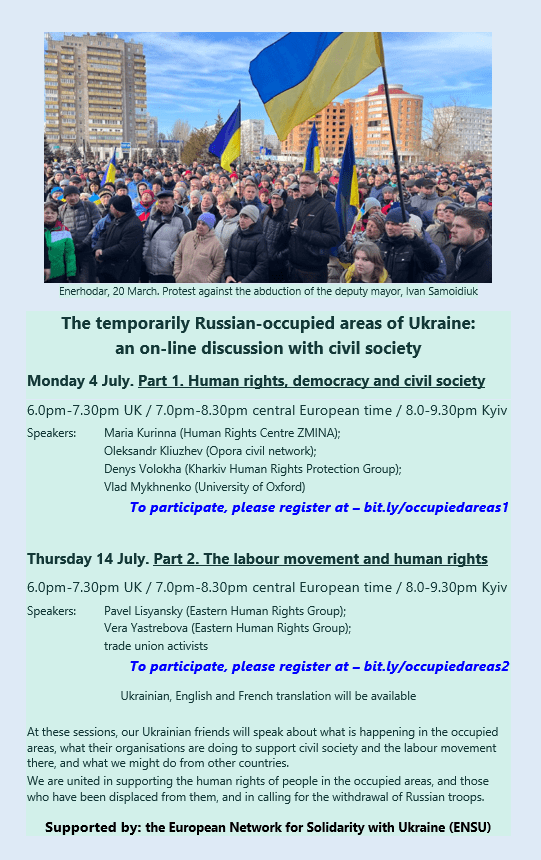
□ Two all-European public zoom calls about the Russian-occupied areas are being held on Monday 4 July and Thursday 14 July, on which Ukrainian activists will report on what can be done to support civil society there. The initiative is supported by the European Network in Solidarity with Ukraine. You need to register in advance to participate.

□ The Eastern Human Rights Group has also reported on forcible military mobilisation in the Donbass “republics,” and use of the death penalty there. Here are three recent Facebook posts. With thanks to Anna Yegorova for the translations.


Forced mobilisation on the rise again (15 June)

For the last three weeks, forced mobilisation in the occupied territories of Luhansk and Donetsk regions has slowed down, due to active protests by mothers, sisters, and spouses of the forcibly mobilized.

However, the Ministry of National Security in the Luhansk and Donetsk “people’s republics” swiftly suppressed women’s protests, as we recorded the detention of several women in Yenakievo and Rovenky.

Since last Saturday, military patrols searching for men of conscription age in the cities of occupied Donbas have become more active with men being detained in the streets again. (The detentions are not as massive as in March, but that is understandable: there are simply not as many men as there were in March.)

This new stage of forced mobilisation is associated with the need to send new manpower to fight in Donbass.

Forced mobilisation has again affected workers at enterprises, and enterprise managers have spoken out against it. The administrations of the “Luhansk people’s republic” and “Donetsk people’s republic” said that “construction brigades” [a term dating back to the Soviet times, usually designating student groups as “volunteers” to work on farms and plants] from the Russian Federation would soon arrive to replace the workers [so that the latter could be send to the battlefield].


“People’s republic” soldiers defecting to Ukraine (23 June)

Over the past three weeks, the so-called “people’s militia” of the Luhansk and Donetsk “people’s republics” has increased military patrols in the temporarily occupied territory of Ukraine, due to the increasing number of defections from AK-1 and AK-2 units. Forcibly mobilised people, even after they have been dressed in uniform, seek opportunities to escape from the Russian convoy escorting them to the front line.

Frequent defections became public thanks to women in [the occupied territories of] Donetsk and Luhansk reporting to Vera Yastrebova, the head of the Eastern Human Rights group.

One woman said that her brother escaped with a group of mobilised men on the way to the front line, and now they are wanted by the local “authorities.” There are also cases when mobilised residents of the two “people’s republics” jump off trains that take them to the front line, following a brief training in the Russian Federation.

Over the past three weeks, there have been more than 100 cases of defections from the “LPR” and “DPR,” a source from the DPR told us.


Luhansk “people’s republic” is about to introduce death penalty (24 June)

By Vera Yastrebova. A working group is preparing to change the criminal “law” of the Luhansk “people’s republic” to introduce a new type of punishment – the death penalty, I have been told by sources there.

A decision was first made back in 2021, when the Kremlin decided to create unitary “legislation” for the Donetsk and Luhansk “people’s republics,” and essentially rewrite the laws in Luhansk to match those of Donetsk. But they haven’t had time to do that.

Now the principle has been agreed, and changes are being developed very quickly. The haste is due to the fact that the Luhansk “people’s republic” will be able to apply the death penalty to Ukrainian prisoners of war.

The issue of the “death penalty” will be further pushed by the Kremlin, in order to force Western countries to engage in direct negotiations with the leaders of the “LPR” and “DPR,” my sources say.

□ Why is Ukrainian resistance invisible to you? An appeal to supporters of the Stop the War Coalition

□ ‘We are surviving, but not living’ under Russian occupation – People & Nature, 13 June

There will be all-European public zoom calls, on Monday 4 July and Thursday 14 July, with Ukrainian activists supporting people in the occupied areas. Details and link to registration here.


Source: Simon Pirani, “Ukrainians face forcible deportation and conscription by Russian forces,” People and Nature, 27 June 2022. Reprinted here with the author’s kind permission

“Goszakaz”: Crimean Tatar Activists Sentenced to Monstrous Prison Terms by Russian Occupation Regime


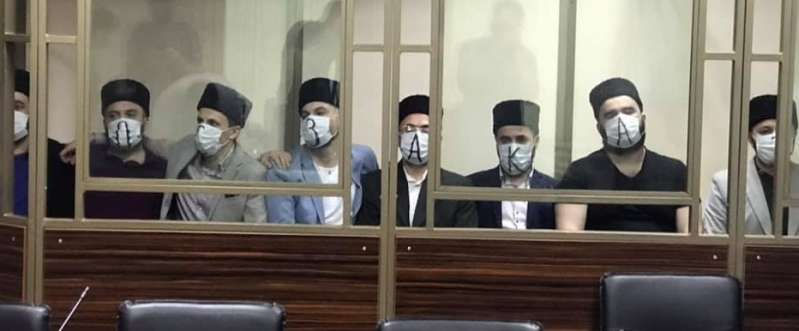
Reading of the sentence on 16.09.2020. The men are each wearing one letter each of the word ГОСЗАКАЗ (“commissioned by the state”). Photo by Crimean Solidarity. Courtesy of khpg.org

Acquittal and monstrous sentences in Russia’s offensive against Crimean Tatar civic journalists & activists
Kharkiv Human Rights Protection Group
Halya Coynash
September 17, 2020

In the last decades of the Soviet regime, dissidents received 7-10-year sentences for so-called ‘anti-Soviet agitation and propaganda’. Modern Russia, persecuting Ukrainian citizens on illegally occupied territory for their religious beliefs and political views, is doubling such sentences. Seven Crimean Tatar civic journalists and activists have received sentences of up to 19 years, without any crime. Justice had not been expected from a Russian court, however absurd the charges and flawed the ‘trial’, so the only – wonderful – surprise was the acquittal of Crimean Solidarity civic journalist and photographer Ernes Ametov. If Russia was hoping, in this way, to prove that these are real ‘trials’ before independent courts, there is no chance. All eight men have long been recognized as political prisoners, and all should have been acquitted.

The sentences passed on 16 September by judges Rizvan Zubairov (presiding); Roman Saprunov; and Maxim Nikitin from the Southern District Military Court in Rostov (Russia) were all lower than those demanded by the prosecutor Yevgeny Kolpikov, but still shocking.

Crimean Solidarity civic journalist Marlen (Suleyman) Asanov: 19 years

Crimean Solidarity activist Memet Belyalov: 18 years and 18 months restriction of liberty

Crimean Solidarity civic journalist Timur Ibragimov: 17 years and 18 months restriction of liberty

Crimean Solidarity Coordinator and journalist Server Mustafayev: 14 years and 1 year restriction of liberty

Crimean Solidarity civic journalist Seiran Saliyev: 16 years and 1 year restriction of liberty

Edem Smailov (the leader of a religious community): 13 years and 1 year restriction of liberty

Crimean Solidarity volunteer Server Zekiryaev: 13 years

In Soviet times, dissidents received a term of imprisonment, then one of exile. Now they add ‘restriction of liberty’ (ban on going outside Crimea and attending events, as well as having to register with the police). In all of the above cases, the sentences are for maximum security prison colonies, although not one of the men was even accused of an actual crime. They are also sentences that Russia, as occupying state, is prohibited by international law from imposing.

The armed searches and arrests of the men in October 2017 and May 2018 were the first major offensive against Crimean Solidarity. This important civic organization arose in April 2016 in response to the mounting persecution of Crimean Tatars and other Ukrainians in occupied Crimea. The initiative not only helped political prisoners and their families, but also ensured that information was streamed onto the Internet and in other ways circulated about armed searches, arrests, disappearances and other forms of repression. Given Russia’s crushing of independent media in occupied Crimea, the work that Crimean Solidarity activists and journalists do is absolutely invaluable. It has, however, subjected them to constant harassment, including administrative prosecutions, and, when that has not stopped them, to trumped-up criminal charges.

The charges
The men were essentially accused only of ‘involvement’ in Hizb ut-Tahrir, a peaceful Muslim organization which is legal in Ukraine. In declaring all Ukrainian Muslims arrested on such charges to be political prisoners, the renowned Memorial Human Rights Centre has repeatedly pointed out that Russia is in breach of international law by applying its own legislation on occupied territory. It has, however, also noted that Russia is the only country in the world to have called Hizb ut-Tahrir ‘terrorist’ and the Russian Supreme Court did so in 2003 at a hearing which was deliberately kept secret until it was too late to lodge an appeal.

In occupied Crimea, the Russian FSB are increasingly using such prosecutions as a weapon against civic activists and journalists, particularly from Crimean Solidarity.

Initially, the FSB designated only Asanov as ‘organizer of a Hizb ut-Tahrir group’ under Article 205.5 § 1 of Russia’s criminal code. The other men were all charged with ‘involvement in such an alleged ‘group’ (Article 205.5 § 2). Then suddenly in February 2019 it was announced that Belyalov and Ibragimov were now also facing the ‘organizer’ charge.  The essentially meaningless distinction is reflected in the sentences passed on 16 September, with the difference in sentence between Timur Ibragimov as supposed ‘organizer’ only one year longer than that passed on fellow civic journalist, Seiran Saliyev (accused of being a member of the so-called Hizb ut-Tahrir cell).

All eight men were also charged (under Article 278) with ‘planning to violently seize power’. This new charge also appeared only in February 2019, with no attempt ever made to explain how the men were planning such a ‘violent seizure’. The charge only highlights the shocking cynicism of any such ‘terrorism’ charges when the only things ‘found’ when armed searches were carried out of the men’s homes were books (not even Hizb ut-Tahrir books), no weapons, no evidence of plans to commit violence. Russian prosecutors simply claim that this follows from Hizb ut-Tahrir ideology. Memorial HRC notes that the extra charge is often laid where political prisoners refuse to ‘cooperate with the investigators’. Since all the Crimean Muslims prosecuted in these cases have stated that they are political prisoners and have refused to ‘cooperate’, the extra charge is becoming standard.

‘Evidence’
The prosecution’s case was based on the testimony of Nikolai Artykbayev, a Ukrainian turncoat, now working for the Russian FSB; two secret witnesses whose identity and motives for testifying are known, and the ‘expert assessments’ of three people with no expert knowledge of the subject.

Russia is now using so-called ‘secret witnesses’ in all politically-motivated trials of Crimeans and other Ukrainians. No good reason is ever provided for concealing the alleged witnesses’ identity, and the bad reason can easily be seen in this case where their identity was understood.  Konstantin Tumarevich (who used the pseudonym ‘Remzi Ismailov’) is a Latvian citizen and fugitive from justice who could not risk being sent back to Latvia after his passport expired. It is likely that the FSB realized this back in May 2016 and have used his vulnerable position as blackmail, getting him to testify both in the earlier trial of four Crimean Tatars from Bakhchysarai, and now in this case.

There is a similar situation with Narzulayev Salakhutdin (whose testimony was under the name ‘Ivan Bekirov’).  He is from Uzbekistan and does not have legal documents.

These men gave testimony that in many places was demonstrably false, yet ‘Judge’ Zubairov constantly blocked attempts by the defendants and their lawyers to ask questions demonstrating that the men were telling lies.

As mentioned, the main ‘material evidence’ was in the form of three illicitly taped conversations in a Crimean mosque. These were supposedly understood to be ‘incriminating’ by Artykbayev, although the latter does not know Crimean Tatar (or Arabic) [or] who transcribed them. That transcript, of highly questionable accuracy, was then sent to three supposed ‘experts’: Yulia Fomina and Yelena Khazimulina, and Timur Zakhirovich Urazumetov. Without any professional competence to back their assessments, all of the three ‘found’ what the FSB was looking for.

While the judges also lack such professional competence, they did hear the testimony of Dr Yelena Novozhilova, an independent and experienced forensic linguist, who gave an absolutely damning assessment of the linguistic analysis produced by Fomina and Khazimulina.

This was only one of the many pieces of testimony that the court ignored. Zubairov actually refused to allow a number of defence witnesses to appear and used punitive measures against the defendants and their lawyers.

All such infringements of the men’s rights will be raised at appeal level, although this will also be before a Russian court, with the charges of justice being minimal.

PLEASE WRITE TO THE MEN!
They are likely to be imprisoned at the addresses below until the appeal hearing and letters tell them they are not forgotten, and show Moscow that the ‘trial’ now underway is being followed.

Letters need to be in Russian, and on ‘safe’ subjects. If that is a problem, use the sample letter below (copying it by hand), perhaps adding a picture or photo. Do add a return address so that the men can answer.

Sample letter

Привет,

Желаю Вам здоровья, мужества и терпения, надеюсь на скорое освобождение. Простите, что мало пишу – мне трудно писать по-русски, но мы все о Вас помним.

[Hi.  I wish you good health, courage and patience and hope that you will soon be released.  I’m sorry that this letter is short – it’s hard for me to write in Russian., but you are not forgotten.]

Addresses

Marlen  Asanov

344010, Россия, Ростов-на-Дону, ул. Максима Горького, 219 СИЗО-1.

Асанову, Марлену Рифатовичу, 1977 г. р

[In English:  344010 Russian Federation, Rostov on the Don, 219 Maxim Gorky St, SIZO-1

Asanov, Marlen Rifatovich, b. 1977]

Memet Belyalov

344010, Россия, Ростов-на-Дону, ул. Максима Горького, 219 СИЗО-1.

Белялову, Мемету Решатовичу, 1989 г.р.

[In English:  344010 Russian Federation, Rostov on the Don, 219 Maxim Gorky St, SIZO-1

Belyalov, Memet Reshatovich, b. 1989]

Timur Ibragimov

344010, Россия, Ростов-на-Дону, ул. Максима Горького, 219 СИЗО-1.

Ибрагимову, Тимуру Изетовичу, 1985 г.р.

[In English:  344010 Russian Federation, Rostov on the Don, 219 Maxim Gorky St, SIZO-1

Ibragimov, Timur Izetovich, b. 1985]

Server Mustafayev

344010, Россия, Ростов-на-Дону, ул. Максима Горького, 219 СИЗО-1.

Мустафаеву,  Серверу Рустемовичу, 1986 г.р.

[In English:  344010 Russian Federation, Rostov on the Don, 219 Maxim Gorky St, SIZO-1

Mustafayev, Server Rustemovich,  b. 1986]

Seiran Saliyev

344010, Россия, Ростов-на-Дону, ул. Максима Горького, 219 СИЗО-1.

Салиеву,  Сейрану Алимовичу, 1985 г.р.

[In English:  344010 Russian Federation, Rostov on the Don, 219 Maxim Gorky St, SIZO-1

Saliyev, Seiran Alimovich, b. 1985]

Edem Smailov

344010, Россия, Ростов-на-Дону, ул. Максима Горького, 219 СИЗО-1.

Смаилову,  Эдему Назимовичу, 1968 г.р.

[In English:  344010 Russian Federation, Rostov on the Don, 219 Maxim Gorky St, SIZO-1

Smailov, Edem Nazimovich, b. 1968]

Server Zekiryaev

344010, Россия, Ростов-на-Дону, ул. Максима Горького, 219 СИЗО-1.

Зекирьяеву, Серверу Зекиевичу, 1973 г.р.

[In English:  344010 Russian Federation, Rostov on the Don, 219 Maxim Gorky St, SIZO-1

Zekiryaev, Server Zekievich, b. 1973]

Thanks to Comrades SP and RA for the heads-up. The text has been very lightly edited for readability. || TRR