Outcasts in Their Own Land: Russia’s Political Prisoners

Over four years into Russia’s war in Ukraine, some of the Russians imprisoned in its early days are still in jail. Even people with no previous political activism have been landed with long prison sentences in order to crush dissent.
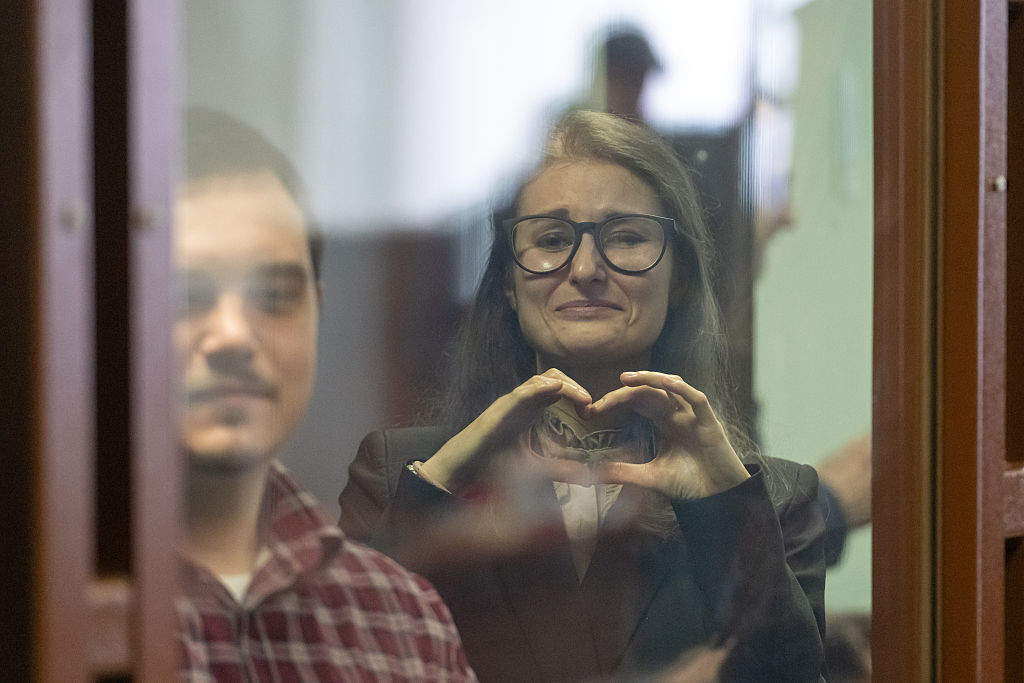
Yevgeny Zateyev and Anna Arkhipova attend a court hearing in the case against the Vesna movement, one of the leading voices of antiwar protest in Russia. A court in St Petersburg sentenced six defendants in the case to prison terms of up to 12 years. (Andrei Bok/ SOPA Images/LightRocket via Getty Images)

Russia’s political prisoners are “outcasts in their own land,” Sergei Dudchenko, a biker tortured and framed by the security services, told his trial judges this month before being handed a seven-year prison sentence.

Those arrested for opposing the war in Ukraine had “fewer rights than a stray dog, and on top of that they bear the humiliating brand of ‘terrorist’ — and all this for their active civic stance.”

Dudchenko and his friend Nikolai Murnev, who received the same sentence, were arrested with others in October 2022 in Stavropol, in southern Russia.

While in detention on minor charges (petty hooliganism and drug possession), they were brutally tortured. A case was put together that they were preparing a “terrorist act” — setting fire to a military recruitment office. Another of the group died in pretrial detention, one fled the country, and one turned state’s witness.

The invasion of Ukraine on February 24, 2022, “split life into before and after, it divided the world into black and white,” Dudchenko told the court.

Russians, Ukrainians, Belarusians, Armenians, Georgians, Azerbaijanis, Kazakhs, Turkmens, Jews, and others had “paid an unimaginable price” to resist Nazism in World War II. How, decades later, could “so much hatred and anger” be directed against Ukraine?

Within days of the invasion, Dudchenko made a solo protest — a motorbike ride with the Ukrainian flag. In court, four years later, he said: “When I sped along, with the banner of the oppressed streaming behind me, past an astonished crowd of militarists, I felt the human in me come into bloom.”

Dudchenko is one of dozens of wartime protesters who have exercised one of the few constitutional rights that remains accessible: to say a “final word” before sentencing.

Some who exercise this right, like Dudchenko, are citizens whose antiwar protest was their first political action. Some, like the powerlifting champion Yulia Lemeshchenko, are Russians who joined the Ukrainian armed forces. She told her trial, in November of last year: “I am not a citizen of the country for which I decided to fight, but for me, Ukraine is home.”

Some are political activists, like Anna Arkhipova, one of six members of the Vesna protest network sentenced at a show trial in St Petersburg last month. “When the war began, it was my conscience that would not let me stand idly by,” she stated.

On Sunday May 17, Try Me For Treason: anti-war protesters’ speeches in Russian courts, an English-language film featuring readings of speeches, will be released on YouTube.

The title comes from a speech by Andrei Trofimov, who is serving ten years for pro-Ukrainian statements on social media — plus three for ending his “final word” to a closed court by saying: “Glory to Ukraine! Putin is a d–khead.”

At the second trial, before getting the three extra years, Trofimov scorned the charges of “discrediting the armed forces” and “justifying terrorism,” and invited prosecutors to charge him for deserting to Ukraine’s side. “Try me for treason. I betrayed your deranged state,” he told the judges.

The fifty-minute documentary was put together on a zero budget by a group of actors in Britain, to make the Russian antiwar movement more visible internationally.

Maya Willcocks, the actor-producer who reads a speech by Darya Kozyreva, said: “These are not well-known political leaders, they are people who have taken a stand against the state. I felt it was very important to have their words translated into English and out there for people to hear — to send the message that occupation is a crime, whether in Palestine or in Ukraine.”

Anthony Aldis, the videographer, said: “What I found compelling about these stories is that the beginning of any fightback is very often when people stand up against an apparently unassailable power.

“These people are not organized. It’s a raw push against something that they don’t believe they can beat, but they think they have to take a stand anyway, in solidarity with someone else who is being attacked and murdered.

“That idea is very important to us in the West, given what we face here in the UK, and in the USA, with the rise of the far right.”

As one of a small group of translators that helped prisoner support groups, I worked on the script, and on the book Voices Against Putin’s War from which it derived.

Having traveled to Russia and Ukraine since Soviet times, I was struck by the political depth and heterogeneity of antiwar protest, even as it is constrained by state terror to individual acts of defiance. Those punished with long sentences range from pacifists who quote Leo Tolstoy to Soviet-era dissidents who ooze contempt for the judges, and Russians who go out of their way to justify Ukraine’s defensive military action.

It would be easy — and stupid — to dismiss the “final words” as atomized cries into a dark, authoritarian night. Rarely are they pleas to judges or government; more often, they are consciously crafted appeals to society.

The “last words” often try to situate those who say them historically. Sergei Dudchenko, born in 1987, said in court that “people like us will always keep emerging, to pick up the fallen banner of good and reason” . . .  and recalled the seven protesters arrested on Red Square in 1968 for opposing the Soviet invasion of Czechoslovakia.

Noteworthy, too, is the infrastructure of support for political prisoners, comprising established human rights organizations such as Memorial: Support Political PrisonersOVD-Info, and Mediazona; newly formed groups such as Fires of Freedom and Solidarity Zone, a website featuring “last words” going back to the 1950s; and Telegram groups caring for individual prisoners.

From California to the Caucasus, dozens of informal groups of Russians in exile gather and write letters to prisoners.

All these organizations support lawyers and activists in Russia who visit prisoners, send parcels, and support relatives — themselves now risky activities.

Ukrainian human rights groups including Zmina, the Crimea Human Rights Group, and the Kharkiv Human Rights Protection Group have a challenge of a different order in supporting Ukrainian civilian prisoners in Russian jails.

Bohdan Ziza, who features in our film, has family and friends who know where he is. (He is serving fifteen years for throwing blue and yellow paint, the colors of the Ukrainian flag, as well as a petrol bomb that was quickly extinguished by a security guard, at a municipal council’s office in Crimea.) So do many Crimean Tatar activists victimized by Russia’s racist, Islamophobic crackdown in the peninsula in 2017–19.

But hundreds, possibly thousands of Ukrainians are at unknown locations in Russia’s twenty-first-century gulag.

The Ukrainian government today counts ninety thousand people as “missing”: many are soldiers, imprisoned or killed, but at least sixteen thousand are civilians, according to the Organisation for Security and Cooperation in Europe. Many are victims of abductions, widespread in the territories occupied by Russia. Ukrainian lawyers and human rights activists have compiled a register of more than five thousand “enforced disappearances,” in addition to the widely publicized cases of kidnapped children.

Long prison sentences, imposed with little or no pretense of legal procedure, and savage torture — especially of those suspected of sympathizing with Ukrainian resistance — are ubiquitous in the occupied territories. The indefatigable Kharkiv Human Rights Protection Group’s website reports a stream of life-destroying sentences for peaceful activities deemed dissident.

Doing all we can to provide practical support for political prisoners and engaging with their compelling articulations of their motives is central to international solidarity.

Try Me For Treason premieres on Sunday, May 17. You can sign up to watch it here.

Source: Simon Pirani, “Russia’s Antiwar Prisoners Are Outcasts in Their Own Land,” Jacobin, 16 May 2026


TRY ME FOR TREASON: anti-war protesters’ speeches in Russian courts

The trailer to “Try Me for Treason”

The filmYoutube premiere, Sun 17 May, 20.00 https://www.youtube.com/watch?v=7FHacVH8tK8

More info trymefortreason.org

London launch event, Sun 17 May, 18.00 https://ukrainesolidarityorg.wordpress.com/wp-content/uploads/2026/04/invite-colour-bck.png

Source: Ukraine Information Group (Facebook), 15 May 2026. Thanks to Simon Pirani for the trailer.
A Bill of Goods

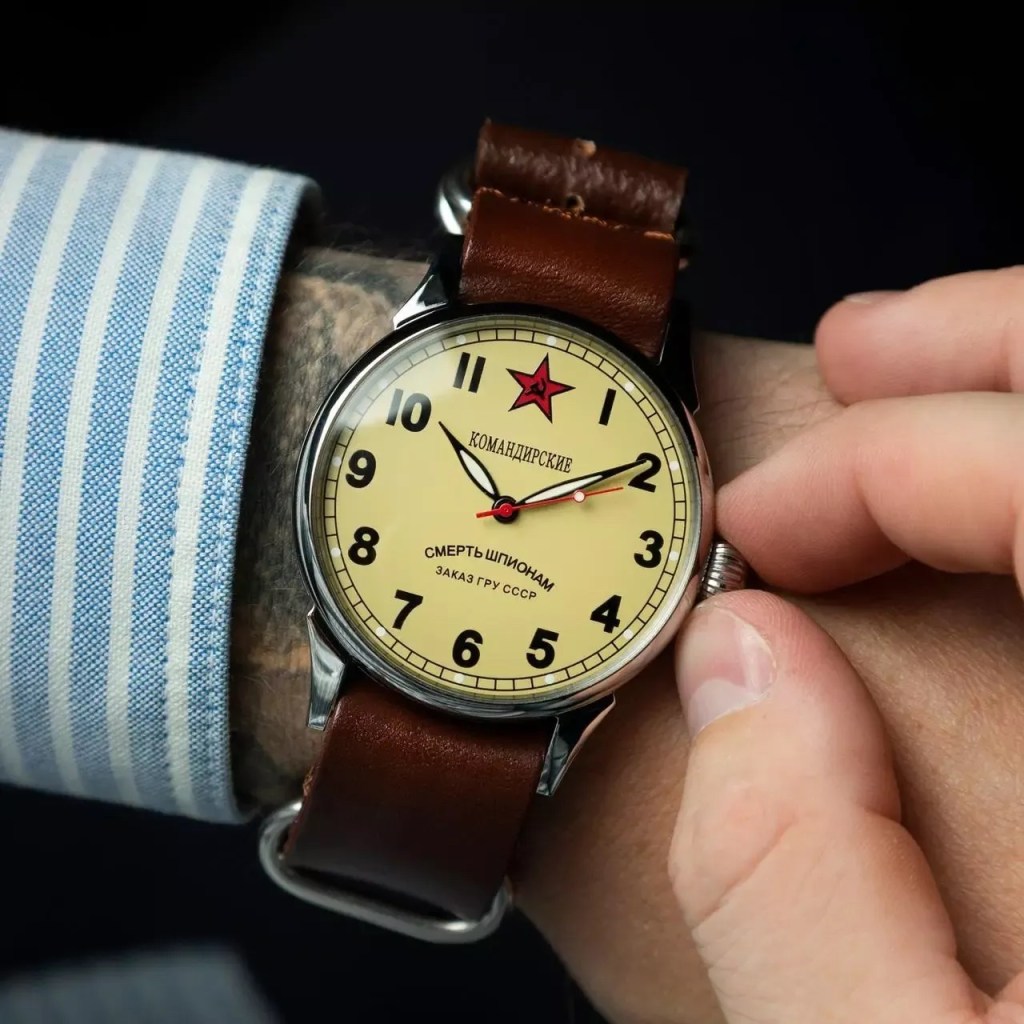
“Commander [watch]. Death to spies: commissioned by the GRU of the USSR.”
Source: Kitenhome, where the watch is identified as a “vintage men’s wrist watch” from 1990. It is priced to sell at $29.99.

Only the blind can claim that Vladimir Putin wants to revive the Soviet Union. On the contrary, he has built one of the most Darwinian and irresponsible capitalist systems on the planet. Only its imperial ambitions and the normalization of permanent theft bear any relation to the late Soviet state. Only the fear of the return of a totalitarian regime, which struck several generations in Russia, has delayed a left turn among the young. But the war has finally started it.

After February 24, the protest against the Putin regime, amplified by antiwar sentiment, was embodied in a digital resistance movement. The global media has been largely silent about this fact, but military commissariats in Russia burn down every few days, freight trains with weapons or raw materials for military factories derail, and the walls of houses and fences are covered with huge pro-Ukrainian graffiti at night. Volunteers take care of Ukrainians forcibly displaced to Russia and help them flow to Europe. This resistance is horizontal and egalitarian, and it is mainly engaged in by twenty- to thirty-year-olds. What values drive them?

[…]

The range of the views of this new left is wide — from anarcho-federalism to social liberalism — but at its heart is a clear demand for equality and a restart of the state with an economy focused on personal self-realization, the satisfaction of basic needs, and the protection of rights. As Russians come to accept responsibility for the terror inflicted on Ukraine, we can expect turbulence to last for decades. But one reason for optimism is the likely fact that any new Russia — or several Russias — will be leftist.

Source: Nikolay V. Kononov, “The Russian Left Is Standing Against Putin’s War in Ukraine,” Jacobin, 4 September 2022. Thanks to Charles Keener and Marxmail for the heads-up. This same article was published in Tribune on 29 August 2022.


Mr. Kononov is identified by Tribune as the “editor-in-chief of Teplitsa Journal, a Russian-language media outlet about activism.” I had trouble finding this “journal” online until my boon companion suggested it might have something to do with the so-called Teplitsa sotsial’nykh teknologii (“Greenhouse of Social Technologies”), an organization that describes itself as a “support system for NGOs and activists.” Teplitsa Journal is only referred to as such in Mr. Kononov’s Anglophonic ventures outside the “hothouse” of Russia’s overhyped (and in fact mostly nonexistent) “anti-war movement.” Teplitsa Journal is not a “Russian-language media outlet,” but a section on Teplitsa’s website.

Among other things, Mr. Kononov recently published an interview there with the philosopher Artemy Magun. This passage in particular struck me as another “bill of goods,” this one intended not for wobbly-kneed western leftists, but for Russian “dissidents” eager to blame anyone else but the Russian regime and an overwhelmingly compliant Russian society for the brutal, utterly unprovoked invasion of Ukraine.

— What is the source of the war?

— A mutual misunderstanding among three countries and cultures: Ukraine, Russia, or rather its leadership, and the West, by which I mean Europe and the US plus Japan and South Korea. Imperial chauvinism comes from Russia, nationalism comes from Ukraine. And on the third hand, there is the as it were universal imperialism of the United States, infused with their special version of civic nationalism.

US relations with other countries are based on soft power, hegemony. This involves not only the dominance of the dollar and financial institutions, not only technological innovations, but also the assertion of national democratic and humanistic values.

As for Russia, it is not only the collapse of one ideology and the misunderstanding of another, but also economic dependence. Russia does not have high-tech products, not only due to backwardness and corruption, but also because many markets have not been opened to it. The free trade space turned out to be not entirely free. For example, Russia was not admitted into the European Union, by and large, except for its energy resources. Do you remember the conversation with Ukraine in 2013–2014 about the common customs zone? Ukraine then refused to join the Russian-Belarusian customs union and was going to sign an association agreement with the European Union, and the Russian elites argued that the loss of its partners in production chains would be economically painful — and it really would have been. Why am I saying this? Imperialism as political economic rivalry among capitalist powers — this situation exists, it is not contrived. And until 2022, everything really did resemble the beginning of the twentieth century, before the First World War. But that’s why it seems to me that the economic factors that led to the war cannot be considered the main ones. Ideological and political [factors], in my opinion, were more important.

— And what are these factors?

— [After the collapse of the USSR and a sharp decline in its influence in the world], the rejection of communism or socialism as a kind of humanistic perspective became a framework factor. Instead, a liberal democratic ideology was proposed that is contradictory. It asserts a universal order of human rights, and at the same time electoral democracy, which is based on national sovereignty. Plus neoliberalism, which asserts the autonomy of economic entities and total competition among [them].

Now there is pressure from the West under the auspices of the universalist empire, aimed at building global liberal democratic institutions. The trick is that this global program and policy is not entirely global. The West, arriving [in the former Soviet bloc] with the universal idea of democracy, did not fully implement its program. They entered undemocratic countries, tried to build democracies there, but they were in no hurry to spend money — nothing like the Marshall Plan was offered anywhere else. Instead of strong support for these countries, a neoliberal political economy was devised, which played a disastrous role by turning their populace away from America.

Source: “In Russia, activism is an existential, heroic choice,” Teplitsa sotsial’nykh tekhnologii, 15 August 2022. Translated by the Russian Reader


The most discussed session at the congress was the session featuring spokespeople from grassroots anti-war initiatives, who were allotted the standard hour and a half for six presentations. Vika Fas of Feminist Anti-War Resistance (FAS) boasted that the movement, founded by activists on February 25, already had sixty cells in Russia and thirty abroad.

“If you don’t know about FAS yet, you should read about us on Wikipedia. I think it’s interesting to observe a grassroots initiative that has become so popular in six months… Feminism was not taken seriously until we gained media weight, but we need international support for our communities and assistance in the form of grants,” she said in a passive-aggressive manner.

Alexander Belik, a spokesperson for the Movement of Conscientious Objectors to Military Service, said that after February 24, they had fielded a good number of requests for assistance from military personnel already deployed in Ukraine.

“Everything is happening quite successfully: you can still refuse conscription and even from serving if you’re already serving there. Everything is possible with due perseverance,” he said.

The recorded live stream of the Congress of Free Russia (Vilnius, 31 August 2022).
The panel discussed by Ilya Azar begins at the 2:54:00 mark.

Maria Novikova thanked [the organizers] for maintaining gender balance at the session and explained that the NITKA project had tried out different formats, but had settled on an “unusual and creative” TikTok account.

“Our audience is not intellectuals who get everything as it is, but ordinary people who need enlightenment. Not only cringeworthy videos about Putin’s battalions are popular [on our account], but also serious videos about various aspects of the war in Ukraine and the crackdown in Russia,” she said.

NITKA, Novikova says, has already garnered more than nine thousand subscribers, and one video has been clicked more than two million times.

The project Media Partisans, according to Olga Demidova, arose when it became clear that due to the fact that large numbers of protesters were being detained by police during protests, “it [was] pointless to take to the streets in Russia.”

“At first, everyone [sic] wanted to stop the war and Putin, but it takes time.”

“Many saw that their protest did not bring results, and they were disappointed, so you need to choose small goals and set realistic tasks,” she explained.

Media Partisans has seven projects: for example, a Telegram channel featuring anti-war artwork and instructions on how to safely distribute leaflets and stickers, as well as the Brave Partisans bot (@bravepartizanbot), where you can get an assignment for a performance or posting leaflets.

Timofey Martynenko of the Vesna Movement boasted that the anti-war rallies and marches in late February and early March were held at the behest of his movement, and talked about other projects, in particular a service for sending appeals to State Duma deputies.

“The same people are seated in the State Duma, and it is vital to show them that a huge number of people oppose the war,” said the activist.

At the end of his talk, Martynenko said that Vesna does not believe that Russians have a “slave mentality” or that there is a “bloodthirsty ‘deep folk’ who love Putin.”

“It is vital to talk about the depoliticization of Russian society, about civic involvement, about how democratic institutions and the media have been destroyed.”

“The problem is not that we are monstrous imperialists at the genetic level, but the monstrous centralization of Russia and the destruction of local self-government,” Martynenko tried to persuade the audience.

Against the backdrop of the war in Ukraine, conversations about TikTok and a service for sending appeals to Russian MPs seemed frankly lightweight, but the young people were clearly pleased with themselves. After the session, I asked the chairman of the Mejlis of the Crimean Tatar People, Refat Chubarov, who had traveled [to the congress] from Kyiv, what he thought about the anti-war movement in Russia.

“I would thank them for what they are doing, and it would be sincere. But it’s all very childish. And they also have to be very careful, because an incorrect diagnosis can lead to incorrect treatment,” Chubarov replied.

The head of the Mejlis said that he had gone up and talked to Martynenko because he strongly disagreed with his “pompous claims that Russians do not suffer from imperialism and servility.”

“About a million Russian nationals [sic] pulled up stakes and settled in occupied Crimea without any remorse. What the fuck? That’s what imperialism is. When we [Crimean Tatars] returned [to Crimea] in the late [19]80s, we didn’t evict a single [Russian] family. I personally purchased the rooms where my mom had been born. When we return to Crimea again, none of those who settled there after 2014 will [be allowed to] live in Crimea. No servility? But what is it when a mother says that her son is being held [as a POW in Ukraine], but immediately adds that he is defending Russian interests? What Russian interests?” said Chubarov.

Source: Ilya Azar, “On the threshold of great achievements: a congress of the Russian emigration took place in Vilnius,” Novaya Gazeta Europe, 4 September 2022. Translated by the Russian Reader


[…]

The ballrooms of the Grand Vilnius Resort, set on a golf course on the outskirts of the Lithuanian capital, were a universe away from the front lines in the Ukrainian regions of Kherson and Donbas. And while the motto of the Congress of Free Russia was “Be Brave Like Ukraine,” this was a gathering of Russians who have fled their country out of fear of what Mr. Putin’s regime might do to them.

Hanging over the three-day gathering was the knowledge that — while Ukrainian President Volodymyr Zelensky has been hailed as a hero for refusing to flee Kyiv — many Russian dissidents who have stood their ground are either dead, or jailed by their government.

[…]

Source: Mark Mackinnon, “Russian dissidents squabble over how to ensure Putin’s defeat,” The Globe and Mail, 2 September 2022

Bhaskar Sunkara: “You Say East Ukraine, I Say West Russia”

Has Bhaskar Sunkara ever been to “West Russia”?

west-russia

Source: Facebook

bhaskartwitter-660x440
Bhaskar Sunkara. Photo courtesy of Magculture

Bhaskar Sunkara (born June 20, 1989) is an American political writer, editor and publisher of Jacobin magazine.

The son of immigrants from Trinidad and Tobago, Sunkara described Jacobin as a radical publication, “largely the product of a younger generation not quite as tied to the Cold War paradigms that sustained the old leftist intellectual milieus like Dissent or New Politics.”

The New York Times interviewed Sunkara in January 2013, commenting on Jacobin’s unexpected success and engagement with mainstream liberalism. In late 2014, he was interviewed by New Left Review on the political orientation and future trajectory of the publication and in March 2016 was featured in a lengthy Vox profile.

Sunkara writes for Vice magazine, Washington Post and The Nation, among other outlets. He has appeared on the PBS Tavis Smiley program, MSNBC’s Up w/ Chris Hayes and the FX show Totally Biased with W. Kamau Bell.

Source: Wikipedia

________________________

Residents in eastern Ukraine face worst fighting in years in war with Russian-backed separatists
Sabra Ayres
Los Angeles Times
February 15, 2017

The news reached Mariupol Mayor Vadim Boychenko via a morning phone call from an assistant: A rocket attack damaged 11 houses on the outskirts of the Ukrainian city.

There were no casualties, but a major concern had become a reality: The escalation of fighting elsewhere in the nation in recent weeks had reached the industrial city, a key component in southeast Ukraine’s struggling economy.

“We’ve gotten used to a peaceful life,” Boychenko said during a recent interview at his office. “I really don’t want to return to the problems we had started to forget.”

Ukraine’s nearly three-year battle against Kremlin-backed separatists in the east erupted into the worst fighting in two years in late January. Exactly why the fighting intensified recently remains unclear, though such encounters have occurred with some frequency during unrest that included Russia’s annexation of Crimea in March 2014.

The small city of Avdiivka, 90 miles north of Mariupol, became the epicenter of the recent violence. The fighting quickly spread along a 300-mile line separating the Ukrainian government-controlled lands and those claimed by separatists in the Donetsk and Luhansk regions.

Mariupol had seen only sporadic fighting over the last two years, primarily in the region’s eastern villages. But as news trickled in about the bombardment of Avdiivka, Mariupol began again hearing the deep rumble of explosions and heavy artillery fire less than 10 miles away.

The fighting halted vital shipments from Avdiivka’s coal processing plant to Mariupol’s massive iron and steel works plants, jeopardizing production at one of the region’s biggest employers.

Many local residents said they feared the renewed violence could quash the growing sense of confidence in Mariupol after nearly two years of relative stability.

One concern in the region is that President Trump and Russian President Vladimir Putin could strike a deal that would lift U.S. sanctions on Russia or force Ukraine to make painful compromises with Moscow. Ukrainian President Petro Poroshenko has urged Western leaders to keep sanctions in place.

“Sanctions are the only way to get Putin to the table,” he said last week in an interview with journalists and academics in Kiev, the capital.

Nationally, there is little faith in the Minsk agreements, a road map to peace brokered in 2014 by European leaders between Ukraine, the Kremlin and the separatist rebel leaders. Poroshenko maintains that Ukraine is committed to its obligations to the agreements.

“Minsk is my plan. Putin accepted it. His signature is there,” he said.

Mariupol has gone through a noticeable transformation since war erupted in eastern Ukraine in the spring of 2014. Once the epitome of a run-down, Soviet industrial port city with two massive metallurgy plants puffing out pollution day and night, Mariupol in the last two years has emerged as a center of civic activism in Ukraine’s southeastern battlefront.

The city was the center of several violent outbreaks in spring 2014, when Ukrainian forces and supporters of the pro-Russian separatist groups fought gun battles in the downtown streets. The charred former police headquarters and city council buildings still stand as reminders. On Jan. 24, 2015, a missile attack hit an eastern region of Mariupol dense with Soviet-era concrete housing blocks, killing at least 30 people.

The previously politically passive, mostly Russian-speaking city created community groups that mobilized to gather whatever money they could to buy medical kits, food, and flak jackets and helmets for Ukraine’s ill-prepared military. The fighting displaced 1.75 million eastern Ukrainians, but locals opened their homes and about 56,000 newcomers settled in Mariupol.

“We don’t call them refugees anymore,” Boychenko said. “They are ‘new Mariupolites’ and have already become part of our city.”

Once-thriving Donetsk is now occupied by rebel forces, so Mariupol, the largest city in the Donetsk region under Ukrainian control, became the de facto cultural hub of the eastern industrial area along the Don River basin, known as the Donbas.

Displaced activists from Donetsk opened an avant-garde theater and creative space that has hosted some of the country’s big names in modern talent.

Small businesses — grocery stores, small restaurants and mom-and-pop shops — whose owners fled the fighting returned, and new cafes have opened. Ukraine’s most popular music group, Okean Elzy, gave a free concert in May attended by more than 30,000 people.

“We’ve been working all year to create a positive mood in the city,” Boychenko said.

Alex Ryabchyn, a deputy in Ukraine’s parliament who was born in Mariupol, said the city is in the early stages of reinvention.

“The population is starting to think of themselves as being the center of southeastern Ukraine. That’s new, “ said Ryabchyn,  who was an economics professor in Donetsk State University before fleeing to Kiev after the pro-Russia rebel takeover.

Mariupol faces major challenges, particularly in the economic sphere. Ukraine’s economy has been battered since protests ousted a Moscow-friendly president, Viktor Yanukovich in 2014. The war ripped apart the country’s coal mining and steel processing industry, destroying many plants and severely curtailing production in those that survived.

The aging steel plants need modernization and the economy needs diversification to revitalize the region. Highways linking Mariupol to other cities are so bad that drivers are forced to reroute to avoid the worst sections. Train rides from Kiev to Mariupol, about 500 miles, take 18 hours, and the airport cannot accept commercial flights because of its location near the front lines of fighting.

Mariupol can feel like an isolated peninsula in Ukraine, an image many hoped was changing.

“You can see why [an increase in fighting] is a problem,” Irina Chirkova, 24, a waitress in Mariupol, said as a series of explosions pierced the cold air. “We have a lot of potential here — a big port, an airport and nice beaches. But our infrastructure needs investment, and who is going to invest in us now with this war?”