Ilya Matveev: Austerity Russian Style

Austerity Russian Style
Ilya Matveev
November 19, 2014
OpenLeft.ru

Despite attempts to confuse and misinform the public, protests in the social sector will continue to grow.
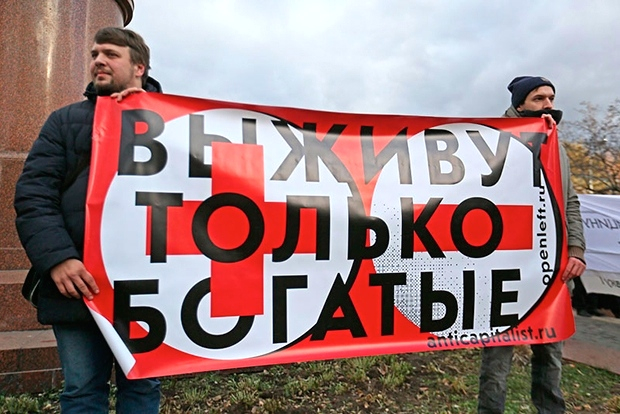
sm13“Only the rich will survive”

Reforms of the social sector in post-Soviet Russia have always had a very important feature: their course has been completely confusing and opaque, and everything connected to the reforms, even their strategic goals (!), has been shrouded in mystery. This is partly a consequence of the extreme fragmentation of the Russian state apparatus, unable to implement a completely coherent reform strategy, but in many ways it is a quite deliberate policy: a policy of disinformation.

The Russian authorities are confident that painful reforms are not necessary to explain, let alone announce, sometimes. One can always give journalists the shake, because who are they anyway? As for the public, it suffices to blame them for not understanding the grand design, for confusing reform and optimization, optimization and modernization, modernization and business as usual. This “spy” policy towards reform leaves wide room for maneuvering. It is always possible to note the level of public indignation and pull back a bit (while making the obligatory remark, “That was the way it was intended!”).

This has been borne out by research. For example, Linda J. Cook, author of Postcommunist Welfare States, has written that when carrying out reforms, both the parliament and the government have relied on a strategy of delays, deliberate obfuscation, and denial of responsibility.

At moments of crisis, chaos and uncertainty in the social sector only grow. Yet now, in my opinion, an absolutely unique situation has taken shape.

First of all, the social sector in Russia has been moved into an austerity regime. This must be noted. Funding will be cut, along with the quantity (and quality) of public services in education, health, and other areas. But how has this austerity been organized?

Paradoxically, it was launched not by a technocratic decision hatched in the bowels of the government, but by Putin’s populist decree on increasing the salaries of state employees. Disinformation has reached its peak: cuts are made to the social sector via a decree that at first glance has nothing to do with it. However, it does, as it turns out. The mechanism is simple. Given insufficient federal subsidies for executing the decree, the regions can carry it out only one way: by cutting some workers while increasing the workload (along with the salaries) of other workers. Of course, the decree does not function in isolation: for example, in health care it is combined with measures to move to “single-channel” financing, meaning that salaries have to be increased, but the only available money is from the health insurance fund. Together, the decree and single-channel financing form a lethal package, leading to indiscriminate layoffs and the closure of health care facilities.

Such is the strange state into which the social sector has been immersed. No less strange is the political spectacle being played out around this issue, a spectacle that reprises in caricatured form the conflict between Party activists and bourgeois specialists in the 1920s. When government and regional “specialists” warn about the impossibility of fulfilling the “order of the Party” (Putin’s May 2012 decrees), “activists” from the All-Russia People’s Front reply, No objections! If you mess up, it’s the firing squad for you! Putin weighs in wisely: the decrees must be carried out, but taking mistakes into account, and without excesses at the local level.

However, the banal fact is that from the outset the federal funds allocated for implementing the decree were not nearly enough, and subsidies will be cut even more in 2015. In such circumstances, implementing the decree on salary increases, in fact, automatically translates into layoffs, increased workloads, and the closure of public facilities.

At the same time, according to Kommersant, “[I]n general, suspension of the decrees may not have to be announced: technically, the government and the administration do not have to do this.”

It is a kingdom of crooked mirrors. “Salary increases” mean layoffs and increased workloads. These increases/layoffs can be stopped at any moment, but what that depends on is unclear. “Activists” are fighting “specialists.” Putin remains calm.

But will society remain calm? The juggling act with Putin’s decrees has not gone unnoticed by independent trade unions representing state employees, including Action, Teacher, and University Solidarity. University Solidarity has already announced protests against cuts to subsidies for increasing the salaries of university lecturers in 2015. The layoffs cannot be hidden, even if they are presented as “increases.”

The rally against the dismantling of the Moscow health care system, on November 2, was the largest social protest since 2005. The protests will continue to grow. In this situation, in my opinion, it is important to point to the clear link between cuts to the social sector and Putin’s policies. The “activists” are no less to blame than the “specialists,” but the main culprit is Putin, who, after all, signed these very decrees. The only way to stop the degradation of the social sector and prevent permanent crisis in the Russian economy, which actually has lasted since 2008, is broad political change.

Ilya Matveev is a researcher and teacher.

Thousands of Muscovites Protest Hospital Closures and Layoffs

Around 6,000 People Rally against “Collapse of Medicine” in Moscow
Farida Rustamova and Artyom Filipenok
November 2, 2014
rbc.ru

A rally against health care reform in Moscow brought together six times more protesters than originally announced, uniting medical and educational trade unions and people from entire spectrum of the political opposition. They protested against the city government’s plans to close twenty-eight medical facilities in the near future. The protesters demanded the resignation of Moscow deputy mayor Leonid Pechatnikov and the heads of the capital city’s health department. According to organizers, another protest, this time nationwide, has been planned for late November.

The Stop the Collapse of Moscow Medicine rally took place on Sunday [November 2, 2014] on Suvorov Square in Moscow. According to rally organizer Alla Frolova (leader of the civic movement Together for Decent Medicine) around six thousand people came out for the rally, despite the fact the announced number had been one thousand.

“We are grateful to the doctors who were not afraid of being laid off and came. Seventy percent of the speakers were doctors, and many people wanted to speak at the open mike we announced at the end of the rally,” Frolova commented.

She told RBC that the trade union Action planned to hold a nationwide protest against medical care reform on November 29, and Together for Decent Medicine would support it.

The speakers included representatives of Yabloko, the December 5th Party, and the CPRF, and Andrei Nechayev, leaders of the Civic Initiative party and former economics minister. The rally was also attended by activists from independent trade unions (Confederation of Labor of Russia, Action, Paramedic.ru, a trade union of ambulance workers, the trade union Teacher, and opponents of reforms at the Russian Academy of Sciences) and opposition movements, from far-rightists (the National Democratic Party) to anarchists.

The rally was attended by people of all ages, but the attendees were mainly middle-aged and elderly. Several protesters wore uniforms of doctors and orderlies. The slogan on the placards borne by protesters called for “bureaucrats to get a conscience shot,” “demolish old Soviet residential buildings, not maternity hospitals,” and so on. Many of the attendees were health care workers who had either been fired or threatened with layoffs. All the protesters with whom RBC spoke wished to remain anonymous, for fear of losing their job and not finding a new one.

ukraine

Protester at Sunday’s rally: “They screwed up with Ukraine, now they’ve moved to medicine. Let’s say a firm no to closures and layoffs. The people who busted the budget should be fired.” Photo courtesy of RBC

Psychiatrist Alexander still works at Psychiatric Hospital No. 14, but the hospital is among those slated for closure by 2017.

“We have slowly been cut back. Over the past two years, half of our 1,100 beds have been slashed. My salary has not been cut yet, but it has been kept afloat by layoffs of coworkers,” he said.

According to Alexander, the elimination of clinics will primarily affect the most disadvantaged people. He warned of a possible increase in the number of offenses and suicides committed by patients, who will be left to fend for themselves at inpatient facilities.

“Western Europe already went through this in the seventies, when psychiatric hospitals there were closed. Later, they had bring them all back,” said the psychiatrist.

The doctors, nurses, trade unionists, and party activists who gathered at Suvorov Square in Moscow demanded an end to layoffs of doctors and wage cuts, and a moratorium on the reorganization of medical facilities. Another demand was the dismissal of all the top managers of the Moscow health department involved in reorganizing the Moscow health care system. During the rally, doctors even promised to organize a Doctor at Hand protest rally where attendees would be able to get free medical advice. Organizers said that doctors who had been planning to attend the rally had been threatened with dismissal.

Marina, a nephrologist, received a layoff notice on Friday.

“I, a highly qualified nephrologist, will be unemployed as of January 1 of next year due to a downsizing of beds. Ten of sixty beds are left in our department at Izmailovo Municipal Children’s Hospital, which has been merged with the Morozovskaya Hospital. Since April, only a third of our five hundred employees are left. I have come here in the hope that we will be heard, because as these reforms continue it will only get worse,” said the fired doctor.

Elena, an anesthesiology nurse, expects to be fired after the New Year.

“Our hospital, Gynecological Hospital No. 5, was merged with Municipal Clinical Hospital No. 57: now we are Medical Diagnostic Unit No. 3. In the past two years, eighty beds have been slashed at our hospital. The remaining one hundred and ten beds will be cut to sixty, meaning only one of five wards will be left,” she said.

Despite the fact she has worked twenty-one years, she is the first to face redundancy, she says. Her salary is now 22,000 rubles a month [approx. 400 euros at the time of publication]. Over the past two years, it has been cut by forty percent.

“Who is now going to provide qualified gynecological assistance to women in our place? We are told that we aren’t wanted,” said Elena.

Ekaterina came to the rally instead of her relatives, who were threatened with dismissal if they went.

“My relatives work in Moscow’s oldest eye clinic, on Mamonovsky Alley. In December, the clinic will turn a hundred and ninety years old. Now it is Branch No. 1 of the Botkin Hospital. This clinic is being vacated. It is on the timetable of hospitals slated for downsizing, and by 2017 there will not be any doctors or patients there,” said Ekaterina.

Not everyone could make it to the rally. As an ob-gyn doctor from Medical Unit No. 33 who identified himself as Dmitry told RBC, a shift prevented him from going to Suvorov Square. According to him, layoffs have also been made in his unit, which is attached to Hospital No. 40.

“Many of my colleagues no longer believe the situation can change,” he said, expressing hope that the rally would have some impact.

In a number of Moscow hospitals, Sunday had been declared “Health Day,” which, people in the crowd claimed, had been done specially to prevent doctors from taking part in the rally. Rain TV reported this, in particular, citing a source in Clinical Diagnostic Center No. 1.

In the resolution adopted by the rally, protesters demanded an immediate halt to “pseudo-reforms to health care in Moscow.” Organizers were also interested in the fate of the real estate vacated after the closure of the health care facilities. There were also demands for the immediate resignations of Moscow deputy mayor Leonid Pechatnikov and the top managers of the Moscow city health department, who had been “discredited by their involvement in the destruction of Moscow’s health care system.” As Frolova told RBC, rally organizers had invited Pechatnikov and health department chief Alexei Khripun, but the deputy mayor’s office only promised to pass the invitation on to him, while Khripun was represented at the rally by an aide, who “remained incognito.”

Protesters called for a public debate on the present state and future of the Moscow health care system involving members of the medical community, the Pirogov Doctors Movement, Together for Decent Medicine, and other public organizations. They demanded that all discussions be public, and the proceedings be published in the media.

“The demands in this resolution will be sent to municipal and federal authorities,” the conclusion of the resolution states.

Cuts to medical institutions in Moscow have been underway since late last years. According to the working version of the timetable for closing Moscow clinics and maternity hospitals, employees at twenty-eight facilities, including fifteen hospitals, will be fired and their premises vacated. Employees have already been laid off at several hospitals listed in the timetable. The bulk of the closures will take place by April of next year.

hospital closures infographic

Plan for eliminating medical facilities in Moscow. Courtesy of RBC

“We did not want to publish [the timetable] because we were crying softly in our offices. But since it has already gone public, we can now all cry together,” said Pechatnikov, commenting on the document.

__________

Read more about the planned hospital closures in Moscow and the public outcry:

  • Andrei Kozenko, “‘You closed a hospital, open a cemetery’: doctors rally against health care reforms,” Meduza, November 2, 2014 (in Russian)
  • Alison Quinn, “Moscow’s Deputy Mayor Attempts to Allay Panic over Health Care Reforms,” Moscow Times, October 29, 2014 (in English)
  • Lyudmila Alexandrova, “Russia’s fast-tracked health service reform sparks protests,” Tass, October 21, 2014 (in English)
  • Ilya Matveev, “Who built them?” OpenLeft.ru, October 17, 2014 (a list of facilities scheduled for closure, in Russian)
  • “We were crying softly in our offices,” Navalny.com, October 17, 2014 (in Russian)
  • Dina Yusupova and Konstantin Gaaze, “Why hospitals are being closed in Moscow,” Bolshoi Gorod, October 17, 2014 (in Russian)

__________

Meanwhile…

Moscow, October 16, 2014, Interfax. On Thursday, Admiral Vladimir Komoyedov told Interfax that, according to the draft budget, a record sum of 3,286,800,000,000 rubles [approx. sixty billion euros] which amounts to 4.2% of GDP, would be spent on the national defense in 2015. This exceeds 2014 spending by 812,160,000,000 rubles.

In 2016, the government plans to spend 3,113,240,000,000 rubles on defense; in 2017, 3,237,820,000,000 rubles.