Western free society is seriously sick too. The symptoms pop up here and there, but one of the most disgusting is the massive support for the alleged “people of Palestine”—that is, Hamas—in this whole monstrous story. I really don’t understand HOW it has been possible, after the atrocities of October 7, after the taking of hostages, including children, to pretend that this was a minor trifle? That the ruthless Jews suddenly out of the blue started tormenting the unfortunate residents of the Gaza Strip?
After all, bolstered by this wave of international support, Hamas thinks it has won. This will lead to fresh terrorist attacks, of course.
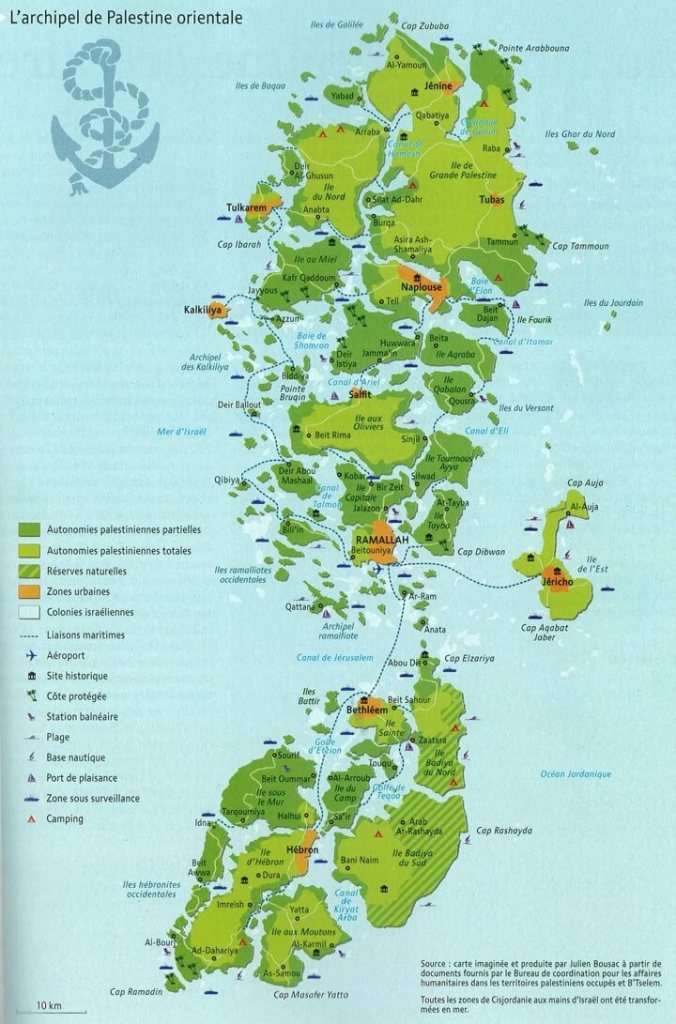
The map above shows what Palestine’s West Bank would look like if all non-Palestinian land suddenly turned into water.
All that would remain would be an archipelago of small islands with the sea of Israel to the west and the Jordanian ocean to the east.
The map is designed to show just how broken up Palestinian land in the West Bank really is. And while originally published in French, it is quite clear in the main point it’s trying to make.
Here are some key points about the map:
Regions of Palestinian Authority:
The map shows areas of partial and total Palestinian autonomy, marked in different shades of green. The darker green areas represent total autonomy, while the lighter green areas represent partial autonomy.
Israeli Settlements:
Areas in blue indicate Israeli settlements.
Urban Zones:
Orange areas represent urban zones.
Protected and Historical Sites:
Natural reserves and protected coasts are marked, along with historical sites.
Geographical Representation:
The map depicts the West Bank as a series of islands, which illustrates the fragmented nature of Palestinian territories due to the division created by Israeli settlements, roads, and checkpoints.
Symbols:
Various symbols denote airports, historical sites, protected coasts, beaches, and camping areas. There are also symbols indicating maritime connections, which, in the context of the map, seem to suggest metaphorical “water” crossings between different areas of Palestinian control.
Geographic Features:
Names of regions and cities such as Ramallah, Nablus, Hebron, Bethlehem, and Jericho are mentioned, providing a sense of the location and distribution of these areas.
The map’s creation by Julien Bousac aims to highlight the challenges faced by Palestinians due to the fragmentation of their territories. The fictional archipelago metaphorically represents how the West Bank is divided and isolated, illustrating the complex political and social landscape of the region.
Red America and Blue America have become two different and mutually antagonistic countries sharing the same geographic space. They barely talk to each other, don’t understand one another — and while Blue America happens to be aware that both itself and Red America exist in a larger, infinitely complex world that needs both of them to be one whole for its survival, just as both of them need that larger world for theirs, Red America is not interested in and indeed is hostile to anything and anyone that is not itself and, while generally tending to be poor and perennially gripped by bitterness and resentment, derives its existential satisfaction almost exclusively from making Blue America feel bad — “owning the libs,” as Red America calls it.
A really good series. I don’t know to what degree it straight up deserves а rating of eight, but it has interesting and fairly unique ideas, and the lead actress is pretty and acts well. We’ll see what the next episodes are like, but on the basis of the first one we can say [that the show] has fine potential. If it develops in a good direction, it could turn out to be decent.
Source: Ororo.TV. Translated by the Russian Reader
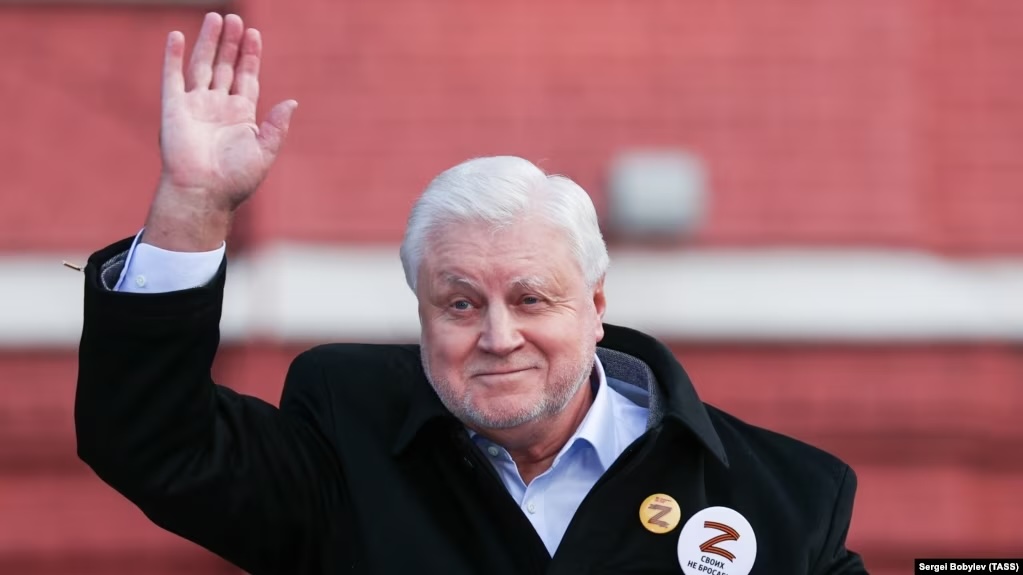
ZZ Top: Russian politician Sergei Mironov and his wife have been accused of kidnapping an infant girl from Ukraine
Sergei Mironov, leader of the party A Just Russia–Patriots–For Truth, and his wife adopted a child taken out of Ukraine. The ten-month-old girl’s personal data was completely changed. Now she bears the surname Mironova, and her birthplace is listed as Podolsk, a city in the Moscow Region, according to an article by Important Stories.
As the Important Stories reporters discovered, in late August 2022, Mironov’s wife, Inna Varlamova, and Mironov’s first deputy in the State Duma, Yana Lantratova, traveled to the Russian-occupied Kherson Region in Ukraine.
In Kherson, the women visited the regional children’s hospital, among other places. They were escorted by the head of the local orphanage, Tatiana Zavalskaya, who had been appointed by the Russian authorities. They examined the children who had been admitted to the hospital from the orphanage and left.
Subsequently, Zavalskaya ordered the hospital to discharge a ten-month-old girl and a two-year-old boy.
When asked by the head of the hospital’s pediatric department why she should discharge sick children (one of them had bronchitis), Zavalskaya said that “that woman chose them and will take them to Moscow.” Doctors tried to delay discharging the children, but Zavalskaya insisted on speeding up the process.
Officially, the children were taken to Moscow for “tests, determination of further treatment options, and rehabilitation.”
The Ukrainian media outlet Hromadskepublished similar information in July 2023.
To adopt a child in Russia, you need to apply to the court. Such cases are heard under a special procedure In November 2022, such a case was heard in the Podolsk City Court in the Moscow Region. Inna Varlamova was listed in the case file as an interested party.
Important Stories claims to have paperwork indicating that in December 2022 Mironov and Varlamova adopted a girl taken out of Kherson. At the request of the adoptive parents, the child’s name and place of birth were changed in official documents.
A source familiar with the situation told the reporters that the girl’s biological mother was deprived of custody and her father had died. And yet, the girl has other blood relatives in Ukraine. The whereabouts of the two-year-old boy taken out of Kherson are still unknown. According to Important Stories, in September 2023, the child was issued a birth certificate that indicates he is in the Moscow Region.
Important Stories notes that this is the first confirmed case of adoption of children taken to Russia from the occupied territories of Ukraine.
Lawyer Maria Chashchilova told Important Stories that adopting Ukrainian children deported to Russia was a crime from the standpoint of international law.
“It is considered genocide. These children often have relatives or guardians in Ukraine who have lost contact with them, and in the case of children from orphanages, their guardians are the officials at these institutions. According to international law, the parties to the conflict must provide relatives and guardians with information about the missing and assist in their search,” the lawyer noted.
It is very difficult to reverse the adoption of a deported child, the journalists say. This can be done only through the court and on serious grounds such as child abuse, alcoholism or drug addiction on the part of the adoptive parents, or the absence of normal conditions for the child’s development and upbringing.
Commenting on the Important Stories article, Mironova called it a fake “by the Ukrainian special services and their western curators.” “They are pursuing a single goal [with all this ‘mudslinging’]—discrediting those who take an irreconcilably patriotic stance today,” the Russian MP wrote on the social network X.
Фейк от украинских спецслужб и их западных кураторов. Я уже привык к информационным атакам. За всем этим стоит одна цель – дискредитация тех, кто занимает сегодня непримиримую патриотическую позицию. Зря стараетесь. Правда всё равно победит. И Россия доведёт СВО до полной победы. https://t.co/nTr39z1Lr2
Sergei Mironov, writing on X earlier today:“A fake by the Ukrainian special services and their western curators. I’m already used to the mudslinging. They are pursuing a single goal with all this—discrediting those who take an irreconcilably patriotic stance today. You’re wasting your time. The truth will win anyway. And Russia will emerge totally victorious in its special military operation.”
Russian children’s rights ombudswoman Maria Lvova-Belova did not respond to a request by Important Stories to comment on the article before it was published. Earlier, she said that children removed from the Ukrainian territories not controlled by Kyiv are not adopted but placed in guardianships.
In March of this year, the International Criminal Court issued an arrest warrant for Vladimir Putin and Lvova-Belova on charges of illegally sending Ukrainian children to Russia. According to the Ukrainian authorities, since the beginning of Russia’s invasion in 2022, about nineteen thousand children have been removed from Ukraine by Russian authorities. Only a few hundred have been able to return to their homeland. Russian authorities claim that they rescued the children from the fighting and are ready to return those whose parents and guardians petition them.
The Gaza Strip is the “most dangerous place in the world to be a child,” the head of the United Nations children’s agency UNICEF said on Wednesday.
UNICEF Executive Director Catherine Russell told the U.N. Security Council that more than 5,300 Palestinian children had reportedly been killed since Oct. 7 – when Palestinian militants of Hamas attacked Israel, killing 1,200 people and taking hostages, most of them civilians.
Israel has focused its retaliation against Hamas in Gaza, a territory of 2.3 million people.
“The true cost of this latest war in Palestine and Israel will be measured in children’s lives – those lost to the violence and those forever changed by it. Without an end to the fighting and full humanitarian access, the cost will continue to grow exponentially,” Russell, who last week visited Gaza, said at a council briefing on women and children there.
Israel has bombarded Gaza from the air, imposed a siege and invaded with soldiers and tanks.
“The Gaza Strip is the most dangerous place in the world to be a child,” Russell said. “In Gaza, the effects of the violence perpetrated on children have been catastrophic, indiscriminate and disproportionate.”
Israel agreed on Wednesday to a ceasefire with Hamas for four days to let in humanitarian aid and free at least 50 hostages held by militants in exchange for at least 150 Palestinians jailed in Israel.
“Women in Gaza have told us that they pray for peace, but that if peace does not come, they pray for a quick death, in their sleep, with their children in their arms. It should shame us all that any mother, anywhere, has such a prayer,” U.N. Women Executive Director Sima Bahous told the 15-member council.
ISRAEL ACCUSES HAMAS OF EXPLOITING CHILDREN
Israel’s U.N. Ambassador Gilad Erdan accused Hamas of exploiting children in Gaza for years and repeated long-held criticisms that the United Nations is biased against Israel.
“Make no mistake as soon as the pause ends, we will continue striving towards our goals with full force,” he said. “We will not stop until we eliminate all of Hamas’ terror capabilities and ensure that they can no longer rule Gaza and threaten both Israeli civilians and the women and children of Gaza.”
Hamas denies operating from places such as hospitals in Gaza and denies using civilians as human shields.
U.N. Secretary-General Antonio Guterres welcomed the ceasefire agreement as “an important step in the right direction, but much more needs to be done to end the suffering.”
There are 5,500 pregnant women expected to give birth in Gaza in the coming month, the head of the U.N Population Fund (UNFPA), the world body’s sexual and reproductive health agency, told the Security Council.
“Every day approximately 180 women deliver under appalling conditions, the future for their newborns uncertain,” said Executive-Director Natalia Kanem, adding that UNFPA was also worried about some 7,000 women who gave birth over the past 47 days and lack access to care, water, sanitation and nutrition.
A car burns inside the yard of a hospital in Mariupol, southern Ukraine, 9 March 2022 Evgeniy Maloletka/AP Photo, courtesy of Al Jazeera
As Israel’s assault on Palestine continues, apparent similarities with Russia’s invasion of Ukraine grow. Israel’s “complete siege” of the Gaza Strip – cutting off water, electricity and food to more than two million inhabitants – echoes Russia’s intentional destruction of our energy infrastructure last winter. This, among other things, earned Russia the label of a “terrorist state” among Ukrainians.
From the moment an evacuation order for northern Gaza’s 1.1 million inhabitants was announced, Ukrainians must have known it would expose the most vulnerable – the elderly and sick – to certain death. We know that when people have no viable alternatives, they often prefer to stay.
The images of widespread devastation that reach us from Gaza, which suggest the Israeli army’s disregard for international humanitarian law, also resemble those from Mariupol or Bakhmut last year. Israel – like Russia in Ukraine – has been accused of bombing residential areas, evacuation corridors and the only exit point from the city, Rafah.
Of course, Hamas’s brutal attacks on civilians in Israeli kibbutzim also appear similar to Russia’s massacres in Bucha in March 2022. It is only right that these were condemned by Ukrainian president Volodymyr Zelenskyi and the Ukrainian Foreign Ministry. But their messages of support for victims and their families were accompanied by problematic assertions, including Zelenskyi’s truly catastrophic conclusion that Israel has the unconditional right to defend itself.
Since then, Ukrainian officials have avoided talking directly about Israel’s ‘Operation Iron Swords’, despite the death toll in Gaza having exceeded 3,500 in the 11 days since its launch, according to the Palestinian authorities.
But Ukraine’s carte blanche to any response that Israel deems necessary makes little sense given historical or recent Ukrainian-Israeli relations, which have been marked by tensions over occupation and respect for international law. Given the security problems Ukraine faces, its foreign policy remains faithful to the promotion of two causes: respect for territorial integrity and nuclear disarmament.
Diplomatic tensions
Unlike the US and its European allies, Ukraine has systematically supported UN resolutions condemning the illegal occupation of Palestinian lands, not without concern for consistency over its own territorial claim on occupied Crimea.
In 2014, Israel did not vote on a UN resolution that denounced Russia’s annexation of Crimea and reaffirmed the territorial integrity of Ukraine. Two years later, Ukraine passed a resolution condemning Israeli settlements in Jerusalem – prompting Israeli prime minister Binyamin Netanyahu to cancel a visit to Israel by a Ukrainian representative, then prime minister Volodymyr Groysman.
These tensions have become heightened over the past year – including when Kyiv supported two UN resolutions in November 2022. The first was for the nuclear disarmament of the Middle East, directed against Israel’s nuclear program, and the second for the opening of an international investigation into Israel’s “prolonged occupation, settlement and annexation of the Palestinian territory”, reaffirming Palestinians’ right to self-determination.
Then, in July 2023, the Israeli Ambassador to Ukraine, Michael Brodsky, condemned Ukraine’s support for 90% of the UN’s “anti-Israel” resolutions, which he described as an “abnormal situation, especially given the fact that Ukraine quite often turns to Israel for various requests”. These requests have also been the subject of tension between the two countries, with Israel having sent humanitarian aid to Ukraine but refusing to send weapons, including defensive weapons, saying that Israel, unlike NATO member states, can only rely on itself.
Israel has also been cautious in its stance on Russian aggression against Ukraine, seeking to maintain cordial diplomatic relations with Russia in light of its own military interests in Syria. It did not join many Western countries in imposing sanctions on Russia and abstained from voting on a UN resolution in favour of Russia’s reparations for its destruction in Ukraine. Since the full-scale invasion, Israel has welcomed 30,000 Ukrainians – including 15,000 Ukrainian Jews as part of a repatriation programme – far fewer than have been taken in by other countries.
Explaining the silence
Most Ukrainian politicians and diplomats likely consider the history between Israel and Palestine too complex to distinguish between aggressor and victim. But this does not explain their silence on Israel’s violations of international law in recent days, which are not dissimilar to actions they have denounced previously. Their silence likely has three sources.
First, Ukraine has sought to distance itself as clearly as possible from Hamas – labelled “the new Nazis” by Netanyahu – and its ruthless methods, which have been used to arbitrarily target Israeli civilians. This is not least because Russia’s justification for the invasion of Ukraine – the alleged need to “denazify” the country – has been effective in the Global South and in certain fringes of Western civil society. Yet in the dominant discourse set by Western governments it is impossible to distinguish between the actions of Hamas and the more general struggle of Palestinians for freedom and justice, which consists of multiple and varied forces. Ironically, diplomats have warned that the lack of support for Palestine will almost certainly result in diminishing support for Ukraine in the Global South.
Prevailing Western discourse is often seen to conflate anti-Semitism and criticism of Israel – another reason why the Ukrainian government is particularly careful with its official statements in the international arena. This is in part because Ukraine is one of the countries most marked by the Holocaust, with nearly 1.5 million Jews killed between 1941 and 1945, but also because Ukrainian nationalist movements, which sheltered people directly responsible for these massacres, have been whitewashed and heroised inside Ukraine.
And finally, Ukraine’s position may simply be geopolitical pragmatism. Ukraine’s Association Agreement with the European Union provides a clause on “convergence on foreign policy and security issues” that requires Ukraine to align itself with positions expressed by European officials. And its dependence on Western humanitarian and especially military aid predisposes its leaders to line up behind its allies, particularly the US, at the risk of being deprived of this support. The fact that Hamas maintains privileged links with Russia only reinforces this loyalty.
A recent statement from the Ukrainian Foreign Ministry, published on 17 October, reflects the ambiguity and the competing principles of Ukraine’s foreign policy. It reaffirms support for Israel’s “efforts to counter terrorist acts”, but it also “advocates the settlement of the Palestinian-Israeli conflict with the help of political and diplomatic means”.
The following day, after the strike on the Al-Ahli Hospital that killed hundreds of Palestinians, which both Israel and Hamas deny responsibility for, Ukrainian officials released their first statement on the humanitarian situation in Gaza. The statement stresses that both parties should “abide by the rules of warfare and respect the norms of international humanitarian law” but fails to call for an immediate ceasefire.
The need to speak out
While Ukraine’s official position is dictated by pragmatic diplomatic considerations, Ukrainian civil society is not obliged to echo its government’s silence on Israel’s punitive operation against Gaza.
Israel’s injustices in Palestine, as well as Russia’s in Ukraine, go far beyond mere failure to respect the laws of war. Ukrainians rightly repeat that Russia’s war against the Ukrainian people did not begin on 24 February 2022. It has occupied part of Ukraine since the annexation of Crimea in 2014, and the colonisation by the Russian Empire of the peoples who inhabit Ukrainian territories dates back to the 17th century.
This history, which continued during the Soviet era, involves episodes of a genocidal nature. These include the Holodomor, a great artificial famine that killed several million Ukrainians in 1932 and 1933, and massive displacements of populations such as the 238,000 Crimean Tatars deported from Crimea to other Soviet republics under Stalin’s orders in 1944. Almost half of the Tatars died of starvation and disease during the following years.
Similarly, Israel’s war against the Palestinian people did not begin on 7 October 2023. It began with the Nakba of 1948, when more than 700,000 Palestinians were expelled from their lands. In 1967, at the end of the Six Day War, Israel occupied the rest of the Palestinian territories, causing a new Palestinian exodus and the installation of new Israeli colonies.
Palestinians often say that the Nakba is a perpetual process, since the dispossessions and colonial crimes have never ended. They have been fragmented and experience different situations depending on whether they live in the West Bank, Israel, Gaza or are refugees. But all are affected by the apartheid regime. Gazan Palestinians particularly suffer from the blockade imposed by Israel since 2006 with the collaboration of Egypt, making the Gaza Strip the world’s largest open-air prison.
The evil that has killed both Israeli and Palestinian civilians in recent days is rooted in the continued occupation and colonisation by Israel of the Palestinian territories. In this sense, the oppression of the Ukrainian and Palestinian peoples has similarities: it is about the occupation of our lands by states with nuclear weapons and overwhelming military force, which mock the resolutions of the UN and international law, putting their causes above any diplomatic dialogue.
As Ukrainians, as supporters of the Ukrainian cause, we have a special responsibility to understand and raise our voices in the face of what is happening. We must point out the inconsistencies of Western governments that support our anti-imperialist struggle while backing Israel’s colonial violence. The tragedy we are currently experiencing must sharpen our sensitivity to similar human experiences.
Following Russia’s invasion, we discovered how little the international community knew about the history of Ukraine. But what do we know about the history of Palestine? In a world where polarisation is increasing, where colonial wars of staggering scale and violence are resurgent, only solidarity between oppressed peoples and curiosity about our respective struggles, beyond geopolitical divisions, can show us the way to just and lasting peace.
Here’s a great example of Israeli hasbara targeting Russian speakers.
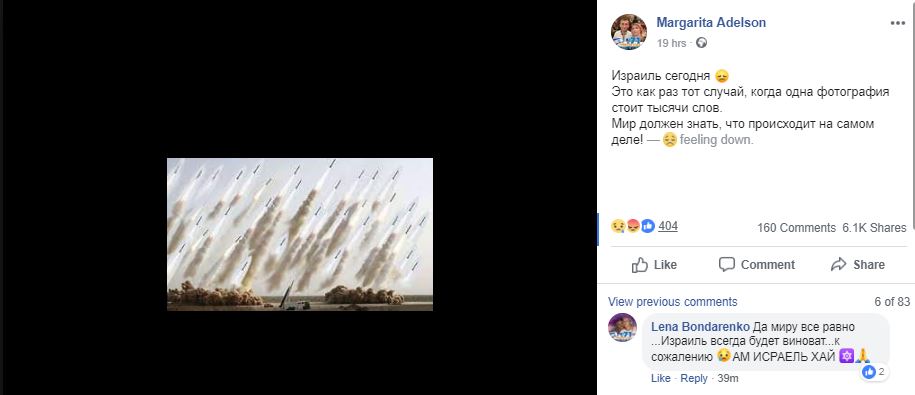
I found the short post on a friend’s Facebook news feed. It consists of three sentences attached to a powerful image of at least thirty missiles or rockets fired simultaneously.
The message reads (in Russian), “Israel today [sad face emoji]. This is exactly the instance when one photo is worth a thousand words. The world needs to know what’s really going on! — feeling down [sad face emoji].”
The post has been shared 6,800 times, garnered 451 likes, and elicited 173 comments in the 20 hours since it was published.
We are meant to imagine, of course, that the “photo worth a thousand words” is a photo of a Hamas rocket installation in the Gaza Strip firing its deadly cargo towards the utterly innocent state of Israel.
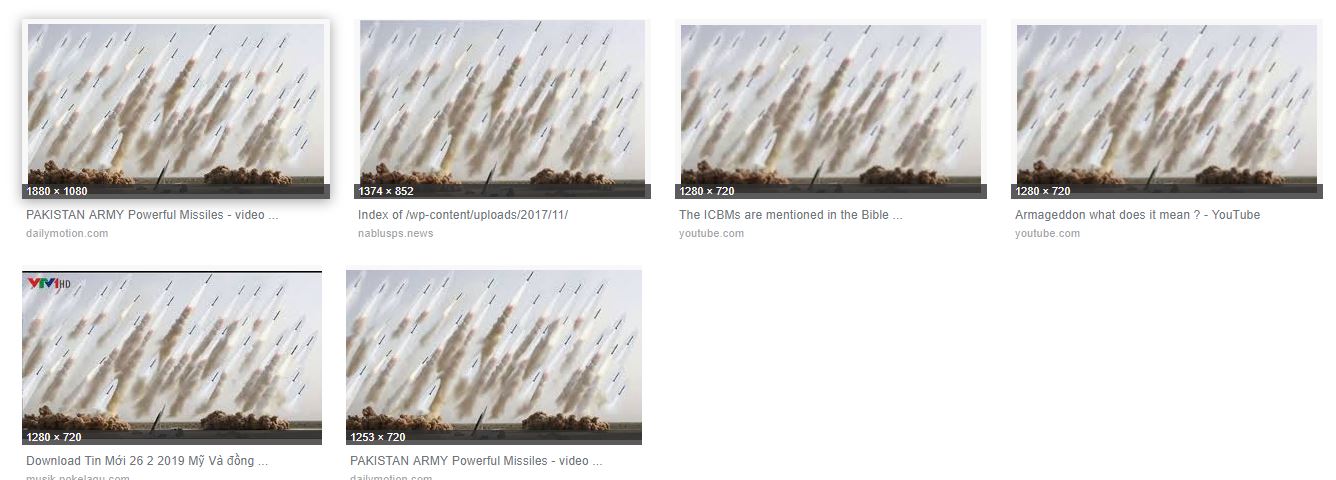
A simple Google image search turned up several instances of the same image, all of them bearing different dates and captions, none of which link the “photo” in question to Hamas or the current hostilities between Hamas and the IDF.
So, in fact, the photo is worthless, except to underscore something we already knew.
Zionist hasbaristas are utterly unscrupulous. They count on people not bothering to check any of their claims, but just to pass the “horrible truth” along, thus confusing more people about the real, complicated facts about the relationship between the state of Israeli and the stateless Palestinians. {TRR}
In Russia, two distinct, completely dissimilar peoples live side by side, and these peoples have long been bitterly hostile towards each other. (May the Byzantine double-headed eagle that Ivan the Third selected as the country’s emblem go to hell in a hand basket.)
There is Us and there is Them.
We have our own heroes: Chekhov, Mandelstam, Pasternak, and Sakharov.
They have their own heroes: Ivan the Terrible, Stalin, Dzerzhinsky, and now Putin.
Members of the two nations recognize each other at first glance and experience a pang of acute dislike that selfsame second. We do not like anything about Them: the way They look, talk, carry themselves, rejoice and grieve, dress and undress. Their favorite singers, films, and TV shows make us sick. They pay Us in kind, and with interest.
Apart from Us and Them, there are just plain folk, who make up the majority of the population. We and They are constantly trying to win over this neither-fish-nor-fowl, to introduce them to our values.
What do you think should be done with this reality? Should we kill each other?
While there seems to be a fair amount of self-irony, in the comments, above, by the famed Russian detective novel writer Boris Akunin, I cannot help laughing when I read such exercises in self-praise by the so-called Russian intelligentsia and, at the same time, recall something that happened to me several years ago when I was running a summer study program in Petrograd for an American university.
Our students lived with Russian host families, and fitting student to host family was not always a snap, but it was mostly doable. That particular summer, however, more students had signed up for the program than ever before, and our limited resources were stretched thin. So I was taking recommendations from whomever I could get them, rather than relying only on the list of potential host families provided by our partners at the state university here in town.
That is how found myself visiting a couple in their flat somewhere in the city’s Central District. It was in a Stalin-era building, but the couple proudly informed me right away that Oleg Basilashvili, a well-known screen and stage actor and liberal intelligentsia icon, was a neighbor. They, too, were members of the creative intelligentsia. One of them was a theater critic, while the other had something to do with the Conservatory, I seem to remember.
The point, as I had already told them over the phone, was that I had one student left to place with a family, a male student. They, it transpired, had a teenage daughter. Would it be a problem for them to have a male student living in the same flat as their daughter? No, it would not be a problem, they told me.
Given the reputation of the university I was representing, they might have imagined I would be setting them up with a blond scion of New England old money, so if their daughter was whisked off her feet over the summer or merely made useful connections in high places, what could be the harm?
As we were wrapping up our conversation at their flat, having ironed out almost all the practical details, the couple thought to ask me what the young man’s name was.
“Diego,” I said.
My answer literally sent their eyes spinning in circles and smoke shooting from their ears. All it took was the “wrong” name for them to imagine a summer of their daughter basking in the glow of old American money with a patina of academic respectability turning into the constant threat of rape and ravishment at the hands of a “hot-blooded Latino.”
And they told me that in so many words, all the while denying that they were what they were—racists.
The funny thing was that Diego was gay in every sense of the word: fun to be around, a kind, sweet-hearted young man, and no “threat” to their precious daughter. But since Oleg Basilashvili’s neighbors had already outed themselves as racists, I did not want to hang around and find out whether they were homophobes as well.
I was more naïve than I am now. Although I had already had many encounters with “casual” racism and anti-Semitism Russian style, Petrograd had not yet arrived at the bad part of its mid noughties, when more proactive racists than my intelligentsia couple would ever want to be began assaulting and murdering immigrants, foreigners, anti-fascists, and members of Russian ethnic minorities in especially large numbers.
But I was not naïve enough to try and plead Diego’s case to these assholes. I immediately left their precious den of culture-vulturehood and hit the streets, cursing them out loud while also trying to think of a back-up plan.
That it is when I thought of our long-time acquaintance F.A., who had nannied the young son of a friend for years, and even had cooked for our family for a short while when we were in a bad spot. By no means was F.A. a member of the ballyhooed intelligentsia, which was not to say that she was uneducated or crude or anything but kind, loving, funny, smart, warm, and one of the best cooks I have ever met in my life. Besides that, she had worked in a factory her whole life, doing quality control, and she was Jewish.
When I telephoned her and told her what the deal was, she did not hesitate a second to welcome Diego into her home.
Needless to say, Diego and F.A. hit it off and had a great time in each other’s company that summer.
So when, a while later, I was asked to find temporary summer accommodation in Petrograd for another young gay Latino man, I could think of no better hostess than F.A. They also hit it off famously.
This is my roundabout way of saying something that has only been confirmed ten thousand times since by experiences both personal and vicarious: the liberal Russian intelligentsia is not all it is cracked up to be. It is often not particularly liberal or progressive, and is just as likely to be as Putinist or more Putinist than Putin’s mythical alleged “base” among industrial workers and peasants in the “Russian heartlands” or the “simple folk” in the big cities. If anything, my own experience has been that, on the contrary, these simple folk are not so simple and not so automatically inclined to putinize the world around them, much less racialize it.
There are just as many bigots and racists among the “Russian liberal intelligentsia” as there are among the Russian lower classes, maybe more.
Whatever the case, the fact that many Russian liberals have loose reactionary, racist screws in their brains has become apparent from the rabid reactionary discourse that has sprung up within Russia’s talking, thinking, and writing classes around the “refugee crisis” in Europe and the fresh clashes between Israelis and Palestinians.
Yegor Osipov and Kirill Kobrin’s attempts, below, to counter this utterly irrational discourse might seem mild outside of this context, but they are welcome contributions to a debate that is most remarkable for its near-total absence from Russian public life.
Yegor Osipov
Humanizing Palestinians
Yegor Osipov
October 21, 2015 Radio Svoboda
“Maybe Israel does not behave perfectly in the Occupied Territories, but this is no justification for terrorism.” This comment on Facebook is nearly the most moderate gesture of support for Israel in connection with the new wave of Palestinian terrorism. Despite the fact that nothing justifies terrorism, the situation requires clarification.
Unfortunately, Russian commentators often forget the fact that Israel occupies around 60% of the West Bank and has been building settlements there for its own citizens. (Despite the fact that the Oslo Accords stipulated this state of affairs was only temporary.) They forget the Jewish settlements are built so as to significantly impede the movement of Palestinians between their towns and prevent the expansion of these towns. They forget that between 2000 and 2012 Israel demolished over two and a half thousand Palestinian buildings, buildings for which it, as the occupying power, had not issued construction permits. They forget that Israel restricts the access of tens of thousands of Palestinians to water, forcing them to pay much more for it than Jewish settlers living nearby. They forget that the IDF keeps troops in the West Bank who are engaged only in maintaining the occupation: a noise grenade there, a noise grenade here, searches of houses (women to the right, men to the left), and so on every other night. This tactic is called “mak[ing] our presence felt,” and sometimes it leads to innocent victims. Without knowing this, you might think that Israel and the West Bank were different planets, but in fact both political entities depend on each other. The West Bank depends on virtually everything that happens in Israel, while Israel (and this becomes clear during waves of terror) depends on the social climate in the West Bank.
The situation with the Gaza Strip, about which Russians also do not know very much, is quite different. In 2005, after the withdrawal of Israeli settlements and military personnel, the Gaza Strip was declared territory to which Israel had no obligations because it had “ended the occupation,” although it continued to implement land, sea, and air control of the Strip. After Hamas came to power and began rocket attacks on the southern part of the Jewish state, Israel proclaimed the Strip a “hostile entity” and established a blockade of the area along with Egypt, essentially locking around 1,800,000 people in an open-air prison.
In July 2014, in response to the murder of three Jewish teenagers by Palestinian terrorists, Israel launched an operation in the Gaza Strip, killing more than 2,200 people. Last summer, Jewish terrorists tossed Molotov cocktails at an Arab house, burning alive three members of the family who lived there, including an 18-month-old baby. Israel has yet to indict the terrorists. Some people manage to include this in the “Jewish people’s struggle for survival.” I think it only plays into the hands of anti-Semites the world over. But anti-Semitism, according to a newly released US State Department report on levels of religious freedom in the world, is once again on the rise, and the bias of the UN Security Council and the world’s leading media in favor of Palestine [sic] has not gone away.
Whether Israel will cope with the current wave of terror is a big question, because what is happening is not an intifada, which involves the coordination of armed protest. Today, we are seeing one-off attacks by ordinary Palestinians in no way linked to terrorist organizations. This is desperation after nearly half a century of occupation and the continuing colonization of Palestinian lands by Israelis. Last Friday, Benjamin Netanyahu, who during the recent elections declared there would be no Palestinian state on his watch, urged Mahmud Abbas to negotiate. But it is very likely that, as Israel’s main partner (just compare Abbas and Arafat), Abbas will be unable to help calm the situation. According to reports by Israel’s security services, the leader of the Palestinian Authority has been trying to resist the current wave of violence as it is. All this only shows that the situation is critical.
However, for the Russian intelligentsia, Israel continues to be a place it prefers to discuss with eyes wide shut and using generalizations like the “clash of civilizations.” Divided, like Europe, over the issue of taking in refugees, when it comes to the Arab-Israeli conflict, Russian intellectuals, with few exceptions, adopt an uncompromising pro-Israeli stance. Reposts of videos from Israeli hospitals showing “ungrateful” Arabs are accompanied by captions such as “Watch this!” or “Read this!” Others post pictures of the Israeli flag emblazoned with the slogan “Yes! I stand with Israel! Share if you do, too!”
The rising wave of support for Israel points to the Orientalist bent of Russian minds, with the classic traits of Orientalism. The eastern, Arab world of Islam is incapable, allegedly, of solving its own problems. This world must always be guided by an “intelligent” West, a role that is often assigned to Israel, because Arabs are fundamentally incapable of changing themselves and their societies. The great Edward Said writes in the preface to Mourid Barghouti’s book I Saw Ramallah that the novel’s translator has done her job excellently, and in the English translation “[t]he Palestinian experience is therefore humanized and given substance in a new way.” Russian intellectuals, however, are not yet willing to humanize Palestinians. Indeed, what difference does it make that Asraa Zidan Tawfik Abed, who tried to stab a soldier in Afula and was gunned down, is a mother of three who holds a degree from Technion University in Haifa?
It is unclear how the conflict will end. It is clear only that the conflict is likely to be another turning point in Israel’s history, the next step after the withdrawal from the Gaza Strip. What can the Russian intelligentsia do if it wants to help Israel deal with these as-yet-unclear new realities? At the very least, it should cease losing its self-control and speaking the language of the “clash of civilizations,” see, finally, what the Palestinian territories are like and how closely bound the West Bank is to Israel, realize the gravity of the situation in the Gaza Strip, and try and work out a positive agenda. In the end, it is this that has not happened the last twenty years. The occupation of and crimes against the Palestinians are, alas, not the problem. The problem is talking about the occupation and crimes of the Jewish state.
In his popular book Memoirs of a Jewish Extremist, Yossi Klein Halevi, once a member of the radical fringe of American Jewry, describes the process of his transformation from an ultra-rightist radical to a centrist. When Halevi’s first daughter, Moriah, was born in 1985, he moved all his books about the Holocaust (which had once played a key role in his life as a member of the second generation) onto the upper shelves of his bookcases. He noticed that he put away even books with no pictures. He writes that this was his way of saying to himself these books were no longer the center of his life. Just as Halevi put away books about the Holocaust, the Russian intelligentsia needs to remove the imaginary radio broadcasting news either about the Six-Day War or Yitzhak Rabin’s murder and replace it with two maps: a map of the Middle East and a map of Israel and the Palestinian territories. The old threats to Israel are ever fewer, while we have a hard time imagining the new threats.
Yegor Osipov is a Russian journalist living in the Netherlands.
Kirill Kobrin
The Intelligentsia and Racism
Kirill Kobrin
October 23, 2015 Current Time
Nationalism was born two hundred years ago. At first, it was the theoretical labor of the early Romantics, poets, folklore compilers, and forgers of nonexistent ancient epics of their own peoples. Only then was it put into practice: amidst the gun and cannon smoke of the Napoleonic epic, in the secret Carbonari societies, on the revolutionary barricades.
In the late nineteenth century, nationalism generated several new nation-states. They became more numerous after 1918, not to mention the post-1945 period.
The process of carving countries up according to ethnicity continued even after 1991. The further disintegration of big countries into small countries, and small countries into tiny countries, was just barely avoided. And yet, until recently it was thought that nationalism in today’s Europe was the bailiwick of football hooligans and political outsiders. However, as recent events have shown, many, many people think in terms of “blood and soil.”
It has transpired that there is no vaccine against nationalism and even racism not only for so-called ordinary people. Wordsmiths, intellectuals, and even liberals chronically suffer from them as well. Russian liberals have proven especially vulnerable, or rather, members of the educated class who consider themselves liberals. We are not engaged in political analysis in this column, but we will look at the ethnic mindset of current Russian liberals as a historic phenomenon.
Russian intervention in the Syrian civil war has excited many people dissatisfied with the Putin regime, even those who resisted the Crimean temptation. For example, one well-known Internet figure, who has somehow passed for a political expert, shook the air with bloodthirsty calls to kill as many Syrians as possible, since they are Arabs and, therefore, enemies.
Whoever bombs Syria today, I very much welcome it, and if it is wiped off the face of the earth I won’t be the least bit disappointed. I will only say thank you.
—Anton Nossik
Many have voiced a slightly more restrained variation on this viewpoint, and one progressive media outlet has published an article that discusses, in particular, the indisputable superiority of Jewish men over Arab men in the sense of devotion to their families and courage. In connection with the influx of Syrian refugees, concern for the purity of European is voiced. The article in question is permeated with hidden and flagrant sexual motifs. The subtitle refers to “Raped Europe,” and in the opening paragraphs the author complains it is unfair that “girls love” starry-eyed defenders of refugees rather than defenders of European values.
Fear and loathing towards an alien tribe (the authors of such texts usually do not distinguish Arabs from Kurds, Kurds from Turks, and so on) and an alien religion, Islam (whose sense and essence they are too lazy to understand) have reached a fever pitch. Like all hysterics, Russian “racialist liberals” have been winding themselves up, and the noise level has been steadily increasing.
We are faced with a typical nineteenth-century and early twentieth-century mindset. Take, for example, the motif of the “raped motherland” (or “native culture”). Motherland and Fatherland had become a “mother” back with the Romantics, and later, Alexander Blok, a Late Romantic congenial to proto-fascist views, even proclaimed Russia his wife.
Oh, my Russia! My wife! Painfully / Clear to us is the long road!
—Alexander Blok
In this scheme of things, any outsider is seen as a threat to the mother’s purity, to her sexual serenity. But war and other hostile (or seemingly hostile) actions are attempted rape. Curiously, the identification also works in reverse. An ordinary woman belonging to “our” people is treated as the Mother, the symbol of the nation.
The further we go into the twentieth century, the clearer the purely ethnic and biological features in the countenance of the Woman/Mother become. She is sexually threatened by telltale-looking strangers: Nazi anti-Semitic propaganda was chockablock with depictions of handsome blonde beauties harassed by swarthy apelike creatures.
For current Russian liberals, the role of the Mother threatened by violence is now played by the whole of Europe. It is strange that these folks so rarely invoke the mythological motif of the rape of Europa, in which the maiden Europa is abducted by Zeus in the shape of a bull, who spirits her away—across the Mediterranean!—to Crete, where has his way with her. The discussions of the newfangled national-liberals about the “rape of Europe” naively retell the myth in the most unpretentious racist manner. The “rapist,” “alien” or “suspicious Muslim” crosses the Mediterranean and, once in Europe, rapes her, meaning he bends her to his will. Just imagine that not so long it was said that classic Freudianism and Jungianism were half-forgotten things of the past. But now it turns out that all these things (combined with Social Darwinism and racial theory about the “inferiority” of certain nations) are alive and dominant in the minds of people, moreover, the minds of people whose job it is to reflect on things and generate meaning.
You can, of course, seek out the historical parallels, for example, the steady rightward drift of the liberal segment of the first Russian emigration or the fascist sympathies of such champions of freedom and justice as G.K. Chesterton. But all historical analogies obscure the essence of the matter. And the essence of the matter is this. Suffocating nationalism, moreover, on both sides of the current Putinist divide, is the principal legacy of seventy years of Soviet rule. While preaching internationalism, the communist ideology and the communist regime were weaker than the primitive xenophobia and fear of outsiders that permeated the minds of the Soviet intelligentsia. The collapse of ideology has brought these sentiments to the fore. Aside from everything else, another thing has become clear. The Russian intelligentsia, which considers itself liberal, knows no more about the world than their predecessors from some Turgenev novel.
By the way, have you heard there was a decisive battle on the Danube? Three hundred Turkish officers killed, Silistra has been taken, and Serbia has declared its independence. Don’t you think that you, as a patriot, should be thrilled? As for me, my Slavic blood is just boiling! However, I advise you to be more cautious. I am sure you are being watched. The spying here is horrible! Yesterday, a suspicious person came up to me and asked whether I was Russian. I told him I was Danish.
—Ivan Turgenev, On the Eve
Everything was clear then: we were fighting for our “fellow Slavs” and wishing death on the “bloodthirsty Muslims.” The only difference is that today the names of the people we should be protecting from the villains are very different. We are witnessing a cynical pathetic remake of the novel On the Eve.
Kirill Kobrin is a writer, historian, journalist, and editor living in London.
The texts by Boris Akunin, Yegor Osipov, and Kirill Kobrin were translated by the Russian Reader.