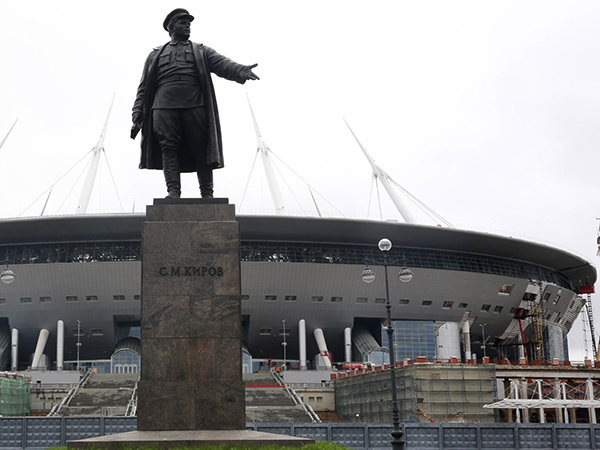
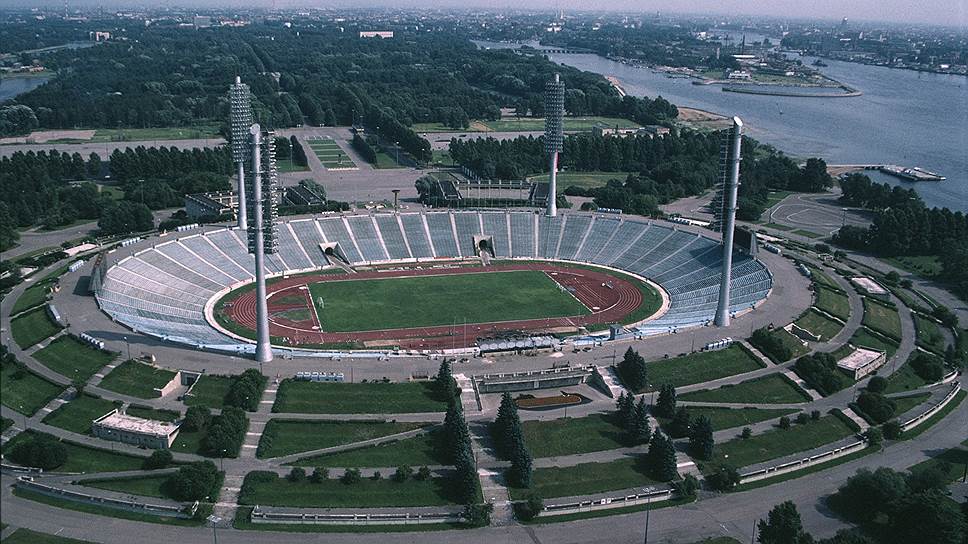
The new football stadium on Petersburg’s Krestovsky Island, still unfinished after years of delays and rampant cost overruns. In the foreground is a monument to former city boss Sergei Kirov, murdered under mysterious circumstances in 1934. Photo courtesy of Pyotr Kovalyov/Delovoy Peterburg
Schools, Kindergarten, and Hospitals Sacrificed to the Stadium Antonina Asanova Fontanka.ru
August 15, 2016
The Smolny [Petersburg city hall] will finance construction of the football stadium on Krestovsky Island twice over. The advances of 2.6 billion rubles that have not been returned by VTB Bank and Transstroy will be issued to new contractor Metrostroy. Schools and kindergartens will have to wait.
To finish the stadium on Krestovsky, the Smolny is ready to sacrifice the completion dates of three dozen facilities, including kindergartens, schools, and hospitals. 2.6 billion rubles, earmarked for social infrastructure, will be “redeployed” to Petersburg’s construction project of the century. City hall is counting on recouping the reinvested funds later, and figures it can afford not to hurry with the construction of public facilities.
The Construction Committee has prepared a draft decree on reallocating its 2016 budget. By law, the agency can redirect up to 10% of the funds in its targeted investment program, i.e., 2.8 billion rubles, a committee spokesperson said on the record.
Off the record, sources at the Smolny have explained that the stadium’s former general contractor, Inzhtransstroy-SPb, has not run through the 3.6 billion rubles it received as an advance. The company can still deliver part of the construction work and purchased materials before August 25, a month after its contract with the city was terminated. But if the city does not succeed in offsetting the entire sum, it will have to try and collect the money either from the contractor or VTB Bank, which issued the guarantee for completion of the work.
Experience shows it is not worth counting on the good will of companies when it comes to giving back money. The Construction Committee is still in the midst of suing VTB for the return of funds issued under contracts for the construction of indoor ice rinks, which were terminated over a year ago.
A strategy of protracted litigation does not suit the Smolny at all. Completing the stadium before year’s end is a matter of honor to the city government. So the Construction Committee has decided to redeploy part of the funds allocated for new kindergartens and schools to Petersburg’s main construction project. Only facilities whose completion was planned for this year have not been touched.
The city’s calculation is simple. Construction of public facilities will be slowed down a bit for the time being. But when the stadium is delivered at the end of the year, and the monies that were advanced are returned to the budget, the long-awaited construction projects will again be accelerated to a proper speed.
Health clinics and hospitals will be most affected by the budget cuts. The Construction Committee has decided to withdraw nearly a billion rubles from construction of these facilities.
Expenditures on one of the city’s most protracted construction projects, a perinatal center at Maternity Hospital No. 9 on 47 Ordzhonikidze Street, have been reduced by a quarter billion rubles. Doctors were preparing to nurse premature and sick newborns in the facility, and spoke of modern operating rooms and a modern intensive care unit. The building, in fact, was supposed to be delivered at the end of 2015. But now the contractor, Stroykomplekt, owned by former Baltstroy top manager Dmitry Torchinsky and Alexei Torchinsky, has a new deadline: the end of 2017.
People in the suburb of Kolpino will also have to wait for the opening of the new surgical wing at Hospital No. 33. Only one million rubles has been left in this year’s budget for its completion, while 155 million rubles will be transferred to erecting the football stadium. However, the construction site on Pavlovskaya Street has already been idle for a year. The Construction Committee terminated its contract with the previous contractor, but has not yet found a new contractor.
The residents of Kolpino will not have to wait alone, however. Among the facilities where construction will be slowed down are health clinics in Strelna and Krasnoye Selo, an ambulance substation in Metallostroy, and a childen’s tuberculosis sanatorium in Ushkovo.
Residents of the housing project on Badayev Street will also have to be patient. The city has stripped their future school of 90 million rubles in financing.
Finally, kindergartens will hardly suffer at all: funding of their construction will be reduced only by 310 million rubles. The biggest loser, to the tune of 130 million rubles, is the future kindergarten in the Golden Bay residential complex, near Tricentennial Park. Its completion has been postponed for a year, until the end of 2017.
The Smolny is even ready to cut funding for construction of a site directly linked to the new stadium: the waterfront near the Novokrestovskaya subway station, currently under construction. The contractor, Leokam, will have its funding for making improvements to the waterfront cut by nearly 240 million rubles. Apparently, the company will have to catch up next year. Under the terms of its contract, it has to deliver the works before the end of 2017.
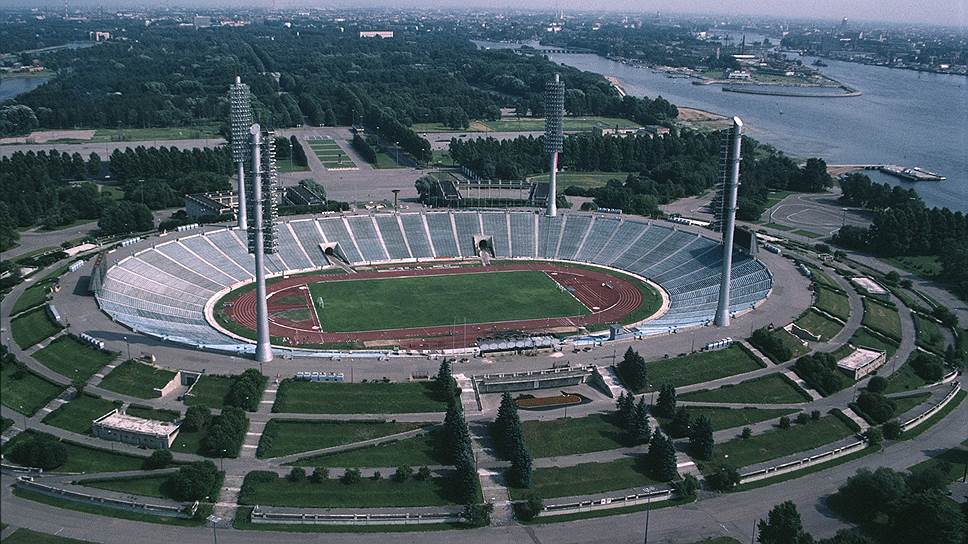
The site of the new stadium was previously occupied by the Kirov Stadium, a federally listed architectural landmark. Designed by world-famous constructivist architect Alexander Nikolsky and opened in 1950, it was unceremoniously demolished in 2006. Photo courtesy of Kommersant.
However, what matters is that the stadium on Krestovsky Island will be delivered before the end of this year, and cost estimates of its construction will not increase, formally speaking.
A total of 42 billion rubles [approx. 582 million euros] have been allocated on the stadium, Petersburg’s principal protracted construction project.
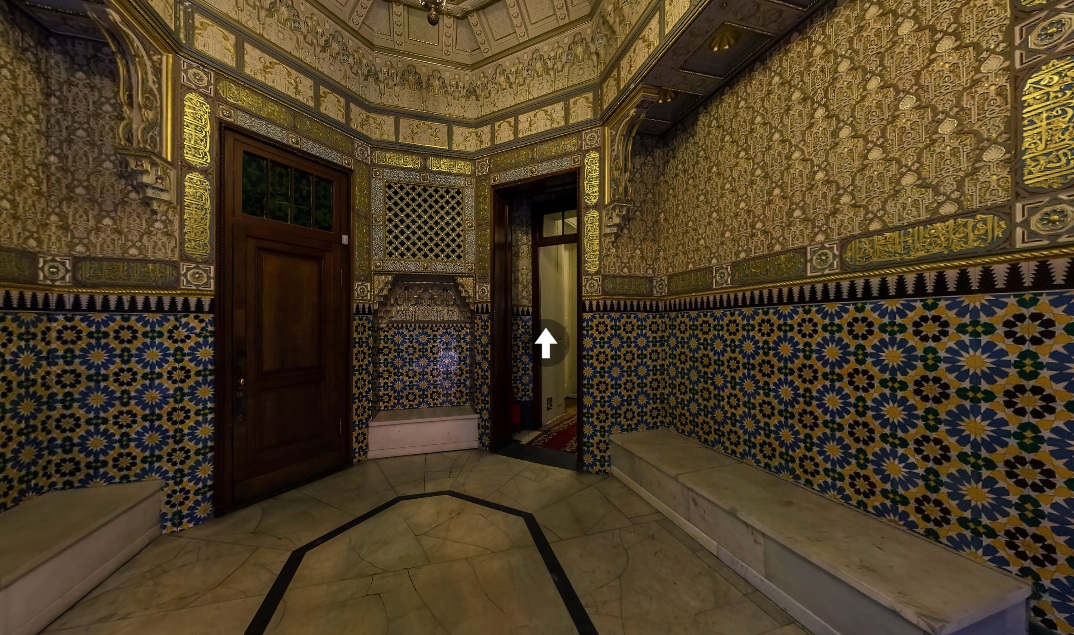
Screenshot of a virtual tour of the Spiridonov Mansion (1895-1896) aka the Baby Palace (since 1965), located at Furshtatskaya Street, 58, in central Petrograd. The room depicted here is known as the Oriental Room. Thanks to Comrade KK for the heads-up
___________________
The Man Behind Dialogues: The FSB Are Listening to Us Now The creator of the project Dialogues, which has been shut down, explained to Fontanka.ru why he wants tostart it up again at another public venue and why he is not leaving Russia
Elena Kuznetsova Fontanka.ru
June 27, 2016
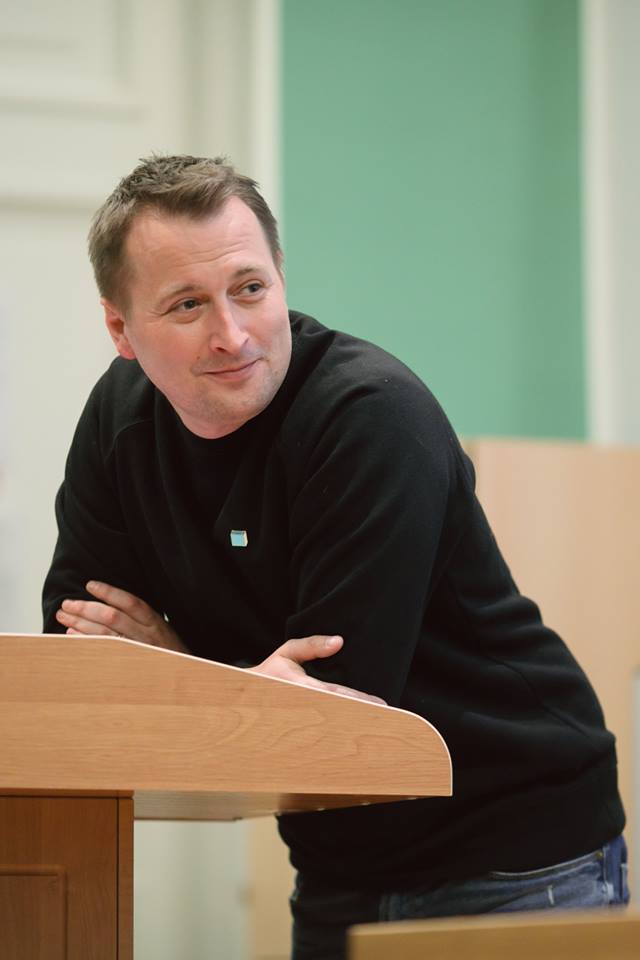
Nikolai Solodnikov. Photo courtesy of Open Library
Nobel Laureate Svetlana Aleksievich, musician Diana Arbenina, animator Garri Bardin, Deacon Andrei Kurayev, journalist Yulia Latynina, and poet Vera Polozkova are just a few of the celebrities who have been guests of the project Dialogues at Petersburg’s Mayakovsky Library. Hundreds of Petersburgers have attended the discussions in person, while even more have watched the live broadcasts on various media websites.
The project, which was run by Nikolai Solodnikov, former deputy general director of the Mayakovsky Library, on a voluntary basis, was shut down yesterday, June 26, after the FSB came to the library and carried out searches. One hypothesis is that the security forces were interested in the political activism of Dialogues. Another hypothesis is it was Solodnikov’s frequent visits to Latvia that bothered them. Fontanka.ru contacted the man behind Dialogues to set the record straight.
Nikolai, if they were in your shoes, many other people would be in Latvia by now. Where are you now?
For reasons of safety, I cannot answer the question.
Meaning you are not in Russia?
All I can say is that I am not in Latvia. [In the background, a voice announcing flights can be heard—Fontanka.ru.]
After the incident with the FSB did you have thoughts of leaving the country?
I am Russian. I do my projects in Russian for Russians. I cannot imagine myself as a political émigré, and I have no plans to leave Russia.
You have said the FSB had been putting pressure on Dialogues for a year and a half. Why did you decide to shut the project down only yesterday?
Different things overlapped. The elections and the fact we had been spending a lot of time in Latvia, where Katya [Solodnikov’s wife Katerina Gordeeva, journalist and co-organizer of Dialogues—Fontanka.ru] had our fifth child. It is not the children who bother them, of course. They are annoyed by the Open Lecture project we have been doing in Riga, Tel Aviv, and Odessa. And they had been combating Dialogues, in fact. So now things boiled over and exploded.
Meaning that if there had been no searches, Dialogues would have continued?
Of course. I hope it will continue, only not at the Mayakovsky Library. Because what is it like for the elderly ladies who make up the core of the library’s employees to go through interrogations and seizures of equipment? That would be incredibly heartless.
Surely after yesterday’s announcement you have already received proposals to move the project to another location.
Private organizations have had some ideas, but I haven’t considered them yet. I am still hoping we can gather in a space where very different people in terms of views, age, and social status can come.
Are you implying the next venue for Dialogues will also be public?
I really hope so. I am a citizen of the Russian Federation, and the people who attend our events are citizens of the Russian Federation. We are, in fact, the Russian people, who have the right to gather in public cultural institutions.
Public institutions have a hard time accepting the opposition agenda, which Dialogues, in particular, supported.
I am not an opposition activist. I am someone who deals with education and awareness. Teaching was my first occupation. I taught for a long time, and I hope I will teach again in the future. The only thing I can do is teach people to talk to each other while maintaining different points of view.
We are speaking via Skype now. Before that you called from a new number.
Tell me straight that the Federal Security Service (FSB) is eavesdropping on us. When you call me, something clicks and hums on your end.
Before yesterday, did you have any sense that the security forces were following you personally?
Since May of last year [when Ukrainian politician Mustafa Nayyem was supposed to speak at Dialogues, but the trip was canceled—Fontanka.ru] I have had no doubt that all my phones have been tapped. Although I think they have not been following me. I have no documents or evidence, but I do have the sense they have been listening in on me.
“Aside from land we have no real estate in Latvia”
You resigned from the Mayakovsky Library yesterday. How will it affect the career of the library’s director, Zoya Chalova?
I really hope things will be a bit easier for her.
We tried to call her, but to no avail. There is no sense that Chalova supports you at all.
She is the director of a public institution. That says it all. I am very grateful to her for the entire time we worked together. She is one of the bricks in the wall who helped deter the people who carried out the search on Thursday and interrogated the librarians.
Cultural functionaries, including Konstantin Sukhenko, head of the Petersburg Municipal Culture Committee, have said that Zoya Chalova did not know what the sources of financing for Dialogues were, and she was very worried about it.
She knew what they were from day one of the project. I have always said this, and I have said it repeatedly to Fontanka.ru: Dialogues is financed solely by Katya and me, meaning the salary I earned at the Mayakovsky Library, 43,000 rubles a month, and what Katya earns. Together, we have tried to combine what we have, borrow money here and there, and ask friends to pay for our guests’ tickets and accommodation. No oligarchs have been involved.
Can you name at least a few of the friends who have supported the project?
Nikolai Solodnikov and Katerinia Gordeeva. That is quite enough.
In addition to financing, the FSB were interested in your links to Latvia. Apparently, the Chekists [sic] assumed that you were not merely spending time there, but living there as well.
We have five children, aged six years to one and half months. We left in late 2015, because Katya was going to have our fifth child. The heating main opposite our house on Chaikovsky Street was turned off. In November, the hot water and light were being turned off every other day. It was impossible to live with small children in a flat with no water and electricity. We decided to temporarily relocate to Riga so that Katya could finish her pregnancy in peace and give birth.
Do you have a residence permit or property abroad?
Everybody knows that three or four years ago Katya bought a small plot of land in Latvia to obtain a residence permit. We did this and, in accordance with the law, immediately informed the Russian Federal Migration Service about it.
You haven’t built a house yet?
No, except for the land, we have no property in Latvia.
How did you feel working at a public library? After all, it is almost like the civil service, but at the same time you had a residence permit in another country.
I felt great. My wish is that all other worthy people had a residence permit while not parting with their Russian passports for any reason. A residence permit makes it easier to get around the world: you don’t have to apply endlessly for visas.
But the FSB sees this as a certain duality and contradiction.
There are some not very healthy people working there, but there are also normal people. Just as there are more people than Sukhenko working in the municipal culture department. By the way, many Petersburg municipal officials also have resident permits abroad.
Getting back to Dialogues, if the project would have continued in the old format, what would have its future been?
We thought we would do Dialogues monthly at least until the end of 2016. We worked like bees, regularly inviting new guests.
What did you feel yesterday when you were told the project was over?
A huge amount of work has been done, and it is sad when it ends this way. But we are going to go forward. There are people who support us. We will cope.
Our conversation is now being constantly interrupted by other calls. Who is calling?
Your journalist colleagues.
You have probably been getting many expressions of support. What matters most?
What matters most is that Katya and I really support each other in these circumstances.
“Eight-grader falls from window on Vasilyevsky Island”“Man throws dog from window in Petersburg”“Search for bomb on roof of building on Lensoviet Street”“Unknown man tries to behead woman on stump in Lomonosov District”
Igor Kalyapin, after he was assaulted by a mob in the Hotel Grozny City on March 16, 2016
“Kadyrov said he would not let us work in Chechnya”
Irina Tumakova Fontanka.ru
March 18, 2016
The Committee for Prevention of Torture has been forced to withdraw from the Republic of Chechnya. Its chair, Igor Kalyapin, a member of the Presidential Human Rights Council, was the latest victim of physical assault there. Kalyapin had long had a troubled relationship with Chechen headman Ramzan Kadyrov.
“Igor Kalyapin was just assaulted outside the entrance to the Hotel Grozny City. He was beaten and pelted with eggs,” Dmitry Utukin, an attorney for the organization wrote on Twitter on Wednesday evening.
Later, Kalyapin recounted what had happened to him.
“Around 6 p.m., I checked into Room 2401 in the Hotel Grozny City,” he wrote on Facebook. “About forty minutes later, two reporters and a cameraman came to my room. While I was still in Ingushetia I had promised to give them an interview as soon as I arrived in Grozny. We had begun recording the interview when there was a knock on the door. A man of about sixty years of age, who introduced himself as the hotel’s general manager, a security guard in a black uniform, and another middle-aged man entered. The manager told me that since I had criticized the head of Chechnya and the Chechen police, while he himself was very fond of Ramzan Kadyrov, I had to leave the hotel. […] After that, I was escorted downstairs, where I was detained by a mob of around thirty women, who had apparently been hastily assembled from hotel staff and the employees of the boutiques located on the first floor. They screamed in unison: how dare you speak ill of Ramzan. When I tried to respond, they screamed loudly: we do not want to listen to you. Nevertheless, I was not allowed to leave the hotel. I realized they were purposely delaying me until a team of assailants arrived. I had let my staff go home in a car before dark, and it would have been wrong for them to come after me at such a time in the evening in Grozny. It was apparent I would not be allowed to check into any hotel in Grozny. Any of my Chechen friends living in Grozny would have been exposed to mortal danger [if I had tried to stay with them]. So basically I was in no big hurry nor could I expect anyone to help me. I tried calling Mikhail Fedotov, chair of the Presidential Human Rights Council. I did not manage to get through to him in time [.]”
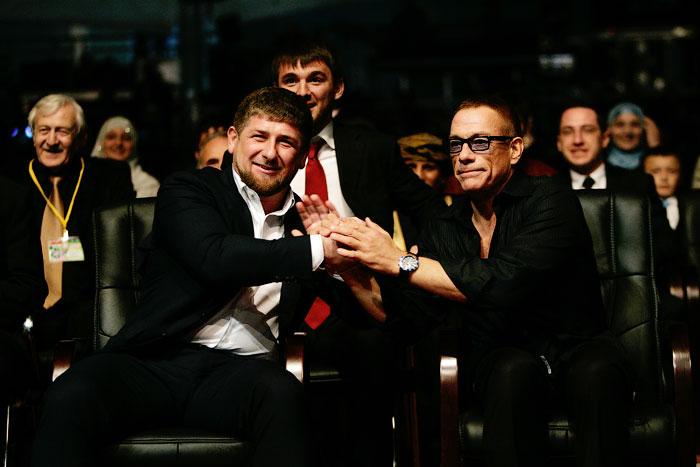
Ramzan Kadyrov and Jean-Claude Van Damme at the opening of the Hotel Grozny City, October 16, 2012
In an interview with Kavpolit, Kalyapin said of his attackers, “I believe the men who attacked me were neither Chechens nor Muslims. People who have done such a thing cannot be called Chechens or Muslims.”
Who, then, were the assailants? What had the anti-torture campaigner done to enrage them? Fontanka.ru posed these questions to Igor Kalyapin.
Igor, how do you explain yesterday’s attack on you?
There is no cause to guess here, it is all fairly simple. Over the past two years, Ramzan Kadyrov has personally, frequently, and quite emotionally accused me of various horrible crimes in the Chechen media. He has said I have defended terrorists and financed terrorism in the Chechen Republic, and that our committee are agents of western intelligence agencies who earn money on the blood of the Chechen people. That is a literal quotation. For example, in December 2014, there was a terrorist attack in Grozny in which a dozen Chechen policemen, young guys, were killed.
Yes, that is a well-known story. Kadyrov blamed you personally for the attack.
He addressed people, including the relatives of the dead, and he did this in the first twenty-four hours after the attack, when people were blinded by grief and pain. And he said to them: I know that a certain Kalyapin transferred money from abroad to the organizers of the attack.
Let us also recall he was not angry with you for no reason. You had tried to prevent him from burning down without trial the houses of people suspected of being relatives of the terrorists.
Of course. But he has said it more than once; he has systematically repeated the charges. Only last month on Chechen TV there were two films about Kalyapin: montages of photographs, videos, and screenshots of our website, and all the charges against me read out against this visual backdrop.
So what is the reason? What has your committee done to Kadyrov?
Many of the kidnappings we have tried to investigate have led us to Kadyrov’s confidants. And he knows it quite well: I once personally told him about it. We constantly pressure the Investigative Committee, which deals with these matters, to perform certain investigative actions. They have tried to stop or suspend criminal proceedings, but we have constantly appealed their actions in the courts.
Well, we understand how our courts and investigators work. Could Kadyrov, for example, just not pay attention to your work?
We publicly talk about all of it. We point out that the Investigative Committee in the Chechen Republic has not been investigating such-and-such a case, although the evidence is there: for example, the case of Murad Amriyev, the case of Islam Umarpashayev, and other matters. We point out that a certain person has not been questioned only because he serves in the Akhmad Kadyrov Regiment, and the investigator is afraid to summon him. We have made such things public on many occasions. We have sent white papers on these cases to all the factions in the State Duma. We have periodically appealed to Alexander Bastrykin, head of the Russian Federal Investigative Committee. Moreover, we have done it openly, by publishing reports, and we have talked about cases not being investigated. I have also spoken about this at the Parliamentary Assembly in Strasbourg. There has been a lot of press about our work. Naturally, it infuriates Kadyrov.
Does it merely infuriate him? Or does he see your work as a serious threat?
Apparently, he does in fact see it as a threat. I think that from time to time he get signals he should stop illegally prosecuting people he does not like. I imagine the powers that be wag their finger at him. Until you stop, they say, your republic will be written about as a lawless land.
Why has everything intensified in recent days? The incidents involving your committee in a single region have been in the headlines for a week running. Whose toes have you stepped on lately?
No, there were incidents before this, too. It was just that nobody wrote about them. If it were not for the March 9 attack on the journalists, which made such a big splash, then no one much would have written about my getting pelted with eggs, probably. The two incidents just happened to coincide. In fact, we have been under intense pressure for at least the last two years. Many things have happened. I cannot detail all of them right now.
For example, three days ago, there was an incident at your committee’s office in Grozny.
Yes, three nights ago, people broke into an apartment in Grozny we use as an office. They tried to turn off the security camera. They thought they had succeeded, but the camera kept on working. So on the recording you can see Emergency Situations Ministry officers and police officers breaking open the door and entering. Then, apparently, they got to the router, and the signal went dead. Basically, one of the reasons I came to Grozny was to get to the bottom of what was going on with the apartment: inspect it, file a complaint with the police, and so on.
Your colleagues at the committee told Fontanka.ru that security officials also went into your office in Ingushetia on March 9.
It was not an office in Ingushetia, but an apartment where we kept documents. And that is important, because we have not done any work in Ingushetia. We do not have a single case in Ingushetia. We do not annoy the security officials in Ingushetia in any way. Moreover, I have had a great relationship with Yunus-bek Yevkurov, head of Ingushetia, and he has had generally good relations with human rights activists, even with the ones who annoy him. So Yevkurov was not behind it, of course. I cannot tell you who these people were. But people at the level of the North Caucasian Federal District have got involved, and I imagine the Interior Ministry could easily establish whether it was policemen or someone else.
Meaning, you are confident they have decided to figure it out?
No, I’m not confident, not confident at all. But if anyone can figure it out, it has to be federal district officials. But if it was security officials who were involved, they were not from Ingushetia.
Why could your committee’s employees not work in Chechnya quietly, without advertising themselves?
That is the specific nature of our work. We are not gathering information, after all; we are lawyers. We are constantly involved in public legal proceedings. Once or twice a week, for example, we are involved in court hearings dealing with the Investigative Committee’s unlawful actions or their inaction. The court sessions are open to the public. Information about them is posted at the entrance to the courthouse or on the court’s website. We are simply legally bound to operate publicly. That is, we have three areas of work: we do paperwork and file documents in court, we are involved in court hearings, and we take part in police investigations. It is quite easy to identify us. And there is nothing to be done about it.
You work to prevent torture, which is a crime. Theoretically, the state should have a stake in the success of your work. How does it help you? Perhaps by physically protecting you?
You know yourself how it “helps” us.
What if I didn’t know?
The work of the Committee against Torture, which is purely juridical and wholly confined to criminal proceedings, was deemed work aimed at changing state policy, and as such the committee was placed on the register of foreign agents. Honestly, I still have not recovered from the shock. We never denied we received foreign funding, but to say that the Committee against Torture had been trying to change state policy is—
A full confession?
In my opinion, it is self-incrimination. When a person says such things, it is called self-incrimination. But here it was the state saying this. Nevertheless, our organization was deemed a foreign agent. So now we have another organization: the Committee for Prevention of Torture does not receive foreign funding. True, they are trying once again to register us as foreign agents. Because they feel like it.
Okay, money from foreign organizations is a very bad thing. But has the Russian government subsidized the prevention of torture?
In 2013–2014, we got our first state subsidy, a so-called presidential grant. Then the organization was declared a foreign agent, and we announced we did not intend to go on working with this status. We discontinued operations and registered the new organization, which for the time being has not received anything from anyone.
How do you survive, then? Legal aid, trips to the regions (you operate in more than just Chechnya), and collecting information are probably all expensive things, no?
Legal aid is not the most expensive thing. And what information collecting do we need to do if people come to us themselves? We need money for other things—for collecting evidence and conducting forensic examinations, and for ensuring people’s safety. We very often send victims to a sanatorium, not only so they get medical treatment there but also to spare them from the intrusiveness of the law enforcement agency whose officers we suspect of having committed the crime. This is what we need money for. For example, last year a man sought our help. He told us a deputy minister of the Chechen Republic had tortured him: the minister had attached electric wires to his body and so on. The victim was in hospital. Moreover, he was disabled: he had only one leg. And he showed us so-called electrode traces, claiming they were evidence of torture. We had this conversation approximately a week after he had been tortured. To force the Investigative Committee to accept this as evidence, you need to carry out a quite complicated forensic examination. So we sent this man with a chaperon (since he was disabled) off to Moscow. In Moscow, we contracted with a licensed, state-accredited forensics bureau, which offers paid services among other things. They did the examination. When we did the numbers, it turned out the examination alone cost us over 100,000 rubles [approx. 1,300 euros at current exchange rates]. They are not always so expensive, but such forensic examinations are required in each case.
So maybe the examinations should be conducted at government expense as part of the investigation.
The Investigative Committee is not going to conduct them, and not only because it is expensive but also because they are afraid of finding out the results. When it does not want to deal with a criminal case, the Investigative Committee’s primary tool is delaying the forensic examination so it is impossible to establish either the nature of the physical injuries or the circumstances in which they were received. So in each case we have to carry out the forensic examinations ourselves.
But someone does pay for it, don’t they? Who are they? Charities, private sponsors?
Our work is divided. There is the Committee for Prevention of Torture. It employs lawyers who go to court, file appeals, and so on. It is a public organization that has no foreign funding. But there is another organization, also noncommercial, which works on the forensic examinations, collects evidence, and so on, that is, on things where money is absolutely necessary, including international protection. It receives foreign funding.
Have I understood you correctly that the fight against torture in Russia is subsidized by foreign organizations?
Yes, that is correct.
You want to return to Chechnya. I gather that the challenges you went there to solve have not been addressed.
The task I have already told you about has lost its relevance. I wanted to inspect our apartment in Grozny, but it is clear I am not going to be allowed to do that. So we will have to solve the problem differently. For example, attorneys can inspect the apartment along with police officers. But I had another objective: to try and organize a press conference in Grozny. Now I would not even risk inviting anyone to go there. In Chechnya, there are reporters who write good things about Kadyrov, and they are not in any danger. But those who have at one time or another permitted themselves even a bit of criticism had better not go there.
What will happen now to the cases your committee has been handling in Chechnya? Will you abandon them?
No, we do not abandon cases. We simply do not have the right, either the moral or the legal right. We will continue to be involved in them. For the time being, I cannot say how we will set up the work and where our lawyers will do the paperwork. It is obvious we will not be allowed to work in the Chechen Republic. Kadyrov himself has said so many times. But we will continue the work itself.
Your staff will still have to travel to Chechnya, won’t they?
Yes, they will. But we are officially involved in criminal cases as counsel for the victims. The investigative authorities are obliged to ensure our safety. They had better do it.
Today a fourth-grader told me that his history teacher [at a school in Petersburg’s Central District] had explained in class that Stalin had shot traitors. “Is it true?” the child asked me. I said the teacher was a foolish woman and it was pity she hadn’t been shot! And that the student could go and tell her so. The child reasonably remarked that if he did that, she would call the police. I then gave him the rundown on Stalin, thus completely and utterly undermining the history teacher’s authority.
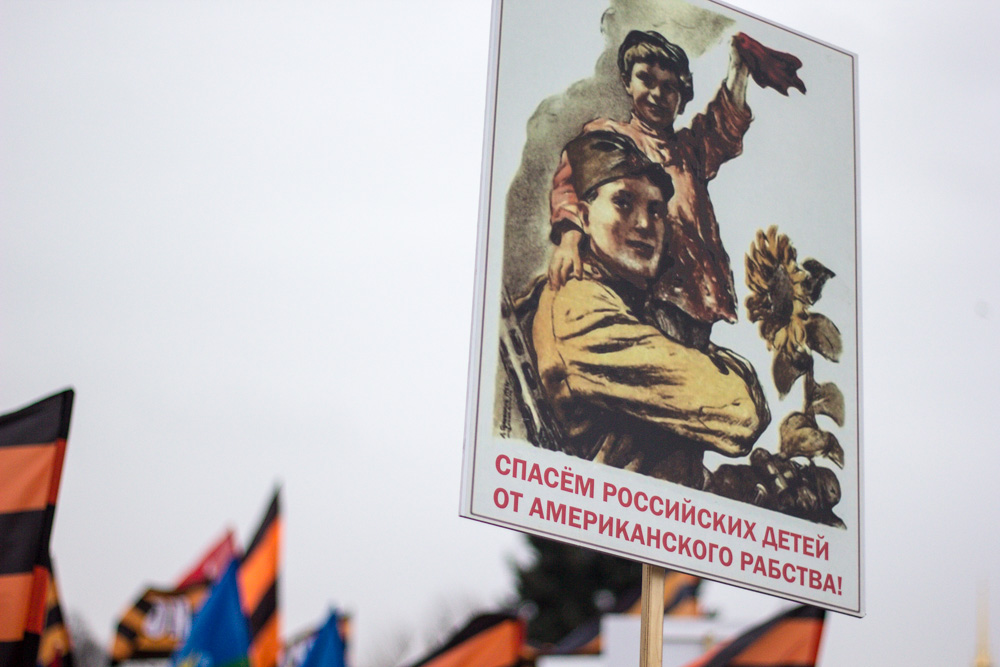
“Let’s Save Russia’s Children from American Slavery!” Placard at Anti-Maidan rally, Field of Mars, Petrograd, February 21, 2015. Photo courtesy of Sergey Chernov
_______
Fontanka looking for kindergarten that staged “Militiaman Day” with arms
February 24, 2015 Fontanka.ru
Photos from a “Militiaman Day,” allegedly held at a St. Petersburg kindergarten, are being discussed today on the blogs. In the photos, a man in a major’s uniform shows children all sorts of modifications of the Kalashnikov assault rifle, as well as a Dragunov sniper rifle, a rocket-propelled grenade launcher, and a shaped charged anti-tank grenade. The children happily pose with all these weapons, which are probably dummies used for training.
The photos has had a bombshell effect on the Russian segment of the Internet. The shots have been compared to images from children’s celebrations in institutions supported by Hamas.
The blogger who posted these photos claims that one of the parents decided to make the children happy in this way.
The only thing that remains off camera is what kindergarten would permit such a celebration? We ask parents who know in what kindergarten the photos were taken to contact Fontanka’s editors.
The images, above, are screenshots from twitter.com as reproduced on Fontanka.ru
__________
Gleb Kuznetsov writes on Facebook that it is no longer necessary to watchtelevision [to experience Russian war hysteria]: it suffices to pay a visit to a kindergarten: “As she was undressing the child, Grandma vaguely heard what was being said in the group before classes began. Seated on little stools, the kiddies were gathered around the minder. ‘Children. There is a war on in Ukraine. People are dying. Little kids and their parents are being hurt. Enemies have attacked them. But our president is a good man, children. He is fighting for peace… He is sending arms to the militiamen. So today we’ll be gluing envelopes.’ A child of six heard this as was he was changing his clothes and yelled, ‘Hurrah! World war. We’ll beat everybody.”
Even today, January 30, 2015, the Russian Federal Penitentiary Service maintains lists of volunteers obliged, if necessary, to shoot those sentenced to death. The moratorium, after all, is a temporary understanding. State Duma deputy speaker Lebedev’s comment that if Russia exits the Council of Europe, it will have the right to restore capital punishment, is a good occasion to discuss how executions technically happen. The door to secret room 2/0 has not creaked for a long time in the depths of the Crosses Prison.
[…]
In the second cross at the Crosses there is a wing that previously held prisoners sentenced to death. Now those sentenced to life imprisonment wait there to be transferred.
The wing is known as 2/1. It is harder to access than the other sections of the prison. The corridor is shorter than in the others, containing not thirty cells, but something like twenty-five. One “cell” there is exceptional. Its door looks like the other doors, but it leads into a secret basement codenamed 2/0.
I have no idea what governs departmental orders in early 2015, but under the Soviet regime the guidelines for selecting executioners had an ideological tinge. Only volunteers could execute prisoners. The guidelines stressed that volunteers would receive no perks or, God forbid, any monetary remuneration.
The takers were few, of course. Age and length of service also had to be taken into account. You could not send a young officer to do the job. Thus, when drawing up the annual lists, the warden at the Crosses would summon veterans and tell them someone had to do it.
People at the prison would guess who was on the list, but it was bad form to gab about it. The incognitos [sic] themselves signed nondisclosure agreements.
When the time came, the officer had the right to examine the case file, to peruse photo records of dismembered bodies or strangled children. It mattered that hand and heart did not tremble in doubt.
At the right time in the evening, the condemned man was visited in solitary confinement by the prison warden, the responsible prosecutor, a doctor, two attending officers and himself [sic]. The prosecutor would briefly read out the Supreme Court’s final decision and denial of clemency. The guards quickly snapped handcuffs on the criminal. Hands behind the back.
At this moment the condemned man’s behavior would become clear. Some would go into a trance and become wobbly, while others would go berserk. It was then that a towel would be thrown over their heads and tied at the back so their screams and curses would be inaudible.
“What kind of towel?” I asked, somewhat surprised, in my conversation with a prison officer.
“A white honeycomb towel, the kind issued to all the prisoners,” he replied.
And the man would be dragged to where he no longer existed [sic], to the door of “cell” 2/0.
It is [sic] already open, the steps leading down. He [?] didn’t count how many. The march ends. A dimly lit basement space with a container in it, something like a trough. The head is bent down, the command is given, a shot from a Makarov pistol, the doctor’s diagnosis.
They say that it would happen that the first bullet didn’t kill. Then it would happen again: command, shot, diagnosis.
The body would be wrapped and, accompanied by a document reading “This transport not subject to checks,” would be taken in a prison vehicle to a cemetery. In Soviet times, this would have been [Petersburg’s] Northern Cemetery. A pit had already been dug in advance, whose significance only the cemetery director knew. The body would be buried and forgotten.
In the archives, this place will forever be designated by a three-digit secret number.
It’s all humdrum. None of the myths about drawing lots or firing squads in which only man’s gun is loaded with live rounds [is true.]
“I come home once after this, and my wife is partying with guests in the kitchen. They’re listening to ABBA on a tape recorder. I take off my coat, sit down, and peck at a salad. My wife starts in on me: ‘Why are you spoiling our mood?’ What could I say to her?” an executioner recalled to me twenty-five years ago or so.
That’s right: if you destroy a dozen unknown boys in battle you’re a hero, but if you kill a maniac you’re a hangman.
That door—to cell 2/0—has not opened since the moratorium was announced in 1996.
The state is sturdily organized: the moratorium is not a dogma, but a timeout. The formal lists of firing squad members are constantly drawn up and amended depending on personnel changes at the Federal Penitentiary Service for Saint Petersburg and Leningrad Region.
So if push comes to shove, they could be ready today, January 30, by nightfall.
Since I’m not a very good translator, it is hard for me to convey the hard-boiled relish with which Fontanka.ru journalist Yevgeny Vyshenkov, an ex-cop, contemplates the return of capital punishment in Russia. Maybe this will do the trick instead:
Here, Alexei Didenko, deputy leader of the LDPR faction in the Russian State Duma, excitedly reports that within “24 hours” of exiting the Council of Europe and its Parliamentary Assembly all the legal mechanisms would be in place for executing “millions and millions of perverts, rapists, and pedophiles.”
Since the prison population in Russia was reported as 671,700 inmates as of December 1, 2014, one wonders where Didenko is going to find all those “millions and millions of perverts.”