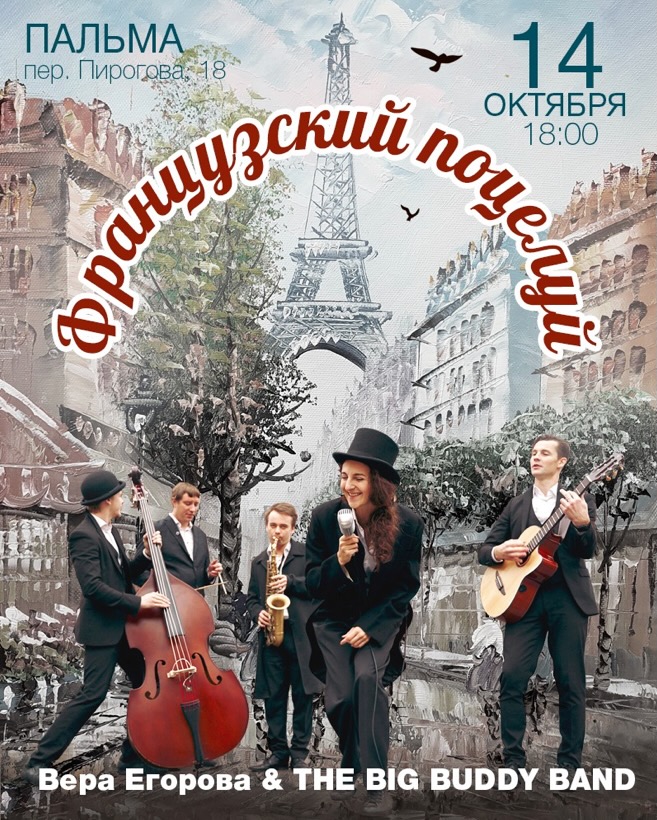
Vocals – Vera Egorova, Double Bass – Anton Krasikov, Guitar – Yuri Yurov, Drums – Ivan Laptev, Saxophone – Anton Seryogin
Description
The lights of the city in evening, the music, the vibe… under a Paris sky!
Stage Magic Agency invites everyone to be inspired by the romantic motifs of France in the light of the crystal chandeliers at the Palma Mansion on October 14. The evening’s programme includes treasures of French pop and chanson as performed by the extravagant Vera Egorova & The Big Buddy Band. We will make a genuine French voyage from Zaz’s contemporary hits to such symbols of the era as Edith Piaf and Yves Montand.
Vera Egorova & The Big Buddy Band are musical hooligans from St. Petersburg and the musical project of singer and actress Vera Egorova. The band has performed more than 500 concerts in Russia and abroad and taken prizes at various international competitions and festivals. Each of their performances is a ton of drive and an endless stream of emotions.
Well, bon voyage! See you at the Palma!
Concert programme: Zaz – Je veux Zaz – Paris sera toujours Paris Zaz – demain c’est toi Edith Piaf – Padam Padam Edith Piaf – La vie En Rose Joe Dassin – Les Champs Elysees Charles Aznavour – Oublie Loulou Paolo Conte – Via con me Yves Montand – Sous le ciel de Paris Patricia Kass – Mon mec a moi Julie London – Fly me to the moon Madeleine Peyroux – J’Ai Deux Amours Osvaldo Farres – Quizas
Duration: 1 hour 15 minutes
Source: Bileter.ru (via the website’s 5 October 2023 email newsletter). The “concert programme” is reproduced here as it appeared in the original.
I could detect almost no actual French in this so-called cover of a French song by the “musical hooligans from St. Petersburg,” making it a perfect illustration of the cargo cult character of “world culture” as imagined and appropriated by xenophobic Putin-era Russians. ||| TRR
Dozens of people, including a 6-year-old child, were killed in a Russian attack that hit a cafe during a wake service in a village in the Kharkiv region of northeastern Ukraine on October 5, according to Ukrainian officials. RFE/RL visited the village a few hours after the deadly attack.
— Why is the issue of colonialism nearly absent from the Russian opposition’s agenda?
— It’s an unpopular topic because it forces us to look for the root of our troubles not only in the Putin regime but in ourselves as well. It forces us to look at our behavior and change it, and that’s an unpleasant process. No one likes admitting they’re wrong. No one likes admitting that their behavior or they themselves are racist. No one likes admitting they’re a xenophobe or colonialist.
— What must we do to rid ourselves of the colonial and imperial mindset?
— First of all, we must understand that Russians have to do this work themselves. Because if someone else from the outside does the work to decolonize Russians, they won’t like it. We don’t have to agree with every position 100%, we can argue on some points.
Changing a mindset is not an instantaneous thing. Unfortunately, we just don’t have time, because if we are going to discuss for another twenty years whether it is possible or not to use slurs in reference to ethnic minorities, nothing can help us anymore. We will turn other people’s lives into hell, and our own, too. But, of course, Russian colonialism won’t let itself be deconstructed without putting up a fight.
— This begs the question about another pattern you described—complaints about Russophobia. Why do you think they are unfounded? And do you consider, for example, banning cars with Russian license plates from entering European countries to be Russophobia?
— Of course, this is a very unpleasant situation. Russian liberals support one of the most important narratives of the Putin regime and of Russian colonialism in general, which boils down to the claim that Russians are victimized. I don’t think that banning Russian cars from entering [the EU] is a manifestation of Russophobia. I think it is a manifestation of the reaction to [Russia’s] full-scale invasion [of Ukraine], which, by the way, is still ongoing. The reaction is going to affect people who themselves have not been involved in the invasion in any way. Moreover, people who are least guilty may suffer from it—for example, activists who have been fighting the Putin regime all their lives.
This will continue, because the citizens of the Russian Federation were unable to oppose what is happening in any way, and in the eyes of the world, most of them fueled this invasion economically, politically, and rhetorically. Precisely because we don’t resist, we have to pay for it somehow. For example, we are in no hurry to separate the criminals from those who have not committed crimes.
@george.spb wrote the following comment when Eva Morozova posted the cartoon, above, on their Instagram page:
I always say that I am from Russia, even though I am [an ethnic] Georgian. I have never got a single unfriendly look. At most, they might somehow make a good-natured joke about it. All foreigners are well aware that not all people in Russia support the military action, especially those who have left. The only thing I won’t do is demonstrate Russian symbols or sing the Russian anthem until the war is over, a correct assessment of what happened has been made, and the perpetrators have been justly punished. I can’t change anything else; I was born there. And if a person is biased about it, then it’s not my problem anymore.
@intelligent_beauty_paris wrote:
It happened once here: – Vous êtes d’où? – Where are you from? – De la Russie. From Russia. – C’est pas grave! / No big deal/ It happens/ Don’t worry about it!
YALTA, Crimea, Aug 29 (Reuters) – In years past, Siberian Viktor Motorin could hop on a plane and arrive in Crimea just four hours later to relax at his holiday apartment. Now he must fly first to Moscow and then spend a day and a half on the train.
The war in Ukraine, now 18 months old, is making it harder for many Russians to reach their favourite summer haunts in the Black Sea region of Crimea, which Moscow seized and annexed from Ukraine in 2014.
And safety is a factor for some, especially after two major Ukrainian attacks since last October on the 19 km (12 mile) Crimean Bridge that links Russia by road and rail to the peninsula.
But after weighing up such concerns, Motorin, from the city of Khanty-Mansiysk in western Siberia, said he decided that making his annual trip was still a risk well worth taking.
“We calculated that it was reasonably safe, especially when my colleagues had already come here in June, early July. They said it was all calm here with no problems on the Crimea Bridge. The goods, the prices, everything is like before,” he said.
In 2022, the year when Russia’s full-scale invasion of Ukraine began, more than 4,300 people renounced their Russian citizenship, the highest such figure for the last three years. Among them were several major Russian businessmen, including [former] Troika Dialog CEO Ruben Vardanyan, venture capitalist Yuri Milner, and Tinkoff Bank founder Oleg Tinkov. However, the Russian Foreign Ministry said that the increase in “refuseniks” was due to the pandemic that raged earlier, claiming that “there are no particular changes in the numbers of requests to withdraw from Russian citizenship from abroad.” And the Russian Interior Ministry recently proposed reviewing the cases of people who have renounced Russian citizenship, that is, theoretically, a person’s citizenship could be forcibly reinstated. Farida Kurbangaleyeva talked to people who decided not to be Russian nationals anymore and found out why it mattered to them.
“If I have the sudden urge to live in Russia I’ll get a residence permit”
Andrei Kreinin, USA, renounced his Russian citizenship
I’ve wanted to emigrate to the USA since I was fifteen, when I saw the good old American movie Short Circuit 2. Spoiler alert: it ends with a scene of the main characters taking the oath of citizenship. I went to the States many times on a tourist visa, and in 2011 my family and I won a green card and moved to Chicago. In Moscow, I worked in telecommunications and I got a job in the same field in our new home.
The decision to renounce citizenship was made on February 25, 2022—after the brutal bombing of Kharkov, when people were hiding in the subway there. Firstly, because there is such a thing as a conscience, and secondly, my mother was born in Kharkov, and it was impossible for me to remain a Russian national. My family said, “We won’t do this. If you want to, do it, but then don’t pine for Russia.” I said I understood them perfectly. I had a couple of friends from Russia who called me bad words on social media, and I had to ban them. But mostly the attitude ranged from neutral to understanding: “It’s your business, Andrei.”
To renounce your citizenship, you need to do two main things—deregister your place of residence [in Russia, where everyone is required to register their place of residence] and get a paper stating that you owe no back taxes in the Russian Federation.
They say that it can be difficult to deregister remotely, so in June 2022 I flew to Russia. I took care of transferring my real estate and deregistering from my apartment. Basically, I covered all the important bases to the max. Before the trip, I carefully monitored the situation: I understood that there would be a mobilization. I actually thought it would be announced on May 9 [celebrated as Victory Day in Russia].
When I had collected all the paperwork, I took it to the consulate in New York. It did not go smoothly. About three months later, I received a letter saying my application had not been approved, because, according to the Interior Ministry’s databases, I was still registered—although I even had a stamp in my [internal] passport stating I had been deregistered. Consequently, I spent two or three sleepless nights, due to the time difference, trying to get through to the proper authorities in Russia. They said, “Send us your application again and a photo of the discharge stamp.” I sent them, and two days later I received a reply that I had been removed from the residence register.
Andrei Kreinin Photo courtesy of Mr. Kreinin via Republic
I forwarded the whole thing to the consulate again, hoping that they would accept the documents online. But they said, “No, you’ll have to come to New York again.” I went again, resubmitted [my application], and after another two and half months I was informed that my application had been approved. I was told to report to the consular department and hand over my [internal and foreign travel] passports, which I did.
I have heard that the [Russian] state does not like people like me, because it is one thing to renounce Russian citizenship in a country where it is a necessary condition for obtaining the local citizenship, for example in Germany or the Netherlands, and another thing when you could retain your Russian citizenship, but you renounce it of your own free will.
But I didn’t notice any particularly negative attitude on the part of the staff at the Russian consulate. They behaved absolutely normally.
When I was in Russia, I forgot to withdraw my military registration. I had to call the military enlistment office. “This is how it is, guys, I’m renouncing my citizenship,” I said. Surprisingly, they did not yell at me or call me a traitor to the motherland, although I expected it. They just said, “Theoretically, we don’t do this sort of thing, but as soon as you complete the procedure, send us your military registration card, a copy of the certificate of renunciation of citizenship, a copy of your US passport, and a written request to be removed from military registration.” There is no mail service between the US and Russia nowadays. I had to make use of different “private couriers”: there are special Facebook groups for [arranging pickups and deliveries of letters and parcels]. Three weeks later, a letter from the military enlistment office addressed to me arrived in Moscow, saying I’d been removed from the register.
I have now applied for a Russian visa, which is granted to US citizens for up to three years. Not that I was planning to go there, but, as the Ukrainians say, schob bulo[“just in case”]. Plus, my father is still in Russia. He has already sent me an invitation to me, but he says, “Just please don’t come.”
I have no plans to reinstate my Russian citizenship under any circumstances. If I have the sudden urge to live in Russia, I can easily get a residence permit. It’s more than enough for me.
As my experience in dealing with the Russian Federation shows, it is better, paradoxically, to be a foreigner—you have fewer obligations.
A residence permit grants a person the same privileges as citizenship [sic], except the right to vote. On the other hand, no one can force me to do military service. The civil service will also be closed to me, but I’ve never aspired to join it either in Russia or the US.
The grandfather of renowned Crimean Tatar historian Shukri Seitumerov was executed during Stalin’s Terror for supposed ‘counter-revolutionary terrorist propaganda’. Eighty years later, Russia’s FSB came for Shukri’s two elder sons, Seitumer and Osman Seitumerov, as well as his wife Lilia’s brother, with the ‘terrorism’ charges they faced no less politically motivated. Such arrests and subsequent sentences of up to 20 years are part of Russia’s ongoing attack on the Crimean Solidarity human rights movement and are also simply ‘good for FSB statistics’. For the next round of victims, armed Russian FSB burst into the Seitumerov home yet again at 4 a.m. on 24 August, this time taking Shukri and Lilia’s last son away from them.Abdulmedzhit Seitumerov is just 23 and became a father less than 2 months ago.
Armed and masked enforcement officers carried out multiple ‘searches’ in the early hours of 25 August, with six Crimean Tatars taken away. All are now facing the huge sentences that have become a standard part of Russa’s most cynical conveyor belt of repression in occupied Crimea. Ruslan Asanov (b. 1975); Remzi Nimetulayev (b. 1985); Seidamet Mustafayev (b. 1995); Abdulmedzhit Seitumerov (b. 1999); Ametkhan Umerov (b. 1986) and Eldar Yakubov (b. 1980) are Crimean Solidarity activists who had previously faced administrative prosecution for peaceful acts of solidarity with other political prisoners.
This is one of the many identical elements in these cases which have been internationally condemned as politically motivated persecution. The ‘armed searches’ are invariably carried out without the men’s lawyers allowed to be present, and with the FSB most often bringing the so-called ‘prohibited religious literature’ that they then claim to have found. The men are generally forced to the ground, often in front of their terrified children, and then taken away as though criminals, although none is accused of any recognizable crime.
The charges are equally predictable with the Crimean Tatars accused solely of unproven ‘involvement’ in Hizb ut-Tahrir. This peaceful transnational Muslim organization was declared ‘terrorist’ by Russia’s Supreme Court in 2003, with the ruling passed in secret and probably politically motivated (making it easier for Russia to send refugees back to Uzbekistan where they faced religious persecution for involvement in Hizb ut-Tahrir). No explanation has ever been provided for why an organization not known to have committed terrorist attacks anywhere in the world should be so labelled, and the organization has always been legal in Ukraine.
Despite the lack of any grounds and in clear violation of international law which prohibits Russia from applying its legislation on occupied Ukrainian territory, Russia has been imprisoning Crimean Tatars (and a few other Ukrainian Muslims) on these charges since 2015. The sentences have been getting longer and longer (up to 20 years), as Russia openly targets Crimean Solidarity journalists and activists speaking out about repression in occupied Crimea.
In all such ‘cases’, at least one man is invariably charged with the more serious Article 205.5 § 1 of Russia’s criminal code (‘organizing a Hizb ut-Tahrir group’), while the others face the lesser charge of ‘involvement’ in the purported ‘group’, under Article 205.5 § 2. There is plenty of evidence from previous ‘trials’ that the more serious charge (carrying sentences of 17-20 years at present) are often laid in reprisal, for example, against Raim Aivazov for refusing to remain silent about the torture he faced from the FSB. The men will likely also be charged with ‘planning a violent uprising’ (Article 278). Once again, this is purely based on the 2003 Supreme Court ruling, with none of the political prisoners having ever been accused of actions or direct plans to commit any action aimed at ‘overthrowing the Russian constitutional order.’
The ‘evidence’ is as flawed as the charges. It hinges on FSB-loyal ‘experts’ providing ‘assessments’ of innocuous conversations about religion, Russian persecution, etc. to fit the prosecution and ‘anonymous witnesses’, whose testimony cannot be verified, and who may have never met the men.
Six families have been ripped apart, with children left traumatized and elderly parents facing never seeing their sons again.
Russia uses such arrests and ‘trials’ as a weapon against the Crimean Solidarity human rights movement and as an instrument of terror and propaganda against Crimean Tatars who have from the outset demonstrated so clearly their identification with Ukraine. The FSB are known to get promotion or bonuses for providing such ‘cases’ and can boast of ‘good statistics on fighting terrorism’.
Abdulmedzhit Seitumerov (b. 1999) was just 20 when the FSB came for his brothers, Seitumer Seitumerov (b. 1988) and Osman Seitumerov (b. 1992) and their uncle, Rustem Seitmemetov (b. 1973). For his parents, this was already a terrible blow, especially since Russia illegally imprisons the men thousands of kilometres from their homes. Now all three sons have been taken from them, and, if Russia is not stopped, Abdulmedzhit’s son Khamza, born on 5 July this year, will spend most of his childhood without his father. Abdulmedzhit had been active in Crimean Solidarity, speaking out in defence of his brothers and other political prisoners.
Ametkhan Umerov (b. 1986)
The 37-year-old Crimean Solidarity activist was detained and fined in July 2019 for a picket in Moscow in support of four Crimean Tatar political prisoners. He was one of 21 Crimean Tatars detained inh November 2021 for trying to stand outside an occupation ‘court’ during the appeal hearing in the case of three other political prisoners. Then in February 2022, he was jailed for several days for trying to attend a purportedly open (but political) ‘court’) hearing.
Ametkhan has three daughters and a son, all of them very young: Zamira (b. 2015); Khatidzha (b. 2017); Ali (b. 2019) and Zainab (b. 2021).
Seidamet Mustafayev (b. 1995)
Seidamet is just 28, but has faced several administrative prosecutions since 2017, when he was jailed for 10 days for taking part in what the occupation regime called an unsanctioned meeting (in fact, people standing outside in solidarity) during an armed search of the home of (now) political prisoner Seiran Saliyev. In 2021, he was also detained and fined for having tried to stand outside an occupation ‘court’ during a political hearing. In February 2022, he was also jailed for several days for trying to attend a purportedly open (but political) ‘court’) hearing.
Seidamet has four small children: Suleiman (b. 2014); Salsabil (b. 2016); Latifa (b. 2020) and Osman (b. 2023).
He has five daughters: Aishe (b. 2009); Anife (b. 2019); Adile (b. 2013); Yasmina (b. 2016) and Alime (b. 2020).
Eldar Yakubov (b. 1980)
The 43-year-old was detained and fined on 25 October 2021 outside the Crimean occupation military ‘court’ during an appeal hearing against the sentences passed on three political prisoners.
He has four daughters and two sons: Safiye (b. 2004); Khalid (b. 2008); Meryem (b. 2013); Khamza (b. 2017); Selime (b. 2018) and Asiya (b. 2021).
Ruslan Asanov (b. 1975) is also a Crimean Solidarity activist.
Archbishop Pitirim of Syktyvkar has called on his parishioners to rally not around Christ, but around Putin, calling the West “the enemy of the human race.”
“After [hearing] the appeal made by His Eminence the President (on supporting the war – ed.), I considered it my duty to appeal to all the clergy, monastics, and God-loving laypeople of the Syktyvkar Diocese of the Russian Orthodox Church, as well as to all the patriots of our Northern Region, to rally even closer around our supreme military and political leadership and our valiant army, which, as in the years of the Great Patriotic War, is defending our earthly Fatherland from the insidious enemy of the human race.
“Only by joint prayer and tireless military efforts will we be able to contain the enemy and erect a strong barrier to the West’s aggression.”
It should be noted that “the Great Satan” is Iran’s traditional name for the United States. Meanwhile, the Head of the Spiritual Assembly of Muslims of the Russian Federation, Mufti Albir Krganov, invoked the same metaphor in a speech he made during Eid al-Adha.
Previously, Pitirim (who had already taken holy orders) expressed his pride at being awarded the rank of Cossack colonel.
We should also add that Metropolitan Leonid, appointed Patriarchal Exarch of Africa, has devoted seven of his last ten posts on Telegram to the polemic with the “collective West.” Leonid’s position statements were published as part of the ROC’s revenge on the Patriarchate of Alexandria for supporting Ukrainian autocephaly.
Source: Sota, 11 July 2022. Photo courtesy of Sota. Translated by the Russian Reader
The officers who raided Father Ioann Kurmoyarov’s home reportedly seized his mobile phone, a laptop, two icons, a cassock and a wooden cross.
He was taken to a police station in St Petersburg, and allowed to make one phone call to his family.
He told them he had been arrested.
Father Ioann is believed to be the first priest imprisoned under laws introduced in Russia to punish those who spread information countering the Kremlin’s narrative of the war.
“I am a prisoner of conscience, suffering for my beliefs. I consider the charges against me and my detention to be illegal,” says Father Ioann now in a statement he dictated to his lawyer in St Petersburg’s Kresty Prison.
Father Ioann adds that he is a Christian pacifist whose moral views are entirely based on the commandments of the Gospel and canons of the Russian Orthodox Church.
“Blessed are the peacemakers for they will be called the sons of God,” and “Thou shalt not kill,” are among the quotes he includes in his statement.
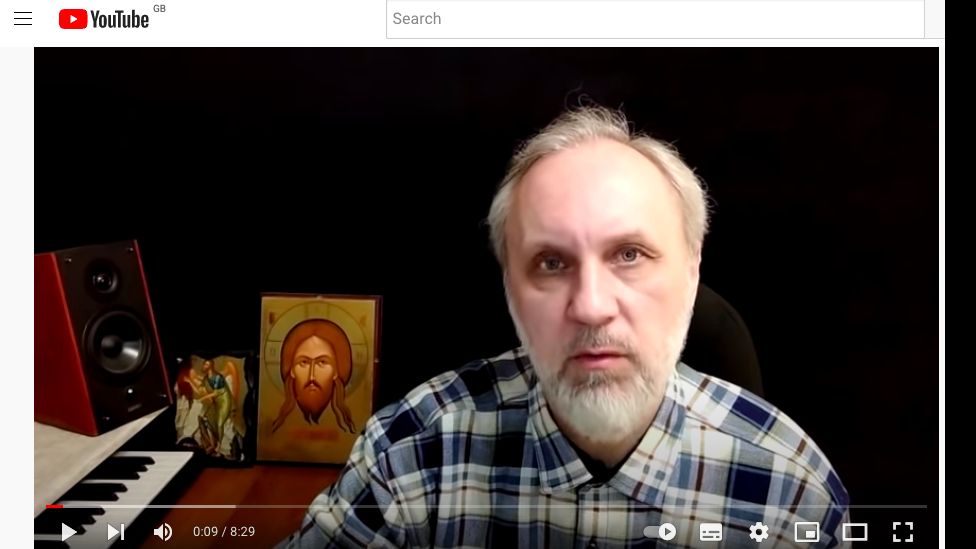
On 12 March, just over two weeks after Vladimir Putin launched his invasion of Ukraine, Father Ioann uploaded an eight and a half minute video to YouTube.
In it he said that those who unleash aggression would not go to heaven, and that in this case it was not Ukraine that attacked Russia but the other way around.
“You are the aggressors who attacked and killed civilians. You will not be in any kind of heaven, you will be in hell,” he says of the Russian leadership.
In a sermon posted on YouTube, Father Ioann Kurmoyarov said Russian aggressors in the conflict would go to hell.
In his video Father Ioann goes on to compare the Russian invasion with violent “jihad” suggesting that bloodthirsty leaders in Moscow should have converted to become “militant Islamists”, a theme that he kept returning to.
“We worried but we just didn’t expect that he would be arrested,” says his brother Alexander Kurmoyarov. He tells me that Father Ioann is currently serving an initial two month detention and is then likely to face trial.
“We thought maybe he would be given a warning by the police, but now we are worried that he will get 10 years in prison,” he says, referring to the maximum sentence Father Ioann could receive.
The only visitor to have seen Father Ioann in Kresty Prison is his lawyer Leonid Krikun who says his client appeared to be in good health and also defiant.
“I told Father Ioann that if he pleads guilty he will probably get a shorter sentence, but he refuses to say he has committed any crime,” Mr Krikun says.
“He says that he would rather serve a longer sentence than admit any wrongdoing and if that happens he will preach to fellow inmates.”
Father Ioann has shown before that he is unafraid of speaking out. He was suspended from the church in 2020 after calling the newly-built Church of the Russian Armed Forces a “pagan temple”.
The Cathedral in Moscow was the brainchild of Russian Defence Minister Sergei Shoigu and was due to house frescos that featured President Putin and Josef Stalin as well as scenes that celebrated the Crimean occupation.
In a social media post, Father Ioann said Mr Shoigu should be arrested for offending religious sentiment.
But what makes Father Ioann’s story all the more unusual is that before he got in trouble with the Russian state, he also had a brush with the Ukrainian security service, the SBU.
Ioann Kurmayarov lived in Vinnytsia in central Ukraine for most of his life, his parents having moved there after his father retired from the Russian army.
“Even as a child he was always very outspoken, always searching for the truth,” says his brother Alexander who speaks to me from Vinnytsia.
“It was in the church that he found a place where that search for truth was satisfied,” says Alexander.
But in 2017, Father Ioann made the news in Ukraine for an act of defiance.
With Crimea annexed by Russia and parts of the east occupied by Russian-backed forces, Ukraine expanded laws banning Soviet symbols.
But Father Ioann posted pictures of one of the most controversial of them, the St George’s ribbon.
He was taken in by police for questioning and the SBU brought administrative charges against him.
“He was not radically pro-Russia, he was standing up for freedom of speech and simply believed the authorities were doing the wrong thing by banning displays of the ribbon,” says Alexander.
At the time Father Ioann said he was prepared to pay the fine, worth around $100 (£84.50), but said he would then openly wear the ribbon seeing as he had now paid for the privilege. The Ukrainian case against him was dropped.
He soon moved to Russia where he is already paying a much higher price for speaking out against curbs on freedom of expression.
In April he was defrocked by the Russian Orthodox Church’s Moscow Patriarchate, though members of the Russian Orthodox Church Abroad (ROCA) say he has been accepted by them.
More pressing is that he remains behind bars at Detention Centre Number One in Kresty Prison with the prospect of staying there for years. His initial detention period ends on 6 August after which his trial date is due to be set.
“I want him to be found innocent, as a Christian who was talking about Christian values,” says Alexander.
“But I worry about what is going to happen now and I worry about his future.”
There are tens of thousands of refugees from Ukraine in Russia. Some of them are trying to leave Russia for countries in Europe or the Transcaucasia, while others remain in temporary accommodation. Both groups are being helped by Russian volunteers. One of the informal leaders of this movement in Petersburg is Grigory Mikhnov-Vaytenko, a bishop of the Apostolic Orthodox Church and a member of the St. Petersburg Human Rights Council. Farida Kurbangaleyeva spoke with him about why he is not afraid of the Russian security forces, why Ukrainians are being taken to the Far East, and why the Russian Orthodox Church failed to oppose the war.
Father Grigory Mikhnov-Vaytenko, holding a copy of the Russian constitution across the street from the Russian Constitutional Court’s current home in downtown Petersburg. Photo courtesy of Facebook and Republic
— How did you start dealing with the problem of Ukrainian refugees?
— In the very first days of the war, we thought about the Ukrainian nationals already living in Russia. According to various estimates, there were from eight hundred thousand to two million such people. We assumed they might have problems. I proposed to the Human Rights Council that we set up a hotline for Ukrainian nationals, and all my colleagues [on the council] supported me. Immediately, there was a large number of inquiries from people trying to leave Russia. In fact, if people’s papers were in order, there was nothing complicated abut the situation. But while we were figuring it out, refugees from Mariupol reached out to us. Som of them wanted to leave Russia, while others wanted to stay. But all of them were asking for legal assistance.
— Could you have imagined that Ukrainians would be brought to Russia?
— To be honest, no. Although it didn’t surprise me. I don’t want issue any judgements now—for this you need to be inside these events. But if you believe what the people directly involved have been saying, there was no possibility of organized evacuation anywhere except to Russia. At least, that’s what these people were told. And yet, when it is said that these people were taken to Russia by force, this is a somewhat inaccurate way of putting it.
— When I spoke with refugees from Mariupol, they said they had wanted to go to areas controlled by Ukraine, but that was tantamount to death—the humanitarian corridor was being shelled all the time.
— I don’t question what they said. I accept it as a fact. There was a humanitarian corridor to Russia, and, apparently, it was quite safe. I know that some people also left for Ukraine, but mostly at their own risk and mainly those who had vehicles. There was no way out on foot, as far as I know.
— But isn’t this violence on Russia’s part?
— When we talk about forcible removal, what I see in my mind’s eye are stills of German shepherds and people being struck in the back with rifle butts. There was no such thing [in this case], of course. But as far as I understand, people were not offered much choice. So, there was an element of there being no alternative. I personally am not ready to speculate about why it happened. I was not an eyewitness myself, and I have not seen any documents in this regard. I have only heard stories.
But it would be much worse if people who found themselves on Russian soil were legally subjected to forced detention, if the authorities prevented them from moving freely. According to my observations, they have not been prevented from doing this. Those who do not want to go to the proposed temporary accommodation facilities can safely go wherever they want.
It is another matter that these people have no money, that they have telecommunications problems, problems with paperwork. In this sense, the Russian state has not been providing them with anything. Ukrainian nationals could not cope without the volunteers who have been helping them obtain papers, board trains, and buy clothes and medicines, including prescription medicines, because there are people with chronic diseases among them.
— But why do the Russian authorities tell Ukrainian refugees to evacuate if they cannot provide for them? Is there no Pharisaism in this?
— I think there is an element of Pharisaism. But, again, now is not the time for making judgements. Now is the time for action. For example, I need to find a place for refugees to spend the night. Here we are talking, but at the same time I am corresponding on a chat, because another family is waiting for help.
The point is that what happened on February 24 is a crime—a crime against humanity, the unleashing of a war of aggression. Period. Everything else is a consequence of this crime.
We’ll figure out a bit later who is a hero and who is a scumbag. But now everyone should do what they can where they can do it. Journalists should write stories, human rights defenders should defend human rights, and caring people should make moral decisions by sharing their apartments, cars, or their own time. Not helping a refugee—even from the point of view of a book called the Bible—is a very grave sin. As the saying goes, “for you were strangers in a strange land.”
— How many Ukrainian refugees are currently in Russia? And how many camps are there?
— There are no official statistics. There are figures from different departments, and they radically contradict each other. The Russian authorities cite certain fantastic figures that are impossible to believe—860,000 people. I don’t understand where they came from, because there are much fewer people in Mariupol. Are they from the Donetsk region? But there seemingly hasn’t been a mass evacuation from there.
I think that these figures, as they pass along the chain through different departments, get zeros and ones added to them. I think that around one hundred thousand people have actually arrived in Russia from the war zone. Several thousand of them have already left, while a certain number of others are planning to leave.
We know of around five hundred temporary accommodation camps. That sounds scary, but you have to understand that there are places housing literally between fifty to seventy people. They’re like small boarding houses. There are probably only a few large camps, like the one near Petersburg, where 550 people have been accommodated. Or, for example, there are around three hundred people at the camp in Vladivostok.
— But why have refugees been taken so far away? Do you have an explanation?
— To be honest, I don’t see any special malicious intent in this. Apparently, somewhere in the presidential administration there was a request to all regions of the federation to ready sites for taking in refugees. And each region reported how many people it could take in. They are still trying to place these people in more or less normal conditions. These are not tent camps or barracks in the taiga.
The regions were also tasked with providing jobs and papers to the people who wanted them. It is clear that no region in the European part of Russia is ready to take in one hundred thousand people and give them jobs. Where would they find them? So, they began spreading people [around the country] as thinly as possible. Taking into account the size of the country, it turned out the way it turned out. We should be grateful that the most distant reception center is in Vladivostok, not Kamchatka.
— The buzz on social media is that this is another [mass] deportation.
— I don’t want to use words lightly. And, since the phrase “special operation” was introduced, words don’t function anymore, they’re finished. The safety of people has been ensured, and tickets from Vladivostok to Moscow, Petersburg, or Tokyo cost no more than money. Of course, this is all redundant. But what can be solved with money is not the problem.
Excerpts from Facebook chats between Ukrainian refugees and Russian volunteers. Courtesy of Republic
— Can people who have no papers at all leave Russia—for example, if they burned up during bombing?
— Refugees can receive a temporary document called a “Certificate establishing the identity of a foreign national or a stateless person.” It’s a very valuable invention. It is issued at police stations, and features a photo, a seal, and three signatures. With this document, a refugee can leave Russia.
To apply for this paper, a person must confirm their identity in any way. They can even submit an electricity bill, or provide witnesses. For example, a family leaves [Ukraine]: five of them have their papers, but the sixth does not. Cases when an entire family does not have their papers are rare. Besides, there is an analogue of Russia’s Public Services Portal in Ukraine, so in ninety-nine percent of cases it won’t be difficult to confirm a person’s identity.
This document was introduced several years ago. As far as I understand, it was championed by the human rights activist Svetlana Gannushkina and her Civic Assistance Committee—because there were a large number of migrant workers in Russia, and their cases were different. Some people had lost their papers. Or, a person, for example, worked in Tyumen, but their country’s consulate was in Yekaterinburg.
Clearly, the nearest Ukrainian consulate is located outside the Russian Federation. Fortunately, the Russian border service understands this, so [Ukrainian refugees] face no particular difficulties when leaving [Russia].
There are more complex dilemmas. For example, there are infants who were born in the now-infamous Mariupol maternity hospital and did not have time to receive any papers. I met a couple here: the dad and mom are legally married, they have plastic biometric cards, but the child’s only ID is the tag it had on its hand or foot.
— Have you baptized any refugee children?
— I was asked to baptize two children, but at that moment there was no room ready. When I asked for a room to be readied, the baptism was postponed. I think we’ll go there in a week. God willing, we will baptize them.
— Who are more numerous—the people who want to leave or the people who want to stay?
— The overwhelming majority (and among them there are people who are absolutely pro-Russian) say that their greatest desire is to get home. You ask, “But isn’t everything wrecked there?” They reply, “That’s okay, we’ll rebuild it.” We’ll set aside how they imagine reconstruction from a political point of view—it’s not about that. The point is that people want to return [to Ukraine]. And they will do so the first chance they get.
That’s why, by the way, the vast majority of refugees do not apply for the fast-track Russian citizenship they are offered. They get either a temporary residence permit or a residence permit. Even those who don’t want to go to Europe and say “We’ll stay here for a while” still regard returning home as their ultimate task.
— How ethical is the offer of Russian citizenship under such circumstances?
— If we set aside February 24, it is something that is done within the concept that the Russian authorities have proclaimed.
— But we cannot set aside February 24, can we?
— That is why it is an outrage. But within this outrage, there may be things that are completely beyond the pale, and there may be things that, from a humanitarian point of view, make it easier for a person to live at a particular moment.
— It seems to me that this is like torturing a person and serving them cake during the breaks.
— But it’s a slightly more complicated scheme if they are told, “Eat cake and we’ll let you go.” Purely practically, there are people who gave the orders to start shelling, others who set up a humanitarian corridor, and still others in the federal migration service who offer fast-track citizenship. All of them together constitute the state apparatus. But individually, they are different people—who, by the way, also have different judgementsd of what is happening.
A very great misfortune has come into our home. But now, I repeat, is not the time for judgements. Now is the time for action.
If a person asks you to give them underpants, a t-shirt, and a toothbrush, you don’t need to ask them who they voted for in the previous election. You have to give them what they ask.
— If martial law is imposed in Russia, will refugees become more vulnerable?
— Such a turn of events would affect everyone. It’s another matter that I have a rather low opinion of our government’s administrative willpower. In Russia, things are usually loudly announced, but come to naught.
I strongly doubt that the authorities would impose martial law. Most likely, they will again make do by adopting hybrid measures so as not to call things by name, because the level of support for this whole business is quite low. In 2014, all the cars were decked out with Saint George’s ribbons and everyone shouted joyfully, “Crimea is ours!” But now we see the letter Z only on Russian National Guard vehicles.
— What about the opinion polls?
— In an authoritarian country that is smoothly segueing to totalitarianism, the worth of such polls is quite low. People are well aware of what answers are expected from them. By the way, the latest poll by the Levada Center says that support for the war has decreased ten percent in a month. This is quite a serious drop, despite the fact that hysteria is being whipped up.
Yesterday, we sent abroad a [Ukrainian] family who had arrived from Astrakhan. They got to Petersburg by train without concealing from others who they were. They did not hide the fact that they were leaving our blessed country. People gave them food, and money, and toys. This is a very important indicator. All the people they met tried to make amends to them.
— Many volunteers also say that they do not go to protest rallies, but help Ukrainians because they feel guilty.
— Now is not a time when you can change the opinion of the authorities with a protest rally. Now there is a flesh and blood problem—the people who have ended up here [in Russia]. And a lot more problems will start to emerge, because the war does no one any good.
I have an appeal on my hands from two hundred families of conscript soldiers who, as you can guess, wound up in this war without any desire or legal grounds for it. But now the high command won’t issue them papers stating that they were involved in hostilities [and are thus owed veterans’ benefits].
Some of them were injured and need long-term rehabilitation and treatment.
It’s called a “ruined life.” A man goes into the army to serve the Motherland and comes home without legs. But he is told, “Actually, fellow, you’re nobody, and we didn’t send you there.” I’m not even talking about those who came back in zinc coffins. War benefits no one except the idiots at the very top.
— If we go back to the statistics, the Ukrainian authorities say that about 200,000 children have been taken to Russia. It turns out that these numbers also don’t jibe with yours?
— Unfortunately, the situation is so monstrous that I am not sure that there is even one agency that can responsibly cite exact figures about the refugees. Imagine: it is a war zone. Management at each individual site belongs to the operational command located there. From there, people are sent to a variety of pretrial detention camps in the Rostov and Belgorod regions, and so on. And from there they are sent further on.
How well are the records kept there? How systematic and accurate are they? Or do people cross the border and that’s the end of it? If I understand correctly, the Russian border service should, theoretically, have more or less accurate data. It should also be borne in mind that among the refugees there are people who managed to get DNR-LNR passports, and people who managed to get Russian citizenship. Some are even citizens of third countries. My data revolves around the number I cited. Perhaps it is already larger. But in any case, it is tens of thousands of people.
— And what is happening in Russia with Ukrainian children who have been left without parents?
— This is the most important issue we are trying to deal with. Fortunately, so far we have not found documentary evidence of such cases. We know that a few days before the war started, an orphanage was evacuated from the DPR. As for all the other children from Ukraine who are in Russia, if they are not with their parents, they are with legal guardians—meaning grandmothers, grandfathers and so on. So we’ve read a lot of stories about total orphans, but we haven’t encountered them yet.
— Do you know what to do if such children turn up?
— Theoretically, we do. In the interests of such a child, a lawyer would represent them with the consent of its legal guardians. This is a difficult job, because the Ukrainian side would have to be involved. I think we would solve the problem somehow.
— You now communicate a lot with children from Ukraine. They say that a child’s psyche is supple, but surely war leaves an irreparable mark on it?
— Of course it does. We can do a deep dive philosophically and discuss when and how to talk to a child about death—what to do if its hamster has died. But what to do if a loved one has died in front of the child? Today, we helped a family travel on to Estonia. The father and grandfather were killed [in Ukraine]. The grandfather died in the arms of his grandson. The boy was barely eighteen years old. And his two younger sisters saw it. Words and tears fail me. This is monstrous.
— How do you find the right words for them?
— I don’t try to find the right words. I try to behave in such a way that, perhaps, they themselves will feel like talking. Of course, post-traumatic syndrome is a very difficult situation. Very often people need to talk to a person who inspires confidence. But I’m not unique in this. All our volunteers are caring, empathetic people. And they all tell their own stories about the refugees.
A few days ago, we had a difficult case getting a family out of the country. The eldest son, who is seventeen years old, has a severe form of cancer. We carried out the evacuation along with the Ukrainian League of Oncologists, because the boy was scheduled for surgery in Switzerland. That was why the family was evacuated directly there, via Warsaw. One of the younger children, a three-year-old boy, has a shrapnel wound. That is, out of four children [in this family], two are in serious condition.
Naturally, this family communicated with our case managers. Our volunteer asked them a completely standard question in the chat: “Do you have pets? Do you need carriers?” And the mother of these children replied, “No, we don’t need anything: our parrot was incinerated along with our apartment.” Such details reveal the degree of horror that has been occurring there.
Yes, a child’s psyche is supple, but we know that young prisoners kept their memories of Auschwitz for life. Many of those who survived have lived thoughtful, fulfilling lives. But this does not mean that they [the Ukrainian children] will forget everything. A lot will depend on the environment and the circumstances in which they find themselves. This is supremely hard work for many years to come.
Father Grigory (far left) with a family from Mariupol whom Russian volunteers were able to send to Switzerland. Photo courtesy of Facebook and Republic
— I can’t help but ask you as an Orthodox priest: how do you feel about the ROC’s position on the war in Ukraine?
— I feel bad about it. This stance was the basis for my leaving the ROC clergy—because I’d been seeing this position since 2014. Let’s set aside all the theological chatter and just say it outright: the ROC is a public organization with members in two countries. Naturally, this public organization has all the levers it needs for getting involved in peacemaking and bringing people together. Instead, the organization a priori takes one side: these guys here are right, and those guys there are wrong.
This is no dialogue. This is the clerical habit of preaching from the pulpit, from the position of “I teach, and you listen.” This has facilitated only one thing—a decline in the ROC’s authority among the faithful both in Russia and Ukraine and around the world. Read what Pope Francis had to say about his conversation with [Patriarch] Kirill: [he called him] “Putin’s altar boy.”
— But why does Patriarch Kirill support this war?
— Kirill is a man of the system. He has his assignment, and he is carrying it out. His assignment is to support the party line. He is part of the Russian leadership. Recently, a friend told me that there is Rosneft [the Russian state oil corporation], and then there is Roschurch, the state corporation in charge of spirituality. Rosspirituality is probably the right name for it.
That’s the wrong way of doing things, guys. In any case, [Patriarch Kirill] is the head of a powerful organization. It has tens of thousands of regional branches—let’s call them that. It has tens of thousands of rank-and-file clergy. I’m not even talking about the millions of believers in Ukraine. And Ukraine is a much more religious country, a much more “observant” country than Russia. That is, they are people who don’t go to church only out of obligation. Many people in Ukraine now say, “Yes, we are parishioners of the Ukrainian Orthodox Church in the Moscow Patriarchate. But, of course, it should stop communicating with Kirill. Of course, Kirill should no longer be our leader.”
I’m not even talking about the huge number of people in Russia who say, “That’s it, we’re not setting foot in that church.” [The ROC] doesn’t have to condemn or anathematize Putin. But it can and should clearly explain the difference between killing and peacemaking.
— Does this mean that Orthodoxy as a whole is losing its reputation?
— The reputation of religion generally will be greatly devalued by this war. Because religious leaders, unfortunately, do not have sufficient resources for peacekeeping missions. Yes, I know a number of clergymen in Ukraine—they are not necessarily Orthodox, many of them are Protestants—who are working in the war zone, evacuating civilians and helping the wounded. This is the Church’s business.
But the Church cannot make political decisions nowadays. Its word doesn’t have the weight it did in the Middle Ages, when wars were stopped and started because the Pope said so. It has no such resources. And there is no Sergius of Radonezh in Russia nowadays who could seal off the churches in Nizhny Novgorod.
One could, of course, do a performance. I could go to Red Square and seal the doors of St. Basil’s Cathedral. It would get written about, but it would be forgotten in five minutes, because [the Church] has now sway over minds. Society has long been de-Christianized.
— But the Pope has spoken out against the war, hasn’t he?
— I have a lot of sympathy for Pope Francis. But the Catholic Church is not just the Pope. There are also a huge number of people who should have worked even more vigorously. Now, unfortunately, what the Pope says is not heard by those to whom it is primarily addressed. Putin does not hear [the Pope], and Kirill does not tell him what the Pope says. We have reached a dead end. This is the trouble with ecclesiastical diplomacy and the Church’s influence.
— Do you cooperate with the Catholic charity organization Caritas?
— I don’t have any prejudices about anyone at all, especially when it comes to humanitarian cooperation. People can be atheists to the fourth degree or Catholics to the eighteenth power, but I say, “Lord, what a blessing that there are people who care.” Basically, we are willing to work with absolutely everyone—with the police, the border service, the Defense Ministry, the FSB. If it can be of real benefit to people, I say let’s cooperate, let’s look for a solution. If people are sitting and talking it’s always better than when they are looking at each other through the sight of a gun.
— Some of the volunteers helping the refugees have now become targets of harassment. Aren’t you afraid of this?
— I’m definitely not afraid of bullying. I didn’t experience it in 2014, when I supported Ukraine. Although I was asked a lot of puzzled questions. I think that the events that are happening now with the volunteers have to do with the fact that one of the heads of the regional special services isn’t quite up to his job. He misunderstands the state’s goals and objectives.
I talked to the big bosses in Petersburg and got their full agreement that everyone who wants to leave [Russia] should be sent away as soon as possible. This is in the public interest. Because otherwise we end up with an unmanageable number of socially disadvantaged people who still have personal ties to Ukraine and may have grievances against the Russian state.
Today, they say they want to live here, but tomorrow? Are we sure? Maybe we should get them out of her faster? And if the state does not have the material resources to keep them here and send them off, then thank God that there are volunteers who are willing to help these people go quietly and calmly wherever they want. [The officials] thought it over. They said, “This is an approach that suits the state.” I replied, “Well, you see.”
— Is it true that volunteers do not unite in one big movement and instead operate as discrete partisan detachments intentionally so that the authorities don’t harm them?
— We don’t have time to unite in one big movement. We would start spending time on organizational work, on electing a chair—on nonsense. Now there is a simple task: a man arrives at a train station [in Petersburg] and writes, “I have three bags and four kids.” He needs to be helped through simple efforts.
You can even just stand at the Moscow Station in Petersburg holding a sign that says, “I am driving refugees to Ivangorod.” That’s it. If you seem basically trustworthy, [the refugees] will approach you.
I am very happy (if I can say that at all nowadays) when I see thousands of volunteer chats. All my hopes rest on this.
People ask me, “Aren’t you afraid that half of [the people on the volunteer chats] are officers in the special services?” If that’s the case, then I’m doubly happy that they see and read everything. A person with the remnants of a healthy psyche cannot help but reach the right conclusions. It is a lot of fun to press a button and destroy an abstract opponent from afar. You listen to [pro-Putin TV talk show presenter Vladimir] Solovyov and go into battle for denazification. But when you come across people who have nothing to do with it at all—such as the dead grandfather [that Father Grigory mentioned, above] and the dad, who worked as an engineer at the Azovstal plant—you get a completely different picture.
— Aren’t you afraid of being named a “foreign agent”?
— I am a foreign agent by definition, because I abide by the the laws of the Kingdom of Heaven. It is not subject to the jurisdiction of the Russian Federation. This does not mean that I would deliberately and maliciously violate the laws of the state. But there are primary laws and secondary laws. The primary laws are: do not kill, do not steal, and so on down the line. So it is shameful to be afraid.
I don’t believe that I am violating the law by doing what I do. I obey it scrupulously. The law does not stipulate that the phrase “no war” is a crime.
Nor do I think that these words discredit the armed forces. I believe that they are words that any sane person would say. War is something that should not be part of humanity in the twenty-first century.
— Now you are you refraining from judging what is happening. When can we make this judgement?
— First of all, the fighting must end. Secondly, all refugees must find a home. It is clear that everyone won’t be getting home anytime soon. And considering such dangers as the use of nuclear weapons, this whole business could drag on for a very long time.
But that day will come. Someday a peace treaty or an act of surrender will be signed. The guns will stop talking. Not only analysts, but also historians will start talking. Sooner or later, judges and prosecutors will have their say. It’s a very sad spectacle. Of course, I would have rather that Russia had avoided this shock. But that didn’t happen.
Source: Farida Kurbangaleyeva, “‘I am a foreign agent by definition, because I abide by the laws of the Kingdom of Heaven’: how a Petersburg priest who left the Russian Orthodox Church has been helping Ukrainian refugees,” Republic, 10 May 2022. Translated by the Russian Reader
The Russian government and pro-Kremlin media say that the aim of Russia’s current war against its neighboring country is the “denazification” of Ukraine. But Farida Kurbangaleyeva argues that Russia’s government has in fact performed “denazification” earlier as well—on the “non-Russian” peoples living in the Russian Federation.
Farida Kurbangeleyeva
Chukcha tatarskaia—“you Tatar Chukchi”—an unknown woman wrote to me via Facebook. To put it mildly, she had not liked my post about the aftermath of the Russian occupation in Bucha and decided to deliver me the knockout punch with an irrefutable argument. For her, this argument was my ethnicity, and this is understandable: there is nothing more shameful for a member of the “state-forming people” than being a Chukchi, or a Tatar, or a Ukrainian yokel. That is, there is nothing more shameful than not being Russian.
This incident made me think of the “denazification” that Putin has used to justify his military invasion of Ukraine. In spite of his plan, from the start of the full-scale war many people started talking about how about Russia itself needed to be denazified—and I completely agree with this. But this is not the end of the story.
What Putin is calling “denazification” is not a struggle against Nazism, but the desire to destroy national identity, to eliminate the Ukrainians as a people. This is why in the occupied territories, as the Ukrainian authorities report, Ukrainian-language books have been removed from libraries and burned, and the study of Ukrainian has been canceled in schools. Where there is no language, there is no culture, no identity, no people. Meanwhile, in Russia, other peoples have been similarly “denazified” already. With more or less bloodshed, but in any case, quite successfully.
My personal denazification began shortly after my third birthday—when I first went to nursery school. At that age I spoke fluently in my native Tatar. One of my relatives loves to recall me energetically explaining the pictures to her from my book about the surrounding world: Менә бу әшәке гөмбә, ә менә бусы — әйбәте. (Mena bu ashake gumba, a mena buse—aibate: “This is an inedible mushroom, and this one is good.”)
I have to admit that it would be hard for me to repeat the stunt now. The nursery-school teachers had been given strict instructions: Soviet children should only have one language—Russian. Everything else was the devil’s work, forget it.
The denazification worked—by the first grade I still understood Tatar, but already had a hard time speaking it. That’s how I am now: I can understand everything being said to me, but I switch to Russian to reply. Why waste time fumbling for the right words?
For many people, Tatar language was a much-despised subject at school. And it’s not surprising: you knew that there was absolutely no reason to study it. People rarely spoke it at home, and in some places not at all, and it was unlikely to come in handy in the future either. Some of my Tatar classmates didn’t even go to Tatar language classes, preferring to take local history classes with the Russian kids instead. That is, they practically didn’t know their native language at all.
This was the late Soviet period, when the myth of the “friendship of peoples” and equality was still actively promoted. “Look at what a good student Farida is,” my teacher Anna Viktorovna would say to my classmate Roma. “Even though she’s a Tatar girl.”
I suppose that my mother had also encountered the same sort of approving motherly intonation at her first job at a nursery school (when she was just out of school and hadn’t yet entered Kazan University as a physics student). One of the other teachers—a woman from a Russian village—would tenderly refer to my mother as “my little chaplashka.”[The chaplashka is a typical Tatar skullcap, but it can be used as a condescending term for Turkic peoples.] At around the same time you could regularly hear people on the Kazan trams saying, “Hey you there! Quit talking in your language!”
But I digress. These are my memoirs, not my mother’s.
I can say that nearly all of my urban Tatar agemates—people who were kids in the 1980s—are a linguistically handicapped generation. Speaking Tatar was awkward and embarrassing. The primary native speakers at this time were people from the villages. Of course, there was also the urban Tatar intelligentsia, but it was so thin and fragile that one almost never heard Tatar spoken in the cities. Except maybe in the national theater.
Because of this, when the republic declared its “sovereignty” in the 1990s and Tatar became a required subject, the majority of the people who came to teach it in schools and universities were villagers. Many of them spoke Russian with a strong accent, lacked a certain confidence and even dressed more poorly than their colleagues in physics, algebra, or English. People treated them correspondingly, referring to them condescendingly as “Soviet farm workers” [kolkhozniki].
It’s hard to imagine anyone yelling at their schoolkid for getting a D in Tatar. What’s more, some parents openly admitted to encouraging their kids not to study it. No one was worried about the final grade report—by the time graduation rolled around, they would get all As and Bs. Who would want to ruin someone’s life over a pointless subject? The same situation held in the technical schools and universities.
The time came for us to become parents ourselves. What could we say to our kids in the “mother tongue”? At best a few primitive phrases. The grandparents would try to make up for lost time, but “lost” is the key word here.
I’ve observed the following scenario several times. At the playground, a group of mothers gangs up on the mother of a “late-speaking” child. “It’s all because you speak two languages at home. That’s not right, you have to pick,” they say. Some of these “instructors” themselves send their kiddos to “early development schools” where the kids are taught English as early as possible—either from the moment the child starts turning over, or maybe when it can lift its head. After all, everyone knows that the earlier you start learning a second language, the better.
Meanwhile, the Russians in Tatarstan are very tolerant Russians. They’re long since used to Tatar names and holidays, and mixed marriages. They know the words isanmesez [исәнмесез] (hello), rakhmat [рәхмәт] (thank you), and sometimes even say Alla birsa [Алла бирсә] (God willing) as a joke. When I left for Moscow, I realized that in other regions the problem isn’t just that Russians don’t want to learn the languages of ethnic minorities. Russia is both a multi-ethnic and a xenophobic country.
My experience working as an anchor on TV channel Rossiya was pretty revealing. It was 2007. Alexandra Buratayeva and Lilya Gildeyeva [who are ethnic Kalmyks and Tatars, respectively] had already made their names on national television, but the negative wow-effect was nevertheless plain to see. Online, I would periodically run into requests like “get rid of that churka” [a racial slur mostly used for people from the Caucasus and Central Asia] or questions like “What, you couldn’t find a Russian woman? Where are the Katyas, Mashas, Natashas?”
My colleagues mostly treated me with decency and goodwill. Well, if you don’t count the entertaining questions like whether I’d been on the Hajj or eaten horsemeat. Or the kinds of questions every member of an ethnic minority gets, like:
“What is your Russian name?”
“This is my only name.”
Rage, negotiation, unwilling acceptance.
I know of many cases when a Fidail has become a Fedya [Ted], a Gulnur., a Gulya, and a Kamil, a Kolya [Nick]. Even closer to home, my grandmother, Khadicha Fazleyevna, lived for fifty years in a communal apartment where she was known as “Auntie Katya.” My friend, an Avar named Maryan, told me that when she was studying at the Russian State University for the Humanities in Moscow, she usually told people her name was Marianna. She thought that people would be nicer to her that way. One girl from her circle of university friends would periodically say to her, “Gosh, you’re so normal—just like us.”
I remember that once a Sberbank employee, holding my Russian Federation-issued passport and reading out my full name, asked me what my citizenship was. That the principal of the school my daughter went to wasn’t sure that her intellectual capacity was the same as her Muscovite agemates: “Southern children (!) achieve physical maturity more quickly, but sometimes lag intellectually.” A midwife in a Moscow birth center asked me whether newborns are swaddled in my country.
One time my wallet was stolen in a mall. The first word uttered by the policeman who came to investigate was “Darkies?” [churbany]. I was stunned, because in my understanding no defender of public order has the right to utter this word. I replied, “It was two women of Slavic appearance,” which obviously stunned the policeman in turn.
My second cousin Azamat was unable to rent an apartment in Moscow. As soon as they heard his name over the phone, Muscovites would ask, “What are you, an Uzbek?” and hang up. He didn’t have time to tell them about his excellent job or steady salary at Sberbank. He was able to rent only through people he knew.
To expand my examples beyond my personal life, I called all my non-Russian friends. I didn’t have to make any effort to seek anyone out or ask insistently for comments. These are all stories of just “one degree of separation.”
Ibragim, a Kumyk born in Grozny (Chechnya): “Once I submitted my papers for a foreign-travel passport and couldn’t get it for eight months. I was told repeatedly that it wasn’t ready yet. In the end I just sat down in the office of the passport officer and declared I wouldn’t leave until I got my passport. The man clearly hadn’t expected such audacity. He thought for a while and then took my passport out of his desk.”
Artur, a Chechen born in Grozny: “We fled Chechnya during the First Chechen War. I went to a bunch of different schools. When I was in the fifth grade, we lived in Cherkessk. One time in class, people started talking about Chechens, and the teacher said, looking right at me, ‘You’re basically all terrorists, you need to be isolated.’ When I started at university, I couldn’t get a job. I didn’t become a waiter at a cafe, a salesman at a store, or someone handing out advertisement flyers [like other university students]. A few years ago, I was barred from entering a Moscow nightclub on New Year’s Eve. The security guy looked at my passport and refused to let me in. When I asked him to explain why, he said, ‘No comment.’”
Alexandra, a Buryat from St. Petersburg: “I never wanted to go down into the subway, where people always gave us dirty looks. One time I was riding with my whole family and heard someone say, ‘They’re breeding up a storm.’ Another time I was walking toward the escalator and a stranger started to shoulder me out of the line. I kept going, so then he shoved me aside roughly and said, ‘You should always let Russians ahead of you! Got it?’”
Alexandra was one of the organizers of the initiative Buryats Against the War in Ukraine. She asked Russia-based subscribers to talk about examples of xenophobia they’d encountered living in Russia. She’s been getting messages for over a month now. Reading them, Alexandra nearly stopped sleeping. One time she wrote me at three in the morning to say she (and many of her respondents) needed a therapist.
But getting back to my Tatars and my denazification. A few years ago, Tatar language was once again made optional as a school subject in Tatarstan. It was happily dropped not only by Russians, whose pressure had largely caused the law to be passed, but also by many Tatars. Why bother? Everyone knows that there’s absolutely no point: almost no one speaks Tatar anywhere, and there’s unlikely to be any need for it in the future. At least at this point in history, speaking Tatar at home isn’t forbidden. The idea was just that: “Speak it at home” and even “How terrible that they used to forbid that.”
Thanks a lot, but “speaking at home” is also a road to nowhere. It also means the loss of language, just dragged out a bit. I can confirm this through the example of some Russians I know who have lived in the Czech Republic for many years.
Here’s a mother who delights in her fifteen-year-old daughter: “You wouldn’t believe it! She wrote a card to her grandma yesterday without making a single mistake!” That is, the girl speaks Russian very well (because they speak it at home), but the grammar is a real problem for her. This girl’s children will speak Russian a bit worse and barely be able to write. The grandchildren will speak in broken Russian and tell their friends that their grandma was Russian. Cool, right?
Without systematic lessons and academic programs, textbooks and teaching aids, courses and constant practice, a language cannot be preserved. All the more so if it’s optional. Imagine if people studied Russian in schools as an elective. Or chemistry, or algebra. Would many students want to take these subjects? Losing a language when it’s “study it if you want to” is just a matter of two or three generations.
No one among my Russian friends who were born and raised in Tatarstan knows Tatar or is planning to learn it. As an illustration, I offer a few sample conversations with my girlfriends. Both are cultured, educated women and highly empathetic. They would never call me a “Tatar Chukchi.”
Dialogue No. 1 (which took place prior to the reversal of the Tatar language requirement in schools):
“Tatar’s on the schedule every day, I’m so sick of it! Katya (her daughter, whose name has been changed) gets so exhausted by it. I wish they’d get rid of it already!”
“And what will you do if they get rid of it?”
“I want them to bring in English, and Italian would be good too. I’d love for her [Katya] to go to university in Italy.”
“But it’s not like all the kids are going to go do that. Many of them will spend their whole lives in Tatarstan.”
“So? What do they need Tatar for?”
“To talk with their friends, for instance. Listen, wouldn’t you like to know Tatar, so you could speak it with me? I speak Russian with you, after all.”
“You got to be kidding! Isn’t that an awfully big sacrifice to make—studying Tatar just so I can talk with you?”
Dialogue No. 2, quoted as a monologue (it was delivered after Tatar was made non-obligatory):
“Thank God, they got rid of Tatar. When I think back on my school days I just shudder (she utters in Tatar the phrase ‘My homeland is the Republic of Tatarstan,’ purposefully mispronouncing the words). They should just make them take local history instead. At work I have a ton of Russian colleagues who used to live in Kazakhstan. They have a hard time getting Russian citizenship here. They have to take a Russian-language exam if you can believe it. But in Kazakhstan they’re really mistreated—they’re forced to learn Kazakh. I even thought lucky my grandparents came here to build the KAMAZ [auto factory] instead of Baikonur [a cosmodrome built in Soviet Kazakhstan]. Otherwise, I’d be suffering—having to learn Kazakh or trying to get Russian citizenship.”
Just a minute! My grandparents didn’t go anywhere to build factories. And my other grandparents didn’t either. They spent their whole lives living on this land. And before that, for centuries, their grandparents lived on the same land. They spoke, read, and wrote in Tatar. Until the moment when someone decided to administer and regulate this process—to denazify the Tatars, you might say.
Yes, Putin started using the term, but he didn’t start the process, of course. The policy of stan “foreigners” was pursued under the Russian Empire as well and hit a high point during Soviet times. Over the past one hundred years, the Tatars have had their alphabet changed twice. Before the Bolshevik coup and for a little while afterwards, Tatars wrote and read in Arabic. This writing system was left alone even when the gate of Lyadsky Garden in downtown Kazan sported a sign saying, “No musicians or Tatars allowed.”
In the late 1920s, Tatar was switched to yañalif—an alphabet based on the Latin one, and then in 1939 to Cyrillic—by the way, easily the most inconvenient option for Tatar phonetics. Consequently, Tatars were cut off from an enormous store of literature, poetry, philosophical and religious works written using the Arabic script. And, by extension, from their own history and culture.
My father, who was born in 1940, spent his childhood and youth in the Old Tatar district—a low-lying part of Kazan where Tatars historically lived. Now this neighborhood has been transformed into a colorful tourist trap with a gaudy ethnic flair. But we have to remember that before 1917 Tatars didn’t have a choice: they did not have the right to live in the prestigious upper part of the city.
According to my papa, when he was growing up in the neighborhood, not a single Russian lived there who didn’t know Tatar. And around mid-century there were quite a few Russians living there. His childhood friends Polina and Katya would switch to Tatar every time they wanted to keep secrets from their mother, who didn’t know Tatar. This means that places spared the denazification process saw wonderful results—a genuine, not sham, friendship of peoples. With true equality, mutual respect, and the preservation of ethnic identity.
Nowadays this tale sounds fantastical, and I can’t find an answer to my question: why did those Russians not mind speaking Tatar, and where did those Russians go? I also have a feeling of guilt for not putting enough effort into developing and preserving the language in my own family. I think I should have hired a tutor. I think I should have bought a self-instruction manual. I think I should speak with my elderly parents more often. At least now, at least a little. And even in a sloppy way, I should still try to speak Tatar with my kids.
So, there is a grain of truth in what the unknown woman on Facebook said. In some sense I really am a “Tatar Chukchi”—an incomprehensible hybrid, a person without kith or kin and without a language, trying to seize hold of her roots before they wither away.
And what will happen later, when Ukraine prevails in the war with Russia, securing both a moral and a physical victory? What will happen when the Ukrainians liberate the occupied territories, when they bring Ukrainian back into the schools, when they publish wonderful new books written in Ukrainian? And when Russia (I really want to believe this) will truly and finally be free? What will happen, not with the Ukrainians, of course, but with us—the denazified Russian-dwelling chebureks? I hope I’m wrong about this, but I think I know what will happen.
I recently stumbled across an openly xenophobic comment on Facebook. The thread was discussing the sanctions that the US government was afraid to implement against Alina Kabaeva. One of the contributors wrote, “What do they expect from her? She’s a typical Tatar woman: husband, kids, family. It doesn’t take a lot of brains to do that.” This comment was liked by someone with whom I share a few dozen friends, someone who’d posted lots of fiery statements against the war in Ukraine.
When I expressed astonishment in response, the Facebook-friend posted a bunch of smile emojis and wrote, “Sorry.” But when I noted that I didn’t find it funny at all, his tone changed abruptly. He wrote repeatedly that he was “speaking with me as an equal” and advised me to “not be stuffy and blow things out of proportion.”
Thus, we non-Russians will go down with this warship. We’ll go where the free Ukrainians—who speak their native language at home, and at school, and at work, and wherever they want—sent it.
We’ll head for the bottom along with our country’s liberal civil society, which will genuinely rejoice over Ukraine’s victory, and then set about building “the beautiful Russia of the future.” But a few things in this new Russia will stay the same. No one there will force anyone to study non-native or pointless languages. After all, this is a violation of rights and freedoms and is basically non-democratic. There will be fewer and fewer people trying to study them on their own. Those who wish to can speak them at home or take elective classes. And not blow anything out of proportion. Those who attempt to get uppity about it will be declared ethnic nationalists and Russophobes.
You’re hearing this from me, the “Tatar Chukchi.”
Source: Farida Kurbangaleyeva, “My Personal Denazification,” Holod, 28 May 2022. Translated by the Fabulous AM. Photo (above) courtesy of Wikipedia. Farida Kurbangaleyeva (Фәридә Корбангалиева/Färidä Qorbanğälieva) worked as a presenter of the program “Vesti” (“The News”) on the Rossiya channel until 2014 and, later, as a presenter on the channel Current Time. Now an independent journalist, she lives in Prague.