Popular Creeps

Chris Mars, “Popular Creeps” (1992)

Popular creeps are talking bad about us when our back’s turned….


Russia in Contemporary World History: A Hinge Nation in a Multipolar World?

Putin’s Russia, a successor state to the Soviet Union, is challenging American and Western foreign policy by offering a “Multipolar World Order,” an alternative to Western capitalism, liberal democracy, globalization, and the rules-based liberal order. This ideological vision includes an anti-democratic and populist development model, authoritarian male leadership, reinforcement of the civilizational and religious foundation of the nation-state, and conservative cultural values that privilege an abstract community over individual rights. 
 
Foreign policy experts are aware of Russia’s successful diplomatic outreach in Asia, Africa, the Middle East, Eastern Europe, and Latin America, many of which are built upon Soviet-era (or even pre-Soviet) relationships and a shared critique of Western colonialism and globalization. This conference, “Contemporary Russia in World History” brings scholars together to offer an in-depth exploration of such historical relationships, to periodize, contextualize, and connect contemporary Russia’s place in the rapidly evolving world order, and to create a coherent ideological response to Russia’s global outreach.
 
Most research in American universities perpetuates a Western and Eurocentric understanding of Russian history. The dominant “Russia and the West” paradigm significantly constrains our academic analyses and foreign policy choices while simplifying the complexity of Russia and the so-called “West” as historical actors. This forum builds on the intellectual bedrock of the “Russia and the West,” paradigm that has sustained the field for over a century but seeks to analyze how various states have found common cause with Russia/the Soviet Union over time while advancing national, economic, energy, and technological, and regional interests. Bringing these cases together, we can cast a new light on Russia’s network of multilateral alliances that span the globe, including significant pockets of support within the West itself. Researching Russia’s global entanglements and considering Russia from multiple outside perspectives will allow us not only to move beyond “Russia and the West,” but also to better understand the geopolitical patterns, rivalries, and coalitions of the twenty-first century.   
 
Russia’s changing position on the global stage, from the vanguard of the proletarian revolution to a proponent of the theory of the “civilizational state,” resonates with cultural imperatives, political developments, and economic policies in various parts of the globe. Conference participants will be asked to consider changes and continuities in Russia’s network of alliances over time, and evaluate how they impact the contemporary world order.

Conference Schedule

DAY ONE 

Friday: November 1 

Building/Room: William C. Powers Hall (WCP) 2.302 


9:30 – 10:00 AM – Coffee and Pastries  
 
Panel 1: OPENING DISCUSSION   10:00 – 11:45 AM  
Conference Co-organizers: 
Mary Neuburger (UT Austin) Moderator and Discussant 
Karen Petrone (University of Kentucky, Lexington) Discussant 
Choi Chatterjee (California State University, Los Angeles) Discussant 
 
Russian Perspectives on the Ukraine War and its Origins 
Anatole [sic] Lieven (Quincy Institute)  
 
Russia’s Long Relations with Western Critics of Liberalism 
Jeremi Suri (UT Austin)  
 
The Russian Economy Under Sanctions 
James Galbraith (UT Austin)  
 
Break for Lunch 11:45 AM – 1:00 PM  
 
Panel 2: AFRICA and LATIN AMERICA   1:00 – 2:30 PM  
(Karen Petrone, Moderator)  
 
Anti-Westernism: The Persistent Factor in Russian Relations with Africa 
Thomas Loyd (University of Augusta) 
 
Ghana and Soviet (Russian) Relations from 1957 to the Present 
Nana Osei-Opare (Rice University) 
 
Homeward Bound: Russia’s Return to Latin American and Caribbean Contemporary History 
Sandra Pujals (University of Puerto Rico) 
 
Break 2:30 – 3:00 PM 
 
Panel 3: THE MIDDLE EAST   3:00 – 4:30 PM  
(Choi Chatterjee, Moderator)  
 
The Legacy of Soviet Rhetoric in Middle Eastern Public Discourse 
Margaret Peacock (University of Alabama) 
 
Russia’s Global Outreach to the Dreamworlds of Socialist Modernity 
Alexey Golubev (University of Houston) 
 

DAY TWO

Saturday: November 2 

Room/Building: Robert L/ Patton Hall (RLP) 1.302 E (Glickman Conference Center) 


Panel 4: ASIA    9:00 – 10:30 AM 
(Degi Uvsh, UT Austin, Moderator) 
 
Russia and China: Ideological Allies in the Quest for an Alternative Global Order? Agreement and Divergence. 
Jeanne Wilson (Wheaton College) 
 
Russia’s Relations with Central Asia: Historical and Contemporary Perspectives 
Sarah Cameron (University of Maryland, College Park) 
 
Russia-India: Geopolitical Habit and the Politics of Goodwill 
Sudha Rajagopalan (University of Amsterdam, Netherlands) 
 
Break 10:30 – 11:00 AM 
 
Panel 5: EUROPE   11:00 AM – 12:30 PM  
(Steven Seegel, UT Austin, Moderator) 
 
From “World Language” to the “Russian World”: Russian in Soviet and Post-Soviet International Relations 
Rachel Applebaum (Tufts University) 
 
“Active Measures”: Subterfuge as Foreign Policy 
Faith Hillis (University of Chicago) 
 
Russia’s Influence in Central and Southeast Europe: Before and After the Full-scale Invasion of Ukraine 
Dimitar Bechev (University of Oxford) 
 
Break for Lunch: 12:30 to 2:00 PM 
 
Panel 6: CONCLUDING THOUGHTS     2:00 – 3:30 PM 
Karen Petrone, Mary Neuburger, and Choi Chatterjee 

Source: College of Liberal Arts, University of Texas


In July 2024, leading Western media published texts with disappointing forecasts for Ukraine several times. Initially, more than 60 American analysts demanded that NATO not invite Ukraine to the Alliance, so as not to provoke an even bigger war and conflict between the USA and Russia. On July 10, eight analysts called on the West to start negotiations on ending the war as soon as possible. Both letters were signed by analysts of the American Quincy Institute for Responsible Statecraft. This Institute is an influential think tank that consistently urges not to provoke Russia, to avoid escalation, and to force Ukraine to a ceasefire. In addition, the Institute disseminates theses beneficial to Russian propaganda, which Russians are happy to quote. Babel correspondent Oleksandr Myasishchev researched dozens of works of the Quincy Institute and the biographies of its members and tells where this American think tank came from and why its analytics should be treated with caution.

The Quincy Institute was founded in 2019. Its official goal is to “advance ideas that make US foreign policy less militaristic.” The institute advocates military restraint and peace. It is symbolic that the Institute was named in honor of US President John Quincy Adams, who was against the active participation of the US in European politics and participation in wars on other continents.

“We are building a world where peace is the norm and war is the exception,” the researchers write.

The Institute receives money for its work from donors and philanthropists, mostly charitable funds. The Institute received the first million from the George Soros Foundation and the billionaire Charles Koch Foundation. According to the publication by Texty media, at least three more analytical centers are associated with Koch brothers, which have an isolationist position regarding the war.

“Kochs were the traditional donors of the Republicans, mainly the part of the party that supports traditional capitalism and a cautious, non-military foreign policy. And Soros was donated to the Democrats. But Soros and Koch were united by a common desire to limit the participation of the United States in “endless wars” and to bet “on energetic diplomacy,” Nataliya Kononenko, political scientist and leading researcher of the Department of Political Institutes and Processes of the National Academy of Sciences of Ukraine, explains.

Over the past six months, Quincy Institute has received at least $500,000 each from venture investor Michael Zack, the Peaceshares Fund organization, Charles Kochʼs libertarian Stand Together Trust, and from the largest US donor, Fidelity Charitable. The institute also received funds from the Ford Foundation and the Carnegie Corporation.

The instituteʼs chief analyst on Ukrainian issues is a Briton and professor at the Kingʼs College in London, Anatol Lieven. Lieven has been writing about Russia and its international relations for many years. As a journalist, he covered the wars in Afghanistan and Chechnya. Subsequently, he wrote books about the Chechen wars, the independence of the Baltic states, and in 1999 — the book “Ukraine and Russia: Fraternal Rivalry”. Until 2022, he regularly wrote for the Russian Valdai club, where Putin regularly speaks, and was an expert of this club. He also regularly contributes to the Russia Matters project and has lectured at Russian universities.

Anatol Lieven

The founder of the Institute is historian and colonel of the US Army Andrew Bacevich, who headed it until March 2024. Bacevich is a veteran of the Vietnam War, and his son was killed during the invasion of Iraq. Andrew Bacevich is an ardent opponent of American militarism.

Since March 2024, the Institute has been headed by Steven Heinz. Prior to that, he managed the Rockefeller Brothers Foundation, which holds the assets of the Rockefeller companies and engages in philanthropy, for more than 20 years. Since 2002, the foundation has worked on rapprochement and negotiations between the United States and Iran, and also advocated for the independence of Kosovo. Heinz personally played a big role in this.

“Heinz is focused on cooperation with the centrists of both parties. He is a supporter of realpolitik in foreign policy,” explains Natalia Kononenko from the National Academy of Sciences. It was after Heinzʼs arrival that the Quincy Institute became more influential and began working with Democrats.

The institute has its own online publication Responsible Statecraft, where it publishes its research. Itʼs often quoted by well-known Western media. For example, letters signed by Institute employees were published by The Hill, FT, Politico and The Nation.

Institute representatives regularly distribute typical cliches of Russian propaganda. Lieven doesnʼt call the cause of the conflict in Donbas the Russian invasion, but the “nationalist revolution” and “the violent overthrow of President Yanukovych.” He also called the war in Donbas “a civil one” and said that people there have been seeking autonomy for decades. At the same time, Levin admitted that since 2014, the Russian military has been fighting in Donbas, and the separatists are completely dependent on Russia.

The Institute also repeated the Russian thesis that Ukraine should become a federation — because the differences in language and culture in different parts of Ukraine seem to be too strong.

The first study on Ukraine was published by the Institute in June 2021, against the background of news about Russiaʼs preparations for a new invasion. Then the Institute called on the US and its partners to put pressure on Ukraine and Russia to sign a ceasefire based on the Minsk agreements. The institute proposed to return the occupied parts of Donetsk and Luhansk regions under the control of Ukraine, but under the conditions of autonomy. And postpone the issue of Crimea to “future generations.”

The Institute urged not to expand NATO, in particular not to include Ukraine in any case. It stated that there are almost no important countries left in Europe outside of the Alliance, and NATOʼs expansion will do little. In addition, the accession of Ukraine to NATO would harm the national security of the United States and create a risk of war with Russia for the States. All because of Putinʼs “legitimate concerns” that NATO weapons will be near Russiaʼs border.

Instead, the US should seek complete neutrality of Ukraine. The Institute did not see any other option — they said, “a new war between Ukraine and Russia can only end with the military defeat of the Ukrainians.” Therefore, before the invasion, the Institute also opposed the supply of weapons to Ukraine.

“This is an extremely bad idea. Helping partisans to maim and kill Russian soldiers may well cause an irreparable rift between Russia and the West,” they explained.

On February 24, 2022, the Institute condemned the Russian invasion and supported Ukraineʼs right to self-defense. At the same time, there were calls to impose the strictest sanctions on Russia, to punish and isolate it.

“Regardless of the legitimacy of at least some of Russiaʼs images regarding the policies of the West and Ukraine, nothing can justify this flagrant violation of international law. Although Russia had legitimate reasons to protest against Ukrainiansʼ discrimination of the linguistic and cultural rights of Russian-speakers in Ukraine, nothing justifies President Putinʼs lies about the Ukrainian genocide and Nazism,” wrote Anatol Lieven.

At that time, Lieven predicted a partisan war and only two options for the development of events: either Russia would occupy Kyiv and create a puppet government, or the countries would agree on the expanded Minsk agreements.

When, at the end of March 2022, Ukraine resisted and liberated the north, Lieven admitted that Ukraine was capable of defending itself. However, he doubted that the country was capable of a major successful counteroffensive. Therefore, in order to prevent a protracted losing war, Ukraine should make “painful compromises”, he stated.

At the same time, Russia cannot suffer a major defeat in the war, wrote another institute analyst, William Hartung. Like, it would undermine the Russian regime and give the world a nuclear failed state, so it is necessary to return to diplomacy, “no matter how difficult it is.”

When Ukraine conducted the Kharkiv counteroffensive in September 2022, the Institute was skeptical. The offensive there was called the “liberation of the countryside”, the institute claimed that the successes were exaggerated. They also believed that in the future it would be difficult for Ukraine to liberate cities, in particular Kherson. One of the reasons is that the people there are supposedly culturally and ethnically closer to Russia. Two months after this statement, Kherson was liberated by the Armed Forces of Ukraine — the soldiers were greeted there with flowers and flags.

“Further successes of Ukraine will threaten Russian control over Crimea and create the risk of nuclear war. Territories whose population is actually loyal to Russia were returned to Ukraine,” the analysts explained.

Since the beginning of the war, the Institute has criticized the active armament of Ukraine. It considered this an escalation. The institute representatives said the weapon supply increases the risk of nuclear war and a confrontation between the US and Russia. In addition, weapons will only prolong the war, make it more destructive, and eventually end up on the black market. The Institute also believes that only American arms manufacturers profit from the war.

“If Ukraine were a US state, it would be in 11th place in terms of the amount of federal funding it receives. The question is not whether the US should support Ukraine, but how much Washington should support it,” Hartung wrote.

Negotiations and peace are the main topic for the Institute regarding Ukraine. Analysts constantly say that it is time to start negotiations, regardless of how successfully the Ukrainian armed forces are fighting.

For the first time, Anatol Lieven wrote about this back on March 3, 2022, when negotiations between Ukraine and Russia began in Belarus. Then he offered the Russians to withdraw to their positions by February 24, and Ukraine to officially establish its neutrality. As soon as Russia withdraws its troops, all sanctions should be lifted. Instead, according to Lieven, Ukraine should have given up Crimea and possibly Donbas for the sake of peace.

“Here, respect for international law must be tempered by considerations of reality, prevention of future conflicts, and the interests of ordinary people in the region. Ukraine has already lost Crimea and cannot get it back due to an endless war, which it will almost certainly lose. The fate of the territories should be decided in democratic referendums under international supervision. This should also apply to the separatist republics of Donbas,” Lieven said.

For Ukraine, the Institute promotes the model of Finland in the middle of the 20th century. Then the country lost the war with the USSR, ceded territories, and in 1948 signed an agreement on friendship and neutrality with the USSR. In this version of the future, according to analysts, Ukraine should become a bridge country between Russia and the West and have good relations with both sides.

The Instituteʼs rhetoric became tougher after the 2023 counteroffensive. According to the Instituteʼs analysts, Ukraine is simply not capable of winning. They explain: Russia has become better at fighting, Ukraine has lost “hundreds of thousands of soldiers”, the West is running out, and sanctions have not stopped Russia. Since then, Lieven no longer suggests going to the borders on February 24, but advises to stop right at the front line. He proposes to decide the fate of the occupied territories “in the future” at negotiations under the auspices of the UN.

“Ukraine has already won in key aspects. “Putin has no hope of subjugating all of Ukraine as a vassal state in the foreseeable future,” Lieven says.

The Institute denies that the concessions will provoke Russia to even greater aggression. Lieven says that only those who do not understand history and international politics think so.

“By this logic, Pakistanʼs claim to Kashmir is a prelude to Pakistanʼs invasion of Myanmar, and Argentinaʼs invasion of the Falkland Islands was part of a plan to invade Brazil. “For ethnic, historical, strategic and political reasons, Donbas, Crimea and the geographical location of Ukraine are vital issues for Russia,” he believes.

Due to this position of the Institute, two key analysts left it in June 2022. Namely, nuclear weapons specialist Joe Cirincione and retired General Paul Eaton. The latter was engaged in the training of Iraqi troops in 2003, when the country was controlled by a coalition led by the United States.

Cirincione says he worked in Quincy because he believed in a more restrained U.S. foreign policy, one that would focus on diplomacy rather than military intervention.

“However, I was shocked when the Instituteʼs leaders applied these principles to the Russian invasion,” Cirincione explains in a commentary to Babel.

Cirincione said that for many months he tried to change the position of his colleagues regarding Ukraine. He failed, and the Institute continued to justify Russia. The “diplomatic solution” promoted by the Institute means the transfer of occupied territories and people to Russia. However, in reality, such a decision would undermine Ukraineʼs defense capabilities and greatly weaken its independence, Cirincione explains to Babel.

“The Institute ignores the dangers and horrors of the Russian invasion, focuses almost exclusively on criticism of the USA, NATO and Ukraine. They justify Russiaʼs actions because they believe that they were provoked by US policy,” Cirincione said. According to him, now the Institute has little influence on the decisions of the White House. However, his strategy is to win the favor of the far-right MAGA movement and its isolationists.

When in the middle of 2022 accusations of isolationism and a pro-Russian position poured down on the Institute, they decided to explain their attitude to the war. Then the Institute again condemned Russia for crimes, but repeated that negotiations and a peace agreement are the only option.

Despite these statements, many publications of the Institute are cited by Russian propagandists. In particular, TASS, Vesti and Russkaya Gazeta. The Instituteʼs research is cited there as proof that the Americans are tired of the war, and that Ukraine is incapable of winning and must agree to Russiaʼs demands.

“Everything I see from them is very friendly to the Kremlin. They either deny Russiaʼs imperial ambitions, which led to the invasion, or actively try to promote Putinʼs appeasement,” Peter Dickinson, a researcher at the Atlantic Council, told Babel.

Translated from Ukrainian by Anton Semyzhenko

List of sources:

“Valdai”. Anatol Liven.

Quincy Institute/ Twitter.

Quincy Institute. Overcoming the threat of war in Ukraine: resolving the conflict in Donbas and the Crimean dispute through negotiations.

Quincy Institute. The position of the Quincy Institute on Russia-Ukraine.

Mother Jones. The main anti-war think tank of the USA is cracking down on Ukraine.

Quincy Institute. Avoiding the danger of protracted conflict in Ukraine.

Responsible Statecraft. Ukraine: What Russia wants, what the West can do.

Responsible Statecraft. Why arming Ukrainian “resistance fighters” would be a bad idea.

Responsible Statecraft. Catastrophe in Ukraine.

Responsible Statecraft. Ukraine should adopt the experience of Finlandʼs struggle against Stalin.

Responsible Statecraft. Bidenʼs role in peace in Ukraine is now clear.

Responsible Statecraft. The West must have an end goal in this new economic war against Moscow.

Responsible Statecraft. How to reach peace in Ukraine.

Responsible Statecraft. The war in urban development, which is incited by the West, will most likely destroy the cities of Ukraine.

Responsible Statecraft. Any aid package for Ukraine should focus on humanitarian aid.

Responsible Statecraft. New aid to Ukraine is on the way — and itʼs more than most states receive in a year.

Responsible Statecraft. What Biden must do immediately to start 2023 off right.

Responsible Statecraft. Review of Ukrainian military successes in a cold, hard perspective.

Russia Matters. What the Trump administration would mean for the war in Ukraine.

The Guardian. Itʼs time to ask: what would a Ukrainian-Russian peace agreement look like?

The Nation. The growth and role of Ukrainian ethnic nationalism.

The Nation. Anatol Lieven on how the Ukrainian war can end.

The Hill. Russia is faltering in Ukraine, but it is unlikely to give up the attack.

Source: Oleksandr Myasishchev and Dmytro Rayevskyi, “The American Quincy Institute calls to hand over the occupied Donbas and Crimea to Russia and stop actively arming Ukraine. Why a well-known think tank justifies aggression?” Babel, 18 July 2024

COLA logo

An Environmental War

Here we should recall Bruno Latour’s last public statement. He left us in October 2022, but managed to formulate in his final text, “Is Europe’s soil changing beneath our feet?” that this war is not only political, but also energy-related, and therefore environmental. I’ll drop the link in the comments below.

It is clear that this is not the war’s main cause of the war. It has many causes, and it is difficult to say whether there is a main cause among them.

Did the war start because the Russian leadership, fed up with earthly pleasures, wants to go down in history? Yes.

Is it a continuation of Russia’s imperialist policies as whole? Yes.

Is it a continuation of the Cold War? Yes.

Is it a consequence of the excessive buildup of aggression, resentment, and indignation in Russia itself? Yes.

But is it also a campaign against the modern world, not only in a cultural sense, but also in the sense of a fight on behalf of the old energy world, on behalf of coal and oil and gas? Yes again. And it is a fight against those “made-up” environmental and climate problems of ours.

This does not mean that the Russians who blew up the Kakhovka hydroelectric power plant had such motives, that they thought, “Fuck you, environmentalists! Suck on this, Greta Thunberg!”as they did what they did. I think they had the simplest of motives — to hold back the Ukrainian army offensive in this area.

But it is the effect wrought by a savage who shows up in a reputable joint and doesn’t understand why he should use a fork, cannot blow his nose on the curtain, and has to wipe his ass. That is, it is the effect wrought by a subject who completely fails to grasp the entire problem of modernity. He does not even try and is unable to understand it, and thus doesn’t regard his actions and their consequences in this way as a matter of principle. He just doesn’t give a fuck. Such a thing as caring for nature has never occurred to him: the savage is hopelessly behind the times.

And Latour writes in his essay that, unfortunately, the problem of savages with dirty asses (well, he doesn’t put that way: the man was cultured after all; I’m conveying the gist of his remarks) is not confined to Russia.

“In order to convince ourselves of this, we only have to identify those we would have to learn to fight if we were serious about getting rid of Putin’s gas and oil. Perhaps they reside on our street, fill the tank of our car, or increase our stock portfolio…”

Source: Dmytro Rayevsky (Facebook), 8 June 2023. Mr. Rayevsky is an editor at Babel.ua, a Ukrainian news and analysis website that ceased publishing its Russian edition after Russia’s February 2022 invasion of Ukraine. It has continued, however, to publish stories in Ukrainian and English translation. Translated, from the Russian, by the Russian Reader


Friends,

After Russia’s destruction of the dam at Nova Kakhovka, Ukrainians face a manmade catastrophe in the Kherson region, amidst all the other horrors of Russia’s invasion.  Ukrainians are hard at work, essentially by themselves, rescuing their fellow citizens from the high waters, often braving Russian artillery and sniper fire.  We can help those volunteers.  Here are ten ways.

1.  Ukraïner have a small group on the scene who have been evacuating people right from the beginning.  Your donation would mean a lot to them.  You can support them on Paypal from abroad via tymoshenkoyulia99@gmail.com or follow this link.

2.  Rescue Now UA is a Ukrainian evacuation organization founded when this invasion began now active in Kherson.  They are constituted as a US 501(c)3 so donations by Americans are tax-deductible.  You can send money by PayPal here or consult the donation link here.

Ukrainian volunteers just doing what needs to be done. But they could use our support.

3.  The Ukrainian Firefighters Foundation is raising money to buy pumps for the Kherson Emergency Services.  You can help via Paypal via bimbirayte@gmail.com or by going to this page and hitting the Paypal button.

4.  Vostok SOS is a Ukrainian evacuation organization working in the flooded Kherson region now to move people with limited mobility, children, and animals.  You can support them through Paypal on nfo@vostok-sos.org or use this donation link.

5.  The Prytula Foundation is an established Ukrainian NGO specializing in matching equipment to local needs.  They are already delivering boats and other gear.  You can support them via Paypal on serhiy.prytula.kyiv@gmail.com (specify goal) or follow this donation link.

6.  UAnimals has been evacuating and caring for animals throughout the war and is raising funds to do so now in Kherson region.  As you might have noticed Ukraine is a country that cares for its land and its animals.  Donation link is here.

7.  Razom is an American NGO that cooperates with local Ukrainian NGOs.  If you donate to Razom, they will make sure your support is appropriately directed.  It is a US 501(c)3.  You can donate here.

8.  World Central Kitchen is an international NGO that has done extraordinary work in Ukraine during this war.  They are providing excellent nutritious food in Kherson region right now.  You can support them here.

9.  United24 is President Volodymyr Zelens’kyi’s official fundraising platform (I am an ambassador).  Their “Lifeboat Ukraine” project is raising money for gear for rescue operations.  Follow this link and look for the Help button.

10.  ComeBackAlive is a trusted NGO that supports Ukrainian soldiers. Ukrainian soldiers are now evacuating disabled people and the elderly. They are also using their drones to deliver water to people stranded on rooftops.  Beyond that: rescue operations are hindered by Russian artillery and snipers.  Only Ukrainian soldiers can get them out of range.  Here’s a link.

Please help.  A catastrophic manmade flood as part of a war of atrocity is no everyday calamity.  Ukrainians are on the scene doing what they can with remarkable calm.  We should so what we can to support them.  A few moments at a keyboard right now can save lives, and help good people feel like they are not alone.

P.S.  And please share this!

Source: Timothy Snyder, “How to help Ukrainians during the flood,” Thinking about…, 8 June 2023


Russia’s war on Ukraine has also been another war of fossil fuel capitalism on the environment, but June 6 marked a new turning point in ecocide when the Kakhovka Hydroelectric Power Plant was blown up in an act of horrifying brutality, an egregious violation of international humanitarian law, and a war crime that shakes the very pillars of global food and environmental security.

While Tucker Carlson dedicates the pilot episode of his new show on his sociopathic accomplice Elon Musk(ovich)’s platform to conspiracy theories as to how Ukraine is to blame for the destruction of the dam (and essentially everything, up to phantasmagoric “persecution of Christians”), and his far-right minions readily spread them, the reality is that the Kakhovka HPP was controlled by the Russian occupation troops, that the Z-propagandists (including that infamous “Tatarsky” guy who was blown up by a statuette of himself) had repeatedly called to destroy the dam, and that their first reaction was boasting about its destruction. (In addition, the Russian government had just canceled investigations of accidents and terrorist attacks at hydraulic structures until 2028).

As a result of the dam’s destruction, countless lives and homes have been devastated. Dozens of settlements, home to tens of thousands of people, are now in peril from catastrophic flooding. The evacuation process has commenced, but the harm inflicted extends far beyond human suffering. In the Kazkova Dibrova Zoo alone, hundreds of animals have perished, and thousands more, both domestic and wild, face a similar destiny in the affected areas. The environmental impact is alarming. Vast stretches of agricultural land have been damaged, and the loss of the Kakhovka Reservoir puts the water supply of numerous regions, cities, and villages (as well as the Zaporizhzhia Nuclear Power Plant’s cooling system) in jeopardy. The potential for outbreaks of botulism looms, following the dumping of large amounts of fish onto the land. Far-reaching ecological consequences would be even worse, with the aridification and desertification of the nearby steppes haunting future generations.

The Social Movement argues that while Russian occupation forces remain in Ukraine, the safety of its residents is perpetually at risk, living under the constant shadow of potential terror attacks. At this moment, the most effective aid we can offer is supporting local volunteers and organizations directly involved in disaster response. We implore local activists and trade unions to rally together, harnessing every possible resource to aid those impacted by this tragedy.

This devastating situation again underscores the vital importance of a welfare-oriented approach to the needs of Ukrainian citizens, one that enables a systemic response to such significant challenges. To overcome the catastrophe with the current neoliberal practices that only exacerbate such crises makes the task of overcoming these disaster impacts an even greater challenge for our nation’s future.

You can donate to organizations that are already providing aid on the ground like Vostok SOS or UAnimals. You can find others here: https://t.me/VolunteerCountry/4129

Source: Denys Pilash (Facebook), 7 June 2023. I edited this text slightly to make it more readable. ||| TRR


The first time I spoke with Olga Shpak, I made the mistake of beginning as I often do when interviewing researchers: by asking for some basic biographical information. “I used to be a scientist,” she said, not sounding bitter, only a bit nostalgic. Now, she clarified, she’s a war volunteer.

Shpak built a storied career studying Arctic and sub-Arctic marine mammals as a researcher at Moscow’s prestigious A.N. Severtsov Institute of Ecology and Evolution of the Russian Academy of Sciences. Her work inspired some of Russia’s most significant whale conservation measures over the last decade, including protections for bowheads in the Sea of Okhotsk, an Alaska-sized body of water on the country’s Pacific coast. But in February last year, just as Vladimir Putin prepared to invade her home country of Ukraine, Shpak abruptly left, ultimately saying goodbye to her life in Russia—and the whales.

“There were relatively very few projects in Russia aimed at actually protecting marine mammals, rather than exploiting them,” Phil Clapham, a retired biologist and a leading expert on large whales, told me. “And with Olga’s loss to the war, they lost one of the absolute—probably the best one of all.”

Today, Shpak is working near the front lines of the war, helping nonprofit aid groups supply civilians and soldiers with everything from underwear and tourniquets to drones, wood-burning stoves, and pickup trucks. When we spoke, bomb sirens blared in the background, a numbingly routine occurrence for Shpak, who told me her focus had been entirely consumed by the war effort. “To do science you have to concentrate,” she said. “You have to kind of put your brain in a certain mode. And that switch is broken.”

[…]

As for Shpak, she’s not sure she’ll ever return to studying marine mammals. People are her priority now. “I became a biologist thinking that ‘I hate people, so I will work with animals,’” she told me. “But now I understand how it’s important and satisfying to help the community survive—I understand the importance of the word ‘community.’”

Source: Jackie Flynn Mogensen, “She Was on the Front Lines of Whale Conservation. Now She’s on the Front Lines of War,” Mother Jones, July/August 2023


The destruction of Ukraine’s Kakhovska dam, likely to have been the work of Russian forces, highlights a problem with capitalist society: not being able to see the whole picture.

Capitalism fragments information and knowledge into separate categories: climate breakdown, Russia’s war on Ukraine, legacies of colonialism.

These categories compartmentalise different acts of violence, making them separate. Take a look at the “climate” sections of major news outlets and you can see that Russia’s invasion of Ukraine is not part of these conversations.

But in reality, the global climate emergency and Russian imperialism are deeply entangled – and it’s time to see them as such.

In the past year, major environmental organisations such as Greenpeace have taken a stance against fossil fuel extraction and petrocapitalism, which have allowed Russia to maintain and expand its empire for years. But that’s not enough today.

The destruction of the Kakhovska dam has caused massive damage, flooding homes and habitats, killing animals, plants and insects en masse. It has contaminated water, washed away landmines and other explosive weapons, and posed a new threat to the Zaporizhzhia nuclear power plant. So far, evidence points strongly in favour of an explosion conducted by Russia.

The flooding has also impacted protected areas that are part of the transnational Emerald Network, including several national nature parks: Velykyi Luh (which remains illegally occupied by Russia), Kam’ianska Sich and Nyzhniodniprovskyi.

This will severely damage biodiversity in Ukraine and contribute to the sixth mass extinction of species globally.

Russia is guilty of ecocide

The destruction in the Kherson region joins a growing number of incidents of deliberate or negligent environmental destruction by Russian forces, which are currently under investigation by Ukrainian prosecutors under the charge of ecocide.

The Rome Statute of the International Criminal Court does not list ecocide as an international crime, but it is part of Ukraine’s criminal code – and Ukraine can set an international precedent by holding Russia accountable for environmental harm.

Other examples of ecocide include another incident in the Kherson region: in March 2002, almost four million birds died at a poultry farm in Chornobayivka that came under massive Russian shelling. That same month, there was a Russian missile attack on an oil depot in the Rivne region.

Beyond the environmental destruction at Kakhovska, Russia has prevented or obstructed the evacuation of civilians from the Russian-occupied southern bank of the Dnipro river (Ukraine controls the northern bank). Ukraine-controlled territory has been attacked by Russian missiles, as rescue teams and volunteers try to evacuate people and animals from the flood zone. Some rescuers have been attacked and killed.

Repeated warnings

Ukraine previously warned the international community about the risk of the destruction of the Kakhovska dam. On 20 October 2022, president Volodymyr Zelenskyi addressed the European Council. “If Russian terrorists blow up this dam,” he said, “more than 80 settlements, including Kherson, will be in the zone of rapid flooding. Hundreds, hundreds of thousands of people may be affected.”

Ukraine has also sent repeated warnings about the risk of an explosion at the Zaporizhzhia nuclear plant, which has been under Russian occupation since March 2022. Last month, the head of the International Atomic Energy Agency, the UN’s nuclear watchdog, warned that the plant’s situation is “potentially dangerous”.

Russia continues to target hazardous infrastructure. Just last week, it repeatedly shelled an ammonia pipeline (the world’s longest), which would cause severe environmental damage if any ammonia was released.

It is important that the world listens to these warnings and takes them seriously. Ukrainians are not speaking from a space of abstraction. These warnings come from lived experience, including the memory of the Chornobyl nuclear disaster in 1986.

Russia has clearly indicated its intention to kill Ukrainians and destroy Ukrainian habitats by any means, including ecocide.

Environmental organisations globally must take urgent action in support of Ukraine and against Russian colonial violence. It is not enough to just lobby against fossil fuel extraction; we must recognise that the end of Russian imperialism is key to the struggle for climate justice. Ukrainian environmental activists have spoken about the increase in CO2 emissions caused by the Russian invasion.

If climate emergency initiatives only remember Ukraine in relation to the global food crisis and crop shortages (the destruction of the Kakhovska dam has further damaged the country’s agricultural sector) or the impact the war has had on the global fossil fuel economy, but remain silent and inactive when Ukrainians are killed by flooding and shelling, they are complicit in Russia’s invasion.

Environmental organisations should be more proactive. They should stand in solidarity with Ukraine by protesting, demanding full support from their governments and international organisations, demanding that rescue teams are sent, and organising donation drives. Today is already too late; there is really no time left.

Source: Darya Tsymbalyuk, “Kakhovska dam destruction is part of the climate emergency,” openDemocracy, 12 June 2023

Expert in a Dying Field

The Beths, “Expert in a Dying Field” (2022)

[…]

On the first episode of his Twitter show, Tucker Carlson concluded that Ukraine was most likely the culprit.

“If this was intentional, it was not a military tactic. It was an act of terrorism,” he said. The dam was “built by the Russian government, and it currently sits in Russian-controlled territory. The dam’s reservoir supplies water to Crimea which has been, for the last 240 years, home of the Russian Black Sea fleet. Blowing up the dam may be bad for Ukraine, but it hurts Russia more. And for precisely that reason, the Ukrainian government has considered destroying it. In December, The Washington Post quoted a Ukrainian general saying his men had fired American-made rockets at the dam’s floodgate as a test strike.”

“So really, once the facts start coming, it becomes much less of a mystery what might have happened to the dam,” Carlson said. “Any fair person would conclude that the Ukrainians probably blew it up. Just as you would assume they blew up Nord Stream… and in fact, they did do that. As we now know.” But the American media has wasted no time “in accusing the Russians of sabotaging their own infrastructure.”

[…]

Source: Isaac Saul, “The Ukraine counteroffensive (and the dam attack),” Tangle, 7 June 2023


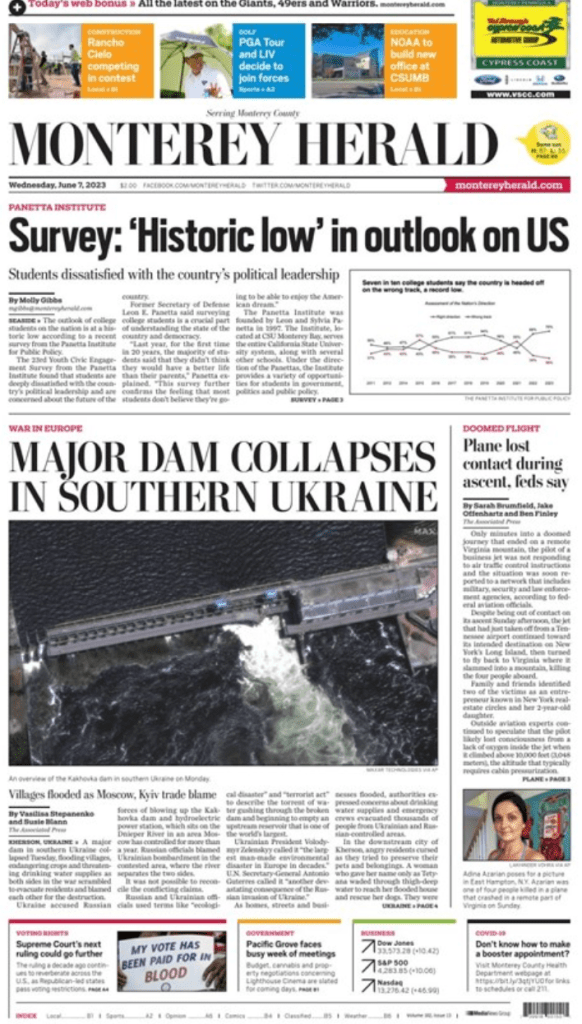
“Villages flooded as Moscow, Kyiv trade blame.”
A screenshot of the front page of the 7 June 2023 Monterey Herald, as sent to this subscriber

The Nova Kakhovka Dam in Ukraine, controlled by Russia, has been destroyed. One consequence is a humanitarian disaster that, had it not taken place within a war zone, would already have drawn enormous international assistance. Thousands of houses are flooded and tens of thousands of people are in flight or waiting for rescue. Another consequence is ecological mayhem, among other things the loss of wetland and other habitats. A third is the destruction of Ukrainian farmland and other elements of the Ukrainian economy. So much is happening at once that the story is hard to follow. Here are a few thoughts about writing responsibly about the event.

1.  Avoid the temptation to begin the story of this manmade humanitarian and ecological catastrophe by bothsidesing it.  That’s not journalism. 

2.  Russian spokespersons claiming that Ukraine did something (in this case, blow a dam) is not part of a story of an actual event in the real world.  It is part of different story: one about all the outrageous claims Russia has made about Ukraine since the first invasion, in 2014.  If Russian claims about Ukrainian actions are to be mentioned, it has to be in that context.

3.  Citing Russian claims next to Ukrainian claims is unfair to the Ukrainians.  In this war, what Russian spokespersons have said has almost always been untrue, whereas what Ukrainian spokespersons have said has largely been reliable.  The juxtaposition suggests an equality that makes it impossible for the reader to understand that important difference.

4.  If a Russian spokesman (e.g. Dmitri Peskov) must be cited, it must be mentioned that this specific figure has lied about every aspect of this war since it began.  This is context.  Readers picking up the story in the middle need to know such background. 

5.  If Russian propaganda for external consumption is cited, it can help to also cite Russian propaganda for internal consumption.  It is interesting that Russian propagandists have been long arguing that Ukrainian dams should be blown, and that a Russian parliamentarian takes for granted that Russia blew the dam and rejoices in the death and destruction that followed.

6.  When a story begins with bothsidesing, readers are being implicitly instructed that an object in the physical world (like a dam) is really just an element of narrative.  They are being guided into the wrong genre (literature) right at the moment when analysis is needed.  This does their minds a disservice.

7.  Dams are physical objects.  Whether or how they can be destroyed is a subject for people who know what they are talking about.  Although this valuable NYT story exhibits the above flaws, it has the great merit of treating dams as physical rather than narrative objects.  When this exercise is performed, it seems clear that the dam could only have been destroyed by an explosion from the inside.

8.  Russia was in control of the relevant part of the dam when it exploded.  This is an elemental part of the context.  It comes before what anyone says.  When a murder is investigated, detectives think about means.  Russia had the means. Ukraine did not. 

9.  The story doesn’t start at the moment the dam explodes.  Readers need to know that for the last fifteen months Russia has been killing Ukrainian civilians and destroying Ukrainian civilian infrastructure, whereas Ukraine has been trying to protect its people and the structures that keep them alive.

10.  The setting also includes history.  Military history offers an elemental point.  Armies that are attacking do not blow dams to block their own path of advance.  Armies that are retreating do blow dams to slow the advance of the other side.  At the relevant moment, Ukraine was advancing, and Russia was retreating.

The pursuit of objectivity does not mean treating every event as a coin flip, a fifty-fifty chance between two different public statements.  Objectivity demands thinking about all the objects — physical objects, physical placement of people — that must be in the story, as well as all of the settings — contemporary and historical — that a reader would need in order to come away from the story with greater understanding.

Source: Timothy Snyder, “The Nova Kakhovka Dam in Ukraine: Ten guidelines for writing about catastrophe,” Thinking about…, 7 June 2023. Thanks to Mark Teeter for the heads-up


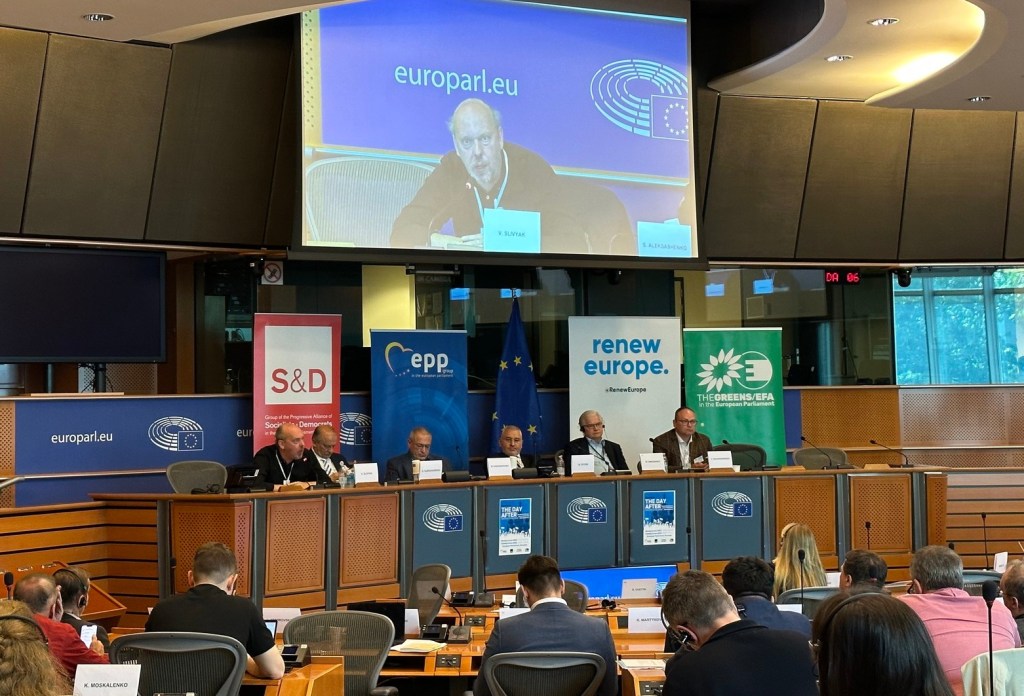
Vladimir Slivyak (far left and on screen), speaking at the European Parliament earlier this week. Mikhail Khodorkhovsky, who made his fortune selling oil and gas, is seated the second to Mr. Slivyak’s left. Photo courtesy of his Facebook page

At the beginning of the week, an important conference, “The Day After,” was held at the European Parliament. I would not call it a “congress” of the Russian opposition, but rather something like a big meeting of Russian civil society. Some of the participants were those who are termed “opposition politicians” and their support groups. There were also human rights activists, women’s rights activists, LGBT+ rights activists, and many others. Environmentalists were extremely poorly represented (three out of the approximately 250 people in attendance). At the dozen or so panel discussions, in which more than fifty people took part, only one person addressed environmental issues—me.

Despite the fact that, as I observed, there were fewer politicians in attendance than non-politicians, the panel discussions were dominated by the topics that only the politicians talk about. Very rarely did anything different get talked about, but when it did the audience was usually quite supportive. I have no quarrel with the gist of what the opposition politicians said. Almost everyone spoke about supporting Ukraine, democratizing Russia, and the horror of the war, which must be stopped and all Russian troops withdrawn. There was a lot of discussion about what the political system of the new Russia should be, how to prevent a repeat of the dictatorship. This is all well and good, and I don’t think anyone in the audience disagreed with the main arguments. The big problem was something else. The vast majority of the speeches seemed to merge into a single digested mass: it was difficult to distinguish among people who, one after another, talked about the same thing in similar terms. If the audience expected just this, then that’s fine. But the audience were definitely expecting more. And they didn’t get it.

On the second day, the wonderful Karina Moskalenko organized a protest for women’s rights, threatening to leave the auditorium if the middle-aged white men in suits continued to dominate the panel discussions. Periodically, women did appear among the participants of the discussions, but not always. I fully supported the protest because the gripe was warranted: those who dominated the discussions (who had been involved in organizing the conference, of course) objectively had no desire to take into account the interests of other groups. This was the reaction of only one of the movements represented at the conference, but similar emotions (about the ignoring of all other interests) were also manifested by representatives of the other groups. Often one had the impression that there were the bearers of the truth, whose important cause everyone else should follow, while all other interests would be dealt with later (maybe). Someone said, How does this differ from Putin? No one else’s interests matter to him either.

There is no doubt that the opposition talked about important things, and I don’t think anyone at the conference questioned this. The topic of unifying the opposition was broached repeatedly. But it’s just that uniting people who don’t feel that their interests are taken into account won’t work. This is the answer to those who are always wondering why the opposition is fragmented. If you want someone to stand beside you, you have to make room for them.

On the morning of the second day, I spoke on the same panel with Mikhail Khodorkovsky, Sergei Aleksashenko, Mark Feygin, Fyodor Krashennikov, and one of the European MPs. It was all per usual until my turn came. Briefly put, I argued that climate policy and the transition to green energy were extremely important, and that it was necessary to deal with this now if you were thinking about how to set up a new democratic Russia: you couldn’t get by without it, because for any civilized country today it was one of the priorities and its importance would only grow. No one would ever take Russia seriously if it was run by politicians who did not understand climate issues. The demand for fossil fuels would decline, and this would become a big economic problem; it would not be possible to employ the previous economic model (which enabled Putin to save money for the war). Also, the opposition needed the support of voters and, most importantly, young people, because it was they who would have to vouchsafe democracy in the future and prevent a new dictatorship. It was young people who would have to face much more terrible manifestations of climate change than those we were witnessing today. So, young people needed politicians to understand the climate agenda and work on it. If you wanted young people to vote for you in the future, you wouldn’t get anywhere with them without it. Nothing would ever happen if you put it off for later. In the USSR and post-Soviet Russia, dealing with environmental issues was always postponed.

Despite the fact that the audience applauded my remarks loudly and more than once, the moderator, Feygin, could not hold himself in check no way no how. He made a brief comment to the effect that of course it’s important, but it’s not important. He went out of his way to show his disrespect for the opinion of the people in the audience who obviously supported my arguments, let alone the climate and environmental agenda. Well, okay, we’ve seen worse things in our lives. But what really struck me was how many people (not a few, but dozens) came up to me during the day to thank me for my speech and say that it was important. About half of those who approached me mentioned how the reaction from the other panelists (I think they meant Feygin) had been ugly.

My conclusion in the light of all this is simple: there is nothing wrong with people, but there is something wrong with the leadership. It is vital to learn to feel what your target audience wants. If you are a politician who, albeit sometime in the future, not now, wants to build a democratic Russia and get people’s support, you not only have to talk about what you stand for. You also need to hear people and respect their interests. It’s not a one-way street. And this is not only my opinion (among the participants of the conference). Within Russian civil society there is an enormous desire to work to change Russia and a huge potential for unification. We can’t let this moment slip.

Source: Vladimir Slivyak (Facebook), 7 June 2023. Translated by the Russian Reader. See Tomsk TV2’s recent interview with Mr. Slivyak, as part of its project Eyewitnesses.


The offices of a subsidiary of Russian oil giant Lukoil on Kurfürstendamm in Berlin, 7 June 2019
Photo by the Russian Reader

There is a phenomenon that, by the way, unites us Ukrainians with Russians—a burning irrational hatred for Greta Thunberg. I can’t understand this phenomenon. Basically, she’s never wronged anyone. But yesterday, social media was just bursting at the seams with hatred for her, including from people who went to her Twitter account to tell her that she was a “juvenile slut.” The conservative momma’s boys at Tyzhden (The Ukrainian Week) even knocked off a column about it.

They don’t hate Tucker Carlson, who yesterday released a video claiming that Ukraine bombed the hydroelectric power station itself. They don’t hate Elon Musk, who reposted it. They don’t hate fucking Ben Shapiro or the Trumpists, who have been stumping against Ukraine from the get-go and at the same time are readily published here in Ukraine, in translation by Our Format, because “we must respect different opinions.” No, for some reason, the hatred is reserved for Greta Thunberg.

The irony here is also that the RePlanet movement, which she represents, just yesterday quite promptly condemned Russia for the situation with the hydroelectric power plant and once again called for the withdrawal of Russian troops from Ukraine’s sovereign territory. But who cares? Greta Thunberg, bitch, you’re going to answer for everything.

Source: Dmytro Rayevsky (Facebook), 7 June 2023. Translated by the Russian Reader

We’re Not in the Same Boat

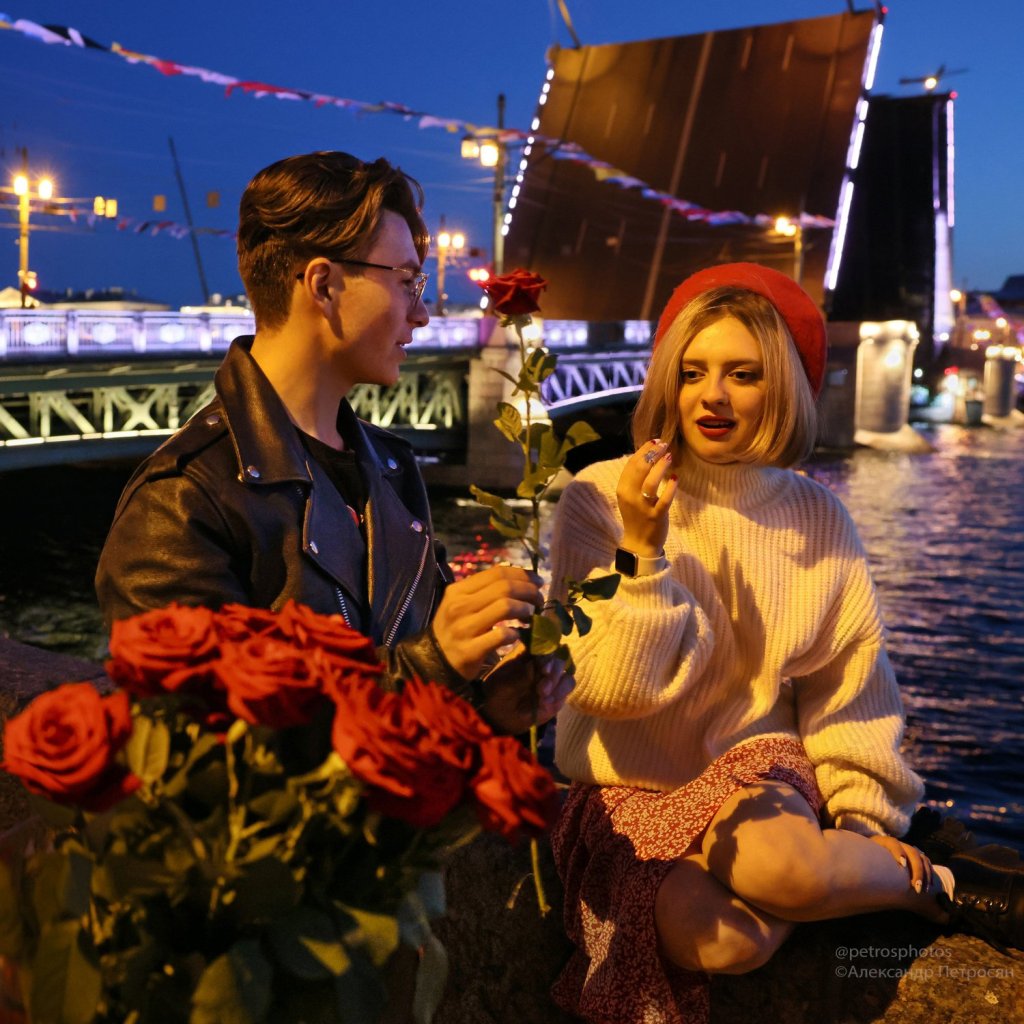
One in a series of photos, taken recently in Petersburg, that the photographer Alexander Petrosyan
posted under the heading “Life goes on”. Source: Alexander Petrosyan, Facebook, 3 July 2022

The main stumbling block in communication between Ukrainians and Russian/Belarusian oppositionists is that the latter believe, for some reason, that they understand the former very well.

As one Belarusian oppositionist (from New York) wrote, “In the areas occupied by the Russian Federation, unarmed people behave the same way, both in Belarus and in Ukraine.”

That’s what they think—that all of us are suffering from an identical disaster. They often go even further and claim that, up until February 24, 2022, people in Ukraine were living the life of Riley, while people in the Russian Federation and the Republic of Belarus faced crackdowns.

As one Russian oppositionist (from Warsaw) told me, “[Opposition] pickets [in Russia] end stupidly, and [protesters] also get the shit kicked out of them. How long did you [Ukrainians] face such things? From January to February 2014?”

To hear them tell it, they endured misfortunes for years and years while we had an easy time of it here in Ukraine. That is, until February 24, we should have sympathized with them due to their immense suffering. But now, after February 24, we must recognize them as equal sufferers.

Firstly, a lot of different mass protest campaigns and protest rallies have taken place in Ukraine in addition to January-February 2014—from the Revolution on Granite, the miners’ strikes of the 90s, and Ukraine without Kuchma, to the Orange Revolution, the Language Maidan, and the Euromaidan. The fact that Ukrainians were able to learn and reflect on the experience gained during each such event, so that the next one would be even more effective, testifies only to the literal fact that you have to learn from your mistakes and do your homework. There is no doctor who can cure you of the fact that you were not able to do it, dear Russians and Belarusians. It’s certainly not the fault of us Ukrainians.

Secondly, the war began in 2014. While things were generally relatively quiet in the Republic of Belarus, and while oppositionists were being jailed in the Russian Federation, artillery was already destroying villages in Ukraine, albeit in a limited area, in two regions.

And, thirdly: half an hour ago, thunder rumbled somewhere in Kyiv. It was ordinary thunder, presaging a thunderstorm. But everyone tensed up. Passersby scoped out furrows in the terrain where they could take cover. Even the courtyard drunks who could still move their legs after the morning rondel, moved closer to building entrances, fences, and other shelters from shrapnel.

No crackdowns in the Russian Federation and the Republic of Belarus, no matter how terrible they are, bear any resemblance to what the absolute majority of Ukrainians are enduring now.

War is different. You can’t sign a police charge sheet and hope that they’ll stop pounding you. You can’t make a deal with a police investigator and get off lightly. You can’t even protect yourself by not “getting mixed up in politics” so as to avoid having any problems in future with the police and prosecutor’s office. Because you’re just getting the shit beat out of you. You go to the shopping center for tea and coffee every time a little like it’s the last time. But then you see that no, a shopping center in another city has been bombed today, and the black bile rises from your guts to your throat as you watch it burn.

And this is in the relatively peaceful cities and towns far from the front. In the frontline areas, they pound the fuck out of you as they grind the cities into piles of concrete and rebar.

And no, Belarusians now are not feeling the same things in “occupied territory” as Ukrainians do. As long as there are no camps there which the absolute majority of the population in the occupied villages and cities must go through. And from which buses bearing the “non-filtered” go somewhere, returning empty. Belarusians do not huddle in apartments without windows and electricity, reading the bulletin from the occupation administration that there will be no cold-season heating in any case. And so.

Everyone has their own sufferings, of course. When the weather changes, someone in Miami, even, suffers from pain in a joint that was dislocated by the cops back in the motherland and smears it with ointment. But objectively, no, we are not in a situation that is equivalent to the one the Belarusians and Russians are in currently. Until they understand this, there will be no dialogue.

UPD. I’m not accusing anyone of anything at all. I am pointing out a difference in our plights, which many do not notice. Otherwise, I have nothing against people being different and having different stories. That goes without saying.

UPD2. And I’m not talking about what passports people have or their ethnic background. In my universe, people who are currently fighting [against the Russian army] and working in Ukraine are “our” people.

Source: Dmytro Rayevsky, Facebook, 29 June 2022. Translated, from the Russian, by the Russian Reader


Yurii Brukhal, an electrician by trade, did not have a very dangerous role when he volunteered for Ukraine’s territorial defense forces at the start of the war. He was assigned to make deliveries and staff a checkpoint in the relative safety of his sleepy village.

Weeks later, his unit deployed from his home in the west to a frontline battle in eastern Ukraine, the center of the fiercest fighting against Russian forces. He was killed on June 10.

Andrii Verteev, who worked in a grocery store in the village, spent the first months of the war guarding a small overpass after work and returning home to his wife and daughter at night. Then he, too, volunteered to head east. He died in battle in Luhansk, only weeks before Mr. Brukhal.

Their deaths have driven home the extent to which the war is reaching into every community across the country, even those far from the front. It has also underscored the risks faced by volunteers, with limited training, who are increasingly heading into the kind of battles that test even the most experienced soldiers. Their bodies are being returned to fill up cemeteries in largely peaceful cities and towns in the country’s west.

[…]

Oksana Stepanenko, 44, is also dealing with grief, along with her daughter Mariia, 8. Her husband, Andrii Verteev, was killed on May 15.

Like Mr. Brukhal, he had been a volunteer, tasked with protecting an overpass just up the road during the early weeks of the war. Then he joined an anti-aircraft unit of the military and was redeployed to the east.

His death added a new level of pain to the family. Ms. Stepanenko’s son, Artur, died of an illness at age 13 three years ago. Now a corner of their small living room has become a shrine to the boy and his father.

Ms. Stepanenko said she found solace in her faith and the fact that it was her husband’s choice to go to the front lines. But, like so many others in Ukraine, she asked, “How many guys have to die before this ends?”

Source: Megan Specia, “Ill Prepared for Combat, Volunteers Die in Battles Far from Home,” New York Times, 2 July 2022