Borshch Belt

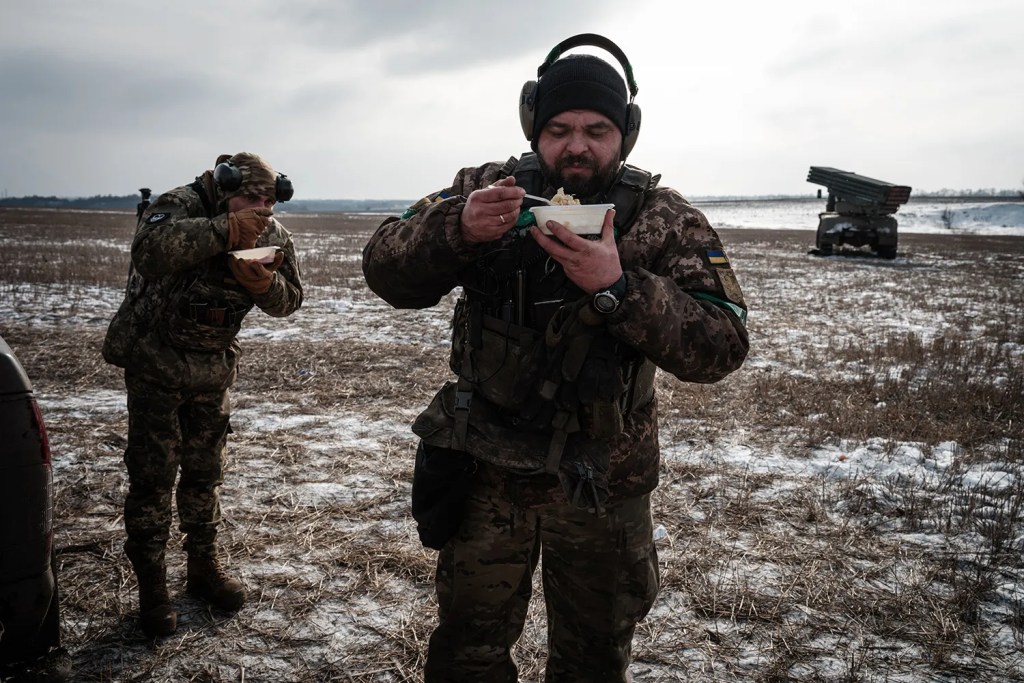
Two Ukrainian soldiers eat borsch delivered to them near Bakhmut, Ukraine, on 7 February 2023. 
Photo: Yasuyoshi Chiba/AFP/Getty Images

At the entrance of Inshi Cafe in downtown Lviv, Ukraine, stood a full-size cardboard likeness of the country’s best-known chef, Yevhen Klopotenko. In immaculate kitchen whites, the 39-year-old was immediately recognizable by his handlebar mustache and eccentric coif: the right side of his head shaved close, with an unruly mop of curls thrown over his left ear. This is an updated take on the hair art of the ancient Ukrainian Cossacks, a nomadic warrior people central to Ukrainian identity. Likewise, Klopotenko seeks to modernize traditional Ukrainian cuisine, especially borsch, a beet-based soup that, he claims, is as Ukrainian as the Cassocks themselves.

“Sure, there’s borsch in other countries in Eastern Europe,” Klopotenko, who co-owns Inshi—which he closed a month ago—and another restaurant in Kyiv, explained in a phone interview. But, he went on to say, nowhere is borsch (the preferred Ukrainian spelling [sic]) so variegated and central to a country’s diet and culture as in Ukraine.

Klopotenko, widely considered Ukraine’s borsch aficionado, has turned the dish into his life’s work. In 2022, when Russia’s full-scale invasion captured one-sixth of Ukraine, Klopotenko raced to fast-track the process of enshrining Ukrainian borsch-making on UNESCO’s list of cultural heritage in urgent need of safeguarding. To help establish the dish’s distinct national roots, Klopotenko co-founded the Institute of Culture of Ukraine, which collected over 700 pages of evidence, including recipes and historical records from across the country. Borsch was inscribed on the UNESCO list that July.

Klopotenko’s field research is explicitly political: He strives to reconnect Ukrainians with their ancestors, building on the national renaissance that took off with independence in 1991 and was turbocharged by the Russian invasions. He wants to show that Ukraine is a full-fledged nation with deep roots and age-old traditions—in stark contrast to Russian President Vladimir Putin’s fiction that Ukrainians are really Russians, and thus a legitimate target of reconquest. For Klopotenko and many other Ukrainians, the country’s borschs are a critical element in the complex cultural tapestry that constitutes national identity.


Likes its kaleidoscope of borschs, the country of Ukraine is a patchwork of different traditions. Ukraine is made up of Jews, Hungarians, Roma, Tatars, Moldovans, and, yes, Russians, among others. Many speak in other languages at home and seamlessly switch to Ukrainian in public. Regionally, Ukraine is also a smorgasbord: Its constituent territories were for centuries divided among the Russian, Austrian, Mongolian, and Polish empires, as well as other foreign lords.

But borsch, whose name comes from the Slavic word for beet, is a passion of all stripes of Ukrainians. Most borschs today include some combination of beets, cabbage, onions, carrots, potatoes, tomatoes, and broth. The first thing that strikes one, even before a bowl is in sight, is the soup’s earthy, tangy fragrance, often accentuated by fresh dill. Its audacious color usually (but not always) takes on a spectrum of vibrant reds and deep purples. The spectacular sweet-and-sour tango that borsch performs on your taste buds is the juxtaposition of its core ingredient, beet kvass—a fermented juice made by soaking beets for days—and the sweetness of the tomatoes. A fulsome dollop of sour cream on top balances the acidic and savory flavors.

Ingredients beyond the basics vary widely, which one learns quickly after striking out to explore Ukraine’s culinary landscape. Central Ukraine, around the historical [Cossack] city of Poltava, boasts a classic Ukrainian borsch: The broth can be beef-, pork-, or poultry-based, with generous chucks of smoked rib meat floating in a bouquet of root veggies. A home-style variation includes halushky, or small dumplings, that swim in the broth.

Central Ukraine is probably where borsch made its debut about a thousand years ago, according to the research of the Institute of Culture of Ukraine, one of the many until-now-unknown facts about the dish. It did not have the name “borsch,” and this was long before the likes of tomatoes or even potatoes appeared in European gardens. The earliest first known written mention of the word borsch dates to the 16th century, concocted out of fermented sorrel and wild grasses, notably hogweed. The borsch Ukrainians know today, Klopotenko said, hails back about two centuries. Ivan Kotliarevsky’s 1798 “Eneida,” a mock-heroic poem considered the first piece of literature published entirely in Ukrainian, mentions various traditional Ukrainian dishes consumed by Cossacks and Ukrainian peasants, including borsch.

In northwestern Ukraine’s Volyn region, along the Polish borderlands, borsch is sometimes cooked with the blood of wild boars. To the south, along the Hungarian border, ethnic Magyars spice up the dish with smoked paprika (a staple of many Hungarian dishes) created by roasting red peppers over a fire. In eastern Ukraine, borsch is often so thick that a spoon can stand up in the dark red stew. And, along the Black Sea, borsch can boast fish rather than meat, Klopotenko said.

Klopotenko’s restaurant in Lviv offered four kinds of borsch, including one flavored with red wine and another that contains wild mushrooms. His signature borsch is known for its smoky, rich flavor and features baked beets, plums, and smoked sour cream. (It also includes pork ribs, but all of his borschs also come in vegetarian versions, a rare courtesy in Ukraine.) But a locality’s truest borsch, Klopotenko said, is served in homes. His mother’s recipe was incomplete without pork ribs, celery root, and smoked dried pears.

Klopotenko contends that Russia’s occupation of Ukrainian territories and the displacement of Ukrainians there threaten the survival of gastronomical traditions. Indeed, many experts, including those from Human Rights Watch, say that Russia targets cultural heritage in a deliberate strategy to erase Ukrainian nationhood and rewrite regional history. In Moscow’s thoroughgoing Russification of the occupied territories, everything Ukrainian—language, symbols, history—is snuffed out or labeled as Russian, including culinary staples.

On the Azov Sea, where all Ukrainian port cities are in Russian hands, Mariupol-style borsch traditionally features sprats, gobies, or other fresh fish. The local bychky (similar to dumplings) are pan-fried and then dropped into the broth shortly before the dish is served. Mariupol was occupied by Russia in 2022 and “cleansed” of Ukrainian culture, including gastronomy, so it’s unclear how common the dish is today. It isn’t that specific types of borsch were literally made illegal to prepare, but rather that the occupying forces erased the variety and identity of Ukrainian food, replacing it with monolithic Russian fare. Sure, Russians eat borsch, too, Klotopenko said, but with nothing of the Ukrainian flair.

Whether Crimean Tatars, also under Russian occupation, still cook borsch in massive kettles and with slabs of roasted lamb and ample coriander, is unknown. There are simply many fewer Tartars there than were in 2014, when Russia annexed the peninsula. Since then, hundreds of thousands of ethnic Russians have moved into Crimea, substantially altering its culture. Crimea is a Russian police state, and there is little truck between the peninsula and free Ukraine. But Crimean-style borsch can still be found in the homes of Tatars who have left Crimea. Around 25,000 Tatars relocated from Crimea to mainland Ukraine after 2014. Today, community groups preserve their culture in exile, convinced that they will return one day to a Ukrainian Crimea.

Russia’s onslaught continues to threaten the cultural fabric of the eastern parts of Ukraine, including the factory city of Dnipro, which boasts a tightly knit community of Ashkenazi Jews. Their borsch is pink, lighter than most variations of the dish, and of course, kosher: no pork, with cows and sheep slaughtered according to ritual. For now, at least, two restaurants at the community’s Menorah Center in downtown Dnipro serve kosher borsch; lemon juice replaces kvass, celery root replaces cabbage. The broth is simmered for four to five hours to induce a rich, concentrated taste. And it is almost always served with out-of-the-oven pampushka: soft white buns smothered in garlic butter. Ukrainian President Volodymyr Zelensky, who is Jewish and was born in Kryvyi Rih, the next city over from Dnipro, probably grew up with a borsch like this.


On the other side of Ukraine, roughly 500 miles to the west, the people of the Carpathian Mountains, who live along the Romanian border, raise their children on white borsch, concocted with fermented white sugar beets and pork, seasoned with dill, parsley, and green onions. This is the favored meal of the Hutsuls, an eastern Slavic people descended from shepherds.

Last December, my Hutsul friend invited me into the homestead of the Makivnychuk family in Verkhovyna, a Carpathian town considered a Hutsul stronghold. There I was honored to attend a 12-course Christmas Eve dinner. The family borsch—cooked on a wood stove and served in candlelight because the Russians had knocked out the electricity—is a marker of identity. Marie Makivnychuk can trace her recipe back six generations, to a time when mountain folk ate what grew on their rock-strewn slopes. White beetroot grows best in the mountain’s cool climate.

Most Ukrainians, Kletopenko said, are aware that borsch is not uniform across the country, but they’re oblivious to the universe of borschs and the rich, historic backstories. And why should they bother, when their mother’s borsch is the most wonderful of all?

SOURCE: Paul Hockenos, “The Battle for Borsch,” Foreign Policy, 17 July 2026


This is Yana Boretska, Operations Manager for the Kyiv Independent Store. So many of you have asked us for a Ukrainian borshch recipe, so here it is at last — my family recipe, the one I make for my family, my friends, and sometimes simply for my own enjoyment.

In 2022, the culture of Ukrainian borshch cooking was added to UNESCO’s List of Intangible Cultural Heritage in Need of Urgent Safeguarding, recognizing its importance as a part of Ukrainian cultural heritage. At the Kyiv Independent, we celebrate the dish with our Borshch collection, which features the ingredients of borshch illustrated by Ukrainian illustrator Albina Kolesnichenko on T-shirts, sweatshirts, aprons, and tote bags.

Yana in Kyiv’s Podil district, wearing a Borshch tote bag

Ingredients


For the broth:                           

  • 1-1.5 lbs. (500g-700g) beef on the bone
  • 1-2 bay leaves

For the borshch:

  • 0.5-1 lb (300-500g) boneless beef
  • 1 onion, diced
  • 1 carrot, grated or julienned
  • 2 medium red beets, grated or finely chopped
  • 2 tbsp tomato puree (or 3–4 fresh tomatoes)
  • 1 tsp sugar
  • 1 tsp vinegar or lemon juice
  • 3-4 potatoes, diced
  • 11oz (300g) cabbage, shredded
  • 2-4 cloves of garlic, finely chopped
  • Fresh dill and parsley, finely chopped

Serves 6-8

Preparation time 2-3 hours

Secret ingredient: Make it in our borshch apron!

Method

First, make the broth. Put the beef on the bone in a large pot and cover with about 4-5 pints (2.5–3 liters) of cold water. Bring to a boil and carefully skim off any foam that rises to the surface. Add the bay leaves and a little salt, then reduce the heat to low and simmer gently for 60–90 minutes, partially covered, until the broth becomes rich and flavorful.

While the broth is cooking, cut the boneless beef into medium-sized pieces. Heat a little oil in a large frying pan or heavy-bottomed skillet over medium-high heat. Add the beef and sear it well, stirring occasionally, for approximately 25–30 minutes, until it has a deep golden-brown crust. Once browned, set the beef aside.

Add a little more oil to the pan. Add the diced onion and cook for 4-5 minutes, until softened, then add the carrot and cook for another 3-4 minutes. Add the beets, and cook for 5-7 minutes, stirring regularly. Then, add the tomato paste, a small amount of water or broth, the sugar, and vinegar or lemon juice, and simmer everything together for another 5-7 minutes. Set aside.

When the broth is done, remove the beef on the bone from the broth. The meat can be removed from the bone, cut into pieces, and returned to the broth if you want.

Bring the broth back to a gentle simmer, add the fried beef, and cook for 5-10 minutes. Then add the potatoes and cook for another 10 minutes or so. Add the shredded cabbage and cook for another 5-7 minutes, depending on how soft you like it.

Add the sautéed vegetables to the pot, stir well, and simmer for another 8-10 minutes. Season with salt and black pepper to taste. Avoid a very aggressive boil— a gentle simmer helps preserve the beets’ beautiful red color.

In the last couple of minutes, add the garlic and fresh herbs. Turn off the heat and taste the borshch — adjust the salt, pepper, sugar, and vinegar/lemon juice if necessary.

Cover the pot and let the borshch rest for at least 30 minutes before serving, an hour if possible.

To serve

This is the most important part. Serve the borshch hot with a generous spoonful of sour cream directly in the bowl. Sour cream adds creamy richness and perfectly balances the acidity of the beets and tomato.

Finish with fresh dill and parsley, and with bread on the side — garlic bread works well. And to really go all out, why not wear a Borshch T-shirt while you eat?

Plate of traditional borshch with sour cream, served with pampushki (garlic bread buns).
(Photo by: Natasha Breen/REDA/Universal Images Group/Getty Images)

For me, borshch has always been about that feeling of home, warmth, and comfort. It carries a taste of Ukraine that is incredibly difficult to forget.

If you decide to try my version of borshch, I would genuinely love to hear how it turns out! If you have any questions while making it, simply reply to this email (<store@kyivindependent.com>), and I’ll be happy to answer personally and help with any details.

With love from Kyiv,

Yana, Operations Manager, The Kyiv Independent Store

SOURCE: “The recipe you’ve been waiting for: traditional Ukrainian borshch,” Kyiv Independent Store email newsletter, 5 November 2026. I just ordered a Kyiv Independent borshch apron and tote bag to go along with the Kyiv Independent borshch t-shirt which I’ve been wearing proudly the last few years. ||||| TRR
Civilization Won’t Be Destroyed by Extraterrestrials: On the Possible Merger of Russia’s Two Largest Libraries

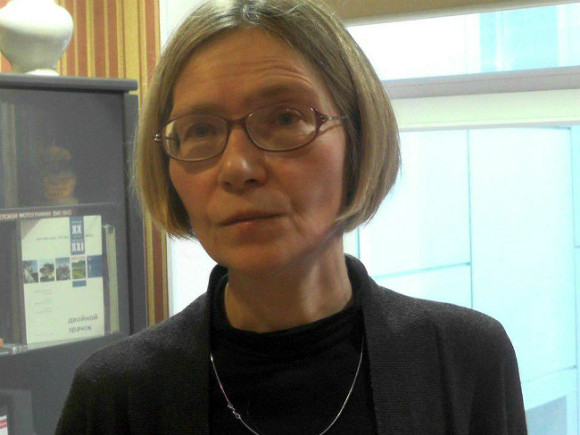
Tatyana Shumilova. Photo courtesy of Rosbalt

Civilization Won’t Be Destroyed by Extraterrestrials
The consequences of merging Russia’s two largest libraries would be disastrous, argues the Russian National Library’s Tatyana Shumilova
Alexander Kalinin
Rosbalt
February 1, 2017

The idea of merging Russia’s two biggest libraries was proposed to culture minister Vladimir Medinsky by their directors, Vladimir Gnezdilov (the Russian State Library in Moscow, aka the Leninka) and Alexander Visly (the Russian National Library in Petersburg, aka the Publichka). The proposal has hardly garnered universal approval. The country’s leading authorities on librarianship have sent a letter to President Putin asking him to stop the merger from going ahead. They have been supported by Russian philologists and historians.

Tatyana Shumilova, chief bibliographer in the Russian National Library’s information and bibliography department, spoke to Rosbalt about how staff there have related to the possible merger with the Russian State Library, and whether the issue has been broached with them.

What are the possible consequences of merging the country’s two biggest libraries?

Our library would simply cease to exist in its current shape. Many people have made much of the fact that the RNL’s executive director Alexander Visly has said the changes would not give rise to a new legal entity. Of course, they wouldn’t. One legal entity would remain: the RSL. So everyone realizes it’s not a merger that is at issue, but a takeover.

So we could equate the words “merger” and “destruction” in this case?

Yes, definitely. A merger would be tantamount to the death of our library here in Petersburg. After the RNL became a branch or appendage of the RSL, our work with readers would cease to be funded. We would not be able to provide them with the full scope of services. Plus, we would have to switch to the RSL’s system, and that would be undesirable. We are told the catalogues in both libraries are structured on the same principle. That is not true. There is a big difference between them. It would be quite complicated to restructure the system. The different approaches to librarianship should be preserved.

Moscow has the administrative resources. The government is located in the capital, as is the Culture Ministry. Moscow and Moscow Region are the home of the RSL, the Russian Institute for Scientific and Technical Information (VINITI), the Russian National Public Library for Science and Technology, the State Historic Public Library of Russia, and the Russian State Library for Foreign Literature (aka the Inostranka). And, until recently, the Institute of Scientific Information on Social Sciences of the Russian Academy of Sciences (INION RAN) was running at full steam. But the Northwest Federal Region has only two major libraries, the RNL and the Library of the Russian Academy of Sciences (aka the BAN). After a merger, there would be one.

I understand that, after the merger, publishers would not have to send an obligatory copy of their books to the RNL. Only Moscow would get new books?

That is one of the cost-saving measures. Allegedly, money would not have to be spent on two sets of obligatory copies. It would be enough to have one hard copy and a digital copy. But the outcome would be that Petersburg would simply stop receiving most new books. It’s a rather cynical cost-cutting measure that would affect only our library, not the RSL, which was founded much later than the RNL. And all because it’s located in Moscow. No one says it outright, but it’s clear anyway.

But the RNL would still get a digital copy.

I really don’t understand the idea of sending a digital copy instead of a hard copy. We have a huge number of readers who for medical reasons cannot and should not use a computer. Why should we deprive them of hard copies? It’s simply indecent. Besides, we know what natural disasters electronic resources are prone to. A blackout, a power surge in the network, a server failure, and everything is lost. A library should not be dependent only on one type of resource.

People who take far-reaching, momentous decisions like to base them by alluding to the know-how of other libraries and even other countries. But nowhere do national libraries receive only digital copies of printed matter. You can probably merge libraries in Denmark, but the Russian Federation is a different country, a much larger country with a much larger population. Although the name would stay the same, the RNL would in fact cease being a national library. We already have municipal and neighborhood libraries in Petersburg. People come to us as a last resort, when there is nowhere else to go.

Nor is anyone probably really aware that digital copies relate not only to books but to magazines and newspapers as well.

Apparently, the shots are being called by people who don’t read and don’t go to libraries. Just how did the culture minister write his dissertations and books? By using the Internet? Or did someone else do it for him?

Where did the idea to merge the libraries come from?

Rumors about the merger have been circulating for a long time. They are all we have to go on, for no one has said anything officially. It’s still too early to draw any conclusions from the available facts. Now no one denies that merger talks are underway. Earlier, apparently, they were too busy to reveal this, or maybe they were ashamed or embarrassed. But now they’re not ashamed anymore.

After the Soviet Union collapsed, Vladimir Zaitsev, the then-director of the Publichka, was worried about the library’s potential plight. That was when the name Russian National Library was coined. Lots of people didn’t like it, but Zaitsev thought it would give us stability and protect us from attacks. As we see now, it didn’t work for long. The opportunity to save millions of rubles has now been identified as grounds for merging the libraries. Indeed, you could probably calculate the worth of the books and the real estate by eye. But how do you evaluate the intangible assets? How many people have been educated here? How many people, from university students to scholars, have grown up here? They wrote their dissertations and books here. If you write a research paper based on more than two sources, you are going to need a library. This is serious work.

It is believed the RNL’s current director Alexander Visly was sent to Petersburg on a “temporary assignment” in order to merge the two libraries. Do you agree?

Officials rarely condescend to explaining the reasons for their actions directly. They believe they should not be accountable to the taxpaypers. No one has announced anything to us officially. But talk of a possible merger started after Anton Likhomanov left the director’s post at the RNL in early 2016. Visly wasn’t the only person tipped for the vacancy, after all. The director of the Lermontov Interdistrict Centralized Library System, in Petersburg, and the director of the National Library of the Republic of Karelia were identified as possible candidates.

Several months passed between Likhomanov’s departure and Visly’s arrival. We don’t know what was discussed during that time. Apparently, there was some kind of horse trading underway. According to the rumors in Moscow, Visly really didn’t want to move to Petersburg, but he was nevertheless talked into going in order to perform certain functions. The fact that an executive director has not yet been appointed at the RSL, and they only have an acting director, causes one to reflect grimly on the subject.

Indeed, Visly has not taken an interest in day-to-day affairs in Petersburg. He is busy with construction, renovating the Lenin Reading Room, and he has visited the cataloguing and acquisition departments. By the way, officials have been saying the functions of these departments overlap at the RNL and RSL. So he hasn’t been dealing with the library as a whole, although he is the executive director and should be responsible for everything that happens in the RNL. Apparently, this circumstance has been agreed upon with someone. No one would reproach him for it.

Has the issue of the possible merger been discussed with RNL staff?

There have been no meetings on the topic with the workforce, and none are planned. No one keeps us in the loop. There are no general staff meetings.  There is the practice of informational meetings, to which the heads of the departments and units are invited. My comrades once expressed a desire to take part in one such meeting, but they were simply booted out. Staff members only talk about the merger amongst themselves.

What do they say?

Very little that is positive. Everyone fears for his or her future. But what can rank-and-file library staffers do? Some signed the letter supporting the library, while others didn’t. Some have signed a petition. What else can we do?  We need large-scale outside support, but how do we get it? People know very little about the merger of the libraries, after all. Even if they wanted  to  find out about the consequences of the mergers, where would they look? Yandex News. And what would they find there? News about fires, missing schoolchildren, pedestrians run over by cars, and people falling from tall buildings. There is almost no news about culture.

And how do we explain to university lecturers, university students, and schoolchildren what could happen to the library? How do we convince them that the problem concerns them, too? Even university students come to us for textbooks, because the university libraries are shortchanged when it comes to new acquisitions of books. But our customers, people to whom provide information, include the St. Petersburg Legislative Assembly, the Investigative Committee, the FSB, the Interior Ministry, and other organizations. So it turns out they could not care less, either. Or they naively believe nothing will change. Maybe they don’t understand the consequences?

Have you thought about organizing a protest rally?

Few library staffers would attend such a rally. Everyone is scared redundancies will kick off, and his or her department will be eliminated. There is the chance of winding up on the streets. There are people working here who went through the hungry 1990s on miserly wages. At least they were paid regularly. Director Vladimir Zaitsev, who constantly traveled to Moscow and literally sat in the minister’s waiting room, deserves the credit for that.

So a lot of people would not attend a rally. No one wants to lose their job. Take a look, for example, at how many people came out to defend St. Isaac’s Cathedral. A lot fewer than could have come out.

People today are surrounded by informational noise. They hear about Crimea, Ukraine, and America. Old ladies at bus stops don’t discuss cultural issues, but US Presidents Obama and Trump. Everyone in Russia is totally confused.

What consequences would the merger have for readers? For example, one of the plusses that has been mentioned is that people with RNL cards would be able to use the RSL in Moscow.

Initially, readers would have no sense of any change. They just wouldn’t understand anything. After all, we would continue to acquire some new books. Qualitative negative changes build up unnoticed. They’re not visible immediately. In Germany in 1933, not everyone realized immediately what exactly was happening, either.

Aside from the issue of conservation and security, replacing hard copies with digital copies would cause yet another exodus of readers, especially elderly people, who often don’t like or cannot read e-books. Indeed, many young readers, when you suggest they use a digital source, reply, “I don’t need your Internet. I came here to read books.” Reducing the numbers of live readers to a minimum would probably lead to the next step: closing the library altogether. “Why keep you open?” officials would say, “Nobody visits your library.”

As for a single library card for the two libraries, there wouldn’t be much advantage to it. RNL readers can easily get a card for the Leninka, and Leninka readers can easily get a card for the RNL. It’s a snap: you just need your internal passport. You don’t even have to bring a photograph to the registration desk anymore.

So is there any way out of the situation, or is the RNL’s takoever inevitable?

I don’t want to accept the fact it could happen. But RNL staff are hardly in a position to do anything. They have almost no influence on the situation. Respected people, prominent scholars and cultural figures, have to speak out, people with whom the authorities have to reckon. As it is, only Arkady Sokolov and Valery Leonov, out of the entire Petersburg library community, have spoken out on the topic. None of the museums or universities have openly supported us. It is sad.

I don’t think the city could solve the problem by talking the library under its wing. That would only delay its death. The city could not fund the RNL properly. I don’t know what other options we have for saving the library. We have let the moment passs when we could have looked for sponsors to support us financially.

What do RSL employees think of the merger?

They are silent because the merger wouldn’t affect them. They would continue to function as before and do the same things they did earlier, such as acquiring the obligatory copies, hard copies and digital copies, of everything published in Russia. The negative consequences would only affect us, meaning the Russian National Library.

The most concise definition of culture is this: culture is the transmission of tradition. Breakdowns in the production, concentration, and reclamation of the national heritage (a process in which libraries are an inalienable and quite important component) have led to the collapse of civilizations throughout history. Then people go looking for the extraterrestrials who flew in and destroyed everything. The perpetrators are actually much closer.

Translated by the Russian Reader. Thanks to Comrade VZ for the heads-up

UPDATE. Sadly but predictably, the Russian National Library has now decided to dismiss Tatyana Shumilova from her job there for granting this frank interview to Rosbalt, although ostensibly, as follows from the letter below, dated 3 February 2017 and signed by E.V. Tikhonova, acting director of the RNL, she is threatened with dismissal for, allegedly, being absent from work for four hours and thirteen minutes on 30 January 2017. Thanks to Comrade VA for this information and the scan of the letter. TRR

16388258_1765605920131726_5540994598165898435_n

UPDATE 2. Today, February 7, there have been corroborated reports that Tatyana Shumilova has been summarily dismissed from her job at the Russian National Library in Petersburg. TRR