The Case of Ekaterina Vologzheninova: Watch What You “Like”

Click on the Button and Get a Sentence
Latest “Extremist” Reposting Case Goes to Court
Margarita Alyokhina
October 14, 2015
Novye Izvestia
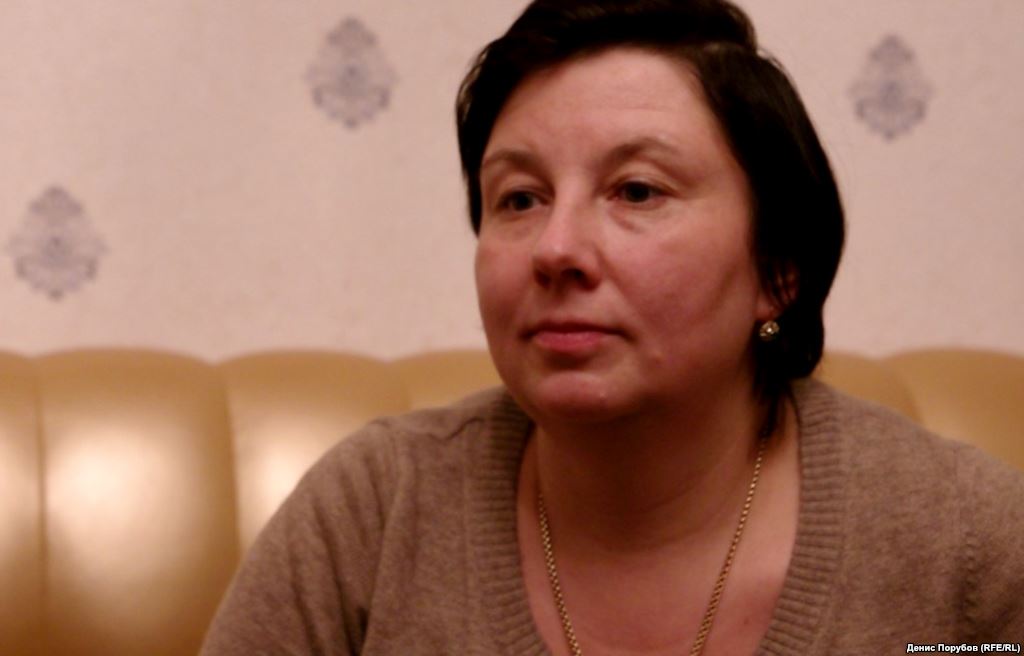
Ekaterina Vologzheninova

The first hearing on the merits of the criminal case against Ekaterina Vologzheninova, who has been accused of extremism for reposts she made on the social network VKontakte, will take place on October 27. In addition to distributing “inflammatory” matter (consisting, in fact, of pictures and poems, supporting Ukraine, that are freely available on the Web), the 46-year-old single mother [from Yekaterinburg] has been accused of associating with “undesirable persons,” which included activists from Memorial and International Amnesty.

Vologzheninova has been charged under Article 282.1 of the Russian Federal Criminal Code (“incitement of hatred or enmity, as well as humiliation of human dignity”). The authorities began pursuing Vologzheninova after she shared several items on VKontakte. These items, we should note, have not been included in the Federal List of Extremist Materials.

Experts from the SOVA Information and Analysis Center have commented on the case against Vologzheninova on their website.

“The poem ‘Katsaps,’ whose main idea is that Ukraine’s ethnic Russians will defend it from Russia, contains accusations that the Russian authorities have attacked Ukraine, but there are no aggressive appeals in it. As for the poster, it obviously calls on Ukrainian citizens to defend the country from occupation.”

As usual, the preliminary hearing in the case was held in closed chambers.

“The prosecutor read out the indictment. But she read it out in an interesting way, omitting the most absurd paragraphs,” Vologzheninova’s attorney Roman Kachanov told Novye Izvestia.

During the hearing, the defense moved to send the case back to the prosecutor’s office, since, according to Kachanov, the indictment did not meet the requirements of the law. It did not make clear what the charges were.

“The conclusion states that [Vologzheninova] committed acts aimed at inciting hatred and enmity on the basis of race, ethnicity, and origin. As for race and origin, we did not understand that at all. But as for ethnicity, the indictment turns on the social group ‘Russians,’ although in the items at issue, ethnic Russians, on the contrary, are assessed positively; it is argued that it is wrong to oppose Russians to Ukrainians. In one text, Russians fighting in the Armed Forces of Ukraine are mentioned proudly,” Kachanov told Novye Izvestia.

According to Kachanov, the indictment accuses Vologzheninova of inciting hatred toward the social group “Moscow occupier” [sic]. It also features the phrase “ethnic hatred and enmity toward the public authorities.”

Earlier, during the investigation, Vologzheninova had also been reproached for associating with “undesirable persons,” human rights activists from Memorial and Amnesty International.

“Formally, such charges were not brought against her, because there is no such crime. At the very end of the investigation, however, [Vologzheninova was interrogated] by a FSB field officer by the name of Khudenkikh. And he, apparently wanting to generate a negative psychological atmosphere, accused her of having dealings with Memorial, which is a ‘foreign agent,’ and with Open Russia, which is funded from the west,” Kachanov told Novye Izvestia.

According to him, on the eve of the court hearing, it transpired that Vologzheninova’s bankcard had been blocked.

“The situation is this. By law, if a person is suspected of extremist or terrorist activities, his or her name is put on Rosfinmonitoring’s black list. A court sentence is not needed for this. But it does not always happen this way. I know people convicted of extremist crimes who have continue to have use of their bank accounts,” the lawyer explained.

According to him, a person who goes on the Rosfinmonitoring list stays there practically in perpetuity. For example, the slain terrorists Shamil Basayev and Salman Raduyev are still on it. And since the list is openly accessible, for “extremists” like Vologzheninova it is an additional humiliation. As Novye Izvestia ascertained, Ekaterina Vologzheninova is indeed listed among terrorists and extremists on Rosfinmonitoring’s website.

Svetlana Mochalova, a linguist with the FSB’s crime lab in Sverdlovsk Region, performed the forensic examination in the case. As Novye Izvestia reported earlier, a whole string of verdicts in controversial “extremism” cases in the Urals have been based on her findings. Among them is the verdict in the case of Pervouralsk resident Elvira Sultanakhmetova, who was sentenced to 120 hours of community service for calling on Muslims not to celebrate New Year’s because it was, in her opinion, a pagan holiday. Mochalova identified “incitement of hatred and enmity towards persons who do not celebrate New Year’s, whose customs and festivals are manifestations of a lack of faith” [sic] in what Sultanakhmetova had written. In 2010, Mochalova found “statements calling for social strife and the violent overthrow of the Russian Federation’s constitutional order an integrity” in the article “Patriotism as a Diagnosis,” written by the attorney Stanislav Markelov, who had been murdered [by Russian neo-Nazis] a year earlier. The article was examined as part of the proceedings against civic activist and Tyumen State University lecturer Andrei Kutuzov. He was prosecuted for, allegedly, handing out leaflets calling for an end to political crackdowns. According to Mochalova, these leaflets incited hatred against the authorities and aroused social discord. Mochalova refused to reveal her examination procedure to the court on that occasion, claiming that it was marked “for official use only.”

In July, teacher Alexander Byvshev, who had posted a pro-Ukrainian poem on a social network (unlike Vologzheninova Byvshev had written the poem himself), was sentenced to 300 hours of community service in the Oryol Region. Sentences for “likes” and reposts have practically become the norm this year. Thus, on September 28, Chelyabinsk blogger Konstantin Zharinov, who had reposted material from the banned Right Sector, was found guilty and immediately pardoned. On September 15, Krasnodar activist Sergei Titarenko was fined 100,000 rubles [approx. 1,400 euros] for reposting a political post. On September 17, the Lenin District Court in Cheboksary sentenced Parnas opposition party activist Dmitry Semyonov [and immediately pardoned] for reposting a caricature of Dmitry Medvedev.

Translated by the Russian Reader. Photo courtesy of Radio Svoboda

__________

A Currenttime.tv report about the criminal case at Yekaterinburg resident Ekaterina Vologzheninova, accused under Article 282 of the Russian Federal Criminal Code of inciting ethnic hatred and enmity against the Russian public authorities, residents of Southeast Ukraine who do not support modern Ukraine’s political course, volunteers from Russia fighting on the side of the Donetsk People’s Republic, and other absurd things. Posted on October 17, 2015. Thanks to Sergey Chernov for the heads-up

Contemporary Art Killed My Dog

On a number of issues and events you have opposed Putin’s policies, and now you are at the Moscow Biennale [of Contemporary Art] at the VDNKh, a venue where the order of things is supposed to be questioned [sic]. Do you believe that here, in the current political situation, there can be a place for real criticism that is both anti-Putinist and anti-capitalist?

Yanis Varoufakis, anti-anti-Putinist

[Yanis Varoufakis:] Absolutely. But let me clarify something. I am not an anti-Putinist.  Anti-Putinism is too strong a word. I am very critical of Putin, but his demonization in the West is something I also resist. We should be smarter and think about what it means to be critical. I am extremely critical of what Putin did in Chechnya, and I have not forgiven him for it. But on the other hand, Putin was absolutely right about what happened in Georgia, and the West was absolutely wrong. I think that the West’s position on Crimea has also been inconsistent. Russia was surrounded [sic] by NATO when Latvia, Lithuania, Estonia, and other countries were included in the alliance. And for Russia it was an insult, as well as something close to violating the agreement between Reagan and Gorbachev [sic]. And Putin has been right about this, too. So I have never supported the policy of demonizing Putin. And I am afraid that Russians will have to suffer the awful consequences of this process, consequences which they do not deserve.

So I believe that spaces like this give us hope for the existence of another, rational, critical approach that does not take one side or the other and allows people from the West and Russia to get together and develop a more sophisticated optics for seeing the world and politics, for being critical without demonizing.

—Excerpted from Sergei Guskov, “Yanis Varoufakis: ‘Being critical without demonizing,’” Colta.Ru, October 2, 2015. Translated, from the Russian, by the Russian Reader

__________

There are only a few things I would add to Mr. Varoufakis’s remarks, above. First, he presumably made them in English, not Russian. Since he is an extremely persuasive speaker and conversationalist, it is quite possible some nuances in what he said at the Moscow Biennale of Contemporary Art were flattened or distorted when translated from English (?) into Russian, and these distortions have only been amplified further in my back translation.

But I doubt this is the case. The point of his remarks seems quite plain, so they are either a fabrication on the part of Colta.Ru or what Mr. Varoufakis more or less said in the event, minus the “static” of two consecutive translations.

If this is what he said, then Mr. Varoufakis is only another in a long line of Western leftist thinkers and activists who, seemingly, have found something “anti-hegemonic” or “anti-imperialist” or “productively” anti-American or, God forbid, “anti-capitalist” about Putin’s policies and actions, or have found it possible to hobnob with or shill for Putinists, on the Putinist dime, in the name of some kind of “criticality” or “third position” above the current fray, or just because they were bored and wanted an all-expenses-paid junket to Moscow or Petersburg or Rhodes.

A smarter person than me (and an actual Russian leftist activist to boot) has pointed out that Putin is nothing remotely like an anti-imperialist or anti-capitalist. On the contrary, my smart friend has argued, folks in the west should make an effort to find out about grassroots social and political activism and activists in today’s Russia and look for ways to make common cause with them. Or, at least, not stab them in the back by supporting Putin explicitly or implicitly.

Because Russia, like “the West,” is not a monolith. And that is the second way in which Mr. Varoufakis went wrong in his remarks in Moscow. “The West” is not a single entity, even among its political, intellectual, and media elites. It is not an organism singularly hellbent on “demonizing” Putin, whatever that means. It requires no effort at all to compile a very long league table of Putin’s wholehearted or partial supporters in “the West,” from Stephen Cohen to Donald Trump, from Silvio Berlusconi to Mary Dejevsky, from Nick Griffin to any number of leftist and centrist politicians in Europe. For reasons I haven’t been able to explain, that table has been growing fatter as Putin’s actions have become more aggressive and “demonic,” both at home and abroad.

Neither is Russian society nor the fabled (and utterly imaginary) “Russian people” monolithic, but over the past fifteen years the Russian state apparatus, the Russian mainstream media (especially television), and Russian mainstream political parties have become a monolith, one of whose primary goals, especially in the last two or three years, has been to demonize “the West” and the domestic opposition any way it can, no holds barred.

You would have to have been in the middle of this properly demonic media hysteria, moral panic, and “cold civil war” to appreciate just how thoroughgoing and thoroughly frightening it has been, and since I have been following Mr. Varoufakis’s own adventures over the past year or so, I can imagine he simply has no clue about what has really been happening in Russia since the blocks came off completely post Maidan, because he was very busy with more important matters.

One job this blog has taken on has been to provide little snapshots of that awfulness while also, more importantly, giving non-Russian speakers a chance to hear Russian voices other than Putin’s, however unimpressive or inaudible they might seem to big shots like Putin and Mr. Varoufakis.

Finally, I would like to address the question of why Mr. Varoufakis imagines, apparently, that big hoedowns like the Moscow Biennale of Contemporary Art are such perfect places for elaborating a “sophisticated optics for seeing the world and politics, for being critical without demonizing.”

Just a year ago, my hometown of Petrograd hosted Manifesta 10, another such prominent venue for “criticality.” In the midst of an occupation and invasion of a neighboring country by the host country, the host country and host city’s continuing legal demonization of LGBT, and a local election campaign, for the city’s governorship and district councils, that involved making sure the non-elected incumbent in the gubernatorial race would face no real opposition in his bid to legitimize his satrapy and, on election day, threatening independent election observers with murder, the Manifestashi did absolutely nothing that would really ruffle anyone’s feathers, least of all their sponsors from city hall and the State Hermitage Museum, and they barely reacted to the maelstrom of neo-imperialist hysteria and officially authorized criminality raging around them. Basically, they partied like it was 1999, while providing their fellow citizens with the welcome illusion that the shipwreck wrought by fifteen years of Putinism in politics, the economy, civil society, culture, education, medicine, science, industry and, most painfully, people’s minds could be conjured away or endured and understood a little better by taking a sip of contemporary art’s renowned and heady “criticality” and pretending Petersburg was Helsinki or Barcelona, if only for a summer.

10497395_10152669630307289_178016388250142251_o

What has got better on Russia’s broken social, political, and art scenes since last autumn to make it even more desirable to engage in “criticality” at a biennale in one of Russia’s capitals, this time with the Russian Federal Ministry of Culture footing the bill?

Latterly, a cynical lunatic named Dmitry Enteo has smashed up a bunch of sculptures by the late Soviet sculptor Vadim Sidur and gotten off almost scot-free for his crimes. On the other hand, the list of political prisoners in Russia has continued to grow, and it now includes Crimean activists Oleg Sentsov and Alexander Kolchenko, sentenced to hard time in prison for no particular reason.

And then there is Alexei Gaskarov, who, if he lived in a more democratic country, would be running a party like Syriza or Podemos (minus the “criticality” and verbal cuddling up to other people’s dictators), but instead looks to be facing another two and half years in a penal colony, again, for no particular reason other than his own staunch opposition to Putin’s regime.

In the current dreadful “conjuncture,” a good day is a day that goes by without news of yet another anti-Putinist activist being arrested, an art exhibition’s being trashed by “Orthodox activists” or otherwise shut down because it might offend the sensibilities of someone’s grandmother, or a new law’s speeding down the State Duma assembly line so as to tighten up the screws on dissent and “treason” yet again.

In fact, I had a bit of such good news earlier today, when I learned that Andrei Marchenko, a Khabarovsk blogger whose case I have been following, was only fined 100,000 rubles (approx. 1,350 euros) instead of being sent down for two years to a work-release prison, as the prosecutor had demanded, for the horrible crime of writing one untoward sentence about Putin’s Ukrainian misadventure on his Facebook page in 2014.

Where does Mr. Varoufakis fit into this picture? Probably nowhere, which is probably where he should have stayed instead of playing to Moscow’s art and hipster crowd, always happy to let itself off the hook when it comes to taking responsibility for the ongoing disaster, and to the invisible figure up in the emperor’s box, especially at an opera with the almost deliberately ham-fisted and parodical title of Acting in a Center in a City in the Heart of the Island of Eurasia.

Thanks to Comrade AW for the heads-up. Images courtesy of BBC News and the Manifesta Biennial Facebook page