Ivan Astashin: Violence Is the Norm

I’m not surprised by the violence. I am not surprised because I know about the violence that occurs in Russia every day. Senseless cruelty is seemingly the norm for some Russians. I don’t have a ready answer to why this is the case. It’s worth asking sociologists, anthropologists, and psychologists for an explanation.

Those of you who were born in the early 1990s or earlier probably know about the brutal executions, tortures, and rapes of the Chechen population by Russian soldiers. Some of you will say that the Chechen militants were cruel too. Yes, they were. But it is always worth remembering that it was the Russian troops who invaded Chechnya, and not vice versa. Another big question is who was the first to employ torture and execute the so-called enemy using elaborate methods. To refresh your memory of those events, I would remind you of several well-known cases. The bombing of Katyr-Yurt. The murder of six dozen civilians in Novy Aldy by the Petersburg riot police. The abduction, rape, and murder of the 18-year-old Chechen girl Elza Kungayeva by Colonel Yuri Budanov. In addition, human rights defenders, journalists, and the European Court of Human Rights have reliably verified a huge number of abductions and the cruelest tortures of Chechens by Russian forces.

I remember the first time I found out about these tortures at school. A classmate told me that his brother had “fought” in Chechnya and brought back a videotape showing the torture of local residents. I didn’t watch the tape: what my classmate told me sufficed. A few years later, in the ninth grade, I met a Chechen boy my age, who told me about similar tortures to which his relatives had been subjected. I was told the same thing about men who had been involved in the Chechen campaign whom I met in prison. Only Chechens themselves do not like talking about the torture and rapes; therefore, the information found in open sources details only a small portion of the crimes committed by the Russian security forces in Chechnya.

‘Post-Soviet visual. An unknown activist’s protest performance titled “Bucha-Moscow” against the war crimes of the Russian army in Ukraine. Images via Холод.’ Courtesy of Soviet Visuals. Thanks as well to OG for the heads-up.

In addition to war, there is also quite enough cruelty (sadism, I would even say) both in the army and outside it. By the way, it is quite logical that since Russian soldiers bully and actually torture their fellow soldiers, they would not have any moral barriers vis-a-vis the enemy and the “enemy” civilian population. The infamous story of Private Andrei Sychev, who was tortured by his mates on the occasion of the New Year, is an eloquent illustration of relations within the army.

As probably everyone knows now, there are whole torture “conveyor belts” in the Russian penitentiary system. In such places, prisoners are tortured with extreme cruelty. And, it seems, with a particular relish. They are tortured both by Federal Penitentiary Service employees and by other prisoners who have signed contracts with the wardens. They torture and rape prisoners, and sometimes they kill them. Moreover, this goes on in both adult and juvenile penitentiaries.

And the cops? They also enjoy torturing, beating, and, on occasion, raping detainees in police departments.

However, cruelty is found not only among the security forces. Due to the fact that I was reputed to be a “lawyer” in the penal colony, many prisoners brought their verdicts to me to “have a look.” I wish I hadn’t seen them. Out of greed, in a drunken stupor or out of fear, these seemingly utterly ordinary people had done terrible things.

I also remember the stories of some of my inmate friends about how their fathers had “raised” them. “My dad beat me with a stick.” “Mine whacked the fucking hell out of me with a hose.”

As for these last arguments, you might counter me by saying that they are criminals from difficult backgrounds. Perhaps.

What about domestic violence? According to the Consortium of Women’s Non-Governmental Associations, at least five thousand women were killed as a result of domestic violence [in Russia] in 2018 alone.

Once in power (whether as conferred by epaulettes or as the “head of the family”) and believing in their impunity, many, many people in Russia become executioners, sadists, and rapists. And if this is also bolstered by xenophobic propaganda and strong alcohol, the monsters begin doing the unimaginable. Since the regime in Russia gives some people the authority to inflict whatever they want on those in their jurisdictions, and forces others to go along and not to rebel, violence becomes commonplace.

Now it has spilled out of Russia. The whole world has now seen what had been happening on the sly during “counter-terrorist operations,” in police departments, in secret prisons and the Federal Penitentiary Service’s unclassified institutions, and in the army, as well as on the streets and in home. [Bucha] is undoubtedly a terrible tragedy and a huge grief for the victims and all decent people. But I hope that over time it will lead to society’s re-examining the policy of giving people uncontrolled power. Ridding the world of violence seems to be an almost unmanageable task, but I think that when Russia doesn’t have policemen who “Putin told to beat the holy fuck” out of someone, when it doesn’t have military men whose crimes will be “written off by the war,” when it doesn’t have security officers who “defend the motherland,” and when there is no support in society for patriarchy, racism, and xenophobia, there will be much less violence.

Source: Ivan Astashin, Facebook, 5 April 2022. Mr. Astashin is a former political prisoner. Translated by the Russian Reader
Vlad Tupikin: Why We Take to the Streets Every Year on January 19

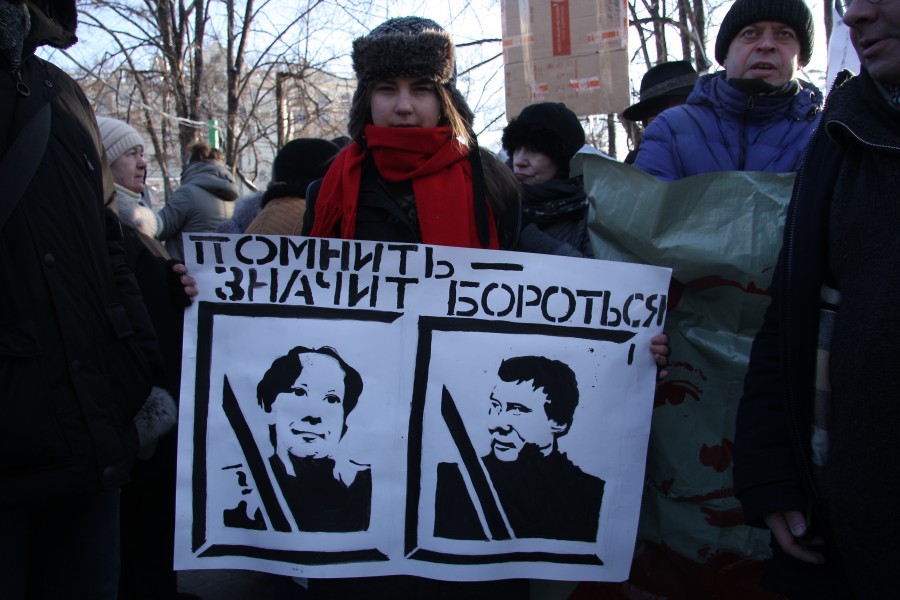
"Remembering Means Fighting," January 19, 2014, Moscow. Photo by Comrade Anatrrra
“Remembering Is a Way of Fighting Back,” January 19, 2014, Moscow. Photo by Comrade Anatrrra

Vlad Tupikin
Why We Take to the Streets Every Year on January 19
Facebook
January 19, 2016

Why do I go to the antifascist demonstration every year on January 19 and call on you to do the same? There are several obvious reasons, but of one of them is deeply personal, and I do not mention it often.

I am not a religious person, but in a sense you might say this is my way of praying to God.

Seven years ago, on the night before January 19, many activists, like today, were sitting in chat room, only they were not on Facebook but on Gmail, although real activists should avoid both Gmail and Facebook, but I will save that conversation for another time.

Seven years ago they were sitting in chat rooms, and so was I. Two events of importance to the Moscow anarchist and antifa community had been scheduled for January 19. The most important was a counter picket against pro-Kremlin youth protesting the arrival of migrants at Moscow’s Kazan Station. To put it more simply, the pro-Kremlin youth were going to frighten newly arrived migrants by citing the severity of Russian laws and their rigorous application, and strongly suggest to the migrants that they were a priori uncultured mugs who wanted to roast a sheep carcass at the drop of a hat, while we anarchists and antifascists believed these accusations were at least latently racist and at most wretched in so many ways that it is a pain to list them all. So we decided to respond to their frightening leaflets with our own welcoming anti-picket.

The second important event on January 19, 2009, was a press conference called by lawyer Stanislav Markelov at the Independent Press Center in downtown Moscow. We paid attention to nearly every public appearance by Stas Markelov, because . . . Because, if you remember, in Arkady and Boris Strugatsky’s novel Beetle in the Anthill, when the KGB-like COMCON-2 ask the Golovan Embassy (the Golovans are a race of intelligent dog-like creatures) about the character codenamed Beetle, the embassy sends this definitive response: “The Golovan people know the Beetle in the Anthill.”

The same thing could have been said about Stas: “The antifa know Stas Markelov.” Was it any wonder. Markelov knew the antifa, loved the antifa, was a friend of the antifa, defended the antifa in court, promoted the antifa, and tried to raise the way the antifa thought and acted to a higher level. (See, for example, his article “Red Book of the Antifa.”) But when the time came, the antifa were unable to save Stas Markelov, just as the Golovans could not protect the Beetle in the Anthill.

Although earlier they had protected him. They had guarded him at pressers before, and had actually prevented an armed attack on Markelov in autumn 2008.

Personally for me, a person whose occupational hazard was calluses from gripping a ballpoint pen and banding on a keyboard, there was not much of a choice on January 19, 2009, although I wavered. It was clear there would be some kind of action at Kazan Station, that it should be described, and so it was better to witness it with my own eyes. It was clear that Stas was holding a routine presser on the Colonel Budanov case (Colonel Yuri Budanov was a Russian military officer who had murdered a young Chechen woman), although it had been occasioned by the extreme circumstances of Budanov’s sudden release from custody. Obviously, I had to go where the action would be, especially since reportage was my favorite genre. But what was there to report about a presser? That a colleague had scratched his ear at some point?

And yet, I hesitated, because I had not seen Stas in a long time, and every encounter with him was a joy. He radiated optimism, cheerfulness, and invincible confidence in the future, something that I, a historical optimist but everyday skeptic, sorely lacked, and so sometimes I basked in Markelov’s rays. And the Budanov case was politically important: it had to be written about, too. Whatever, I thought. First, I would take in the action at Kazan Station, then file a story about the action at Kazan Station, and only then would I read the reports colleagues had filed about Stas’s presser, and if need be I would get Stas on the phone to clarify some details, and then I would write about it, too.

No sooner said than done. I went to watch the protest and counter protest at Kazan Station and, as it turned out, try and save a female anarchist activist from being abducted by the pro-Kremlin crowd. She was thin and light as a feather, and so they had grabbed her and raced off with her down the platform.

Basically, a good time was had by all. I then traveled to the nearest computer (at a girlfriend’s office) and sat down to type it all out. That was when I heard the news. A man had been shot and killed in broad daylight on Prechistenka in Moscow, near the Kremlin. A woman who was with him had also been shot.

A colleague had also spent half the night in a chat room persuading another anarchist journalist to go to Kazan Station the next day. But he was unable to persuade her, and she went to Stas Markelov’s press conference. Now everyone knows this journalist’s name, Anastasia Baburova.

But that was a personal digression.

Generally, of course, such crimes must not go unanswered. The answer is not to respond with deadly force. (None of us wants a civil war). The answer is the clearly expressed civic will to stop such crimes and prevent their repetition in the future. That is why there is a demonstration every year on January 19.

It is like our May first holiday, a holiday celebrated round the world in memory of murdered workers, workers who were murdered a long, long time ago, in 1886. But people still remember them.

May the memory of Stas and Nastya live forever!

Those who remember them know what to do. Today, January 19, we gather at Novopushkinsky Square in Moscow at 7 p.m, and then we march in demonstration down the boulevards to Kropotinskaya. And people will also be laying flowers at the murder site on Prechistenka. But there it is everyone for themselves, and the spirit of antifa for all.

Translated by the Russian Reader