

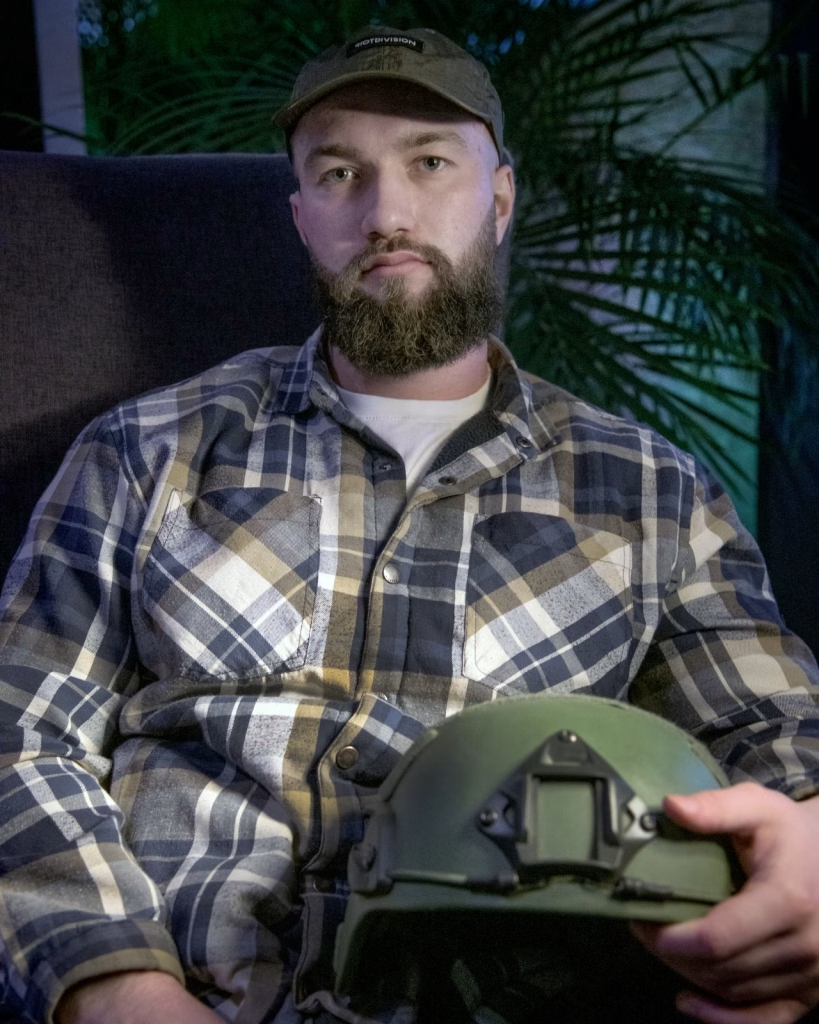
Lt. Lev Stupnikov pulled his truck up to the edge of a field in eastern Ukraine on a frigid February morning, followed by a convoy of senior Russian army officials coming to observe a training exercise near the front line.
For several consecutive days, Russian infantrymen, medics and officers had been drilling on the frozen mud, preparing for an offensive on the nearby city of Vuhledar. The only cover was a line of bare trees.
Stupnikov approached a group of waiting soldiers and snapped a photo, keeping his cellphone close to his chest to avoid drawing attention. Then he quickly tapped out a message: “There must be between 120 and 150 men here.”
Stupnikov, a recent graduate from a prestigious military academy in St. Petersburg, Russia, had a secret. Earlier that month, he had begun covertly sharing information with Ukrainian intelligence.
He had already given his contact the exact coordinates of the field.
Now, with scores of Russian soldiers and their commanding officers gathered there, Stupnikov would have only moments to move out of the line of fire.
“Walk away,” the Ukrainian contact replied, then: “I’m waiting for a message that you’ve left.” Having received no answer, the contact sent a note in all caps a minute later: “LEAVE.”
Stupnikov took this video as he walked away from the target area.
Stupnikov was already on the move, sidling up to a group of drivers smoking beside idling vehicles. Feigning a grimace and clutching his stomach, he asked them for a pack of wet wipes. Then he disappeared into the nearby stand of trees and stooped down, pretending to relieve himself.
He was knocked to the ground by an explosion that sent shrapnel careening into a nearby truck. The Ukrainians had fired a barrage of missiles.
When he got to his feet, Stupnikov was stunned by the gruesome sight. Dozens of mutilated bodies lay strewn across the field. Victims groaned in their death throes. Others were motionless over pools of blood on the black earth beneath them.
His phone buzzed. “Were there explosions? Send a photo.”
“There’s just meat,” he answered.
Later that day, he shared a confirmed tally with the Ukrainians: 68 killed and 60 wounded. Among the dead were 10 officers, including one of Kyiv’s top targets: Col. Gusein Musayev, commander of the 36th Motorized Rifle Brigade. The death toll was among the highest from any single strike since Russia began its invasion of Ukraine two years earlier.
It was the first in a string of attacks that the Ukrainians carried out with Stupnikov’s help, making him one of the most consequential saboteurs in recent military history. Ukraine used the intelligence and coordinates he supplied to kill more than 300 Russian soldiers, according to interviews with his handlers, video footage, text exchanges and official Russian reports.
The 26-year-old’s story offers a rare window into a shadow war waged by Ukrainian military intelligence. Ukrainian agents communicate over encrypted platforms with thousands of Russians, ranging from homemakers living near military factories to soldiers on the front line.
The operation taps into growing political disaffection inside Russia. The aim isn’t just to end Russia’s invasion; Ukraine is trying to build an army of Russian turncoats with the training and determination to one day mount an armed struggle inside Russia and help bring an end to Russian President Vladimir Putin’s decadeslong grip on power.
Stupnikov’s decision to turn against his own comrades came after years of deepening disillusionment with the Russian military. But his deadly act of betrayal, which inspired others to follow his lead, was ultimately enabled by an unlikely person, seeking to get him out of harm’s way—his mother.
Continue reading “Do the Right Thing”