Peace for Our Time

Trump didn’t win the Nobel Peace Prize, but he’s a lock for the Kremlin’s Employee of the Month.

Source: Andy Borowitz (Facebook), 22 November 2025


The 28-point Russia–Ukraine peace plan—put on the table this week by Steve Witkoff, President Donald Trump’s emissary, and Kirill Dmitriev, a Kremlin aide equally inexperienced at diplomacy—grants Kyiv two favors but otherwise amounts to a Moscow wish list.

It is worth noting that neither Ukrainian President Volodymyr Zelensky nor any European leader was consulted in the backroom drafting. Spokesmen for Russian President Vladimir Putin say, a bit improbably, that they haven’t seen the deal either. Even if its outlines were acceptable to both sides, several of its planks are ambiguous, requiring extensive negotiation. Still, Trump has demanded that Ukraine accept the plan before Thanksgiving.

This timetable seems unlikely, as does the notion that peace is now at hand.

The plan allows Ukraine to apply for membership to the European Union—a significant point, given that, in some ways, the war began back in 2014, when Putin deposed a Ukrainian president who was on the verge of striking a deal with the EU. The plan also commits $100 billion in seized Russian assets to rebuild war-torn areas of Ukraine.

However, the rest is a shambles. It hands much of Ukrainian territory to Russia—including Crimea and the eastern Donbas districts of Luhansk and Donetsk. It reduces the size of the Ukrainian army to 600,000 troops (it currently has about 880,000), while putting no cap on the number of Russian troops on Ukraine’s borders. It demands that Ukraine revise its constitution to prohibit membership in NATO, bars NATO troops from being stationed in Ukraine, and forbids Ukraine from attacking Moscow or St. Petersburg with missiles (a peculiar clause—as Lawrence Freedman asks, “But [attacking] Rostov is OK?”), without barring Russia from firing missiles at cities in Ukraine.

Finally, Ukraine must hold elections within 100 days (nothing about how security might be kept at polling stations in areas still under dispute), all combatants and politicians are granted amnesty (so much for war-crimes trials), and Russia “will be reintegrated into the global community,” complete with restored membership in the G8 and the dropping of sanctions.

A few other articles seem to favor Ukraine at first glance, but not so much upon scrutiny. For instance, “Russia is expected not to invade neighboring countries” (italics added), which sounds like a courteous request, not a legal demand. (By contrast, the same plank—in fact, the same sentence—states, “NATO will not expand further.”)

Another: “Ukraine will receive reliable security guarantees,” but there isn’t a hint on what Moscow would find acceptable in this department. Similarly, “Russia will codify a non-aggression policy toward Europe and Ukraine,” thus allowing Putin to load the codification with whatever loose language and loopholes he’d like.

The plan calls for the creation of a “humanitarian committee” to oversee an “all for all” exchange of prisoners, detainees, and kidnapped children. That’s good, but there’s nothing about who appoints the committee members or how the trades are enforced; for instance, who sends police into Moscow homes to retrieve Ukrainian babies and adolescents? Even assuming the best of intentions (a dubious assumption), this will take a while to formalize.

Similarly, the plan says that Donetsk will be turned into a “demilitarized zone,” with no Ukrainian or Russian troops allowed to enter. Again, fine, but who supplies the armed peacekeepers to enforce this rule—and why should Moscow accept it, given that the deal recognizes Donetsk as Russian territory?

These are not small points. Article 28, the plan’s final plank, states, “Once all parties accept this memorandum, a ceasefire will take effect immediately after both sides withdraw to the agreed points for the start of the agreement’s implementation.” In other words, all of the plan’s ambiguities, loose ends, and remaining disputes have to be settled—and then troop withdrawals have to be completed, not merely started—before a ceasefire takes hold.

This is the opposite of the 20-point peace plan that Trump helped impose on Israel and Hamas in Gaza. It shrewdly demanded a ceasefire and hostage exchange as the deal’s first steps. It is not at all clear that details about the remaining points will ever be negotiated, much less implemented (in fact, most of those points seem politically dead on arrival), but the important thing—Trump and his Arab partners realized—was to stop the killing and to keep it stopped for as long as possible.

The Russia–Ukraine plan does the opposite: It imposes a ceasefire after agreement and action on all the other steps toward a peace—and an unjust peace at that.

The main problem with the plan is that, like its American authors, it fails to recognize the true nature of the war: namely, that Ukrainians are fighting for their sovereignty as an independent nation, while Putin is fighting for the restoration of the old Russian empire, which entails, among other things, the total subjugation of Ukraine.

A Kremlin spokesman said as much on Friday, when he said that any peace deal must address the war’s “root causes.” Putin has made clear a number of times that he regards, as the war’s main root cause, the insistence by the government in Kyiv—which he denounces as an illegitimate “neo-Nazi dictatorship”—that Ukraine exists as a nation with its own history, culture, and language.

The best way to end the war is for Trump to realize this fact—and to convince Putin that the West will not let this imperial dream come true. Short of that, all the rest, including the 28-point peace plan, is at best a distraction and at worst a recipe for democratic Ukraine’s surrender.

Source: Fred Kaplan, “The Closer You Look at Trump’s Ukraine Peace Plan, the Worse It Looks for Ukraine,” Slate, 21 November 2025


Ukraine’s president Volodymyr Zelensky addressed the Ukrainian people today. The current moment, he said, is “one of the most difficult” for the country. “Ukraine may soon face an extremely difficult choice. Either the loss of dignity or the risk of losing a key partner. Either 28 complicated points or the hardest winter yet—and the risks that follow,” Zelensky said.

Zelensky’s use of the word “dignity” recalled Ukraine’s 2014 “Revolution of Dignity” that ousted Russian-aligned president Viktor Yanukovych and turned the country toward Europe.

Zelensky was responding to a 28-point “peace” plan President Donald J. Trump is pressuring him to sign before Thanksgiving, November 27. The plan appears to have been leaked to Barak Ravid of Axios by Kirill Dmitriev, a top ally of Russia’s president Vladimir Putin, and reports say it was worked out by Dmitriev and Trump’s envoy Steve Witkoff. Ukrainian representatives and representatives from Europe were not included. Laura Kelly of The Hill reported on Wednesday that Congress was blindsided by the proposal, which Mark Toth and Jonathan Sweet of The Hill suggest Russia may be pushing now to take advantage of a corruption scandal roiling Ukraine’s government.

Luke Harding of The Guardian noted that the plan appears to have been translated from Russian, as many of the phrases in the text read naturally in that language but are awkward and clunky in English.

The plan is a Russian wish list. It begins by confirming Ukraine’s sovereignty, a promise Russia gave Ukraine in 1994 in exchange for Ukraine giving up its nuclear weapons but then broke when it invaded Ukraine in 2014.

The plan gives Crimea and most of the territory in Ukraine’s four eastern oblasts of Kherson, Zaporizhzhia, Donetsk, and Luhansk to Russia, and it limits the size of the Ukrainian military.

It erases any and all accountability for the Russian attacks on Ukrainian civilians, including well-documented rape, torture, and murder. It says: “All parties involved in this conflict will receive full amnesty for their actions during the war and agree not to make any claims or consider any complaints in the future.”

It calls for $100 billion in frozen Russian assets to be invested in rebuilding and developing Ukraine. Since the regions that need reconstruction are the ones Russia would be taking, this means that Russian assets would go back to Russia. The deal says that Europe, which was not consulted, will unfreeze Russian assets and itself add another $100 billion to the reconstruction fund. The plan says the U.S. “will receive 50 percent of the profits from this venture,” which appears to mean that Europe will foot the bill for the reconstruction of Ukraine—Russia, if the plan goes through—and the U.S. and Russia will split the proceeds.

The plan asserts that “Russia will be reintegrated into the global economy,” with sanctions lifted and an invitation to rejoin the Group of Seven (G7), an informal group of countries with advanced economies—Canada, France, Germany, Italy, Japan, the United Kingdom, and the United States, along with the European Union—that meets every year to discuss global issues. Russia was excluded from the group after it invaded Ukraine in 2014, and Putin has wanted back in.

According to the plan, Russia and “[t]he US will enter into a long-term economic cooperation agreement for mutual development in the areas of energy, natural resources, infrastructure, artificial intelligence, data centres, rare earth metal extraction projects in the Arctic, and other mutually beneficial corporate opportunities.”

The plan requires Ukraine to amend its constitution to reject membership in the North Atlantic Treaty Organization (NATO). It says “[a] dialogue will be held between Russia and NATO, mediated by the US, to resolve all security issues and create conditions for de-escalation to ensure global security and increase opportunities for cooperation and future economic development.”

Not only does this agreement sell out Ukraine and Europe for the benefit of Russia—which attacked Ukraine—it explicitly separates the U.S. from NATO, a long-time goal of Russia’s president Vladimir Putin.

NATO grew out of the 1941 Atlantic Charter. Months before the U.S. entered World War II, U.S. president Franklin Delano Roosevelt and British prime minister Winston Churchill and their advisors laid out principles for an international system that could prevent future world wars. They agreed that countries should not invade each other and therefore the world should work toward disarmament, and that international cooperation and trade thanks to freedom of the seas would help to knit the world together with rising prosperity and human rights.

The war killed about 36.5 million Europeans, 19 million of them civilians, and left many of those who had survived homeless or living in refugee camps. In its wake, communism backed by the Soviet Union began to push west into Europe. In 1949, France, the U.K., Belgium, the Netherlands, and Luxembourg formed a military and economic alliance, the Western Union, to work together, but nations understood that resisting Soviet aggression, preventing the revival of European militarism, and guaranteeing international cooperation would require a transatlantic security agreement.

In 1949 the countries of the Western Union joined with the U.S., Canada, Portugal, Italy, Norway, Denmark, and Iceland to make up the twelve original signatories to the North Atlantic Treaty. In it, the countries reaffirmed “their desire to live in peace with all peoples and all governments” and their determination “to safeguard the freedom, common heritage and civilisation of their peoples, founded on the principles of democracy, individual liberty and the rule of law.”

They vowed that any attack on one of the signatories would be considered an attack on all, thus deterring war by promising strong retaliation. This system of collective defense has stabilized the world for 75 years. Thirty-two countries are now members, sharing intelligence, training, tactics, equipment, and agreements for use of airspace and bases. In 2024, NATO countries reaffirmed their commitment and said Russia’s invasion of Ukraine had “gravely undermined global security.”

They did so in the face of Russian aggression.

Putin invaded Crimea in 2014 after Ukrainians ousted Yanukovych, earning economic sanctions and expulsion from what was then the G8. But Crimea wasn’t enough: he wanted Ukraine’s eastern oblasts, the country’s industrial heartland. Former secretary of state Hillary Clinton, who was running for the U.S. presidency against Donald Trump in 2016, would never stand for that land grab. But Trump was a different story.

According to Special Counsel Robert Mueller’s 2019 report on Russian interference in the 2016 presidential election, in summer 2016, Trump campaign manager Paul Manafort discussed with his business partner, Russian operative Konstantin Kilimnik, “a ‘backdoor’ means for Russia to control eastern Ukraine.” According to the Republican-dominated Senate Intelligence Committee, the plan was for Trump to say he wanted peace in Ukraine and for him to appoint Manafort to be a “special representative” to manage the process. With the cooperation of Russian and Russian-backed Ukrainian officials, Manafort would help create “an autonomous republic” in Ukraine’s industrialized eastern region and would work to have Russian-backed Yanukovych, for whom Manafort had worked previously, “elected to head that republic.”

According to the Senate Intelligence Committee, the men continued to work on what they called the “Mariupol Plan” at least until 2018. Putin has been determined to control that land ever since. And now it appears Russia is pushing Trump to deliver it.

This plan, complete with its suggestion that the U.S. is no longer truly a part of NATO but can broker between NATO and Russia, would replace the post–World War II rules-based international order with a new version of an older order. In the world before NATO and the other international institutions that were created after World War II, powerful countries dominated smaller countries, which had to do as their powerful neighbors demanded in order to survive.

Source: Heather Cox Richardson, Notes of an American, 21 November 2025


Donald Trump’s “peace plan” for Ukraine has caused an international firestorm—perhaps because its origins are surrounded by mystery.

We know the plan is the love child of Trump special envoy Steve Witkoff and Vladimir Putin’s emissary, financier Kirill Dmitriev. But what did Trump know about it? (Apparently not much.) Where does Marco Rubio stand? Did Vladimir Putin greenlight this plan on the Russian side? Does he want it implemented? Can it be implemented? What exactly is in it, and how is it being revised? It’s the proverbial Winston Churchill line about Kremlin politics as a “bulldog fight under a rug”—only now with Jared Kushner under there, holding a leash.

There is widespread agreement that the 28-point proposal is devastating for Ukraine: it would lose the entirety of the Donetsk and Luhansk provinces (including the roughly 15 percent of these territories currently in Ukrainian hands) and the occupied parts of the Kherson and Zaporizhia provinces. The part of the Donetsk province currently controlled by Ukraine is to be converted, after Ukrainian withdrawal, into a “neutral demilitarized buffer zone” de facto recognized as Russian but off-limits to Russian troops. What does that mean? Who will police that zone, especially considering that the proposal rules out NATO troops in Ukraine? Those details are, we imagine, currently being filled in.

The plan also includes a proposed cap on the Ukrainian military that is outrageous in principle since it infringes on Ukrainian sovereignty. The one positive spin may be that the 600,000 cap does not include the National Guard and many other types of troops. And while it’s a substantial reduction from the current 900,000 troop size of the Ukrainian armed forces, that number is elevated precisely because the country is currently at war. Moreover, in their spring 2022 peace talk proposal, the Russians had demanded an 85,000 cap.

Still, many other provisions of the plan are infuriating not only for Ukraine but for the civilized world in general. There is, among other things, the failure to name Russia as the aggressor even once, and Russia’s proposed reintegration into the G-7 and other international structures. And yet some strongly pro-Ukraine analysts, such as expatriate Russian journalist Michael Nacke, argue that the proposal has some equally unacceptable elements for Vladimir Putin. Most notably, it stipulates a guarantee of Ukrainian security similar to NATO’s Article 5: an attack on Ukraine would be treated as an attack on the entire transatlantic structure.

Maybe Russia regards this clause as meaningless and believes NATO will never go to war with Russia over Ukraine. It is also worth noting that Putin has continued to insist that Russia intends to achieve all the goals of the “special military operation”—which would include the demilitarization of Ukraine and its de facto relegation to a Russian satellite. Nacke, like a number of other commentators, believe that whatever Ukraine does, Putin will not sign the Trump peace plan.

So the plan may not be a Kremlin wish list. But it does have a distinct Russian flavor. It’s possible that, as investigative journalist Christo Grozev has suggested, the Russian side of the plan comes not from Putin but from the “dovish” Kremlin faction concerned primarily with trade and improved relations with the West.

In this interpretation, the plan represents not so much a proposal for Ukrainian surrender as Trump administration amateur hour: a plan that was cooked up by a real estate developer and a financier that won’t be acceptable to either side. Will current attempts to revise it yield a better version? They’re happening as we hit send on this email. So stay tuned.

Source: Cathy Young, “Moscow’s Mule,” The Bulwark, 24 November 2025


“Do I understand correctly that there is now a dispute within the administration about whether this ‘peace plan’ was written by Russians or Americans?” foreign affairs journalist Anne Applebaum asked last night on social media.

Applebaum was referring to confusion over a 28-point plan for an end to Russia’s war on Ukraine reported by Barak Ravid and Dave Lawler of Axios last week. After the plan was leaked, apparently to Ravid by Kirill Dmitriev, an ally of Russian president Vladimir Putin who is under U.S. sanctions, Vice President J.D. Vance came out strongly in support of it.

But as scholar of strategic studies Phillips P. OBrien noted in Phillips’s Newsletter, once it became widely known that the plan was written by the Russians, Secretary of State Marco Rubio tried to back away from it, posting on social media on Wednesday that “[e]nding a complex and deadly war such as the one in Ukraine requires an extensive exchange of serious and realistic ideas. And achieving a durable peace will require both sides to agree to difficult but necessary concessions. That is why we are and will continue to develop a list of potential ideas for ending this war based on input from both sides of this conflict.”

And yet, by Friday, Trump said he expected Ukraine president Volodymyr Zelensky to sign onto the plan by Thanksgiving: next Thursday, November 27. Former senate majority leader Mitch McConnell (R-KY) said: “Putin has spent the entire year trying to play President Trump for a fool. Rewarding Russian butchery would be disastrous to America’s interests.”

Yesterday a group of senators, foreign affairs specialists gathered in Halifax, Nova Scotia, for the Halifax International Security Forum, told reporters they had spoken to Rubio about the plan. Senator Angus King (I-ME) said Rubio had told them that the document “was not the administration’s position” but rather “a wish list of the Russians.” Senator Mike Rounds (R-SC) said: “This administration was not responsible for this release in its current form.” He added: “I think he made it very clear to us that we are the recipients of a proposal that was delivered to one of our representatives,” Rounds said. “It is not our recommendation, it is not our peace plan.”

But then a spokesperson for the State Department, Tommy Pigott, called the senators’ account of the origins of the plan “blatantly false,” and Rubio abruptly switched course, posting on social media that in fact the U.S. had written the plan.

Anton La Guardia, diplomatic editor at The Economist, posted: “State Department is backpedalling on Rubio’s backpedal. If for a moment you thought the grown-ups were back in charge, think again. We’re still in the circus. ‘Unbelievable,’ mutters one [of the] disbelieving senators.”

Later that day, Erin Banco and Gram Slattery of Reuters reported that the proposal had come out of a meeting in Miami between Trump’s special envoy Steve Witkoff, Trump’s son-in-law Jared Kushner, and Dmitriev, who leads one of Russia’s largest sovereign wealth funds. They reported that senior officials in the State Department and on the National Security Council were not briefed about the plan.

This morning, Bill Kristol of The Bulwark reported rumors that Vice President J.D. Vance was “key to US embrace of Russia plan on Ukraine, Rubio (and even Trump) out of the loop.” He posted that relations between Vance and Rubio are “awful” and that Rubio did, in fact, tell the senators what they said he did.

Yaroslav Trofimov, chief foreign affairs correspondent of the Wall Street Journal, posted: “Foreign nations now have to deal with rival factions of the U.S. government who keep major policy initiatives secret from each other and some of which work with foreign powers as the succession battle for 2028 begins, is how one diplomat put it.”

[…]

Source: Heather Cox Richardson, Letters from an American, 23 November 2025


This!

Source: Andy Borowitz (Facebook), 24 November 2025

Sunday Reader No. 5: American Pie

Jade Bird, “American Pie” (Don McLean cover). Thanks to the amazing Dick Gregory for the heads-up.

Nearly 3 million Americans identify as transgender, including one in 30 of those aged 13 to 17, according to a new report. But data on the country’s trans community may soon be hard to come by, its authors warned, as the Trump Administration and a number of GOP-led states seek to limit the recognition, and rights, of transgender people.

The UCLA Williams Institute has been publishing reports about transgender Americans since 2011, tracking information such as the race, ethnicity, age, regional location, and mental health of transgender individuals. 

Trans adults and youth make up 1% of Americans aged 13 and older and 3.3% of 13-to 17-year-olds, according to the institute’s Wednesday report. Researchers found that younger adults, those aged 18 to 34, were more likely to identify as transgender than their older counterparts, making up more than 50% of the country’s transgender population.

For its initial 2011 report, the institute relied on just two state-level population surveys. Researchers noted that they have since been able to access broader and higher-quality data through the Centers of Disease Control and Prevention (CDC): To generate the most recent findings, they used data from the CDC 2021-2023 Behavior Risk Factor Surveillance System and 2021 and 2023 Youth Risk Behavior Survey. The report authors noted that the Youth Risk Behavior Survey in particular “currently provides the best available data for our estimates of the size and characteristics of youth who identify as transgender in the U.S.”

But the agency will no longer collect information on transgender people in compliance with President Donald Trump’s Executive Order calling for federal recognition of only two biological sexes. 

Since Trump returned to office in January, information regarding trans people and health resources for LGBTQ+ people has been quietly removed or modified on federal websites. And the Department of Health and Human Services (HHS) has stepped away from its previous practice of supporting gender-affirming-care, in spite of numerous statements from all major medical associations in the U.S., including the American Medical Association and the American Academy of Pediatrics, declaring the care as best practice. In May, HHS called for “exploratory therapy” or psychotherapy to treat individuals with gender dysphoria instead of the medically recommended care.

Multiple states have also sought to restrict access to gender-affirming care, particularly for minors, amid broader global efforts to target such care for trans youth. A June Supreme Court decision upholding a Tennessee state-level ban on gender-affirming-care for youth delivered a heavy blow to the U.S. LGBTQ+ community, permitting similar bans that have been enacted across the country and presenting a significant obstacle to future efforts to challenge restrictions in the courts.

Amid the current political climate, the authors of Wednesday’s Williams Institute report say they are unsure whether survey respondents will accurately respond to questions regarding their gender identity moving forward. In addition to the uncertain future of data on the U.S. transgender population, they wrote, “It is also unclear whether individuals’ willingness to disclose on surveys that they identify as transgender will remain unchanged in the years to come.”  

Despite those looming challenges in gathering information, however, the authors noted it is already clear that younger people are more likely to identify as transgender and they anticipate that to continue being true.

“This has implications for institutions in our society, including educational institutions, the U.S. Armed Forces, civilian workplaces, health care settings, and other areas, regarding how to meet the needs of and provide opportunities for current youth and future generations,” they said.

Source: Solcyré Burga, “1 in 30 U.S. Teens Identifies as Transgender—But That Data May Soon Disappear,” Time, 20 August 2025


Jade Bird, “I’ve Been Everywhere” (Johnny Cash cover)

In the Central Coast, where my father farmed strawberries, the land is mostly flat for miles in every direction so it was easy to spot the green vans and trucks of the Immigration and Naturalization Service heading our way in the distance, kicking up a cloud of dust in their wake. It was the late ‘70s and raids were an occasional part of working in the ag industry.

When the trucks were spotted — most often by a worker — a loud call would go out: “La Migra, la migra.” That’s when immigrant workers without legal status would drop what they were doing and sprint away, either for a nearby riverbed or over a set of raised railroad tracks adjacent to the fields. The immigration raids on my father’s strawberry fields fascinated me when I was a boy. It wasn’t until I was older that I understood the impact on the workers who were rounded up and deported, as well as the effects on the families left behind. I now recall them in a more somber light.

My father worked as a sharecropper in the Central Coast. He oversaw several acres of strawberries and managed up to a dozen workers for Driscoll Inc., the berry company headquartered in my hometown of Watsonville.

From the time I was about 6 or 7 years old until I was 16, I spent my summers and most weekends in the fall in my dad’s strawberry fields. It was backbreaking work. I have the chiropractor invoices to prove it.

Immigration raid methods have changed. The toll they take has not

The ICE raids of the past few months across Southern California reignited my boyhood memories of the strawberry field raids.

What has not changed is the impact on the immigrant families, especially the children. Children of immigrants sustain deep emotional scars from immigration raids.

A study published last month on Psychiatry News said immigrant children or children of mixed-status parents endure serious trauma when their parents are deported.

“Forced family separations, particularly those resulting from immigration enforcement (e.g., detention, deportation), introduce acute psychological risks,” according to the study, which list the results as an “elevated risk of suicidal ideation, externalizing behavior and alcohol use.”

Even living under the threat of having a parent deported is traumatizing to children.

“These fears have been shown to lead to school absenteeism, academic disengagement, and heightened emotional distress,” the study says.

Even as a boy, the fear and desperation were palpable

When I worked in the fields, the raids came about once or twice a summer. I didn’t witness this myself, but the family lore includes the story of a worker who was so desperate to escape the INS that he jumped into a nearby port-a-potty — hiding among the feces and urine in the holding tanks — until the INS agents departed.

Each summer, two or three of my father’s workers would be deported, only to return the following season. That was more common back in the ‘70s than it is today. My dad tried to help his workers without green cards by connecting them with legal aid groups or lawyers so they could straighten out their legal status. Not all of them did and some who had green cards ran at the sight of INS trucks anyway.

In a recent conversation with my younger brother, Peter, he recalled panicking during the first raids he witnessed. He said he asked my older siblings if he should run from the agents, too.

“No, you’re an American. Just shut up,” they told him.

“How do they know that?” my brother asked.

Source: Hugo Martín, “Essential California” newsletter (Los Angeles Times), 22 August 2025


Jade Bird, “Grinnin’ in Your Face” (Son House cover)

[…]

A lost white race of Bible giants—literally bigger, stronger, and whiter than everyone else—fashioned as a symbol of everything conservatives wanted to remake America into, is an all-too-convenient bit of lore for the conspiracy-besotted right. (Never mind that the Nephilim were technically the villains in Genesis!) And the Smithsonian was, if anything, a useful foil for a fringe movement looking for an enemy to accuse of suppressing the truth.

Soon enough, claims that the Smithsonian intentionally hid the bones of Bible giants went mainstream, presaging the country’s own rightward shift. By the 2010s, the Smithsonian’s secret giants appeared in popular paranormal books, on late-night radio shows, in multiple cable TV documentaries (including at least two separate History Channel shows), and across a network of evangelical and far-right media outlets.

Among the most popular of these were the Christian DVDs and later podcasts produced by Steve Quayle and his Nephilim-hunting partner, Timothy Alberino. Quayle, an archconservative, blamed Bible giants for “teaching” men to be gay. He and Alberino were regulars on the right-wing podcast circuit in the 2010s, often appearing with figures like Alex Jones and Jim Bakker so Quayle could hawk their merch, attack Democratic politicians as demonic, and advocate for a targeted genocide of Nephilim-controlled liberals.

Burlinson told Blaze TV that he had been radicalized against the Smithsonian through Alberino’s podcasts and videos. In his podcasts, Alberino has described Bible giants as a “superior race society.”

In recent years, Alberino has made moves to go more mainstream. He has appeared on Ancient Aliens, the History Channel show advocating historical conspiracies, where David Childress is a featured star. That same show also hosted Tucker Carlson, Tennessee Republican Representative Tim Burchett, and others to peddle conspiracies about government cover-ups of space aliens, interdimensional beings, demons, and more.

For the far right, the E.T.s of Ancient Aliens—the same ones Congress is currently hunting in various UFO hearings—are actually angels and demons, and those demons are the souls of the giants who died in the Flood, according to a nonbiblical text Alberino endorses. Burlinson said in 2023 that he thinks UFOs could be angels, and more recently he promised that a congressional UFO hearing to be held on September 9 would feature witnesses who “handled the bodies” of these beings.

Conspiracies about Bible giants are basically the Christian version of UFOs and aliens, and it’s no wonder there is significant cross-pollination between believers in the two camps, even in Congress, where several representatives like Burlinson and Burchett have publicly discussed their belief in both. In fact, both conspiracies give pride of place to the Nephilim narrative from Genesis 6:4 as proof of either fallen angels or alien intervention.

It would be laughable if the Smithsonian conspiracy theory and tales of Bible giants now being spread on Blaze TV, on Joe Rogan’s podcast, and across right-wing media, were not a kind of Trojan horse to soften up the public to accept political propaganda in place of history and complete the assault on America’s museums that failed in the 1990s. But the conspiracists continue to spread their lore, and mainstream conservative politicians continue to escalate their attacks on the Smithsonian—a far-right pincer movement directed at an institution that is both the nation’s premier repository of historical fact and a potent bolsterer of America’s civic fabric. And that is no laughing matter.

Source: Jason Colavito, “The Super-Weird Origins of the Right’s Hatred of the Smithsonian,” New Republic, 21 August 2025


Jade Bird, “Love Has All Been Done Before”

THE BIZARRE TWISTS AND TURNS of Donald Trump’s Ukraine peacemaking project continue: Just three days after the president announced in a triumphant Truth Social post that Vladimir Putin was willing to meet with Volodymyr Zelensky—either one on one or in a trilateral summit with Trump—and to accept an arrangement in which NATO countries would provide postwar security guarantees for Ukraine, the Putin regime has unequivocally shot down both proposals. Russian foreign minister Sergei Lavrov (last seen sporting a “USSR” sweatshirt on his trip to Alaska) has made it clear that there won’t be a meeting with Zelensky until “all the issues” have been resolved—including the question of Zelensky’s legitimacy as president, given that Ukrainian elections have been put on hold on account of the war—and that Russia will not accept the presence of foreign troops, presumably other than its own, on Ukrainian soil.

Trump’s stormy bromance with Putin seems to be off again, too: in social media posts on Thursday, he criticized “crooked and grossly incompetent” Joe Biden for not allowing Ukraine to strike back at Russia and (speciously) compared his chummy-seeming interaction with Putin in Alaska with Richard Nixon’s confrontation with Nikita Khrushchev in Moscow in 1959.

It’s impossible to tell whether Trump’s social-media posturing will translate into action. There is still no word, for instance, on whether the administration is greenlighting Ukraine’s proposal, unveiled after the Monday White House meeting, for $100 billion in U.S. arms shipments to Ukraine (with the Europeans footing the bill) and an additional $50 billion project for joint U.S.-Ukrainian drone production. Nor is there any word on whether or when new sanctions will kick in.

WHILE THE CIRCUS PLAYS ON in Washington and Moscow, the war on the ground—and in the air—continues in Ukraine, and sometimes in Russia. Ukraine is in an undeniably tough position, though nowhere near the desperate predicament imagined both by haters and by worriers who keep predicting an imminent “collapse” of its defenses. On August 12, just before the Alaska summit, many thought they saw a sign of such collapse in a Russian “breakthrough” not far from the long-contested city of Pokrovsk (Donetsk region), near the former coal-mining town of Dobropillia, where Russian forces managed to make rapid advances past severely undermanned Ukrainian lines, move about nine miles forward, seize three villages (now mostly deserted, though some residents who have not been able to get out still remain there), and cut off a vital supply route for Ukrainian troops. These gains appeared to augur the fall of Pokrovsk itself, a prospect that has been discussed since late last year.

But a few days later, the supposed catastrophic defeat turned into an impressive Ukrainian victory thanks to the quick deployment of new units from the Armed Forces of Ukraine and the National Guard, which retook two of the captured villages as well as four previously occupied settlements and cleared the area of Russian troops, reportedly inflicting significant losses. As for Pokrovsk itself, there have been some clashes inside the city, with incursions by small Russian units; but observers such as expatriate Russian military expert Yuri Fedorov think it’s extremely unlikely that the city will fall before inclement weather forces the Russian offensive to wind down.

It is true that momentum is on Russia’s side, in the sense that only Russia is currently conducting offensive operations. But Russian forces’ progress is snail-paced and intermittent, with the Ukrainians often successful in pushing them back (and using drones to make up for manpower and ammunition shortages). The result, more often than not, is a ghastly tug-of-war over small patches of devastated land—contests in which a “win” may consist of planting a flag in a ghost settlement.

Overall, analysts agree that Russia has no chance of capturing the entirety of the Donetsk region—as it has tried to do since the start of Putin’s covert war in Eastern Ukraine in 2014—anytime in the foreseeable future; doing so would require taking heavily fortified urban areas, and even the most cavalier willingness to sacrifice men may not accomplish that goal without several more years of costly fighting. Hence Russian demands for Ukraine to surrender the remainder of the region without a fight.

Ukraine also continues to score successes in its aerial war on strategic Russian targets such as oil refineries, arms and ammunition depots and factories, and trains carrying weapons and fuel to the frontlines. (Russian troops aren’t the only ones feeling the effects: there are reported miles-long lineups for gasoline in parts of Russia.) And, Western arms deliveries aside, Ukraine is making strides in developing its own weaponry, like the new Flamingo long-range cruise missile capable of hitting targets more than 1,800 miles away; Zelensky has said that it could be mass-produced by February.

In other words: Ukraine is still not losing. But there is no question that it is exhausted—and that the enemy’s continuing terrorism against its civilian population is taking its toll. On Wednesday night, Russia launched one of its heaviest assault waves yet: 574 drones and 40 missiles, with targets located as far away from the frontlines as Lviv and Transcarpathia. Most were intercepted by Ukrainian defenses, but one person was killed and over a dozen wounded.

Was this a deliberate middle finger to Trump over his supposed peace effort? It sure looks like it, especially considering the bombing of an American factory in the Transcarpathian city of Mukachevo—the premises of Flex Ltd., a manufacturer of civilian electronic goods. At the very least, it shows that Russia is not de-escalating. Likewise, it’s unclear whether the incursion of a Russian drone that crashed and burned in a rural area in eastern Poland during the overnight attack on Ukraine was a deliberate provocation, as the Polish government charged. But it certainly doesn’t tell us that Putin wants peace.

He can still be forced into it, however. A scenario in which Ukraine drives Russian troops and occupation forces out of its territory is as impossible as one in which Russia makes major territorial gains in Ukraine; but there may come a point, perhaps soon, when the war’s economic and political burdens for the Putin regime become too heavy. Even with rigged elections and a thoroughly owned population, Putin still cannot afford too much discontent among the Russian middle class—or among the elites. There is a reason he has not undertaken another round of mobilization since 2022. But right now, recruitment is dropping, soldiers recovering from wounds or suffering from serious physical and mental health problems are being forced into combat, and mobilization may be the only way to keep the war going. The war will end when Putin starts to see its costs as too high and the chances of achieving his aims, stated and unstated, as too low.

U.S. policy could be instrumental in making that happen. But for that, the Trump administration would have to commit to a firm and consistent pro-Ukraine policy. For starters, the president’s promises of “very severe consequences” if Putin stands in the way of peace should mean something more than memes and empty talk. (And the vice president shouldn’t keep fawning about the “soft-spoken” Kremlin dictator who “looks out for the interests, as he sees it, of Russia.” Sorry, JD, but you sound like a jackass.)

Yet here we are, with Putin doing everything to sabotage any meaningful peace talks but put up an “I ♥ WAR” neon sign on the Kremlin walls—and what is Trump’s response? Another deadline: this time, he says, we’ll know whether a deal can be made “within two weeks”—famously, Trump’s “placeholder” unit of time. No doubt they’re quaking in their boots in the Kremlin.

Source: Cathy Young, “Putin Tanks Trump’s Supposed Peace Effort,” The Bulwark, 22 August 2025

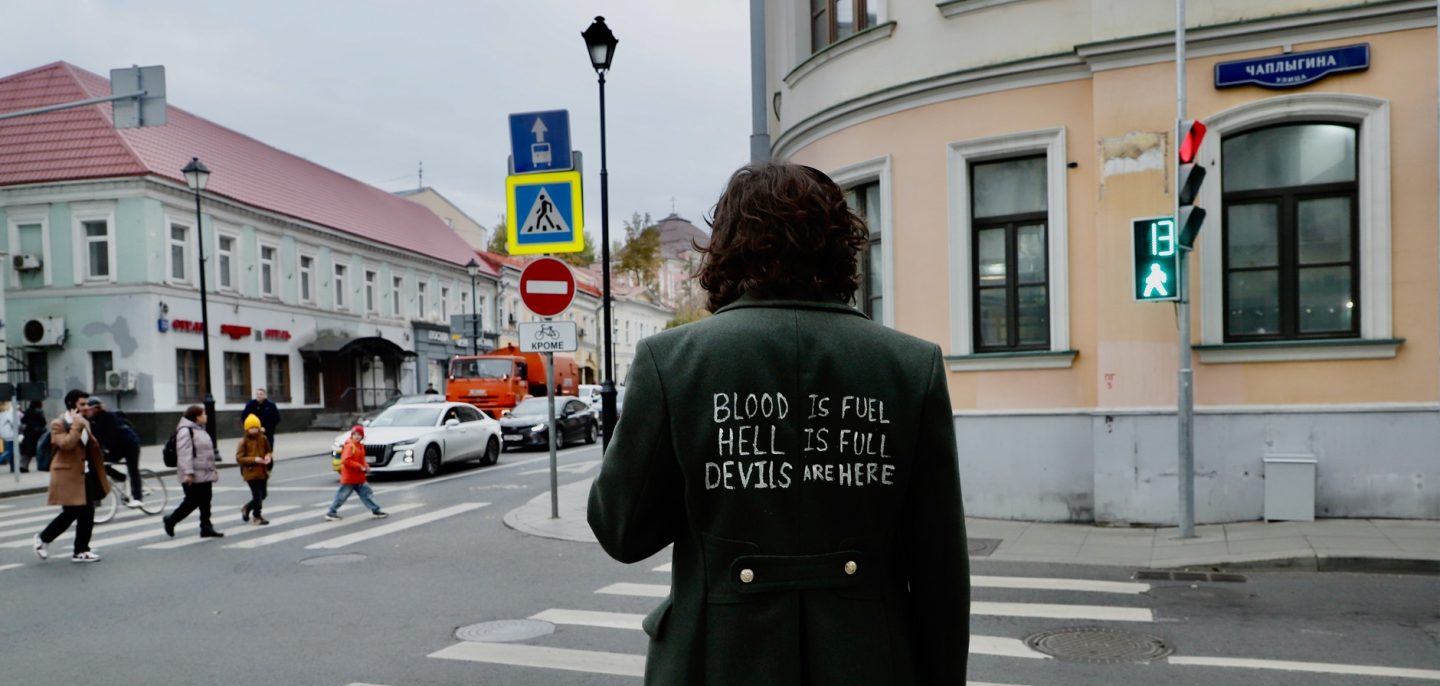
Photo by the Russian Reader

The Trump administration has quietly rescinded long-standing guidance that directed schools to accommodate students who are learning English, alarming advocates who fear that schools will stop offering assistance if the federal government quits enforcing the laws that require it.

The rescission, confirmed by the Education Department on Tuesday, is one of several moves by the administration to scale back support for approximately 5 million schoolchildren not fluent in English, many of them born in the United States. It is also among the first steps in a broader push by the Trump administration to remove multilingual services from federal agencies across the board, an effort the Justice Department has ramped up in recent weeks.

The moves are an acceleration of President Donald Trump’s March 1 order declaring English the country’s “official language,” and they come as the administration is broadly targeting immigrants through its deportation campaign and other policy changes. The Justice Department sent a memorandum to all federal agencies last month directing them to follow Trump’s executive order, including by rescinding guidance related to rules about English-language learners.

Since March, the Education Department has also laid off nearly all workers in its Office of English Language Acquisition and has asked Congress to terminate funding for the federal program that helps pay for educating English-language learners. Last week, education advocates noticed that the guidance document related to English learning had a new label indicating it was rescinded and remains online “for historical purposes only.”

On Tuesday, Education Department spokeswoman Madi Biedermann said that the guidance for teaching English learners, which was originally set forth in 2015, was rescinded because it “is not in line with Administration policy.” A Justice Department spokesman responded to questions by sending a link to the July memorandum and said he had no comment when asked whether the guidance would be replaced.

For decades, the federal government has held that failing to provide resources for people not proficient in English constitutes discrimination based on national original under Title VI of the Civil Rights Act.

In rescinding the guidance, the Trump administration is signaling that it may stop enforcing the law under that long-standing interpretation. The Education and Justice departments have been responsible for enforcing the law.

In the July memorandum, Attorney General Pam Bondi cited case law that says treating people, including students, who aren’t proficient in English differently does not on its face amount to discrimination based on national origin.

Other guidance related to language access for people using services across the federal government is also being suspended, according to the memo, and the Justice Department will create new guidance by mid-January to “help agencies prioritize English while explaining precisely when and how multilingual assistance remains necessary.” The aim of the effort, Bondi said in a statement published alongside the memo, is to “promote assimilation over division.”

The consequences for school districts were not immediately clear, but advocates worry that rescinding the 2015 guidance could open the door for weaker instruction for English learners and upend decades of direction from the federal government to provide English-language services to students who need them.

“The Department of Education and the Department of Justice are walking away from 55 years of legal understanding and enforcement. I don’t think we can understate how important that is,” said Michael Pillera, an attorney who worked at the Office for Civil Rights for 10 years and now directs the Educational Opportunities Project at the Lawyers Committee for Civil Rights.

Without pressure from the federal government to comply with the law, it is possible that some school districts will drop services, Pillera said, particularly as many districts struggle with financial pressures.

“It’s going to ripple quickly,” he predicted. “Schools were doing this because the Office for Civil Rights told them they had to.”

Many districts will probably not change their services, but rescinding the guidance opens the door, said Leslie Villegas, an education policy analyst at New America, a think tank. Advocates may watch for changes in districts that previously had compliance problems or those that had open cases with the Office for Civil Rights related to English-language instruction, she noted.

“The rescission of this guidance may create the mentality that no one’s watching,” Villegas said.

In recent months, the Justice Department notified at least three school districts — in Boston; Newark; and Worcester, Massachusetts — that the government was releasing them from government monitoring that had been in place to ensure they offered services to English-language learners.

Officials in Worcester said they expected the action even before Trump took office. But in Boston, some parent advocates questioned why the monitoring had ended, the Boston Globe reported.

Supporters of immigration restrictions argued that relieving pressure on schools to provide these services might be helpful, especially given the costs to districts.

“If you devote all these resources to these kids coming in [to school] completely unprepared, inevitably it will diminish the quality of education others are getting,” said Ira Mehlman, spokesman for the Federation for American Immigration Reform.

Todd DuBois, communications director for U.S. English, a group that advocates for English as the official and common language, said some education is needed to help “bridge the gap” for students who do not speak English, but the group is concerned that multilingualism “gets in the way of teaching English literacy earlier in life.”

The requirement to serve English-language learners in school is based on two federal statutes. The first is Title VI of the Civil Rights Act, which bars discrimination based on national origin, among other traits. Alandmark 1974 Supreme Court case, Lau v. Nichols, interpreted this law to include a mandate for English-language services in schools.

The second federal law at issue is the 1974 Equal Educational Opportunities Act, which requires public schools to provide for students who do not speak English. A 1981 case decided in federal appeals court, Castañeda v. Pickard, laid out a test to determine whether schools were properly providing services to English learners in school.

In 2015, the Justice and Education departments published their 40-page guidance document, explaining how schools can properly comply with these laws and avoid potential federal investigations and penalties.

“For a teacher, it was kind of like the Bible,” said Montserrat Garibay, who headed the Office of English Language Acquisition under the Biden administration. “If, in fact, we want our students to learn English, this needs to be in place.”

In her memorandum, Bondi said that in addition to cutting back on multilingual services the administration deems “nonessential,” federal agencies would be tasked with boosting English education and assimilation.

“Instead of providing this office with more capacity and more resources to do exactly what the executive order says — to make sure that everybody speaks English — they are doing the total opposite,” Garibay said.

Mark Krikorian, executive director of the Center for Immigration Studies, which supports immigration enforcement measures, suggested the federal government should not direct how school districts offer services. But he also said that teaching children English is consistent with efforts to make sure people living in the United States speak English.

“I’m all for English-language education. We probably need to do even more of that,” he said. “If you’re going to let people in who don’t speak English, then you want them to be acquiring English as soon as possible.”

Source: Laura Meckler and Justine McDaniel, “Education Department quietly removes rules for teaching English learners,” Washington Post, 20 August 2025