Tests on Protest Rallies and Compulsory Voting in Workplaces: What Is Happening in Petersburg’s Public Sector Institutions as the Election Nears
Vladislav Chirin and Sofia Volyanova
Bumaga
March 7, 2018
In early March, a test about the law on protest rallies was distributed to lecturers in Petersburg’s tertiary educational institutions. Pupils at Petersburg schools have been forced to take the same test, while employees of schools and hospitals report they have been forced to apply for absentee ballots and vote at different polling stations under threat of punishment.
Bumaga has been monitoring the goings-on in Petersburg’s public sector institutions in the run-up to the March 18 presidential ballot. In the following article, we discuss what violations have already surfaced.
Schoolchildren Required to Pass Test about Law on Protest Rallies
Pupils at a school in the Vyborg District told Bumaga that on March 6 all groups had been excused from classes in order to take a test on protest rallies. In particular, the pupils were quizzed on whether participants of public events had the right to bear arms and under what circumstances demonstrations could be held on Palace Square and Nevsky Prospect.
 “Tests like this have been handed out in Petersburg schools. This is only the second page of the test, featuring questions about the Field of Mars, invitations to protest rallies via the internet from persons unknown, etc.” Post courtesy of Telegram channel Somebody Else
According to senior pupils at the school, teachers removed them from their second period classes and made them stay during the break to familiarize them with the test. In the event, the teachers explained to the pupils what the right answers were.
When the pupils asked whether the test was connected with protest rallies organized by opposition politican Alexei Navalny, the teahers replied the test was being administered since a pupil at the school had been detained at one such rally and fined.
Central District School Headmaster and Vocational School Employee Talk about Compulsory Test
Svetlana Lebedeva, headmaster of Gymnasium No. 168 in Petersburg, also talked about the test. According to her, the prosecutor’s office had sent them the test, demanding it be administered to upperclassmen.
“It was by order of the district prosecutor’s office. The order was sent to Nelly Simakova, head of the Central District education department. They sent it to us. All the schools did it. The test was on Saturday, and today the pupils who were absent on Saturday took the test,” Ms. Lebedeva told MR7.ru.
On March 6, the same test was administered to students at all the city’s vocational schools, an employee at one of them told Bumaga.
MR7.ru also published a screenshot of the letter sent to educational institutions. The letter makes it clear the testing had been administered at the behest of the city’s education committee after an urgent request from the Petersburg prosecutor’s office.
A pupil at Lyceum No. 126 has also told Bumaga that, during an event for war veterans on March 6, one of the guests took to the stage and urged attendees to vote for Vladimir Putin.
The prosecutor’s office and the education committee did not return our telephone calls.
Council of Rectors Sent Test on Protest Rallies to Lecturers at Tertiary Educational Institutions
Lecturers at Petersburg’s tertiary educational institutions allegedly received the same test about the law on protest rallies, only electronically.
Echo of Moscow reporter and Higher School of Economics graduate student Valery Nechay published a letter allegedly sent to Petersburg’s tertiary educational institutions. The letter asks university employees to take the test online “at the request of the Council of Rectors.”
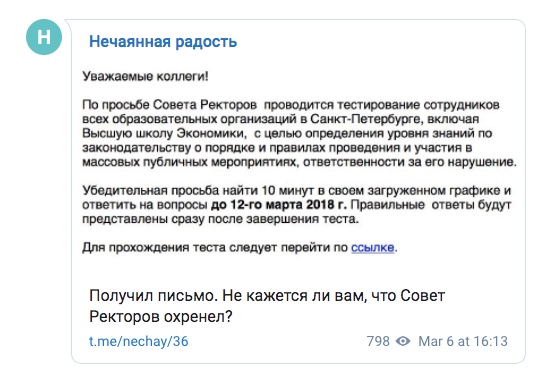 “Dear colleagues! At the request of the Council of Rectors, staff at all educational organizations in St. Petersburg, including the Higher School of Economics, are being tested in order to determine the level of their knowledge of the laws on rules for holding and attending large-scale public events and the penalties for violating them. We strongly encourage to take ten minutes from your busy schedules and answer the questions before March 12, 2018. The correct answers will be provided immediately after you complete the test. To take the test, follow this link.” Post courtesy of Telegram channel Unexpected Joy.
The test, a link to which Nechay has published, features questions about the rights of people attending protest rallies and punishment for extremism. Some of the questions describe particular circumstances, for example, “You have been invited on the internet to attend a protest rally on the Field of Mars. The rally in question has not been authorized by the relevant executive authorities for the exact time or day listed. You are curious, however, and so you go to the rally. Have you violated the law?”
Students at Petersburg University Say They Have Been Forced to Monitor Elections
First-year students at the Petersburg campus of the All-Russian State University of Justice have been assigned “compulsory on-the-job training” on March 18: they must attend the presidental election as grassroots monitors. They told the organization Petersburg Observers about their plight.
The correspondence published by Petersburg Observers makes it clear that if the students fail to report for duty they have been threatened with administrative punishments and bad marks in their permanent record. But if they show up for duty, they allegedly will have a day off on Monday, March 19, and be sent official thank-you letters.
 “Where do the fake election observers come from? On March 4, 2012 [the date of the previous presidential election] grassroots oversight was usually portrayed by pensioners and state employees. Over the past six years, however, the fake election observers movement has mastered the streams of financing, gone large scale, and become much younger. For example, first-year students at the Petersburg campus of the All-Russian University of Justice received this message from their class leader: ‘March 18 is a school day, compulsory on-the-job training, meaning that everyone will be a grassroots election observer at the polls. Sponsored by the Association of Lawyers, our university is officially taking part in the Observers Corps for Clean Elections event, so if you do not show up you face administrative penalties and a bad mark in your permanent record.’ In addition to free food and transportation on voting day, letters of gratitude and a day off from classes on March 19 have been promised to the students. Basically, this is how correct public opinion is forged: in return for a day off, free grub, and a certificate of [political] trustworthiness.” Screenshot of a post on the VK community page of Petersburg Observers for Fair Elections
A student at the Petersburg campus of the Russian Presidential Academy of National Economy and Public Administration (RANEPA) has told Bumaga that out-of-town students at the academy are going to be forced to vote in the presidential election. However, he was unaware of whether the students would be encouraged for turning out or punished for failing to vote.
 “Very Important Information! In the next 30 minutes ALL out-of-two students need to shoot back the following information: what resources you will use to vote in the March 18 Russian presidential election; where you will vote (at what polling station); how you will register to vote. Send it to https://vk.com/%5Bdeleted]. […] Basically, we have been asked by [illegible] to register as many people living in each section as possible to vote. Meaning that each manager is responsible for his section and, subsequently, for sending everyone off to vote. The section in which the most people vote will get the Prize Sector [a reference to the “prize” section on the spinning wheel in the Russian version of Wheel of Fortune]. Ideally, you could assemble your entire section and all go together to the district voting commission. This is a mandatory request that concerns everyone. I think it is in our interest to give our vote . . .” Screenshoots of correspondence among RANEPA students. Courtesy of Bumaga
Schoolteachers and State Employees in Petersburg Say They Are Being Forced to Apply for Absentee Ballots and Vote Somewhere Other than Their Own Polling Stations
A teacher at a school in the Central District has told Bumaga that the school’s headmaster has obliged the entire teaching staff to report to the polling station in School No. 183 [an English-language magnet school on Kirochnaya Street in downtown Petersburg] on voting day. According to her, the teachers in all Central District schools have been given the same orders.
According to the teacher, if staff fail to vote as instructed, they will be given extra work during the spring holidays, from March 26 to April 1. When the voting is over, the headmasters of the Central District’s schools will receive lists of teachers who reported to the polling station in School No. 183, the teacher said. Her headmaster added, however, the orders were “not his whim,” but that all school headmeasters had received the same orders from the “top brass.”
Instances in which the heads of state-sector institutions have tried to force staff and students to apply for absentee ballots and vote at other polling stations have been reported by Petersburgers claiming to be employed at the Center for the Social Rehabilitation of Disabled People and Disabled Children in the Krasnoye Selo District, the Center for Social Assistance to Families and Children in the Central District, the Alexander Hospital, Children’s Health Clinic No. 68, Children’s Health Clinic No. 71, the Leningrad Regional School for Culture and Art, School No. 684 [a kindergarten and grammar school in the Kirov District in the city’s south], and the Municipal Monitoring Center.
Violations Reported by Members of Several Petersburg Election Commissions
Member of Precinct Election Commission No. 1164, located in City Hospital No. 15, have reported that Irina Nikolich, the polling station’s deputy chair, had drawn up absentee ballot declarations, based on photocopies of four voters’ internal passports, although the voters themselves were not present at the polling station, and Nikolich came to the polling station when it was not her shift.
The polling station was visited by police officers, who interviewed witnesses and submitted the evidence to the Investigative Committee.
Members of Territorial Election Commissions No. 1 and No. 14 have reported to Bumaga that in their electoral districts, precinct commissions had in several instances approved four ballot boxes for at-home voting, although only three ballot boxes are legally required. The extra ballot boxes could lead to vote rigging and ballot box stuffing.
UPDATE
On the evening of March 7, Territorial Election Commission No. 1 reduced the number of mobile ballot boxes in its district to three.
Students at St. Petersburg State University of Film and Television Complain They Have Been Forced to Vote (Updated March 10, 2018)
A student at the University of Film and Television told Bumaga he and his classmates in the Screen Arts Department had received a message from the student leader of second-year students.
The message made it clear that the master of the filmmaking course had informed the student leader that students who did not vote would be threatened with explusion, said the source. The dean’s office had allegedly issued the orders, and all students were required to register to vote at the same polling station.
Another student at the university told Bumaga she and her classmates had received messages containing a list of five polling stations at which they had to register to vote. Information about whether a student had registered to vote or not would allegedly be reported to their department. The students were promised they would be given postcards at the polling stations that could be used to get into a private screening of the film Dovlatov, the young woman told us.
Translated by the Russian Reader