Leningrad 4

If you have been to Chronicles Bar [in downtown St. Petersburg], you have definitely seen the photos discussed in this film. In today’s session of “Screening the Real,” we are watching Leningrad 4, a documentary about Sergei Podgorkov and other champions of Leningrad’s unofficial photography scene during perestroika. Yuri Mikhailin spoke to the filmmaker, Dmitry Fetisov, about dramatic structure, time as a form and rhythm, and Soviet-era beer stalls.

“Leningrad 4,” Dmitry Fetisov, 2023 (in Russian with no subtitles)

My path to documentary filmmaking was a tortuous one. At school, I was interested in writing texts, and at the age of seventeen I decided to apply to the St. Petersburg State University of Film and Television (KiT) to study drama, but at the interview I was advised to go into documentary directing. At the time, Victor Kossakovsky was accepting students, but I didn’t go to study with him, I went to Tver (I’m from the Tver Region) and studied three years at the College of Culture, specializing in directing and theatrical acting. Then I went to study in Konstantin Lopushansky’s feature filmmaking program at KiT. I studied for a year, but them I decided to try my hand at documentary filmmaking again, although I didn’t really understand what it was.

I transferred to Vladislav Borisovich Vinogradov’s course, and I more or less made a go of it there. I guess I had found my master. It was the first time I saw examples of poetic documentary films with characters and dramatic structures that intrigued me. I also really liked Vladislav Borisovich’s work (I Return Your Portrait, A New Year at the End of the Century). I think that I have inherited to some extent his format, in which the films are based on interviews with the characters, and the themes have something to do with Leningrad culture.
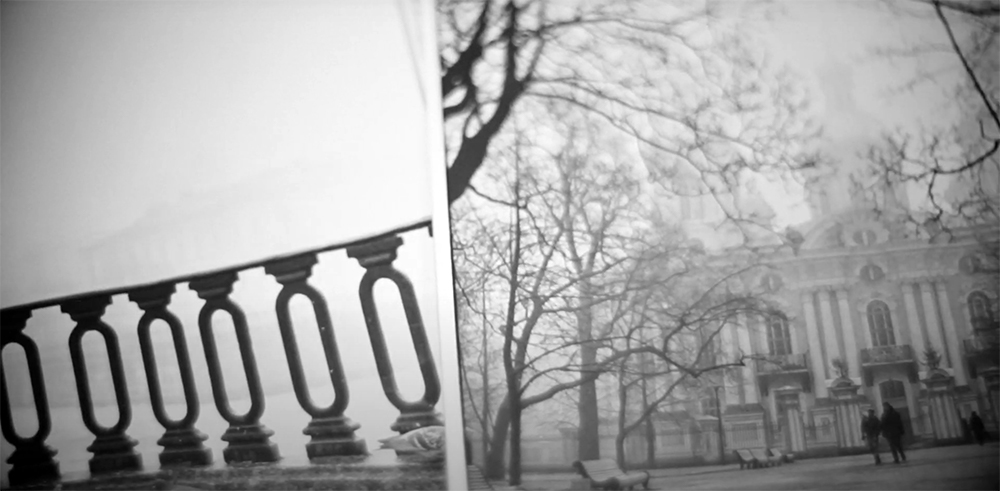
Still from “Leningrad 4,” Dmitry Fetisov, 2023

My interest in photography stemmed from moving to St. Petersburg. I liked the texture of its central districts, the most banal things—palaces and , the difference between the Petrograd Side and Vasilievsky Island. And I was very interested in the movies made at Lenfilm Studios—Ilya Averbakh, the so-called Leningrad school, the perestroika-era pictures. This texture intrigued me. I came across the photographs of Boris Smelov, Leonid Bogdanov, and Boris Kudryakov. I became a big fan of theirs, and started looking for lesser-known photographers.

You could say that Leningrad 4 was born in 2011, when I went to a photo exhibition at the legendary Borey Gallery on Liteiny for the first time and saw Sergei Podgorkov’s work. I thought that I should make a movie about this man. I was very impressed by Ludmila Tabolina’s show at the Akhmatova Museum, as well as the exhibition on the Zerkalo photo club, from which many photographers had emerged.
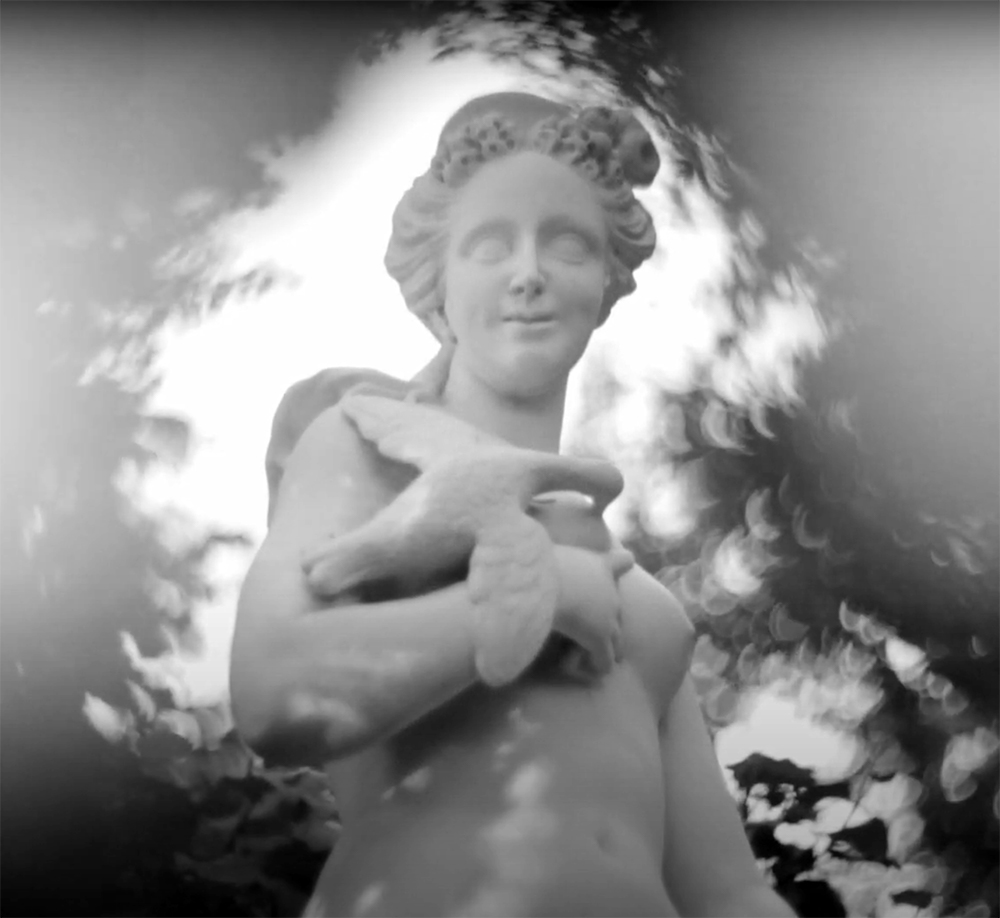
Still from “Leningrad 4,” Dmitry Fetisov, 2023

In 2021, I decided to make a short film about Sergei Podgorkov. At the time, I had no idea that it would turn out to be a forty-minute movie. I wrote to Sergei on VKontakte, and he invited me to his place in Borovichi. If I were making the film now, I would probably add a video chronicle of the trip. Podgorkov showed us around the town, including the old railway station, and after filming we drank some good Novgorod moonshine with him to celebrate our acquaintance.

Many of the shots were made with Soviet gear—a Helios 40 telephoto lens. I bought it in a thrift store, and I successfully fitted this 1965-made lens to a Sony mirrorless camera. The Helios 40 handsomely blurs the edges and thus emphasizes the subject in the frame. It is my favorite lens.

After filming Podgorkov, I realized that the topic could be pursued further. I had always been interested in the Leningrad Rock Club, and so I decided to film Andrei “Willie” Usov, who was the staff photographer for the band Aquarium and did all the covers of their records, and was friends with Mike Naumenko.
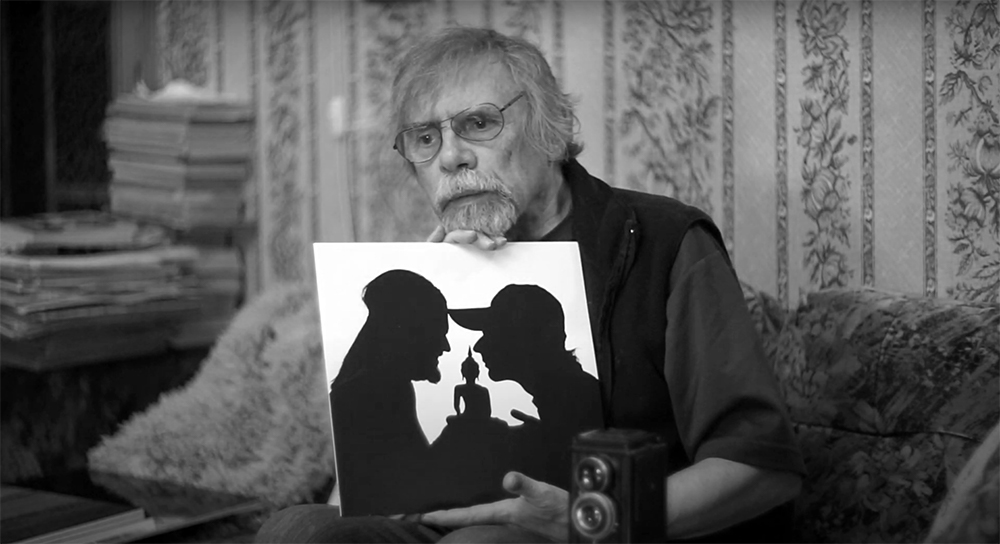
Andrei “Willie” Usov, holding his iconic image
of Boris Grebenshchikov and Mike Naumenko. Still from “Leningrad 4,” Dmitry Fetisov, 2023

The third character was the pictorialist Ludmila Tabolina. I appreciate this movement in photography. The next character was Alexander Kitaev. I liked the Kitaev’s powerful countenance, that of a bohemian. Petersburg photographer, and I decided that I would film him even before I got acquainted with his images myself.

Another character is Valery Valran. He is not a photographer, but a well-known artist in Petersburg, a popularizer of photography, a curator of photo exhibitions, and the first to turn [photos by Leningrad’s underground photographers] into a photo album: the book Leningrad Photo Underground appears at the beginning of the film. I decided to include it in the film to tell about this photography movement a little from the outside.

And finally, there was Sergei Korolyov. I filmed him, but during editing I realized that, unfortunately, a short subject about him did not fit into the film. I edited it separately and posted it on my “Blog Stall” which I dreamed up when blogging was the cool thing and where I publish stories related to cinema. This episode is called “The Photographer Korolyov”.

“The Photographer Koroylov,” Blog Stall, episode 26

How did I realize that these characters were enough? When I filmed them, I had an idea for the next film I might make: about photographers who are no longer alive, like Bogdanov and Kudryakov. And I decided that the filming was over.

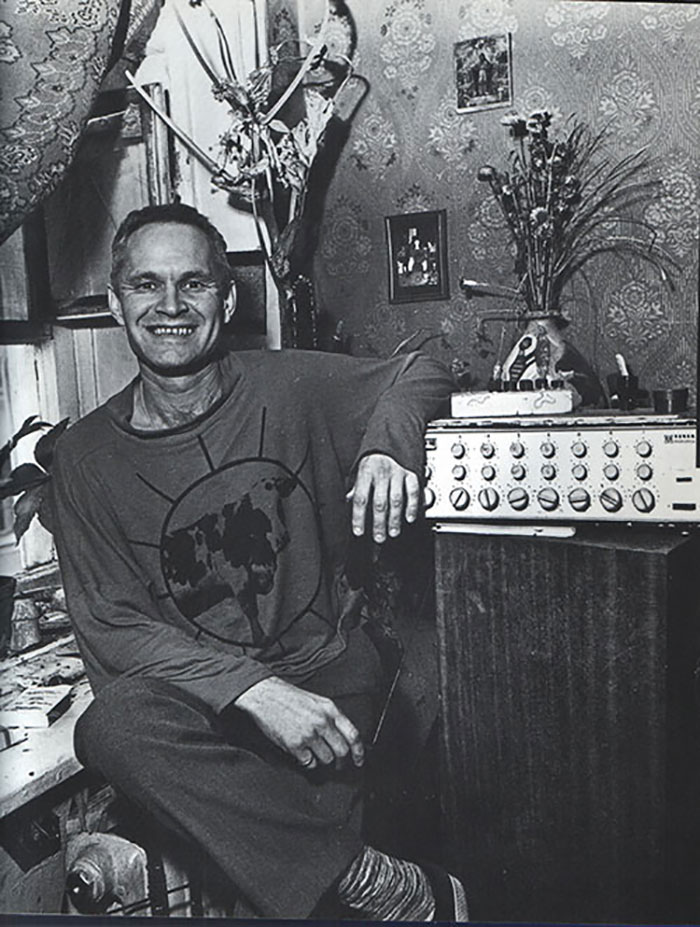
The film took a long time to edit, almost a year. I realized that each photographer has a certain leitmotif. Sergei Podgorkov has a story connected with beer stalls (although he does not emphasize it himself), Andrei Usov has rock, Ludmila Tabolina has the white nights, and Kitaev has [Petersburg’s] Kolomna neighborhood.
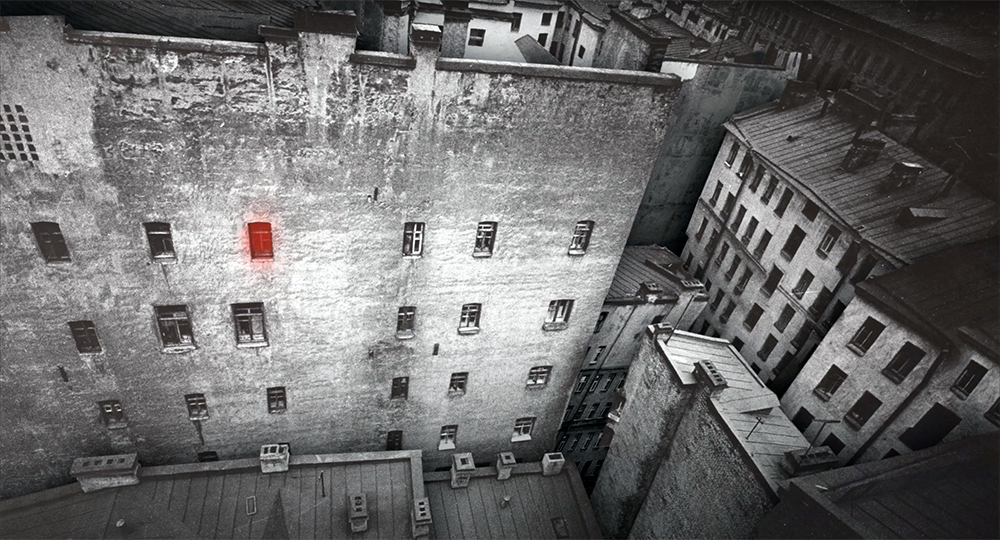
Still from “Leningrad 4,” Dmitry Fetisov, 2023

To separate the interviews and photos, I decided to use a film footage frame. Some of my colleagues think that this is visual bad form, but for me it seems logical: conversations with photographers are the present day, while their photos are the past, and the footage works as a transition between them.

Sometimes I wanted to connect the times. The chapter “Conversations at Beer Stalls” features music by contemporary jazz-noir artist Bebopovsky and the Orkestry Podyezdov. I had enjoyed him for a long time. I met the artist, and the opportunity to use his music in the film presented itself.

While I was editing, I did a photo shoot on black and white film for an acquaintance. I was supposed to make shots like in the scene in Godard’s movie Le petit soldat in which the main character takes a picture of a young woman. For this photo shoot, my friend bought a Leningrad 4 light meter on Avito. I realized that I would call the film that, because the main character is late Soviet Leningrad, and there are four photographers in it. Then I decided that I would divide the movie into four parts. Besides, perhaps these photographers possibly also used the Leningrad 4, as it was one of the most popular exposure meters of its time.

It was later that Sonia Minovskaya, my co-director and assistant on the movie, noticed that in some mythologies the nuumber four is the number of decay, death, and demised. And indeed, in each chapter something fades away or dies. In the first one, the Leningrad white nights are buried, while in the second, Mike Naumenko and a whole erа exits the stage. Then we see the end of the Summer Garden in its historical guise, and in the final chapter, where the rallies in the squares are shown, we see a country disintegrating. I didn’t think about this symbolism when I was making the film. I did it intuitively.
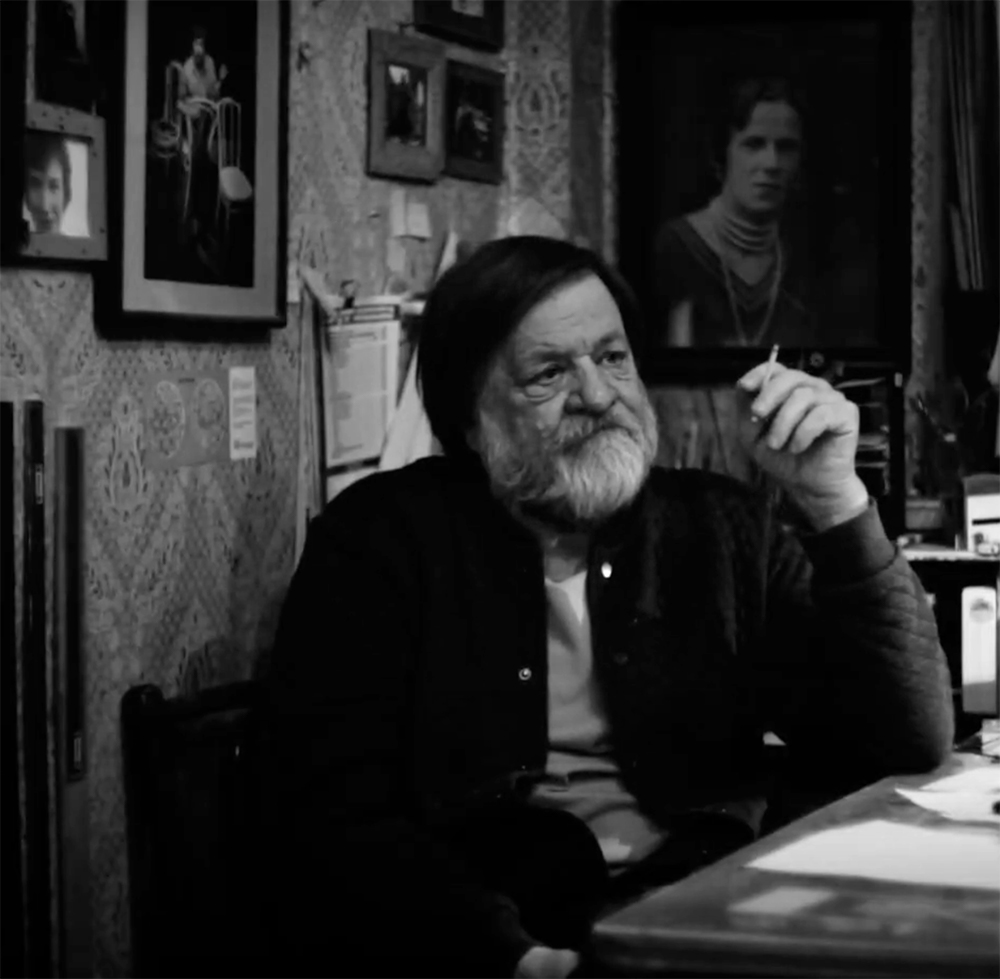
Photographer Alexander Kitaev. Still from “Leningrad 4,” Dmitry Fetisov, 2023

I understand that the editing is finished when a special, unique time emerges in a film. Time is a rhythmic form to me. A movie is ready to go when it suits me rhythmically. My films are calm, lyrical, and meditative. I probably like the documentaries of Wim Wenders for a reason.

Leningrad 4 was screened at the Arctic Open Festival in Arkhangelsk, where it got a super-warm reception; at the Salt of the Earth Festival in Samara; and in the online program at Artdocfest.

At one of the premiere screenings at the Rosphoto Museum, Sergei Podgorkov, with his usual irony, criticized the film for being too sentimental about an era that, in his opinion, is not worth the nostalgia. I did not put nostalgia in the movie, especially nostalgia for the Soviet Union, which I do not have. Andrei Usov noted that the films uses images from a time when the city was more interesting texturally for photographers. Nowadays, Petersburg is quite touristy, shiny and bright. He also admitted that the film left him with a heavy feeling. He and Naumenko had a great, strong friendship, and he still takes his departure quite personally.
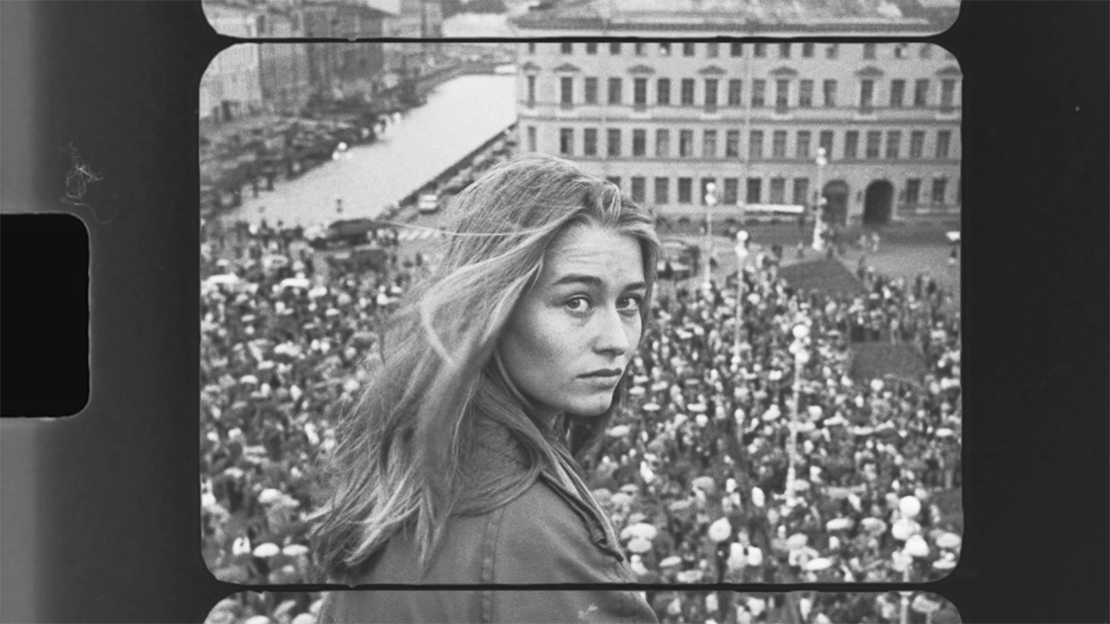
Still from “Leningrad 4,” Dmitry Fetisov, 2023. Photo by Sergei Podgorkov

Another character in the movie, Svetlana, attended the screening at the bar WÖD. In the final scene, we see a photo of her standing on the roof of a building opposite the Mariinsky Palace during the attempted coup in August 1991 and looking into the lens—as if that era were upon us today. This is a famous photo by Sergei Podgorkov. Recently, Sergei found Svetlana through the internet and invited her to the screening. And now, thirty-three years later, she saw herself on the screen and recounted how the picture was taken. Podgorkov had run out of film, but Svetlana was also an amateur photographer, so she lent him her own camera, and he photographed her.

Recently, I went to Chronicles Bar on Nekrasov Street and saw Podgorkov’s photos there. It was amazing. It is a young people’s bar, and yet the walls are adorned with photos of Soviet-era beer stalls, so it is as if two eras were connected through Podgorkov’s photographs.

Source: Yuri Mikhailin, “Screening the Real: Dmitry Fetisov’s ‘Leningrad 4,'” Seans, 25 May 2024. Translated by the Russian Reader
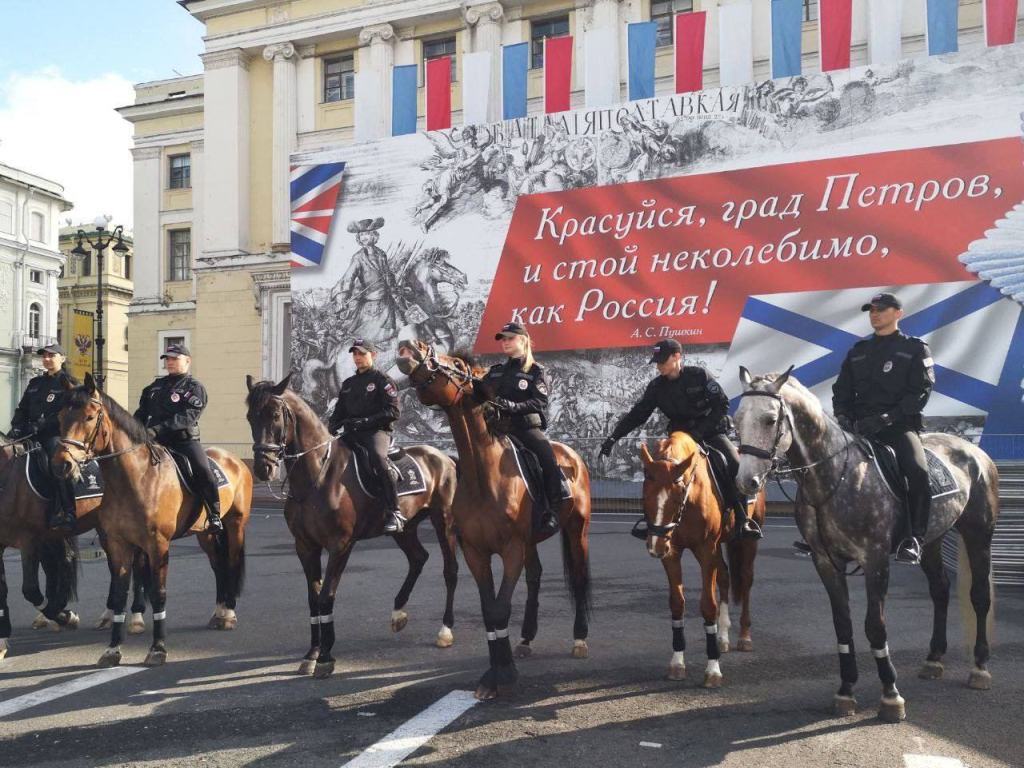
Mounted

Photo by Marina Varchenko. The banner behind Petersburg’s newly minted mounted police features an illustration of and a reference to the Battle of Poltava (1709) and a quotation from Alexander Pushkin’s poem The Bronze Horseman (1837): “Now, city of Peter, stand thou fast, / Foursquare, like Russia; vaunt thy splendor!”

🐎 Mounted police have returned to the streets of St. Petersburg.
Source: Marina Varchenko (Facebook), 10 June 2023. Translated by the Russian Reader


Riders!
The cavalry charges on knotted legs, bucking their backs!
Confucius-handed and Buddha-headed
People with arms and torso
Move across the tundra
Other same-sex creatures walk around and whistle…
A light downpour pours and pours
Pitter-patter
And
Pitter-patter
And 
Pitter-patter
And
Pitter-patter
And 
Pitter-patter
Softly, softly, as if it isn’t water, but happiness
Under the bright sun
Of historical materialism…
Everyone is free to go.

* * *

Riders Horsemen Scouts!
The delegation from the nearby islands,
So near so near, by the edge of the red peacock,
Oohed and aahed nearby and then fell silent… Basically, we're doing great!
Buzz off, I’m a married woman, as they say.
The delegation from the islands considered the problem of
“The oppression of ethnic minorities.” It was a fruitful meeting.
Henceforth many streets will be called “avenues,”
But “rain” and “cream-colored” will remain.
It will seem odd to you, but songs shall also be sung,
And internal resources employed…
The delegation did not approve what is called “freedom.”
They started saying it was “anarchy.”
Well, of course we went for our knives… the carnage lasted for a long while!
It’s inhumane to finish off the wounded, they…
All belong to the people.
Vadim Ovchinnikov in his studio at Pushkinskaya 10 in Petersburg, early 1990s
Photo by Boris Smelov. Courtesy of ov-ov.com

Born in Pavlodar (Kazakh SSR), Vadim Ovchinnikov (1951–1996) was a Leningrad/Petersburg-based artist who worked in a number of media, including painting, watercolor, collage, animation, mail art, conceptual literature, and music. His works can be found in the collections of the Russian Museum (Petersburg), the Moscow Museum of Modern Art, the Art Museum of Pavlodar, and Kai Forsblom Gallery (Helsinki). For more information on Ovchinnikov’s art and life, see the website ov-ov.com. The two poems by Mr. Ovchinnikov, above, were originally translated by Thomas Campbell for the exhibition catalogue The New Artists (Yekaterina Andreyeva and Nelly Podgorskaya, editors; Moscow Museum of Modern Art, 2012). These translations have been revised for publication here.

Mike Naumenko, “Summer (A Song for Tsoi)”


Mike Naumenko, “Summer (A Song for Tsoi)” (1982)

Summer!
I’m sizzled like a burger.
I got time, but no money,
But I don’t care.

Summer!
I bought myself a paper.
I got a paper, but no beer.
And I’m going to look for one.

Summer!
There’s a jam session today at the Lensovet.
There will be this, and there will be that.
Should I go there?

Summer!
All the rowdies wear brass knuckles,
They must have a vendetta.
However, this is rubbish. Yes, yes, yes!

Summer!
There is no escape from mosquitoes,
And in the stores there is no DEET.
We hold donors in high esteem.

Summer!
It will be the death of me.
Quick, my carriage, my carriage!
However, kvass will also do.

Summer!
My pants are worn shiny like a coin.
A cigarette is smoking in my mouth.
I’m going for a swim in the pond.

Summer!
Recently I heard somewhere
That a comet was coming
And that then we would all die, all die.

Source of original lyrics in Russian. “Summer” was released on the album Mike: LV (1982),  which you can enjoy in its entirety for free on Spotify. The video, above, features photographs by the great Petersburg underground photographer Boris Smelov. Photo and translation by the Russian Reader

fullsizeoutput_17a4

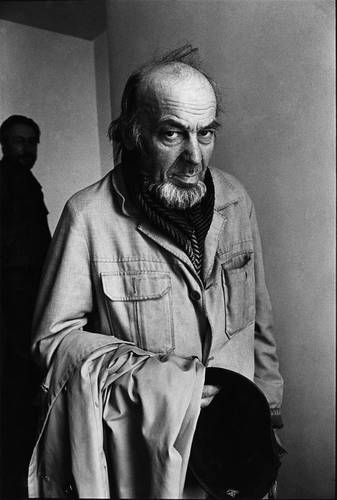
Sholom Shvarts

Boris Smelov, Portrait of Sholom Shvarts, 1995

“Shalya”: Artist Valentin Gromov Remembers His Friend Sholom Shvarts

I don’t remember what year we met. I have no particular first impression. We were ordinary students. We were in the second class, and he was in the second class, too, only in a parallel class. That class came to our class, and we would go to their class to look at their work. Shalya did not especially stand out from the rest. He did everything the way his teachers told him to do it. One time, Arekh (Alexander Arefiev) asked us to come look at how they were drawing nudes in the other class. He pointed out Shvarts’s work. He said, “Look at his sense of line!” Later, Arekh told me he had been to Shalya’s house and seen his other drawings and paintings, and that it was day and night compared to what he was doing at school. He suggested going to visit him. Shalya and his parents lived then not far from the Finland Station, in the slums, on some side street. Shalya, his father, and his mother were sitting in the corner. Shalya tossed pieces of paper all over the place. I saw that tons of the drawings had been done on drafting paper. I asked him whether he didn’t have normal paper, and he replied that his father worked somewhere and had all these leftover finished blueprints for frame-and-panel houses that had been built and he did not need, so he brought them home, and they were great for drawing on. And we saw these stunning sketches on these blueprints. It was then we became pals.

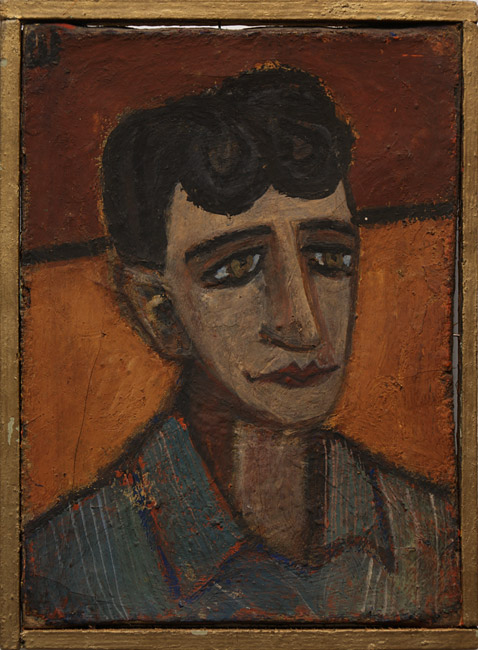
Sholom Shvarts, Portrait of Roald Mandelstam, 1958. Tempera on canvas, 33 x 24 cm. Collection of Valentin Gromov

All of us got the boot [from school], so Shalya was the only one in our band of friends who graduated from the Arts High School at the Academy of Arts. When we were expelled, we spent a long time hanging out. We couldn’t find a place for ourselves anywhere; we were in state of complete uncertainty. Shalya’s family had moved at that time to Ligovka [Ligovsky Prospect], where the three of them lived in a single room. He was still in school, and we were independent artists, but we saw a lot of each other at that time.

In terms of character, he was calm, reserved, and quite private. When we were still in school together and would go out on the landing to smoke, I noticed that Shalya was a little bit afraid of Arekh. Arekh’s say-so meant a lot. He argued in a quite strange way, but quite professionally. So Shalya was filled with respect and loyalty towards him.

We once got talking about indoor scenes. Shalya was quite taken with this topic and said a lot about how he saw it. Arekh suggested that Shalya paint an indoor scene for him. He said the topic should really be up his alley. Shalya accepted the challenge, and they agreed he would complete it in a week. We met again, and Arekh asked whether Shalya had finished the painting. He said he still had not finished it and asked for another week. Arekh saw him a week later, and Shalya again made excuses for why the painting was not done. Arekh then told him, “If you don’t have it painted within a week, I’ll smack you in the kisser!” When Shalya finally painted this indoor scene, Arekh’s jaw dropped. From then on he stopped treating him like a master treats a disciple and spoke with him as an equal.

Shalya was not a talkative person, but once in a great while he could get carried away with some topic and then you could not stop him. He turned a deaf ear on topics that did not interest him.

Shalya never drew people from life. He simply memorized the images and drew his “memories” of these people. He had no contact with women. We all had girlfriends and got married off, but Shalya was the only one of us who was virtually a monk. So his depictions of women were inspired by memories of passersby and acquaintances, by youthful fantasies.

shvarts-v lodke
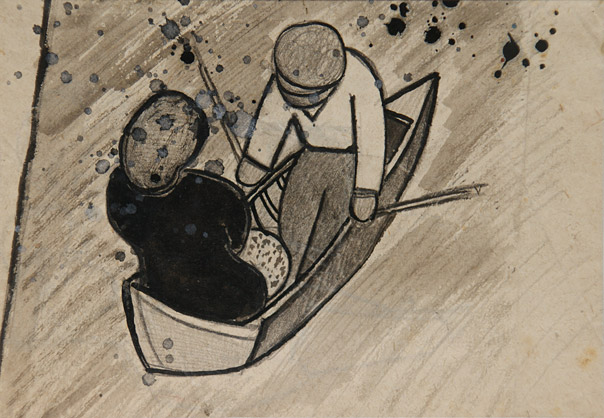
Sholom Shvarts, In a Boat, 1950s. Ink and pencil on paper, 15.5 x 21 cm. Collection of Oleg Frontinsky

Nowadays, the post-war avant-garde is highly prized, so it is no wonder that so many forgeries surface, including forgeries of our work. The forgers try to fake Arekh’s work and sometimes they succeed in producing something that bears a fair resemblance. Shalya’s work is absolutely impossible to forge, given his technique and the way he worked with his media.

I have four works by Shalya, and all of them are masterpieces. I donated one of them (At Home, 1954) to the Tsarskoye Selo Collection. It was hard to part with it, but it seemed less individual than the rest, a little bit like scenery.

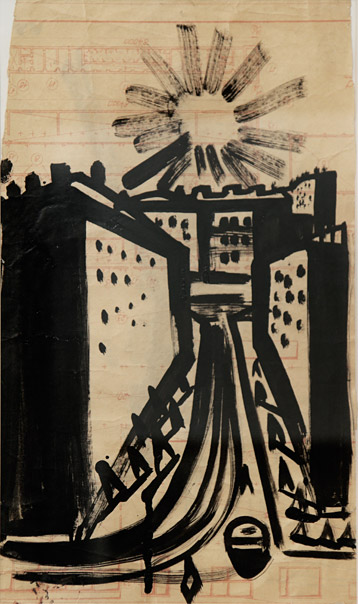
Sholom Shvarts, Canal, 1960s. Ink on paper, 31.5 x 19.5 cm. Collection of Dmitry Shagin

When Shalya’s mom died, he and his father stopped living together. Shalya moved to Ordinarnaya Street, where he lived until the end of his life. He lived in a five by four meter room with a single window. He almost never left that room. I can never remember seeing him, say, in the kitchen. There was a pile of pots, jars, tin cans, dirty plates, and cigarette butts everywhere. It was a hell of a mess. There was nowhere to sit down.

Shalya was a big fan of the cinema. There was not a new movie he had not seen. He constantly watched television at home. Once, Rikhard [Vasmi] and I went to see Shalya. He said he wanted to watch a film. His TV set was quite old. To turn it on you had to twist this screw and then, finally, the screen would light up. But that was it: you could not distract him with conversation of any kind after that.

Shalya lived on the third floor on Ordinarnaya. His window overlooked a street with a movie theater nearby. He was always watching passersby from the window, memorizing them, immediately pouring out his impressions on paper, and then tossing these fantastic drawings under the table, where they would intermingle with half-eaten bowls of porridge. He produced his masterpieces amidst this muddle, amidst dirty duds, leftover food, and cigarette butts. Any of these pieces would be the pride of the most prestigious museum. It was his drawing Feast that wound up on the frontispiece of the album The Arefiev Circle (Saint Petersburg: Avangard na Neve, 2002). It is absolutely stunning.

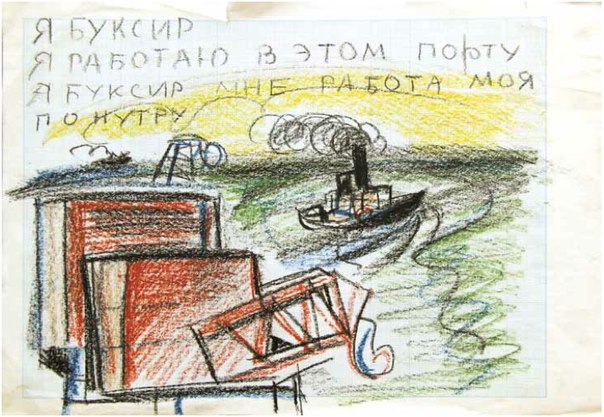
shvarts-ballad of little tug boat
Sholom Shvarts, Sketch for an illustrated edition of Joseph Brodsky’s poem “Ballad of the Little Tugboat,” 1989-1990. Colored pencil on paper. Collection of Dmitry Shagin

Shalya was the only fellow in our circle who adored Lenin. We all were anti-Soviets, but he felt Lenin had done many good things. Ordinarily, this way of thinking would have been off-putting, but art always mattered the most to Shalya, and so we figured that if he liked Lenin, then so be it.

If you talk about drawings, then of course Shalya would have to be ranked in first place among us.

Excerpted from Sholom Shvarts: Paintings and Drawings (exhibition catalogue), ed. Irina Kogan, Saint Petersburg: K Gallery, 2015. Excerpt translated by the Russian ReaderK Gallery’s posthumous retrospective of work by Sholom Shvarts (1929–1995) runs from October 8 to October 31, 2015, at Fontanka River Embankment, 24, in Petersburg. Images courtesy of paldenlenka.livejournal.com, parizhskoye kafe, and K Gallery’s VKontakte page.