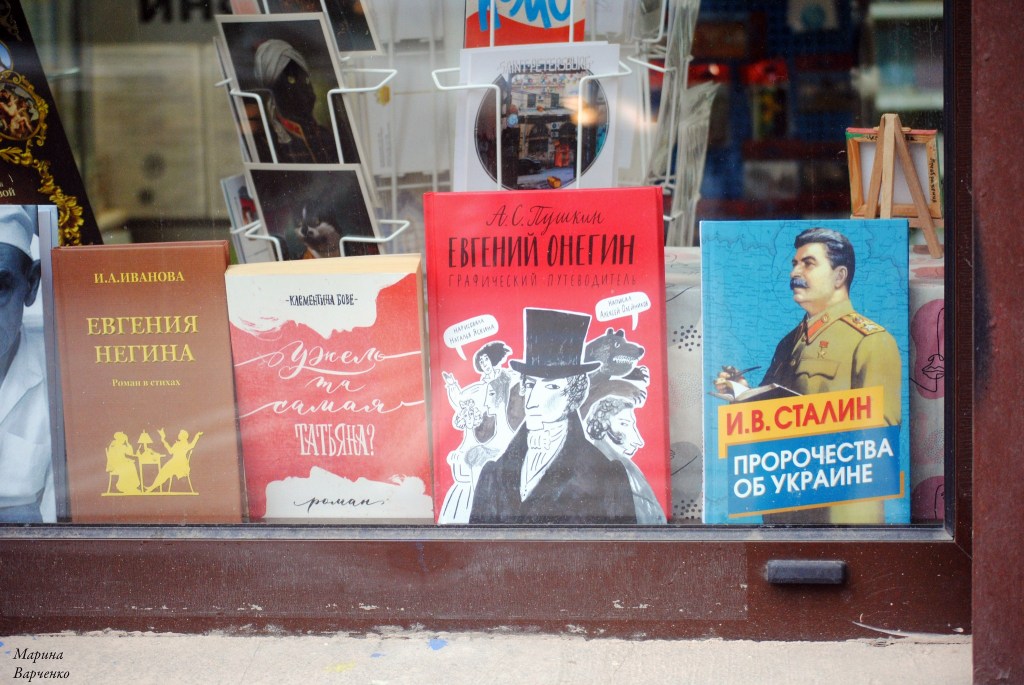
The books on display, from left to right, are: I.A. Ivanova, “Yevgenia Negina: A Novel in Verse”; Klementina Bove, “Is That Really the Same Tatiana? (A Novel)”; A.S. Pushkin, “Yevgeny Onegin: A Graphic Guide”; I.V. Stalin, “Prophecies about Ukraine”
A textbook and resource guide store for school teachers, Lomonosov Street, Petersburg, today.
Source: Marina Varchenko, Facebook, 21 October 2022. Remarking on this post, “Marina Marina” wrote: “I got into a fight with a history teacher from Russia in the comments [to another social media post]. She doesn’t see any historical parallels at all. And she says that it was the Americans who made up the history of Ukraine. And that what she teaches there at home is the only truth in the world.” Translated by the Russian Reader
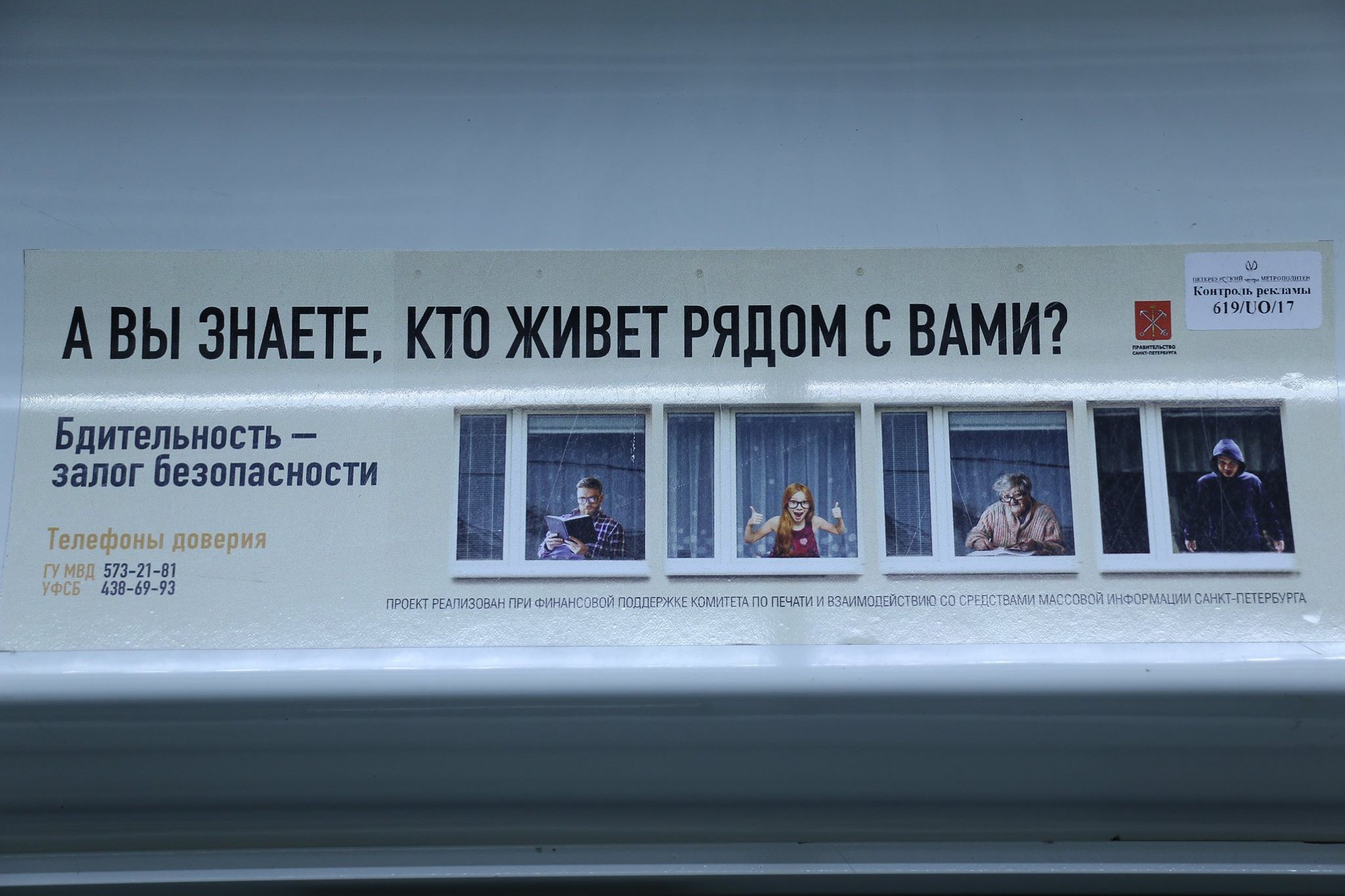
“Do you know who lives next door? Vigilance is the key to security.”
I admit that I sometimes try and get people talking to understand what’s going on in their heads. Today, however, I had no such plan. I only permitted myself to go outside for ten minutes to drink a cup of coffee and to look at the sun as seen from somewhere other than the window of my office. I went to my favorite coffee shop, a two-seater, without any ulterior motives. And without wanting to hobnob with anyone. I sometimes have a nice chat with the barista, because it was simply impossible to have an unpleasant chat with him before [the war]: he has no interest in politics whatsoever. He’s an exemplary sweet summer child, a vegan, the antipode of universal evil. But then he tried to get me talking, on the contrary, taking me by surprise. He suddenly started discussing Ukraine. For some reason I assumed that the hellishness going on there would disgust him, but far from it! When I said that civilians were being killed there, he was genuinely surprised. “Who’s killing them? What civilians?” In a nutshell, he has a girlfriend in Kharkiv. She stays at home, doesn’t go out, and hears gunshots, but she hasn’t mentioned anything to him about casualties. “There, in Kharkiv, you know, everything is fine, you just shouldn’t go outside.” Then he started complaining to me that, in Ukraine, they name streets in honor of [Stepan] Bandera. Tall and blond, the guy looks to be about twenty-five. Bandera is the bane of his existence, but otherwise everything is cool. Something tells me he’ll never want to learn the truth.
This feuilleton was posted friends-only on social media earlier today by an experienced and thoughtful Moscow-based journalist and activist. They have kindly permitted me to translate and publish it here. Photo by the author. (It was taken on another occasion several years ago, but seemed to fit this story.) Translated by the Russian Reader
SMERSH: Stalin’s Special Forces
Alexander Tamonikov, It’s a Pity We Didn’t Finish Them Off (Eksmo, 2017)
The time is 1946, the place, Lvov. SMERSH Captain Alexei Kravets has been appointed head of the local MGB office. The main job of its operatives is still liquidating gangs of nationalists. Among their ranks is Alexei’s personal enemy, Nestor Babula. Once again, the houses of peaceful Ukrainians and Poles are ablaze, and blood flows. The captain has been planning a decisive operation to destroy the bandits, but the hardened Babula is on the alert. The trap he sets is sprung, and a wounded Kravets is captured by the Banderites. The hour of reckoning has come. The only question is who will get off the first shot.