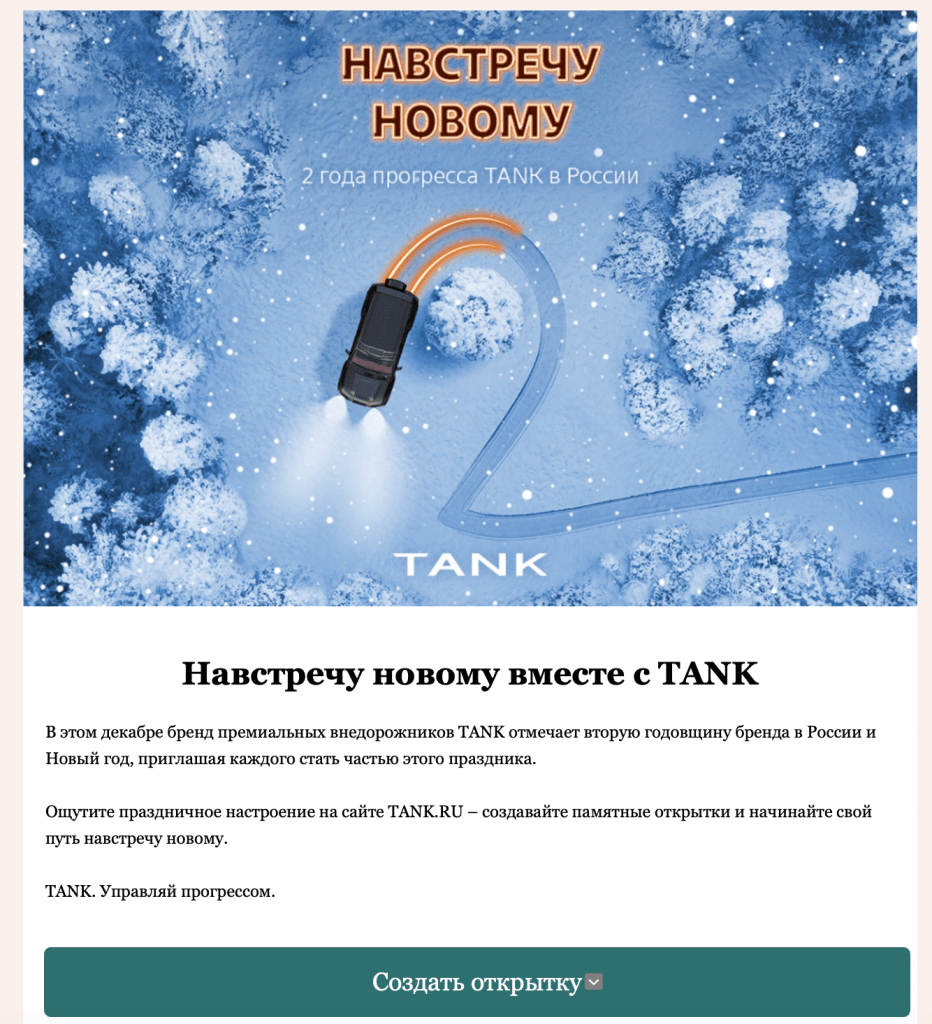
This December, premium SUV brand TANK celebrates its second anniversary in Russia and the New Year, inviting everyone to be a part of the celebration.
Get into the festive mood on the TANK.RU website by creating commemorative cards and beginning your own journey towards the new.
TANK. Drive your own progress.
Source: Unsolicited email from Vedomosti, 10 December 2024
The fall of the Baath state in Syria is a serious defeat for Russia (and a disaster for Iran). It would however be a grave mistake to assume that this by necessity makes it a success for the United States.
Moscow and Washington may indeed now face similar challenges in Syria.
Three issues led Russia to intervene in the Syrian civil war to save the Assad regime. First was a general desire to preserve a partner state — one of the very few remaining to Russia after the U.S. overthrow of the regimes in Iraq and Libya, which helped to prop up Moscow’s international influence. Second was a desire to retain Russia’s only naval and air bases in the Mediterranean.
Third was a deep Russian fear that an Islamist victory would lead to Syria becoming a base for terrorism against Russia and its partners in Central Asia. That anxiety was increased by the presence of numerous fighters from Chechnya and other Muslim regions of Russia in the ranks of the Islamist forces in Syria and Iraq.
[…]
Thanks to our readers and supporters, Responsible Statecraft has had a tremendous year. A complete website overhaul made possible in part by generous contributions to RS, along with amazing writing by staff and outside contributors, has helped to increase our monthly page views by 133%! In continuing to provide independent and sharp analysis on the major conflicts in Ukraine and the Middle East, as well as the tumult of Washington politics, RS has become a go-to for readers looking for alternatives and change in the foreign policy conversation.
We hope you will consider a tax-exempt donation to RS for your end-of-the-year giving, as we plan for new ways to expand our coverage and reach in 2025. Please enjoy your holidays, and here is to a dynamic year ahead!
On Sunday, something extraordinary happened: the Syrian people overthrew the Assad regime. For years we have been waiting to share this news with you. We wanted to make sure you didn’t miss our message below.
Dear Thomas,
This is the message we have been waiting so long to write. Assad is gone. The Syrian people have toppled the Assad regime. Our hearts burst with hope today. A war criminal of the worst kind no longer has the power to torture, starve, bomb and detain people in Syria.
The regime that has caused indescribable suffering and trauma for decades no longer has the power to commit war crimes. Syrians in Syria and all over the world are singing, “Syria is for the people, it does not belong to the Assad family”. We are chanting along with them. Ragheed al-Tatari, Syria’s longest-held political prisoner, has been freed alongside many others.
We write these words thinking of so many of our friends and loved ones who we lost in the past years. Our hearts break that they’re not witnessing these moments with us.
There is much that is unknown. We have lost so much. Our dream for freedom and democracy declared almost 14 years ago was for a peaceful transition of power out of authoritarian hands into those of the Syrian people – all of us diverse and different but together in our vision for a new Syria.
At the Syria Campaign we commit to continuing to work with all those who stand with human rights, with you all, to ensure our vision for a free and democratic Syria is made real.
The hope we feel today feels something like those first weeks when we took to the streets and dared to call for freedom and dignity. We believed the world would join us to protect humanity and champion the values they claimed to hold dear.
As our committed and courageous supporters you all know the journey we have been on since then. You have been with us as we rallied loudly against the bombings of hospitals, whole communities massacred by chemical weapons, the systematic use of detention and disappearance, meant to crush our spirits. You, and hundreds of thousands of people around the world, have stood with us and made our demands for protection of civilians and justice for war crimes more powerful.
Our movement, alongside the heroes on the ground in Syria – the White Helmets, medics, women’s rights activists, journalists – and the vibrant Syrian civil society in refuge around the world – the lawyers, investigators, artists, campaigners, survivor groups and family associations, has kept the demands of the revolution loud and clear.
Today, those demands are all the more urgent. It is time for Syrians to lead a peaceful Syria. Free and democratic, vibrant and diverse.
Now is the moment for Syria and the international community to restart Syria’s stalled UN-led political process, with a clear timeline for political transition that leads to free elections, as outlined in UN Resolution 2254.
There is so much to be done. We are impatient for accountability and justice. So many people remain detained or disappeared and families across the world are now hoping to go back to their homes and cities and be reunited with their loved ones. Almost every Syrian carries pain and trauma into this new moment. It is a moment that holds such promise. It is the chance to create a new beautiful Syria.
P.S. The weeks ahead will be critical. Please consider donating to support our work towards our vision for a free, just and democratic Syria.
The Syria Campaign is a human rights organisation that supports Syria’s heroes in their struggle for freedom, justice and democracy. Read more about our work here.
Online donations by credit card are processed by Voices Project USA and are tax deductible in the United States to the full extent allowable under the law. Online donations by PayPal are processed by The Voices Project (UK) and are not currently tax deductible in the US or available for gift aid in the UK. Voices Project USA Federal Identification Number is 82-3505967.
Source: A very welcome email from the Syria Campaign, 10 December 2024
“GREETING THE NEW”: the “commemorative postcard” generated for me by TANK.RU, based on my answers to six leading questions and a photo of myself I uploaded to the website.
Since the beginning of 2023, Russians have bought more than 600 Chinese Tank SUVs. According to Autostat, from January to April, Tank dealers sold 632 cars, and the more affordable model with the 300 index is more popular than the Tank 500 — during the reporting period, the first sold 479 copies, and the second — 153 copies. Thus, the Tank 300 accounts for 76 percent of total sales, and the “five hundredth” — 24 percent. Tanks are in the greatest demand in Moscow — every fourth car of this brand (166 units) is registered in the capital. In second place in terms of sales is St. Petersburg with an indicator of 125 Chinese SUVs sold (every fifth), followed by the Moscow region – every 10th SUV is registered there. The top 5 regions also include Nizhny Novgorod and Kemerovo regions (45 and 37 copies, respectively).
Tanks are in the greatest demand in Moscow — every fourth car of this brand (166 units) is registered in the capital. In second place in terms of sales is St. Petersburg with an indicator of 125 Chinese SUVs sold (every fifth), followed by the Moscow region – every 10th SUV is registered there. The top 5 regions also include Nizhny Novgorod and Kemerovo regions (45 and 37 copies, respectively).
Official sales of the Tank 300 began only in the early spring of this year. The “younger” Tank is supposed to have a two-liter “turbocharger” with a capacity of 220 horsepower in conjunction with an eight-band automatic, the drive is only full. The larger Tank 500 model appeared a month after the “three hundredth” — it is offered with a 3.0-liter V6 engine that develops 299 horsepower and works with a nine-band automatic. The drive is also full.
Popular creeps are talking bad about us when our back’s turned….
Russia in Contemporary World History: A Hinge Nation in a Multipolar World?
Putin’s Russia, a successor state to the Soviet Union, is challenging American and Western foreign policy by offering a “Multipolar World Order,” an alternative to Western capitalism, liberal democracy, globalization, and the rules-based liberal order. This ideological vision includes an anti-democratic and populist development model, authoritarian male leadership, reinforcement of the civilizational and religious foundation of the nation-state, and conservative cultural values that privilege an abstract community over individual rights.
Foreign policy experts are aware of Russia’s successful diplomatic outreach in Asia, Africa, the Middle East, Eastern Europe, and Latin America, many of which are built upon Soviet-era (or even pre-Soviet) relationships and a shared critique of Western colonialism and globalization. This conference, “Contemporary Russia in World History” brings scholars together to offer an in-depth exploration of such historical relationships, to periodize, contextualize, and connect contemporary Russia’s place in the rapidly evolving world order, and to create a coherent ideological response to Russia’s global outreach.
Most research in American universities perpetuates a Western and Eurocentric understanding of Russian history. The dominant “Russia and the West” paradigm significantly constrains our academic analyses and foreign policy choices while simplifying the complexity of Russia and the so-called “West” as historical actors. This forum builds on the intellectual bedrock of the “Russia and the West,” paradigm that has sustained the field for over a century but seeks to analyze how various states have found common cause with Russia/the Soviet Union over time while advancing national, economic, energy, and technological, and regional interests. Bringing these cases together, we can cast a new light on Russia’s network of multilateral alliances that span the globe, including significant pockets of support within the West itself. Researching Russia’s global entanglements and considering Russia from multiple outside perspectives will allow us not only to move beyond “Russia and the West,” but also to better understand the geopolitical patterns, rivalries, and coalitions of the twenty-first century.
Russia’s changing position on the global stage, from the vanguard of the proletarian revolution to a proponent of the theory of the “civilizational state,” resonates with cultural imperatives, political developments, and economic policies in various parts of the globe. Conference participants will be asked to consider changes and continuities in Russia’s network of alliances over time, and evaluate how they impact the contemporary world order.
Conference Schedule
DAY ONE
Friday: November 1
Building/Room: William C. Powers Hall (WCP) 2.302
9:30 – 10:00 AM – Coffee and Pastries
Panel 1: OPENING DISCUSSION 10:00 – 11:45 AM Conference Co-organizers: Mary Neuburger (UT Austin) Moderator and Discussant Karen Petrone (University of Kentucky, Lexington) Discussant Choi Chatterjee (California State University, Los Angeles) Discussant
Russian Perspectives on the Ukraine War and its Origins Anatole [sic] Lieven (Quincy Institute)
Russia’s Long Relations with Western Critics of Liberalism Jeremi Suri (UT Austin)
The Russian Economy Under Sanctions James Galbraith (UT Austin)
Break for Lunch 11:45 AM – 1:00 PM
Panel 2: AFRICA and LATIN AMERICA 1:00 – 2:30 PM (Karen Petrone, Moderator)
Anti-Westernism: The Persistent Factor in Russian Relations with Africa Thomas Loyd (University of Augusta)
Ghana and Soviet (Russian) Relations from 1957 to the Present Nana Osei-Opare (Rice University)
Homeward Bound: Russia’s Return to Latin American and Caribbean Contemporary History Sandra Pujals (University of Puerto Rico)
Break 2:30 – 3:00 PM
Panel 3: THE MIDDLE EAST 3:00 – 4:30 PM (Choi Chatterjee, Moderator)
The Legacy of Soviet Rhetoric in Middle Eastern Public Discourse Margaret Peacock (University of Alabama)
Russia’s Global Outreach to the Dreamworlds of Socialist Modernity Alexey Golubev (University of Houston)
DAY TWO
Saturday: November 2
Room/Building: Robert L/ Patton Hall (RLP) 1.302 E (Glickman Conference Center)
Panel 4: ASIA 9:00 – 10:30 AM (Degi Uvsh, UT Austin, Moderator)
Russia and China: Ideological Allies in the Quest for an Alternative Global Order? Agreement and Divergence. Jeanne Wilson (Wheaton College)
Russia’s Relations with Central Asia: Historical and Contemporary Perspectives Sarah Cameron (University of Maryland, College Park)
Russia-India: Geopolitical Habit and the Politics of Goodwill Sudha Rajagopalan (University of Amsterdam, Netherlands)
Break 10:30 – 11:00 AM
Panel 5: EUROPE 11:00 AM – 12:30 PM (Steven Seegel, UT Austin, Moderator)
From “World Language” to the “Russian World”: Russian in Soviet and Post-Soviet International Relations Rachel Applebaum (Tufts University)
“Active Measures”: Subterfuge as Foreign Policy Faith Hillis (University of Chicago)
Russia’s Influence in Central and Southeast Europe: Before and After the Full-scale Invasion of Ukraine Dimitar Bechev (University of Oxford)
Break for Lunch: 12:30 to 2:00 PM
Panel 6: CONCLUDING THOUGHTS 2:00 – 3:30 PM Karen Petrone, Mary Neuburger, and Choi Chatterjee
In July 2024, leading Western media published texts with disappointing forecasts for Ukraine several times. Initially, more than 60 American analysts demanded that NATO not invite Ukraine to the Alliance, so as not to provoke an even bigger war and conflict between the USA and Russia. On July 10, eight analysts called on the West to start negotiations on ending the war as soon as possible. Both letters were signed by analysts of the American Quincy Institute for Responsible Statecraft. This Institute is an influential think tank that consistently urges not to provoke Russia, to avoid escalation, and to force Ukraine to a ceasefire. In addition, the Institute disseminates theses beneficial to Russian propaganda, which Russians are happy to quote. Babel correspondent Oleksandr Myasishchev researched dozens of works of the Quincy Institute and the biographies of its members and tells where this American think tank came from and why its analytics should be treated with caution.
The Quincy Institute was founded in 2019. Its official goal is to “advance ideas that make US foreign policy less militaristic.” The institute advocates military restraint and peace. It is symbolic that the Institute was named in honor of US President John Quincy Adams, who was against the active participation of the US in European politics and participation in wars on other continents.
“We are building a world where peace is the norm and war is the exception,” the researchers write.
The Institute receives money for its work from donors and philanthropists, mostly charitable funds. The Institute received the first million from the George Soros Foundation and the billionaire Charles Koch Foundation. According to the publication by Texty media, at least three more analytical centers are associated with Koch brothers, which have an isolationist position regarding the war.
“Kochs were the traditional donors of the Republicans, mainly the part of the party that supports traditional capitalism and a cautious, non-military foreign policy. And Soros was donated to the Democrats. But Soros and Koch were united by a common desire to limit the participation of the United States in “endless wars” and to bet “on energetic diplomacy,” Nataliya Kononenko, political scientist and leading researcher of the Department of Political Institutes and Processes of the National Academy of Sciences of Ukraine, explains.
Over the past six months, Quincy Institute has received at least $500,000 each from venture investor Michael Zack, the Peaceshares Fund organization, Charles Kochʼs libertarian Stand Together Trust, and from the largest US donor, Fidelity Charitable. The institute also received funds from the Ford Foundation and the Carnegie Corporation.
The instituteʼs chief analyst on Ukrainian issues is a Briton and professor at the Kingʼs College in London, Anatol Lieven. Lieven has been writing about Russia and its international relations for many years. As a journalist, he covered the wars in Afghanistan and Chechnya. Subsequently, he wrote books about the Chechen wars, the independence of the Baltic states, and in 1999 — the book “Ukraine and Russia: Fraternal Rivalry”. Until 2022, he regularly wrote for the Russian Valdai club, where Putin regularly speaks, and was an expert of this club. He also regularly contributes to the Russia Matters project and has lectured at Russian universities.
Anatol Lieven
The founder of the Institute is historian and colonel of the US Army Andrew Bacevich, who headed it until March 2024. Bacevich is a veteran of the Vietnam War, and his son was killed during the invasion of Iraq. Andrew Bacevich is an ardent opponent of American militarism.
Since March 2024, the Institute has been headed by Steven Heinz. Prior to that, he managed the Rockefeller Brothers Foundation, which holds the assets of the Rockefeller companies and engages in philanthropy, for more than 20 years. Since 2002, the foundation has worked on rapprochement and negotiations between the United States and Iran, and also advocated for the independence of Kosovo. Heinz personally played a big role in this.
“Heinz is focused on cooperation with the centrists of both parties. He is a supporter of realpolitik in foreign policy,” explains Natalia Kononenko from the National Academy of Sciences. It was after Heinzʼs arrival that the Quincy Institute became more influential and began working with Democrats.
The institute has its own online publication Responsible Statecraft, where it publishes its research. Itʼs often quoted by well-known Western media. For example, letters signed by Institute employees were published by The Hill, FT, Politico and The Nation.
Institute representatives regularly distribute typical cliches of Russian propaganda. Lieven doesnʼt call the cause of the conflict in Donbas the Russian invasion, but the “nationalist revolution” and “the violent overthrow of President Yanukovych.” He also called the war in Donbas “a civil one” and said that people there have been seeking autonomy for decades. At the same time, Levin admitted that since 2014, the Russian military has been fighting in Donbas, and the separatists are completely dependent on Russia.
The Institute also repeated the Russian thesis that Ukraine should become a federation — because the differences in language and culture in different parts of Ukraine seem to be too strong.
The first study on Ukraine was published by the Institute in June 2021, against the background of news about Russiaʼs preparations for a new invasion. Then the Institute called on the US and its partners to put pressure on Ukraine and Russia to sign a ceasefire based on the Minsk agreements. The institute proposed to return the occupied parts of Donetsk and Luhansk regions under the control of Ukraine, but under the conditions of autonomy. And postpone the issue of Crimea to “future generations.”
The Institute urged not to expand NATO, in particular not to include Ukraine in any case. It stated that there are almost no important countries left in Europe outside of the Alliance, and NATOʼs expansion will do little. In addition, the accession of Ukraine to NATO would harm the national security of the United States and create a risk of war with Russia for the States. All because of Putinʼs “legitimate concerns” that NATO weapons will be near Russiaʼs border.
Instead, the US should seek complete neutrality of Ukraine. The Institute did not see any other option — they said, “a new war between Ukraine and Russia can only end with the military defeat of the Ukrainians.” Therefore, before the invasion, the Institute also opposed the supply of weapons to Ukraine.
“This is an extremely bad idea. Helping partisans to maim and kill Russian soldiers may well cause an irreparable rift between Russia and the West,” they explained.
On February 24, 2022, the Institute condemned the Russian invasion and supported Ukraineʼs right to self-defense. At the same time, there were calls to impose the strictest sanctions on Russia, to punish and isolate it.
“Regardless of the legitimacy of at least some of Russiaʼs images regarding the policies of the West and Ukraine, nothing can justify this flagrant violation of international law. Although Russia had legitimate reasons to protest against Ukrainiansʼ discrimination of the linguistic and cultural rights of Russian-speakers in Ukraine, nothing justifies President Putinʼs lies about the Ukrainian genocide and Nazism,” wrote Anatol Lieven.
At that time, Lieven predicted a partisan war and only two options for the development of events: either Russia would occupy Kyiv and create a puppet government, or the countries would agree on the expanded Minsk agreements.
When, at the end of March 2022, Ukraine resisted and liberated the north, Lieven admitted that Ukraine was capable of defending itself. However, he doubted that the country was capable of a major successful counteroffensive. Therefore, in order to prevent a protracted losing war, Ukraine should make “painful compromises”, he stated.
At the same time, Russia cannot suffer a major defeat in the war, wrote another institute analyst, William Hartung. Like, it would undermine the Russian regime and give the world a nuclear failed state, so it is necessary to return to diplomacy, “no matter how difficult it is.”
When Ukraine conducted the Kharkiv counteroffensive in September 2022, the Institute was skeptical. The offensive there was called the “liberation of the countryside”, the institute claimed that the successes were exaggerated. They also believed that in the future it would be difficult for Ukraine to liberate cities, in particular Kherson. One of the reasons is that the people there are supposedly culturally and ethnically closer to Russia. Two months after this statement, Kherson was liberated by the Armed Forces of Ukraine — the soldiers were greeted there with flowers and flags.
“Further successes of Ukraine will threaten Russian control over Crimea and create the risk of nuclear war. Territories whose population is actually loyal to Russia were returned to Ukraine,” the analysts explained.
Since the beginning of the war, the Institute has criticized the active armament of Ukraine. It considered this an escalation. The institute representatives said the weapon supply increases the risk of nuclear war and a confrontation between the US and Russia. In addition, weapons will only prolong the war, make it more destructive, and eventually end up on the black market. The Institute also believes that only American arms manufacturers profit from the war.
“If Ukraine were a US state, it would be in 11th place in terms of the amount of federal funding it receives. The question is not whether the US should support Ukraine, but how much Washington should support it,” Hartung wrote.
Negotiations and peace are the main topic for the Institute regarding Ukraine. Analysts constantly say that it is time to start negotiations, regardless of how successfully the Ukrainian armed forces are fighting.
For the first time, Anatol Lieven wrote about this back on March 3, 2022, when negotiations between Ukraine and Russia began in Belarus. Then he offered the Russians to withdraw to their positions by February 24, and Ukraine to officially establish its neutrality. As soon as Russia withdraws its troops, all sanctions should be lifted. Instead, according to Lieven, Ukraine should have given up Crimea and possibly Donbas for the sake of peace.
“Here, respect for international law must be tempered by considerations of reality, prevention of future conflicts, and the interests of ordinary people in the region. Ukraine has already lost Crimea and cannot get it back due to an endless war, which it will almost certainly lose. The fate of the territories should be decided in democratic referendums under international supervision. This should also apply to the separatist republics of Donbas,” Lieven said.
For Ukraine, the Institute promotes the model of Finland in the middle of the 20th century. Then the country lost the war with the USSR, ceded territories, and in 1948 signed an agreement on friendship and neutrality with the USSR. In this version of the future, according to analysts, Ukraine should become a bridge country between Russia and the West and have good relations with both sides.
The Instituteʼs rhetoric became tougher after the 2023 counteroffensive. According to the Instituteʼs analysts, Ukraine is simply not capable of winning. They explain: Russia has become better at fighting, Ukraine has lost “hundreds of thousands of soldiers”, the West is running out, and sanctions have not stopped Russia. Since then, Lieven no longer suggests going to the borders on February 24, but advises to stop right at the front line. He proposes to decide the fate of the occupied territories “in the future” at negotiations under the auspices of the UN.
“Ukraine has already won in key aspects. “Putin has no hope of subjugating all of Ukraine as a vassal state in the foreseeable future,” Lieven says.
The Institute denies that the concessions will provoke Russia to even greater aggression. Lieven says that only those who do not understand history and international politics think so.
“By this logic, Pakistanʼs claim to Kashmir is a prelude to Pakistanʼs invasion of Myanmar, and Argentinaʼs invasion of the Falkland Islands was part of a plan to invade Brazil. “For ethnic, historical, strategic and political reasons, Donbas, Crimea and the geographical location of Ukraine are vital issues for Russia,” he believes.
Due to this position of the Institute, two key analysts left it in June 2022. Namely, nuclear weapons specialist Joe Cirincione and retired General Paul Eaton. The latter was engaged in the training of Iraqi troops in 2003, when the country was controlled by a coalition led by the United States.
Cirincione says he worked in Quincy because he believed in a more restrained U.S. foreign policy, one that would focus on diplomacy rather than military intervention.
“However, I was shocked when the Instituteʼs leaders applied these principles to the Russian invasion,” Cirincione explains in a commentary to Babel.
Cirincione said that for many months he tried to change the position of his colleagues regarding Ukraine. He failed, and the Institute continued to justify Russia. The “diplomatic solution” promoted by the Institute means the transfer of occupied territories and people to Russia. However, in reality, such a decision would undermine Ukraineʼs defense capabilities and greatly weaken its independence, Cirincione explains to Babel.
“The Institute ignores the dangers and horrors of the Russian invasion, focuses almost exclusively on criticism of the USA, NATO and Ukraine. They justify Russiaʼs actions because they believe that they were provoked by US policy,” Cirincione said. According to him, now the Institute has little influence on the decisions of the White House. However, his strategy is to win the favor of the far-right MAGA movement and its isolationists.
When in the middle of 2022 accusations of isolationism and a pro-Russian position poured down on the Institute, they decided to explain their attitude to the war. Then the Institute again condemned Russia for crimes, but repeated that negotiations and a peace agreement are the only option.
Despite these statements, many publications of the Institute are cited by Russian propagandists. In particular, TASS, Vesti and Russkaya Gazeta. The Instituteʼs research is cited there as proof that the Americans are tired of the war, and that Ukraine is incapable of winning and must agree to Russiaʼs demands.
“Everything I see from them is very friendly to the Kremlin. They either deny Russiaʼs imperial ambitions, which led to the invasion, or actively try to promote Putinʼs appeasement,” Peter Dickinson, a researcher at the Atlantic Council, told Babel.
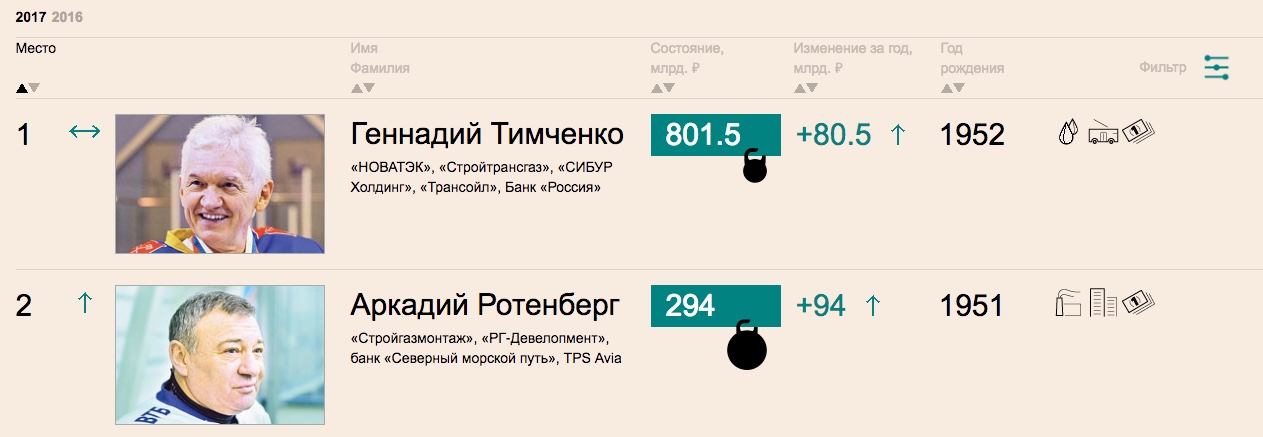
Delovoi Peterburg, a business daily, has just published its ranking of Petersburg’s alleged ruble billionaires.
It is no surprise that Putin’s cronies Gennady Timchenko (I thought he was a Finnish national?) and Arkady Rotenberg topped the list of 304 capitalists, with alleged net worths of 801.5 billion rubles and 294 billion rubles, respectively. (That is approximately 11.8 billion euros and 4.3 billion euros, respectively.)
Screenshot, from Delovoi Peterburg, showing Putin cronies Gennady Timchenko and Arkady Rotenberg in the number one and two slots of the business daily’s 2017 ranking of Petersburg’s ruble billionaires
There are lots of other pals of Putin and Medvedev in the top fifty, but I was disappointed to see the personal fortunes of my own favorite Russian super villain, former head of Russian Railways Vladimir Yakunin, had faded a bit in the past year. He has dropped to the number twenty-six spot in the ranking, claiming a net worth of a mere 37.07 billion rubles, which means that in Old Europe, where Yakunin is now dispensing Russian softpowerish wisdom to decision-makers and academics via his newly opened Dialogue of Civilizations Research Institute, in Berlin, he would be a regular old euro millionaire, with a measly net worth of 548 million euros.
Screenshot, from Delovoi Peterburg’s website, showing Yakunin’s number 26 spot in its list of Petersburg’s ruble billionaires.
Another thing that struck me when I surveyed the list was the signal lack of women among the city’s ruble billionaires. Women appear on the list only towards the very bottom, which means they are not really billionaires, but dollar or euro millionaires, at most, and maybe not even that. And there are no more than ten such women in a list of 304 names.
So, the Delovoi Peterburg ranking is not only more evidence of Russia’s extreme wealth inequality—which is a matter of elite practice, if not of explicit government policy—but of the fact that this extreme wealth inequality has an even more extreme gender bias.
Even if Putin crony and Russian oligarch Vladimir Yakunin had named his newish Berlin think tank the “Vladimir Putin Institute for Peace and Freedom,” this would have had no effect, I am afraid, on all the decision-makers and academics who are prepared to rush into Yakunin’s embrace at the drop of a hat, forgiven, as it were, by the squirrelier name he has has chosen, Dialogue of Civilizations.
Yesterday and today, DOC Berlin has been holding a bang-up conference, dealing, like all conferences these days, with the centenary of the October Revolution.
Georgy [sic] Derluguian, Professor of Social Research and Public Policy, New York University Abu Dhabi
Michael Ellman, Professor Emeritus, Amsterdam University
Domenico Nuti, Professor of Comparative Economic Systems, University of Rome “La Sapienza”
Vladimir Popov, Professor, DOC RI Research Director and a Principal Researcher in Central Economics and Mathematics Institute of the Russian Academy of Sciences
Beverly J. Silver, Professor and Chair, Department of Sociology, Director of the Arrighi Center for Global Studies, The Johns Hopkins University, Baltimore, USA
Andres Solimano, International Center for Globalization and Development
Vladislav Zubok, Professor, Department of International History,London School of Economics, UK
Kevan Harris, Assistant Professor,Department of Sociology, University of California-Los Angeles, USA
But they are there, holding forth on “revolution” on the Putinist dime, while Yakunin, who clearly loves these powwows (there are tons of videos from past DOC gatherings on YouTube and elsewhere in which this is apparent), and is eager to show he is running the show, laughs his silent “former KGB officer” laugh.
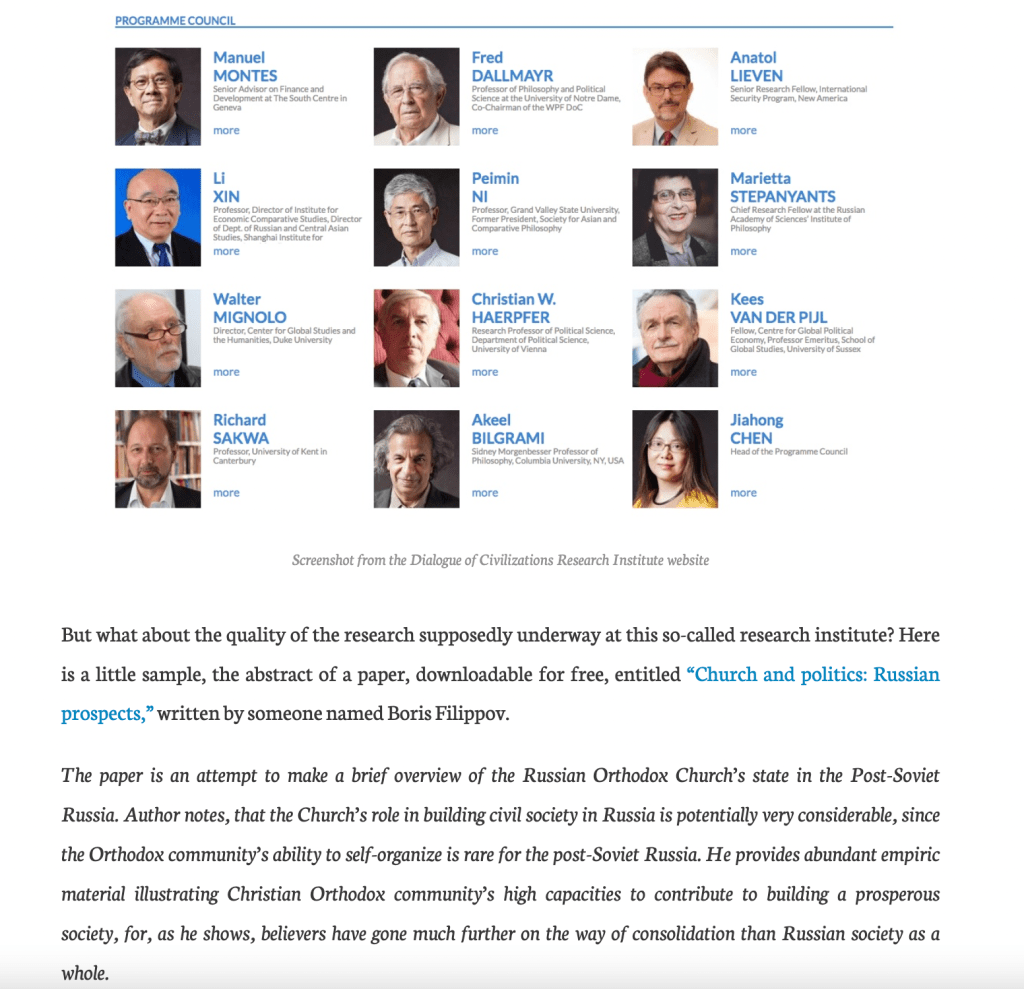
While you are at it, check out this rogues’ gallery of useful idiots. Even if you have only a few toes in the world of academia, as I do, you will immediately recognize several of the people serving Yakunin on his think thank’s “supervisory board” and “programme council.”
Screenshot from the Dialogue of Civilizations Research Institute website
Screenshot from the Dialogue of Civilizations Research Institute website
But what about the quality of the research supposedly underway at this so-called research institute? Here is a little sample, the abstract of a paper, downloadable for free, entitled “Church and politics: Russian prospects,” written by someone named Boris Filippov.
The paper is an attempt to make a brief overview of the Russian Orthodox Church’s state in the Post-Soviet Russia. Author notes, that the Church’s role in building civil society in Russia is potentially very considerable, since the Orthodox community’s ability to self-organize is rare for the post-Soviet Russia. He provides abundant empiric material illustrating Christian Orthodox community’s high capacities to contribute to building a prosperous society, for, as he shows, believers have gone much further on the way of consolidation than Russian society as a whole.
Is everyone who is speaking at today’s conference in Berlin and everyone who serves on Yakunin’s supervisory board and programme council kosher with obscurantist Russian Orthodox nationalism masquerading as scholarship? Do all of them know that “Russian Orthodoxy” (as interpreted by Patriarch Kirill and his intemperate followers) is now being used in Russia as an ideological battering ram to quash dissent and difference and reinforce Putin’s seemingly endless administration, as “Marxism-Leninism” was similarly used in the Soviet Union?
Do they know that their generous benefactor Vladimir Yakunin, in one of his other guises, wholeheartedly supports just this variety of aggressive Russian Orthodox nationalism?
The merging of political, diplomatic and religious interests has been on vivid display in Nice, where the Orthodox cathedral, St. Nicholas, came under the control of the Moscow Partriarchate in 2013.
To mark the completion of Moscow-funded renovation work in January, Russia’s ambassador in Paris, Aleksandr Orlov, joined the mayor of Nice, Christian Estrosi, for a ceremony at the cathedral and hailed the refurbishment as “a message for the whole world: Russia is sacred and eternal!”
Then, in a festival of French-Russian amity at odds with France’s official policy since the 2014 annexation of Crimea, the ambassador, Orthodox priests, officials from Moscow and French dignitaries gathered in June for a gala dinner in a luxury Nice hotel to celebrate the cathedral’s return to the fold of the Moscow Patriarchate.
Speaking at the dinner, Vladimir Yakunin, a longtime ally of Mr. Putin who is subject to United States, but not European, sanctions imposed after Russia seized Crimea, declared the cathedral a “corner of the Russian world,” a concept that Moscow used to justify its military intervention on behalf of Russian-speaking rebels in eastern Ukraine. Church property from the czarist era, Mr. Yakunin added, belongs to Russia “simply because this is our history.”
This entry has the title it does, not because I wanted an excuse to insert a recording by a beloved band of my salad days, which I did anyway, but because when I draft editorials like this on Facebook, as I often do, I usually endure stony silence from my so-called friends and readers after I post them. It is not that they are usually so garrulous anyway, but I do know they read what I write, because they are capable of responding enthusiastically to other subjects.
Writ large, this stony silence is what has helped Vladimir Yakunin operate his Dialogue of Civilizations hootenannies (usually held annually in Rhodes until the recent upgrade and move to Berlin) under the radar for nearly fifteen years with almost no scrutiny from the western and Russian press and, apparently, no due diligence on the part of the hundreds and maybe thousands of non-Russian academics, politicians, experts, and other A-league movers and shakers who have attended and spoken at these events.
So can we assume, for example, that Georgi Derluguian, Anatol Lieven, Walter Mignolo, and Richard Sakwa (I am only picking out the names of scholars with whose work I am familiar) condone the Kremlin’s occupation of Crimea, the Kremlin’s invasion of Eastern Ukraine, the Kremlin’s downing of Flight MH17, the Kremlin’s repeat invasion and wholesale destruction of Chechnya, during the early day of Putin’s reign, and the Kremlin’s extreme crackdown on Russian dissenters of all shapes and sizes, from ordinary people who reposted the “wrong” things on social networks to well-known opposition politicians, journalists, and activsts shot down in cold blood for their vocal dissent, including Anna Politkovskaya, Boris Nemtsov, and Stanislav Markelov, a crackdown that has been intensifying with every passing year Putin has remained in power?
A resounding “yes!” would be refreshing to hear, but we will never get any response from the members of Vladimir Yakunin’s semi-clandestine fan club. It is their dirty little open secret, and only someone who is uncouth, someone unfamiliar with the ways of the world’s power brokers and their handmaidens and spear carriers, would even think about asking them to reveal it. ||| TRR