Riot police disperse protesters in Baymak, Bashkortostan, on 17 January 2024. Photo: Anya Marchenkova/AFP via Getty Images via Foreign Policy
On Wednesday, a local court in the Orenburg region handed out prison sentences to four participants of peaceful rallies in support of Indigenous activist Fayil Alsynov.
Up to 5,000 people gathered in Bashkortostan’s southeastern Baymak district in January last year to protest the imprisonment of Alsynov, a prominent Indigenous rights and environmental campaigner. The protests were followed by sweeping arrests.
Aydar Yusupov, Ilnaz Makhmutov, Zaki Ilyasov and Vallyam Mutallapov, who will spend from three to four years in a penal colony, are among more than 80 men and women facing criminal prosecution in the “Baymak case,” the largest political trial in Russia’s history.
To mark the first anniversary of the Baymak events, Kremlin-installed authorities in Bashkortostan released a propaganda film “The Anatomy of Bashkir Nationalism. The Baymak Tragedy” produced by state-aligned journalist Timur Valitov.
In her piece for From the Republics, Bashkort social researcher Iliuza Mukhamedianova considers why regional authorities invested in the film and aired it during prime time, as well as how carefully crafted smear campaign against the protesters could impact Bashkortostan’s civil society.
Kremlin-Funded Propaganda Fuels Destabilization in Bashkortostan
By Iliuza Mukhamedianova
25 minutes. That’s how much time the creators of “The Anatomy of Bashkir Nationalism” dedicate to speaking about the local national organization “Bashqort.” This is almost a third of the entire movie.
But why pay such close attention to an organization dismantled back in 2020, long before the protests in Baymak?
Perhaps, that’s the easiest way to construct an image of an almighty enemy.
In the film, “Bashqort” — an organization that aimed to reinstate Bashkortostan’s sovereignty and preserve the Bashkort language and culture — is portrayed as the ultimate evil. The filmmakers place sole responsibility for the Baymak protests on “Bashqort” members, accusing them of “extremism” and collaboration with “foreign enemy states.”
Demonizing an organization that no longer exists helps to absolve Bashkortostan’s authorities of responsibility, legitimizes their actions, and justifies their brutal response to the protests.
The film also glances over the fact that protests in Baymak were not organized by a single group like “Bashqort” or one individual but were instead a grassroots action, an organic reaction to the sentencing of activist Fayil Alsynov.
Neither does the film mention who killed protester Rifat Dautov or who tortured the many Baymak detainees. And that’s truly a shame because these are the questions we, the people of Baymak, would like to have answered.
The Baymak protests would not have gained momentum without extensive media coverage — the authorities understand this well.
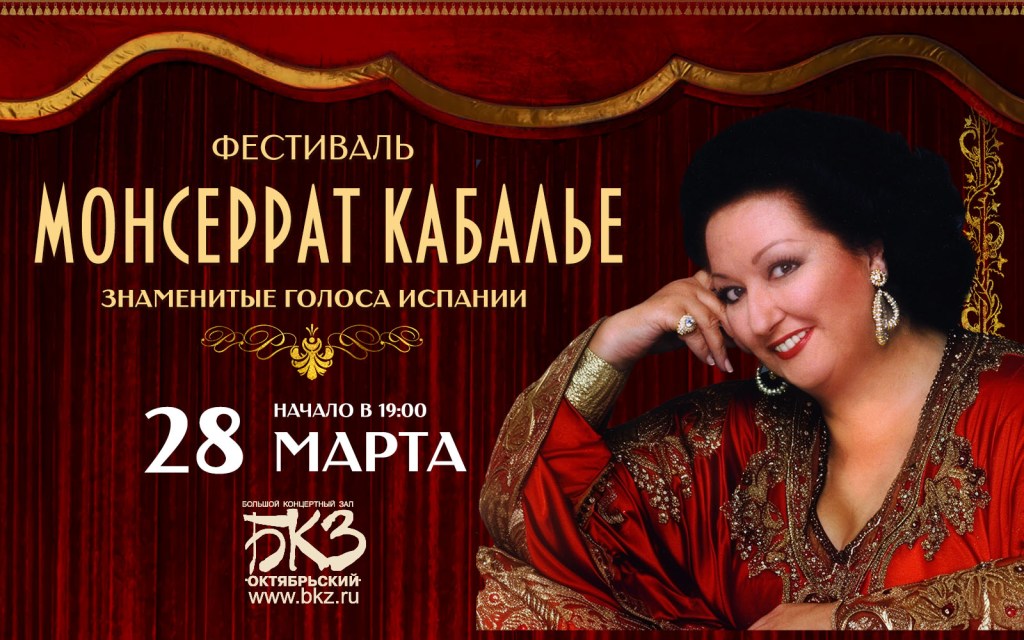
Performers: MONTSERRAT MARTÍ CABALLE (soprano), OSCAR ENCINAS (tenor), LUCÍA GARCÍA (soprano), CARLOS COSÍAS (tenor), OLGA PUDOVA
A Russian premiere!
THE MONSERRAT CABALLÉ FESTIVAL
On 28 March 2025, the Oktyabrsky Concert Hall will host a magnificent musical celebration, the first Monserrat Caballé Festival, dedicated to the great Spanish opera singer.
Specially for this event, renowned artists from Spain — relatives, friends, and students of the legendary opera diva — will come to Russia for one evening only! For their one and only performance they have chosen the beautiful St. Petersburg, our country’s musical capital, and the Oktyabrsky Concert Hall, where a distinct atmosphere always reigns.
Monserrat Caballé, whose name has come to symbolize impeccable vocals and subtle artistry, has left an indelible mark on world culture. Having performed over 100 opera roles and almost 1,000 different musical works, she has forever remained in the hearts of not only connoisseurs of exquisite classical music but also fans of musicals and fans of pop rock for performances like the title song from the album Barcelona, the international mega hit she recorded with Queen lead signer Freddie Mercury. Monserrat adored Russia and often visited our country to give concerts. The Caballé family thus decided to hold the first music festival named after her in our country.
The Monserrat Caballé Festival is meant to preserve the superstar’s historical legacy and introduce the public to today’s talents, the most popular performers continuing the Spanish school of opera’s rich traditions.
Among the performers are the great singer’s daughter, MONTSERRAT MARTÍ CABALLÉ (soprano), and the famous Spanish voices OSCAR ENCINAS (tenor), LUCÍA GARCÍA (soprano), and CARLOS COSÍAS (tenor). OLGA PUDOVA, a guest soloist at the Bolshoi and Mariinsky theaters, a phenomenal coloratura soprano who has already conquered Europe’s principal opera stages, is a special guest from Russia.
The artists will be accompanied by OLGA PUDOVA, well known to Russian and international audiences, and the famous conductor MIKHAIL GOLIKOV, People’s Artist of Kabardino-Balkaria. Creative teams from St. Petersburg and Moscow will also be involved in the concert.
The Monserrat Caballe Festival is not only a tribute to the legendary singer but also a grand exuberant celebration, aimed at a wide range of spectators and embracing all generations and the most varied musical tastes.
Don’t miss the opportunity to gift yourself an unforgettable evening full of vivid emotions, beautiful melodies and Spanish passion!
Source: Bileter.ru. Translated by the Russian Reader
On 20 October 2012, during her tour in Russia, Caballé suffered a stroke in Yekaterinburg and was quickly transferred to the Hospital de Sant Pau in Barcelona.
In his Literary Life, [Joseph] Brodsky’s friend Lev Loseff explained the background of “A Halt in the Desert,” a poem about the destruction of a beautiful old building: “One night Brodsky watched the first stages in the razing of the Greek Orthodox church from the apartment of his friends, two sisters from a Tatar family,” and called the poem “a meditation on the symbolic significance of what has just happened: Russia has broken with its Christian and Hellenistic cultural heritage.” Brodsky writes:
So few Greeks live in Leningrad today that we have razed a Greek church, to make space for a new concert hall, built in today’s grim and unhappy style. . . . it is sad that from this distance now we see, not the familiar onion domes, but a grotesquely flattened silhouette.
The deliberately created “fresh ruins” and “open altar wounds” recall the recent wartime devastations. The biblical allusion in “Thou who doest sow” suggests the threat of retribution in Hosea 8:7, “they have sown the wind and they shall reap the whirlwind.” Brodsky concludes by hopelessly asking:
What lies ahead? Does a new epoch wait for us? And if it does, what duty do we owe?– What sacrifices must we make for it?
Loseff claimed that Brodsky condemns “the collective guilt of a nation that produced this regime, that refused to accept the historical alternative, the heritage of Greece and Greek democracy.” But the Russians did not refuse to accept the heritage of Greece. They were not consulted and had no choice. An atheistic Communist system had been imposed on them by deadly force after the Revolution of 1917 and brutally maintained by all successive regimes. It was now the poet’s responsibility to preserve this culture.
Tomorrow in Ukraine, Russian soldiers will attack Ukrainians. Russian drones and bombs and rockets will target Ukrainian homes. A criminal war of aggression will continue.
Tomorrow in Saudi Arabia, Russian officials will discuss the future of Ukraine with a handful of Americans, delegated by a president who sympathizes with the Russian view of the war. The Russians will have the luxury of talking about Ukraine without the presence of Ukrainians.
The headlines are about “peace negotiations.” But what is really going on? How should we think about this unusual encounter in Saudi Arabia?
Here are ten suggestions, drawn from years on working on relations among the three countries, and from some recent personal observations at the Munich Security Conference.
1. Be critical of the words on offer. Question the word “peace.” The term used in the media is “peace negotiations.” The United States and Russia are not at war. Russia is at war with Ukraine, but Ukraine is not invited to these talks. Russian authorities, for their part, do not generally speak of peace. They present the talks with the United States as a geopolitical coup, which is not the same thing. The highest Russian officials have repeatedly stated that their war aims in Ukraine are maximalist, including the destruction of the country. Informed observers generally take for granted that Russia would use a ceasefire to distract the United States and Europe, demobilize Ukraine, and attack again. This is not a plan that the Russians are working very hard to disguise. It is a simple point, but always worth making: there could indeed be peace tomorrow in Ukraine, if Russia simply removed its invasion force.
Kirill Medvedev,* a poet, publisher, and member of the band Arkady Kots, left Russia in 2023 and returned in late 2024. At Republic Weekly’s request, he explains his winding road, what Moscow looks like when one hasn’t seen it from the inside for a long time, and what remainers have to say about leavers.
After a year and a half of living in other countries for personal (but, of course, political) reasons, I have been living in Moscow for several months now. Despite certain risks, I really don’t want to leave, and I am terrified of everything having to do with living in exile. I’m willing to speak in allegories or even to keep silent altogether just to be able to live in my hometown. Although what could be more important than waking up in the morning and smacking the Putin regime in the face without pulling your punches?
Everything in Moscow is still familiar and homely. I am indifferent to Sobyanin’s renovations. Things have improved in some places, while in other places it’s the reverse. Half-abandoned spots have suddenly emerged even in the most expensive neighborhoods, as if the money had suddenly been hoovered out of them. I’m certain that’s literally what happened.
I don’t see any particular feasting amid a plague, but I guess I’m just not hitting the right spots. Moscow has become more desolate and wild on the whole. When the capital is finally moved to Siberia, the Moscow I know and love will look even better. But for now, it is still what it is: a crazy quilt fashioned from Eurasian chaos, absorbing a million shades of the glitz and poverty of the entire country and its neighbors, and tempting us with new revolutions somewhere in its squares and back alleys.
All of Russia can be found in Moscow, and yet, as everyone knows, Moscow is not Russia. Thanks to this fun fact, it is easier for Muscovites than for anyone else to love the entire country, albeit an imaginary and unfathomable country, shaped from different scraps. “I stand as before an eternal riddle, / Before a great and fabulous land,” sang one remarkable Muscovite. I repeat another poet’s line about another city, thinking that love for one’s capital city and one’s country is an enormous, complicated privilege: “May it not be my lot / To die far away from you.”
Online public communication habits have actually changed a lot because of the risks involved. It no longer feels like your event didn’t happen if it wasn’t written up online and if you didn’t post a photo of yourself with a crowd of happy spectators.
There are [now] more personal channels of communication within communities and more word of mouth. Reactions are more reserved in public and more emotional among friends. Pardon my sentimentality, but there is little to compare with physical hugs with friends and family in a city charged with your own and other people’s memories.
Of course, there are a lot of new problems, and I’d rather deal with some variety of internet addiction than the nightmare in which everyone has found themselves. And yet there is the perception that the war has ushered in the degradation of all ways of living in Russia. This is not true. Humans are ultra-creative and crafty creatures. Violent shocks do not neutralize life but propel it into new forms. A caveat: no new ways of living and creating can justify the mass murder of people who will never wake up to life again. But cultural, activist, educational, and other communities who persist and change, albeit semi-clandestinely, albeit at the cost of compromise or risk, increase our chances of transitioning to a different way of living in this country in the future. The more allies we have here at home now, the more likely they are to be in the right place at the right time—that is, if the first flights our friends who have been shoved out of the country plan to take are delayed a bit.
Irony or irritation towards the people who have left [Russia] for one reason or another is evident among almost all those who have stayed, except for those who are definitely planning to leave. One of the frequent complaints is “They left to live in safety, and they did the right thing—they just shouldn’t pass it off as a political act.”
That is true, though with many caveats. Bravo, of course, to the activists who have been helping people who have to leave to get out of the country and to adapt to life abroad. Bravo to the journalists who have moved to relatively safe places and continue to fulfill their professional obligation to their fellow citizens. Regular albeit serious news, reported with respect for themselves and the audience, without unnecessary harshness (“so that you can send it to your grandmother”) is needed desperately: almost everyone talks about it. But pessimism and aggression about life inside the country on the part of fellow citizens who have left the country is completely out of place. It is clearly old-fashioned exile self-therapy and should be practiced in private.
While the demand for alternative information is great (many people in the USSR who were not necessarily anti-Soviet also listened to Voice of America), one can see skepticism or simply a lack of interest in émigré politics. Why is this the case? There seem to be many examples in history when political émigrés came back home, were involved in great transformations, or even spearheaded them. Escaping from prison in Russia, making one’s way abroad, drinking to a successful adventure with comrades in Geneva, discussing future strategies in a relaxed atmosphere, and soon returning home to work underground was a typical trajectory for Russia’s radical democrats in the early twentieth century.
Things have changed since then, although today many also travel back and forth. You can talk at length to those who have stayed in Russia about the hardships of emigration, and they will agree and sympathize with you, especially if you were actually in danger here at home.
For the most part, though, people still see someone else’s moving abroad as their means of upgrading their private existence.
By renouncing your past life, it is as if you automatically renounce your past community. The propaganda, of course, does its best to inflate the resentment, but it’s not just propaganda at work. Emigration is indeed an experience of constant self-denial. Especially today, when Russian emigrants are so evidently prodded (gently and not so gently) to cancel themselves in terms of of their citizenship, background, language, identity, or even flag. Moreover, the reanimated ethical-religious discourse of the Cold War, with its confrontation between good and evil on a global scale, has played a considerable role in this.
The field where dialogue should have taken place between leavers and remainers, as well as between moderate oppositionists and hesitant loyalists, has been overrun by moralizers in proverbial white coats and rabid patriots. They are the dividers and conquerors.
The leavers more often argue in terms of negative freedom—freedom from censorship, political crackdowns, and military mobilization, from having to indirectly finance the war or live among its supporters. The remainers stay because they do not see how they can realize themselves abroad, at least not without the sort of superhuman effort and self-denial that many of them find more frightening than living under the threat of arrest or self-censorship. They often speak of duty—to elderly relatives, students, patients, voters, political prisoners, the graves of relatives, the homeland, etc. And they often hear in response that it is immoral to be involved in the normalized life in today’s Russia. The ethical conflict is evident.
I wander the Pokrovkas and the Ordynkas, thinking about where I can get money to pay the bills and pay off my debts. There are posters calling for men to sign up for the army. Somehow I don’t feel more upstanding than the guys who go off to kill for money. I would definitely not go to do that, but this certainty does not raise my moral self-esteem. I think of an old comrade who perished in the “special military operation.” His debts, low social status, and leftist anti-western ressentiment had blossomed into imperialist obfuscation.
I sit in a cafe, thinking about my plans. The people around me talk about different things, while people in a neighboring country are bombed in our name.
I’m good at displacing unpleasant things. We all are good at it.
Being here, dissolving into this life, it is difficult to feel like a member of an ethics committee. It’s easier to realize that all people are basically the same, that there are no insuperable differences between them. All our actions (whether ordinary, shameful, or magnificent), all the passivity of the masses, all the revolts of nations, are manifestations of the same human principle in different historical circumstances. The way humanness manifests itself in our present circumstances, the way my own humanness manifests itself in them, is the most interesting thing to observe. Okay, we’ve established that.
No, of course, there is a huge difference between opposition to evil, passive non-participation, and complicity in it. Putin’s propagandists have been blurring the distinction between the first, second and third to depoliticize and morally degrade society. We know this, and you can’t fool us. In both the secular and Christian systems, a person always has a choice and a responsibility for it. We should not see the individual as a unwilling victim of want and propaganda. But something else is also true: even if you believe that you have made your own super-correct moral choice once and for all, endlessly judging your neighbor, or believing they are made of some qualitatively different stuff than you, or finding them complicit in collective guilt without trial is also a quite devilish temptation, akin to the temptations proffered today in our country by various spiritual and political leaders.
Political evil is countered not by personal virtue, and even less by moralistic posturing. It is countered by political or civic ethics, but our country has a huge problem with that.
All the debates between the leavers and the remainers, all the debates over the slogans “peace now” vs. “war until the dictatorship’s defeat,” all the debates about whether Navalny should have returned to Russia, revolve around the missing answer to the ethical (aka political) question: for what are we willing to risk our private lives, for what collective ideals?
I certainly don’t have a clear answer. Russia is long past the heroic times of liberalism and socialism, when people believed that civic heroism was not weak-mindedness or recklessness, but a deliberate, mature step toward a better future. Popular willingness to take to the streets against war and dictatorship is impossible without the conviction that we are on the right side of history, that we are in a movement that both overlaps with and transcends our private interests.
The Bolsheviks believed in communism’s inevitable advent on a global scale, and were able to convince many people this would happen, which was why they won. In 1991, Russians believed that by defending the [Russian] White House and confronting the coup plotters’ tanks, they were leading Russia onto the road of progress which all democratic nations were already rolling down. Whether we like it or not, Russia is not ready to follow any well-trodden path. There is no single road anymore: the road is just going to have to be paved anew. (I’m reckoning on this.)
Today we see a faint glimmer of hope in republicanism, with its idea that community spirit is not a consolation prize for people who lack professional fulfillment and personal happiness. It is not reducible to a professional or personal virtue and is not a profession itself.
Anyone willing to stand with others to oppose tyranny and then work every day to prevent it from happening again is capable of demonstrating civic valor. And the brighter, bolder and more constructively a person commits to this work, the more they make use of their professional, creative and other kinds of potential, the greater their authority in the community will be and the more likely they will remain in the community’s memory. This sounds good as a motivation, but if the republican ethic is realizable, then it is realizable in the small and medium-size spaces of campaigns around residential buildings, courtyards, neighborhoods, and (at most) cities, where it is possible to find analogues of the ancient Greek square for people to hold meetings.
A national community is imaginary, no matter how you look at it, and it is based on a rather sketchy common historical plight and collective memory. If we do not want it to be the memory of how “everyone was afraid of us,” it should be the memory of how we survived together and resisted—secretly and explicitly, passively and actively—the extermination of others and self-extermination, of how we built ties, engaged in “culture,” taught children, supported political prisoners, and helped the bombing victims and the homeless.
This is the ground of community, a ground not nourished by moral superiority, by denying oneself and one’s roots, or by essentializing differences. It is nourished by responsibility for the people who stand or have stood next to you in the same squares and the same queues, for the people who walk the same streets, who went to the same schools, who share the same hopes for the future.
If we indeed stand on this ground, then it makes sense for us to challenge and set our hearts on something together.
* Medvedev has been placed on the Russian Justice Ministry’s registry of “foreign agents.”
Yesterday was a rare sunny, warm day, so my boon companion and I traveled to the city’s far southeast to walk through Bruno Taut’s Falkenberg Garden City in Berlin-Bohnsdorf. It was like a tiny vision of heaven.
As it happened, it was also a short walk from Max Bel, Franz Clement, and Hermann Muthesius’s Prussian Street Estate, which was also quite handsome and built to a properly human scale.
I’ve noticed Berlin’s modernist housing estates seem to have had a beneficent effect on their neighborhoods, so that even current architects designing new houses and developments there try to get into the Tautian spirit, as it were. The overwhelming impression, however, is that you’re looking at a future we have lost forever.
The Russian Reader, Berlin-Friedrichshain, 30 March 2019
And now we come to this verb “see.” Within fifteen lines it’s been used six times. Every experienced poet knows how risky it is to use the same word several times within a short space. The risk is that of tautology. So what is it that Frost is after here? I think he is after precisely that tautology. More accurately, non-semantic utterance. Which you get, for instance, in “’Oh,’ and again, ‘Oh.’” Frost had a theory about what he called “sentence-sounds.” It had to do with his observation that the sound, the tonality, of human locution is as semantic as actual words. For instance, you overhear two people conversing behind a closed door, in a room. You don’t hear the words, yet you know the general drift of their dialogue; in fact, you may pretty accurately figure out its substance. In other words, the tune matters more than the lyrics, which are, so to speak, replaceable or redundant. Anyway, the repetition of this or that word liberates the tune, makes it more audible. By the same token, such repetition liberates the mind—rids you of the notion presented by the word. (This is the old Zen technique, of course, but, come to think of it, finding it in an American poem makes you wonder whether philosophical principles don’t spring from texts rather than the other way around.)
Alexander Ivanov, “Gennady Shpalikov: Being Restless” (in Russian, with no subtitles)
Gennady Shpalikov and Guy Debord were nearly the same age, and their popularity peaked at the same time. But is this the only thing that unites the French philosopher and the Russian writer? Alexander Ivanov, founder of the publishing house Ad Marginem, will show that these two figures were connected not only by the time in which they worked but also by the very spirit of the time, which they saw, felt and were able to convey to others.
Debord’s adage “Love is possible only on the eve of a revolution” could well have been endorsed by Shpalikov.
Debord was the founder of Situationism.
An amazing poet, screenwriter, and director, Shpalikov was the Soviet Guy Debord. Like Debord, Shpalikov had an explicitly spatial mind: he understood space not as a receptacle for bodies but as a way of assembling the soul in the gaps, intervals, and flashes of aimless, unprogrammed, slippery movements around the urban environment. Debord called this mode of movement détournement — a deviation, an illegitimate, reverse appropriation in which the spaces and cultural signs captured by other people’s meanings are reappropriated by turning them inside out semantically or simple shifting their meaning. This was exactly how Shpalikov dealt with the anonymous, official space of the Soviet city: by romanticizing its most banal corners and nooks. Both of these artists conjured the mood of an entire epoch in the late 50s and early 60s.
November 1 is the fiftieth anniversary of the death of Gennady Shpalikov, the screenwriter, filmmaker, and poet, one of the symbols of the Thaw era, an extremely popular writer and yet one whose work has been poorly read. Igor Gulin explains how Shpalikov looked for an answer to the question of where good people end up, and how the drama of his characters reprised his own.
Gennady Shpalikov on the set of the film I Am Twenty. Photo: Gorky Film Studio
Screenwriting was an honorable profession in the Soviet Union. Screenwriters were not considered to be craftsmen consigned to the sidelines, but serious writers, and so the screenwriter’s name was listed first in the credits, before the director’s. Nevertheless, not even the best of them were stars. Gennady Shpalikov was an exception. From his very first efforts in cinema, his name was a symbol of the new art of the Thaw — first among his fellow filmmakers, then for a relatively wide swath of the intelligentsia. His death in 1974 was a token of the sixties generation’s demise.
The cinematic Thaw was already in full swing by the time Shpalikov joined the profession. Marlen Khutsiev and Felix Mironer’s Spring on Zarechnaya Street(1956), Mikhail Schweitzer’s The Tight Knot (1957), Mikhail Kalatozov’s The Cranes Are Flying (1957), and Grigory Chukhrai’s The Ballad of a Soldier(1959) had been released, but these beautiful pictures still lacked something that would instill a sense of decisive reform and renewal. Shpalikov carried out a tiny revolution in Soviet cinema — not alone, of course, but he was its leader. He contributed an open sense of form, showing that a movie could be something other than an itinerary from point A to point B. It could be a stroll, a stroll with no clear goals, from one impression to another, from one funny and touching incident to another.
Almost all of Shpalikov’s scripts from the 1960s are just such cinematic walkabouts: A Streetcar to Other Cities (1962), directed by his friend Yuli Fait (1962); The Star on the Buckle (1962) and I’m from Childhood (1966), written for Viktor Turov; I Walk Around Moscow (1963) directed by Georgiy Daneliya; The Wharf and Summer Holiday, which were never made into films; A Long Happy Life (1966), of course; and Ilyich’s Gate (1962–1964) to a great extent. This film was more complicated, however. Khutsiev’s lofty idealism counterbalanced Shpalikov’s nimble gifts, and it was their confrontation and, at times, conflict that gave birth to a masterpiece. This later worked with Larisa Shepitko, when she and Shpalikov agonizingly co-wrote You and I (1971). To produce something truly significant, Shpalikov needed a co-writer-slash-director — a collaborator and an opponent, not a faithful executor of his ideas.
The stroll was the genre not only of Shpalikov’s creative work but also of his life. He existed in the same way, charming everyone he met, traipsing from one crowd to another, from one idea to another. He wrote the same way: on telegram blanks and napkins, not bothering with punctuation and spelling, and often not worrying whether the text was coherent, paying mind to its intonation and pacing, rather than to the idea and the logic of form. His scripts and songs, poems and prose experiments often seem sloppy to a sober eye. But their sloppiness never irritates: it comes across as organic, as a hallmark of authenticity.
Dozens of memoirs have been written about Shpalikov. Their authors constantly wonder aloud how it happened that this carefree, lively man took to drinking heavily and eventually committed suicide. They often blame the era. There is some truth to this, but it is a little different than is commonly thought. The Stagnation was not only a time of disillusionment after the upswing of the Thaw. It was also a time of complication. The members of the Sixties generation who continued to create and grow learned to resist better. It required them to mobilize their inner strength, making them more reflective and deeper. Shpalikov was a genius of splendid superficiality, of drifting and gliding. He understood this perfectly well. The drama of his art kicked off long before the frosts of the Brezhnev era set in.
The same disturbing intuition — sometimes well concealed, sometimes voiced as directly as possible — was evident in everything Shpalikov wrote. Surprisingly, this anxiety was hardly detected by his contemporaries, who remained under the hypnosis of the myth they had created themselves. It concerns the central figure of Shpalikov’s entire oeuvre. What to do with the fact that the “good man,” about whom he always wrote, so easily goes to the bad? What to do with the fact that charming frivolity quickly turns into grim irresponsibility, moral freedom into immorality, the freewheeling life of the tumbleweed into pathetic escapism, and nonstop wittiness into nauseating clownishness? Committed to the utmost sincerity, Shpalikov had an absolute ear for falsity and from the very beginning heard the rudiments of falsity in himself. Perhaps that is why he seemed doomed (and suicidal notes appear in his texts very early on). Drunkenness, however, made it easier for him to accept his fate.
This intuition is almost nonexistent in Ilyich’s Gate, in which the romantics and the bastards are delineated from each other. But it is already present (for the time being, as a quite vague hint) in I Walk Around Moscow (the young Nikita Mikhalkov’s ambiguous charisma works perfectly in this regard). It is also palpable in TheWharf, Shpalikov’s first major feature. (Its director, Vladimir Kitaysky, committed suicide while working on the picture, and the movie was never completed.) The script of The Wharf is an enchanting, airy text centered on a rather savage deed. Coming to Moscow for a single evening, the main character, a barge captain, decides to kidnap his son from his mother, wanders around nighttime Moscow with the boy for a long while, and when he falls asleep on a bench, simply runs away to his barge. A good guy’s transformation into a scoundrel is amped up to wholly Dostoevskyean cruelty in Summer Holiday and A Charming Man’s Day (another script that was never produced). This trajectory devolves into total despair in You and I, in which a Thawnik’s romantic flight to the Far North is played out as an egoistic escape from his own worthless life, frittered-away talent, ruined romance, and lost friendship.
Shpalikov never judges his characters: their meannesses and downfalls just happen. There is no reflection at all in his art. There is only movement, and this movement has its own laws. At the beginning of the trajectory there is a good, harmonious man, but once chosen, the freewheeling life gradually whittles him down to the ugly figure of a cynic, a vulgarian, a scoundrel. Shpalikov has a very frank poem about this:
Аh the streets, the only refuge Not for the homeless, but for those who live in the city. The streets pester and haunt me, They are my comrades and my adversaries.
I don’t feel as if I am walking them, I obey them, I move my feet, And the streets guide me, they lead me Through a sequence set once upon a time,
A sequence of cherished back alleys, A sequence of jaunty notions and good intentions.
The same thing happens in Shpalikov’s only directorial work. A Long Happy Life is usually remembered as a light, lyrical picture, but actually it is chockablock with contempt for oneself and one’s kind. It is a movie about how a typical man of the 1960s, a charming unshaven geologist, runs off into nowhere and away from a beautiful woman, and at the same time from any future, from that selfsame long happy life, simply because he cannot help but run. A lighter note is generated by the finale: the famous five-minute scene of a barge on a river is Shpalikov’s homage to Jean Vigo’s L’Atalante, his favorite film.
This is Shpalikov’s main gimmick. As intoxication relieves a hangover, so the shame of escape is relieved by yet another escape. And if the body can no longer escape, there remain flights of fantasy. Distracted from the protagonist’s mediocre fate, the gaze follows the barge and loses itself in this marvelous tracking shot. All of Shpalikov’s best poems are about the same thing: not about the joy of life, but about the desire to escape from it to a place that is obviously impossible, somewhere “where mother is young and father is alive.” To leave, but not by sinking into drunkenness, illness, and rows, but to disappear gently, to be weathered away from the world. “My head is vacant, / Like a deserted place. / I’m flying off somewhere, / Like a tree from a leaf.”
In 2006, [Fredric] Jameson spoke at a conference in Moscow and then visited Petersburg for a few days. [Elena] Petrovskaya asked me to show him around the city. Jameson stayed at the apartment of Artemy Magun, who was out of town but left the key. The program was the most predictably capitalist, with opera-schmopera, Malevich-schmalevich, the fountains of Peterhof and other logic of cultural consumption. On the third day I got tired of it and invited Jameson to a birthday party for little Tasya Zaslavskaya in [the painter Anatoly Zaslavsky’s] studio, which was chockablock with preschoolers, cakes, Fanta and balloons. There was also Foma [Thomas] Campbell and dancing. I should re-read Brecht and Method. RIP.
[Arlie Russell] Hochschild gets a lot right. Still, as an investigative journalist who covers the MAGA movement, her portrayal of Trump’s America sometimes felt incomplete to me. She mentions how a pastor was radicalized by the QAnon conspiracy theory on the Telegram app, but such online worlds, which can become realer for their believers than the physical world, aren’t captured here with the same concrete specificity as what’s happening on the dusty back roads of small-town Kentucky. And her portrayals of the wounded masculine pride and white nationalism that she suggests drive some Trump voters can feel chilly, distanced by sociological and psychological analysis; in person, such emotions are palpably volcanic.
I finished “Stolen Pride” nagged by the sense that she wasn’t giving us the full picture — most of all, of her own place in it as a retired professor from the University of California, Berkeley embedding in Pikeville to explain its residents to themselves and the nation. It’s a position that I suspect triggered at least some stereotypes that conservatives have about liberals thinking they know better. And yet her ethnography is frictionless. There is none of the grinding of opposing viewpoints so common during this contentious political time. There is little sense of what they thought of her and her project.
Instead, Hochschild has produced a seamless election-season-ready explanation of conservatism that might be just a little too neat. What, I kept wondering, would her subjects say was her “deep story”? And would including that viewpoint in her book have destabilized its carefully engineered explanations? If America is increasingly divided into two countries, one liberal and one conservative, what would it have meant to compare their two deep stories in one narrative rather than have one side tell the other how it is?
We can all agree that Vladimir Putin is a bloodthirsty brute, whose invasion of Ukraine was a shameful act of aggression. Having said that, I personally would wish this horrible war to end as soon as possible, which will almost certainly mean with some degree of compromise. When Snyder writes that, for America to remain “the land of the free” half a century from now, “Ukraine must win its war against Russia,” does he really believe that’s possible? Does “winning” mean a Russian capitulation comparable to the German generals’ unconditional surrender in May 1945? The only way anything of the kind could conceivably happen would be following a coup to overthrow Putin, a most desirable outcome but improbable at present.
And when [Timothy] Snyder writes that if Ukraine’s “allies fail it, tyrants will be encouraged around the world, and other such wars will follow,” some of us are old enough to feel that we’ve seen this movie before. It was called the domino theory, and it was invoked to justify the Vietnam War — fought in the name of freedom, but bringing much unfreedom in its wake.
This may seem a gloomy and unhelpful way to end a review of a stimulating and well-intentioned book. Of course Snyder is right, in the sense that his heart’s in the right place. I share his horror at crimes past and present. I only wish I could share his optimism about the future.
All modern entertainment that “undermines” traditional values should be banned in Russia, conservative philosopher and “Russian World” ideologue Alexander Dugin has said.
“Only morally healthy entertainment should be allowed — first of all, round dances and traveling around one’s native land, and even better, pilgrimages to holy places. Everything else should be banned,” Dugin wrote on his Telegram channel.
According to Dugin, a healthy nation should have wholesome leisure activities, “and not all of that stuff.” As a negative example of entertainment, he cited KVN, which has become, he claims, “a poisonous matrix of degeneration.”
“The sinister nature of this pernicious phenomenon is now clearly visible. [Ukrainian President Volodymyr] Zelensky, [comedian Maxim] Galkin, and all the rest,” Dugin said.*
Earlier, the philosopher claimed that the West regards Russia as its principal foe because Russian President Vladimir Putin has been reviving traditional values and liberating the country from global influence. This, in his opinion, is what provoked the disgust of Western “progressive elites” with Putin.
Dugin has also argued that Russia has neither a parliament nor democracy, but a de facto monarchy headed by Putin, who can do whatever he wants. The philosopher noted the irrelevance of certain laws in Russia, as well as the people who propose or support them. In his opinion, all of this is “boyars dancing for the time being,” that is, until the sovereign pays attention to the antics of these “selfish and thieving bastards.”
Dugin has argued that Russia itself is the Katechon — the last bulwark against the Antichrist, who today reigns in a West “totally perverted” by LGBT+, postmodernism, relativism, and transhumanism.
The philosopher has dubbed the war in Ukraine “the most important event in history.” In his opinion, it is being waged on behalf of a multipolar world, with many superpowers. Consequently, according to Dugin, Russia will free other countries of the world from Western liberal imperialism, in whose grip they are trapped. And yet, Dugin acknowledged that Russia would lose a great many people in the course of the war.
* Zelensky was captain of the Kryvyi Rih KVN team Kvartal 95 from 1998 to 2003.
Enter Thoughts of Days to Come, dressed to the nines in khaki blouses. They are lugging atom bombs, ICBMs, a launching pad. O, how they reel, dance, and caper: “We are warriors and carousers! Russians and Germans will fall together; for example, at Stalingrad.” And like old widow Matryona, cyclotrons are dumbly howling. In the Ministry of Defense a nest of crows is loudly cawing. Look at the pillow. What do you know! Shiny medals all in a row.
“Where there’s a will, there’s a way.” “A pint of vodka, they say, Soon’ll be a ruble a pop.” “Mom, I really don’t love Pop.”
Enter a certain Orthodox, saying: “These days I’m number one. I’m pining for the sovereign, and in my soul the Firebird flares. Soon Igor will reunite with Yaroslavna and have his fun. Let me make the benediction or else I’ll box you on the ears. Worse than evil eye or herpes is the plague of Western thinking. Sing, accordion, and drown out the saxophone, jazz’s vile offspring.” On the icons they plant a kiss, Sobbing victims of circumcis—
Aydyn Zhamidulov. Photo: Russian Defense Ministry via Kommersant
Kommersant has learned that a military court has begun hearing the criminal case against Senior Lieutenant Aydyn Zhamidulov, a platoon commander in the Airborne Troops, and his subordinate, Private Alexei Dorozhkin. The Russian Investigative Committee alleges that the men kidnapped a young woman who had threatened the officer that she would tell his wife about their relationship and took her to their unit’s temporary deployment point as a Ukrainian spy. There, they stabbed the victim to death and blew up her body in an attempt to conceal their crime. Zhamidulov gained renown for writing patriotic poems during his combat training and was shown reciting them on Telegram channels.
The criminal case against Senior Lieutenant Zhamidulov and Private Dorozhkin was submitted to the Southern District Military Court, sitting in Rostov-on-Don. The men are accused of the kidnapping and brutal murder of a resident of the Luhansk People’s Republic per articles 126.1, 105.2, 30.3, 33.4, and 244.2 of the Russian Criminal Code.
In the file of the case, as investigated by military investigation units at the Russian Investigative Committee, it is reported that Zhamidulov is twenty-eight years old, a native of Kazakhstan, and lived in the Pskov Region. He has a higher education, is married, and was raising two daughters.
In January 2022, Zhamidulov signed a contract with the Defense Ministry and, in the rank of senior lieutenant, served as commander of a parachute platoon in an airborne assault regiment of the famous 76th Airborne Division.
In late 2022, a video was widely circulated in social networks and the media in which Lieutenant Zhamidulov recited a poem of his own about the those involved in the special military operation. At the end of the recital, the officer stated that his family was proud of him and was waiting for him to come home.
Dorozhkin was mobilized on 1 January 2023. Ranked as a private, he served as a senior scout in the Airborne Troops.
According to investigators, at about eight p.m. on 13 January 2023, Zhamidulov and other military men, including Dorozhkin, were drinking hard alcoholic beverages at the Rainbow Cafe in Luhansk. About half an hour later, local resident Valentina Davronova, with whom Zhamidulov had previously been in an intimate relationship, entered the cafe.
A row broke out between the senior lieutenant and the twenty-three-year-old woman. Fearing that Ms. Davronova would report their relationship to his wife, Zhamidulov decided to deal with the young woman, the case file says. He told his subordinates that he would take Ms. Davronova to her current boyfriend.
The young woman was put in the back of a KamAZ truck, and when the truck arrived at the unit, Zhamidulov tied her hands with duct tape. Dorozhkin, who went with them, was ordered by the senior lieutenant to tape Valentina’s eyes, which he did.
To avoid questions from his subordinates and make his actions look legitimate, the investigators note, Zhamidulov told them that Ms. Davronova had served in the Ukrainian army from 2018 to 2021 and had tattoos featuring Ukrainian symbols on her body. He also alleged that she was engaged in intelligence on behalf of the Ukrainian armed forces.
The young woman was taken to a soldier’s bathhouse, where Zhamidulov stabbed her about two dozen times in different parts of her body. At that time, the commander of a reconnaissance platoon combat vehicle, Sergeant Roman Pleshcheyev, entered the bathhouse (his case will be tried separately). Zhamidulov ordered him to finish off the victim. Not wanting to kill her, but fearing negative consequences on the part of the senior lieutenant, Plescheyev stabbed Ms. Davronova with his knife in the area of her left shoulder and right leg.
At 12:20 a.m., Dorozhkin entered the bathhouse, and Zhamidulov instructed him to finish what he had started. Pleshcheyev left the room and Dorozhkin killed the victim by stabbing her in the area of her heart.
Having made sure that the young woman was dead, Zhamidulov ordered his subordinates to take the body outside the temporary deployment point and detonate it with three F-1 grenades so that the deceased could not be identified and the cause of her death could not be determined.
Nevertheless, the crime was solved literally while the trail was still hot. All three defendants were detained and then remanded in custday by a military court.
The case is now in preliminary hearings, and is expected to be considered on the merits this summer. Zhamidulov’s lawyer Natalia Kokhan refused to comment on the case without vetting her answers with her client.
Aydyn Zhamidulov was mobilized from the Orenburg Region. As a civilian he worked as a welder, but now he serves in an Airborne Troops reconnaissance unit. He has a wife, two daughters, and his parents waiting for him at home.
“I was retrained in my specialty. In the short period of mobilization combat training, everything — camouflage, identifying the enemy, working with topographic maps, artillery fire — is very easy to learn,” Zhamidulov said.
All of the things he saw and his interactions with his fellow soldiers inspired Aydyn to write poems. They are plain but honest and poignant, straight from the heart.
Always our ancestors fought evil. They wrote history with blood, with the pen. They weren’t afraid to go all the way. They removed shackles, they united hearts. Now, our brothers, it’s our turn To defend our country, our home, and our people. To do justice, to open their eyes. The enemy is in deep, like a needle under the skin. Let us strike down the puppeteers, the servants of evil, Who pull the strings Of bewildered people, Of gray-haired mothers shedding tears For them, the lives of people are just a game. We must put a stop to this once and for all!
Impact of Discrimination on Integration of Emigrants From the Aggressor Country (with Ivetta Sergeeva)
Following the full-scale invasion of Ukraine in 2022, up to one million Russians fled their homeland, marking the most significant brain drain since the Soviet Union’s collapse. While some host countries view the highly educated and politically active migrants as an asset, integrating nationals of the aggressor state has presented challenges. Many migrants face institutional restrictions aimed at sanctioning Russia, alongside varied experiences of discrimination from local populations. This study delves into the effect of discrimination on the assimilation intentions of Russian migrants, focusing on language learning as a key indicator. Laitin’s model of identity building suggests that migrants’ willingness to assimilate depends on the perceived benefits, including acceptance by the host society. Following the model, Sergeeva assumes that discrimination signals to migrants that the host country’s society does not accept them, making learning the local language a less rational choice.
Utilizing a cross-sectional panel survey, the study establishes a link between discrimination and integration, differentiating between the effects of discrimination experienced from local citizens and local institutions on language acquisition. Findings reveal that societal discrimination significantly dampens migrants’ willingness to learn local languages and diminishes their trust in and attachment to host societies, unlike institutional discrimination, which shows no such effect on language learning. These insights contribute to an understanding of the impact of nationality-based discrimination, highlighting the role of societal acceptance in the successful integration of political migrants.
This event will be hosted in person and virtually on Zoom. Register for the Zoom meeting here. Non-NYU affiliates must RSVP for in-person campus access.
Ivetta Sergeeva is a PhD candidate at the European University Institute in Florence. She specializes in political behavior, civil society, and Russian emigration. She is a co-founder and co-principal investigator of OutRush and ViolenceMonitor (a series of surveys on intimate partner violence in Russia). She also has eight years of experience supervising projects in civil society and human rights organizations in Russia. Website: www.ivettasergeeva.com. Email: ivetta.sergeeva@eui.eu.
Date: 29 April 2024 4:00 PM – 5:30 PM
Speaker: Ivetta Sergeeva
Location: Jordan Center, 19 University Place, New York
Professoressa on the Pole* is the result of Polina Kanis’ investigation into the perceptual transformation of the female body in Russia following the onset of the full-scale invasion of Ukraine and subsequent ideological shift within Russian society. As part of this investigation the artist trained as a pole dancer and worked at a strip club.
The exhibit includes photographs documenting Kanis’ three-month stint at a strip club, the club’s rules of conduct for strippers, and a video re-enactment of the artist’s stage performance. The project marks the latest chapter in Kanis’ ongoing research into the changing role of a female teacher in Soviet and post-Soviet Russia, where limitations imposed by the state can only be counter-balanced by imagination.
*Professoressa (Italian: female teacher) refers to the 1967 manifesto Letter to a Teacher (Letters a una Professoressa), which harshly criticizes the power structure and classism of the educational system in 1960s Italy.
location: Expo
price: €5, tickets for a performance of the CARTA ’24 festival give free admission
duration: 5h
extra info: wed – sun: 14:00 – 19:00, evening performances until 22:00
Nadya Tolokonnikova, an artist who is founder of the feminist collective Pussy Riot, has long been persecuted in Russia for her conceptual performances and artistic protest against the Putin regime. Her performance Punk Prayer in the Christ the Savior Cathedral in Moscow, recognized by The Guardian as one of the most important artworks of the twenty-first century, ended for her and her colleagues with imprisonment for “hooliganism motivated by religious hatred.”
OK LINZ is bringing Nadya Tolokonnikova’s art to the museum, presenting her haunting works dealing with resistance, repression, and patriarchy for the first time to the European public.
Tolokonnikova’s oeuvre encompasses objects, installations, and performative works in which she processes her traumatic experiences during her life under Putin. Out of a state of repression, she has developed a visual language that rebels against aesthetical and political realities: anarchic and radical, yet also moving and witty.
“Being from Russia brings me pain. Most of my life, even after 2 years imprisonment following my art protest, I chose to stay in Russia, even though I had plenty of opportunities to immigrate, I tried to change Russia, make it a country that I would be proud of—peaceful, prosperous, friendly, democratic, loving, a country that values human life, art and happiness. First with Voina Group, later with Pussy Riot, I’ve been in performance art since 2007, for 17 long years—years filled with joy of protest and comradery, harassment, arrests. I watched my friends being murdered and revolutions suffocating under Putin’s boot.“ —Nadya Tolokonnikova
An oversized blade hangs like a sword of Damocles over visitors to the OK. “Shiv” is the title, American prison slang for an improvised knife. It stands for the precarious situation of artists and activists in Russia who, like Tolokonnikova herself, live in constant fear of persecution by the Russian judiciary. The exhibition will spotlight a selection of Situatioinist actions by Pussy Riot. At the center is Tolokonnikova’s 2022 performance Putin’s Ashes in which she joined forces with twelve women from Ukraine, Belarus, and Russia who experienced repression and aggression at the hands of the Russian president to burn a portrait of Vladimir Putin in a desert, collecting the ashes in small bottles.
“This art is a weapon,” says Tolokonnikova of her works, analyzing and exploring in this way the role that her art and she herself can play in the context of international power structures.
Curators: Michaela Seiser / Julia Staudach
Source: e-flux mailing list, 22 April 2024
Akhmatova’s Orphans International conference Princeton University 3-5 May 2024
May 3
4:00 pm–5:00 pm. Location: Firestone Library
The Anatoly Naiman Papers. Visit to the Special Collections
Presentation by Thomas Keenan-Dormany, Slavic Librarian
5:00 pm–6:30 pm. Location: McCosh 50
Rock. Paper. Scissors (2023)
Documentary film screening
Q&A with the co-author Anna Narinskaya
7:00 pm
Reception at the Levings’ residence (Shuttle provided)
May 4
Location for all talks: 245 East Pyne
9:30 am
Breakfast at East Pyne
Session 1
10:00 am–12:00 pm
Veniamin Gushchin, Columbia University
Late Akhmatova and Philology: Intertextuality, Interpretive Communities, and Effective History
Evgeny Soshkin, Free University / Brīvā Universitāte (Latvia)
Akhmatova’s Dead Orphans: Toward the History of a Paradox
Gleb Morev, Independent researcher
Akhmatova and Brodsky
12:00 pm–1:00 pm
Lunch
1:00 pm–1:40 pm
Keynote speech
Roman Timenchik, The Hebrew University of Jerusalem / PrincetonUniversity
Akhmatova’s Orphans and the Literary Orbit of the 1960s
Session 2
2:00 pm–4:00 pm
Dmitry Bobyshev, University of Illinois Urbana-Champaign [via Zoom]
On the so-called ‘Akhmatova’s Orphans’
Emily Lygo, University of Exeter
Dmitry Bobyshev’s Poetry of the Turn of the Century
Marco Sabbatini, University of Pisa
“Out of the Magic Choir”: Viktor Krivulin and the Leningrad Underground Poetry on Akhmatova and her Orphans
4:00 pm–4:30 pm
Coffee break
4:30–5:50 pm
Sofia Guerra, Princeton University
Anatoly Naiman’s Translations from Giacomo Leopardi
Benjamin Musachio, Princeton University
Estrada as a Fault Line: Akhmatova and Company vs. Evtushenko
6:00 pm–7:30 pm
Location: East Pyne 010
Akhmatova’s Orphans. Disassembly (2024)
Documentary film screening
Q&A with the director Yuri Leving
7:30 pm
Dinner
May 5
Location for all talks: 245 East Pyne
9:30 am
Breakfast at East Pyne
Session 1
10:00 am–12:00 pm
Maya Kucherskaya, Jordan Center, New York
Solo in a ‘Magic Choir’: The Case of Joseph Brodsky
Michael Meylac, StrasbourgUniversity [via Zoom]
An Enchanting (!) Chorus (?): Different Poets of Dissimilar Fortunes
Alexander Dolinin, University of Wisconsin-Madison
Brodsky’s Poem “Darling, I left the house today…” in the Context of Poetic Tradition
12–1 pm
Lunch
1:00 pm–1:40 pm
Leningrad Poetic Circles of the 1960s Through the Camera Viewfinder
Roundtable devoted to photography of Boris Shwartzman, Mikhail Lemkhin and Lev Poliakov
Session 2
2:00 pm–4:00 pm
Polina Barskova, Berkeley University [sic!]
Depiction of Links and Ruptures of Time in Evgeny Rein’s Poetry
Oleg Lekmanov, Princeton University
On Evgeny Rein’s Poem “In the Pavlovsky Park”
Anna Narinskaya, Independent researcher, Berlin
The Orphans and Jews
4:00 pm–4:30 pm
Coffee break
Session 3
4:30 pm–6:45 pm
Translating Poetry of “Akhmatova’s Orphans” into English
An Open Workshop: Kathleen Mitchell-Fox, Emma George and Ilya Kaminsky, Princeton University
Lev Oborin, Berkeley University
Anatoly Naiman’s “Vegetation”: Towards Poetology of Branching
Maria Rubins, University College London
Is Brodsky a Poet for Our Time?
6:45 pm
Dinner
Organizing Committee:
Yuri Leving, Chair
Ekaterina Pravilova, Ilya Vinitsky and Michael Wachtel
Sponsored by REEES, PIIRS, and Department of Slavic Languages and Literatures, Princeton University